
AI In Dermatology Market Size and Share
Market Overview
| Study Period | 2020 - 2031 |
|---|---|
| Market Size (2026) | USD 9.32 Billion |
| Market Size (2031) | USD 19.09 Billion |
| Growth Rate (2026 - 2031) | 15.43 % |
| Fastest Growing Market | Asia-Pacific |
| Largest Market | North America |
| Market Concentration | Medium |
Major Players *Disclaimer: Major Players sorted in no particular order Image © Mordor Intelligence. Reuse requires attribution under CC BY 4.0. | |
AI In Dermatology Market Analysis by Mordor Intelligence
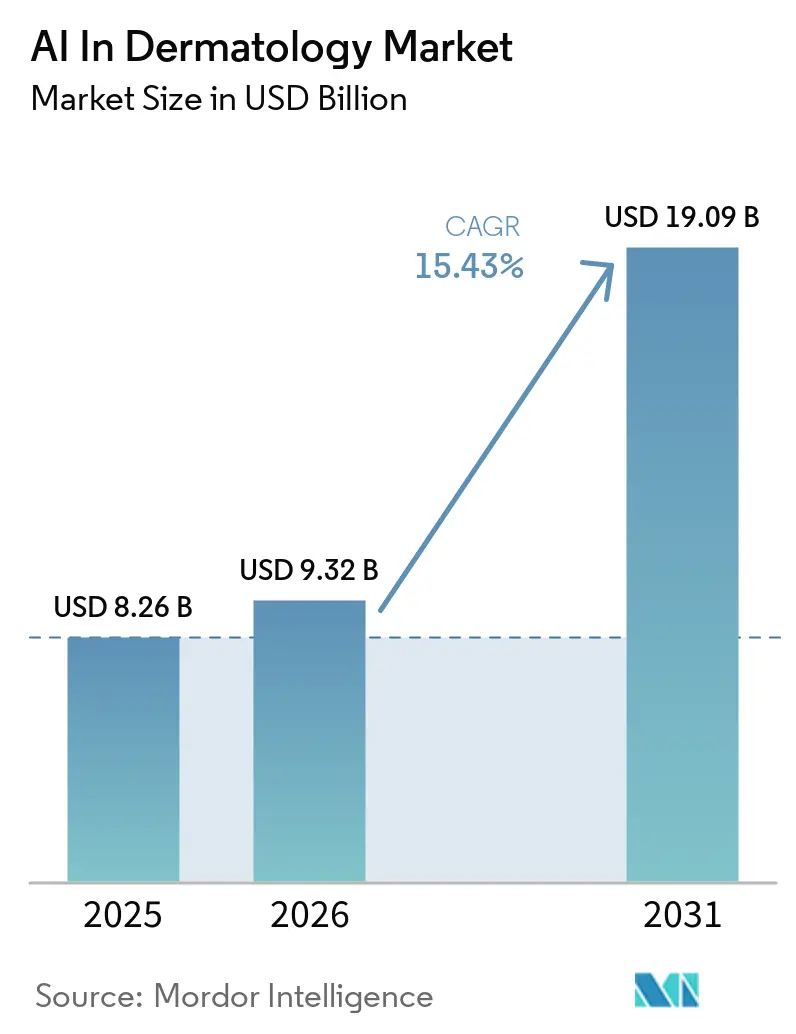
The AI in dermatology market is expected to increase from USD 8.26 billion in 2025 to USD 9.32 billion in 2026 and is forecasted to reach USD 19.09 billion by 2031, advancing at a CAGR of 15.43% over 2026-2031. The AI in dermatology market continues to be led by skin lesion detection software, where stronger deep-learning performance, persistent dermatologist shortages, and broader digital pathology use are pushing buyers from limited pilots into routine clinical deployment. The shift from experimental use to infrastructure-grade procurement became clearer in May 2026, when Roche announced a definitive merger agreement to acquire PathAI for up to USD 1.05 billion, linking dermatopathology AI with large-scale diagnostics distribution. The 2025 baseline also reflects wider pilot-to-production conversion across hospital networks in North America and Europe, where software contracts are increasingly moving into multi-year enterprise terms. Competition is now layered rather than linear, with specialist vendors, diagnostics incumbents, and newer model developers all shaping pricing, product design, and acquisition activity at the same time. Even with clear friction around dataset bias and uneven regulation, the market keeps a strong demand profile because oncological and inflammatory skin conditions are rising, specialist capacity remains constrained, and non-invasive diagnostic workflows are gaining a broader evidence base.
Key Report Takeaways
- By product type, AI diagnostic software led with a 44.36% share in 2025, while AI-integrated imaging devices are projected to grow at a 17.43% CAGR through 2031.
- By deployment mode, cloud-based deployment held a 51.73% share in 2025, while Edge/Device-Based deployment is projected to expand at a 17.63% CAGR through 2031.
- By dermatology condition, skin cancer accounted for a 54.12% share in 2025, while psoriasis is projected to record the fastest growth at a 16.95% CAGR through 2031.
- By end user, dermatology clinics held a 51.38% share in 2025, while hospitals are expected to grow fastest at an 18.12% CAGR through 2031.
- By geography, North America held a 49.81% share in 2025, while Asia-Pacific is projected to advance at an 18.43% CAGR through 2031.
Note: Market size and forecast figures in this report are generated using Mordor Intelligence’s proprietary estimation framework, updated with the latest available data and insights as of January 2026.
Market Trends and Insights
Drivers Impact Analysis of AI In Dermatology Market*
| Driver | (~) % Impact on CAGR Forecast | Geographic Relevance | Impact Timeline |
|---|---|---|---|
| Increasing Accuracy Of Deep-Learning Skin-Lesion Classifiers | +3.2% | Global, with concentrated gains in North America, Europe, and East Asia | Short term (≤ 2 years) |
| Accelerating Dermatology Image-Database Partnerships Between Hospitals And AI Vendors | +2.5% | North America and EU, with spillover to APAC | Medium term (2-4 years) |
| Smartphone Penetration Enabling Direct-To-Consumer Skin-Health Apps | +2.0% | APAC core, with follow-on in MEA and South America | Short term (≤ 2 years) to Medium term (2-4 years) |
| Payers Piloting AI-Triage Reimbursement Codes In The United States And Europe | +1.7% | North America and EU | Medium term (2-4 years) |
| FDA Fast-Track Pathways For Software-As-A-Medical-Device | +1.4% | United States, with CE-MDR mirror effects in the EU | Short term (≤ 2 years) |
| Rise Of Multimodal Models Integrating Dermoscopy, Genomics, And EHR Data | +2.2% | Global, with early adoption in the United States, Germany, and Japan | Long term (≥ 4 years) |
| Source: Mordor Intelligence | |||
Increasing Accuracy of Deep-Learning Skin-Lesion Classifiers
The AI in dermatology market is gaining momentum because classifier performance has moved close to specialist-level results in real clinical settings. A prospective multicenter study across 8 German university hospitals found that the ADAE ensemble reached balanced accuracy of 0.798 versus 0.781 for dermatologists, while sensitivity reached 0.922 versus 0.734, with especially strong performance in lentigo maligna and superficial spreading melanoma.[1]Jan-Gregor Schlager, “Prospective Multicenter Study Using Artificial Intelligence to Improve Dermoscopic Melanoma Diagnosis in Patient Care,” PLOS Medicine, pmc.ncbi.nlm.nih.gov That improvement matters because it changes procurement discussions from whether the software works to how it should be calibrated in practice. The tradeoff is that higher sensitivity can reduce specificity, which means over-referral risk increases unless thresholds are adjusted for local patient profiles. In UK teledermatology deployment, Skin Analytics’ DERM was estimated to save GBP 156,063.79 and 259 specialist hours per 1,000 patients versus standard care, which gives the AI in dermatology market a clearer economic argument when calibration is managed carefully.[2]C. Hartley, “Accuracy of an Artificial Intelligence as a Medical Device as Part of a UK-Based Skin Cancer Teledermatology Service,” Frontiers in Medicine, frontiersin.org
Accelerating Dermatology Image-Database Partnerships Between Hospitals And AI Vendors
The AI in dermatology market is also being shaped by hospital data partnerships that strengthen model quality and make replacement more difficult once systems are embedded. PathAI announced a strategic collaboration with Northwestern Medicine in June 2025 to deploy the AISight digital pathology platform and co-develop new AI diagnostics, tying image management and workflow integration directly to clinical operations.[3]PathAI, “PathAI and Northwestern Medicine Announce Strategic Collaboration,” PathAI News, pathai.com In Japan, the National Skin Disease Database led under the Japanese Dermatological Association supported domestic model development and enabled skin tumor detection accuracy above 90%, creating a national training asset that is difficult for outside vendors to replicate quickly. These partnerships matter because they reduce institution-specific performance swings that appeared in earlier validation work. As a result, the AI in dermatology market is building entry barriers through data access, workflow integration, and switching costs before application features become more standardized.
Payers Piloting AI-Triage Reimbursement Codes in the United States and Europe
The AI in dermatology market needs reimbursement progress because coding and payment are what turn clinically promising pilots into repeatable commercial contracts. In December 2024, the American Medical Association updated CPT Appendix S to create an AI taxonomy for medical services and procedures, which established a reporting structure for AI-enabled care pathways. That step does not guarantee broad payer coverage, but it gives vendors a clearer route for billing and evidence generation. The remaining challenge is that Category III CPT codes are designed to track emerging procedures, so commercial payer adoption can still lag for years even when coding exists. Even so, the AI in dermatology market becomes easier to scale when public systems or larger payers move first, because procurement teams can then justify pathway-level use rather than isolated departmental budgets.
Rise of Multimodal Models Integrating Dermoscopy, Genomics, and EHR Data
The AI in dermatology market is moving beyond single-image analysis toward models that combine several data types in one clinical workflow. PanDerm, published in Nature Medicine in 2025, was pretrained on 2,149,706 unlabeled images from 11 institutions across 4 imaging modalities and improved clinician accuracy from 0.69 to 0.80 overall and from 0.69 to 0.83 for melanoma in reader studies. A separate 2025 study in Scientific Reports showed that combining 3D total body photography with structured clinical data produced recall and F1 scores above 95% and AUC values above 0.95 across lesion categories. These results raise the performance ceiling for the AI in dermatology market, but they also make large, high-quality training datasets more important. That is why R&D investment is concentrating in better-resourced model groups, while the application layer of the AI in dermatology market continues to split into more specialized deployment tools.
Restraints Impact Analysis of AI In Dermatology Market*
| Restraint | (~) % Impact on CAGR Forecast | Geographic Relevance | Impact Timeline |
|---|---|---|---|
| Dataset Bias Causing Reduced Accuracy On Darker Skin Tones | -1.5% | Global, most acute in sub-Saharan Africa, South Asia, and minority populations in North America and the EU | Medium term (2-4 years) |
| Fragmented Global Regulatory Guidance For Adaptive Algorithms | -1.3% | Global, especially for cross-border deployments spanning the United States and the EU | Long term (≥ 4 years) |
| Limited Clinician Trust In AI Black-Box Decisions | -1.1% | Global | Short term (≤ 2 years) to Medium term (2-4 years) |
| High Liability Risk For Misdiagnosis In Direct-To-Consumer Apps | -0.9% | North America and EU, with spillover to APAC as consumer apps scale | Medium term (2-4 years) |
| Source: Mordor Intelligence | |||
Dataset Bias Causing Reduced Accuracy on Darker Skin Tones
The AI in dermatology market faces a major limit because training data still underrepresent darker skin tones in a way that affects both equity and commercial reach. ICCS 2025 research found only 10 images of Fitzpatrick skin type V and 1 image of type VI across major dermatological training datasets, which is far from global demographic reality. A 2025 study in npj Digital Medicine further showed that missing skin-tone labels inside large datasets is a direct cause of performance gaps, and it found that synthetic augmentation cannot replace authentic image diversity in high-stakes diagnosis. This matters commercially because the AI in dermatology market cannot scale evenly across South Asia, sub-Saharan Africa, Latin America, and diverse populations in North America and Europe if approvals or labels are narrowed by performance concerns. Vendors that build broader community-based datasets early are therefore likely to hold both a regulatory and a commercial advantage as the AI in dermatology market expands.
Fragmented Global Regulatory Guidance for Adaptive Algorithms
The AI in dermatology market is also constrained by the fact that adaptive software does not move through the United States and Europe under one common regulatory logic. The EU AI Act treats AI-enabled medical devices as high-risk systems and requires compliance alongside MDR or IVDR, and MDCG 2025-6 confirmed that this obligation remains even when device conformity work is already complete. This raises development costs because vendors may need separate documentation, update plans, and risk management workflows for each region. It also slows commercialization for learning systems, since an update that fits one framework may trigger a new review step in another. Until guidance becomes more aligned, the AI in dermatology market will keep favoring companies with larger regulatory teams, stronger quality systems, and enough capital to support parallel approval strategies.
*Our forecasts treat driver/restraint impacts as directional, not additive. The impact forecasts reflect baseline growth, mix effects, and variable interactions.
AI In Dermatology Market Segment Analysis
By Product Type:
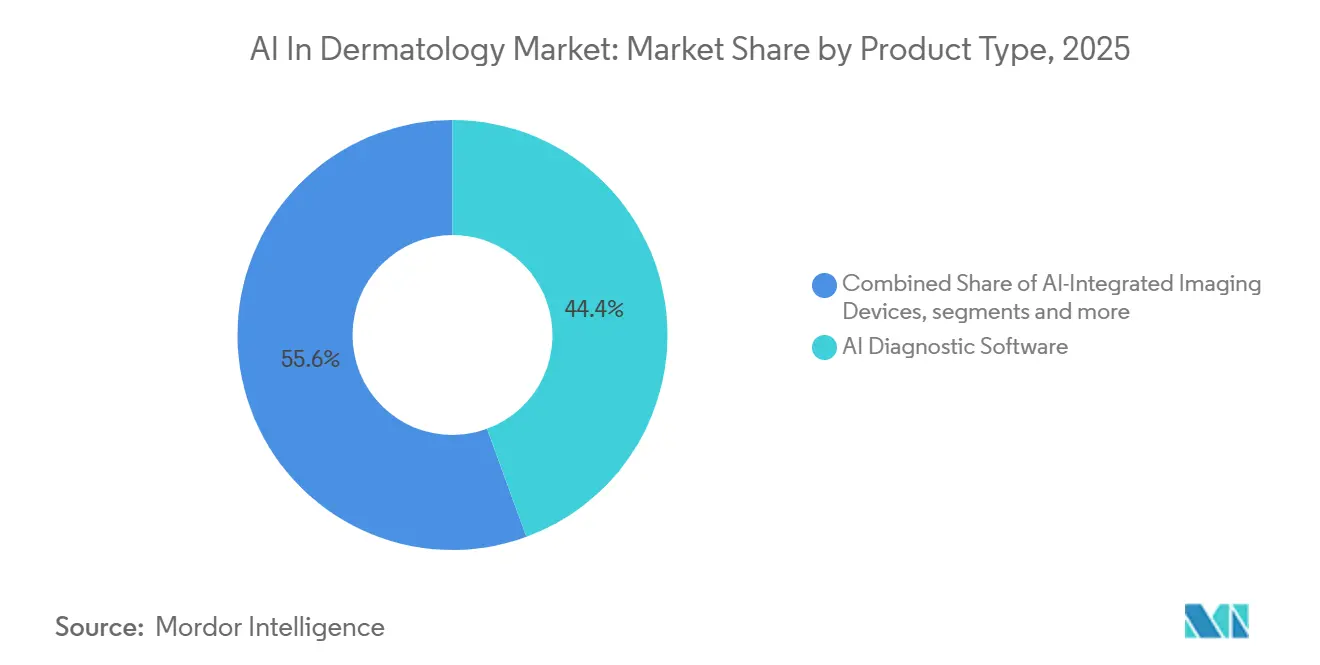
Software Dominates, Devices Accelerate at the Point of CareAI diagnostic software held 44.36% of AI in dermatology market share in 2025, which made it the largest product category by revenue. That lead reflects the cost profile of software-only SaMD offerings and their ability to fit into existing clinical systems without hardware procurement. The AI in dermatology market still gives software an operational advantage because implementation can move through IT and workflow budgets instead of capital equipment cycles. This position also benefits from faster regulatory pathways relative to hardware-embedded alternatives in many deployment settings.
AI-integrated imaging devices are projected to grow at a 17.43% CAGR through 2031, making them the fastest-rising product segment in the AI in dermatology market. DermaSensor reported 96% sensitivity for melanoma, basal cell carcinoma, and squamous cell carcinoma in a validation study of 1,005 patients across 22 primary care sites, and the company said the device cut physicians’ missed skin cancer referrals by 50%. That kind of handheld performance matters because it narrows the gap between primary care and specialist review at the point of care. The AI in dermatology industry is therefore seeing software remain the revenue core while device growth rises faster where immediate imaging feedback, triage, and non-specialist use are becoming more valuable.



By Deployment Mode:
Cloud Leads, Edge Unlocks Underserved SettingsCloud-based deployment accounted for 51.73% of the AI in dermatology market size in 2025, which keeps it as the leading deployment architecture. Large hospital networks favor this approach because centralized model management, easier software updates, and scalable computing fit enterprise procurement patterns. The AI in dermatology market still leans toward cloud systems where data governance permits it, especially in organizations that want one managed environment across many facilities. That position is strengthened by the fact that cloud tools are easier to update as evidence, algorithms, and compliance needs evolve.
Edge or device-based deployment is expected to grow at a 17.63% CAGR through 2031, the fastest rate in this segmentation of the AI in dermatology market. This growth is tied to use cases where latency is a clinical issue or where data sovereignty rules make full cloud transfer less practical. The AI in dermatology market is also opening up in rural, remote, and resource-limited settings because offline-capable tools can keep working without stable bandwidth. The likely direction is a hybrid model, with centralized cloud training and local inference at the point of care, because that structure fits both performance and privacy needs.
By Dermatology Condition:
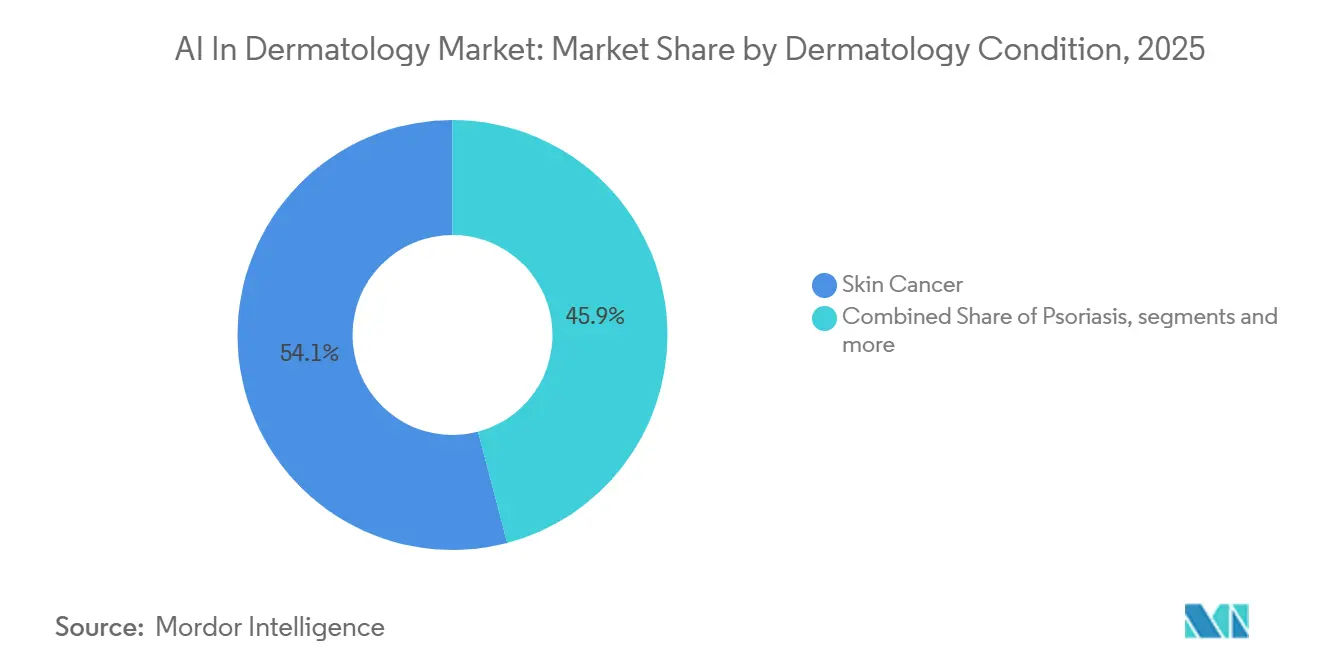
Skin Cancer Anchors Revenue, Inflammatory Conditions Expand the Addressable BaseSkin cancer held 54.12% of the AI in dermatology market size in 2025, which keeps it as the largest condition segment by a wide margin. That dominance comes from richer imaging datasets, a clearer regulatory history, and stronger payer willingness to fund earlier detection. The AI in dermatology market therefore remains anchored in skin cancer workflows, where the clinical and commercial case has been built over a longer period than in most inflammatory conditions. This installed base also gives vendors a practical route into health systems before they widen into adjacent disease areas.
Psoriasis is projected to expand at a 16.95% CAGR through 2031, making it the fastest-growing condition segment in the AI in dermatology market. A JMIR Dermatology review showed that machine learning tools can support PASI scoring and help identify patient subgroups more likely to respond to biologics, which broadens AI use beyond image classification alone. Atopic dermatitis is also emerging as a clinically relevant use case, and researchers at Kyoto Prefectural University of Medicine reported an AI-based severity assessment model from smartphone photos in 2025. The AI in dermatology industry is therefore widening from cancer detection into chronic inflammatory management, where longitudinal monitoring and treatment response support may create a different revenue mix over time.
By End-User:
Clinics Lead on Volume, Hospitals Gain on Pathway IntegrationDermatology clinics held 51.38% of the market in 2025, which kept them as the largest end-user base in the AI in dermatology market. Clinics are a natural fit because they handle concentrated lesion volume, have specialist operators, and generate image feedback that can improve deployment performance quickly. The AI in dermatology market also benefited from the teledermatology infrastructure already in place across many clinic settings, which lowered integration barriers for new software layers. That combination allowed clinics to remain the revenue anchor even as larger institutions expanded their AI programs.
Hospitals are projected to grow at an 18.12% CAGR through 2031, which makes them the fastest-growing end-user group in the AI in dermatology market. Growth at the hospital level reflects a shift from isolated pilots toward pathway integration across urgent referral, pathology, and enterprise imaging workflows. The AI in dermatology market is becoming more attractive to hospitals because a single deployment can influence triage, capacity use, specialist time, and reporting quality at once. Academic and research institutes still produce a smaller share of direct revenue, but they remain central to co-development, validation, and the evidence base that supports larger hospital purchases.
Geography Analysis
North America AI in Dermatology Market
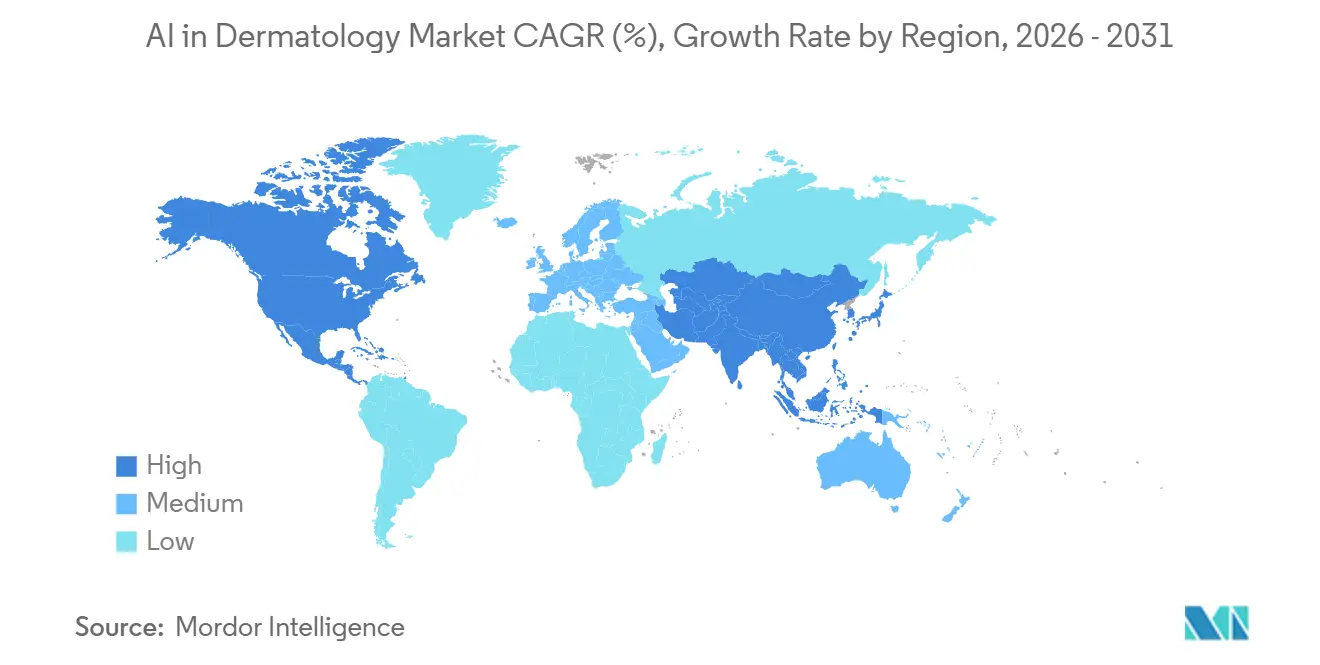
North America held 49.81% of AI in dermatology market share in 2025, which made it the largest regional contributor. The AI in dermatology market in this region benefits from a mature reimbursement environment, clearer clinical procurement pathways, and stronger early adoption across hospital networks. The United States remains the anchor because regulatory precedent, specialist demand, and private-sector buying capacity all support faster commercialization. DermaSensor’s January 2025 FDA authorization for objective melanoma, basal cell carcinoma, and squamous cell carcinoma risk assessment in primary care strengthened the practical case for non-specialist use of the AI in dermatology market in the United States.
Europe AI in Dermatology Market
Europe is moving forward on two tracks inside the AI in dermatology market. Northern and Western Europe are advancing faster because public health systems, digital referral models, and clinical evidence programs support structured deployment. NICE conditionally recommended Skin Analytics’ DERM for autonomous use in the NHS urgent suspected skin cancer pathway, which gives the AI in dermatology market in England a visible benchmark for other vendor. In Germany, DKFZ reported in 2024 that explainable AI combining predictions with visual and textual dermoscopic justification improved dermatologist accuracy and reduced cognitive fatigue, supporting a more evidence-based case for explainability-first positioning. The AI in dermatology market in Europe also faces heavier compliance work because the EU AI Act and MDR or IVDR must be managed together, which can slow smaller vendors more than larger ones.
APAC, MEA and South America AI in Dermatology Market
Asia-Pacific is projected to grow at an 18.43% CAGR through 2031, making it the fastest-growing regional segment in the AI in dermatology market. The main reason is structural demand, since dermatologist shortages and broader digital health programs create stronger incentives for scaled AI triage. Japan provides one of the clearest institutional examples in the AI in dermatology market, with the National Skin Disease Database helping domestic researchers build models that exceeded 90% accuracy in skin tumor detection. The AI in dermatology market in China, India, and South Korea is also supported by government-backed digital health mandates that make remote triage more practical at large population scale. The Middle East and Africa and South America remain earlier-stage regions, where smartphone-enabled apps and teledermatology platforms are moving ahead of hospital-grade deployments, but the AI in dermatology market still has meaningful longer-term room to expand in those settings as evidence and reimbursement mature.

Competitive Landscape
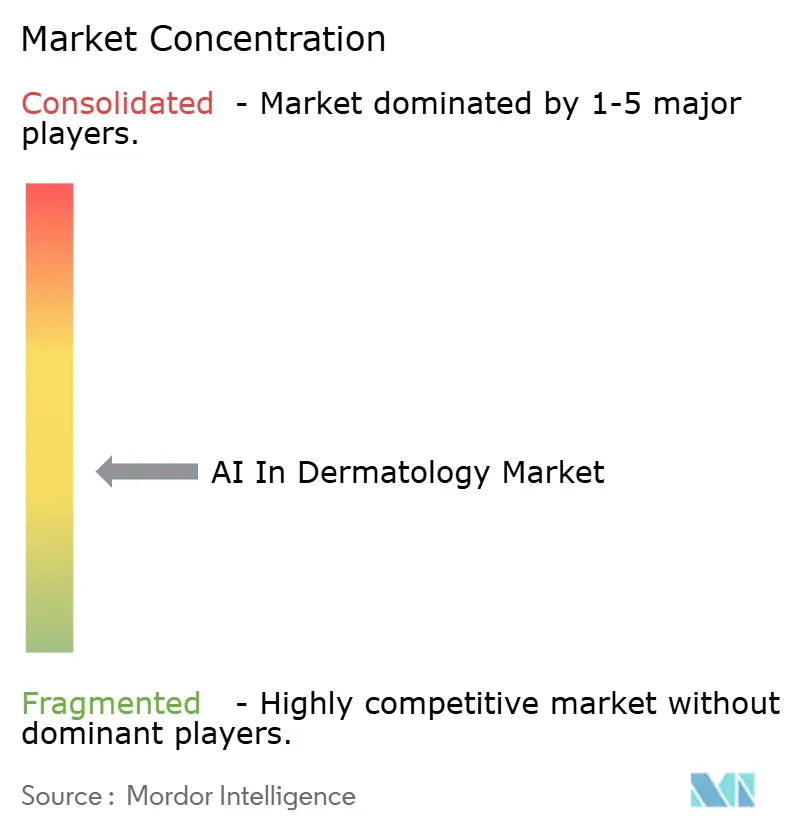
The AI in dermatology market is moderately fragmented, with specialized clinical AI companies, diagnostics incumbents, and newer multimodal model developers all competing at the same time. No single vendor controls a dominant global position, so differentiation depends more on clinical validation, regulatory clearances, workflow integration, and access to proprietary datasets. The AI in dermatology market also shows a layered structure, where some vendors sell autonomous or triage tools, while others focus on pathology, imaging hardware, or broader decision support. This mix is why competition looks active in product design and consolidation at the same time.
One of the clearest strategic moves in the AI in dermatology market was Roche’s May 2026 agreement to acquire PathAI for up to USD 1.05 billion. That transaction links PathAI’s FDA-cleared AISight Image Management System and dermatopathology capabilities with Roche’s global diagnostics platform, which pushes AI further into routine enterprise procurement. PathAI also received FDA Breakthrough Device Designation in March 2026 for PathAssist Derm, an AI tool for analyzing digital pathology whole-slide images of skin lesions, which reinforces its regulatory position in dermatopathology.
The AI in dermatology market still has open space in darker-skin calibration, edge deployment for primary care outside mature Western systems, and inflammatory-condition management beyond lesion detection. Vendors that secure hospital partnerships early are likely to defend their position better because data access and workflow embedding are becoming as important as application features. PathAI’s collaboration with Northwestern Medicine illustrates that point, since the partnership ties image management and diagnostic development to daily pathology operations before competitors can offer comparable integrated datasets. Skin Analytics’ partnership with Affidea across Europe shows another version of the same logic, where cross-border clinical reach supports faster deployment and broader real-world evidence generation. Over the next few years, the AI in dermatology market is likely to keep favoring vendors that combine explainability, multimodal design, and regulatory discipline rather than relying on standalone classifier performance alone.
AI In Dermatology Industry Leaders
DermaSensor
SkinVision
FotoFinder Systems
Canfield Scientific
VisualDx
- *Disclaimer: Major Players sorted in no particular order
AI In Dermatology Market Companies Covered in this Report
- AIBerry Derm
- Canfield Scientific
- DeepSkin
- DermaSensor
- DermTech
- Diagnoskin
- FotoFinder Systems
- Heidelberg Engineering
- IBM
- Legit.Health
- Lunit
- MedX Health
- MetaOptima (MoleScope)
- PROscia
- Quantificare
- Skin Analytics
- SkinIO
- SkinVision
- VisualDx
- VUNO

Recent Industry Developments in AI In Dermatology Market
- May 2026: Roche announced a definitive merger agreement to acquire PathAI for up to USD 1.05 billion (USD 750 million upfront, up to USD 300 million in milestones). The acquisition integrates PathAI's FDA-cleared AISight Image Management System and its dermatopathology AI tools into Roche Diagnostics' global oncology platform, accelerating vertical integration across tissue, image, and diagnostic decision-making.
- March 2026: PathAI received FDA Breakthrough Device Designation for PathAssist Derm, an AI tool designed to analyze digital pathology whole-slide images of skin lesions and assist pathologists in dermatopathology review. The designation follows PathAI's 2025 FDA clearance of AISight Dx, the first digital pathology IMS cleared with an authorized Predetermined Change Control Plan.
- March 2026: SkinVision announced a research collaboration with Mayo Clinic to conduct an FDA-required pivotal trial evaluating the performance of SkinVision's AI-based skin spot assessment app, representing a significant regulatory milestone in the company's US market entry strategy.


Global AI In Dermatology Market Report Scope
According to the report’s scope, the AI in dermatology market refers to the use of artificial intelligence technologies, including machine learning and computer vision, to assist in the detection, diagnosis, monitoring, and treatment of skin conditions. These solutions analyze dermatological images and patient data to improve diagnostic accuracy, support clinical decision-making, and enhance workflow efficiency in dermatology practices and healthcare settings.
The AI in dermatology market is segmented into product type, deployment mode, dermatology condition, end-user, and geography. By product type, the market is segmented into AI diagnostic software, AI-integrated imaging devices, clinical decision-support platforms, and virtual care and tele-dermatology platforms. By deployment mode, the market is segmented into cloud-based, on-premise, and edge/device-based. By dermatology condition, the market is segmented into skin cancer, psoriasis, acne, atopic dermatitis, and other conditions. By end-user, the market is segmented into hospitals, dermatology clinics, academic and research institutes, and other end-users. By geography, the market is segmented into North America, Europe, Asia-Pacific, the Middle East and Africa, and South America. The report also covers the estimated market sizes and trends for 17 countries across major regions globally. The report offers values (USD) for all the above segments.
| AI Diagnostic Software |
| AI-Integrated Imaging Devices |
| Clinical Decision-Support Platforms |
| Virtual Care and Tele-Dermatology Platforms |
| Cloud-Based |
| On-Premise |
| Edge / Device-Based |
| Skin Cancer |
| Psoriasis |
| Acne |
| Atopic Dermatitis |
| Other Conditions |
| Hospitals |
| Dermatology Clinics |
| Academic and Research Institutes |
| Other End-Users |
| North America | United States |
| Canada | |
| Mexico | |
| Europe | Germany |
| United Kingdom | |
| France | |
| Italy | |
| Spain | |
| Rest of Europe | |
| Asia-Pacific | China |
| Japan | |
| India | |
| Australia | |
| South Korea | |
| Rest of Asia-Pacific | |
| Middle East and Africa | GCC |
| South Africa | |
| Rest of Middle East and Africa | |
| South America | Brazil |
| Argentina | |
| Rest of South America |
| By Product Type | AI Diagnostic Software | |
| AI-Integrated Imaging Devices | ||
| Clinical Decision-Support Platforms | ||
| Virtual Care and Tele-Dermatology Platforms | ||
| By Deployment Mode | Cloud-Based | |
| On-Premise | ||
| Edge / Device-Based | ||
| By Dermatology Condition | Skin Cancer | |
| Psoriasis | ||
| Acne | ||
| Atopic Dermatitis | ||
| Other Conditions | ||
| By End-User | Hospitals | |
| Dermatology Clinics | ||
| Academic and Research Institutes | ||
| Other End-Users | ||
| By Geography | North America | United States |
| Canada | ||
| Mexico | ||
| Europe | Germany | |
| United Kingdom | ||
| France | ||
| Italy | ||
| Spain | ||
| Rest of Europe | ||
| Asia-Pacific | China | |
| Japan | ||
| India | ||
| Australia | ||
| South Korea | ||
| Rest of Asia-Pacific | ||
| Middle East and Africa | GCC | |
| South Africa | ||
| Rest of Middle East and Africa | ||
| South America | Brazil | |
| Argentina | ||
| Rest of South America | ||


Key Questions Answered in the Report
What is the current value of the AI in dermatology market?
The market is expected to increase from USD 8.26 billion in 2025 to USD 9.32 billion in 2026 and is projected to reach USD 19.09 billion by 2031 at a 15.43% CAGR over 2026-2031.
Which product category leads revenue in dermatology AI?
AI diagnostic software led product revenue with a 44.36% share in 2025, supported by software-only economics and easier integration into existing clinical systems.
Which region is growing fastest for dermatology AI adoption?
Asia-Pacific is the fastest-growing region, with an 18.43% CAGR through 2031, helped by dermatologist shortages and broader digital health rollout.
Why does skin cancer remain the main use case for AI in dermatology?
Skin cancer held a 54.12% share in 2025 because it benefits from stronger imaging datasets, more established regulatory precedent, and clearer payer support for early detection.
Page last updated on:





