
AI In Wound Care Market Size and Share
Market Overview
| Study Period | 2020 - 2031 |
|---|---|
| Market Size (2026) | USD 3.66 Billion |
| Market Size (2031) | USD 8.42 Billion |
| Growth Rate (2026 - 2031) | 18.15 % |
| Fastest Growing Market | Asia Pacific |
| Largest Market | North America |
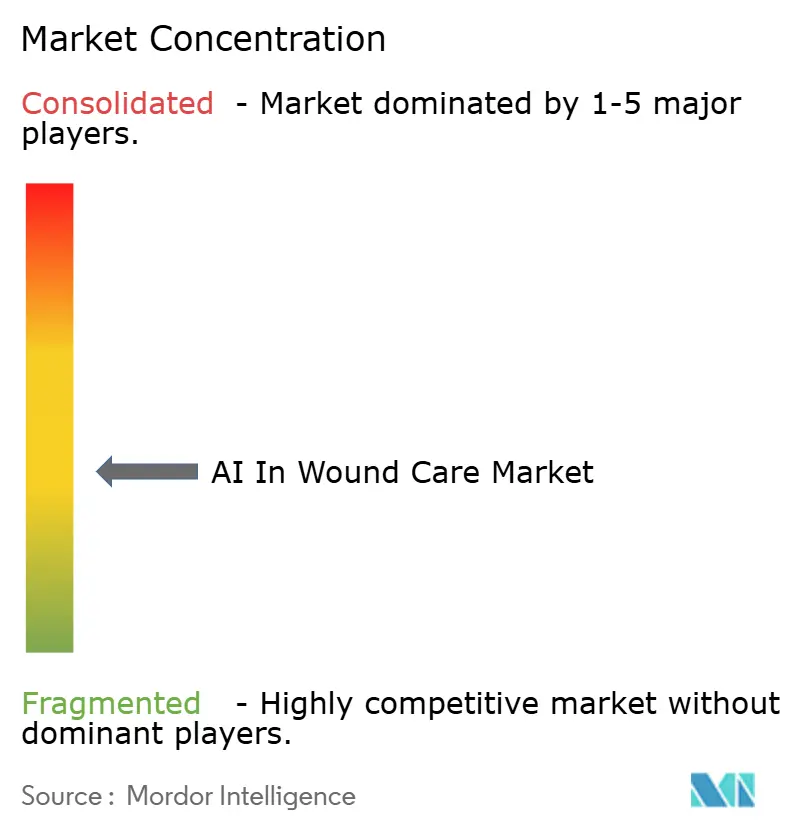
| Market Concentration | Medium |
Major Players *Disclaimer: Major Players sorted in no particular order Image © Mordor Intelligence. Reuse requires attribution under CC BY 4.0. | |

AI In Wound Care Market Analysis by Mordor Intelligence
The AI In Wound Care Market size is estimated at USD 3.66 billion in 2026, and is expected to reach USD 8.42 billion by 2031, at a CAGR of 18.15% during the forecast period (2026-2031).
Increasing diabetes prevalence, supportive reimbursement codes for remote therapeutic monitoring, and algorithmic breakthroughs in deep learning have shifted capital toward automated assessment, pushing hospital administrators to embed decision support into electronic health records for time-critical wound management. Reinforcement learning pilots that tune negative-pressure therapy parameters in real time, fluorescence imaging for acute burns, and federated learning frameworks that safeguard patient privacy are widening the competitive moat for platforms able to execute continuous model updates without triggering new regulatory submissions. Meanwhile, the European Union’s AI Act and the FDA’s TEMPO pilot program are clarifying pathways for adaptive algorithms, shrinking review cycles and unlocking larger addressable volumes across both developed and emerging settings.
Key Report Takeaways
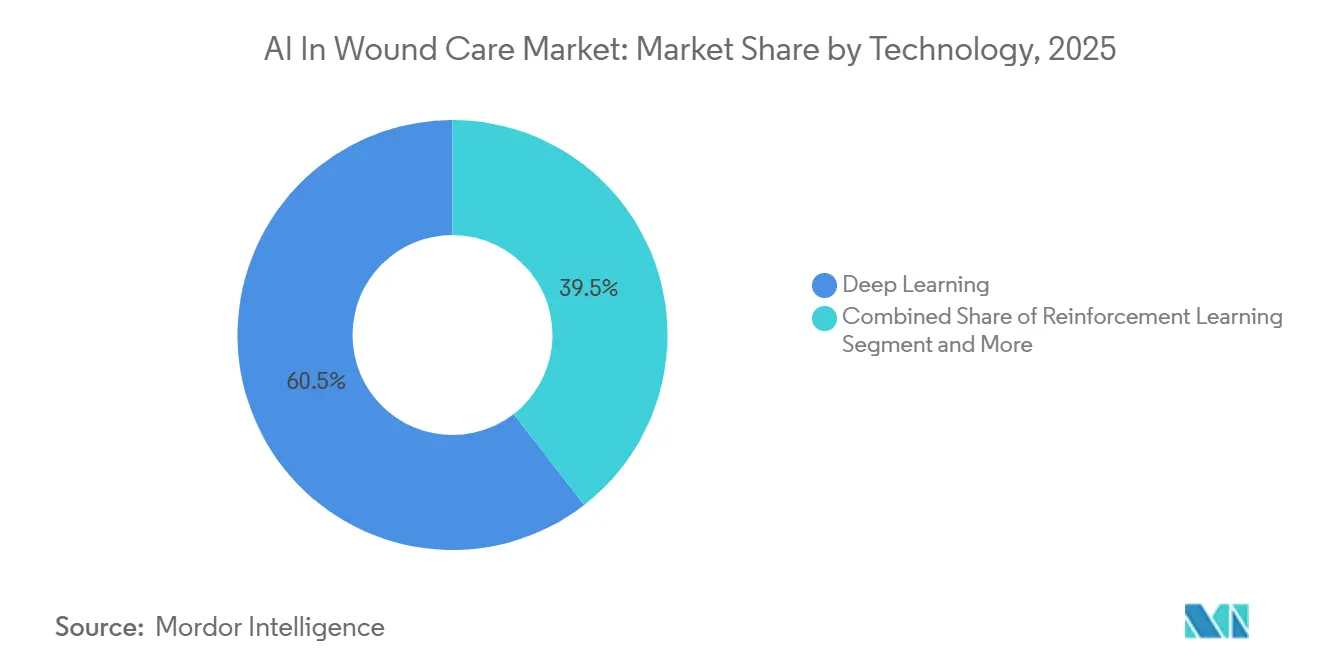
- By technology, deep learning led with 60.55% of the AI in wound care market share in 2025, while reinforcement learning is projected to expand at a 25.25% CAGR through 2031.
- By application, wound assessment and monitoring accounted for 45.23% of the AI in wound care market size in 2025; healing prediction and decision support is advancing at a 24.15% CAGR to 2031.
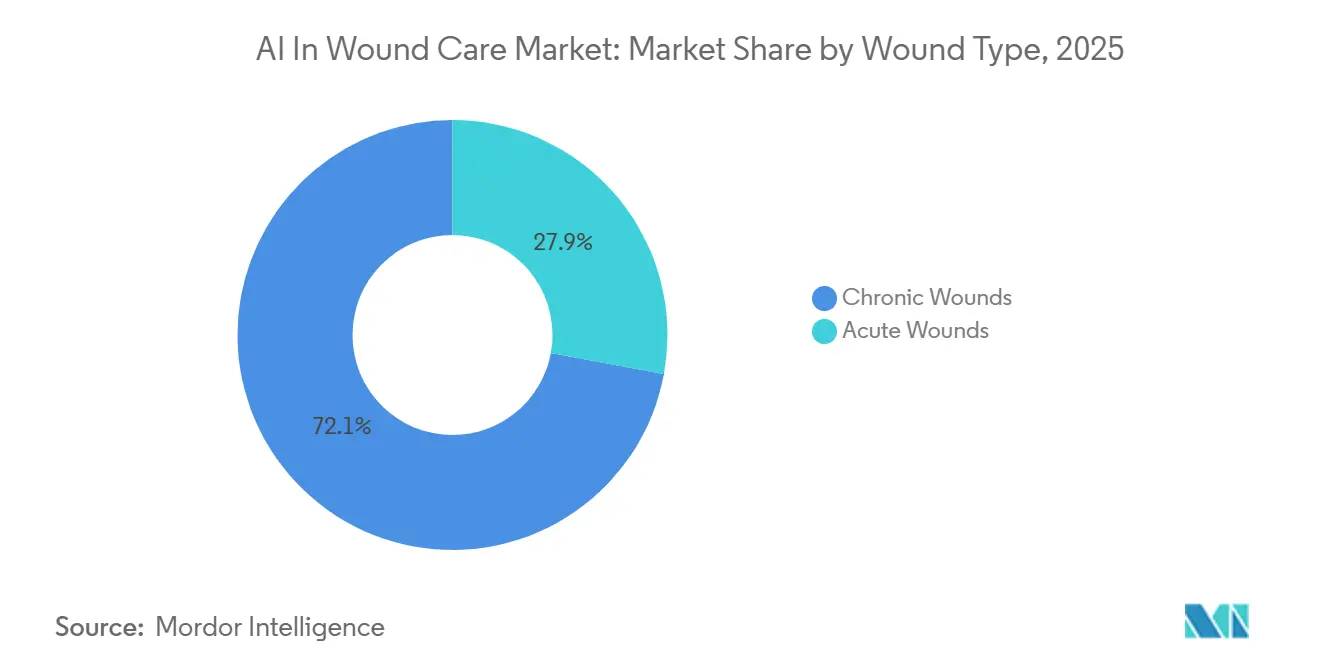
- By wound type, chronic wounds held 72.15% of 2025 revenue, whereas acute wounds are forecast to grow at a 19.51% CAGR between 2026 and 2031.
- By end user, hospitals captured 54.35% of 2025 revenue, and home healthcare plus telehealth channels are poised for a 21.11% CAGR through the forecast horizon.
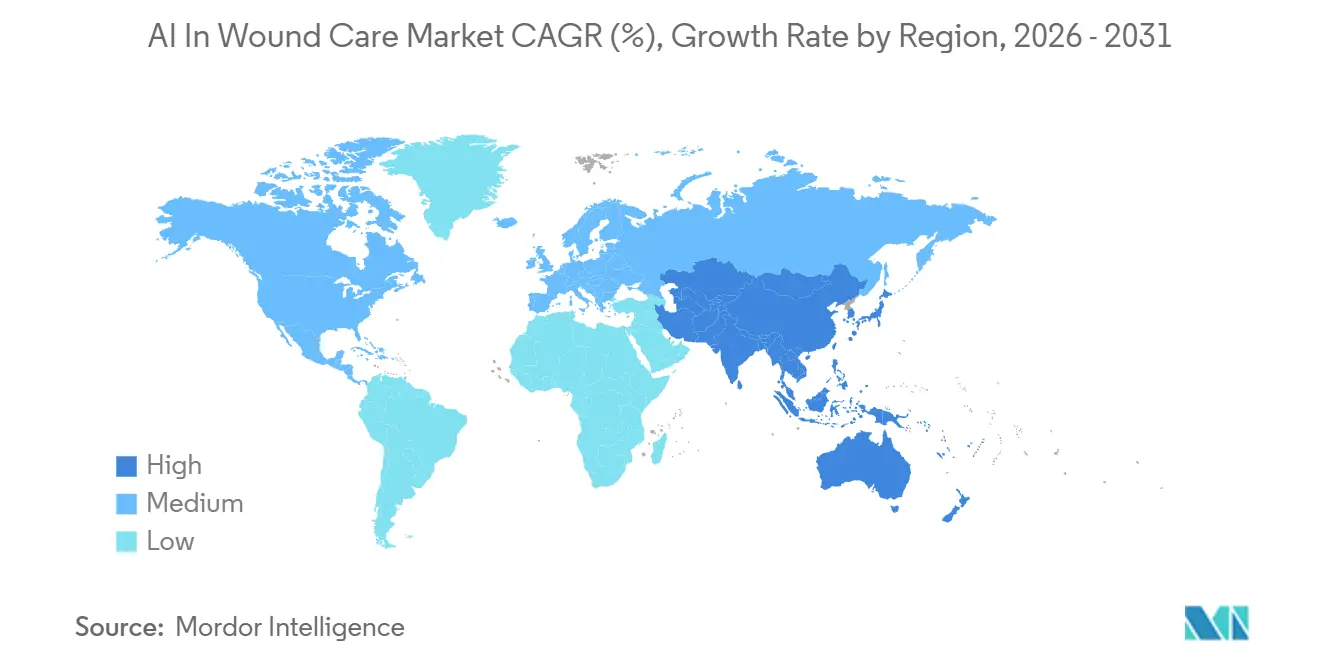
- By geography, North America dominated with a 42.25% share in 2025, while Asia-Pacific is set to record the fastest growth at a 19.02% CAGR over 2026-2031.
Note: Market size and forecast figures in this report are generated using Mordor Intelligence’s proprietary estimation framework, updated with the latest available data and insights as of January 2026.
Market Trends and Insights
Drivers Impact Analysis of AI In Wound Care Market*
| Driver | (~) % Impact on CAGR Forecast | Geographic Relevance | Impact Timeline |
|---|---|---|---|
| Rising prevalence of chronic wounds & diabetes | +3.2% | Global; highest clinical pressure in North America and Europe, emerging strain in Asia-Pacific | Long term (≥ 4 years) |
| Growing adoption of telehealth & RPM | +2.8% | Led by North America, followed by Europe; rapid urban uptake in Asia-Pacific | Medium term (2-4 years) |
| Advances in deep-learning algorithms | +3.5% | Global R&D concentration in North America, Europe, East Asia; deployment worldwide | Medium term (2-4 years) |
| Supportive reimbursement & regulatory pathways | +2.9% | North America and Europe primary; gradual extension into Asia-Pacific | Short term (≤ 2 years) |
| Integration of AI analytics into value-based care | +2.3% | North America dominant; early pilots in Europe, limited in APAC and MEA | Medium term (2-4 years) |
| Federated-learning platforms enabling privacy-preserving model training | +2.1% | North America and EU; spillover to APAC | Long term (≥ 4 years) |
| Source: Mordor Intelligence | |||
Rising Prevalence of Chronic Wounds & Diabetes
Diabetic foot ulcers now develop in up to 25% of the 38.4 million Americans with diabetes, driving 85% of lower-limb amputations and stretching Medicare’s USD 22.5 billion wound budget. Pressure ulcers in long-term care cost USD 10,000–USD 40,000 per episode, spurring adoption of predictive analytics that flag high-risk residents before tissue breakdown. Siren’s temperature-sensing sock cut diabetic foot ulcer incidence by 68% and amputation risk by 83% in a 2025 cohort, underscoring preventive ROI. Epidemiological momentum will persist as the CDC projects one in three U.S. adults will have diabetes by 2050, enlarging the AI in wound care market[1].
Growing Adoption of Telehealth & RPM
CMS codes 99457 and 99458 reimburse 20 minutes of monthly remote wound monitoring, converting AI-enabled imaging from pandemic expedient to permanent infrastructure. Healthy.io’s smartphone platform lowered in-person visits by 30% and shortened healing by 21 days, saving USD 1,800 per patient in 2024 field trials. Swift Medical’s consortium now links over 2,000 facilities and monitors 100,000 beds, generating datasets that sharpen algorithm accuracy with every dressing change. These economics align with accountable care organizations that cut 30-day readmissions for wound complications by 18% when leveraging AI-enabled RPM.
Advances in Deep-Learning Algorithms
Convolutional neural networks trained on annotated images reach 94.2% sensitivity in flagging early pressure injuries, surpassing bedside nurse inspection and delivering a 3-second inference on standard smartphones. The FDA’s TEMPO pilot, launched December 2025, trimmed review timelines for digital devices to nine months, accelerating iterative model refinement. Reinforcement learning trials now adjust negative-pressure therapy based on real-time exudate flow, halving clinician intervention frequency.
Federated-Learning Platforms Enabling Privacy-Preserving Model Training
Hospitals hesitant to pool wound images can train models locally via federated frameworks such as NVIDIA’s MONAI, sharing only weight updates and protecting PHI. The FDA’s 2025 guidance explicitly allows predetermined change plans for federated models, avoiding a fresh 510(k) with each update. Early pilots show accuracy parity with centralized datasets, opening rural centers to algorithm improvements without data transfer.
Restraints Impact Analysis of AI In Wound Care Market*
| Restraint | (~) % Impact on CAGR Forecast | Geographic Relevance | Impact Timeline |
|---|---|---|---|
| High implementation costs & limited reimbursement | -2.2% | Global; most acute in emerging markets and rural facilities | Short term (≤ 2 years) |
| Regulatory validation hurdles for adaptive algorithms | -1.7% | EU and North America most stringent; APAC evolving | Medium term (2-4 years) |
| Algorithmic bias from under-represented skin tones | -1.5% | Global; highest clinical risk in Africa, South Asia, Latin America | Medium term (2-4 years) |
| Data-ownership & cybersecurity liability concerns | -1.3% | Strictest in North America and EU; rising in APAC | Long term (≥ 4 years) |
| Source: Mordor Intelligence | |||
High Implementation Costs & Limited Reimbursement
Enterprise platforms cost USD 50,000–USD 150,000 up front, plus 15–20% annual maintenance, straining community hospitals that still receive bundled payments rather than discrete AI carve-outs. A 2024 survey of 200 U.S. hospitals found 62% cited uncertain ROI as the chief barrier to adoption. Emerging markets face steeper gaps; India’s Ayushman Bharat Digital Mission has yet to reimburse AI wound assessments despite enrolling 680 million citizens. EU conformity assessments under the AI Act can exceed EUR 100,000 and extend launch timelines 6–9 months, adding further friction[2].
Algorithmic Bias from Under-Represented Skin Tones
The 2024 WISDOM AI study recorded an 18% higher misclassification rate for wound severity in darker-skinned patients when algorithms were trained on Caucasian-dominant datasets. Under-staging early pressure ulcers delays intervention and worsens outcomes. Vendors are diversifying image repositories—Swift Medical lifted Fitzpatrick IV–VI representation to 30% in 2025—yet older models remain in clinical use for up to five years, prolonging disparities.
*Our forecasts treat driver/restraint impacts as directional, not additive. The impact forecasts reflect baseline growth, mix effects, and variable interactions.
AI In Wound Care Market Segment Analysis
By Technology:
Edge-Inference Deep Learning Dominance with Reinforcement Learning UpsideDeep learning commanded 60.55% of the AI in wound care market share in 2025, propelled by smartphone-based image segmentation that quantifies tissue types for every dressing change[3]. Edge inference chips from Apple and Qualcomm shorten processing to under three seconds, erasing latency and easing HIPAA compliance. Reinforcement learning’s 25.25% forecast CAGR reflects hospital pilots that autonomously modify negative-pressure settings in response to tissue perfusion, demonstrating 15% faster granulation. Federated learning complements both approaches by enabling cross-institution training without data migration, a design praised by CIOs wary of ransomware exposure. The FDA’s draft guidance on change control plans smooths over-the-air algorithm updates, allowing vendors to iterate weekly and sustain clinical accuracy. Smaller methods such as random forests remain relevant where annotated datasets are thin, ensuring entry-level adoption among resource-constrained centers.
Convergence is emerging: hybrid pipelines first run lightweight machine-learning triage, then escalate complex cases to deep learning or reinforcement modules, balancing cloud costs against clinical acuity. Vendors that orchestrate this multi-tier architecture position themselves to capture hospital informatics budgets as CIOs rationalize duplicated point solutions. Intensifying capital flows into GPU clusters underscore the importance of owning the algorithm stack to lock in recurring licensing.

By Application:
Healing Prediction Outpaces Assessment as Payers Demand OutcomesWound assessment and monitoring contributed 45.23% of 2025 revenue, rooted in an installed base exceeding 2,000 facilities where bedside nurses capture daily images that auto-populate electronic records. Clinicians cite a 40% reduction in documentation minutes per dressing change, freeing bandwidth for complex cases. Healing prediction and decision support, expanding at 24.15%, converts longitudinal datasets into seven-day closure forecasts that prompt early escalation to biologics, lowering stalled-wound incidence by 22%. Documentation automation and remote management modules integrate pharmacy fulfillment, minimizing stock-outs of specialty dressings. As platforms bundle these functions, segmentation lines blur, and procurement committees increasingly issue single RFPs for unified ecosystems. Payers now require predictive analytics to authorize costly regenerative matrices, cementing healing prediction as the next adoption wave within the AI in wound care market.
By Wound Type:
Chronic Cases Dominate While Acute Burns Accelerate Imaging DemandChronic lesions captured 72.15% of 2025 revenue, propelled by diabetic foot ulcers and pressure injuries that afflict 10.5 million Medicare beneficiaries. Preventive sensors such as Siren’s socks slashed ulcer incidence by 68% and amputations by 83%, reinforcing chronic care ROI. Acute wounds, including surgical and traumatic burns, are climbing at 19.51% CAGR as fluorescence imaging triages grafting decisions within 72 hours. Spectral AI’s DeepView system predicts burn depth with 95% accuracy versus 70% from visual inspection, catalyzing interest among burn centers that face thin surgical margins. Surgical site infections, which elevate per-case costs by USD 20,000–USD 30,000, present a high-value use case for AI surveillance embedded in infection-control dashboards.
By End User:
Hospitals Anchor Spend, Home Healthcare Surges on RPM CodesHospitals retained 54.35% of 2025 revenue, leveraging enterprise-grade servers that host multi-modal wound analytics across inpatient and outpatient portals. Yet the home healthcare and telehealth corridor is set to grow at 21.11% CAGR as CMS reimbursement unlocks remote therapeutic monitoring revenue. Healthy.io-enabled nurses manage triple the patient load compared with legacy in-home rounds, easing clinician shortages. Long-term care facilities, though budget-constrained, are piloting mattress-integrated pressure injury sensors paired with AI risk dashboards, signalling future upside. Specialized wound clinics harness triage algorithms to prioritize high-risk referrals, aligning with bundled-payment quality targets.
Geography Analysis
North America AI in Wound Care Market
North America commanded 42.25% of 2025 revenue, supported by CMS payment reform, FDA regulatory clarity, and a mature electronic health record spine that simplifies API integration. Canada’s single-payer system lags adoption, yet Ontario pilots report reduced home-care visits, pressuring other provinces to follow. Mexico’s private chains import U.S. platforms, but public institutes lack infrastructure, constricting scale.
APAC AI in Wound Care Market
Asia-Pacific is advancing at 19.02% CAGR; India’s Ayushman Bharat Digital Mission registered 680 million citizens and is piloting AI modules in primary centers, while China’s accelerated device review pathway supports domestic vendors targeting 1.4 billion citizens under Healthy China 2030. Japan’s rapidly aging population demands remote monitoring to offset specialist shortages; South Korea’s permanent telemedicine program incorporates AI wound triage in rural clinics. Australia’s interoperable My Health Record fosters urban deployments, though geography challenges remote outback adoption.
EMEA and South America AI in Wound Care Market
Europe’s share is tempered by AI Act assessments that add six-plus months to launches, yet a unified framework eases multi-country commercialization. Germany’s DiGA pathway is expected to reimburse AI wound tools by 2027, and the United Kingdom’s GBP 10 million Wound Care Sector Deal catalyzes pilots across NHS trusts. The Middle East, Africa, and South America trail, with adoption concentrated in private tertiary centers serving expatriate or insured populations, though Brazil’s primary-care pilots hint at future public-sector demand.
Competitive Landscape
The AI in wound care market is moderately fragmented. Legacy suppliers Smith+Nephew, Mölnlycke, and ConvaTec acquire or ally with digital startups to leapfrog algorithm development cycles. Mölnlycke’s USD 8 million Siren stake secures exclusive access to temperature-sensing wearables for diabetic foot prophylaxis. Smith+Nephew partners with HOPCo to marry analytics with value-based reimbursement triggers inside hospital systems. Pure-plays Swift Medical, Healthy.io, and eKare win contracts by slashing nurse documentation time 40%, resonating with administrators under staffing pressure. Spectral AI targets burn assessment, while NVIDIA’s federated-learning toolkits democratize dataset access for emerging entrants, eroding incumbents’ data moats. The FDA’s TEMPO pilot low-ers regulatory barriers, enticing new venture-funded challengers and intensifying price competition.
AI In Wound Care Industry Leaders
-
eKare
-
Healthy.io
-
Swift Medical
-
Kronikare
-
Spectral AI
- *Disclaimer: Major Players sorted in no particular order
AI In Wound Care Market Companies Covered in this Report
- B. Braun
- Cardinal Health
- Coloplast
- Convatec
- eKare
- Essity
- Healogics
- Healthy.io
- Intellicure
- Joerns Healthcare
- Kronikare
- MediWound
- MolecuLight
- Molnlycke
- Net Health Systems
- Organogenesis
- Perceptive Solutions
- Smiths Group
- Solventum Corporation
- Spectral AI
- Swift Medical
- The Wound Pros
- WoundVision
- WoundZoom
Recent Industry Developments in AI In Wound Care Market
- December 2025: Net Health integrated MolecuLightDX fluorescence imaging into Tissue Analytics, enabling immediate bacterial load visualization inside its mobile AI workflow.
- September 2025: University of California Santa Cruz engineers unveiled “a-Heal,” a wearable that uses a micro-camera plus AI to detect healing stage and deliver medication or electric fields automatically.
Global AI In Wound Care Market Report Scope
As per the scope of the report, AI in wound care refers to the application of artificial intelligence technologies to improve the management, diagnosis, treatment, and monitoring of wounds. It involves using machine learning algorithms, computer vision, and data analysis to assist healthcare professionals in assessing wound severity, predicting healing outcomes, personalizing treatment plans, and detecting infections or complications early.
The segmentation for the AI in wound care market is categorized by technology, application, wound type, end user, and geography. By technology, the market includes machine learning techniques, deep learning methods, computer vision techniques, natural language processing tools, and reinforcement learning approaches. By application, it covers wound assessment and monitoring tools, healing prediction and decision support systems, documentation automation solutions, and remote patient management platforms. By wound type, the segmentation includes chronic wounds such as diabetic foot ulcers, pressure ulcers, venous leg ulcers, and others, as well as acute wounds like surgical/traumatic wounds and burns. By end user, the market is segmented into hospitals, specialized wound clinics, home healthcare and telehealth services, and long-term care facilities. Geographically, the market is divided into North America, Europe, Asia-Pacific, the Middle East and Africa, and South America. The Market Forecasts are Provided in Terms of Value (USD).
Segmentation Overview
| Machine Learning |
| Deep Learning |
| Computer Vision Algorithms |
| Natural Language Processing |
| Reinforcement Learning |
| Wound Assessment & Monitoring |
| Healing Prediction & Decision Support |
| Documentation Automation |
| Remote Patient Management Platform |
| Chronic Wounds | Diabetic Foot Ulcers |
| Pressure Ulcers | |
| Venous Leg Ulcers | |
| Others | |
| Acute Wounds | Surgical/Traumatic Wounds |
| Burns |
| Hospitals |
| Specialized Wound Clinics |
| Home Healthcare & Telehealth |
| Long-term Care Facilities |
| North America | United States |
| Canada | |
| Mexico | |
| Europe | Germany |
| United Kingdom | |
| France | |
| Italy | |
| Spain | |
| Rest of Europe | |
| Asia-Pacific | China |
| India | |
| Japan | |
| Australia | |
| South Korea | |
| Rest of Asia-Pacific | |
| Middle East and Africa | GCC |
| South Africa | |
| Rest of Middle East and Africa | |
| South America | Brazil |
| Argentina | |
| Rest of South America |
| By Technology | Machine Learning | |
| Deep Learning | ||
| Computer Vision Algorithms | ||
| Natural Language Processing | ||
| Reinforcement Learning | ||
| By Application | Wound Assessment & Monitoring | |
| Healing Prediction & Decision Support | ||
| Documentation Automation | ||
| Remote Patient Management Platform | ||
| By Wound Type | Chronic Wounds | Diabetic Foot Ulcers |
| Pressure Ulcers | ||
| Venous Leg Ulcers | ||
| Others | ||
| Acute Wounds | Surgical/Traumatic Wounds | |
| Burns | ||
| By End User | Hospitals | |
| Specialized Wound Clinics | ||
| Home Healthcare & Telehealth | ||
| Long-term Care Facilities | ||
| By Geography | North America | United States |
| Canada | ||
| Mexico | ||
| Europe | Germany | |
| United Kingdom | ||
| France | ||
| Italy | ||
| Spain | ||
| Rest of Europe | ||
| Asia-Pacific | China | |
| India | ||
| Japan | ||
| Australia | ||
| South Korea | ||
| Rest of Asia-Pacific | ||
| Middle East and Africa | GCC | |
| South Africa | ||
| Rest of Middle East and Africa | ||
| South America | Brazil | |
| Argentina | ||
| Rest of South America | ||
Key Questions Answered in the Report
What growth rate is projected for AI in wound care between 2026 and 2031?
The market is expected to expand at an 18.15% CAGR, climbing from USD 3.66 billion in 2026 to USD 8.42 billion by 2031.
Which technology currently leads adoption in AI-driven wound management?
Deep learning dominates, holding 60.55% share in 2025 due to its accuracy in image segmentation and classification.
Why are healing-prediction tools gaining funding priority?
Payers now require outcome forecasts to authorize advanced therapies, and predictive algorithms have reduced stalled-wound incidence by 22% in clinical studies.
How do CMS codes 99457 and 99458 influence remote wound monitoring?
They reimburse clinicians for 20 minutes of monthly remote monitoring, driving a 21.11% CAGR in home healthcare adoption.
Which region is expected to grow fastest through 2031?
Asia-Pacific leads with a forecast 19.02% CAGR, propelled by India's digital health mission and China's accelerated AI device approvals.
What is the main barrier preventing wider AI deployment in long-term care facilities?
Up-front platform costs and limited reimbursement prevent budget-strained facilities from investing despite high pressure-ulcer prevalence.