
Online Dermatology Consultation Market Size and Share
Market Overview
| Study Period | 2019 - 2030 |
|---|---|
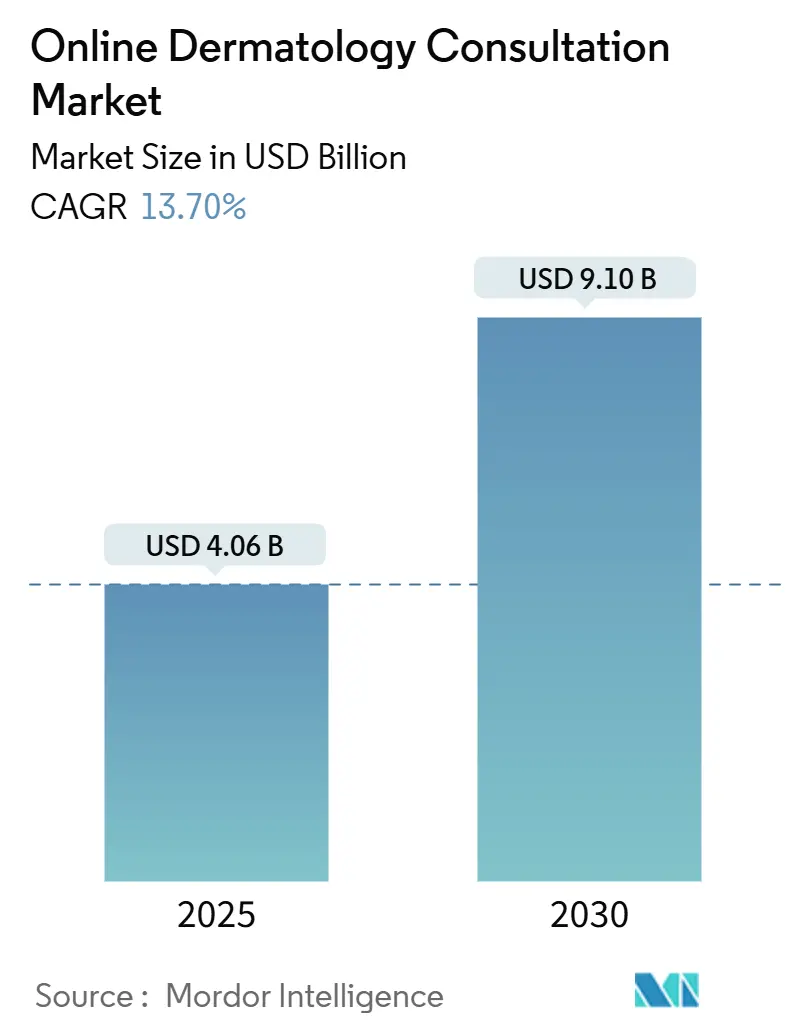
| Market Size (2025) | USD 4.06 Billion |
| Market Size (2030) | USD 9.10 Billion |
| Growth Rate (2025 - 2030) | 13.70 % |
| Fastest Growing Market | North America |
| Largest Market | Asia Pacific |
| Market Concentration | Medium |
Major Players *Disclaimer: Major Players sorted in no particular order Image © Mordor Intelligence. Reuse requires attribution under CC BY 4.0. | |
Online Dermatology Consultation Market Analysis by Mordor Intelligence
The online dermatology consultation market size touched USD 4.06 billion in 2025 and is projected to advance to USD 9.10 billion by 2030, reflecting a robust 13.7% CAGR. Increasing prevalence of skin disorders that affect 84.5 million Americans annually, a chronic shortage of board-certified dermatologists across 68.2% of U.S. counties, and fast-maturing AI decision-support tools with 93% melanoma-detection sensitivity combine to accelerate adoption.[1]American Academy of Dermatology, “Burden of Skin Disease,” aad.org Growth is further propelled by payment-parity regulations, the ubiquity of smartphones that enable high-resolution image capture, and payer demand for lower-cost care pathways. Vendors in the online dermatology consultation market are bundling AI-assisted triage, mobile dermatoscopes, and integrated e-pharmacy services to unlock prescription margin while enhancing platform stickiness. Meanwhile, tightening data-privacy laws and licensure rules raise compliance costs, creating a competitive moat for clinically validated, workflow-embedded solutions.
Key Report Takeaways
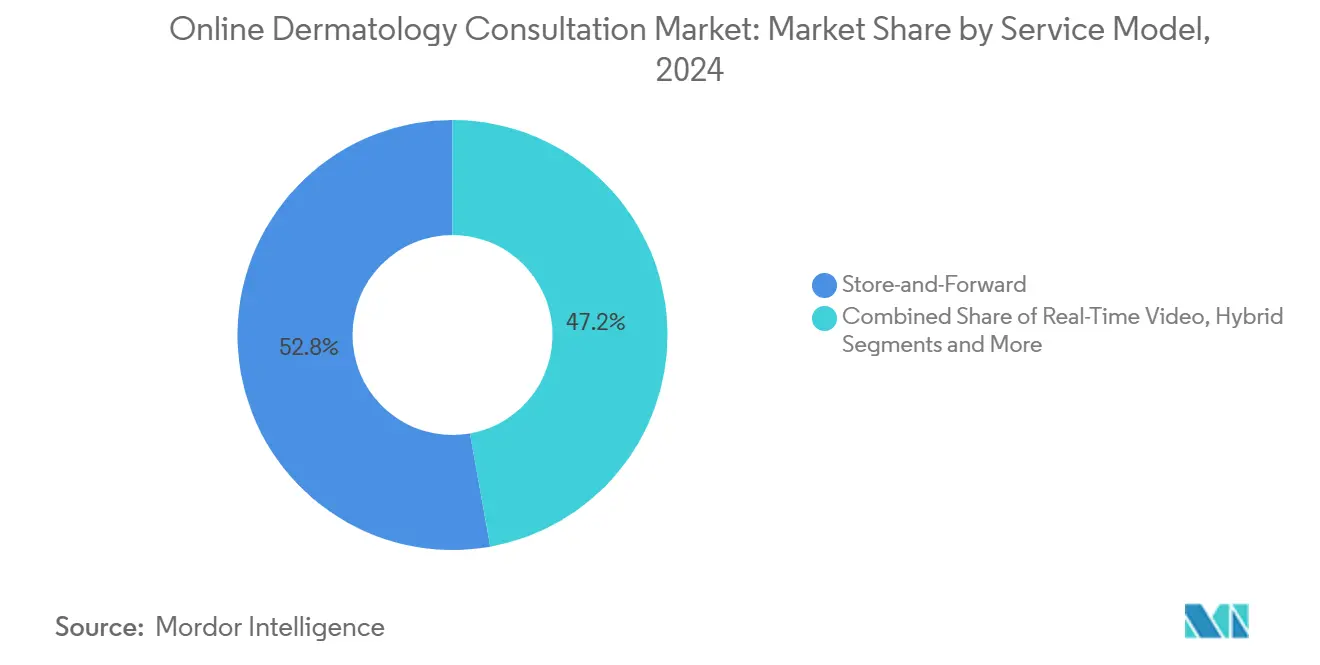
- By service model, store-and-forward asynchronous consultations held 52.8% of the online dermatology consultation market share in 2024. Hybrid service models are forecast to expand at 23.4% CAGR through 2030, the fastest among all service approaches.
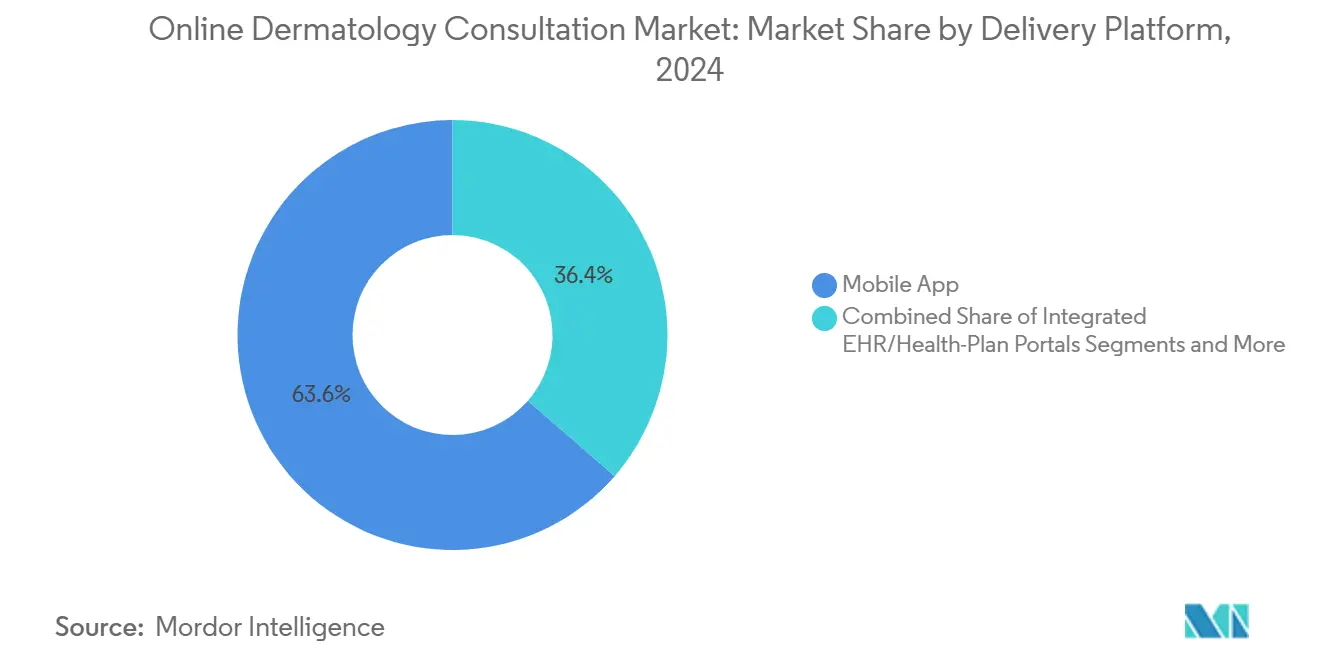
- By delivery platform, Mobile applications represented 63.6% of the online dermatology consultation market size in 2024 and are set to grow at a 26.1% CAGR through 2030.
- By geography, North America commanded 38.6% revenue share of the online dermatology consultation market in 2024, while Asia Pacific is the fastest-growing region at a 20.5% CAGR.
Global Online Dermatology Consultation Market Trends and Insights
Drivers Impact Analysis*
| Driver | (~) % Impact on CAGR Forecast | Geographic Relevance | Impact Timeline |
|---|---|---|---|
| Rising Dermatologic Disease Burden & Wait-Time Crisis | +2.80% | Global, concentrated in North America & Europe | Medium term (2-4 years) |
| Post-COVID Virtual-Care Reimbursement Parity | +2.10% | North America & EU, selective APAC adoption | Short term (≤ 2 years) |
| AI-Augmented Triage & Dermatoscopy Accuracy Gains | +3.20% | Global, early adoption in developed markets | Long term (≥ 4 years) |
| Cost-Containment Push By U.S. & EU Payers | +1.90% | North America & EU core markets | Medium term (2-4 years) |
| Mobile Dermatoscope Peripherals Create D2C Upgrade Cycle | +1.60% | Global, premium market penetration | Medium term (2-4 years) |
| E-Pharmacy Integration Unlocking Prescription Margin Capture | +1.10% | North America & EU, regulatory dependent | Long term (≥ 4 years) |
| Source: Mordor Intelligence | |||
Rising Dermatologic Disease Burden & Wait-Time Crisis
Average dermatology appointment waits times reach 50 days in large U.S. cities, and rural Indian Health Service hospitals sit 68 miles from the nearest dermatologist. The disparity intensifies as specialist retirements accelerate under Medicare’s 2.83% fee reduction for 2025, leaving primary-care physicians to manage routine cases via virtual platforms. By allowing image uploads, structured history forms, and AI triage, the online dermatology consultation market expands the effective provider base and reduces unnecessary referrals.
Post-COVID Virtual-Care Reimbursement Parity
Temporary U.S. and EU payment-parity rules keep virtual consultations reimbursed at rates comparable to in-person visits, sustaining revenue predictability and encouraging capital investment in AI and dermatoscopy peripherals. Similar pilots in Thailand and Singapore further validate the economic case. Once codified into permanent law, parity will cement teleconsultation as a standard dermatologic pathway, anchoring growth in the online dermatology consultation market.
AI-Augmented Triage & Dermatoscopy Accuracy Gains
Convolutional-neural-network classifiers now achieve 93.59% sensitivity for malignant lesions, while patient-facing smartphone apps deliver 79% overall disease-classification accuracy.[2]Aline L. Okita et al., “AI-Based Skin Cancer Recognition Model,” mdpi.com Generative-AI chatbots augment ABCDE rule assessments with personalized risk profiles, prompting timely escalation to dermatologist oversight. Although specificity varies, mandated clinician review mitigates medico-legal exposure and increases consumer trust, reinforcing technology adoption across the online dermatology consultation market.
Cost-Containment Push by U.S. & EU Payers
Teledermatology generates an estimated 275% return on investment, producing USD 42 billion in annual system-wide savings through avoided emergency visits and optimized specialty referrals.[3]April Noel, “Telehealth in 2025,” ctel.org Rural veterans save USD 65–73 per teleconsultation while avoiding hours of travel. National health services in Europe view virtual dermatology as an enabler for shifting care from inpatient to ambulatory settings. Cost pressure therefore remains a long-term driver for the online dermatology consultation market.
Restraints Impact Analysis*
| Restraint | (~) % Impact on CAGR Forecast | Geographic Relevance | Impact Timeline |
|---|---|---|---|
| Uneven Broadband / Smartphone Access In Rural & Elderly Cohorts | -1.80% | Rural North America, developing APAC regions, remote Australia | Medium term (2-4 years) |
| Image-Quality & Medico-Legal Liability Concerns | -1.40% | Global, heightened in litigation-prone markets like North America | Short term (≤ 2 years) |
| Cross-Border Licensure & Malpractice Premium Spikes | -1.20% | North America interstate, EU cross-border, Canada provincial | Short term (≤ 2 years) |
| Data-Privacy Backlash Against Direct-To-Consumer Apps | -0.90% | North America & EU core, expanding to APAC markets | Medium term (2-4 years) |
| Source: Mordor Intelligence | |||
Uneven Broadband / Smartphone Access in Rural & Elderly Cohorts
Only 46% of U.S. rural households subscribe to broadband, compared with 71% in southeastern cities. Counties lacking high-speed internet host 12% fewer outpatient clinics and 48% fewer diagnostic labs, limiting use cases where virtual care could close glaring access gaps. Older adults face compounded barriers from digital-literacy gaps and device-cost concerns once subsidies lapse, tempering full penetration of the online dermatology consultation market in the demographics with the greatest need.
Cross-Border Licensure & Malpractice Premium Spikes
U.S. physicians must hold licenses both in their practice state and the patient’s state, creating a complex compliance lattice. New York’s policy of reciprocal disciplinary action can trigger nationwide license suspension on a single infraction. Similar fragmentation in Canada and Europe complicates continent-wide coverage, while insurers raise malpractice premiums for cross-jurisdictional risk. Elevated operating costs deter small entrants, restraining network expansion in the online dermatology consultation market.
*Our forecasts treat driver/restraint impacts as directional, not additive. The impact forecasts reflect baseline growth, mix effects, and variable interactions.
Segment Analysis
By Service Model: Hybrid Solutions Bridge Care Continuity Gaps
Store-and-forward consultations captured 52.8% of the online dermatology consultation market share in 2024 by enabling asynchronous image uploads reviewed later by specialists. These encounters cost less, integrate seamlessly into primary-care workflows, and deliver rapid triage within 24–48 hours. The online dermatology consultation market size for store-and-forward services is projected to reach USD 3.7 billion by 2030 as rural clinics embed the model into chronic-care protocols.
Hybrid models combining AI-based risk scoring, asynchronous image storage, and live video follow-up are the fastest-growing subsegment with a 23.4% CAGR. The Mayo Clinic reduced diagnostic turnaround by 37% using a hybrid pathway that snaps high-risk cases into synchronous consultants while routing mild dermatitis through low-cost ticketing systems. Medicare’s temporary parity for mixed-modality visits, now extended to 2025, signals regulatory validation. Broader rollout hinges on scaling AI engines trained on diverse skin phototypes, a gap that vendors are rapidly addressing to seize share in the online dermatology consultation market.
Second-order benefits of hybrid delivery include stronger patient adherence, richer longitudinal datasets for algorithm retraining, and lower no-show rates than pure video visits. As employers seek care-continuity solutions, hybrid workflows are being bundled with workforce-wellness platforms, expanding the commercial footprint of the online dermatology consultation market. Competitive positioning will favor providers demonstrating quantifiable reductions in specialist backlog and hospitalizations.



By Delivery Platform: Mobile Apps Dominate Consumer Engagement
Mobile applications controlled 63.6% of the online dermatology consultation market size in 2024 and will likely sustain a 26.1% CAGR through 2030. Always-available cameras, biometric sensors, and push notifications transform smartphones into personal dermatology hubs, while deep-learning modules run real-time lesion screening. Smartphone dermatoscopes across the Apple and Android ecosystems now deliver 20- to 30-fold magnification, narrowing the diagnostic gap relative to in-clinic devices.
Web portals remain vital for health-system deployments requiring audit trails, medication reconciliation, and HL7-FHIR data exchange. Kiosk terminals in pharmacies and airports target opportunistic screening, as demonstrated by OnMed’s airport-based CareStation that logs vitals on-site and streams dermatologist consults within minutes. For integrated accountability, EHR-embedded modules allow hospitalists to trigger specialist referral without exiting clinical workflows, reinforcing platform stickiness.
Regulatory agencies still mandate dermatologists sign-off for prescription fulfillment, but closed-loop e-pharmacy APIs accelerate time-to-therapy once approval is issued. Growing privacy rules like New York’s Health Information Privacy Act compel platforms to harden encryption, manage granular consent, and localize data storage. Players that combine robust security with superior user experience will maintain leadership in the highly competitive online dermatology consultation market.
Geography Analysis
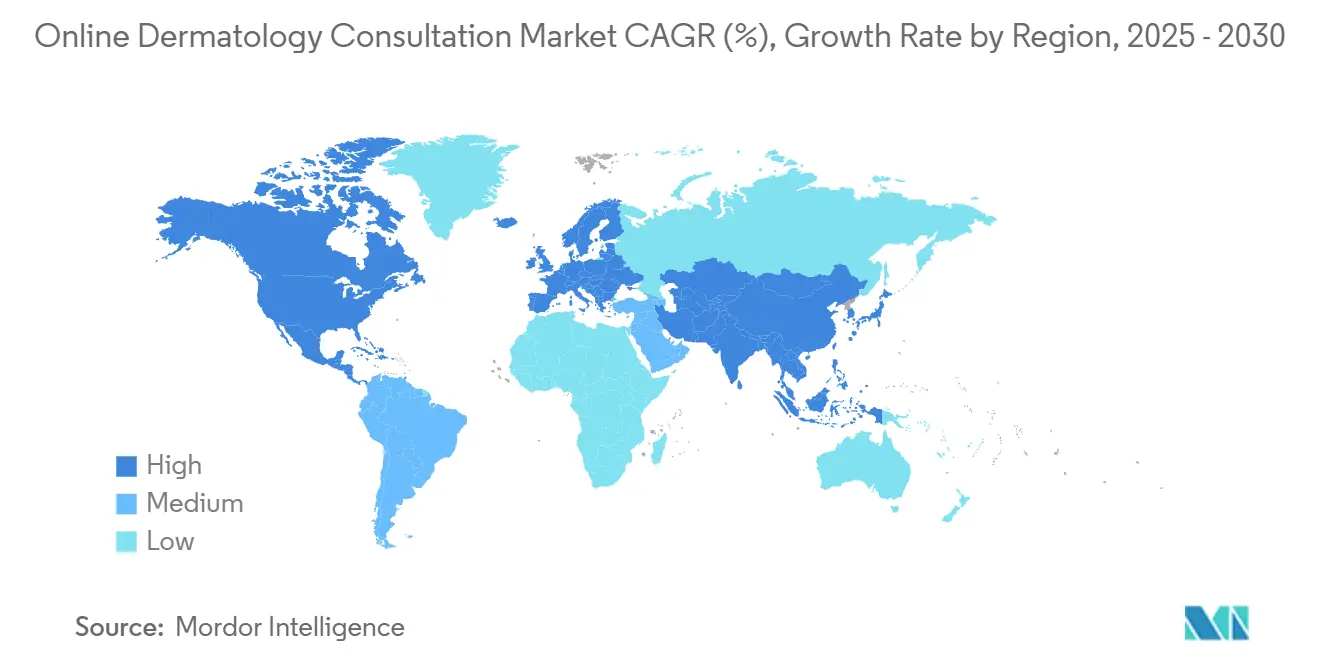
North America remained the epicenter of the online dermatology consultation market in 2024, holding 38.6% revenue share. Intense broadband penetration, favorable reimbursement, and mounting physician shortages underpin demand. However, compliance costs mount under regulations such as New York’s Health Information Privacy Act, which imposes penalties up to USD 15,000 or 20% of in-state revenue for violations. Market growth also rides on federal programs that reimburse telehealth under Medicare, though permanent parity beyond March 2025 is still uncertain.
Europe exhibits steady but regulated momentum. The Medical Device Regulation subjects software-as-a-medical-device to rigorous clinical-evidence standards, extending launch timelines. Germany’s Digital Health Applications framework reimburses certified apps, helping maintain a double-digit expansion pace. Rural broadband gaps persist, particularly in Eastern Europe, presenting an opportunity for satellite-backed solutions. Post-Brexit, the United Kingdom continues to adapt its telehealth reimbursement, adding another layer of regulatory fragmentation.
Asia Pacific offers the highest trajectory, advancing at a 20.5% CAGR through 2030. China drives cloud-hospital proliferation with AI triage integrated into provincial dermatology hubs, while Thailand’s Ministry of Public Health funds tele-consult booths in community hospitals, broadening rural reach. Smartphone adoption surpasses 80% in urban China, simplifying mobile-first rollout. Australia illustrates cost savings, reporting AUD 895 million (USD 595 million) in annual travel savings as telehealth already accounts for nearly 20% of GP visits. Yet, inconsistent malpractice laws slow private-sector scale-up across India and Indonesia. Overall, Asia Pacific’s youthful demographics and public-sector investment cement it as a primary engine for incremental revenue in the online dermatology consultation market.

Competitive Landscape
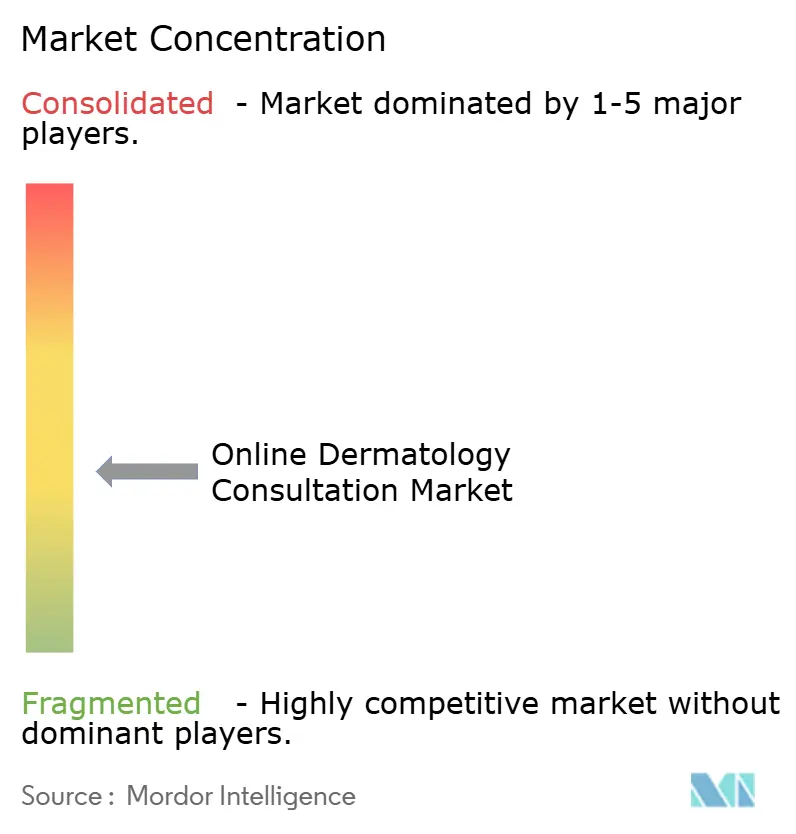
The online dermatology consultation market is moderately fragmented, with differentiation anchored in AI-diagnostic accuracy, mobile integration depth, and EHR interoperability. Teladoc Health has reinforced its integrated-care vertical by acquiring Catapult Health for USD 65 million, adding home-based wellness exams that feed dermatology referrals. American Well’s Converge platform processed 1.3 million visits in Q1 2025, while narrowing net loss by integrating behavioral-health triage and chronic-care modules.
Platform resilience increasingly hinges on demonstrable return on investment. Health-system buyers request validated metrics such as first-visit resolution rates, specialist backlog reduction, and reduced inpatient dermatology admissions. Players unable to meet these benchmarks face exit or acquisition. Hims & Hers shuttered Apostrophe four years after spending USD 190 million, reallocating resources to high-margin virtual-primary-care offerings.
Hardware-software hybrids gain traction as dermatoscope makers like DermTech report 38% revenue growth thanks to higher selling prices and better reimbursement. Yet, variable payer recognition of AI-augmented lab tests limits immediate upside. Rural access remains white space: 27.2% of U.S. counties lack basic broadband, creating an opportunity for satellite or 5G-enabled kiosks. Companies that master data-privacy compliance, clinician engagement, and hardware miniaturization are best positioned to gain share as the online dermatology consultation market scales.
Online Dermatology Consultation Industry Leaders
Teladoc Health
Amwell
MDLIVE
DermatologistOnCall
First Derm
- *Disclaimer: Major Players sorted in no particular order

Recent Industry Developments
- July 2025: OnMed deployed the first airport-based CareStation, merging onsite vitals with virtual dermatology consults to serve travelers in high-traffic hubs.
- March 2025: Hims & Hers closed its Apostrophe skincare service to streamline core telehealth operations.
- February 2025: Teladoc completed its USD 65 million Catapult Health acquisition, adding at-home wellness checks to its chronic-care pathway.


Global Online Dermatology Consultation Market Report Scope
| Store-and-Forward (Asynchronous) |
| Real-Time Video (Synchronous) |
| Hybrid (Combined) |
| Mobile Application |
| Web Browser Portal |
| Integrated EHR/Health-Plan Portals |
| Kiosk & Retail Clinic Terminals |
| North America | United States |
| Canada | |
| Mexico | |
| Europe | Germany |
| United Kingdom | |
| France | |
| Italy | |
| Spain | |
| Rest of Europe | |
| Asia Pacific | China |
| Japan | |
| India | |
| South Korea | |
| Australia | |
| Rest of Asia Pacific | |
| Middle East & Africa | GCC |
| South Africa | |
| Rest of Middle East & Africa | |
| South America | Brazil |
| Argentina | |
| Rest of South America |
| By Service Model | Store-and-Forward (Asynchronous) | |
| Real-Time Video (Synchronous) | ||
| Hybrid (Combined) | ||
| By Delivery Platform | Mobile Application | |
| Web Browser Portal | ||
| Integrated EHR/Health-Plan Portals | ||
| Kiosk & Retail Clinic Terminals | ||
| By Geography | North America | United States |
| Canada | ||
| Mexico | ||
| Europe | Germany | |
| United Kingdom | ||
| France | ||
| Italy | ||
| Spain | ||
| Rest of Europe | ||
| Asia Pacific | China | |
| Japan | ||
| India | ||
| South Korea | ||
| Australia | ||
| Rest of Asia Pacific | ||
| Middle East & Africa | GCC | |
| South Africa | ||
| Rest of Middle East & Africa | ||
| South America | Brazil | |
| Argentina | ||
| Rest of South America | ||


Key Questions Answered in the Report
How big will the online dermatology consultation market be by 2030?
Projections place the online dermatology consultation market size at about USD 9.10 billion by 2030, based on a 13.7% CAGR.
Which service model is expanding fastest?
Hybrid solutions that mix asynchronous image review with live video follow-ups are forecast to grow at a 23.4% CAGR through 2030.
Why do payers support virtual dermatology visits?
Teleconsultations deliver up to a 275% ROI by preventing emergency visits and trimming unnecessary specialty referrals, saving an estimated USD 42 billion each year.
What limits rural adoption of virtual dermatology care?
Limited broadband access and lower smartphone ownership in rural and elderly populations constrain usage, reducing potential reach.
How is AI reshaping online dermatology services?
Deep-learning image classifiers now detect malignant lesions with 93% sensitivity, enabling rapid triage that still relies on dermatologist oversight for final diagnosis.
Which region offers the strongest growth outlook?
Asia Pacific leads with a projected 20.5% CAGR, backed by government-funded telemedicine infrastructure in China and Thailand.
Page last updated on:





