
Market Overview
| Study Period | 2019 - 2031 |
|---|---|
| Forecast Data Period | 2026 - 2031 |
| Base Year Market Size (2025) | USD 0.41 Billion |
| Market Size (2026) | USD 0.44 Billion |
| Market Size (2031) | USD 0.67 Billion |
| Growth Rate (2026 - 2031) | 8.41 % |
| Market Concentration | High |
Major Players *Disclaimer: Major Players sorted in no particular order Image © Mordor Intelligence. Reuse requires attribution under CC BY 4.0. | |
MEA Automotive EPS Market Analysis by Mordor Intelligence
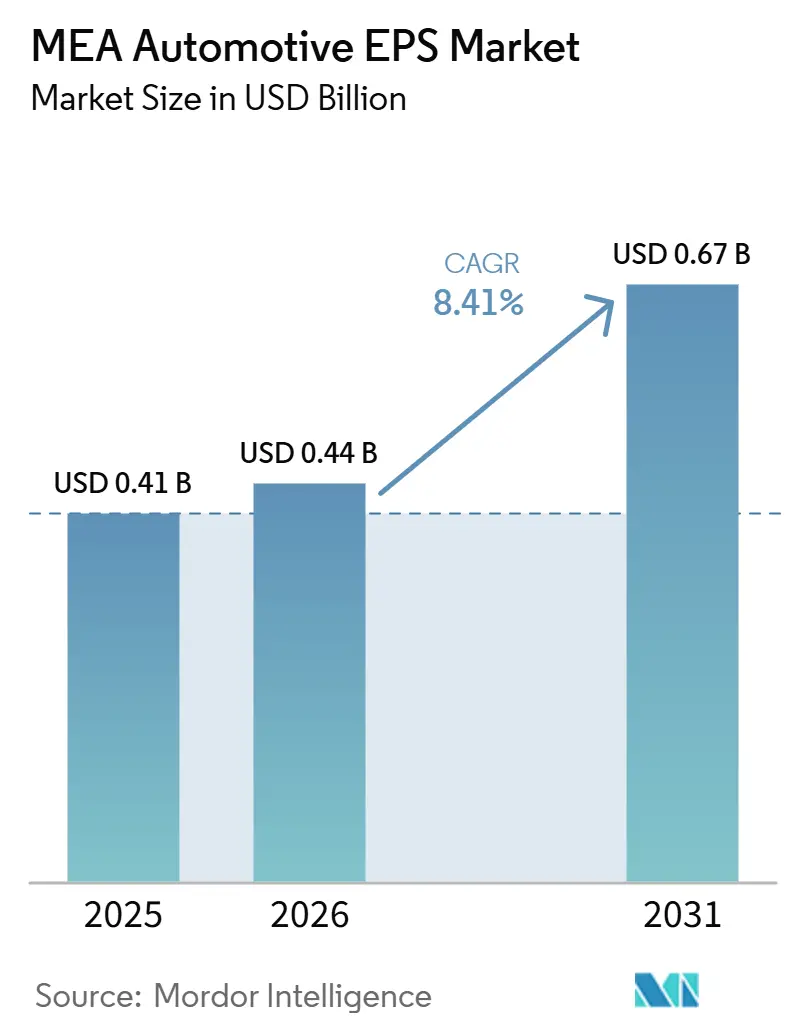
The MEA automotive EPS market size is projected to expand from USD 0.41 billion in 2025 and USD 0.44 billion in 2026, reaching USD 0.67 billion by 2031, registering a CAGR of 8.41% between 2026 and 2031. Growth is being shaped by the steady replacement of hydraulic steering with electronic systems across passenger vehicles and commercial fleets. The shift is also being supported by tighter safety requirements in the Gulf, where newer vehicle platforms increasingly require steering systems that integrate with lane-support and emergency-braking functions. Electric vehicle adoption in the UAE and Saudi Arabia is adding another layer of demand because those platforms need EPS by design. Local industrial programs in Saudi Arabia and the UAE are also starting to influence sourcing and assembly decisions for steering components. At the same time, weak calibration infrastructure, limited local manufacturing depth across much of the region, rising cybersecurity compliance requirements, and currency pressures in import-reliant markets continue to slow the pace of adoption.
Key Report Takeaways
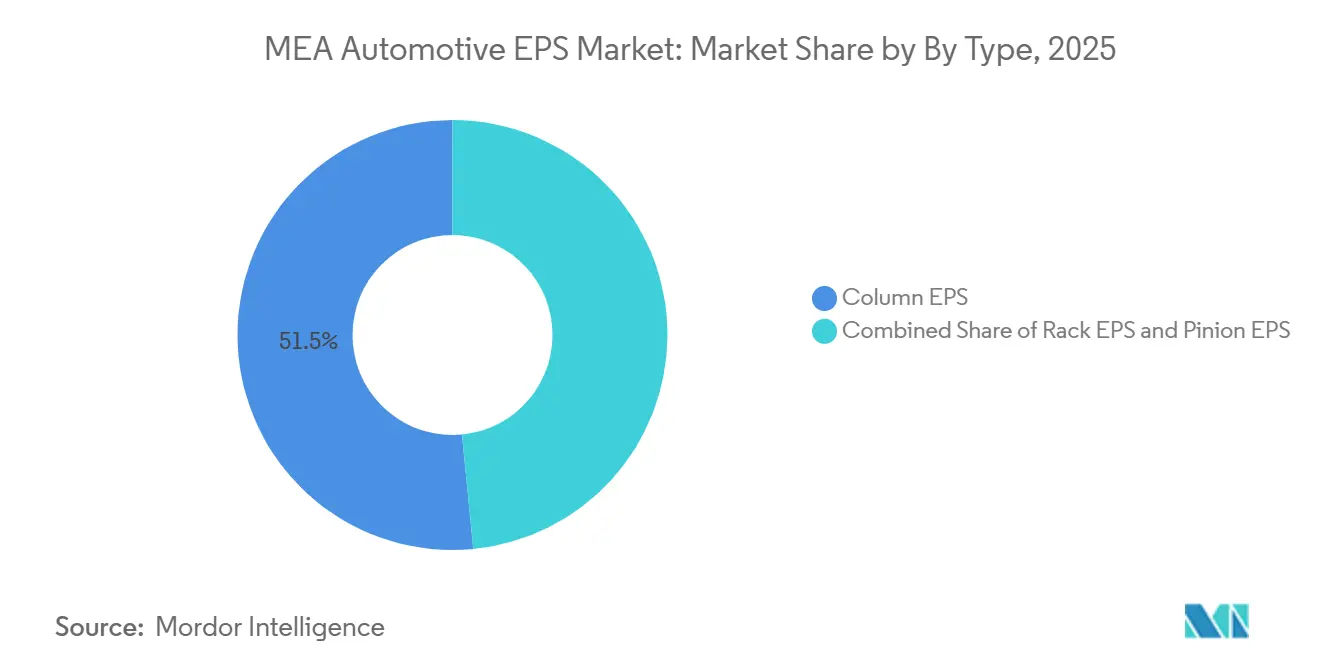
- By type, column EPS held 51.53% of the market in 2025, while pinion EPS is projected to record the fastest CAGR of 10.47% through 2031.
- By component type, steering wheel and column assemblies held 40.49% of the market in 2025, while sensors are projected to record the fastest CAGR of 9.98% through 2031.
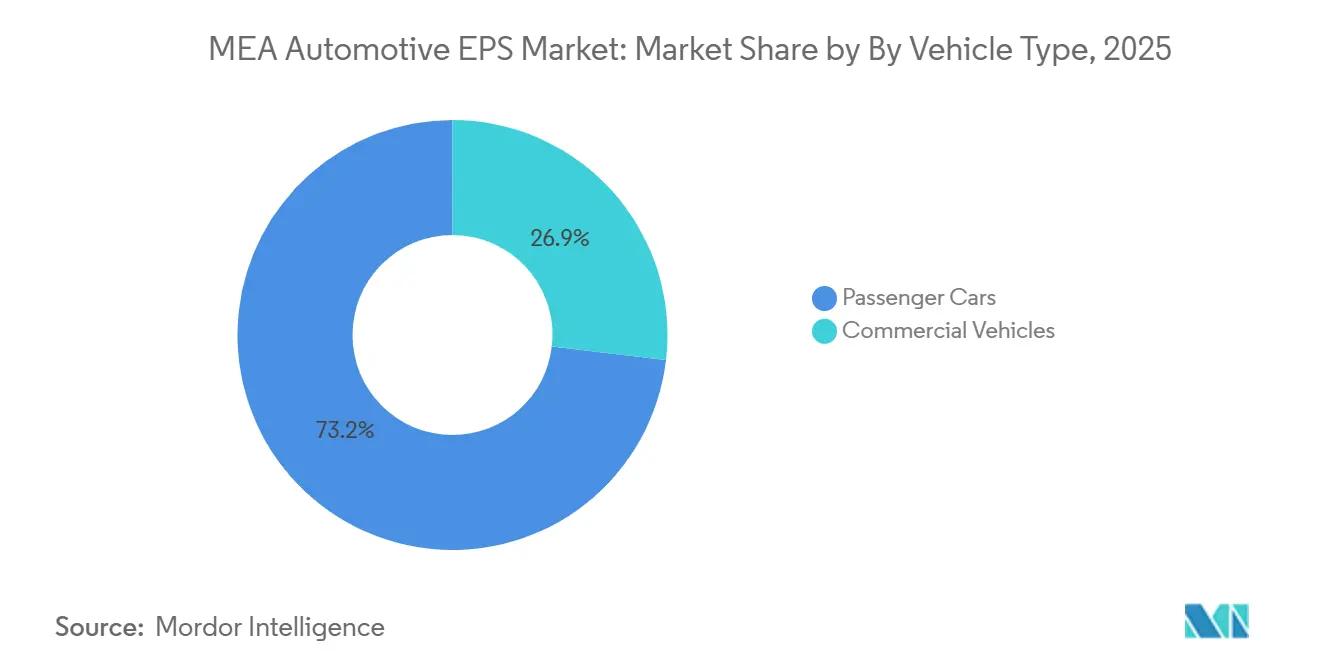
- By vehicle type, passenger Cars held 73.15% of the market in 2025, while commercial vehicles are projected to record the fastest CAGR of 9.46% through 2031.
- By propulsion type, ICE vehicles held 61.05% of the market in 2025, while battery electric vehicles are projected to record the fastest CAGR of 14.89% through 2031.
- By country, Saudi Arabia held 30.33% of the market in 2025, while the UAE is projected to record the fastest CAGR of 8.59% through 2031.
Note: Market size and forecast figures in this report are generated using Mordor Intelligence’s proprietary estimation framework, updated with the latest available data and insights as of January 2026.
Market Trends and Insights
Drivers Impact Analysis of MEA Automotive EPS Market*
| Driver | (~) % Impact on CAGR Forecast | Geographic Relevance | Impact Timeline |
|---|---|---|---|
| Shift From Hydraulic Steering Systems | +2.1% | Global, with core demand in GCC and South Africa | Medium term (2–4 years) |
| Rising ADAS Penetration | +2.0% | GCC core (UAE & Saudi Arabia leading); North Africa | Short term (≤ 2 years) |
| Growth of EV and Hybrid Vehicles | +1.8% | UAE, Saudi Arabia, South Africa, Egypt, Morocco | Short term (≤ 2 years) |
| Software-Defined Steering Architecture | +0.8% | UAE, Saudi Arabia, with early gains in Morocco | Long term (≥ 4 years) |
| Lower Fleet Total Cost of Ownership | +0.7% | GCC core, spill-over to Egypt and Nigeria | Medium term (2–4 years) |
| OEM Platform Localisation | +0.6% | Saudi Arabia, Morocco, South Africa | Long term (≥ 4 years) |
| Source: Mordor Intelligence | |||
Shift From Hydraulic Steering to Electric Power Steering for Fuel Efficiency and Lower CO2 Emissions
EPS is gaining ground because it removes the efficiency loss that comes with hydraulic pump operation. That matters in fleet-heavy markets where fuel use, maintenance, and lifecycle cost are reviewed closely before purchase decisions are made. In the Gulf, centralized buying by public fleets and large operators makes that cost logic even more influential. It is also speeding up the move away from electro-hydraulic systems, which many buyers now see as a short-lived compromise rather than a lasting solution. This is why the MEA automotive EPS market is moving through the transition faster than a simple replacement cycle would suggest.
Rising ADAS Penetration in Passenger Cars and Light Commercial Vehicles
ADAS requirements in the Gulf are making EPS a practical necessity for new vehicle platforms. Hydraulic steering does not align well with lane support and automated braking functions that depend on electronic steering response. This is pushing OEMs to lock in EPS specifications well before enforcement dates arrive. Fleet procurement also plays a role because buyers linked to large logistics and transport programs are increasingly asking for ADAS-ready vehicles at the order stage. As a result, the MEA automotive EPS market is being pulled forward by regulation and procurement at the same time.
Growth of EV and Hybrid Vehicle Platforms
Electric vehicle growth is giving the MEA automotive EPS market a demand base that is less exposed to shifts in steering preference. Battery electric vehicles need EPS because they do not have the mechanical setup required for hydraulic systems. Regional EV momentum is also increasingly tied to Chinese vehicle platforms, which already use EPS across their model lines. This means steering demand is being shaped not only by local sales growth but also by upstream platform choices made by global OEMs. The regional EV trend is now strong enough to support a steady floor for EPS demand across both the Middle East and key African markets.[1]
Software-Defined Steering Calibration for Harsh Roads, High Heat, and Mixed Vehicle Duty Cycles
Software-defined steering is creating a higher-value layer within the market. It allows steering calibration, response tuning, and system behavior to be adjusted through software rather than through hardware changes alone. This aligns well with newer vehicle programs designed around connected, upgradeable architectures. It also gives local development programs in places such as Abu Dhabi and Riyadh a way to differentiate vehicle behavior for local road and climate conditions. As these vehicle programs mature, the MEA automotive EPS market is likely to see a clearer split between standard EPS supply and more advanced software-linked steering systems.
Restraints Impact Analysis of MEA Automotive EPS Market*
| Restraint | (~) % Impact on CAGR Forecast | Geographic Relevance | Impact Timeline |
|---|---|---|---|
| Higher Upfront System Costs | -1.8% | Africa (South Africa, Nigeria, Egypt), Iran | Medium term (2–4 years) |
| Vulnerability of Electronic Systems to Cybersecurity | -1.2% | UAE, Saudi Arabia (high connectivity exposure) | Medium term (2–4 years) |
| Weak Aftermarket Calibration Infrastructure | -0.7% | Africa, Iran, Rest of MEA | Long term (≥ 4 years) |
| Limited Steering Feel and Driver Feedback | -0.5% | GCC, North Africa | Short term (≤ 2 years) |
| Source: Mordor Intelligence | |||
Higher Upfront System Cost Versus Conventional Steering Architectures
Higher system cost remains a real barrier outside the richer Gulf markets. In many African countries, the vehicle base is still shaped by used imports, which slows the share of new models carrying modern EPS setups. Currency pressure adds another problem because most EPS modules are still imported into the region. That raises landed costs and makes local buyers more sensitive to upfront pricing. This is likely to leave lower-cost Chinese configurations in a stronger position in the most price-sensitive parts of the MEA automotive EPS market.
Vulnerability of Electronics to Heat, Dust, Voltage Variability, and Road Shock
EPS is now part of the vehicle's electronic control environment, which means cybersecurity has become a steering issue as well as a software issue. Suppliers working on connected vehicle programs need to prove that their systems can manage safety and security risks across the product lifecycle. This adds documentation, validation work, and longer qualification timelines for new programs[2]. It also makes life harder for smaller suppliers that lack the engineering depth required to meet these standards. In the GCC, where connected vehicle adoption is moving quickly, this has become a real filter in OEM sourcing decisions.
*Our forecasts treat driver/restraint impacts as directional, not additive. The impact forecasts reflect baseline growth, mix effects, and variable interactions.
MEA Automotive EPS Market Segment Analysis
By Type:
Column EPS Holds the Base While Pinion EPS Builds the Next Growth LayerColumn EPS held 51.53% of the MEA automotive EPS market share in 2025. Its lead reflects the strong presence of imported mass-market passenger cars across Saudi Arabia, the UAE, and Egypt. This type fits well with compact packaging needs, cost control, and the electronic compatibility needed for modern driver support features. It also remains a familiar and practical configuration for high-volume vehicle programs entering the region. For that reason, column systems continue to anchor the present demand structure of the MEA automotive EPS market.
The fastest growth within this category is expected from pinion EPS, which is projected to expand at a 10.47% CAGR through 2031. This reflects the rising presence of newer vehicle platforms that need a balance between efficiency, responsiveness, and packaging flexibility. Chinese OEMs are important here because many of their newer electric and mid-segment models already use pinion-oriented steering layouts. The growing SUV mix in Gulf markets also supports this shift because buyers increasingly expect a more refined steering response without moving into premium rack-based systems. Over time, this should allow pinion systems to build share without immediately displacing column systems from their core role.

By Component Type:
Steering Assemblies Lead Current Demand While Sensors Capture the Strongest Upgrade CycleSteering wheel and column assemblies held 40.49% of the market in 2025. Their lead stems from their central role in every EPS architecture, regardless of propulsion type or vehicle class. The current installed base in the region still leans heavily toward column-assist systems, and that naturally supports demand for this component group. These assemblies also sit at the center of cost, packaging, and integration decisions for OEM steering programs. That keeps them closely tied to volume production across the MEA automotive EPS market.
Sensors are projected to record the fastest CAGR of 9.98% through 2031. The reason is straightforward because modern EPS systems need increasingly accurate torque, angle, and position sensing to work with ADAS and software-based control logic. As steering systems become more electronic, value creation shifts toward the sensing and control layer rather than only the mechanical layer. This is especially relevant for suppliers targeting vehicles with lane support, automated braking, and connected software functions. In practical terms, the fastest-growing opportunity inside the MEA automotive EPS market is moving toward sensor-rich steering platforms rather than basic structural assemblies.
By Vehicle Type:
Passenger Cars Dominate Volume While Commercial Vehicles Open the Faster Expansion PathPassenger cars held 73.15% of the market in 2025. This reflects the region's broad passenger vehicle base, especially in Gulf countries where private ownership remains high, and dealer networks are well established. The passenger car category also benefits from large volumes of imported models that already come with EPS as a standard or near-standard feature. Many of these vehicles sit in mainstream segments where cost and functionality need to stay balanced. That makes passenger cars the natural foundation of demand across the MEA automotive EPS market.
Commercial vehicles are projected to record the fastest CAGR of 9.46% through 2031. Fleet electrification is the main reason because electric buses, trucks, and logistics vehicles are better aligned with EPS than with hydraulic steering systems. Large transport, delivery, and infrastructure programs in the Gulf are also pushing buyers toward vehicles that can support modern safety and control features from the outset. Commercial operators tend to focus on operating efficiency, system integration, and future platform suitability, which gives EPS a stronger case in this category. This should allow commercial vehicles to play a larger role in the market, even though passenger cars remain the main revenue base.
By Propulsion Type:
ICE Retains the Installed Base While BEVs Redefine the Direction of DemandInternal combustion Engine (ICE) vehicles held 61.05% of the market in 2025. Their lead reflects the continued importance of conventional SUVs, pickups, and passenger vehicles across much of the Gulf and wider MEA region. Consumer familiarity, fuel economics in some markets, and the size of the existing ICE vehicle ecosystem all help sustain this base. ICE models, therefore, continue to support a large part of current steering demand, especially in mainstream vehicle classes. This keeps conventional propulsion at the center of present volumes in the MEA automotive EPS market.
Battery electric vehicles are projected to record the fastest CAGR of 14.89% through 2031. Unlike ICE platforms, BEVs lack a viable path to hydraulic steering, so EPS adoption rises directly with EV adoption. This makes BEVs the clearest source of structurally locked-in steering demand. The effect is stronger because many incoming EV platforms are already designed around advanced electronic steering architectures. As electric mobility expands, it will continue to lift the technical mix and value profile of the MEA automotive EPS market.
Geography Analysis
Saudi Arabia Automotive EPS Market
Saudi Arabia held 30.33% of the market in 2025, making it the largest country segment in the MEA automotive EPS market. Its position comes from strong vehicle demand, a large commercial fleet base, and its central role in Gulf procurement activity. The country is also becoming more important from a supply-side point of view as industrial policy starts to shape local sourcing and assembly decisions. Vehicle programs linked to national manufacturing goals are likely to favor suppliers that can align with localization priorities. This gives Saudi Arabia influence not only over demand volume but also over the future structure of regional EPS supply.
United Arab Emirates Automotive EPS Market
The UAE is projected to record the fastest CAGR of 8.59% through 2031. Its role goes beyond growth because it often acts as the first regional market for newer EV, ADAS, and software-linked vehicle platforms. That makes it an early testing ground for the steering architectures that later spread across other Gulf markets. The country's electric vehicle momentum also gives it outsized importance in shaping the regional mix of OEM platforms and steering specifications. This helps explain why the UAE has become a strategic demand center for the MEA automotive EPS market.
Africa Automotive EPS Market
Morocco, Egypt, and South Africa add a different layer to the regional picture because they matter more for manufacturing linkages, assembly potential, and long-run supply positioning. Morocco continues to strengthen its role as an automotive production base, and recent supplier investment supports that direction. Egypt offers scale potential through its vehicle base and its growing presence of Chinese brands, while South Africa remains the most established automotive assembly environment in Sub-Saharan Africa. The rest of MEA still depends more on imported vehicles and imported steering systems, which slows adoption of advanced EPS features. That said, the spread of newer imported vehicles will keep bringing EPS into markets that previously relied more heavily on older hydraulic platforms.
Competitive Landscape
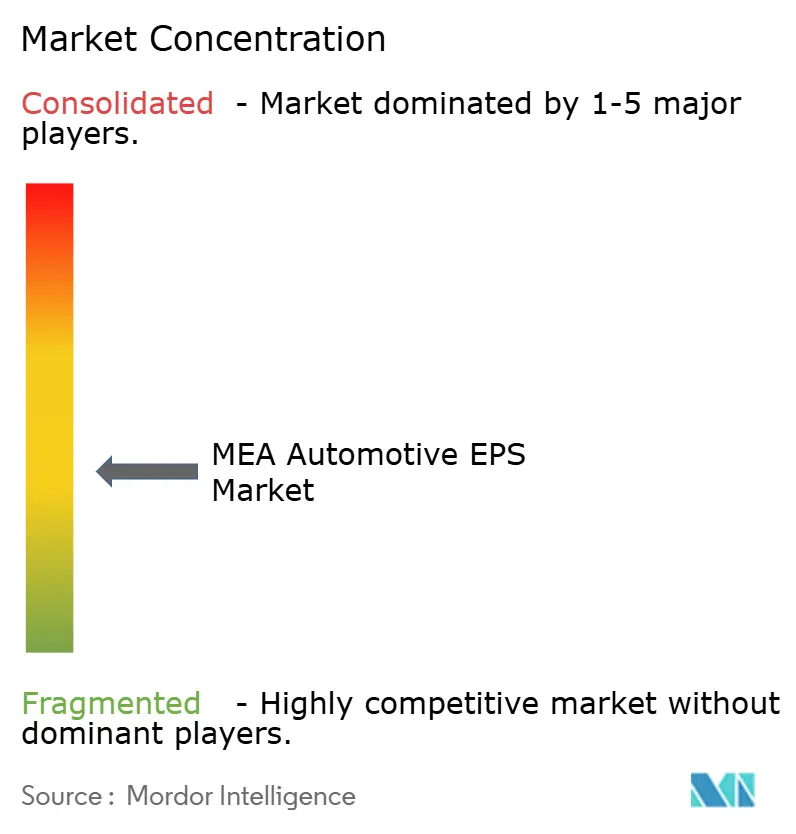
The MEA automotive EPS market shows a medium level of concentration, with global Tier-1 suppliers holding the leading positions across OEM-linked demand. The competitive field is shaped less by simple pricing pressure and more by platform access, software readiness, and regional sourcing alignment. Established suppliers still benefit from qualification depth, system integration capability, and long OEM relationships. That gives them an advantage in formal procurement channels, especially for connected and safety-linked vehicle programs. At the same time, the market is not closed because shifting OEM mixes are creating openings for suppliers with strong ties to Asian vehicle manufacturers.
Nexteer, ZF, and NSK provide clear examples of how competition is evolving. Nexteer strengthened its position through strong new bookings and continued progress in steer-by-wire and software-linked steering programs, which matter as more Chinese OEM platforms enter Gulf markets[3]. ZF continues to build a technology-led position through advanced steering systems and manufacturing expansion that support regional supply options. NSK has also sharpened its steering focus by consolidating its steering operations more tightly, which points to a more specialized approach in future program bids. These moves show that supplier strategy is now centered on platform fit, electronics capability, and manufacturing positioning rather than only scale.
A second competitive layer is forming around cost-optimized supply for African markets and calibration-related support services across the wider region. Price-sensitive markets create room for lower-cost component suppliers, especially where formal qualification barriers are weaker than in the Gulf. Even so, cybersecurity and software compliance standards still work in favor of larger and more established suppliers for advanced programs. Suppliers with strong Asian OEM ties may gain the most from the rise of Chinese brands in regional showrooms because vehicle architecture decisions often travel with the platform. This means the next stage of competition in the MEA automotive EPS market is likely to be shaped by who captures the incoming vehicle platforms rather than only who leads the current installed base.
MEA Automotive EPS Industry Leaders
-
ZF Friedrichshafen AG
-
Robert Bosch GmbH.
-
NSK Ltd.
-
Nexteer Automotive
-
JTEKT Corporation
- *Disclaimer: Major Players sorted in no particular order
MEA Automotive EPS Market Companies Covered in this Report
- Robert Bosch GmbH
- JTEKT Corporation
- ZF Friedrichshafen AG
- Nexteer Automotive
- NSK Ltd.
- Mando Corporation
- Hitachi Astemo, Ltd.
- Denso Corporation
- Hyundai Mobis Co., Ltd.
- Mitsubishi Electric Corporation
- Thyssenkrupp AG
- Valeo SE
- Continental AG
- Nidec Corporation
- Magna International Inc.
- Schaeffler AG
- Aptiv PLC
- BorgWarner Inc.
Recent Industry Developments in MEA Automotive EPS Market
- May 2026: Toyota South Africa Motors (TSAM) unveiled its 2026 lineup, led by the Toyota bZ4X and Lexus RZ. The RZ will launch in three variants: RZ 500e EX, RZ 500e SE, and RZ 550e F Sport. The RZ 550e F Sport includes a yoke-style steering wheel with steer-by-wire technology.
- July 2025: ZF LIFETEC opened its first African manufacturing facility in Tangier, Morocco. The 8,000 sq m plant at the Tanger Med Industrial Platform employs about 350 people and produces steering wheels for local and European automotive OEMs. Together with plants in O Porriño, Spain, and Vila Nova de Cerveira, Portugal, it helps reduce logistics lead times for Mediterranean-facing supply chains.
MEA Automotive EPS Market Report Scope
The MEA Automotive EPS market is segmented by type, component type, vehicle type, propulsion type, and country.
By Type, the market is segmented into Column EPS, Rack EPS, and Pinion EPS. By Component Type, the market is segmented into Steering Wheel, Sensors, Electronic Control Unit (ECU), Motor and Actuator, Rack and Pinion, and Other Components. By Vehicle Type, the market is segmented into Passenger Cars and Commercial Vehicles. By Propulsion Type, the market is segmented into Internal Combustion Engine (ICE), Hybrid Vehicles, and Battery Electric Vehicles. By Country, the market is segmented into United Arab Emirates, Saudi Arabia, Iran, Egypt, South Africa, Nigeria, Morocco, and Rest of the MEA.
Market forecasts are provided in terms of Value (USD) and Volume (Units).
Segmentation Overview
By Type
| Column EPS |
| Rack EPS |
| Pinion EPS |
By Component Type
| Steering Wheel and Column |
| Sensors |
| Electronic Control Unit |
| Motor and Actuation Module |
| Rack and Pinion Assembly |
| Other Component Type |
By Vehicle Type
| Passenger Cars |
| Commercial Vehicles |
By Propulsion Type
| Internal Combustion Engine (ICE) Vehicles |
| Hybrid Vehicles |
| Battery Electric Vehicles |
By Country
| United Arab Emirates |
| Saudi Arabia |
| Iran |
| Egypt |
| South Africa |
| Nigeria |
| Morocco |
| Rest of the Middle East and Africa |
| By Type | Column EPS |
| Rack EPS | |
| Pinion EPS | |
| By Component Type | Steering Wheel and Column |
| Sensors | |
| Electronic Control Unit | |
| Motor and Actuation Module | |
| Rack and Pinion Assembly | |
| Other Component Type | |
| By Vehicle Type | Passenger Cars |
| Commercial Vehicles | |
| By Propulsion Type | Internal Combustion Engine (ICE) Vehicles |
| Hybrid Vehicles | |
| Battery Electric Vehicles | |
| By Country | United Arab Emirates |
| Saudi Arabia | |
| Iran | |
| Egypt | |
| South Africa | |
| Nigeria | |
| Morocco | |
| Rest of the Middle East and Africa |
Key Questions Answered in the Report
What is the outlook for automotive EPS demand across MEA?
The MEA automotive EPS market is projected to grow from USD 0.44 billion in 2026 to USD 0.67 billion by 2031 at an 8.4% CAGR, supported by safety regulation, EV adoption, and platform localization.
Why is electric power steering replacing hydraulic steering in MEA vehicles?
EPS fits better with ADAS functions, electric vehicle platforms, and fleet cost management. That makes it a more practical choice for newer vehicle programs across the region.
Which vehicle category leads current demand?
Passenger cars lead current demand, with a 73.15% share in 2025. Their large installed base and strong import volumes keep them at the center of present revenue.
Which propulsion category is growing the fastest?
Battery electric vehicles are growing the fastest, with a 14.89% CAGR through 2031. Their importance is high because every BEV platform requires EPS by design.
What is the main risk for suppliers entering this space?
Cybersecurity qualification, weak calibration infrastructure in many markets, and cost sensitivity outside the Gulf are the main barriers. Suppliers need strong compliance capability and the right cost structure to compete well.