
Aerospace Propulsion Systems Market Size and Share
Market Overview
| Study Period | 2019 - 2030 |
|---|---|
| Market Size (2025) | USD 119.53 Billion |
| Market Size (2030) | USD 144.86 Billion |
| Growth Rate (2025 - 2030) | 3.92 % |
| Fastest Growing Market | Asia Pacific |
| Largest Market | North America |
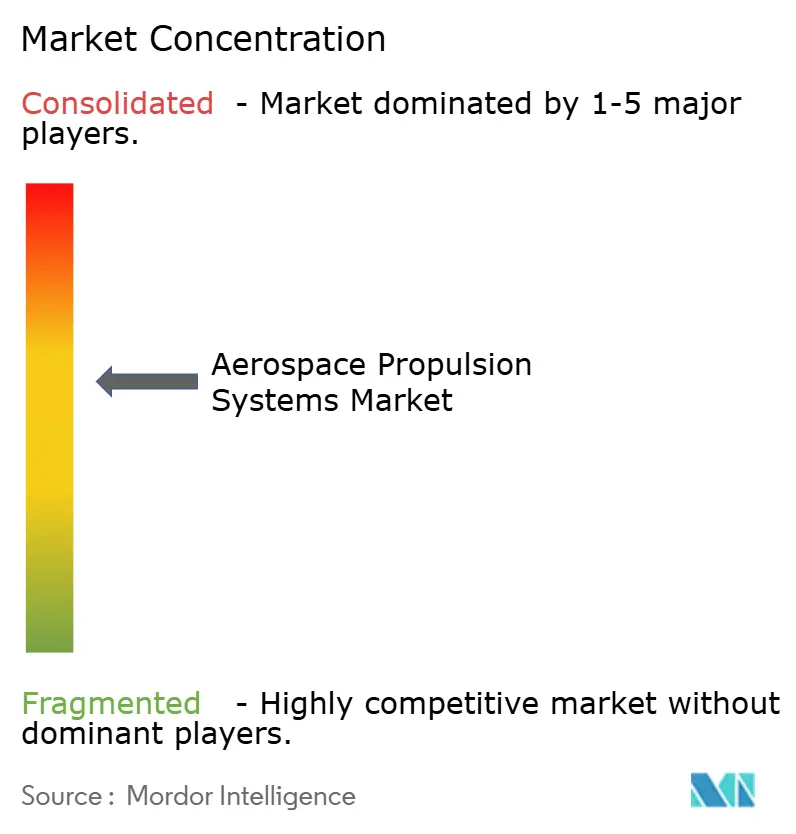
| Market Concentration | Medium |
Major Players *Disclaimer: Major Players sorted in no particular order Image © Mordor Intelligence. Reuse requires attribution under CC BY 4.0. | |

Aerospace Propulsion Systems Market Analysis by Mordor Intelligence
The aerospace propulsion systems market size reached USD 119.53 billion in 2025 and is projected to climb to USD 144.86 billion by 2030, translating into a 3.92% CAGR over the forecast period. Expansion is fueled by the sustained recovery in commercial air travel, steady defense spending, and growing demand for cost-effective launch services. Airlines are refreshing fleets with engines that yield double-digit fuel-burn cuts, space companies are standardizing reusable propulsion lines, and militaries are prioritizing efficiency upgrades for legacy platforms. Prolonged certification timelines, supply-chain disruption in high-temperature alloys, and infrastructure gaps for alternative fuels constrain momentum but have not derailed long-term growth. Consolidation among prime engine builders co-exists with the rapid entry of niche electric and hybrid start-ups, heightening competitive dynamics across the aerospace propulsion systems market.
Key Report Takeaways
- By propulsion type, gas turbine engines held 49.55% of the aerospace propulsion systems market share in 2024; ramjet and scramjet engines are forecasted to grow at a 6.54% CAGR between 2025 and 2030.
- By platform, fixed-wing aircraft captured 71.28% of the aerospace propulsion systems market size in 2024, while space launch vehicles and satellites are projected to expand at a 5.78% CAGR through 2030.
- By application, passenger transport generated 40.31% revenue in 2024; space exploration is on track for a 6.79% CAGR in the same period.
- By component, compressors commanded 52.89% of the aerospace propulsion systems market size in 2024; nozzle and exhaust assemblies will advance at a 4.38% CAGR to 2030.
- By geography, North America retained a 43.78% share in 2024, whereas the Asia-Pacific is expected to register a 4.58% CAGR through 2030.
Note: Market size and forecast figures in this report are generated using Mordor Intelligence’s proprietary estimation framework, updated with the latest available data and insights as of January 2026.
Market Trends and Insights
Drivers Impact Analysis of Aerospace Propulsion Systems Market*
| Driver | (~) % Impact on CAGR Forecast | Geographic Relevance | Impact Timeline |
|---|---|---|---|
| Rising global air passenger traffic | +2.80% | Global; Asia-Pacific strongest | Medium term (2–4 years) |
| Fleet modernization towards fuel-efficient engines | +2.10% | North America and Europe; spreading to Asia-Pacific | Long term (≥ 4 years) |
| Increasing government and private investments in space exploration | +1.90% | North America, Europe, Asia-Pacific | Long term (≥ 4 years) |
| Hypersonic propulsion R&D for defense applications | +1.60% | North America, Europe, China, Russia | Medium term (2–4 years) |
| Emergence of eVTOL and UAM demand | +1.30% | North America and EU early adoption; Asia-Pacific scaling | Medium term (2–4 years) |
| Hydrogen-propulsion initiatives tied to national decarbonization goals | +1.10% | Europe leads; North America and Asia-Pacific follow | Long term (≥ 4 years) |
| Source: Mordor Intelligence | |||
Rising Global Air Passenger Traffic
International Air Transport Association (IATA) statistics confirm that passenger journeys climbed to 4.7 billion in 2024, surpassing the 4.5 billion mark set in 2019.[1]International Air Transport Association, “2024 World Air Transport Statistics,” iata.org Fuel accounted for 25–30% of airline operating expenses during the year, pushing carriers to demand engines that achieve at least 15% lower burn. Asia-Pacific contributed the steepest rise, registering 15% annual traffic growth, led by expanding Chinese domestic networks and India’s middle-income demographic. This surge supports a steady pipeline of turbofan orders to meet ICAO CORSIA emissions limits and noise standards. Sustained fleet expansion, therefore, feeds directly into revenue growth for the aerospace propulsion systems market.
Fleet Modernization Toward Fuel-Efficient Engines
Aircraft orderbooks worth over USD 150 billion through 2024 concentrate on powerplants that slash fuel use, including GE Aerospace’s RISE open-fan concept targeting 20% gains and Pratt & Whitney’s geared turbofan that already delivers 16% savings.[2]GE Aerospace, “RISE Open-Fan Program,” geaerospace.com Europe’s ReFuelEU regulation mandates a 70% sustainable aviation fuel (SAF) blend by 2050, prompting airlines to retrofit or select engines with SAF-ready combustors from the outset. Nearly half of today’s active fleet will reach retirement age by 2030, forcing operators to replace aging engines to maintain reliability and compliance. Updated propulsion units also cut maintenance costs through advanced materials and digital health monitoring. These factors anchor a multiyear replacement cycle that enlarges the aerospace propulsion systems market.
Increasing Government and Private Investments in Space Exploration
NASA received a USD 25 billion allocation in 2024, while private capital injections surpassed USD 17 billion, directed toward reusable launch systems and deep-space propulsion.[3]National Aeronautics and Space Administration, “Artemis Program,” nasa.gov Each Artemis lunar sortie requires multiple high-thrust engines, and proliferating satellite constellations add hundreds of orders yearly. Reusable methane engines lower the cost per flight, encouraging a higher cadence of launches for government and commercial operators. Start-ups entering the small-sat launch arena adopt modular engine designs that shorten production lead times. Elevated investment levels thus translate into consistent demand growth within the aerospace propulsion systems market.
Hypersonic Propulsion R&D for Defense Applications
Global spending on hypersonic programs topped USD 15 billion in 2024, reflecting strategic priorities across major powers.[4]Defense Advanced Research Projects Agency, “HAWC Flight Tests,” darpa.mil DARPA’s HAWC flight tests verified Mach 5+ capability using scramjet propulsion, demonstrating practical progress beyond laboratory studies. Parallel efforts under the US NGAD initiative and comparable Chinese and Russian projects focus on high-temperature materials, advanced cooling, and integrated flight-control algorithms. Specialized test facilities and instrumented ranges are expanding to validate sustained hypersonic performance. This research pipeline widens future revenue streams for suppliers of high-temperature alloys, guidance systems, and propulsion components.
Restraints Impact Analysis of Aerospace Propulsion Systems Market*
| Restraint | (~) % Impact on CAGR Forecast | Geographic Relevance | Impact Timeline |
|---|---|---|---|
| High R&D and certification costs | –1.8% | Global, acute for smaller firms | Long term (≥ 4 years) |
| Volatile supply of critical materials (Ni-based alloys, rare earths) | –1.4% | Global supply chains concentrated in China and Russia | Short term (≤ 2 years) |
| Stringent NOx/contrail emission regulations | –1.2% | North America and Europe primary | Medium term (2–4 years) |
| Infrastructure gaps for cryogenic and hydrogen fuels | –1.0% | Global airports and spaceports | Long term (≥ 4 years) |
| Source: Mordor Intelligence | |||
High R&D and Certification Costs
Developing a clean-sheet aircraft engine can demand USD 5 billion in capital and 10–15 years to clear regulatory hurdles, including 150-hour endurance trials prescribed by FAA and EASA rules. Such a scale of funding limits participation to a handful of well-capitalized OEMs, concentrating technological leadership. Smaller firms must secure risk-sharing partnerships or government grants to remain viable in advanced propulsion research. Lengthy test-cell occupancy and iterative design cycles add further cost, delaying cash-flow breakeven. These economic barriers restrict market entry and moderate overall innovation velocity.
Volatile Supply of Critical Materials
Rhenium prices fluctuated 40% in 2024 as global output held near 50 tons, while China supplied 85% of the rare-earth elements essential for permanent-magnet electric machines. Resulting alloy and magnet cost spikes lifted turbine raw-material expenses by up to 25% for OEMs. Geopolitical uncertainty around key mining regions drove engine makers to build strategic inventories and seek secondary suppliers. Recycling initiatives and material-substitution research have accelerated but remain years from large-scale impact. Supply instability, therefore, poses a persistent drag on near-term margins and scheduling across the aerospace propulsion systems market.
*Our forecasts treat driver/restraint impacts as directional, not additive. The impact forecasts reflect baseline growth, mix effects, and variable interactions.
Aerospace Propulsion Systems Market Segment Analysis
By Propulsion Type:
Gas Turbines Dominate While Scramjets AccelerateGas turbines held 49.55% of the 2024 volume thanks to their entrenched role in civil and military fleets. Turbofans lead with bypass ratios above 12:1, while turboprops power cost-sensitive regional networks. Ongoing upgrades in ceramic matrix composites (CMCs) and single-crystal blades continue to enhance overall cycle pressure ratios, reinforcing the aerospace propulsion systems market.
Ramjet and scramjet units are projected to expand at 6.54% CAGR—fastest within this category—driven by Mach 5+ weapons research and next-generation reconnaissance craft. Rocket engines sustain volume for launch markets, and electric powertrains support UAM prototypes.




By Platform Type:
Fixed-Wing Aircraft Lead as Space Platforms SurgeFixed-wing aircraft accounted for 71.28% of 2024 demand, with the A320neo, B737 MAX, and advanced widebody jets serving global route expansion. Retrofits to meet ICAO Stage 5 noise limits and SAF compatibility bolster replacement orders.
Space launch vehicles and satellites show a 5.78% CAGR as reusable methane engines reach high-rate production for Starship, New Glenn, and small-sat launchers. Rotary-wing and UAM segments add incremental growth through distributed electric propulsion.
By Application:
Passenger Transport Stable While Space Exploration AcceleratesPassenger transport produced 40.31% of 2024 revenue, and airlines continue to prioritize low-burn engines for cost control. Fleet forecasts call for 20,000 single-aisle deliveries by 2030, supporting steady expansion in the aerospace propulsion systems market.
Space exploration will grow at 6.79% CAGR through 2030, reflecting sustained government lunar and Mars missions plus commercial human-spaceflight ambitions. Cargo logistics and defense combat applications remain stable contributors, each demanding specialized propulsion designs.
By Component:
Compressors Lead While Nozzles Show Strong GrowthCompressors generated a 52.89% share in 2024, driven by high-pressure-ratio goals above 60:1 that lower specific fuel consumption. Advanced additive-manufactured blisks improve reliability and decrease weight.
Nozzle and exhaust systems will grow at a 4.38% CAGR due to vector-thrust requirements on fifth-generation fighters and infrared signature suppression mandates.

By Fuel Type:
Conventional Fuels Dominate While Electric Systems EmergeConventional and SAF-ready engines comprise most deliveries, yet SAF accounted for 0.2% of total jet fuel in 2024. Engines certified for 100% SAF help airlines achieve mandated blends under ReFuelEU.
Electric and hybrid systems advance at 5.42% CAGR, enabled by 300 Wh/kg batteries and gas-electric hybrids that cut take-off emissions. Hydrogen fuel cells progress under the EU Clean Aviation Joint Undertaking, aiming for regional routes by 2035.
Geography Analysis
North America Aerospace Propulsion Systems Market
North America retained a 43.78% share in 2024, underpinned by US defense expenditures above USD 800 billion and commercial traffic recovery to 105% of 2019 levels. Canada contributes turboprop expertise, and Mexico hosts cost-efficient structures and wire-harness manufacturing.
APAC Aerospace Propulsion Systems Market
Asia-Pacific is poised for a 4.58% CAGR: China advances the CJ-1000A turbofan for the COMAC C919, India recorded 15% air-traffic growth in 2024, and regional launch programs spent USD 25 billion that year. Japan and South Korea support high-performance materials and testing facilities, while Australia and Singapore anchor maintenance hubs.
Europe Aerospace Propulsion Systems Market
Europe maintains a robust position through Rolls-Royce, Safran, and MTU Aero Engines. The EU’s EUR 4.1 billion (USD 4.79 billion) Clean Aviation budget accelerates hydrogen and electric research, supporting the aerospace propulsion systems market globally.


Competitive Landscape
The top five players—General Electric Company, Rolls-Royce Holdings plc, Pratt & Whitney (RTX Corporation), Safran SA, and Honeywell International Inc.—controlled a significant share of 2024 revenue, giving the aerospace propulsion systems market moderate concentration. Joint ventures like CFM International cement dominance in single-aisle categories, while digital twins and predictive maintenance strengthen aftermarket margins. SpaceX’s fully integrated Raptor production cuts cost per engine by more than half relative to external suppliers, reshaping value chains.
Acquisitions remain frequent: Safran bought Collins Aerospace’s actuation unit for USD 1.8 billion in 2024, MTU launched an additive-manufacturing center in Munich, and Honeywell teamed with Vertical Aerospace on hybrid-electric drive integration. Electric start-ups—including magniX, Joby Aviation, and Lilium—attract venture funding and prototype orders, injecting fresh competition.
Aerospace Propulsion Systems Industry Leaders
General Electric Company
Pratt & Whitney (RTX Corporation)
Safran SA
Honeywell International Inc.
Rolls-Royce Holdings plc
- *Disclaimer: Major Players sorted in no particular order
Aerospace Propulsion Systems Market Companies Covered in this Report
- General Electric Company
- Rolls-Royce Holdings plc
- Pratt & Whitney (RTX Corporation)
- Safran SA
- Honeywell International Inc.
- MTU Aero Engines AG
- Space Exploration Technologies Corporation
- Blue Origin Enterprises, L.P.
- ArianeGroup SAS
- L3Harris Technologies, Inc.
- IHI Corporation
- Kawasaki Heavy Industries, Ltd.
- Aero Engine Corporation of China (AECC)
- GKN Aerospace Services Limited (Melrose Industries plc)
- Boom Technology, Inc.
- Amprius Technologies, Inc.
- HyImpulse Technologies GmbH
- Astra Space, Inc.
- Exotrail

Recent Industry Developments in Aerospace Propulsion Systems Market
- June 2025: Airbus and MTU Aero Engines signed a Memorandum of Understanding (MoU) to advance hydrogen fuel cell propulsion technology for aviation decarbonization jointly.
- February 2025: Hindustan Aeronautics Limited (HAL) signed a long-term contract with Safran Aircraft Engines (SAE) during Aero India 2025 to supply turbine forged parts for LEAP engines.
- November 2024: SpaceX executed a sixth Starship flight test, confirming in-flight Raptor relight.


Global Aerospace Propulsion Systems Market Report Scope
| Gas Turbine Engines | Turbofan Engines |
| Turboprop Engines | |
| Turbojet Engines | |
| Turboshaft Engines | |
| Ramjet and Scramjet Engines | |
| Rocket Engines | |
| Nuclear-Thermal Propulsion | |
| Other Propulsion Types |
| Fixed-wing Aircraft |
| Rotary-wing Aircraft |
| Space Launch Vehicles and Satellites |
| Missiles and Guided Weapons |
| Urban Air Mobility (UAM) |
| Passenger Transport |
| Cargo and Logistics |
| Defense Combat |
| Space Exploration |
| Surveillance and Intelligence |
| Compressor |
| Combustor |
| Turbine |
| Fan and Blades |
| Nozzle and Exhaust |
| Other Components |
| Conventional/Sustainable Aviation Fuel (SAF) |
| Rocket Fuel |
| Electric/Hybrid |
| Nuclear |
| North America | United States | |
| Canada | ||
| Mexico | ||
| Europe | United Kingdom | |
| France | ||
| Germany | ||
| Italy | ||
| Russia | ||
| Rest of Europe | ||
| Asia-Pacific | China | |
| India | ||
| Japan | ||
| South Korea | ||
| Australia | ||
| Singapore | ||
| Rest of Asia-Pacific | ||
| South America | Brazil | |
| Rest of South America | ||
| Middle East and Africa | Middle East | Saudi Arabia |
| United Arab Emirates | ||
| Israel | ||
| Rest of Middle East | ||
| Africa | South Africa | |
| Rest of Africa | ||
| By Propulsion Type | Gas Turbine Engines | Turbofan Engines | |
| Turboprop Engines | |||
| Turbojet Engines | |||
| Turboshaft Engines | |||
| Ramjet and Scramjet Engines | |||
| Rocket Engines | |||
| Nuclear-Thermal Propulsion | |||
| Other Propulsion Types | |||
| By Platform Type | Fixed-wing Aircraft | ||
| Rotary-wing Aircraft | |||
| Space Launch Vehicles and Satellites | |||
| Missiles and Guided Weapons | |||
| Urban Air Mobility (UAM) | |||
| By Application | Passenger Transport | ||
| Cargo and Logistics | |||
| Defense Combat | |||
| Space Exploration | |||
| Surveillance and Intelligence | |||
| By Component | Compressor | ||
| Combustor | |||
| Turbine | |||
| Fan and Blades | |||
| Nozzle and Exhaust | |||
| Other Components | |||
| By Fuel Type | Conventional/Sustainable Aviation Fuel (SAF) | ||
| Rocket Fuel | |||
| Electric/Hybrid | |||
| Nuclear | |||
| By Geography | North America | United States | |
| Canada | |||
| Mexico | |||
| Europe | United Kingdom | ||
| France | |||
| Germany | |||
| Italy | |||
| Russia | |||
| Rest of Europe | |||
| Asia-Pacific | China | ||
| India | |||
| Japan | |||
| South Korea | |||
| Australia | |||
| Singapore | |||
| Rest of Asia-Pacific | |||
| South America | Brazil | ||
| Rest of South America | |||
| Middle East and Africa | Middle East | Saudi Arabia | |
| United Arab Emirates | |||
| Israel | |||
| Rest of Middle East | |||
| Africa | South Africa | ||
| Rest of Africa | |||


Key Questions Answered in the Report
What is the aerospace propulsion systems market size in 2025?
It stands at USD 119.53 billion with a 3.92% CAGR outlook to 2030.
Which propulsion type grows fastest through 2030?
Ramjet & scramjet engines lead with a 6.54% CAGR.
Which region records the highest growth rate?
Asia-Pacific is projected to expand at 4.58% CAGR, driven by indigenous engine programs.
Why are airlines upgrading engines?
Fuel cost pressures and stricter emissions rules compel adoption of turbofans offering 15–20% efficiency gains.
How concentrated is supplier competition?
Five large OEMs hold around 60% share, giving the market a moderate concentration score of 6.
What emerging fuels influence future engines?
SAF, hydrogen, and battery-electric hybrids are gaining traction as decarbonisation pathways.
Page last updated on:


 Your data is secure and never sold or shared.


