
Activated Charcoal Supplements Market Size and Share
Market Overview
| Study Period | 2021 - 2031 |
|---|---|
| Market Size (2026) | USD 5.99 Billion |
| Market Size (2031) | USD 10.02 Billion |
| Growth Rate (2026 - 2031) | 10.84 % |
| Fastest Growing Market | Asia Pacific |
| Largest Market | Europe |
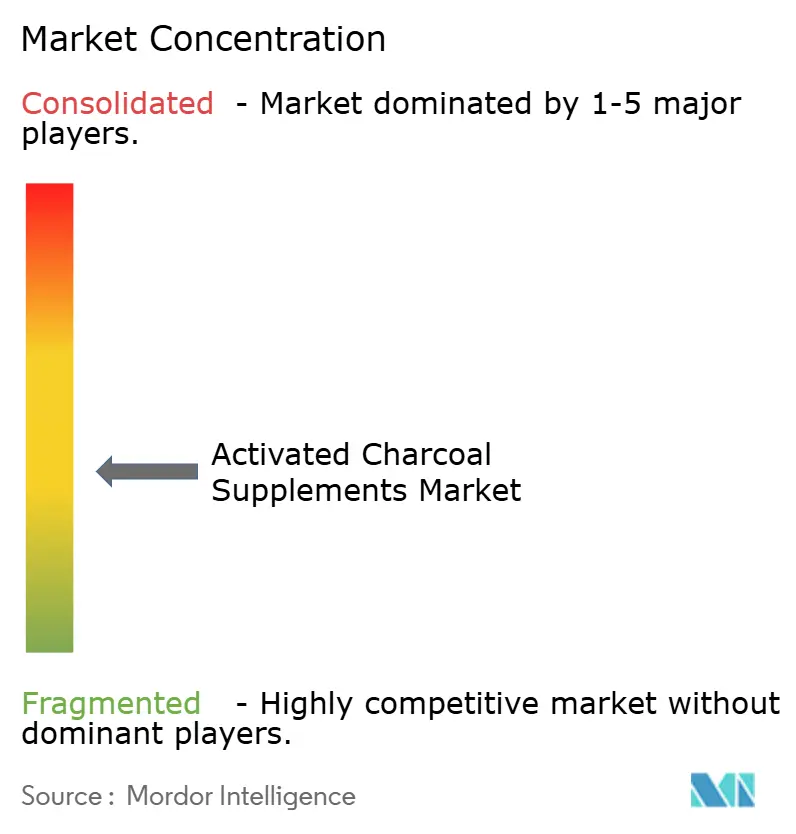
| Market Concentration | Medium |
Major Players
*Disclaimer: Major Players sorted in no particular order Image © Mordor Intelligence. Reuse requires attribution under CC BY 4.0. |
|
Activated Charcoal Supplements Market Analysis by Mordor Intelligence
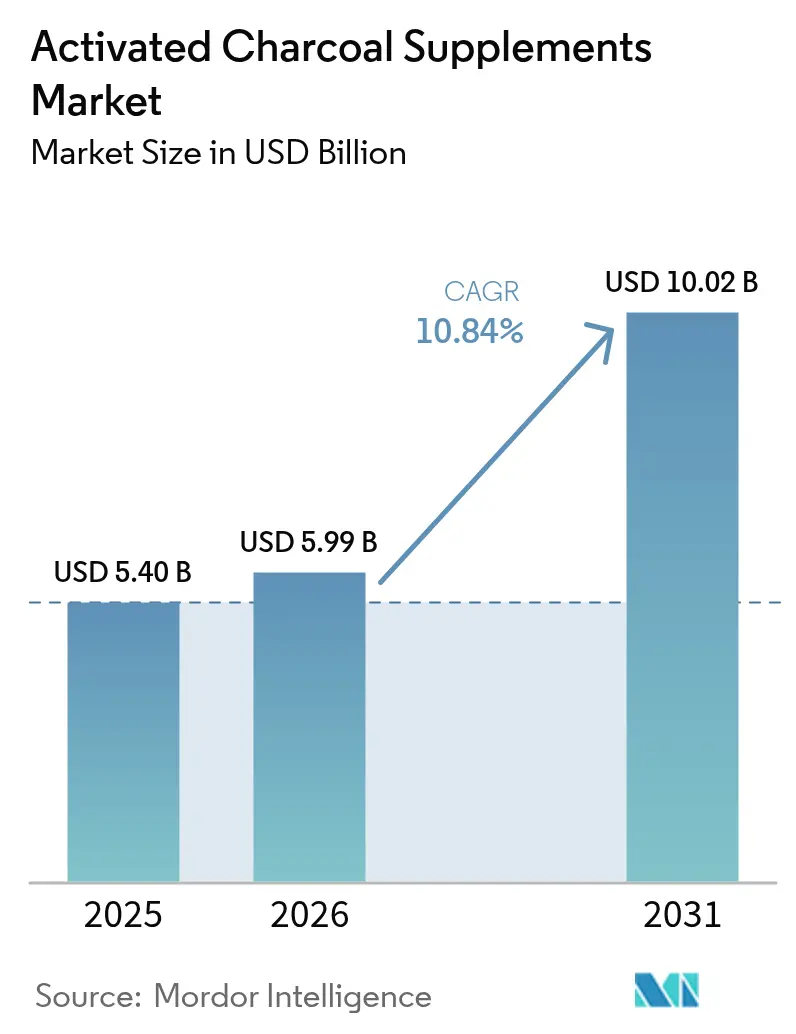
The activated charcoal supplements market size was valued at USD 5.40 billion in 2025 and estimated to grow from USD 5.99 billion in 2026 to reach USD 10.02 billion by 2031, at a CAGR of 10.84% during the forecast period (2026-2031). The market growth is driven by increasing consumer demand for natural detoxification products and expanding applications beyond emergency poisoning treatment. Product innovations focusing on improved bioavailability and taste have resulted in enhanced absorption rates and more palatable supplements. These advancements address historical barriers to consumer adoption, particularly concerns about taste and effectiveness. Digital marketing strategies, especially through social media platforms and wellness influencers, are effectively targeting younger consumers and increasing market penetration among the Gen Z demographic.
Key Report Takeaways
- By form, capsules led with 60.62% of the activated charcoal supplements market share in 2025; powders are forecast to expand at a 15.96% CAGR during 2026-2031.
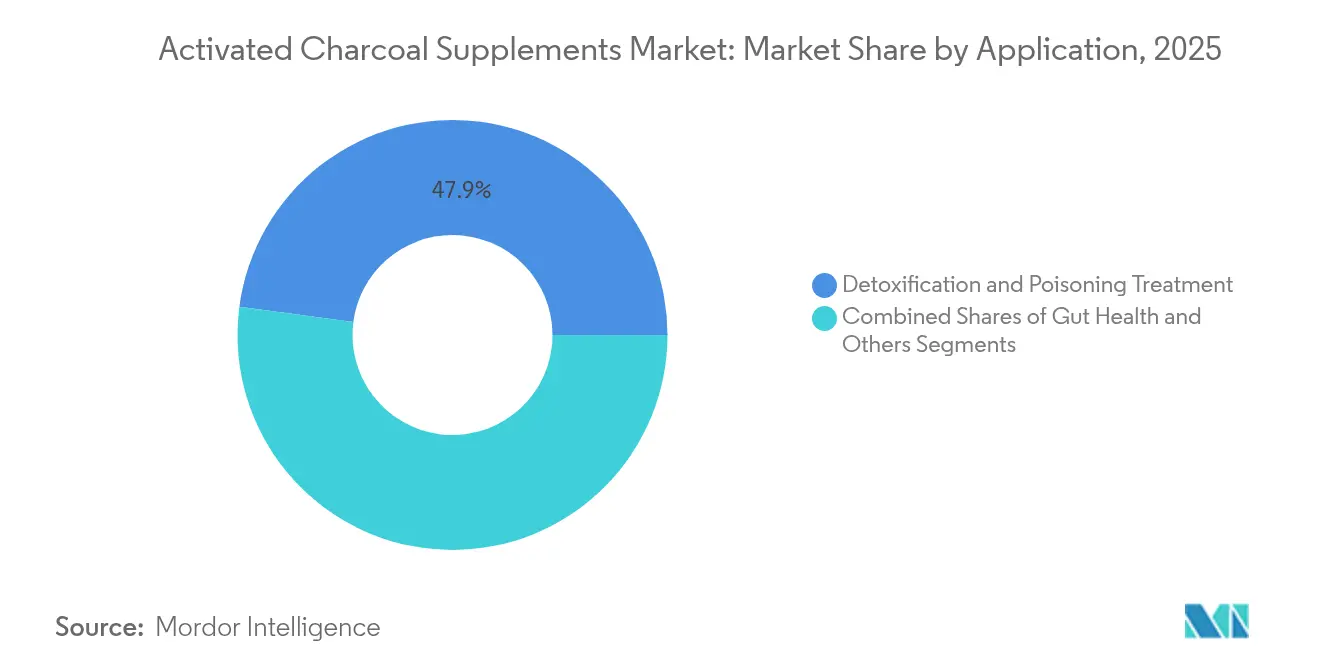
- By application, detoxification and poisoning treatment accounted for 47.91% of the activated charcoal supplements market size in 2025, while gut health is projected to grow at a 18.95% CAGR through 2031.
- By distribution channel, specialty and health stores held 38.67% of the activated charcoal supplements market share in 2025; online retail is set to progress at a 19.41% CAGR over the forecast period.
- By geography, Europe commanded 43.85% of the activated charcoal supplements market in 2025; Asia-Pacific is expected to register an 17.75% CAGR between 2026-2031.
Note: Market size and forecast figures in this report are generated using Mordor Intelligence’s proprietary estimation framework, updated with the latest available data and insights as of 2026.
Global Activated Charcoal Supplements Market Trends and Insights
Drivers Impact Analysis*
| Drivers | (~) % Impact on CAGR Forecasts | Geographic Relevance | Impact Timeline |
|---|---|---|---|
| Consumer preference for natural detoxification solutions stimulates market growth of activated charcoal supplements | +3.2% | Global, with stronger impact in North America and Europe | Medium term (2-4 years) |
| Product innovation through enhanced formulations strengthens market position | +2.8% | North America, Europe, developed Asia-Pacific markets | Short term (≤ 2 years) |
| Social media influence drives gen z demand for internal cleansing products | +3.5% | Global, with highest impact in North America and Europe | Short term (≤ 2 years) |
| Increased awareness of digestive health benefits, such as reducing bloating and gas, fuels supplement adoption | +1.4% | Global, with emerging impact in Asia-Pacific | Medium term (2-4 years) |
| Functional ingredient in oral health supplement | +2.2% | North America and Europe, expanding to Asia-Pacific | Medium term (2-4 years) |
| Accelerated use in skin and beauty supplement | +1.6% | Global, with premium positioning in developed markets | Long term (≥ 4 years) |
| Source: Mordor Intelligence | |||
Consumer preference for natural detoxification solutions stimulates market growth
The shift toward natural wellness solutions is fundamentally reshaping the activated charcoal supplements market as consumers increasingly seek non-synthetic detoxification options. This preference is particularly pronounced among health-conscious millennials and Gen X consumers who are driving demand for products perceived as "clean" and minimally processed. The clean label movement has extended beyond ingredient transparency to encompass sourcing practices, with retailers like Whole Foods and Holland & Barrett enforcing stringent standards that favor activated charcoal derived from sustainable sources. This driver is creating premium-segment opportunities for brands that can authenticate their natural credentials through third-party certifications and transparent supply chain documentation.
Product innovation through enhanced formulations strengthens market position
Formulation advancements are revolutionizing activated charcoal supplements, with ozonated activated charcoal emerging as a breakthrough innovation that increases toxin-binding capacity by a factor of ten. This technological leap addresses historical efficacy concerns while enabling reduced dosage requirements, creating both premium pricing opportunities and improved consumer experiences. The American Chiropractor has highlighted Global Healing's Ozonated Activated Charcoal, priced at USD 29.95, as a product that leverages this advanced ozonation process to increase surface area and binding capacity for toxins, positioning it as superior to standard activated charcoal. Beyond ozonation, manufacturers are developing targeted formulations that combine activated charcoal with complementary ingredients like probiotics and digestive enzymes to address specific health concerns, particularly in the fast-growing gut health segment. These innovations are creating distinct market tiers, with basic products facing commoditization pressure while enhanced formulations command premium pricing and build brand loyalty.
Social media influence drives gen Z demand for internal cleansing products
Digital platforms have become the primary catalyst for activated charcoal supplement adoption among younger consumers, with TikTok and Instagram driving awareness through influencer-led content focused on "internal cleansing" and detoxification. According to StatCounter Global Stats data from 2025, 8.88% of people used Instagram worldwide [1]StatCounter Global Stats, "Social Media Stats Worldwide", gs.statcounter.com. This phenomenon has transformed marketing dynamics, as traditional clinical messaging gives way to experiential content that emphasizes immediate benefits like reduced bloating and improved energy levels. The supplement industry is experiencing a fundamental shift toward self-care rather than healthcare, with 74% of consumers taking supplements to maintain wellness rather than address specific health concerns in the United States, according to Council for Responsible Nutrition data from 2023[2]Council for Responsible Nutrition, "Consumption of Dietary Supplements in the United States", crnusa.org. This driver is particularly potent in creating rapid demand surges for specific formulations that gain viral attention, requiring brands to maintain production flexibility and robust digital engagement strategies.
Increased awareness of digestive health benefits fuels supplement adoption
Growing recognition of activated charcoal's efficacy in addressing common digestive complaints is expanding its application beyond emergency detoxification to everyday digestive wellness. Clinical evidence suggesting activated charcoal may alleviate gas and bloating, support kidney detoxification, and improve cholesterol levels is driving adoption among consumers seeking natural solutions for digestive discomfort. This awareness is creating new use cases and consumption patterns, with consumers incorporating activated charcoal supplements into regular wellness routines rather than occasional detoxification protocols. The trend aligns with broader market movements toward gut health optimization, which is emerging as a cornerstone of holistic wellness approaches. Manufacturers are responding by developing specialized formulations that target specific digestive concerns, creating segmentation opportunities within the broader activated charcoal market, and extending product lifecycles through specialized applications.
Restraints Impact Analysis*
| Restraints | (~) % Impact on CAGR Forecasts | Geographic Relevance | Impact Timeline |
|---|---|---|---|
| Growing popularity of natural detox alternatives intensifies market competition | -2.1% | Global, with highest impact in North America and Europe | Medium term (2-4 years) |
| Raw material constraints and supply chain issues affect market operations | -1.8% | Global, with acute impact in Asia-Pacific and North America | Short term (≤ 2 years) |
| Stringent advertising and labeling regulations | -1.5% | North America and Europe, expanding to Asia-Pacific | Long term (≥ 4 years) |
| Short shelf life when premixes in liquid | -1.3% | Global, with higher impact in humid climates | Short term (≤ 2 years) |
| Source: Mordor Intelligence | |||
Growing popularity of natural detox alternatives intensifies market competition
The proliferation of alternative natural detoxification products is creating significant competitive pressure in the activated charcoal supplements market, particularly as consumers experiment with options like zeolite, bentonite clay, and chlorella. This diversification of detoxification approaches is fragmenting consumer spending and challenging activated charcoal's historical position as the primary detoxification supplement. The trend toward multi-ingredient formulations further complicates the competitive landscape, as activated charcoal increasingly appears as one component in comprehensive detoxification blends rather than as a standalone solution. This restraint is particularly impactful in mature markets where consumer sophistication drives experimentation with diverse wellness approaches, requiring activated charcoal brands to clearly articulate their unique benefits and scientific validation to maintain market position.
Raw material constraints and supply chain issues affect market operations
Supply chain vulnerabilities are emerging as a significant constraint on market growth, with activated charcoal production facing raw material sourcing challenges and processing capacity limitations. The introduction of United States tariffs in 2025 has increased costs for raw materials, prompting manufacturers to reevaluate sourcing strategies and invest in in-house carbon activation capabilities to maintain margin stability. These challenges are particularly acute for smaller manufacturers without vertically integrated supply chains, creating competitive advantages for larger players with diversified sourcing networks. The industry is responding with strategic approaches, including establishing relationships with reliable suppliers, ensuring certifications for quality assurance, and diversifying sourcing to mitigate risks. Forward-thinking companies are integrating blockchain for traceability and artificial intelligence for demand forecasting, while also shifting toward sustainable and local sourcing practices to reduce supply chain vulnerabilities. These adaptations are creating a bifurcated market where supply chain sophistication becomes a key competitive differentiator.
*Our forecasts treat driver/restraint impacts as directional, not additive. The impact forecasts reflect baseline growth, mix effects, and variable interactions.
Segment Analysis
By Form: Capsules Dominate While Powders Gain Momentum
Capsules command a dominant 60.62% market share in 2025, benefiting from consumer preference for convenient, precise dosing and minimal taste interaction. This format's popularity stems from its ability to mask activated charcoal's inherently unpleasant taste while providing standardized dosing that aligns with growing consumer demand for supplementation convenience. Powders, while currently holding a smaller market share, are experiencing the fastest growth with a 15.96% CAGR from 2026-2031, driven by their versatility in formulation and higher absorption rates that appeal to performance-focused consumers.
The powder segment's growth is further accelerated by innovative flavoring technologies that overcome traditional palatability challenges, with brands introducing naturally flavored options that can be mixed into beverages or foods. The scientific advancement is enabling manufacturers to develop next-generation capsule formulations with enhanced efficacy and reduced side effects. These technological advancements are creating opportunities for premium positioning in both segments, with scientifically validated improvements in bioavailability justifying higher price points and building brand differentiation in an increasingly competitive market.




By Distribution Channel: Specialty Stores Maintain Lead as E-commerce Surges
Specialty and health stores maintain market leadership with a 38.67% share in 2025, leveraging their consultative selling approach and curated product selections to attract health-conscious consumers seeking expert guidance. These retailers benefit from their ability to educate consumers about activated charcoal's benefits and appropriate usage, creating trust that translates to premium pricing opportunities. The online retail channel is experiencing explosive growth with a 19.41% CAGR for 2026-2031, driven by convenience, competitive pricing, and the ability to reach consumers in areas underserved by specialty retailers.
Supermarkets and hypermarkets represent a significant but slower-growing channel. The e-commerce revolution extends beyond mere convenience to fundamentally transform how consumers discover and evaluate activated charcoal supplements. Online retail enables sophisticated targeting of health-conscious consumers through data-driven marketing, while subscription models are building recurring revenue streams and customer loyalty.
By Application: Detoxification Leads While Gut Health Accelerates
The detoxification and poisoning treatment segment maintains market leadership with 47.91% share in 2025, reflecting activated charcoal's well-established role in binding toxins and impurities in the digestive tract. This core application continues to drive market growth as consumers increasingly seek preventive approaches to environmental toxin exposure and occasional digestive distress. Gut health applications are experiencing explosive growth with a 18.95% CAGR for 2026-2031, as consumers discover activated charcoal's efficacy for common digestive complaints beyond acute detoxification needs.
The growing use of activated charcoal supplements has expanded into new market segments, creating additional consumption opportunities. This expansion extends beyond traditional applications and enables manufacturers to develop specialized formulations for specific health conditions. Manufacturers are introducing activated charcoal in various forms, including capsules, tablets, powders, and others, to meet diverse consumer preferences. The supplement's applications now range from digestive health and detoxification to gut health and more. This diversification has attracted new consumer segments, particularly health-conscious individuals seeking natural wellness solutions.
Geography Analysis
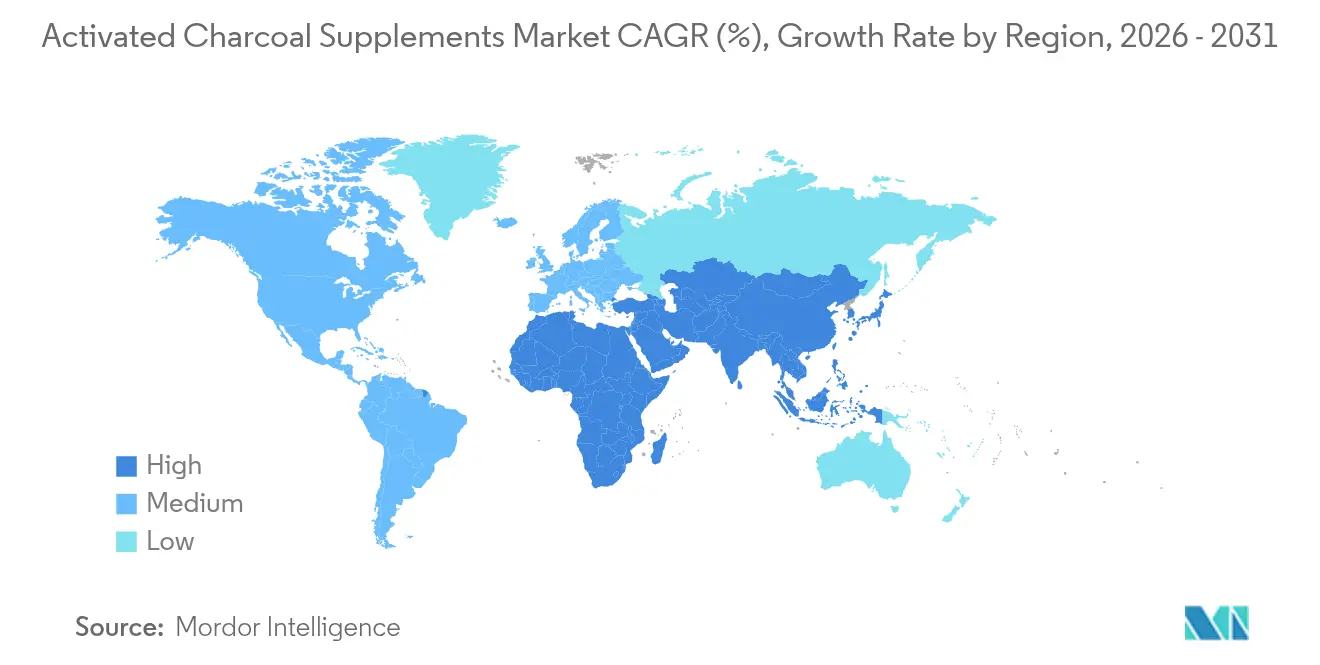
Europe dominates the activated charcoal supplements market with a commanding 43.85% share in 2025, driven by a sophisticated consumer base with high awareness of preventive healthcare and natural wellness solutions. Germany, France, Italy, and the United Kingdom represent the largest European markets, with Germany leading consumption of herbal and food supplements, including activated charcoal products. Regulatory clarity and consumer trust in supplement efficacy create favorable conditions for premium positioning, while the shift toward organic and sustainably sourced products is particularly pronounced, with European consumers prioritizing organic labels. The region's growth is further supported by strong retail infrastructure and healthcare practitioner involvement in supplement recommendations, creating multiple trusted channels for consumer education and product discovery.
Asia-Pacific is emerging as the growth engine of the global activated charcoal supplements market with an impressive 17.75% CAGR projected for 2026-2031, fueled by rising health consciousness, growing middle-class populations, and increasing awareness of preventive healthcare approaches. The region's growth is accelerated by digital adoption that enables rapid consumer education and e-commerce penetration, particularly in urban centers. Kirin Holdings is strategically expanding its Health Science business in Japan and China, leveraging increased health consciousness to drive growth in dietary supplements, including those with detoxification properties.
North America represents a mature but still-expanding market for activated charcoal supplements, characterized by high consumer awareness and sophisticated retail channels that support premium product positioning. The United States leads regional consumption, benefiting from a regulatory environment that allows for relatively straightforward market entry while maintaining basic safety standards. The FDA's ongoing reforms to modernize the OTC monograph system aim to reduce the time for monograph updates . The region's growth is increasingly driven by specific application segments rather than general market expansion, with digestive health and targeted detoxification protocols gaining traction among health-conscious consumers.

Regulatory Landscape
Regulation for activated charcoal supplements is shaped by divergent food-additive and health-claim rules across major regions. In the European Union, vegetable carbon (E 153) is permitted as a food additive under Regulation (EC) No 1333/2008, with purity specifications set in Regulation (EU) No 231/2012. EFSA published a January 2026 scientific opinion re-evaluating E 153 specifications, reinforcing the importance of periodic safety and specification reviews for supplier qualification and QC testing.
Claims and use conditions also affect go-to-market. The EU permits a specific authorized health claim for activated charcoal under Regulation (EU) No 432/2012 for reduction of excessive flatulence, tied to a defined use level (1 g per portion) and timing before and after meals, which influences labeling and dosage formats. In the United States, activated charcoal appears in FDA listings for indirect food additive/food-contact uses (for example, 21 CFR 177.1210 for certain food-contact applications), while direct addition as a food additive or color additive for consumption is not broadly authorized in the same way. This increases label, claim, and compliance risk for consumer-ingestible positioning versus the EU framework.
Value Chain Analysis
The value chain starts with sourcing carbonaceous feedstocks (notably coconut shells, as well as wood and coal-derived inputs), followed by carbonization and activation (commonly steam activation) to create high surface area material. Food- and pharma-aligned grades typically require additional refining, such as acid washing, to reduce ash and impurities. As a result, process capability and analytical testing become key differentiators when supplying supplement formulators that need consistent particle size, adsorption performance, and contaminant control.
Downstream, supplement brands and contract manufacturers formulate activated charcoal into capsules, tablets, and powders, then distribute through specialty and health stores, pharmacies/drug stores, and increasingly online channels. Supply continuity is sensitive to feedstock availability and price, particularly for coconut-shell inputs. Cross-border compliance adds friction as well, since EU-oriented supply often aligns to E 153 specifications, while US positioning faces tighter constraints around direct-use and claims, pushing companies to invest in documentation, traceability, and quality systems that can meet retailer standards and jurisdiction-specific labeling requirements.
Competitive Landscape
The activated charcoal supplements market exhibits moderate fragmentation with a concentration score of 4 out of 10, creating a dynamic competitive environment where established players and innovative newcomers compete for market share. Major players in the market include Country Life LLC, Dr. Schwabe Holding, Holland & Barrett Retail Ltd, and NOW Foods. Strategic patterns reveal a bifurcation between premium-positioned brands emphasizing scientific validation and quality sourcing, and mass-market players competing primarily on price and distribution reach.
White-space opportunities exist in specialized applications beyond general detoxification, particularly in condition-specific formulations targeting digestive health, athletic recovery, and beauty-from-within segments. The competitive intensity is increasing as consumer packaged goods conglomerates enter the space through acquisitions and new product launches, bringing sophisticated marketing capabilities and retail relationships that challenge independent brands.
Technology is emerging as a key competitive differentiator, with advanced formulation techniques and enhanced bioavailability creating performance advantages that justify premium pricing. Established players are responding with accelerated innovation cycles and expanded product lines that address emerging consumer needs, while simultaneously strengthening their digital capabilities to defend against online-first challengers. The market's evolution is increasingly shaped by scientific advancements that expand activated charcoal's applications beyond traditional uses, creating opportunities for brands that can effectively translate research into compelling consumer benefits.
Activated Charcoal Supplements Industry Leaders
-
Country Life LLC
-
Dr. Schwabe Holding
-
Holland & Barrett Retail Ltd
-
Swanson Health Products
-
NOW Foods
- *Disclaimer: Major Players sorted in no particular order

Market Opportunities and Future Outlook
A key opportunity is to build differentiated, compliance-forward products and messaging around the most clearly defined claim environment. In the EU, activated charcoal has an authorized health claim for reducing excessive flatulence under Regulation (EU) No 432/2012 with explicit conditions of use (1 g per portion and timing around meals). Brands can use this narrow but concrete claim pathway to support condition-specific SKUs and clearer on-pack instructions, while supplier selection and QC can be aligned to E 153 requirements under Regulation (EC) No 1333/2008 and purity specifications in Regulation (EU) No 231/2012.
Quality and specification tightening creates room for higher-grade sourcing, testing, and formulation that work across channels, especially online retail where consumers compare labels and certifications. EFSA's January 2026 re-evaluation of E 153 specifications highlights continued scrutiny of additive specifications in Europe, favoring manufacturers that invest in contaminant control, consistent activation/acid-washing capability, and documentation. In the United States, where activated charcoal is listed for certain indirect food-contact uses but lacks broad direct food additive/color additive authorization for consumption, companies can reduce friction by emphasizing compliant structure-function communication, robust substantiation files, and product formats that focus on measured dosing and third-party testing rather than expansive detox claims.
Recent Industry Developments
- January 2026: The European Food Safety Authority (EFSA) published a scientific opinion re-evaluating and proposing amendments to specifications for vegetable carbon (E 153). This development elevates the importance of meeting updated additive specifications and strengthens the role of analytical testing and supplier qualification for brands selling activated charcoal products in Europe.
- July 2025: NativePath launched a 1,000 mg activated charcoal supplement sourced from coconut shells and positioned for daily gut health support, including bloating and gas. The company highlighted GMP manufacturing and third-party testing, reinforcing competitive differentiation through clean-label sourcing and quality assurances in the gut-health positioning space.
- May 2024: The United States FDA continued to list activated carbon in its inventory for certain indirect food additive applications (for example, food-contact uses), while direct-use status for consumption-oriented coloring/additive purposes remains constrained. The regulatory framing keeps US market strategies focused on careful labeling and claims discipline, shaping how supplement marketers position activated charcoal versus EU pathways.


Research Methodology Framework and Report Scope
Market Definition and Coverage
This market covers the retail and prescribed use of activated charcoal sold as dietary supplements for human consumption, tracked in value terms across major regions and common sales channels.
Scope exclusions: We exclude activated carbon used for water and air filtration, industrial processing, and clinical emergency-use charcoal that is supplied as a medical treatment rather than a supplement.
Segmentation Overview
-
By Form
- Capsules
- Powders
- Others
-
By Application
- Detoxification and Poisoning Treatment
- Gut Health
- Others
-
By Distribution Channel
- Supermarkets/Hypermarkets
- Specialty and Health Stores
- Online Retailers
- Other Distribution Channels
-
By Geography
-
North America
- United States
- Canada
- Mexico
- Rest of North America
-
Europe
- United Kingdom
- Germany
- France
- Italy
- Spain
- Netherlands
- Poland
- Belgium
- Sweden
- Rest of Europe
-
Asia-Pacific
- China
- Japan
- India
- Australia
- Indonesia
- South Korea
- Thailand
- Singapore
- Rest of Asia-Pacific
-
South America
- Brazil
- Argentina
- Colombia
- Chile
- Peru
- Rest of South America
-
Middle East and Africa
- South Africa
- Saudi Arabia
- United Arab Emirates
- Nigeria
- Egypt
- Morocco
- Turkey
- Rest of Middle East and Africa
-
North America
Data Sources, Market Sizing, and Validation
Desk Research
Desk research starts with clarifying what is being counted as a supplement, and then building a clean view of demand signals and rules that shape labeling and claims. We mainly referenced public sources such as the US FDA (dietary supplement and labeling guidance), the NIH Office of Dietary Supplements (ingredient and safety context), the US CDC (poisoning and GI-related health references that influence awareness), and WHO food safety and consumer health materials for cross-country context.
To keep assumptions realistic, we also reviewed company annual reports, investor decks, product catalogs, and public recalls and warning letters that indicate what is actively sold and what gets restricted. Import and export trade statistics and shipment-level trade databases were used selectively to sanity-check ingredient movement, especially where finished-goods trade data is limited. This list is not exhaustive, and many other public sources were also used for data collection, validation, and clarification during the research.
Primary Interviews and Surveys
Primary interviews and surveys were used to pressure-test the desk assumptions on typical pricing, channel mix, and the pace at which new products are being adopted. We spoke with supplement manufacturers, ingredient suppliers, distributors, and channel-side stakeholders across APAC, EMEA, and the Americas so regional differences in claims, compliance, and consumer usage patterns could be reflected in the model.
Distribution of primary research fieldwork respondents
| Company type | Respondent position | Region |
|---|---|---|
| Top tier: 35% | CXOs: 15% | APAC: 46% |
| Mid tier: 48% | Functional/Unit leaders: 42% | EMEA: 34% |
| Smaller Players: 17% | Managers: 43% | Americas: 20% |
Market-Sizing & Forecasting
Sizing follows a top-down build where consumption is reconstructed from the broader dietary supplements spend pool, then narrowed using ingredient penetration and channel availability checks until the activated charcoal supplement subset is reached. Where the picture becomes unclear, totals are corroborated through selective bottom-up approximations, using sampled average selling prices by form (capsules and tablets are treated separately) multiplied by expected unit movement from key channels.
A few practical inputs kept the model grounded, such as average retail price ranges by channel, share of online sales versus pharmacy and modern trade, observed product form mix, and the pace of claims tightening that can reduce shelf presence. Trade flows of activated carbon inputs were used only as a reasonableness check, since finished supplement trade is not always visible in standard codes. For forecasting, we relied on scenario analysis supported by interview feedback, where base cases were adjusted for expected e-commerce growth, pricing inflation, and region-specific regulatory enforcement, and then reviewed against historical growth patterns so the curve did not overreact to short-term spikes.
Data Validation & Update Cycle
Validation is done in steps so the final value is not driven by one data point. Our team compares outputs against independent signals like supplement channel growth, observed pricing bands, and ingredient supply movement, then investigates outliers before sign-off. When a variance cannot be explained by a clear driver, assumptions are revisited and follow-up calls are triggered with relevant respondents.
The report is refreshed on an annual schedule, and interim updates are added when there are material events such as major regulatory actions, unusually large pricing shifts, or changes in channel policies. Before delivery, a final analyst review pass is completed so clients receive the most recent view based on the latest available public information and interview learnings.
Mordor Intelligence's Activated Charcoal Supplements Market Estimate Compared With Other Published Estimates
It is normal to see different market values for activated charcoal supplements because studies do not always count the same years, products, and selling routes. Gaps also show up when pricing logic differs, when currency conversion timing is not aligned, and when demand is inferred from broad wellness trends without enough checks.
For this market, the biggest drivers are whether clinical-use products get mixed with supplements, how powders are treated versus tablets and capsules, and how online sales are normalized to avoid double counting across direct-to-consumer and marketplace listings. The spread is also affected by whether the model starts from total supplement spending or from smaller ingredient-led demand pools, and how often assumptions are refreshed after policy changes and claim enforcement, which is handled explicitly in the 2026 starting point used here by Mordor Intelligence.
Benchmark comparison
| Source | Market Size | Gaps in Research Methodology |
|---|---|---|
| Mordor Intelligence | USD 5.99 B (2026) | |
| Global Consultancy A | USD 9.32 B (2024) | Uses an earlier base year and a faster growth curve, and the scope description is broader, which can pull in adjacent wellness products and inflate online channel scaling. |
| Industry Publisher B | USD 10.83 B (2025) | Counts a different base year and includes a wider form set, and the price progression approach appears more aggressive, which can lift the value even when unit demand signals are similar. |
When the year alignment and scope filters are made consistent, most of the difference becomes explainable rather than confusing. Our approach stays repeatable because each assumption is tied back to observable pricing, channel mix, and form-level demand, and then adjusted only after checks from interviews and secondary signals agree.


Key Questions Answered in the Report
What is the current value of the activated charcoal supplements market?
The market is valued at USD 5.99 billion in 2026 and is forecast to reach USD 10.02 billion by 2031.
Which region leads global sales?
Europe leads with 43.85% revenue share in 2025 owing to high preventive-health awareness and strong regulatory support.
What application segment is growing fastest?
Gut health is advancing at a 18.95% CAGR for 2026-2031 as consumers use charcoal for everyday digestive comfort.
Which distribution channel is gaining momentum?
Online retail is progressing at a 19.41% CAGR for 2026-2031, driven by convenience and subscription models.
What are the main restraints to market growth?
Competition from alternative natural detox products and raw-material supply constraints are the primary challenges limiting faster expansion.
Page last updated on:


 Your data is secure and never sold or shared.


