
1-Decene Market Size and Share
Market Overview
| Study Period | 2020 - 2031 |
|---|---|
| Forecast Data Period | 2026 - 2031 |
| Historical Data Period | 2020 - 2024 |
| Growth Rate | 3.01 % |
| Fastest Growing Market | Asia Pacific |
| Largest Market | Asia Pacific |
| Market Concentration | Medium |
Major Players *Disclaimer: Major Players sorted in no particular order Image © Mordor Intelligence. Reuse requires attribution under CC BY 4.0. | |
1-Decene Market Analysis by Mordor Intelligence
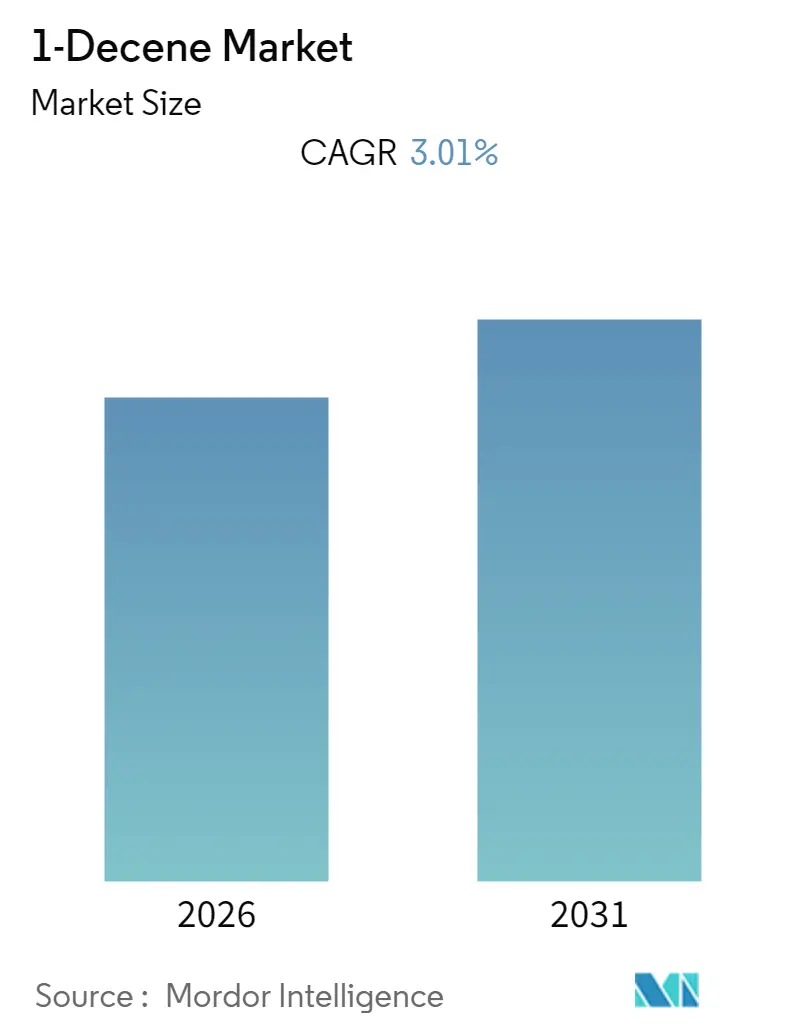
The 1-Decene Market size is expected to register a CAGR of 3.01% during the forecast period.
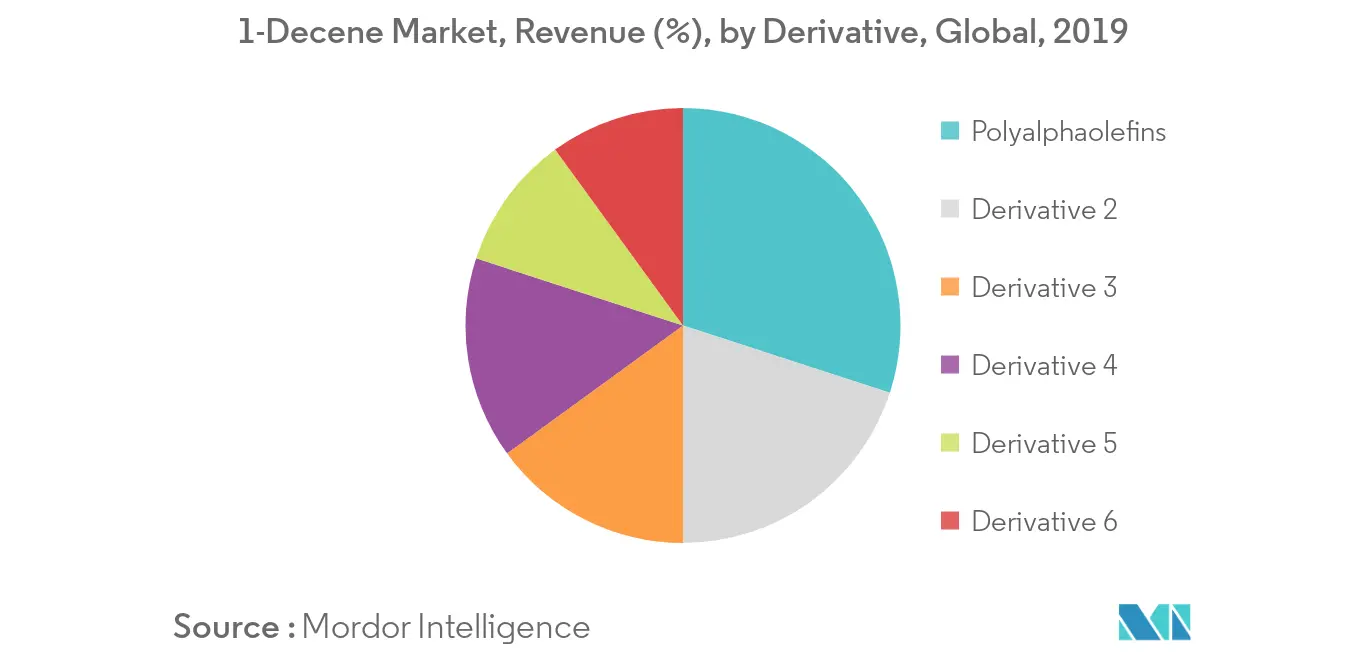
- Polyalphaolefin is expected to remain largest due to its increasing applications from the various sectors during the period of forecast.
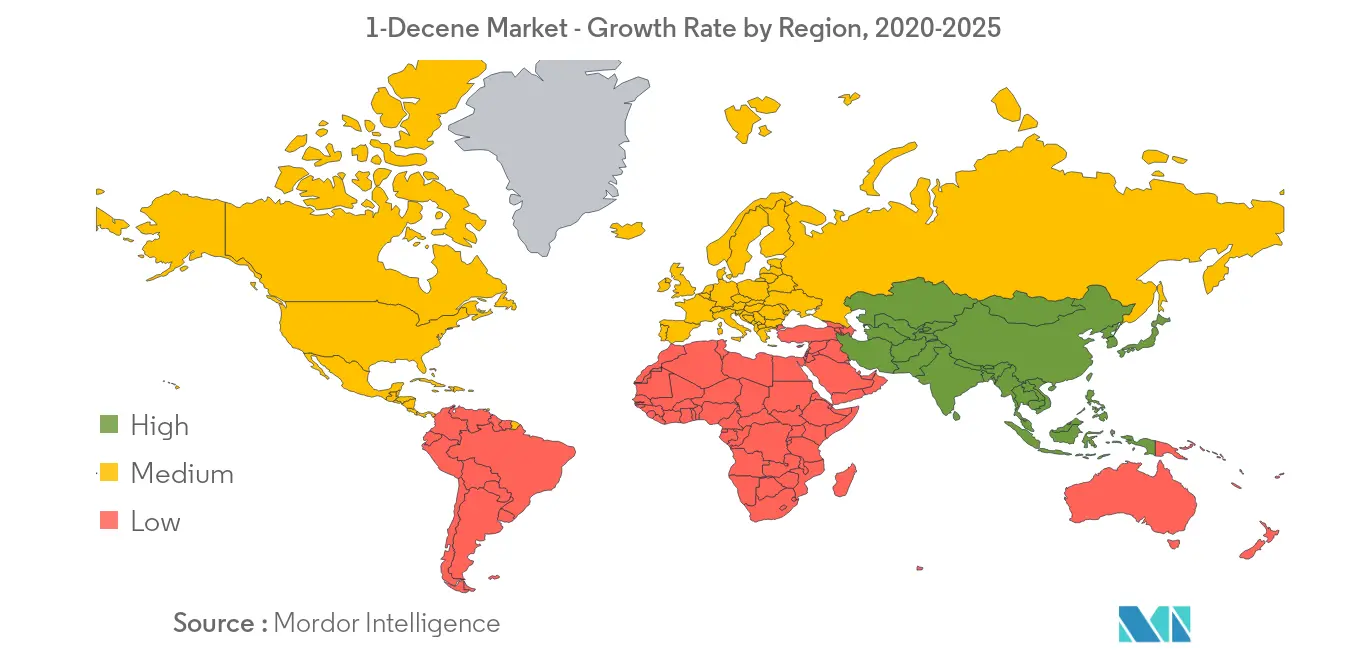
- Asia-Pacific is expected to be the largest market due to the large-scale production and consumption of the 1-decene products in the region.
Note: Market size and forecast figures in this report are generated using Mordor Intelligence’s proprietary estimation framework, updated with the latest available data and insights as of 2026.
Market Trends and Insights
Polyalphaolefins to be the Largest Segment for 1-Decene Market
- 1-decene is majorly employed in the production of polyalphaolefins (PAO), a type of synthetic lubricant. Polyalphaolefins are significantly utilized in the automotive and manufacturing businesses.
- Moroever, they are also utilized as compressor oil, transmission oil, lube-oil added substance, and gear oil.
- In 2020, it is estimated that the worldwide wind turbine gear oil market volume amount to 41,100 million metric tons.
- By 2023, the global market value of the synthetic lubricants is anticipated to reach a value of USD 37.3 billion.
- All the aforementioned factors are expected to drive the 1-Decene Market during the forecast period.
Asia-Pacific Region to Dominate 1-Decene Market
- Asia-Pacific region holds a prominent share in the 1-decene market globally and is expected to dominate the market during the forecast timeline.
- In 2019, Malaysia produced approximately 138.5 thousand metric tons of lubricating oil.
- Detergent alcohols and their subordinates are key raw materials utilized for delivering surfactants in clothing and dishwashing applications. In 2020, the Asia-Pacific region is forecasted to add up to USD 8.057 billion in revenue from the dishwashing detergents section.
- The demand for polyethylene from the Asia-Pacific region is expected to be 62 million metric tons in 2022.
- Thus, rising demand from various industries is expected to drive the 1-Decene Market in the region during the forecast timeframe.
Value Chain Analysis
Upstream supply is anchored in ethylene and paraffinic streams, with 1-decene typically produced through ethylene oligomerization and, to a lesser extent, wax cracking. The resulting linear alpha-olefin is distributed by integrated producers and chemical distributors (including players such as SABIC, PJSC Nizhnekamskneftekhim, Shell, Exxon Mobil, Chevron Phillips Chemical, INEOS, Idemitsu Kosan, and SEA-LAND CHEMICAL COMPANY) to derivative manufacturers producing polyalphaolefins (PAO), oxo alcohols, linear alkyl benzene, mercaptans, and chlorinated alpha olefins.
Midstream and downstream stages include purification and grade control, blending and formulation (particularly in synthetic lubricants and surfactant intermediates), and customer qualification for industrial and OEM end uses. Across these links, supply chains are being reshaped by decarbonization and circularity requirements and by tighter documentation practices, as lubricant and specialty chemical buyers increasingly request batch-level certification and product stewardship documentation, particularly for European downstream obligations.
Competitive Landscape
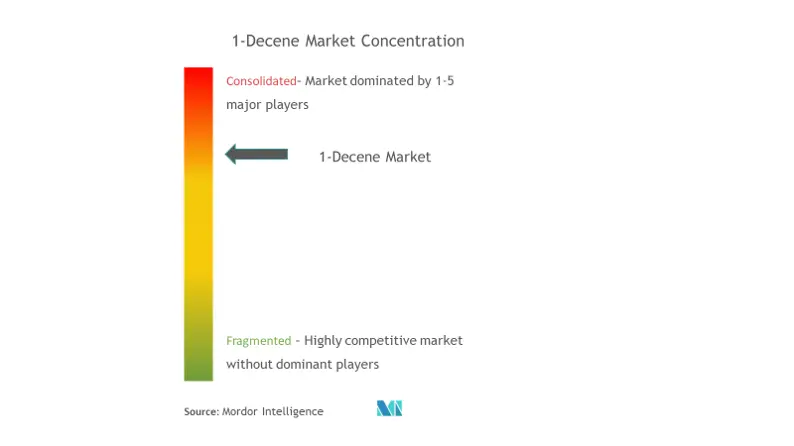
The 1-Decene Market is consolidated. Some of the players in the market include SABIC, SEA-LAND CHEMICAL COMPANY, PJSC Nizhnekamskneftekhim, Royal Dutch Shell, and Exxon Mobil Corporation.
1-Decene Industry Leaders
-
SABIC
-
SEA-LAND CHEMICAL COMPANY
-
PJSC Nizhnekamskneftekhim
-
Royal Dutch Shell
-
Exxon Mobil Corporation
- *Disclaimer: Major Players sorted in no particular order
1-Decene Market Companies Covered in this Report
- Chevron Phillips Chemical Company
- Exxon Mobil Corporation
- INEOS
- Idemitsu Kosan Co.,Ltd
- LG Chem
- PJSC Nizhnekamskneftekhim
- Qatar Petroleum
- Royal Dutch Shell
- SEA-LAND CHEMICAL COMPANY
- SABIC
Market Opportunities and Future Outlook
A core opportunity centers on high-purity 1-decene grades used in synthetic lubricant base stocks, especially PAO, where OEM fill specifications and lifecycle-emissions documentation raise the value of consistent quality and traceability. To support that demand, producers are expanding purification capacity and quality assurance to differentiate high-purity output for lubricants from broader commodity grades, while aligning with lifecycle reporting expectations under policy regimes such as the EU Green Deal. Separately, growth in Group IV base oils for specialty applications supports demand for tightly controlled decene grades and related intermediates.
A second opportunity is supply diversification through alternative feedstock pathways and modular production assets that improve flexibility and resilience. Renewable 1-decene from ethenolysis and other biogenic routes creates a non-fossil supply pathway and supports customer requests for documented sustainability attributes in surfactants and lubricant value chains. In this context, Verbio Life Chemicals' deployment of renewable 1-decene and the broader push to certify life-cycle emissions point to a concrete shift toward lower-emission olefins, while giving downstream formulators more supplier options.
Recent Industry Developments in 1-Decene Market
- January 2026: Verbio Life Chemicals Commenced operation of a large-scale ethenolysis plant in Bitterfeld, Germany producing renewable 1-decene from rapeseed oil methyl ester. The project expands renewable 1-decene production and adds capacity to the renewable supply chain for 1-decene, reflecting sustainability-driven market dynamics.
- January 2026: Nizhnekamskneftekhim Reported a 15% increase in annual marketable product production for 2025, supported by the commissioning of the EP-600 ethylene complex. The ethylene feedstock expansion affects downstream olefin supply and improves feedstock availability for 1-decene precursors, with knock-on implications for lubricant and surfactant applications.
- January 2026: Verbio Commenced operation of a large-scale ethenolysis plant in Bitterfeld, Germany designed to produce 17,000 tonnes per year of renewable 1-decene from rapeseed oil methyl ester. The project increases renewable 1-decene capacity to 17 000 tonnes annually and strengthens the renewable feedstock base for downstream lubricant and additive markets.
1-Decene Market Report Scope and Research Methodology
Market Definition and Coverage
For this study, the 1-decene market is defined as the commercial sales of 1-decene used as a chemical intermediate, where demand is created by downstream derivative and polymer uses across major regions.
Scope exclusions: We exclude internal transfer pricing inside integrated plants and any value counted at a downstream finished-product level (for example, lubricants or detergents).
Segments Covered in This Report
- Derivative
- Polyalphaolefins
- Oxo Alcohols
- Linear Alkyl Benzene
- Linear Mercaptans
- Chlorinated Alpha Olefins
- Others
- Application
- Surfactants
- Plasticizers
- Synthetic Lubricants
- Polyethylene
- Others
- Geography
- Asia-Pacific
- China
- India
- Japan
- South Korea
- Rest of Asia-Pacific
- North America
- United States
- Canada
- Mexico
- Europe
- Germany
- United Kingdom
- France
- Italy
- Rest of Europe
- South America
- Brazil
- Argentina
- Rest of South America
- Middle-East and Africa
- Saudi Arabia
- South Africa
- Rest of Middle-East and Africa
- Asia-Pacific
Data Sources, Market Sizing, and Validation
Desk Research
We started by building a clean fact base on how 1-decene is produced, traded, and converted into common downstream chemicals. Public and official sources were used to anchor the model on repeatable signals, such as customs trade statistics from UN Comtrade, chemical energy and feedstock series from agencies such as the US Energy Information Administration, and manufacturing indicators from sources such as the US Census Bureau and Eurostat.
To keep the chemistry inputs grounded, we also reviewed technical references on linear alpha olefins from sources such as NIST, along with peer reviewed papers and patent filings that describe process routes and typical yield ranges. Company filings, investor presentations, and reputable press were used to cross-check capacity changes, turnaround cycles, and regional supply shifts. In a few places, we also referenced paid subscriptions for company financials and patent databases to improve consistency in company mapping and technology tracking. These sources are illustrative, and many other public references were also used for data collection, validation, and clarification.
Primary Interviews and Surveys
Next, we validated desk findings through expert interviews and short surveys with producers, distributors, and downstream buyers, so pricing logic and application splits could be corrected where needed. For this global market, we ensured coverage across APAC, EMEA, and the Americas, and we also spoke with commercial and operations roles to confirm purchasing patterns and contract structures.
Distribution of primary research fieldwork respondents
| Company type | Respondent position | Region |
|---|---|---|
| Top tier: 28% | CXOs: 17% | APAC: 48% |
| Mid tier: 54% | Functional/Unit leaders: 26% | EMEA: 29% |
| Smaller Players: 18% | Managers: 57% | Americas: 23% |
Market-Sizing & Forecasting
Our sizing logic starts with a top-down build that reconstructs demand from a defined consumption pool, where derivative demand and polymer use are tied back to 1-decene requirements through typical conversion ratios. To make sure totals do not drift, we then check outputs using selective bottom-up approximations, such as sampled supplier volumes, channel checks on traded flows, and an ASP times volume cross-check for major regions.
Key inputs used in the model include announced and operating capacity for relevant olefin and alpha olefin units, regional trade flows that indicate supply shifts, operating rate assumptions discussed by industry contacts, price spreads between 1-decene and adjacent olefins, and the application mix across polyalphaolefins, oxo alcohols, and comonomer use in polyethylene. When bottom-up detail is limited for smaller markets, gaps are handled using proxy indicators like import reliance, utilization bands, and buyer-side purchase frequency, followed by a consistency check against regional supply availability.
For forecasting, we used scenario analysis because the market is sensitive to feedstock economics and capacity changes that can shift quickly. Under each scenario, the same drivers are projected with inputs agreed in interviews, and then the final forecast is taken as a balanced case after reconciling the scenarios with recent trade and capacity signals.
Data Validation & Update Cycle
Before sign-off, we triangulate the model using independent checks, including comparing implied consumption against trade direction, checking whether price and volume movements behave logically, and testing whether regional totals align with capacity and operating rate realities. Outliers are reviewed in a second pass, and if the variance cannot be explained, the assumption is revisited and we re-contact sources for clarification.
Reports refresh annually, and we also trigger interim updates when material events occur, such as large capacity announcements, shutdowns, or sustained pricing shifts. Right before delivery, an analyst performs a fresh pass across key inputs so clients receive the latest updated view.
Mordor Intelligence's 1 Decene Market Size Compared With Other Published Estimates
Published numbers for 1-decene can look far apart because the market boundary is not always handled the same way, and because price and volume assumptions are often updated at different times. The table makes this visible since some publishers size a broader chemical chain, while others keep the count closer to the intermediate itself.
The table shows a spread that is mainly explained by scope and pricing logic. Under Mordor Intelligence's model, the value is counted at the 1-decene intermediate level and not rolled into the value of downstream finished products, and prices are aligned to the same base-year currency timing before forecasting.
Benchmark comparison
| Source | Market Size | Gaps in Research Methodology |
|---|---|---|
| Mordor Intelligence | USD 1.20 B (2024) | |
| Global Consultancy A | USD 1.06 B (2023) | Uses an earlier base year and applies a faster growth curve, and the sizing appears to rely on broader demand proxies without clearly separating comonomer use from other linear alpha olefin consumption. |
| Industry Publisher B | USD 1.39 B (2025) | Starts from a later base year and applies a steeper ASP progression, which can inflate value if contract price resets and regional spreads are not normalized to a consistent currency timing window. |
Once the market is kept at a consistent value point in the chain and the same time-aligned price assumptions are applied, remaining differences usually narrow to application mix and regional weighting. That is why we keep the steps traceable to capacity signals, trade direction, and confirmed usage splits, so users can replicate the logic and adjust assumptions if their scope needs change.
Key Questions Answered in the Report
What is the current 1-Decene Market size?
The 1-Decene Market is projected to register a CAGR of 3.01% during the forecast period (2026-2031)
Who are the key players in 1-Decene Market?
SABIC, SEA-LAND CHEMICAL COMPANY, PJSC Nizhnekamskneftekhim, Royal Dutch Shell and Exxon Mobil Corporation are the major companies operating in the 1-Decene Market.
Which is the fastest growing region in 1-Decene Market?
Asia Pacific is estimated to grow at the highest CAGR over the forecast period (2026-2031).
Which region has the biggest share in 1-Decene Market?
In 2025, the Asia Pacific accounts for the largest market share in 1-Decene Market.
What years does this 1-Decene Market cover?
The report covers the 1-Decene Market historical market size for years: 2019, 2020, 2021, 2022, 2023 and 2024. The report also forecasts the 1-Decene Market size for years: 2026, 2027, 2028, 2029, 2030 and 2031.