
Israel Lubricants Market Size and Share
Market Overview
| Study Period | 2021 - 2031 |
|---|---|
| Forecast Data Period | 2026 - 2031 |
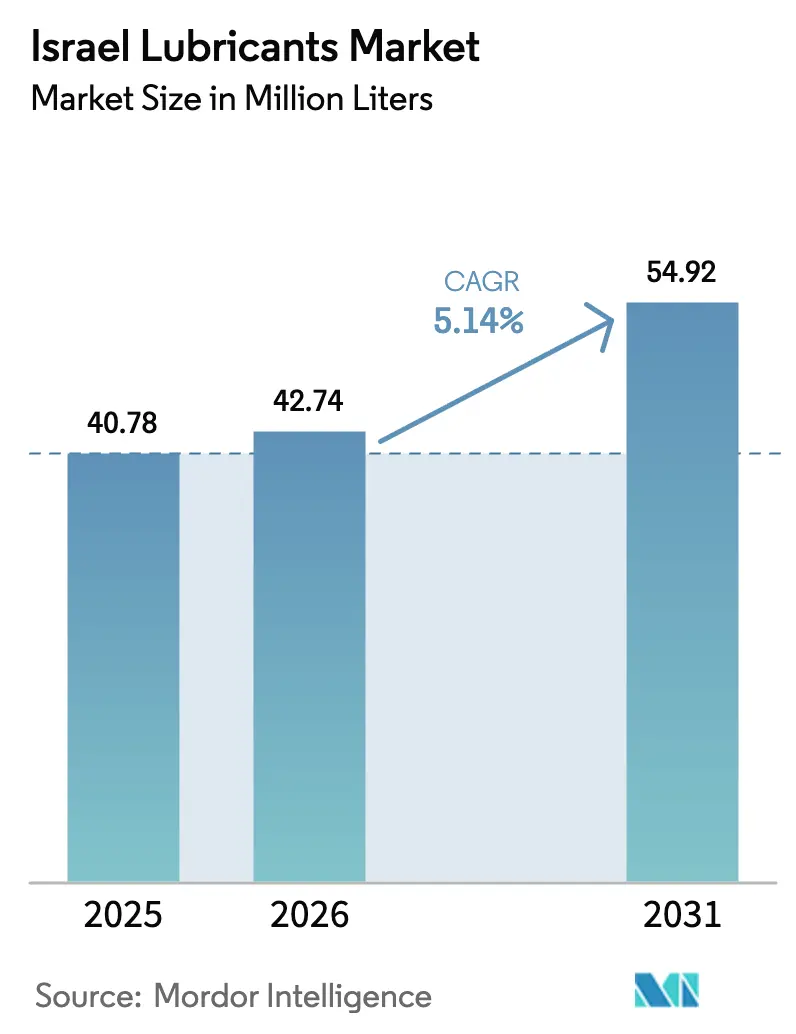
| Base Year Market Size (2025) | 40.78 Million liters |
| Market Volume (2026) | 42.74 Million liters |
| Market Volume (2031) | 54.92 Million liters |
| Growth Rate (2026 - 2031) | 5.14 % |
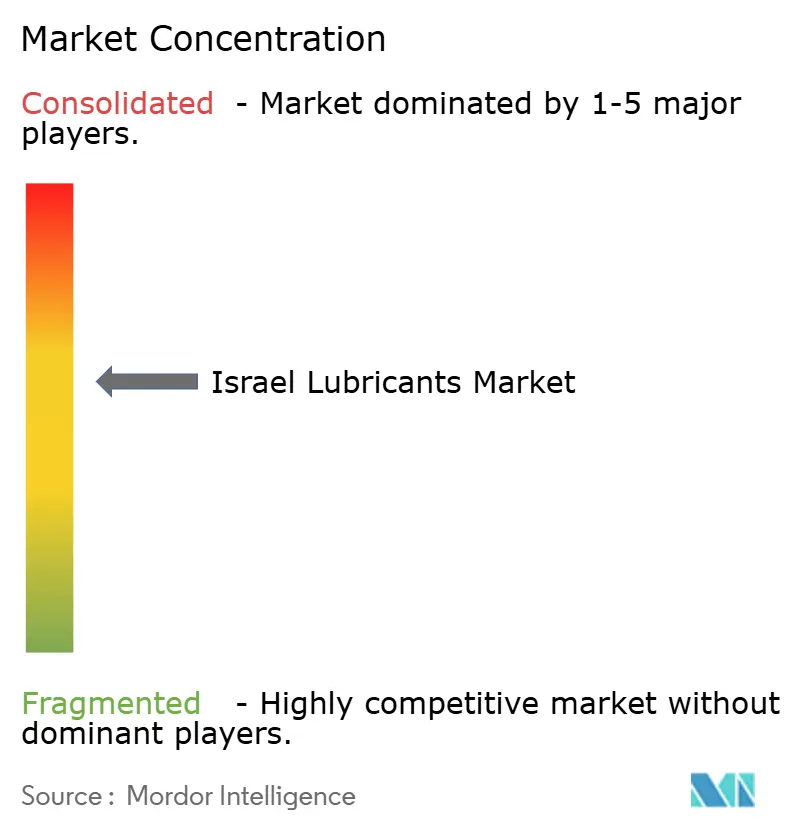
| Market Concentration | Medium |
Major Players *Disclaimer: Major Players sorted in no particular order Image © Mordor Intelligence. Reuse requires attribution under CC BY 4.0. | |
Israel Lubricants Market Analysis by Mordor Intelligence
The Israel Lubricants Market size was valued at 40.78 million liters in 2025 and is estimated to grow from 42.74 million liters in 2026 to reach 54.92 million liters by 2031, at a CAGR of 5.14% during the forecast period (2026-2031). Defense-fleet expansion, large-scale desalination projects, and a rebound in industrial production are the three structural forces that keep the Israel Lubricants market on a steady growth path. A NIS 7.8 billion (USD 2.26 billion) armored-vehicle and naval modernization program is unlocking demand for greases, marine oils, and hydraulic fluids. Commissioning of the 200 million m³-per-year Sorek 2 desalination plant is opening a niche for high-temperature synthetic lubricants. Industrial production rose 9.4% year-on-year in December 2025, signaling a return to pre-conflict utilization rates. Counter-balancing these tailwinds, rapid electric-vehicle penetration, EVs already capture nearly one-quarter of new-car sales, continues to erode passenger-car engine-oil volumes faster than the regional average.
Key Report Takeaways
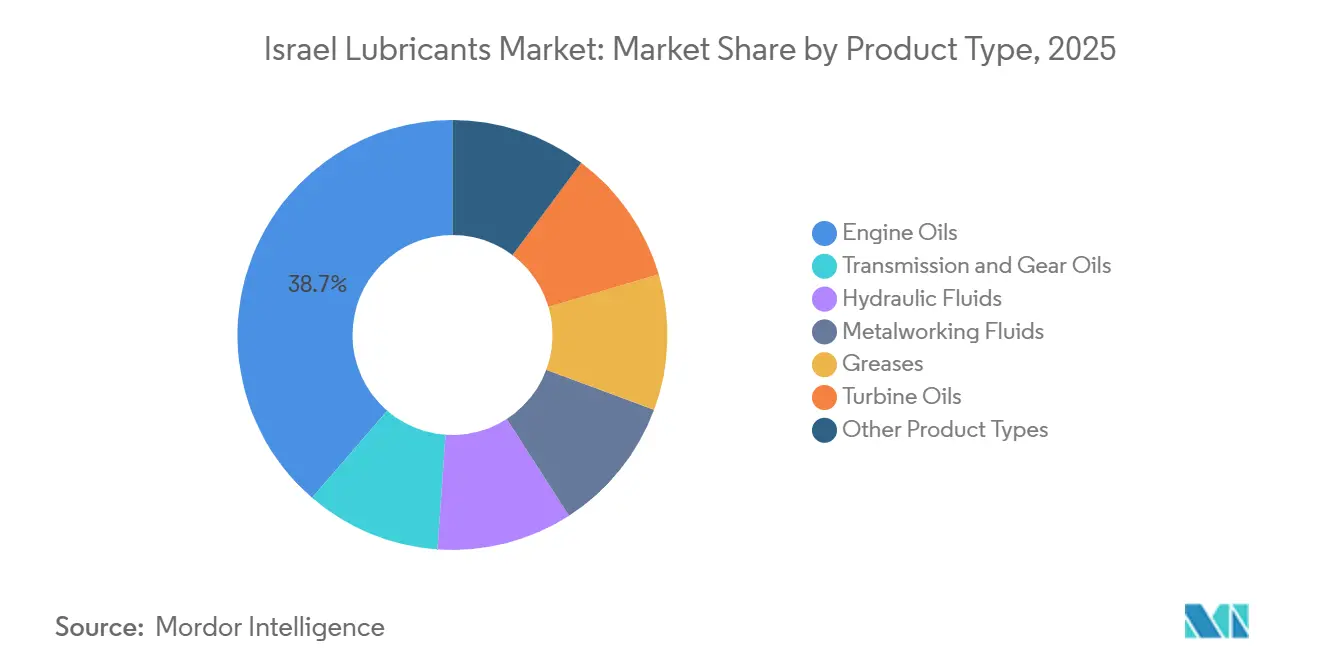
- By product type, engine oils led with a 38.66% share of the Israel Lubricants market in 2025, while greases are advancing at a 6.21% CAGR during the forecast period (2026-2031).
- By base-oil type, mineral formulations accounted for 52.39% of the Israel Lubricants market size in 2025; bio-based lubricants are forecast to expand at a 6.78% CAGR during the forecast period (2026-2031).
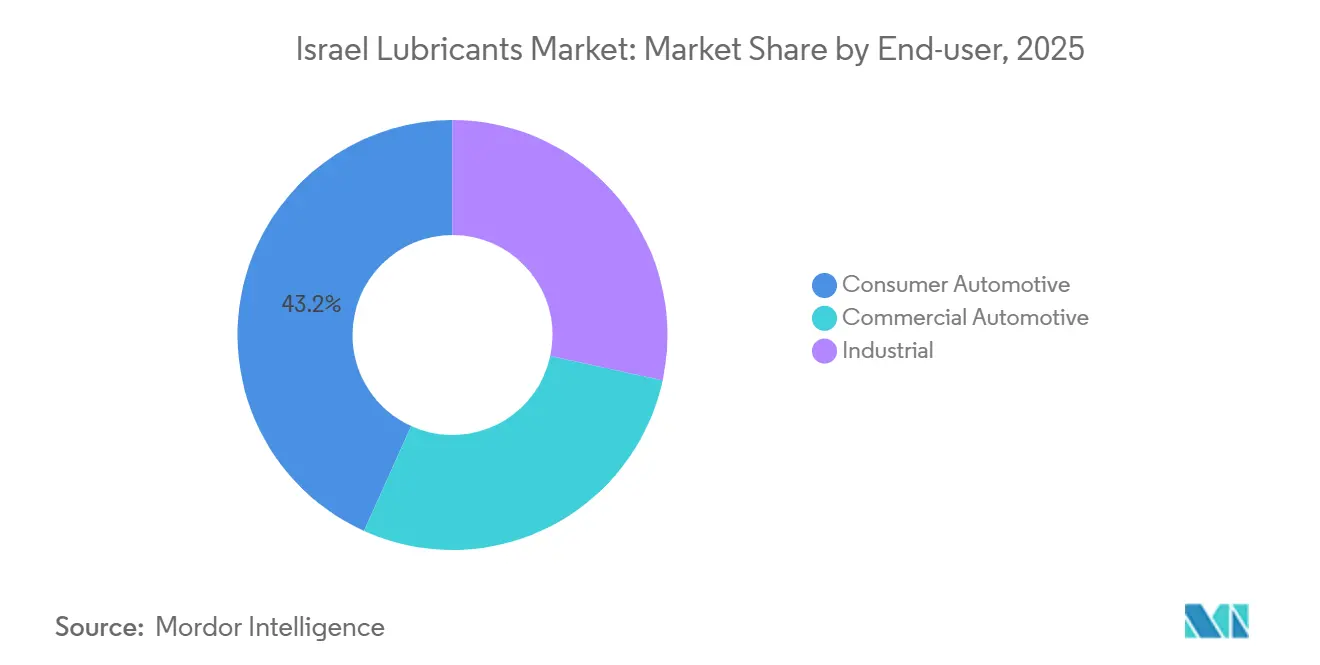
- By end-user, consumer automotive represented 43.24% of 2025 volume, yet industrial applications are the fastest-growing segment at a 6.34% CAGR during the forecast period (2026-2031).
Note: Market size and forecast figures in this report are generated using Mordor Intelligence’s proprietary estimation framework, updated with the latest available data and insights as of January 2026.
Israel Lubricants Market Trends and Insights
Drivers Impact Analysis*
| Driver | (~) % Impact on CAGR Forecast | Geographic Relevance | Impact Timeline |
|---|---|---|---|
| Growing automotive-import fleet size | +1.2% | National, with concentration in Tel Aviv, Haifa, Jerusalem metropolitan areas | Medium term (2-4 years) |
| Expanding natural-gas power generation capacity | +0.9% | National, with infrastructure hubs in Hadera, Ashkelon, and planned Western Galilee | Long term (≥ 4 years) |
| Rebound of domestic manufacturing PMI | +0.8% | National, with industrial clusters in Haifa Bay, Ashdod, and peripheral regions | Short term (≤ 2 years) |
| Defence fleet modernisation by IDF | +0.6% | National, with production in Haifa (naval), central Israel (armored vehicles) | Long term (≥ 4 years) |
| Surge in desalination-plant installations | +0.5% | Coastal regions: Sorek, Hadera, Ashkelon, Western Galilee | Medium term (2-4 years) |
| Source: Mordor Intelligence | |||
Growing Automotive-Import Fleet Size
Monthly import volatility masks an upward trajectory in Israel’s rolling vehicle park. Passenger-car registrations recovered sharply in early 2026 as buyers raced to beat the planned hike in purchase tax. Commercial-vehicle imports rose 4% in 2025, underpinning lubricant demand because trucks and vans consume larger volumes of engine and transmission oils per kilometer traveled. Government projections of a 6.4 million-unit fleet by 2040, supported by one of the OECD’s fastest population-growth rates, ensure that the absolute number of combustion vehicles keeps rising even as electrification gains ground. An aging fleet, average truck age now tops 9 years, extends drain intervals, and steers workshops toward higher-grade synthetics.
Expanding Natural-Gas Power Generation Capacity
Natural gas supplied 71% of Israel’s electricity in 2024, and upstream investments are widening that dominance. Chevron is adding roughly 9 billion m³ of annual capacity at the Leviathan field, with output expected to pass 3 billion cubic feet per day in 2026. Forty-one additional industrial off-takers were connected to the distribution grid in 2025, spanning hospitals, food plants, and plastics converters. Turbine oils, compressor fluids, and heat-transfer media tailored for high-temperature, high-load gas-turbine service are direct beneficiaries. Planned connections for data-center clusters in northern Israel extend the opportunity well into the next decade.
Rebound of Domestic Manufacturing PMI
Israel’s Manufacturing PMI edged above the 50-point expansion line in early 2025, and industrial output climbed 9.4% year-on-year by December 2025. Electronics, pharmaceuticals, and metal-fabrication plants in Haifa Bay and Ashdod resumed full operations after conflict-related shutdowns. Metalworking-fluid demand rebounded in parallel, although formulators face the country’s uniquely tight wastewater-discharge limits. Regulatory push for ashless, biodegradable chemistries is nurturing a nascent market for bio-ester emulsions and sulfur-free extreme-pressure additives. Suppliers able to certify compliance with Israel’s Public Health Regulations gain a clear edge.
Defence Fleet Modernisation by IDF
A NIS 5 billion (USD 4.05 billion) armored-vehicle acceleration plan and a NIS 2.8 billion (USD 0.81 billion) contract for five Reshef-class corvettes extend defense-driven lubricant demand through 2031. New Merkava Barak tanks, Namer APCs, and Eitan armored cars require lithium-complex greases that withstand high shock loads and desert temperatures. The lighter, faster Reshef ships boost the need for premium marine oils compatible with high-speed propulsion systems. Localized production spreads this demand beyond Israel’s central corridor, deepening the Israel lubricants market footprint in peripheral regions.
Restraints Impact Analysis*
| Restraint | (~) % Impact on CAGR Forecast | Geographic Relevance | Impact Timeline |
|---|---|---|---|
| Base-oil price volatility | -0.4% | Global, affecting Israeli refineries and importers | Short term (≤ 2 years) |
| Rapid EV adoption curbing engine-oil demand | -0.7% | National, concentrated in urban centers (Tel Aviv, Haifa, Jerusalem) | Medium term (2-4 years) |
| Tight wastewater-discharge limits on metal-working fluids | -0.3% | National, particularly Haifa Bay, Ashdod industrial zones | Long term (≥ 4 years) |
| Source: Mordor Intelligence | |||
Base-Oil Price Volatility
J.P. Morgan projects Brent crude at roughly USD 60 per barrel in 2026, easing feedstock costs yet injecting margin uncertainty for small Israeli blenders. Sanctions have rerouted Russian barrels, creating regional supply gaps and logistics premiums that ripple into Group I and II base-oil pricing. Distributors with limited storage struggle to hedge effectively, amplifying pass-through volatility to workshops and industrial buyers. Any Mideast flare-up could trigger short-lived spikes, reminding stakeholders that cost stability is far from guaranteed.
Rapid EV Adoption Curbing Engine-Oil Demand
EVs captured 17.9% of new-car sales in 2023 and roughly one-quarter in 1Q 2024[1]. Purchase-tax rates will climb to 52% in 2026, and 60% in 2027, but government modeling still puts the EV parc at up to 1.3 million units by 2030. Engine-oil demand in the Israel Lubricants market, therefore, peaks in the late 2020s. Diesel trucks and natural-gas buses soften the blow, yet formulators must recalibrate product portfolios toward e-thermal fluids and EV-specific greases.
*Our forecasts treat driver/restraint impacts as directional, not additive. The impact forecasts reflect baseline growth, mix effects, and variable interactions.
Segment Analysis
By Product Type: Greases Gain on Infrastructure Buildout
Engine oils held a 38.66% share of the Israel Lubricants market in 2025. Greases, however, are on track for a 6.21% CAGR during the forecast period (2026-2031) as desalination pumps, naval propulsion systems, and armored-vehicle tracks favor high-performance lithium-complex and synthetic PAO formulations.
The Israel Lubricants market size for greases is projected to climb steadily as defense procurement accelerates and desalination capacity expands along the Mediterranean coast. Manufacturers are introducing water-resistant, high-temperature greases that meet NATO and ISO seawater resistance tests while complying with Israel’s stringent wastewater rules. Newer bio-thickened variants help local users satisfy green-procurement criteria without sacrificing load-carrying capacity.

By Base-Oil Type: Bio-Based Oils Capitalize on Circular-Economy Push
Mineral oils dominated with a 52.39% share in 2025, but bio-based grades posted the fastest growth at 6.78% CAGR. TotalEnergies’ recycled-and-renewable base-oil initiative, launched in September 2025, validates the commercial upside.
Israel Lubricants market share for bio-based formulations remains in single digits, yet desalination operators and public-sector fleets increasingly specify biodegradable lubricants in tender documents. Peer-reviewed research shows waste-cooking-oil esters achieving viscosity indices above 180 and pour points below -20°C, making them viable hydraulic and metalworking basestocks. Cost competitiveness improves when circular feedstocks avoid import duties levied on virgin mineral oils.
By End-user: Industrial Segment Outpaces Consumer Automotive
Consumer automotive generated 43.24% of the 2025 volume, but its expansion slows as EV sales leap ahead. Industrial end-users register a 6.34% CAGR during the forecast period (2026-2031), the highest among segments.
The Israel Lubricants market size allocated to industrial applications is swelling as natural-gas turbines, desalination pumps, and precision-machining centers come online. Global majors are steering R&D toward ashless turbine oils and bio-ester metalworking fluids to win public tenders that rank environmental compliance alongside price.
Geography Analysis
Tel Aviv, Haifa, and Jerusalem still concentrate a majority of the lubricant demand, yet peripheral regions now set the growth pace. The coastal energy-and-water corridor, from Ashkelon through Hadera to Sorek, anchors turbine oil and pump-fluid consumption. Haifa Bay’s refinery complex, with nearly 300,000 barrels per day of capacity, remains the single largest buyer of process oils and industrial greases.
Northern expansion of the natural-gas grid is shifting incremental volume toward Galilee and the Golan. Upcoming Western Galilee desalination capacity and new data-center clusters require high-specification synthetic lubricants, pulling distribution channels outward from the central conurbations[2].
The Negev benefits from defense-industrial offshoots tied to the armored-vehicle acceleration plan. Workshops in Be’er Sheva and Dimona demand specialty greases and hydraulic oils certified to military standards, giving local blender Delkol a logistics advantage over import-reliant multinationals.
Competitive Landscape
The Israel Lubricants market is moderately concentrated. Technology partnerships reinforce competitive edges. Castrol’s Formula 1 collaboration with Audi serves as a test bed for low-viscosity EV fluids. Shell’s 2026 Helix refresh adds anti-friction chemistry that yields up to 1.8% better fuel economy, messaging that resonates even as ICE volumes plateau. FUCHS’ February 2026 takeover of its Turkish joint venture augments regional supply resilience, enabling direct shipments to Israeli industrial accounts from Izmir.
Israel Lubricants Industry Leaders
-
BP p.l.c.
-
Paz Retail and Energy Ltd
-
TotalEnergies
-
Exxon Mobil Corporation
-
Shell Plc
- *Disclaimer: Major Players sorted in no particular order
Recent Industry Developments
- December 2024: The Defense Ministry of Israel signed a deal to acquire five advanced Reshef missile ships from Israel Shipyards to replace the Saar 4.5 ships at the level of a maritime vehicle that can move faster and be more maneuverable. This move can bolster the demand for lubricants in the country.
- June 2024: Stellantis, the global automaker, announced the Middle East (including Israel) launch of bproauto-branded engine oil, designed to meet the diverse needs of post-warranty, all automotive makes and models.
Israel Lubricants Market Report Scope
Lubricants are substances made from a combination of base oils and additives. These lubricants are used in various automotive applications such as engines, brakes, gears, and the lubrication of other parts. The base oil composition in the formulation of lubricants is primarily between 75-90%. Lubricants are used to reduce friction between surfaces in contact to minimize energy loss generated from friction.
Israel's Lubricants market is segmented by product type, base-oil type, and end-user. By Product Type, the market is segmented into engine oils, transmission and gear oils, hydraulic fluids, metalworking fluids, greases, turbine oils, marine and railroad oils, and other product types. By base-oil type, the market is segmented into mineral, semi-synthetic, fully synthetic, and bio-based. By end-user, the market is segmented into consumer automotive, commercial automotive, and industrial. For each segment, the market sizing and forecasts have been done on the basis of volume (liters).
| Engine Oils |
| Transmission and Gear Oils |
| Hydraulic Fluids |
| Metalworking Fluids |
| Greases |
| Turbine Oils |
| Other Product Types |
| Mineral |
| Semi-synthetic |
| Fully Synthetic |
| Bio-based |
| Consumer |
| Commercial |
| Industrial |
| By Product Type | Engine Oils |
| Transmission and Gear Oils | |
| Hydraulic Fluids | |
| Metalworking Fluids | |
| Greases | |
| Turbine Oils | |
| Other Product Types | |
| By Base-Oil Type | Mineral |
| Semi-synthetic | |
| Fully Synthetic | |
| Bio-based | |
| By End-user | Consumer |
| Commercial | |
| Industrial |
Key Questions Answered in the Report
How fast is the Israel Lubricants market is expected to grow by 2031.
The Israel Lubricants market is expected to reach 54.92 million liters by 2031 from 42.74 million liters in 2026 at a CAGR of 5.14%.
Which product category is expanding the quickest?
Greases lead with a 6.21% CAGR to 2031 as defense vehicles and desalination pumps require high-specification lubricants.
Why are bio-based lubricants gaining traction?
Tight wastewater regulations and corporate carbon-reduction targets encourage users to adopt renewable base oils that are biodegradable and low in metals.
Will electric vehicles erase Israel’s engine-oil market?
EV adoption slows growth but does not reverse it before 2030 because the absolute number of internal-combustion vehicles keeps rising through the decade.
Where will future demand be concentrated geographically?
Growth hotspots include the Western Galilee and Negev regions, where new desalination plants, defense manufacturing sites, and gas-grid extensions are under construction.