
Wooden Decking Market Size and Share
Market Overview
| Study Period | 2021 - 2031 |
|---|---|
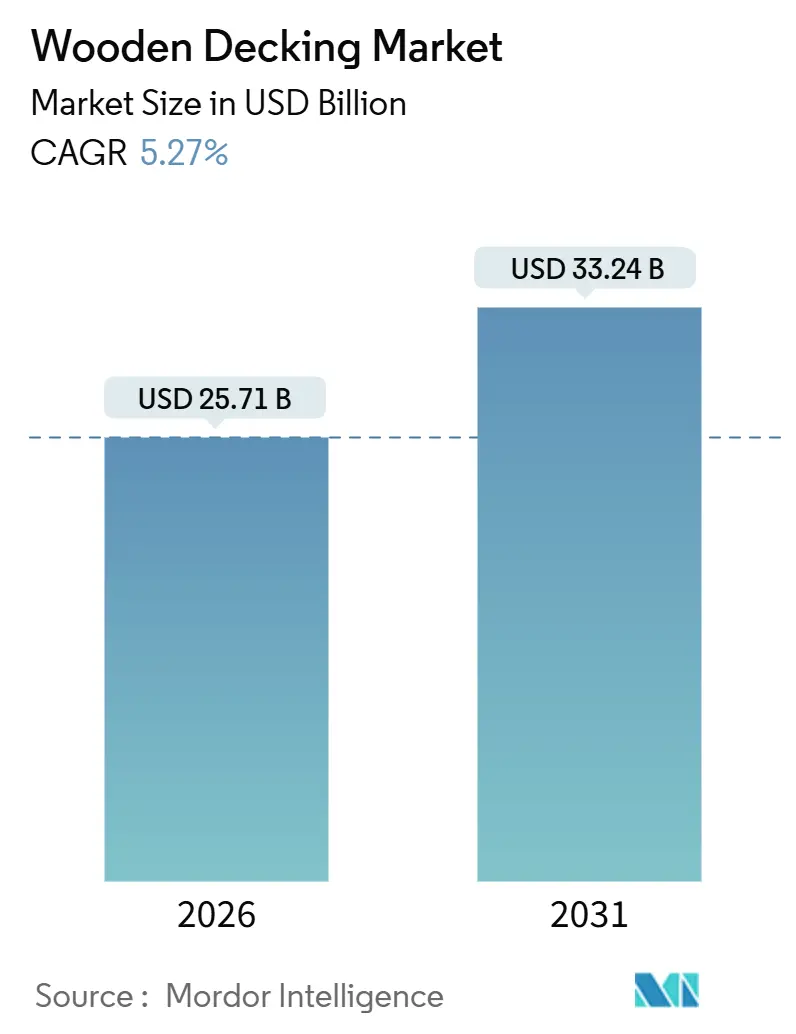
| Market Size (2026) | USD 25.71 Billion |
| Market Size (2031) | USD 33.24 Billion |
| Growth Rate (2026 - 2031) | 5.27 % |
| Fastest Growing Market | Asia Pacific |
| Largest Market | North America |
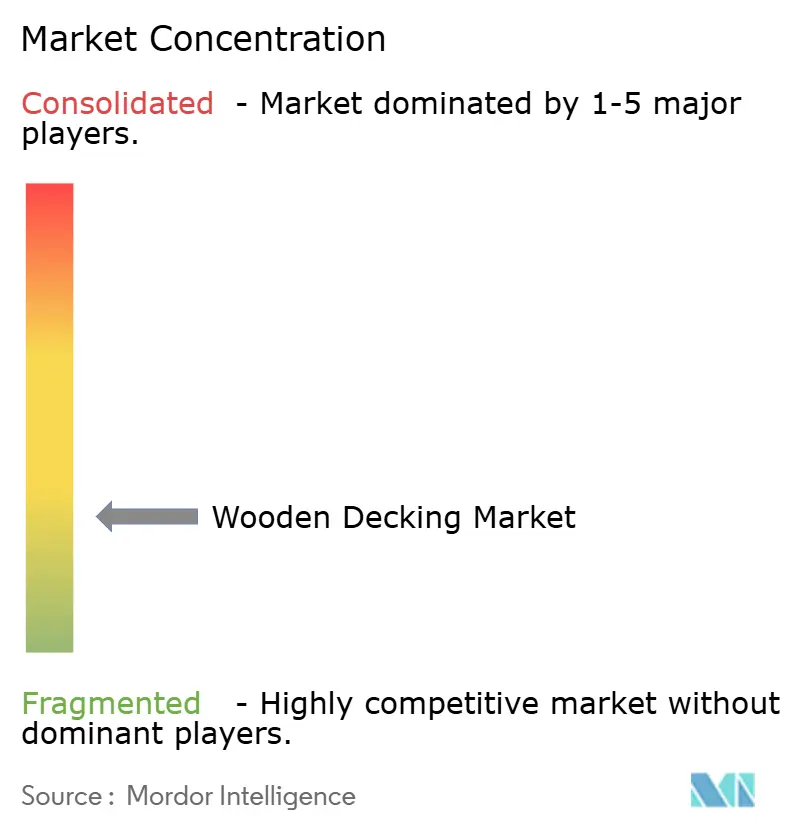
| Market Concentration | Low |
Major Players *Disclaimer: Major Players sorted in no particular order Image © Mordor Intelligence. Reuse requires attribution under CC BY 4.0. | |
Wooden Decking Market Analysis by Mordor Intelligence
The Wooden Decking Market size is estimated at USD 25.71 billion in 2026, and is expected to reach USD 33.24 billion by 2031, at a CAGR of 5.27% during the forecast period (2026-2031). This growth path reflects resilient residential remodeling demand, expanding green-building mandates, and rapid innovation in modified-wood technologies that together buoy the wooden decking market even as composite substitution intensifies. Pressure-treated pine retains price leadership, yet consumers continue to favor materials that promise longer service life, lighter maintenance, and verified sustainability credentials. Regional dynamics remain diverse: North America benefits from an aging housing stock and a strong DIY culture, while Asia-Pacific delivers the fastest incremental volume thanks to ongoing urbanization and a growing middle-class homeowner base. Over the next five years, suppliers that align product portfolios with fire-safety codes, eco-certification requirements, and modular installation systems are expected to capture outsized gains within the wooden decking market.
Key Report Takeaways
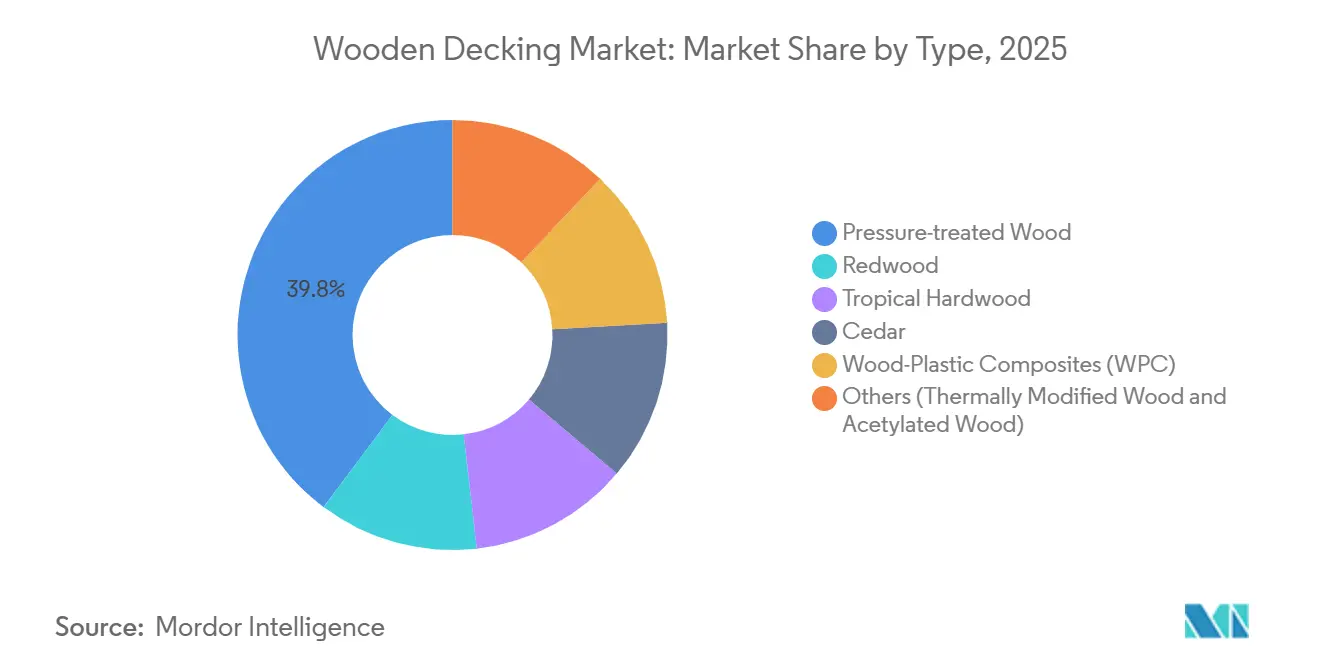
- By material type, pressure-treated wood held 39.75% of the Wooden Decking market share in 2025, while wood-plastic composites are forecast to expand at an 8.67% CAGR from 2026 to 2031.
- By application, floor installations accounted for 46.91% of the Wooden Decking market size in 2025 and will advance at a 5.42% CAGR through 2031.
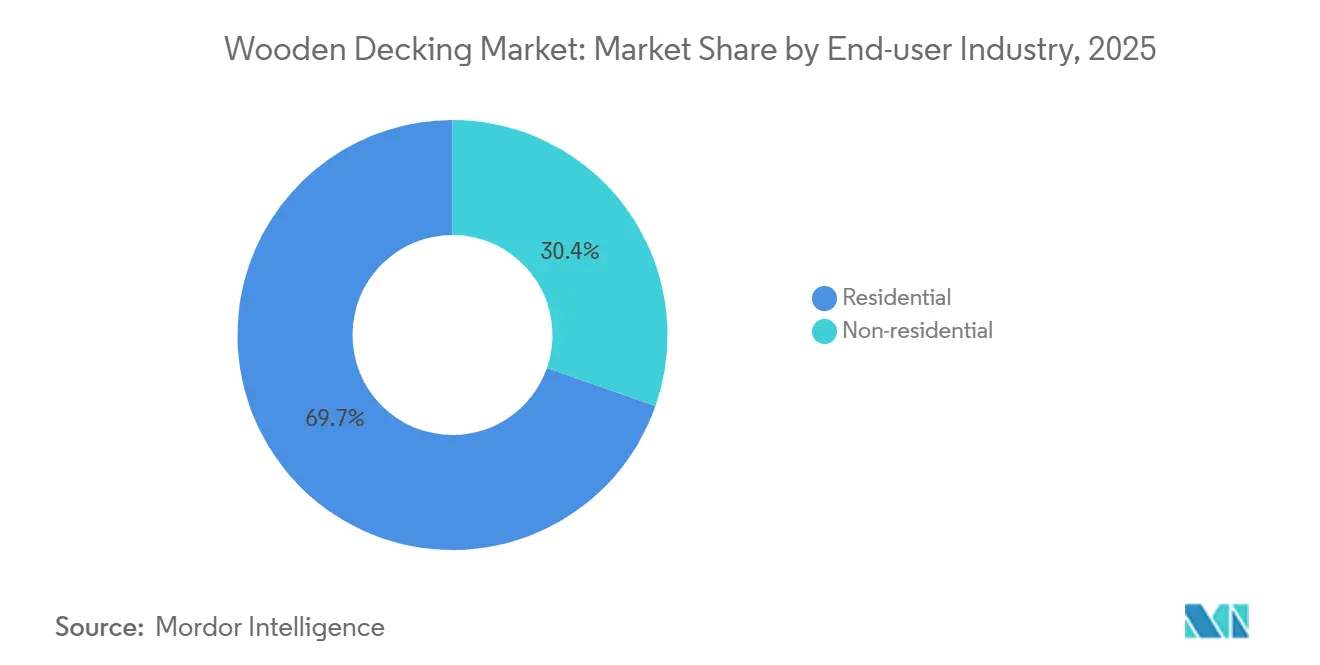
- By end user, residential projects represented 69.65% of demand in 2025; the segment is projected to grow at a 5.37% CAGR between 2026 and 2031.
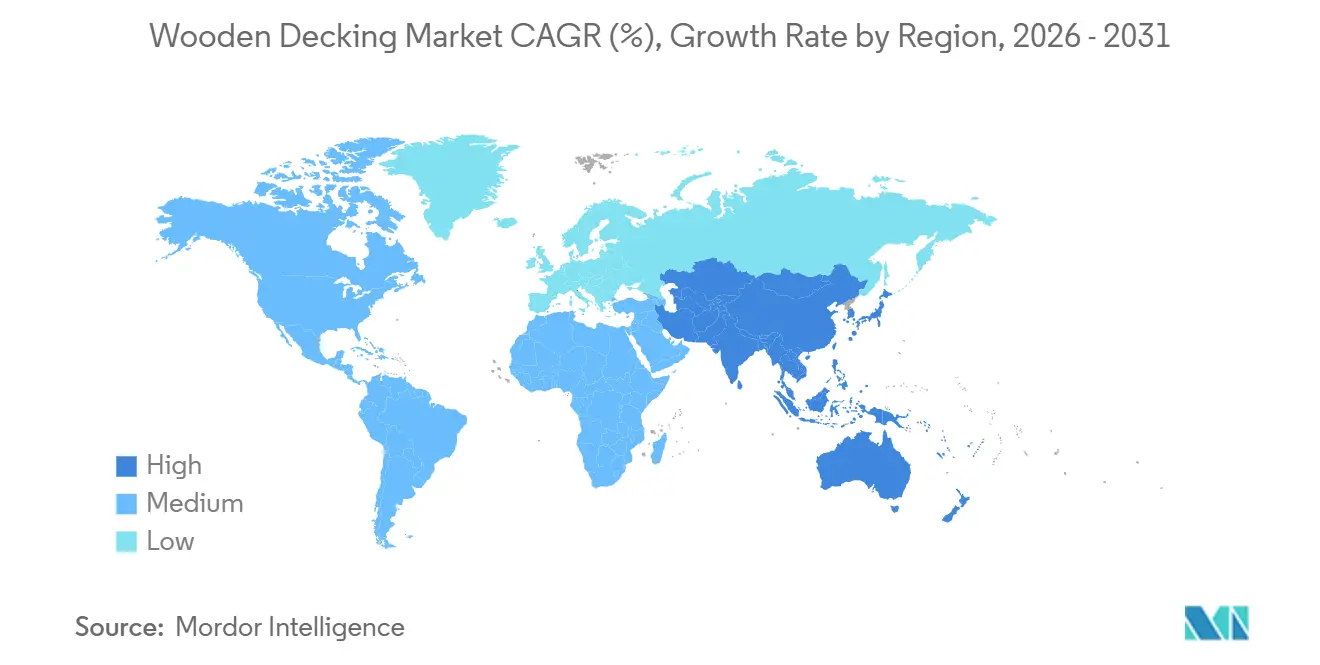
- By region, North America commanded 36.77% of the Wooden Decking market share in 2025, while Asia-Pacific is poised for the fastest regional CAGR of 5.37% during 2026-2031.
Note: Market size and forecast figures in this report are generated using Mordor Intelligence’s proprietary estimation framework, updated with the latest available data and insights as of January 2026.
Market Trends and Insights
Drivers Impact Analysis of Wooden Decking Market*
| Driver | (~) % Impact on CAGR Forecast | Geographic Relevance | Impact Timeline |
|---|---|---|---|
| Remodeling and refurbishment activities | +0.8% | United States, United Kingdom, Germany, France | Medium term (2-4 years) |
| Residential outdoor-living and DIY culture | +1.2% | Global focus on United States and Australia | Short term (≤ 2 years) |
| Eco-certified wood under green-building codes | +0.9% | Europe, California, Singapore | Long term (≥ 4 years) |
| Advances in thermally modified and acetylated wood technologies | +0.7% | Nordic producers and premium segments in North America | Long term (≥ 4 years) |
| Municipal mass-timber procurement | +0.4% | United Kingdom, France, Canada, Oregon, Washington | Long term (≥ 4 years) |
| Source: Mordor Intelligence | |||


Increase in Remodeling and Refurbishment Activities
Residential remodeling expenditure in the United States reached USD 485 billion in 2024, with outdoor-living upgrades such as deck replacement representing 12% of spend[1]Joint Center for Housing Studies, “Improving America’s Housing 2025,” jchs.harvard.edu. The median US home age exceeded 40 years in 2024, and decks built during the 1980s-1990s have reached end-of-life, prompting widespread replacement. Mortgage-rate pressure is discouraging home sales, so owners invest in improving existing properties, placing decking high on the project list. In Europe, the United Kingdom’s Timber in Construction Roadmap targets 300,000 cubic meters of additional timber usage each year by 2030, much of it tied to garden-decking and balcony upgrades. Bundling of energy-efficiency retrofits with outdoor-space enhancements further lifts volume. As a result, the wooden decking market gains predictable replacement demand that moderates cyclicality.
Surge in Residential Outdoor-Living and DIY Culture
Sixty-eight percent of US homeowners plan an outdoor project in 2025, up from 52% in 2019, underlining durable lifestyle shifts toward at-home leisure. Sales of decking materials to DIY customers at big-box retailers expanded at double-digit rates in 2024. Easy-to-assemble kits, hidden-fastener systems, and ubiquitous online tutorials have lowered the perceived difficulty of installing a deck, broadening the addressable buyer pool. Comparable momentum appears in Australia, where composite and timber decking volumes rose 15% year over year in 2024. The wooden decking market, therefore, benefits from both discretionary lifestyle spending and the democratization of installation skills.
Demand for Eco-Certified Wood Under Green-Building Codes
LEED v4.1 awards credits for FSC-certified wood, while LEED v5 extends recognition to PEFC and SFI certifications. California’s Title 24 update in 2025 requires environmental product declarations for all wood decking used in public projects, favoring suppliers with chain-of-custody documentation. The share of certified lumber in global industrial roundwood rose from 38% in 2020 to an estimated 48% in 2025. Extended service life from acetylated and thermally modified woods further strengthens lifecycle sustainability profiles, making eco-certified options commercially attractive. These rules anchor long-run demand within the wooden decking market instead of creating transient spikes.
Advances in Thermally Modified and Acetylated Wood Technologies
Thermal modification reduces hygroscopicity, delivering decking that resists warping in humid climates, while acetylation replaces hydroxyl groups to extend service life beyond 30 years. Accoya wood now carries a 50-year above-ground warranty and meets Class 1 durability under EN 350. Accsys doubled acetylation capacity to 80,000 cubic meters in 2024, lowering unit cost by 18%, and Kebony opened distribution channels in Japan and South Korea the following year. These innovations combine premium performance with non-toxic profiles, gradually converting design-conscious buyers and institutional specifiers, and thereby lifting the wooden decking market.
Restraints Impact Analysis of Wooden Decking Market*
| Restraint | (~) % Impact on CAGR Forecast | Geographic Relevance | Impact Timeline |
|---|---|---|---|
| Substitution by composite and PVC decking | -1.1% | Coastal United States, United Kingdom, Netherlands, Australia | Short term (≤ 2 years) |
| Volatile lumber prices and supply-chain shocks | -0.8% | Global, with acute swings in North America and Europe | Short term (≤ 2 years) |
| Stringent fire-safety rules on untreated softwoods | -0.6% | California, Oregon, Colorado, Australia bushfire zones | Medium term (2-4 years) |
| Source: Mordor Intelligence | |||
Rapid Substitution by Composite and PVC Decking
Wood-plastic composites captured 28% of U.S. decking demand in 2025, gaining six percentage points in five years[2]Trex Company, “Q3 2024 Earnings Release,” trex.com. Homeowners in high-moisture or salt-air regions favor maintenance-free surfaces, and national builders increasingly specify composites to cut warranty risk. Regulatory support compounds the shift: California’s 2025 Chapter 7A update requires Class A-rated decking in wildland-urban interface areas, a threshold that most untreated softwoods fail to meet. As composites replicate exotic-wood aesthetics and widen color choices, the wooden decking market confronts ongoing share dilution in coastal geographies.
Volatile Lumber Prices and Supply-Chain Shocks
Random Lengths framing-lumber prices swung between USD 430 and USD 475 per thousand board feet during 2024-2025, compressing contractor margins and delaying projects. Reduced North American sawmill capacity, wildfire-damaged timber, and export tariffs compound supply tightness. Similar pressures are seen in Europe, where bioenergy demand diverts logs away from lumber production. Unpredictable raw-material costs erode buyer confidence, nudging some toward composites that carry more stable pricing owing to integrated resin and fiber sourcing. Such volatility dampens near-term growth in the wooden decking market.
*Our forecasts treat driver/restraint impacts as directional, not additive. The impact forecasts reflect baseline growth, mix effects, and variable interactions.
Wooden Decking Market Segment Analysis
By Type:
Composites Challenge Pressure-Treated DominancePressure-treated wood retained a 39.75% share of the wooden decking market in 2025, thanks to its USD 1.50-2.00 per linear-foot price point and established retail networks. The segment still benefits from the AWPA 2024 updated Use Category system that reduced copper-azole loading by 12% without undercutting durability. Despite this base, composites are projected to log an 8.67% CAGR during 2026-2031, the quickest among all materials. Their encapsulated-shell designs prevent moisture ingress and carry warranties up to 50 years, narrowing long-term cost differentials. Thermally modified and acetylated woods, grouped under Others, were helped by capacity expansion at Accsys and distribution partnerships forged by Kebony and Thermory. As a result, the wooden decking market continues to bifurcate between value-driven pressure-treated lumber and performance-driven alternatives that command premium pricing.
Pressure-treated pine still satisfies budget buyers and large-volume DIY projects, while composites seize coastal share where humidity, salt spray, and fire codes accelerate lifecycle replacements. Tropical hardwoods remain a niche, concentrated in luxury hospitality and high-end residential settings that demand natural aesthetics and extreme density. Redwood and cedar supply constraints, triggered by lower federal timber sales in California, sustain pricing premiums that edge some specifiers toward thermally modified substitutes. Collectively, these dynamics underpin an evolving material mix that keeps innovation at the core of the wooden decking market.


By Application:
Flooring Anchors Demand, Railings Gain ShareFloor installations represented 46.91% of the wooden decking market size in 2025 and are expected to advance at a 5.42% CAGR through 2031. Growth stems from modular fastener systems that cut labor requirements by as much as 25%, encouraging wider DIY uptake and faster turnarounds for professional contractors. Railings captured nearly 30% share in 2025 and benefit from International Residential Code changes that now call for taller, more robust guardrails on elevated decks, increasing linear footage per project. This regulatory shift raises bill-of-materials value even when overall square footage remains stable.
Wall-cladding demand resides mainly in commercial segments; European architects frequently pair vertical wood elements with cross-laminated timber structures to achieve biophilic design goals and consistent material palettes. Other uses, including pergolas, privacy screens, and built-in furniture, absorb the balance of volume and enjoy strong price realization because homeowners treat these items as aesthetic upgrades. As multi-level outdoor rooms become common, accessories such as lighting channels and integrated seating drive incremental board-foot consumption, reinforcing positive mix dynamics within the wooden decking market.
By End-User Industry:
Residential Dominance, Non-Residential UpsideResidential customers commanded 69.65% of total volume in 2025 and are forecast to grow at a 5.37% CAGR during 2026-2031, mirroring housing-stock age profiles and a persistent stay-at-home lifestyle bias. Remodeling Magazine reported that wood-deck additions recoup 63% of cost at resale, boosting homeowner confidence in project payback. DIY channels continue to expand; individual consumers formed major decking sales at leading home-improvement chains in 2024. This deep, steady demand base underpins the wooden decking market even when new-build housing cycles pause.
Non-residential demand is projected to rise due to hotels, retail centers, and institutional builds that specify premium materials for high-traffic areas. Public-sector mass-timber schemes in Europe and Canada further enlarge institutional appetite for engineered-wood decking that shares aesthetics and structural coherence with primary CLT or glulam elements. Warranty requirements of 25 years or more and mandatory Class A fire ratings drive specifiers toward composites and modified woods, supporting revenue-per-foot growth across the wooden decking market.
Geography Analysis
North America Wooden Decking Market
North America controlled 36.77% of the wooden decking market in 2025, anchored by USD 485 billion in US remodeling spend that funnels 12% toward outdoor projects. Replacement cycles remain active because most decks installed before 2000 have reached the typical 20-25-year service limit. Canada’s updated 2025 building code, permitting 18-story mass-timber structures, adds public-plaza decking demand, and Mexico’s year-over-year rise in cement consumption during Q3 2024 indicates broader construction momentum that also lifts decking volumes. Fire-safety regulations in western US states accelerate composite penetration, while lumber-price volatility complicates planning for smaller contractors, nudging some to lock in composite supply contracts to avoid price swings.
APAC Wooden Decking Market
Asia-Pacific delivers the fastest CAGR at 5.37% through 2031. China’s focus on quality-of-life improvements in existing urban housing, despite wider real-estate cooling, favors balcony and terrace refurbishments that require decking. India’s 11% increase in 2024 housing starts boosts pressure-treated lumber shipments into tier-2 cities. Japan and South Korea gravitate toward premium acetylated or thermally modified species for high-rise balconies, a niche Kebony has targeted since expanding local distribution in 2025. ASEAN tourism rebounded in 2024, and hospitality chains in Thailand and Indonesia refurbished pool decks and beachfront walkways, thereby lifting composite and hardwood consumption.
Europe Wooden Decking Market
Europe remains a pivotal technology and policy leader within the wooden decking industry. The United Kingdom aims to inject 300,000 cubic meters of timber into construction annually by 2030, a figure that includes residential garden decking. Germany and France have begun adopting LEED v5 alongside DGNB standards, spurring uptake of FSC-certified lumber and boosting demand for product-specific environmental declarations. Nordic producers Thermory and Metsa Wood enjoy proximity to spruce and ash resources suitable for thermal modification, enabling competitive exports across Europe and into North America. Bioenergy competition for sawlogs, however, tightens supply and supports hardwood and composite pricing across the continent.
South America and MEA Wooden Decking Market
South America and the Middle East & Africa remain smaller contributors. Brazilian resort developments continue specifying tropical hardwoods despite a 2.1% contraction in domestic construction in 2024. Saudi Arabia’s Vision 2030 projects incorporate promenade decks, yet high reliance on imports inflates costs by nearly 30% compared with North American supply chains. While their combined volume remains modest, strategic vendors view these regions as future growth pockets once local standards evolve to prioritize sustainability and fire performance.

Value Chain Analysis
The wooden decking value chain begins with managed forests and timberland owners supplying logs, followed by harvesting contractors and primary processing (sawmills for softwoods such as pine, cedar, and redwood; and import channels for tropical hardwoods). Treatment and modification steps add value: preservative treatment aligned with AWPA U1 use categories for pressure-treated products, and thermal modification or acetylation for premium, low-toxicity durability. Material conversion then flows into profiling, machining, staining/coating, and accessory integration (fasteners, hidden-clip systems, rail kits), before reaching distribution through big-box retail, specialty pro-dealers, lumberyards, and contractor networks serving residential and non-residential projects.
Supply reliability and compliance documentation are the primary friction points. Europe-facing tropical supply has elevated due-diligence demands under deforestation-risk scrutiny, while Germany has faced timber-access constraints that lift sawlog costs and tighten availability despite standing timber volumes, impacting lead times and pricing across the chain. In response, players are using inventory buffering and substitution strategies, such as shifting volume from import-reliant hardwoods to U.S.-sourced thermally modified species, and expanding certified inventory for premium specifications (for example, FSC-positioned tropical decking inventory increases by specialist importers). These moves are also pulling more services into distribution, including chain-of-custody support and project-level documentation needed by institutional and public buyers.
Competitive Landscape
The Wooden Decking market is fragmented. Composite leaders Trex and AZEK benefit from vertically integrated extrusion lines and extensive dealer networks that standardize training and after-sales support. AZEK’s 2024 purchase of StruXure extends its reach into pergolas and complements railing lines, enabling packaged outdoor-structure deals that raise share of wallet. Given scale advantages in resin procurement and nationwide distribution, incremental consolidation is likely. Nonetheless, regional sawmills and specialty modifiers will stay relevant by offering localized species and fast turnarounds that large multinationals cannot match.
Wooden Decking Industry Leaders
Trex Company, Inc
The AZEK Company LLC
Fiberon
UFP Industries, Inc.
West Fraser Timber Co.
- *Disclaimer: Major Players sorted in no particular order
Wooden Decking Market Companies Covered in this Report
- Advantage Lumber, LLC.
- Deck Solutions LLC
- Deckorators Inc.
- DuraLife Decking and Railing Systems
- Fiberon
- Humboldt Sawmill Company LLC
- Kebony AS
- Metsa Wood
- NeoTimber
- Setra
- Shubh Composites
- Tecnodeck (Mitera Group)
- The AZEK Company LLC
- Thermory
- Trex Company Inc.
- UFP Industries, Inc.
- United Construction Products Inc. (BISON Innovative Products)
- West Fraser Timber Co.
- Weyerhaeuser Company

Market Opportunities and Future Outlook
A clear whitespace sits at the intersection of durability, sustainability documentation, and code compliance. Green-building frameworks that reward certified wood and product-specific documentation increase the value of chain-of-custody services, environmental product declarations, and verified sourcing for wood decking, especially in public and institutional procurement. At the same time, stricter deck-code expectations in the International Residential Code (IRC) ecosystem keep decay resistance and treatment standards central for mainstream installations, supporting opportunities for suppliers that package compliant lumber with installation systems and accessories.
Material innovation and adjacent categories create additional expansion lanes. Research programs and funded initiatives pursuing non-toxic wood protection chemistry, including lignin-based impregnation concepts (such as Innovation Fund Denmark backed work) and academic demonstrations of bio-based impregnation approaches, highlight an R&D pipeline aimed at reducing reliance on traditional heavy-metal or biocide preservatives in exterior wood. Separately, fastener compatibility requirements tied to modern copper-based pressure treatments (hot-dip galvanized, stainless steel, silicon bronze, or copper options) broaden the accessory and systems opportunity around treated-wood decks. Ongoing investment in mass timber supply chains and capacity (notably in North America through end-2025) also supports a wider ecosystem for forestry-derived performance materials and documentation workflows that can spill over into decking specifications and procurement.
Recent Industry Developments in Wooden Decking Market
- July 2026: Trex Company announced a realignment of its North American distribution network. The move targets tighter national coverage and better channel alignment, influencing product availability, service levels, and competitive positioning at the dealer and contractor level.
- June 2026: Deckorators (UFP Industries) opened a 253,310-square-foot manufacturing facility in Lackawanna, New York, backed by a USD 77 million investment. The site expands regional manufacturing reach and doubles production capacity for products using Surestone technology, improving responsiveness to Northeast demand and logistics efficiency.
- November 2025: SRS Distribution announced its acquisition of Specialty Wood Products, a distributor focused on premium wooden decking, siding, heavy timber products, and other architectural-grade materials. The deal strengthens SRS reach in higher-end wood categories and expands the channel footprint for specialty decking specifications.


Wooden Decking Market Report Scope and Research Methodology
Market Definition and Coverage
This market covers revenue generated from wooden decking products used to build or renovate outdoor deck surfaces and related structures across residential and non-residential settings across major regions.
Scope exclusions: Decking installation labor and general construction services are excluded from the market value.
Segments Covered in This Report
- By Type
- Pressure-treated Wood
- Redwood
- Tropical Hardwood
- Cedar
- Wood-Plastic Composites (WPC)
- Others (Thermally Modified Wood, Acetylated Wood)
- By Application
- Railing
- Floor
- Wall
- Other Applications
- By End-user Industry
- Residential
- Non-residential
- By Geography
- Asia-Pacific
- China
- India
- Japan
- South Korea
- ASEAN Countries
- Rest of Asia-Pacific
- North America
- United States
- Canada
- Mexico
- Europe
- Germany
- United Kingdom
- France
- Italy
- Spain
- Russia
- Rest of Europe
- South America
- Brazil
- Argentina
- Rest of South America
- Middle-East and Africa
- Saudi Arabia
- South Africa
- Rest of Middle-East and Africa
- Asia-Pacific
Data Sources, Market Sizing, and Validation
Desk Research
Desk research was used to build the demand context and to anchor assumptions that later get tested in interviews. We reviewed public construction and remodeling indicators, timber and wood-products trade flows, and macro drivers that affect outdoor building activity.
Typical references included sources such as the US Census Bureau construction spending series, USDA and US Forest Service publications, FAO forestry statistics, UN Comtrade trade data, and customs or port statistics from key importing countries. We also checked company annual reports and investor presentations for product mix cues, along with trade-association websites and reputable press coverage for shifts in building codes and sustainability claims. Where needed, a paid subscription covering company financials and another covering shipment-level import and export records were used to cross-check scale and pricing direction. These examples are not exhaustive, and we consulted additional sources to collect data, validate assumptions, and clarify open questions.
Primary Interviews and Surveys
Primary interviews focused on validating what actually sells as wooden decking, how price points move by wood type, and how demand changes with repair and remodel cycles across regions. We spoke with a mix of manufacturers, distributors, contractors, and large buyers to address gaps left by public data, then used the inputs to test volume, mix, and margin assumptions before finalizing totals.
Distribution of primary research fieldwork respondents
| Company type | Respondent position | Region |
|---|---|---|
| Top tier: 39% | CXOs: 16% | APAC: 49% |
| Mid tier: 44% | Functional/Unit leaders: 24% | EMEA: 30% |
| Smaller Players: 17% | Managers: 60% | Americas: 21% |
Market-Sizing & Forecasting
Sizing started with a top-down demand pool built from construction and remodeling activity, then translated it into decking demand using penetration and usage rates for outdoor decks and renovation jobs. We corroborated the totals with selective bottom-up checks, such as rolling up a sampled set of supplier revenues, and testing implied volumes using average selling price ranges by wood type and application.
Inputs that mattered in the model included housing starts and permitting trends, repair and remodel spending, per-project deck area ranges, the share of projects using pressure-treated wood versus cedar or hardwood, and observed price movement tied to lumber and treatment costs. We also incorporated seasonality and regional weather patterns because they affect installation timing and dealer inventory turns. For forecasting, we used scenario analysis supported by an exponential smoothing backbone on key demand indicators, and then adjusted the outlook based on expert views on renovation cycles and substitution trends.
When bottom-up signals were incomplete, gaps were handled by applying conservative mix assumptions by application and end-user, followed by checks that the implied market size by region stayed consistent with trade flows and construction activity.
Data Validation & Update Cycle
The model was validated through multiple cross-checks to ensure no single data series could over-influence the final number. Outputs were compared against independent signals such as timber trade direction, regional construction momentum, and price trends, and any large variances were reviewed before sign-off.
If an outlier showed up, analysts revisited the input assumptions, rechecked unit conversions and currency timing, and re-contacted select respondents when the variance could not be explained by public indicators alone. Reports are refreshed annually, with interim updates triggered by material events such as sharp raw-material price swings or major regulatory changes. Before delivery, a final review pass is completed so clients receive the most current view available at that time.
Mordor Intelligence's Wooden Decking Market Sizing Compared With Other Published Estimates
Published market sizes for wooden decking can look far apart because the included product basket and the counted revenue line are not always the same, even when the market name matches. Differences also come from the year used as the starting point, the way prices are projected, and how strictly assumptions are validated with channel feedback.
Decking installation labor and general construction services sit outside Mordor Intelligence's scope, which is one key reason the 2026 value can differ from figures that bundle project spending into the product market. Another common gap is that some estimates treat wood-plastic composites differently or apply broad lumber price inflation to finished decking without testing it against distributor pricing and mix shifts by wood type.
Benchmark comparison
| Source | Market Size | Gaps in Research Methodology |
|---|---|---|
| Mordor Intelligence | USD 25.71 B (2026) | |
| Global Consultancy A | USD 5.52 B (2024) | Uses an earlier base year and a narrower counted revenue pool that appears closer to select wooden-deck board revenues, which can exclude adjacent applications and non-residential demand in some regions. |
| Industry Publisher B | USD 8.26 B (2025) | Relies on a different start year and a slower price and mix progression, which can understate the lift from renovation-driven demand and premium wood-type mix in higher value markets. |
The table shows that timing and scope choices explain most of the spread, more than small math differences. By keeping the counted value tied to product revenues and then testing volume, mix, and price assumptions against real channel feedback, the estimate stays traceable to clear inputs and repeatable checks.


Key Questions Answered in the Report
What is the current value of the wooden decking market?
The wooden decking market size is USD 25.71 billion in 2026 and is set to reach USD 33.24 billion by 2031.
Which region is growing the fastest for wooden decking?
Asia-Pacific holds the highest forecast CAGR at 5.37% between 2026 and 2031 due to rapid urbanization and expanding middle-class homeownership.
Why are composites gaining share against traditional wood?
Composites offer low maintenance, Class A fire ratings, and warranties up to 50 years, making them attractive in coastal and wildfire-prone areas.
How do fire-safety codes affect material choice?
How do fire-safety codes affect material choice?
Which application dominates wooden decking demand?
Which application dominates wooden decking demand?
Page last updated on:


 Your data is secure and never sold or shared.


