
Market Overview
| Study Period | 2020 - 2031 |
|---|---|
| Forecast Data Period | 2026 - 2031 |
| Base Year Market Size (2025) | USD 148.73 Billion |
| Market Size (2026) | USD 154.17 Billion |
| Market Size (2031) | USD 184.5 Billion |
| Growth Rate (2026 - 2031) | 3.66 % |
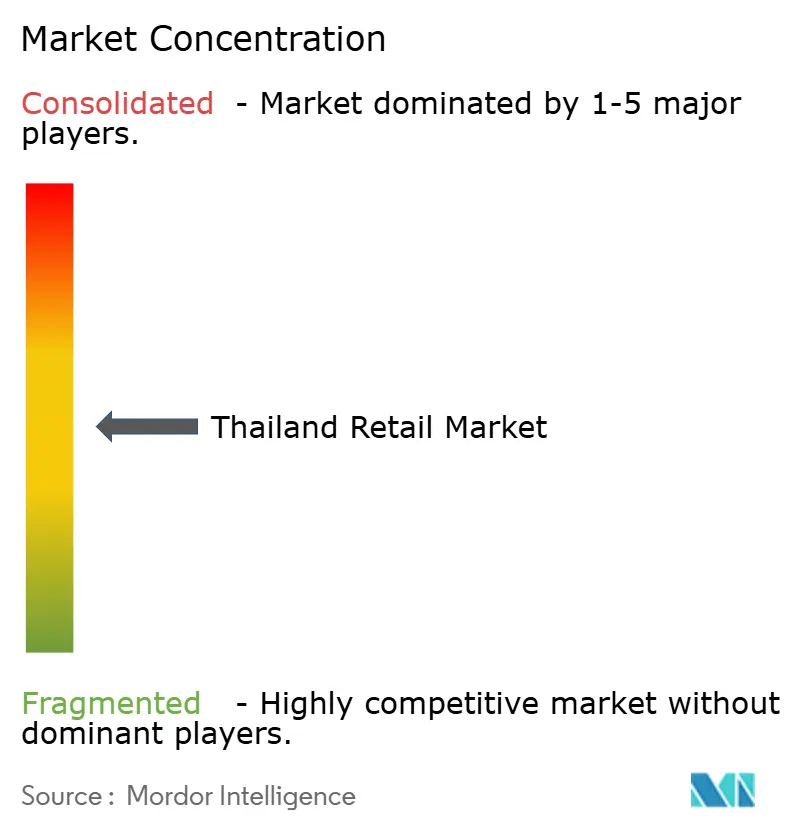
| Market Concentration | Medium |
Major Players *Disclaimer: Major Players sorted in no particular order Image © Mordor Intelligence. Reuse requires attribution under CC BY 4.0. | |
Thailand Retail Market Analysis by Mordor Intelligence
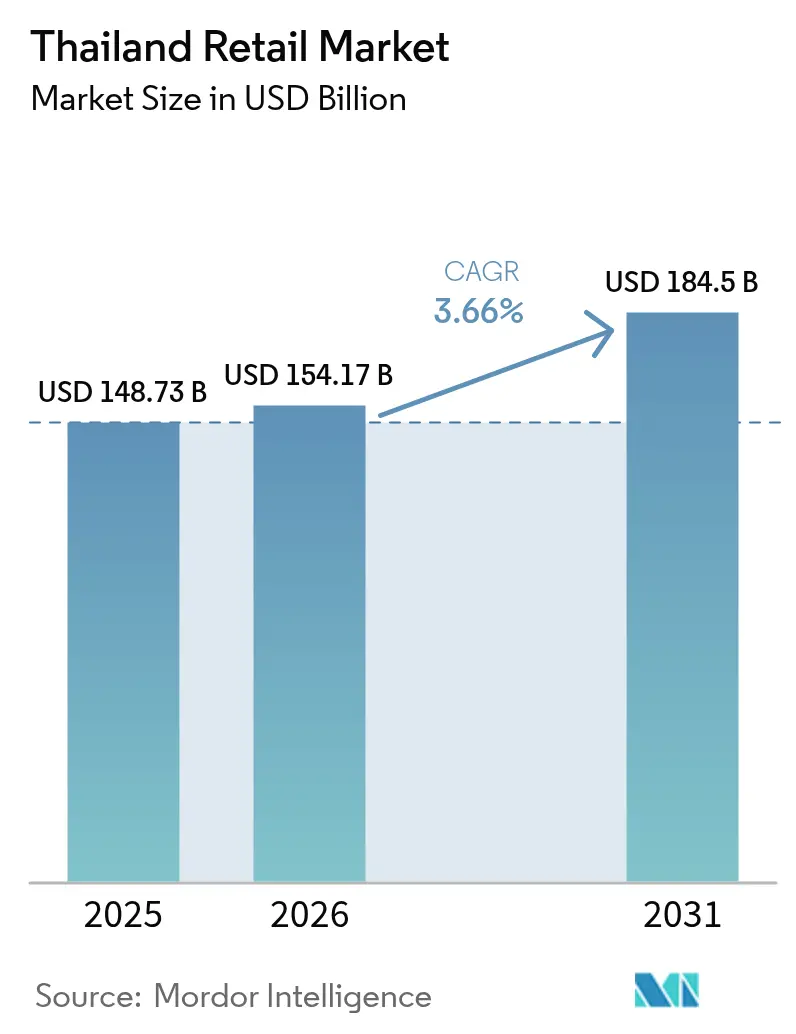
The Thailand retail market size is expected to grow from USD 148.73 billion in 2025 to USD 154.17 billion in 2026 and is forecast to reach USD 184.5 billion by 2031 at 3.66% CAGR over 2026-2031. Household deleveraging, evolving payment systems, and sustained tourism inflows form the bedrock of growth, while persistent cost pressures and muted credit expansion temper the outlook. Omnichannel integration accelerates as PromptPay usage tops 52.7 million accounts, steering consumers toward friction-free shopping journeys[1]. Quick-commerce fulfillment networks continue to proliferate, raising the competitive bar for inventory localization and same-hour delivery propositions. Modern trade chains extend footprints into rural provinces, leveraging mobile wallets and data-driven category management to capture rising up-country spending.
Key Report Takeaways
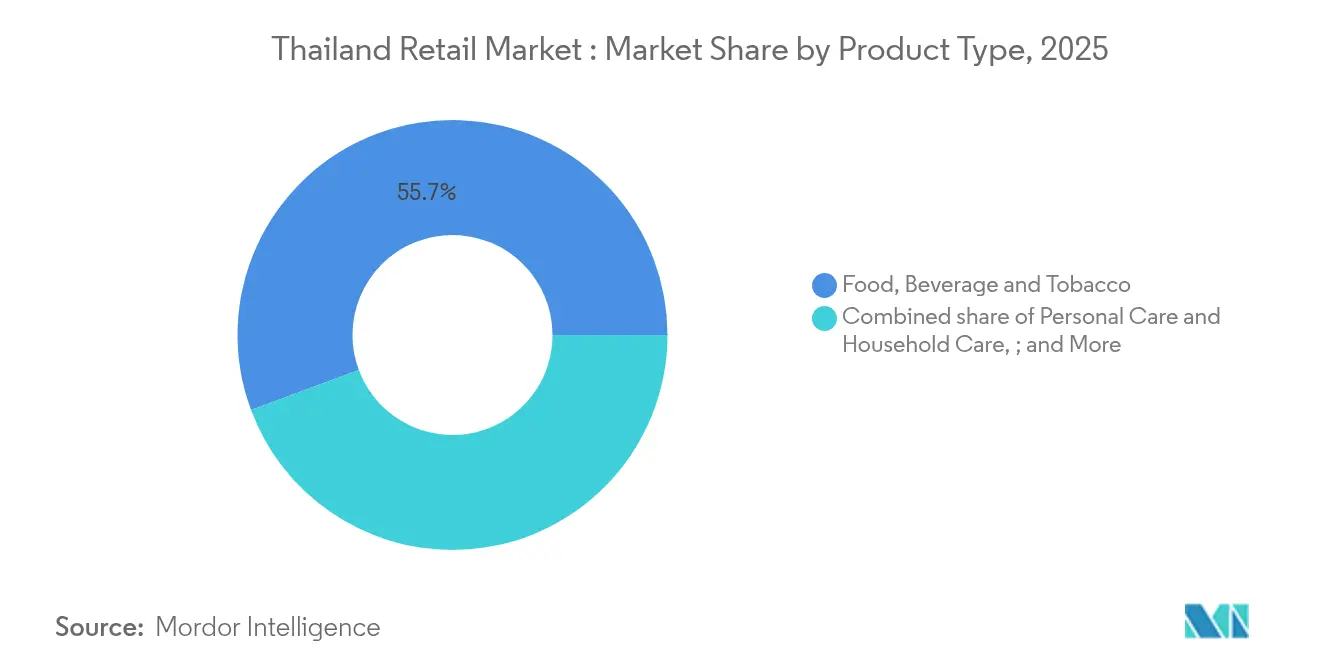
- By product type, food, beverage & tobacco captured 55.68% of the Thailand retail market share in 2025, while personal care & household care is projected to grow at a CAGR of 11.15% between 2026 and 2031.
- By retail channel, traditional mom & pop outlets accounted for 44.10% of the Thailand retail market share in 2025, whereas e-commerce & others are expected to expand the Thailand retail market size at a CAGR of 16.85% during 2026–2031.
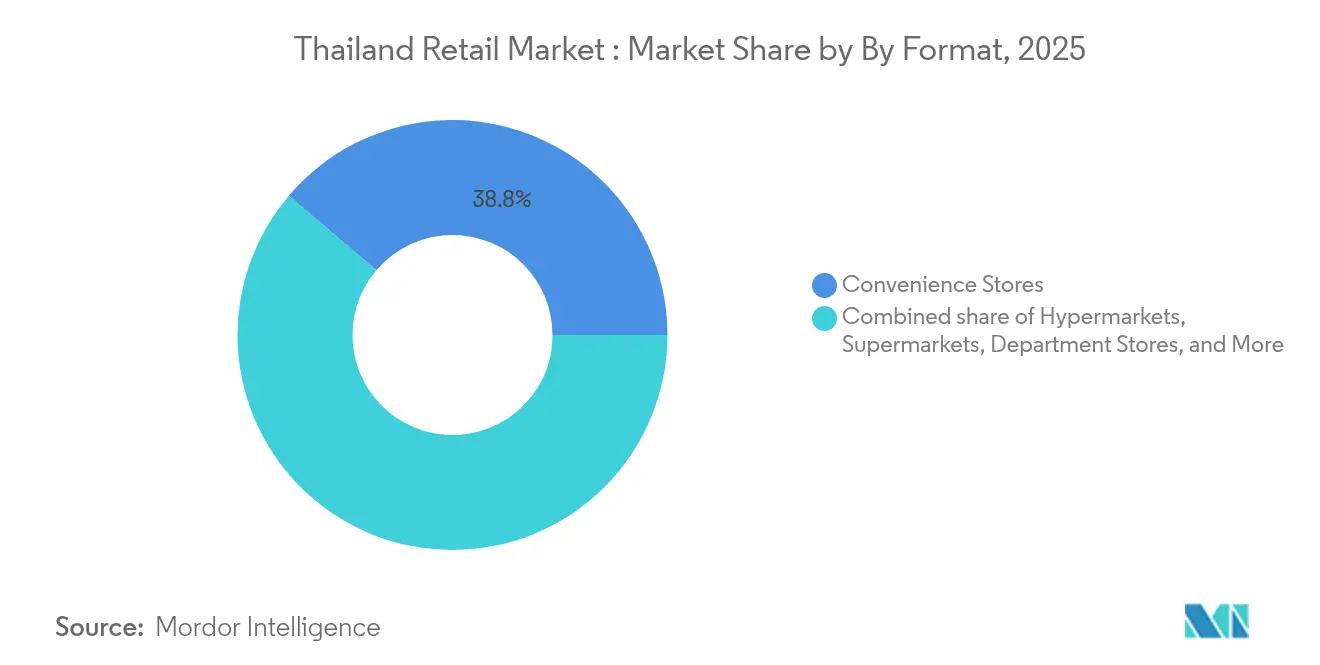
- By format, convenience stores held 38.78% of the Thailand retail market share in 2025, and the segment is forecast to advance the Thailand retail market size with a CAGR of 10.15% from 2026 to 2031.
Note: Market size and forecast figures in this report are generated using Mordor Intelligence’s proprietary estimation framework, updated with the latest available data and insights as of 2026.
Market Trends and Insights
Drivers Impact Analysis of Thailand Retail Market *
| Driver | (~) % Impact on CAGR Forecast | Geographic Relevance | Impact Timeline |
|---|---|---|---|
| Quick-commerce demand in Bangkok & tier-2 cities | +1.2% | Bangkok, Chiang Mai, Phuket | Short term (≤ 2 years) |
| Tourism rebound lifting discretionary spend | +0.8% | Bangkok, Phuket, Pattaya | Medium term (2-4 years) |
| Modern trade push into rural provinces | +0.6% | Northeast & North | Long term (≥ 4 years) |
| “Thailand 4.0” digital-payment incentives | +0.4% | National | Medium term (2-4 years) |
| E-commerce platform expansion and logistics improvements | +1.0% | Nationwide | Short to Medium term (1–3 years) |
| Rising middle-class incomes driving premium product demand | +0.7% | Bangkok, Chiang Mai, Khon Kaen | Medium term (2–4 years) |
| Source: Mordor Intelligence | |||
Surging Quick-Commerce Demand in Bangkok & Tier-2 Cities
Dark stores and micro-fulfillment hubs redefine urban logistics as consumers embrace 30-minute delivery promises. Operators deploy AI-based demand forecasting to trim spoilage and raise pick-accuracy, enabling higher service levels without inflating costs. Parcel-sorting automation at Thailand Post complements private last-mile fleets, ensuring consistent peak-season throughput[2]. Food-focused aggregators consolidate, leaving capitalized players to widen assortment beyond meals into daily essentials. Retailers test “shop-in-app” livestreams to blend impulse discovery with rapid fulfillment, capturing incremental basket value. Regulatory attention centers on traffic congestion and rider-safety mandates, potentially reshaping service geographies over time.
Tourism Rebound Lifting Discretionary Retail Spend
Tourist arrivals rose past 35 million in 2024, restoring footfall across flagship malls and duty-free stores. Average international trip expenditure climbed to THB 50,900 (USD 1,450), with more than half of bookings executed online, signaling heightened digital engagement[3]. Luxury beauty, travel retail exclusives, and local craft items see higher conversion as visitors pursue experiential purchases. Retail landlords allocate incremental space to F&B and themed zones that capture tourist dwell-time. Currency strength of key source markets China, Malaysia, South Korea directly shapes SKU mix and promotional calendars. While geopolitical shocks could disrupt flows, ongoing infrastructure upgrades at Bangkok’s airports enhance long-term capacity and retail tenancy demand.
Modern Trade Expansion into Rural Provinces
The strategic push by major retailers into previously underserved provincial markets represents a fundamental shift in Thailand's retail geography, driven by rising rural purchasing power and infrastructure improvements. Major operators plan approximately 1,000 new store openings in 2024, with significant focus on smaller format stores designed for provincial markets, including Big C's 200 Mini branches and Lotus's 100 Go Fresh branches. This expansion strategy capitalizes on limited competition in rural areas while addressing evolving consumer preferences for modern shopping experiences and product variety. The franchise sector's 9% growth to THB 300 billion (USD 9.25 billion) in 2024, particularly driven by young entrepreneurs in provincial areas, demonstrates increasing market sophistication and purchasing power beyond traditional urban centers. Success in provincial markets requires careful adaptation to local preferences, supply chain optimization for smaller volumes, and community engagement strategies that respect traditional retail relationships while offering superior value propositions.
Government “Thailand 4.0” Digital-Payment Incentives
Thailand's comprehensive digital transformation initiative accelerates retail sector modernization through infrastructure investments and consumer incentive programs that reshape payment behaviors and business models. The government's digital wallet program distributing approximately USD 276 to 45-50 million citizens through the 'Tang Rat' application represents a USD 12.5 billion stimulus directly targeting consumer spending. The PromptPay system, with 52.7 million users and widespread QR code adoption, has made seamless digital payments a new normal across retail formats. These initiatives not only increase transaction efficiency and transparency but also expand financial inclusion, empowering small businesses and supporting the rise of omnichannel retail. Regulatory influence from the Bank of Thailand and the Digital Economy Promotion Agency ensures robust frameworks for digital transactions, while ongoing infrastructure upgrades position Thailand as a regional leader in cashless commerce.
Restraints Impact Analysis of Thailand Retail Market *
| Restraint | (~) % Impact on CAGR Forecast | Geographic Relevance | Impact Timeline |
|---|---|---|---|
| High household debt curbing big-ticket buys | -1.0% | National | Short term (≤ 2 years) |
| Rising minimum wages squeezing margins | -0.6% | National | Medium term (2-4 years) |
| Fragmented cold-chain limiting fresh e-grocery | -0.3% | Rural & peri-urban | Long term (≥ 4 years) |
| Grey-market imports diluting brand equity | -0.2% | Border provinces & online | Short term (≤ 2 years) |
| Source: Mordor Intelligence | |||
High Household Debt Curbing Big-Ticket Purchases
Debt-to-GDP ratios exceeding 90% constrain credit appetites as lenders tighten scoring models. Auto and consumer-durable loans decelerate, prompting retailers to emphasize entry-level SKUs, refurbishment programs, and subscription models. Promotional calendars pivot toward value packs and zero-interest installments shorter than 12 months. Government debt-relief pilots for vulnerable households alleviate stress but lack scale to spark immediate spending surges. Retailers counter by bundling financial services—micro-insurance, layaway—within loyalty ecosystems, spreading payments without impairing cashflow. The trajectory implies muted volume growth for white goods until mid-2027, when income gains are projected to restore affordability.
Rising Minimum Wages Squeezing Retail Margins
Nationwide wage floor adjustments elevate labor costs, particularly in convenience and department stores where staffing densities are high. Chains deploy self-checkout kiosks and shelf-scanning robots to offset payroll inflation, reallocating associates to advisory roles that enhance upsell rates. Smaller independents face disproportionate strain due to limited capex capacity, accelerating consolidation or formal franchise affiliation. Retailers explore flexible scheduling and senior hiring programs to tap a growing 60-plus talent pool, aligning with demographic realities. Productivity gains from workforce digitization are essential to preserve EBITDA margins amid rising utilities and logistics expenses.
*Our forecasts treat driver/restraint impacts as directional, not additive. The impact forecasts reflect baseline growth, mix effects, and variable interactions.
Thailand Retail Market Segment Analysis
By Product Type:
Food Anchors, Wellness AcceleratesFood, Beverage & Tobacco retained a 55.68% Thailand retail market share in 2025, underpinned by dependable domestic demand and menu innovation that appeals to tourists and locals alike. The segment benefits from resilient agri-supply chains and government food-security initiatives that stabilize farm-gate prices. Modern grocery chains amplify local sourcing to hedge currency swings and shorten replenishment cycles. In contrast, Personal Care & Household Care posts an 11.15% CAGR through 2031 as aging consumers pursue functional skincare, nutraceuticals, and eco-friendly detergents. Cross-border e-commerce introduces niche J-beauty and K-beauty lines, elevating competitive benchmarks on ingredient transparency. Brands emphasize recyclable packaging and halal certification to capture diverse urban cohorts. Electronics and home appliances record softer momentum as deferred upgrades coincide with debt overhang, yet premium smart-home bundles retain a tech-savvy niche.
The Thailand retail market size for Personal Care & Household Care is projected to climb from USD 15.45 billion in 2026 to USD 26.18 billion by 2031, while Food, Beverage & Tobacco expands steadily to USD 104.12 billion, confirming both defensive and aspirational consumption poles. Parallel-import and counterfeit challenges prompt multinationals to deploy serialization and QR-based authenticity checks, educating shoppers on safe-channel purchases. Specialty food exporters leverage origin-tracing platforms to differentiate at modern trade shelves. Regulatory enforcement of intellectual-property laws intensifies at customs points, curbing grey flows and shielding authorized distributors’ price architecture. Overall, product diversification and premium-tier development mitigate topline reliance on core staple categories.

By Retail Channel:
Informal Resilience Meets Digital DisruptionTraditional Mom & Pop outlets captured 44.10% of Thailand retail market size in 2025 as community trust, micro-credit extension, and proximity remain compelling among lower-income shoppers. Wholesaler route-to-market models support these stores with direct drop-offs and short credit terms, minimizing stock-out risk. The rise of QR payments empowers small proprietors to lower cash-handling costs and join loyalty coalitions sponsored by FMCG majors. Conversely, E-Commerce & Others grows at a 16.85% CAGR, propelled by live-stream shopping, gamified vouchers, and cross-border campaigns originating from China-based platforms. National data-privacy regulations mandate local data-center residency, pushing platforms to upgrade compliance infrastructure.
Marketplace operators enhance regional fulfillment centers, achieving next-day coverage across 90% of postal codes. Hybrid pickup points embedded in convenience stores widen delivery options, bridging last-mile gaps in rural districts. Modern trade banners respond by integrating endless-aisle kiosks and click-and-collect bays, converging physical and digital paths. Meanwhile, government consumer-protection laws require transparent seller identification and return policies, bolstering trust. The competitive narrative shifts toward retail media networks that monetize first-party data streams, an arena where big-box incumbents enjoy traffic advantages over pure-plays.
By Format:
Convenience Stores Extend the LeadConvenience Stores held 38.78% of Thailand retail market size in 2025, outperforming other formats through strategic density in mass-transit nodes and residential clusters. Operators roll out AI-driven planograms that tailor SKU mixes to 200-meter catchment demographics, maximizing turns. Differentiated food-service counters offering freshly prepared meals elevate ticket averages and combat margin erosion. Cashless self-checkout lanes shrink queue times and liberate staff for value-added engagement. Hypermarkets reposition as multi-purpose “retail-tainment” hubs, incorporating indoor playgrounds and wellness clinics to revive weekend traffic. Department stores revamp beauty halls with augmented-reality mirrors and curated local designer pop-ups, catering to experience-seeking tourists. Specialty stores focus on high-touch advisory categories such as pet care, cycling, and DIY, leveraging expert staff to justify price premiums.
The format race tightens as operators invest in solar-powered rooftops and energy-efficient refrigeration to lower opex and meet ESG targets. Regulatory zoning continues to cap hypermarket footprints in dense districts, fueling smaller-box experimentation. Franchise-based convenience concepts accelerate in provincial towns, enhancing brand visibility while harnessing local market knowledge. By 2030, convenience outlets are forecast to exceed 27,000, anchoring last-mile parcel networks and reinforcing the Thailand retail market’s omnichannel backbone.
Regulatory Landscape
Thailand retail operates under a mix of competition, consumer protection, foreign ownership, and price-control measures. On March 25, 2026, the Trade Competition Commission of Thailand (TCCT) brought Guidelines on Multi-Sided Platforms and E-commerce Businesses into force, increasing compliance focus on platform governance, data use, algorithmic ranking, and anti-competitive conduct. This has direct implications for marketplaces and omnichannel retailers running digital storefronts.
On pricing and essential goods, the Ministry of Commerce (through the Committee on the Price of Goods and Services) oversees controlled-goods mechanisms, with late-March 2026 proposals to expand the controlled goods list and broaden the set of goods requiring approval for price increases. Foreign participation in retail remains governed by the Department of Business Development requirements, including the need for a Foreign Business License for foreign-owned retail activities and stipulated minimum-capital thresholds. Cross-border merchandise flows are governed by Thai Customs tariff administration under the ASEAN Harmonized Tariff Nomenclature (AHTN) and the Customs Tariff Decree B.E. 2530 (1987), influencing landed costs and documentation for imported retail assortments.
Value Chain Analysis
Thailand retail value creation starts with domestic and imported sourcing across FMCG, fresh food, personal care, apparel, and durables, then moves through brand owners and distributors that supply wholesalers, modern trade chains, and traditional trade. Omnichannel models increasingly link store networks with e-commerce marketplaces and social commerce, supported by payments infrastructure, including QR-based rails such as PromptPay, and by customer data and loyalty stacks used for targeted promotions and retail media monetization.
Distribution and fulfillment are shifting toward centralized and automated logistics as large retailers build-to-suit facilities aligned with national logistics corridors, including the Eastern Economic Corridor (EEC) and airport-linked industrial zones. Capability upgrades include Big C's 89,000 sqm distribution hub in Bang Pa-in (completed 2025), Watsons Thailand commencing operations at a 25,000 sqm distribution center in Bangplee (April 2026), and MR. D.I.Y. signing to acquire land for an automated distribution center at ARAYA, The Eastern Gateway (announced November 2025). Persistent friction points include cold-chain depth outside major cities, uneven logistics management maturity among smaller operators, and rising quick-commerce expectations, which push retailers to localize inventory in micro-fulfillment nodes and tighten last-mile partnerships.
Competitive Landscape
In 2024, the top players held a significant share of Thailand’s retail market, reflecting a moderately concentrated landscape where scale provides bargaining power, but local agility continues to play a critical role. Leading chains deploy machine-learning engines that recalibrate prices multiple times daily, enhancing value perception and raising basket sizes. Strategic acquisitions extend capabilities; prominent examples include a Thai conglomerate acquiring a European department-store chain, broadening private-label sourcing options and luxury know-how. Retailers forge cross-border alliances with Japanese convenience giants to co-develop food-to-go menus tuned to Thai palates while exploiting procurement synergies.
Digital-wallet and loyalty-app ecosystems evolve into data-rich advertising platforms, birthing new revenue streams. For example, a cash-and-carry wholesaler partners with a global media agency to launch a retail-media network that targets SME shoppers inside and outside physical stores. Sustainability gains momentum as leading grocers sign MoUs on recyclable packaging and commit to halving single-use plastic by 2030. Exit of a foreign food-delivery platform accelerates consolidation, empowering remaining players to invest in autonomous delivery pilots and dark-kitchen expansions. Cold-chain specialists and parcel integrators vie for contracts as grocery players scale e-commerce.
Fragmentation persists in niche categories such as specialty fashion and DIY, where local brands leverage cultural resonance and agile replenishment cycles to fend off global entrants. Intellectual-property enforcement intensifies; customs authorities deploy AI-powered image recognition to intercept counterfeit shipments, safeguarding authorized retailers’ margins. Competitive intensity is expected to heighten as 5G-enabled in-store analytics mature, leveling decision-making across store sizes. Strategic emphasis on omnichannel profitability over sheer footprint growth characterizes the next strategic horizon.
Thailand Retail Industry Leaders
-
CP All PCL (7-Eleven Thailand)
-
Central Retail Corporation
-
Lotus’s (Ek-Chai Distribution System)
-
Big C Supercenter PCL
-
Siam Makro PCL (Makro/Cash & Carry)
- *Disclaimer: Major Players sorted in no particular order
Thailand Retail Market Companies Covered in this Report
- CP All PCL (7-Eleven Thailand)
- Central Retail Corporation
- Lotus's (Ek-Chai Distribution System)
- Big C Supercenter PCL
- Siam Makro PCL (Makro/Cash & Carry)
- Shopee (Sea Ltd.)
- Lazada (Alibaba Group)
- JD Central
- HomePro
- The Mall Group
- Minor International (Fashion/F&B)
- Decathlon Thailand
- Power Buy
- Robinson Department Store
- King Power Duty Free
- B2S
- Watsons Thailand
- Boots Thailand
- PTT Oil & Retail Business (OR – Café Amazon)
- True Money (Ascend Retail)
Market Opportunities and Future Outlook
Omnichannel and platform governance changes create operational whitespace for retailers and marketplaces that can standardize data controls, seller governance, and ranking and pricing practices in line with TCCT's multi-sided platform and e-commerce guidelines effective March 25, 2026. Meanwhile, Ministry of Commerce price-control mechanisms, including late-March 2026 proposals to broaden controlled goods and price-increase approval items, increase the importance of margin engineering (private label, pack-price architecture) and more responsive demand planning across essential categories.
Two investment-led opportunity lanes stand out across Thailand's retail footprint. First, large mixed-use and destination retail projects are being funded, including Central Pattana's five-year THB 110 billion investment plan (2026-2030) and Central Group's expansion investment in Phuket (announced February 2026) aimed at tourism-linked premium spend. Second, provincial and peri-urban fulfillment and community-mall formats are being rolled out by major chains, including CP AXTRA's Lotus's Plus Udon launch (July 2026) and Lotus's Oasis Pattanakarn 30 premium community concept (opened February 2026). These moves extend modern trade reach beyond core Bangkok corridors, support faster replenishment and broader assortments in up-country catchments, and target omnichannel adoption where traditional trade remains large but payment digitization and store-linked delivery are lowering barriers.
Recent Industry Developments in Thailand Retail Market
- July 2026: CP AXTRA officially launched Lotus's Plus Udon, introducing the Happy Mall concept and PLUS HAPPY EXPERIENCE model that combines shopping, dining, and community services. The project reinforces Lotus's provincial strategy by positioning Udon Thani as a modern trade hub for Upper Northeastern Thailand and helps capture non-Bangkok discretionary spend.
- May 2025: Foodpanda exited the Thai market after 13 years, accelerating consolidation in app-based food delivery and adjacent quick-commerce. The exit shifted competitive intensity toward remaining platforms and increased the importance of retailer-led last-mile and in-house fulfillment partnerships.
- October 2024: Central Group completed the acquisition of Swiss department store Globus, expanding its access to luxury retail know-how and international sourcing capabilities. The transaction supports cross-border merchandising and private-label development that can be leveraged through Thailand-facing department store and premium retail formats.
Thailand Retail Market Report Scope and Research Methodology
Market Definition and Coverage
For this methodology, the Thailand retail market is treated as the total value of goods sold to end consumers through store-based and online retail channels within Thailand, measured in current USD.
Scope exclusions: Wholesale-only transactions, B2B trade that does not reach a consumer checkout, and re-exports are excluded where the value cannot be reasonably tied to domestic retail spend.
Segments Covered in This Report
- By Product Type
- Food, Beverage, and Tobacco Products
- Personal Care and Household Care
- Apparel, Footwear, and Accessories
- Furniture, Toys, and Hobby
- Industrial and Automotive
- Electronic and Household Appliances
- Other Products
- By Retail Channel
- Traditional Mom and Pop Retail
- Modern Trade Retail
- E-Commerce and Others
- By Format
- Hypermarkets
- Supermarkets
- Convenience Stores
- Department Stores
- Specialty Stores
- Others (drugstore, cash & carry, wholesaler)
Data Sources, Market Sizing, and Validation
Desk Research
Desk research starts by mapping Thailand consumer spending and retail turnover signals into a consistent demand pool, and then aligning that pool with how retail channels report value. We refer to public sources such as Thailand's National Statistical Office, the Bank of Thailand, Thailand's Ministry of Commerce trade statistics, and the Office of Trade Policy and Strategy publications, which help explain demand direction, price movement, and channel shift.
To keep the inputs grounded, we also review listed retailer annual reports, investor presentations, retail association websites, and reputable business press coverage, so the model reflects store expansion, format changes, and online adoption. For cross-checks on company scale and activity, we use paid subscriptions for company financials and intelligence, plus news and financials coverage, which help confirm timing of major expansions and one-off events. The sources named here are illustrative, and many other public references were used for collection, validation, and clarification during the work.
Primary Interviews and Surveys
Primary work was used to sanity-check how retail value is counted across formats, and to close gaps where public data is not consistent across online versus store-based sales. We spoke with a mix of retail operators, distributors, consumer goods stakeholders, and logistics and payments-linked experts across Thailand, and then used their inputs to confirm category growth drivers, pricing behavior, and the pace of channel shift.
Distribution of primary research fieldwork respondents
| Company type | Respondent position |
|---|---|
| Top tier: 28% | CXOs: 14% |
| Mid tier: 58% | Functional/Unit leaders: 42% |
| Smaller Players: 14% | Managers: 44% |
Market-Sizing & Forecasting
The core sizing model is built using a top-down and bottom-up combination, where national retail value is first reconstructed from consumer expenditure direction, retail turnover indicators, and category-level signals, which are then reconciled to channel splits for modern trade, traditional retail, and online. To keep totals realistic, results are corroborated with selective bottom-up approximations, such as sampled store-format revenue ranges, store-count checks by format, and interview-led views on average basket value in key channels.
A few practical inputs used in the model include retail sales growth and consumer sentiment direction, CPI and category price movement (to separate real growth from price lift), store network expansion and format mix (such as convenience stores, supermarkets/hypermarkets, department stores, and specialty stores), online penetration trends, and exchange-rate timing for converting local-value signals into USD. Forecasting is run using scenario analysis supported by expert views, because Thailand retail growth is sensitive to household purchasing power, tourism-linked demand, and how quickly omnichannel programs scale. When bottom-up checks have gaps (for example, smaller provincial players with limited disclosures), ranges are applied and then constrained using the top-down totals so the final value stays traceable to clear inputs.
Data Validation & Update Cycle
Validation is done through triangulation across independent signals, followed by step-by-step variance checks before numbers are finalized. We compare model outputs against markers such as retail turnover direction, inflation-adjusted spending movement, retailer expansion announcements, and channel-mix changes, and then investigate any unusual jumps at category or channel level.
Before sign-off, the work is reviewed by another analyst who checks assumptions, conversions, and whether the narrative matches the data trail. The report is refreshed annually, and interim updates are made when material events occur that can move retail value quickly, such as tax changes, sharp currency shifts, or step changes in consumer spending behavior. Right before delivery, a final pass is completed so clients receive the most current view available at that time.
Mordor Intelligence's Thailand Retail Market Size Compared With Other Published Estimates
It is normal to see different market size numbers for Thailand retail, even when the topic sounds identical, because the counting rules and timing choices can change the outcome. The main reasons usually sit in what gets included as retail value, how online sales are blended with store sales, and whether figures are reported in local currency first and then converted to USD.
A second driver is refresh cadence and pricing logic, since retail value moves with inflation, discounting, and category mix, and these can shift within the year. Differences also show up when one source focuses mainly on organized formats or selected product baskets, while another includes a wider set of formats and categories but uses different checks at channel level.
Benchmark comparison
| Source | Market Size | Gaps in Research Methodology |
|---|---|---|
| Mordor Intelligence | USD 148.73 B (2025) | |
| Government Briefing A | USD 139.00 B (2024) | States a total retail value in THB for one year and then converts to USD, which can shift depending on the exchange-rate window used and whether online value is captured consistently across reporting periods. |
| Global Advisory B | USD 54.41 B (2025) | Presents a much smaller value that appears tied to a narrower retail scope or a selected basket, and the figure is described around growth-added value language which is not the same as a full retail market total. |
When currency conversion timing is refreshed alongside category price movement and channel mix, and then cross-checked against retail turnover and format-level expansion signals, the year value tends to stay more stable across update cycles, which is how Mordor Intelligence keeps the Thailand retail total aligned to observable demand patterns.
Key Questions Answered in the Report
How large is the Thailand retail market in 2026?
The Thailand retail market size is USD 154.17 billion in 2026 and is projected to grow at a 3.66% CAGR to 2031.
Which product category leads sales value?
Food, Beverage & Tobacco accounts for 55.68% of 2025 sales, reflecting the country’s strong food culture and steady tourist demand.
What retail channel is growing fastest?
E-Commerce & Others is expanding at a 16.85% CAGR to 2031, fueled by live-stream shopping and improved nationwide fulfillment.
Why are convenience stores proliferating?
Convenience formats blend proximity, extended hours, and integrated financial services, driving a 10.15% CAGR through 2031.
How is digital payment influencing retail?
Government-backed wallets and PromptPay QR codes accelerate cashless adoption, enabling seamless omnichannel experiences and data-driven promotions.