
Pyrophyllite Market Size and Share
Market Overview
| Study Period | 2021 - 2031 |
|---|---|
| Market Volume (2026) | 802.81 kilotons |
| Market Volume (2031) | 891.16 kilotons |
| Growth Rate (2026 - 2031) | 2.11% CAGR |
| Fastest Growing Market | Asia Pacific |
| Largest Market | Asia Pacific |
| Market Concentration | Medium |
Major Players *Disclaimer: Major Players sorted in no particular order Image © Mordor Intelligence. Reuse requires attribution under CC BY 4.0. | |
Pyrophyllite Market Analysis by Mordor Intelligence
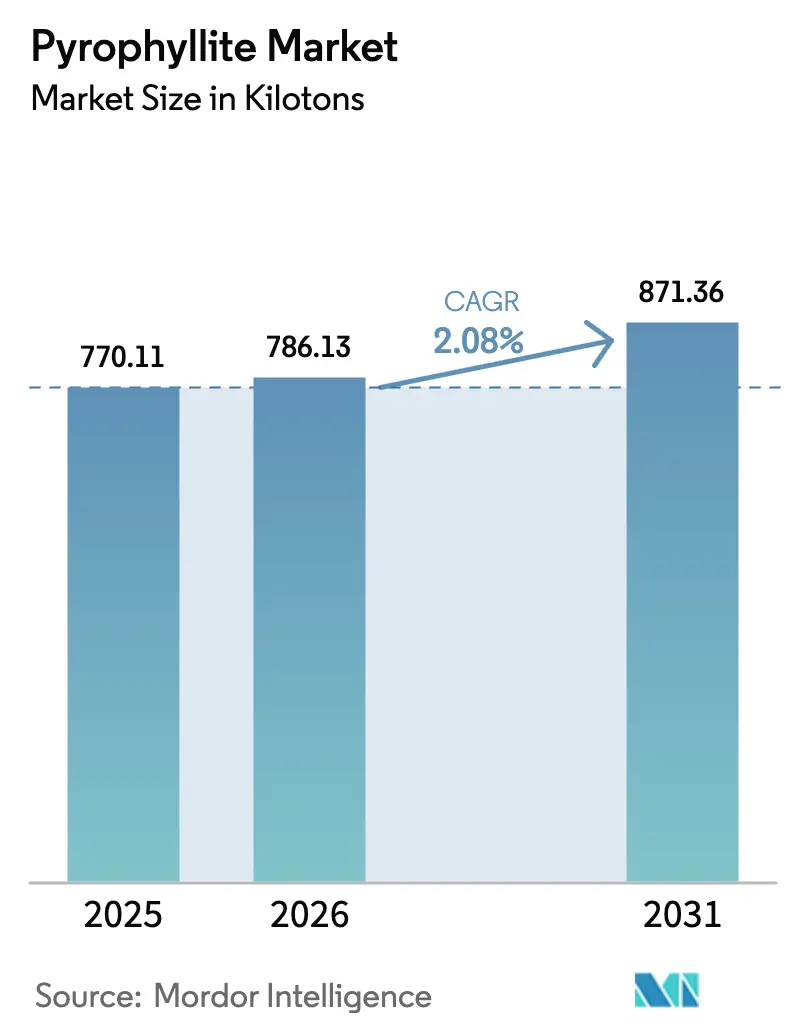
The Pyrophyllite Market size is expected to increase from 786.22 kilotons in 2025 to 802.81 kilotons in 2026 and reach 891.16 kilotons by 2031, growing at a CAGR of 2.11% over 2026-2031. Asia-Pacific holds three-quarters of global demand, electric-arc steelmaking now channels almost half of output into refractory blends, and battery as well as cosmetics producers are paying premiums for low-iron, high-alumina concentrates. Integrated refractory groups are securing captive ore supplies, while battery-separator innovators reward processors that can deliver <0.05% Fe₂O₃ feedstocks. Substitution pressure from talc, kaolin, and feldspar curbs margins, yet hydrogen-based furnaces and solid-state battery separators create distinct technical niches that sustain price differentials within the pyrophyllite market.
Key Report Takeaways
- By type, natural grades captured 86.65% of 2025 volume, while beneficiated and synthetic variants are expanding at a 2.71% CAGR through 2031.
- By application, refractory material led with a 49.18% pyrophyllite market share in 2025 and is forecast to register the fastest 2.56% CAGR to 2031.
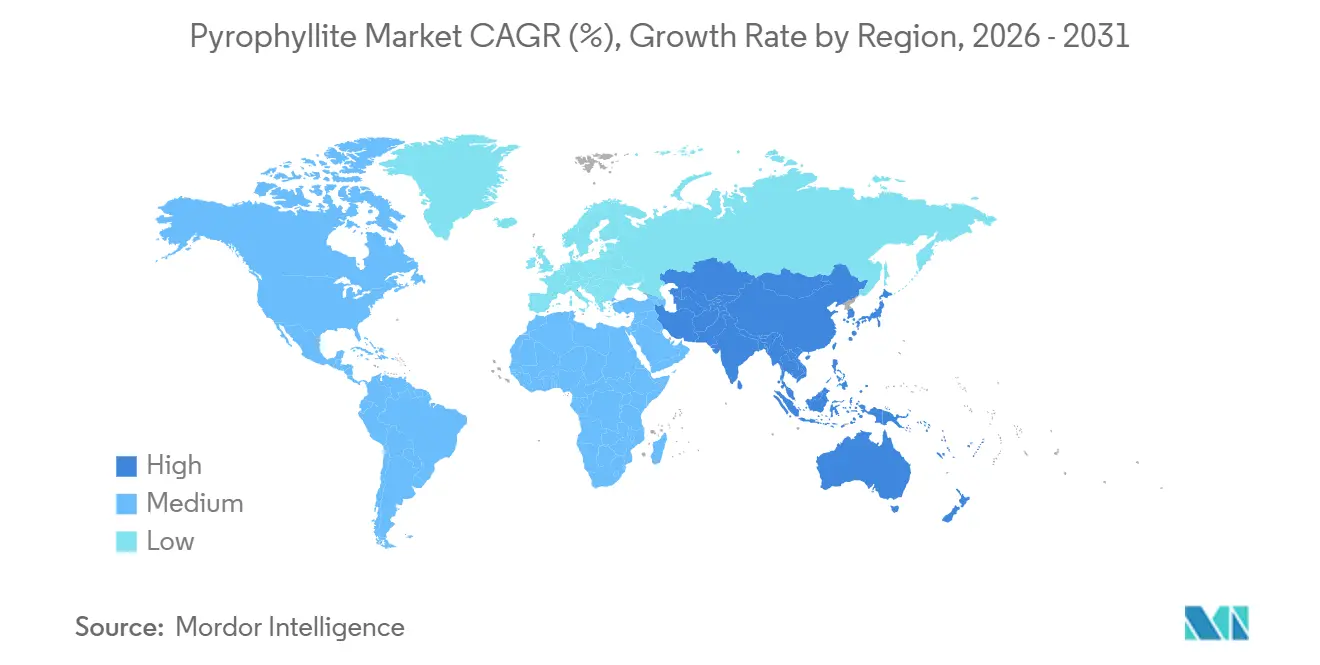
- By geography, Asia-Pacific commanded 75.62% of 2025 demand and is projected to grow at 2.78% through 2031.
Note: Market size and forecast figures in this report are generated using Mordor Intelligence’s proprietary estimation framework, updated with the latest available data and insights as of January 2026.
Global Pyrophyllite Market Trends and Insights
Driver Impact Analysis
| Drivers | (~) % Impact on CAGR Forecast | Geographic Relevance | Impact Timeline |
|---|---|---|---|
| Rising refractory demand in electric-arc steelmaking | +0.5% | Asia-Pacific core, spill-over to North America and Europe | Medium term (2-4 years) |
| Lightweight mineral fillers for high-build industrial coatings | +0.3% | Global, with concentration in North America and Europe | Short term (≤ 2 years) |
| Shift from talc to pyrophyllite in cosmetics amid asbestos litigation | +0.2% | North America and Europe | Short term (≤ 2 years) |
| Solid-state battery ceramic separators needing high-purity Al-Si feedstocks | +0.4% | Asia-Pacific (China, Japan, South Korea), spill-over to North America | Long term (≥ 4 years) |
| Low-alkali grades enabling hydrogen furnace refractories | +0.2% | Europe and North America, early pilots in Asia-Pacific | Long term (≥ 4 years) |
| Source: Mordor Intelligence | |||
Rising Refractory Demand in Electric-Arc Steelmaking
Electric-arc furnaces displace blast-oxygen routes because they cut direct CO₂ emissions and accept 100% scrap feedstocks. Every heat subjects refractories to 1,600 °C thermal shock, so tap-hole, ladle, and launder bricks increasingly rely on pyrophyllite binders that exhibit very low thermal expansion, excellent slag resistance, and stable alumina-silica networks. Global EAF capital spending rose from USD 670 million in 2024 and is slated to hit USD 1.27 billion by 2032 at an 11% CAGR, which feeds directly into refractory-grade pyrophyllite absorption. RHI Magnesita’s USD 1 billion acquisition spree locks in ore supply for this wave, while any Chinese export restriction on magnesite would widen the application window for alumina-silicate alternatives.
Lightweight Mineral Fillers for High-Build Industrial Coatings
Offshore wind-turbine towers, LNG tanks, and marine structures need thick coatings that resist corrosion without adding mass. Pyrophyllite’s platy habit and 1.58 refractive index deliver hiding power equivalent to talc at lower loading, enabling 400-600 μm dry-film thickness in one pass[1]Vanderbilt Minerals, “Performance Silicates for High-Build Coatings,” vanderbiltminerals.com. North American and European formulators also substitute the mineral for titanium dioxide after 2024’s 40% TiO₂ price spike. Fiberglass manufacturers mix pyrophyllite into E-glass batches to lower the melting temperature by 30-50 °C, which trims natural-gas use and aligns with decarbonization goals. These factors add 0.3 percentage points to the forecast CAGR, mainly in 2026-2028, while paint lines qualify new masterbatches.
Shift from Talc to Pyrophyllite in Cosmetics Amid Asbestos Litigation
FDA’s proposed talc-testing ruling in December 2024, though withdrawn in November 2025 for review, spurred cosmetic houses to trial pyrophyllite that has no geological link to asbestos[2]U.S. Food and Drug Administration, “Proposed Talc Rule for Cosmetics,” fda.gov. Brands accept USD 800-1,200 per-ton pricing, double standard talc, to avoid recall risks. The mineral duplicates talc’s softness and oil absorption, yet is sourced from North Carolina schists and South African metapelites safely outside serpentine zones. Litigation over talc propelled Estée Lauder, L’Oréal, and Shiseido to audit powders and shift procurement, contributing 0.2 percentage points to near-term CAGR.
Solid-State Battery Ceramic Separators Needing High-Purity Al-Si Feedstocks
QuantumScape and Corning aim for commercial oxide separators after their September 2025 partnership, and ProLogium had already shipped 2.4 million ceramic units by July 2025. Battery recipes require aluminosilicate filler with <0.05% Fe₂O₃ to avoid internal redox, so beneficiated pyrophyllite replaces costlier high-purity alumina. Current concentrates at 30-32% Al₂O₃ undercut pure alumina by 40-50% and add 0.4 percentage points to long-term CAGR, with Asia-Pacific at the forefront as most gigafactory pilots cluster in China, Japan, and South Korea.
Restraint Impact Analysis
| Restraints | (~) % Impact on CAGR Forecast | Geographic Relevance | Impact Timeline |
|---|---|---|---|
| Abundant substitute minerals: talc, kaolin, feldspar | -0.4% | Global | Short term (≤ 2 years) |
| Scarcity of low-iron, high-Al₂O₃ ore bodies | -0.3% | Global, acute in North America and Europe | Medium term (2-4 years) |
| High-energy intensity of fine-grinding and flotation circuit upgrades | -0.2% | Global, most severe in Europe and South Africa | Short term (≤ 2 years) |
| Source: Mordor Intelligence | |||
Abundant Substitute Minerals: Talc, Kaolin, Feldspar
Talc, kaolin, and feldspar serve roughly 80% of the same end uses and benefit from multi-million-ton economies of scale. Kaolin sales should climb from USD 4.85 billion in 2024 to USD 6.67 billion by 2030, bolstered by low-cost mining in Georgia, Cornwall, and Jiangsu. Talc continues as the default filler for polymers and paper, while feldspar remains the cheapest ceramic flux. These options shave 0.4 percentage points off pyrophyllite’s CAGR as buyers substitute whenever performance requirements allow.
Scarcity of Low-Iron, High-Al₂O₃ Ore Bodies
Fewer than 20 deposits worldwide combine >28% Al₂O₃ with <1% Fe₂O₃, and only two North Carolina mines stayed active through 2025 after U.S. output declined in 2023. South African exporters face rail constraints and port congestion, capping shipments at 150,000-200,000 tons/year. Chinese Liaoning ores need magnetic cleaning that adds USD 80-120 per ton while still missing battery-grade specifications. Ore scarcity, therefore, subtracts 0.3 percentage points from CAGR as demand outruns approved mining expansions.
Segment Analysis
By Type: Natural Dominance Masks Synthetic Gains
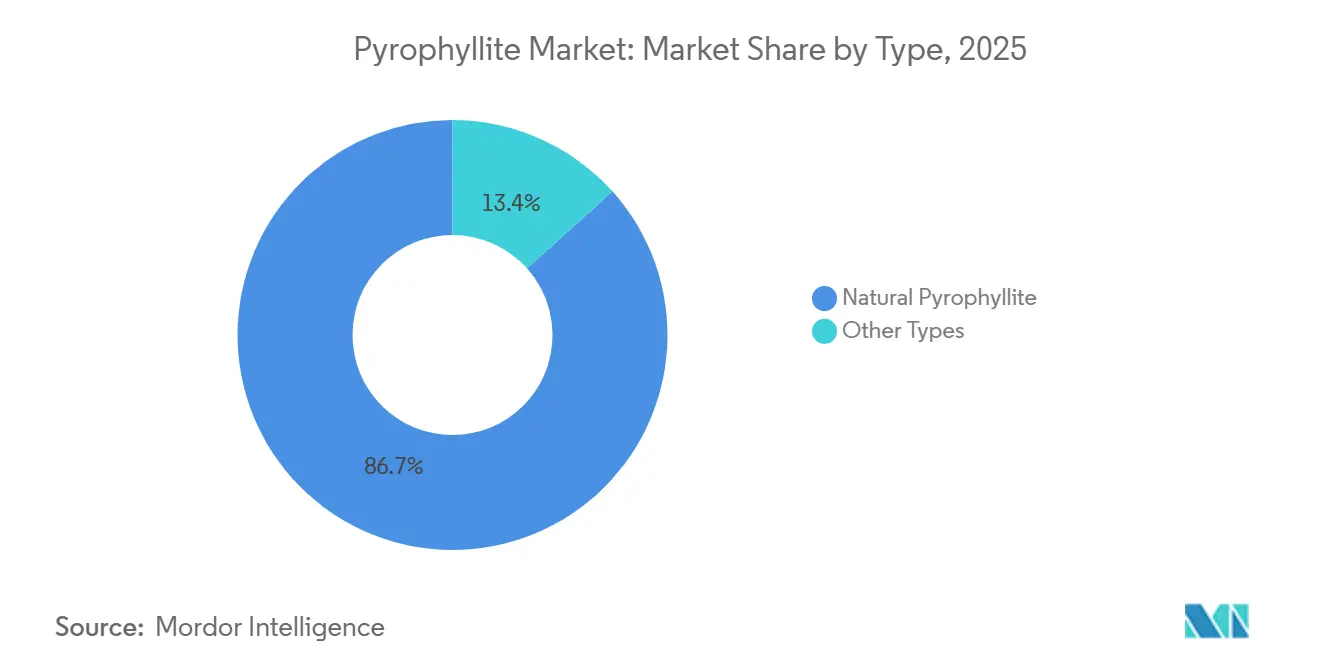
Natural grades supplied 86.65% of 2025 tonnage, yet beneficiated and synthetic options are logging a 2.71% expansion through 2031. Natural feedstocks from Kings Mountain and Ottosdal sell at USD 200-350 per ton for ceramics, refractories, and filler uses, while battery and cosmetics buyers demand concentrates leached to <0.05% Fe₂O₃ that fetch USD 800-1,200. QuantumScape specifies ±0.02% tolerance on alumina, achievable only by flotation plus acid-leach routes that straddle natural and synthetic classes.
Hybrid processing is redefining product taxonomy. North Carolina producers are adding magnetic separation before calcination, while Japanese traders surface-treat powders with silanes for cosmetics. This migration shifts revenue even if natural ore retains volume leadership. The pyrophyllite market reports that synthetics can command three to five times natural pricing, supporting processors’ capital spending on leach and calcine assets.
By Application: Refractories Lead, Batteries Disrupt
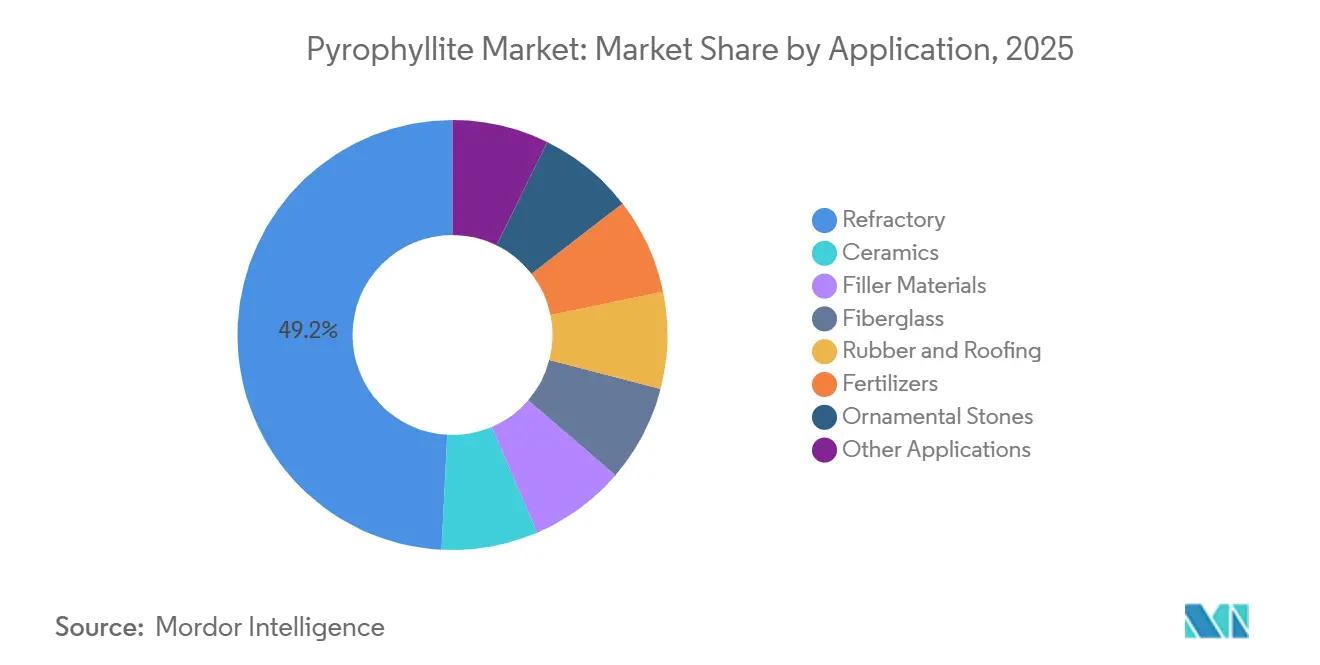
Refractories used 49.18% of 2025 supply and will log the fastest 2.56% CAGR to 2031 as EAF steelmaking doubles North American and European capacity. Ceramics secure roughly one-fifth of demand, but feldspar substitution holds growth below 2%. Coatings, paper, and plastics fillers cluster around 16% of volume, with coatings outperforming because offshore wind requires thick, durable layers that tap pyrophyllite’s platy opacity. Fiberglass melts absorb 6% on average, driven by wind-blade and automotive lightweighting. The residual “other applications” bucket, solid-state battery separators, cosmetics, and 3D-printed feedstocks, remains under 5% but is growing in double digits, so its revenue share is set to outrun tonnage through 2031.
Note: Segment shares of all individual segments available upon report purchase
Geography Analysis
Asia-Pacific possessed 75.62% of 2025 consumption and will advance at 2.78% to 2031. China’s coupled mining-refractory ecosystem in Liaoning underpins most of that demand, and India’s ceramics and filler sectors add further pull. Japan and South Korea import low-iron North Carolina concentrates at USD 600-900 per ton for advanced ceramics and separator research and development.
North America accounted for a significant market share in 2025 as two North Carolina operations feed U.S. steelmakers and coatings formulators. Inflation Reduction Act incentives should lift domestic EAF steel output 15-20% by 2030, nudging regional pyrophyllite uptake. Europe is witnessing moderate market growth, with Germany’s and Sweden’s hydrogen-furnace pilots sparking new low-alkali refractory demand. Southern Europe retains ceramics customers in Italy and Spain, while Nordic offshore-wind investments push coating fillers.
South America, plus the Middle East and Africa, are witnessing an expansion of the market. South African production goes mostly to export markets, but rail and energy constraints cap quantum. Any Chinese export quota, similar to the 2010 rare-earth move, would reroute buyers toward North Carolina and South Africa. Given permitting lags, Asia-Pacific is unlikely to drop below 70% share by 2031.
Competitive Landscape
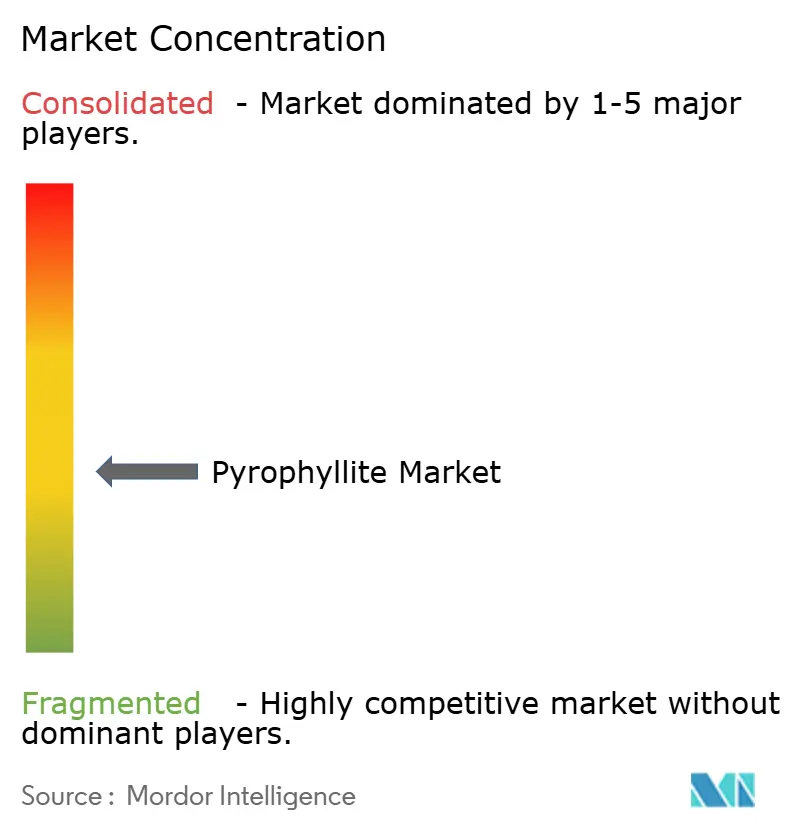
The pyrophyllite market is moderately fragmented. RHI Magnesita spent USD 1.01 billion during 2024-2025 to acquire Krosaki Harima, Resco Products, and Dolomite Franchi, thereby locking in feedstock for captive refractory plants across three continents. Wonderstone and Idwala distribute to 40 nations but struggle with South African freight bottlenecks, while several Indian miners compete in low-margin ceramic fillers.
Strategic whitespace revolves around upgrading middling ores to battery grade, premixing LLZO masterbatches for cell makers, and coupling beneficiation with on-site renewables to market “green aluminosilicates.” Technology startups pilot sensor-based ore sorting that can cut downstream energy by 30-40%. Very few operators have ISO 14001 certification, giving sustainability-oriented newcomers a wedge to win auto and battery offtake contracts bound by science-based targets.
Pyrophyllite Industry Leaders
Avani Group
Wonderstone
R.T. Vanderbilt Holding Company, Inc.
Hankook Mineral Powder Co. Ltd.
Anand Talc
- *Disclaimer: Major Players sorted in no particular order
Recent Industry Developments
- May 2025: Hercules Metals Corp. has identified pyrophyllite occurrences within advanced argillic alteration zones at its Leviathan project in western Idaho. SWIR analysis has confirmed the presence of narrow pyrophyllite zones associated with high-sulfidation epithermal systems, highlighting the potential for targeting deeper mineralization.
- February 2025: RHI Magnesita finalized the EUR 160 million (USD 170 million) purchase of Dolomite Franchi, adding 200,000 tons/year of dolomite refractories and integrating European pyrophyllite blending for hydrogen-steel pilots.
Global Pyrophyllite Market Report Scope
Pyrophyllite, a phyllosilicate mineral, has the molecular formula Al₂Si₄O₁₀(OH)₂, indicating its composition of aluminum silicate hydroxide. This mineral occurs in two primary forms: crystalline folia and compact masses. Pyrophyllite is often found in association with other minerals, such as quartz, mica, kaolinite, epidote, and rutile. Its diverse applications extend to refractory materials, ceramics, paints, rubber, and more.
The pyrophyllite market is segmented by type, application, and geography. By type, the market is segmented into natural pyrophyllite and other types. By application, the market is segmented into ceramics, refractory, filler materials, fiberglass, rubber and roofing, fertilizers, ornamental stones, and other applications. The report also covers the market size and forecasts for the pyrophyllite market in 28 countries across major regions. For each segment, the market sizing and forecasts have been done on the basis of volume (Tons).
| Natural Pyrophyllite |
| Other Types |
| Ceramics |
| Refractory |
| Filler Materials (Paper, Paints, Insecticides) |
| Fiberglass |
| Rubber and Roofing |
| Fertilizers (Soil Conditioners) |
| Ornamental Stones |
| Other Applications |
| Asia-Pacific | China |
| India | |
| Japan | |
| South Korea | |
| Malaysia | |
| Thailand | |
| Indonesia | |
| Vietnam | |
| Rest of Asia-Pacific | |
| North America | United States |
| Canada | |
| Mexico | |
| Europe | Germany |
| United Kingdom | |
| France | |
| Italy | |
| Spain | |
| Nordic Countries | |
| Turkey | |
| Russia | |
| Rest of Europe | |
| South America | Brazil |
| Argentina | |
| Colombia | |
| Rest of South America | |
| Middle-East and Africa | Saudi Arabia |
| United Arab Emirates | |
| Qatar | |
| Egypt | |
| Nigeria | |
| South Africa | |
| Rest of Middle-East and Africa |
| By Type | Natural Pyrophyllite | |
| Other Types | ||
| By Application | Ceramics | |
| Refractory | ||
| Filler Materials (Paper, Paints, Insecticides) | ||
| Fiberglass | ||
| Rubber and Roofing | ||
| Fertilizers (Soil Conditioners) | ||
| Ornamental Stones | ||
| Other Applications | ||
| By Geography | Asia-Pacific | China |
| India | ||
| Japan | ||
| South Korea | ||
| Malaysia | ||
| Thailand | ||
| Indonesia | ||
| Vietnam | ||
| Rest of Asia-Pacific | ||
| North America | United States | |
| Canada | ||
| Mexico | ||
| Europe | Germany | |
| United Kingdom | ||
| France | ||
| Italy | ||
| Spain | ||
| Nordic Countries | ||
| Turkey | ||
| Russia | ||
| Rest of Europe | ||
| South America | Brazil | |
| Argentina | ||
| Colombia | ||
| Rest of South America | ||
| Middle-East and Africa | Saudi Arabia | |
| United Arab Emirates | ||
| Qatar | ||
| Egypt | ||
| Nigeria | ||
| South Africa | ||
| Rest of Middle-East and Africa | ||
Key Questions Answered in the Report
How large will the market size be for pyrophyllite in 2031?
The pyrophyllite market is anticipated to reach at 891.16 kilotons in 2031 by growing with a CAGR of 2.11% during the forecast period.
Which countries drive demand for pyrophyllite in refractories by 2031?
China, India, Japan, and South Korea account for most Asian growth, with the U.S. and Germany adding capacity through new electric-arc and hydrogen furnaces.
How fast will natural versus synthetic grades grow to 2031?
Natural maintains volume dominance at roughly 86% share, while synthetic and beneficiated grades grow 2.71% annually, faster than overall demand.
What lifts pricing for battery-grade pyrophyllite?
Separator producers pay three to five times refractory price to secure <0.05% Fe₂O₃ and tight alumina tolerance needed for LLZO and LATP chemistries.
Why is energy intensity a concern for processors?
Achieving −325 mesh with low iron uses up to 280 kWh per tonne, so higher electricity tariffs in Europe raise operating cost to one-quarter of selling price.
Which companies dominate global supply?
RHI Magnesita, Wonderstone, Idwala, and major Chinese state-owned miners together hold about 55% of capacity; none control more than 20%.
What new end uses arise beyond refractories and ceramics?
Solid-state battery separators, asbestos-free cosmetics powders, and high-build industrial coatings are emerging niches with higher margins.


