
Macadamia Nuts Market Size and Share
Macadamia Nuts Market Analysis by Mordor Intelligence
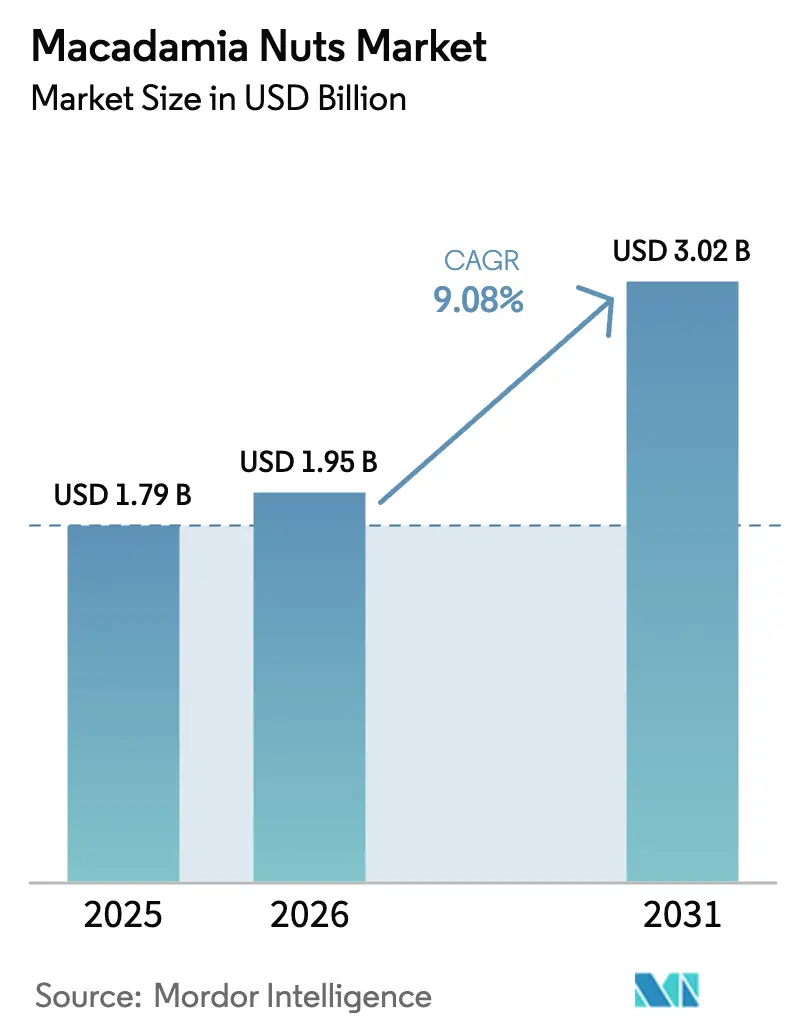
The macadamia nuts market is anticipated to grow from USD 1.79 billion in 2025 to USD 1.95 billion in 2026 and is forecast to reach USD 3.02 billion by 2031 at 9.08% CAGR over 2026-2031. Robust expansion reflects a widening shift among premium food manufacturers that now favor macadamia kernels when formulating plant-based dairy, confectionery, and nutritious snacks. Kernel fats replicate the lipid profile of human sebum, allowing cosmetic brands to substitute macadamia oil for argan and jojoba while trimming formulation costs. Rapid orchard plantings in Kenya and South Africa, alongside fast-bearing cultivars released in Queensland, signal rising supply momentum. Meanwhile, blockchain traceability platforms win premiums of up to 10% because sustainability officers must prove deforestation-free origins under new European Union rules.
Key Report Takeaways
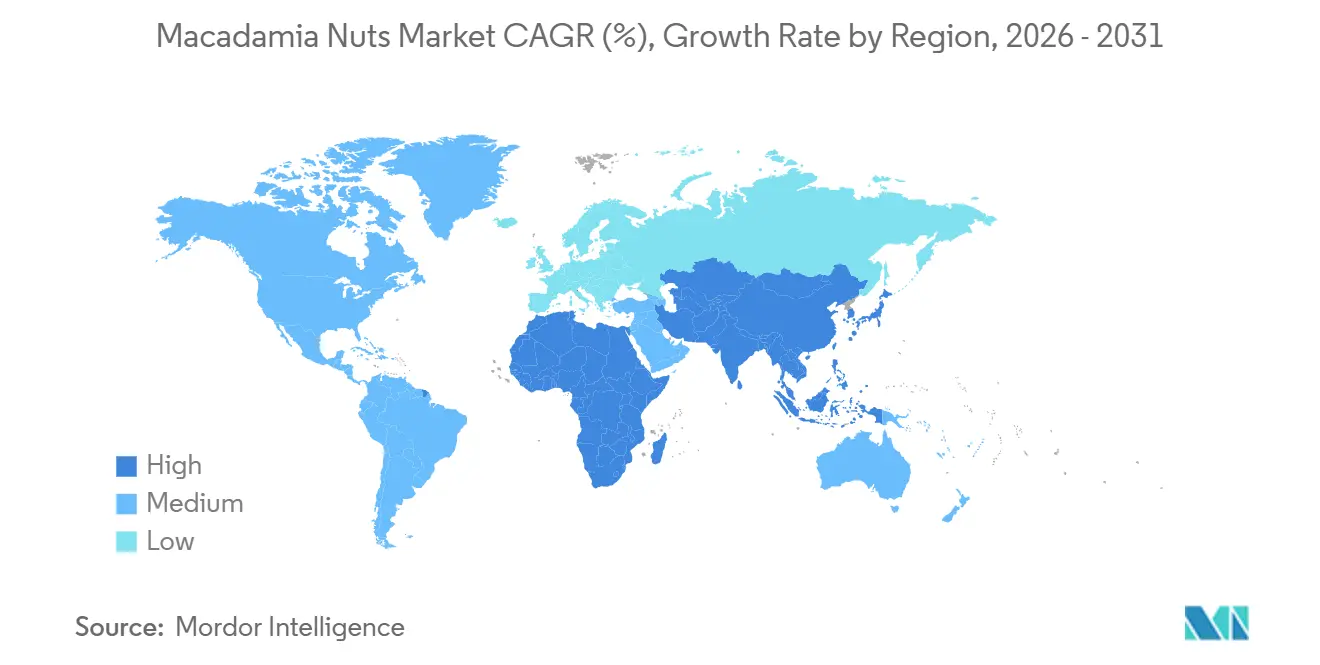
- By geography, Asia-Pacific accounted for 46.0% share of the macadamia nuts market size in 2025, while Africa records the fastest projected CAGR at 7.7% between 2026 and 2031.
Note: Market size and forecast figures in this report are generated using Mordor Intelligence’s proprietary estimation framework, updated with the latest available data and insights as of January 2026.
Global Macadamia Nuts Market Trends and Insights
Drivers Impact Analysis
| Driver | (~) % Impact on CAGR Forecast | Geographic Relevance | Impact Timeline |
|---|---|---|---|
| Accelerated demand from premium plant-based milk producers | +1.8% | Global, with peak intensity in North America and Asia-Pacific | Medium term (2-4 years) |
| Expanding cosmetic-grade oil applications | +1.5% | Europe and North America core, spillover to Asia-Pacific premium segments | Medium term (2-4 years) |
| Rising popularity of macadamia-based protein concentrates | +1.3% | North America and Asia-Pacific, early adoption in urban Europe | Long term (≥ 4 years) |
| Blockchain-enabled farm-to-shell traceability premiums | +0.9% | Global, concentrated in direct-trade channels serving premium buyers | Short term (≤ 2 years) |
| Carbon-credit monetization for macadamia agro-forestry systems | +0.7% | Africa and South America, with pilot projects in Australia | Long term (≥ 4 years) |
| Genetic rootstock breakthroughs shortening juvenile period | +1.2% | Asia-Pacific and South America emerging origins, spillover to Africa | Long term (≥ 4 years) |
| Source: Mordor Intelligence | |||
Accelerated Demand from Premium Plant-based Milk Producers
Macadamia milk retails between USD 6.50 and USD 9.00 per liter in North America and Europe, fetching a 40-60% premium over almond milk. Producers prefer kernels because a natural emulsion delivers viscosity without hydrocolloids, which simplifies clean-label ingredient decks. Macadamia's natural creamy texture has made them suitable for premium "barista ready" products that serve coffeehouse chains and upscale retailers. Higher retail prices have gradually raised kernel quotations as processors diverted supply from confectionery spot markets. Large dairy-alternative brands now lock in multi-year contracts, reducing visibility on the open market and squeezing small roasters that depend on spot availability. Recent regulatory changes in Europe permit nut milks to use traditional dairy terms, eliminating a significant marketing constraint and creating new opportunities for brand positioning.
Expanding Cosmetic-grade Oil Applications
Macadamia oil's lipid profile mirrors human skin oils, making it valuable for anti-aging skincare products. Clean-beauty brands replaced a portion of argan oil with macadamia oil due to its similarity to human sebum. This change improved skin hydration, increasing its appeal among European formulators. Beauty companies in Asia and Western markets incorporate it into high-end formulations for enhanced hydration and antioxidant protection. Advanced extraction methods increase their effectiveness, enabling premium positioning and enhanced consumer appeal. Wholesale cosmetic-grade macadamia oil averaged USD 18 per kilogram against USD 32 per kilogram for certified-organic argan, creating margin upside for processors. Companies obtain oil from certified orchards to validate sustainability claims and enhance traceability. The oil's value as a coproduct strengthens financial stability for nut processors, who benefit from multiple revenue streams while meeting increased demand in the luxury personal care market.
Blockchain-Enabled Farm-to-Shell Traceability Premiums
Provenance platforms utilizing distributed-ledger technology enable buyers to verify single-estate kernel origins, harvest dates, and processing timestamps, achieving price premiums of 8% to 10% over commodity-grade kernels in direct-trade channels. A pilot blockchain traceability system allows European confectionery buyers to scan QR codes and access orchard-level data, including soil health metrics and water-use efficiency. This level of transparency is particularly valuable to corporate sustainability officers tasked with documenting Scope 3 emissions and ensuring deforestation-free sourcing, in compliance with the European Union Deforestation Regulation requirements. However, smaller processors encounter significant adoption challenges, as blockchain integration costs range from USD 50,000 to USD 150,000 for initial setup, along with annual licensing fees, making it unaffordable for cooperatives processing less than 500 metric tons annually. The technology's influence is anticipated to remain concentrated in premium segments catering to multinational buyers, with minimal impact on spot markets.
Rising Popularity of Macadamia-based Protein Concentrates
Macadamia protein contains 55-65% protein by weight and is free of top-eight allergens, making it ideal for ready-to-drink shakes and bakery blends. Manufacturers are converting macadamia press-cake into high-purity protein concentrates that exceed the performance of other nut-based alternatives. These proteins enhance sports drinks and gluten-free baked goods, providing functional benefits in texture and nutrition. Wholesale prices remain USD 28-35 per kilogram because only a few processors have enzymatic hydrolysis and spray-drying capacity. Manufacturers are increasing production through advanced reactors, improving process efficiency and cost-effectiveness. The protein's adaptability and premium position improve processor margins, encouraging investment in integrated facilities. As plant-based protein demand increases, macadamia concentrates establish a position in health-focused and gourmet food segments, providing an effective alternative to conventional ingredients.
Restraints Impact Analysis
| Restraint | (~) % Impact on CAGR Forecast | Geographic Relevance | Impact Timeline |
|---|---|---|---|
| Price volatility due to weather-sensitive harvests | -1.4% | Global, with acute impact in Australia and South Africa | Short term (≤ 2 years) |
| Lengthy juvenile period of macadamia trees | -0.9% | Global, particularly affecting smallholder adoption in Africa and South America | Long term (≥ 4 years) |
| Tightening aflatoxin limits in EU and China | -1.1% | Africa and Asia-Pacific exporters, with compliance costs concentrated in processing hubs | Medium term (2-4 years) |
| Container-freight cost spikes disrupting kernel supply | -0.8% | Global, with highest impact on Africa-to-Asia and Australia-to-Europe routes | Short term (≤ 2 years) |
| Source: Mordor Intelligence | |||
Price Volatility due to Weather-sensitive Harvests
El Niño events and tropical cyclones repeatedly devastate Queensland and KwaZulu-Natal orchards, triggering kernel price swings of 20 to 35% within a single crop year and complicating long-term contract negotiations for food manufacturers[1]Source: Australian Bureau of Meteorology, “Tropical Cyclone Jasper Impact Assessment,” bom.gov.au. As of April 2024, average kernel prices experienced a slight increase compared to March, remaining above the USD 8.25/kg level reported in 2023. Cyclone Jasper struck Queensland in December 2023, damaging several hectares of bearing orchards, including macadamia. South Africa faced a similar disruption when unseasonal hail in Mpumalanga province destroyed the pre-harvest crop, tightening global kernel availability and pushing spot prices. This volatility forces buyers to carry higher inventory buffers, raising working-capital costs for confectionery manufacturers who previously operated on just-in-time supply models. Weather risk also deters institutional investment in orchard expansion, as private equity funds require stable cash-flow projections that macadamia cultivation cannot reliably deliver without crop insurance. To mitigate these challenges, buyers source macadamias from diverse regions, including South Africa, Kenya, and Australia.
Tightening Aflatoxin Limits in EU and China
Stricter maximum residue levels for aflatoxins raise testing costs and increase rejected consignments, particularly for African exporters who lack the climate-controlled storage infrastructure to prevent fungal contamination during post-harvest handling. The EU strictly regulates aflatoxin in macadamia nuts, for Aflatoxin B1 and for total aflatoxins. These limits are enforced through stringent testing, especially for imports, in accordance with Commission Regulation (EU) 2023/915[2]Source: European Commission, “Commission Regulation 165/2010 on Aflatoxins,” ec.europa.eu. China's GB 2761 standard imposes a 5 microgram per kilogram limit for aflatoxin B1 in tree nuts, forcing exporters to implement high-performance liquid chromatography testing. Compliance investments in dehumidification equipment and hermetic storage bags add USD 0.40 to USD 0.60 per kilogram to processing costs, eroding margins for smallholder cooperatives that operate on net returns of USD 2.00 to USD 2.80 per kilogram. This regulatory tightening advantages large processors with capital to invest in controlled-atmosphere storage, consolidating market share at the expense of smaller players.
Geography Analysis
In 2025, Asia-Pacific held 46.0% of the macadamia nuts market share value and is projected to grow steadily. China saw increased imports of kernels, driven by confectionery reformulations that enhanced the status of tree nuts in premium gift boxes. Japan increased its per-capita macadamia consumption, supported by the availability of ready-to-eat nut snacks in convenience stores. Australia remained the leading producer in the region, despite losses due to cyclone-related damage.
Africa, with South Africa and Kenya as key producers, shows the highest regional growth rate at 7.7% CAGR from 2026 to 2031. The region supplies 25% of global kernel production, using advanced sorting technologies to improve export quality. South Africa improved kernel recovery rates, enhancing export competitiveness in the European market. Kenya reduced phytosanitary clearance times, cutting spoilage. Additionally, new orchard financing is accelerating the adoption of agroforestry models that integrate carbon credits with kernel revenue streams.
North America accounted for a notable share of global macadamia consumption in 2025 and is forecast to grow steadily, driven by increasing demand for plant-based dairy alternatives and sports nutrition products. The United States imported a significant volume of kernels, primarily sourced from Australia and South Africa. In Canada, macadamia milk products reflect consumer willingness to pay for creaminess and omega-7 benefits. Europe held a notable share of the macadamia nuts market in 2025 and is projected to grow at a moderate rate. Growth is constrained by mature snack segments, however, Germany and the Netherlands continue to serve as key re-export hubs for African kernels to the wider European Union. Middle Eastern countries consider nuts as essential food items, with Saudi Arabia streamlining import procedures to increase protein source diversity.


Competitive Landscape
The macadamia nuts market exhibits moderate concentration, with the top processors controlling a significant portion of the market revenue in 2025. Marquis Macadamias leverages assets across multiple regions to mitigate risks associated with crop fluctuations[3]Source: Marquis Group, “Sustainability and Traceability Initiatives,” marquis-group.com. South African aggregators, Green and Gold Macadamias and Golden Macadamias, channel smallholder production into premium export programs equipped with aflatoxin testing. Horizontal consolidation continues as processors acquire orchards to secure raw material access and protect margins from price volatility.
Protein concentrate remains an under-served niche, with only a few processors operating dedicated enzymatic production lines. Wholesale prices are significantly higher than other protein isolates, but supply bottlenecks limit market penetration to high-end sports nutrition brands. Vietnamese producers aim to offer competitive pricing due to labor cost advantages, though quality challenges persist in humid climates. High capital requirements for cold-press oil units and traceability platforms favor well-funded players.
Technology differentiation is increasingly critical in the macadamia nuts market. Marquis Macadamias has implemented blockchain initiatives to verify product origins and ensure compliance with environmental regulations. Smaller cooperatives face challenges in adopting such systems due to high onboarding costs, widening the gap between large-scale players and smaller suppliers. The adoption of climate-controlled storage further consolidates volumes around tier-one processors. Mid-sized regional specialists primarily focus on marketing organic or single-estate provenance products through direct-to-consumer channels.
Recent Industry Developments
- February 2026: The Australian macadamia industry has initiated a project to enhance its presence in key export markets, including the United States, Germany, and China. The project will report on sales value, volume, market share, and average prices for macadamias, while benchmarking their performance against other nut categories in major global markets.
- June 2024: Love Macadamia, an initiative by the World Macadamia Organization, has teamed up with Nature’s Basket to promote macadamia nuts in India. This collaboration will make the delicious macadamia nut available in select stores across Delhi and Mumbai, providing consumers with easy access to its taste and health benefits.
- March 2024: Premier Nut, a veteran macadamia producer from South Africa, has launched three new value-added products namely Sutton Pressed, MacaPaste, and Snackadamia. Sutton Pressed is a cold-pressed oil derived from macadamia nuts. MacaPaste is a creamy spread crafted from roasted macadamia nuts, while Snackadamia presents a gourmet selection of roasted macadamia kernels, available in flavors like Italian herb, spicy, and salted.


Global Macadamia Nuts Market Report Scope
Macadamia nuts, harvested from the macadamia tree, are renowned for their smooth, creamy texture and rich, buttery flavour. These nuts are typically encased in a hard, woody shell, which is removed before they are consumed. The Macadamia Nuts Market is Segmented by Geography (North America, Europe, Asia-Pacific, South America, Africa, and More). The Report Includes Production Analysis (Volume), Consumption Analysis (Value and Volume), Export Analysis (Value and Volume), Import Analysis (Value and Volume), Wholesale Price Trend Analysis and Forecast, and More. The Market Forecasts are Provided in Terms of Value (USD) and Volume (Metric Tons).
| North America | United States | Production Analysis (Production Volume) |
| Consumption Analysis (Consumption Value and Volume) | ||
| Import Market Analysis (Import Value, Volume, and Key Supplying Markets) | ||
| Export Market Analysis (Export Value, Volume, and Key Destination Markets) | ||
| Wholesale Price Trend Analysis and Forecast | ||
| Regulatory Framework | ||
| List of Key Players | ||
| Logistics and Infrastructure | ||
| Seasonality Analysis | ||
| Canada | Production Analysis (Production Volume) | |
| Consumption Analysis (Consumption Value and Volume) | ||
| Import Market Analysis (Import Value, Volume, and Key Supplying Markets) | ||
| Export Market Analysis (Export Value, Volume, and Key Destination Markets) | ||
| Wholesale Price Trend Analysis and Forecast | ||
| Regulatory Framework | ||
| List of Key Players | ||
| Logistics and Infrastructure | ||
| Seasonality Analysis | ||
| South America | Brazil | Production Analysis (Production Volume) |
| Consumption Analysis (Consumption Value and Volume) | ||
| Import Market Analysis (Import Value, Volume, and Key Supplying Markets) | ||
| Export Market Analysis (Export Value, Volume, and Key Destination Markets) | ||
| Wholesale Price Trend Analysis and Forecast | ||
| Regulatory Framework | ||
| List of Key Players | ||
| Logistics and Infrastructure | ||
| Seasonality Analysis | ||
| Colombia | Production Analysis (Production Volume) | |
| Consumption Analysis (Consumption Value and Volume) | ||
| Import Market Analysis (Import Value, Volume, and Key Supplying Markets) | ||
| Export Market Analysis (Export Value, Volume, and Key Destination Markets) | ||
| Wholesale Price Trend Analysis and Forecast | ||
| Regulatory Framework | ||
| List of Key Players | ||
| Logistics and Infrastructure | ||
| Seasonality Analysis | ||
| Europe | Netherlands | Production Analysis (Production Volume) |
| Consumption Analysis (Consumption Value and Volume) | ||
| Import Market Analysis (Import Value, Volume, and Key Supplying Markets) | ||
| Export Market Analysis (Export Value, Volume, and Key Destination Markets) | ||
| Wholesale Price Trend Analysis and Forecast | ||
| Regulatory Framework | ||
| List of Key Players | ||
| Logistics and Infrastructure | ||
| Seasonality Analysis | ||
| France | Production Analysis (Production Volume) | |
| Consumption Analysis (Consumption Value and Volume) | ||
| Import Market Analysis (Import Value, Volume, and Key Supplying Markets) | ||
| Export Market Analysis (Export Value, Volume, and Key Destination Markets) | ||
| Wholesale Price Trend Analysis and Forecast | ||
| Regulatory Framework | ||
| List of Key Players | ||
| Logistics and Infrastructure | ||
| Seasonality Analysis | ||
| United Kingdom | Production Analysis (Production Volume) | |
| Consumption Analysis (Consumption Value and Volume) | ||
| Import Market Analysis (Import Value, Volume, and Key Supplying Markets) | ||
| Export Market Analysis (Export Value, Volume, and Key Destination Markets) | ||
| Wholesale Price Trend Analysis and Forecast | ||
| Regulatory Framework | ||
| List of Key Players | ||
| Logistics and Infrastructure | ||
| Seasonality Analysis | ||
| Germany | Production Analysis (Production Volume) | |
| Consumption Analysis (Consumption Value and Volume) | ||
| Import Market Analysis (Import Value, Volume, and Key Supplying Markets) | ||
| Export Market Analysis (Export Value, Volume, and Key Destination Markets) | ||
| Wholesale Price Trend Analysis and Forecast | ||
| Regulatory Framework | ||
| List of Key Players | ||
| Logistics and Infrastructure | ||
| Seasonality Analysis | ||
| Asia-Pacific | China | Production Analysis (Production Volume) |
| Consumption Analysis (Consumption Value and Volume) | ||
| Import Market Analysis (Import Value, Volume, and Key Supplying Markets) | ||
| Export Market Analysis (Export Value, Volume, and Key Destination Markets) | ||
| Wholesale Price Trend Analysis and Forecast | ||
| Regulatory Framework | ||
| List of Key Players | ||
| Logistics and Infrastructure | ||
| Seasonality Analysis | ||
| Australia | Production Analysis (Production Volume) | |
| Consumption Analysis (Consumption Value and Volume) | ||
| Import Market Analysis (Import Value, Volume, and Key Supplying Markets) | ||
| Export Market Analysis (Export Value, Volume, and Key Destination Markets) | ||
| Wholesale Price Trend Analysis and Forecast | ||
| Regulatory Framework | ||
| List of Key Players | ||
| Logistics and Infrastructure | ||
| Seasonality Analysis | ||
| Vietnam | Production Analysis (Production Volume) | |
| Consumption Analysis (Consumption Value and Volume) | ||
| Import Market Analysis (Import Value, Volume, and Key Supplying Markets) | ||
| Export Market Analysis (Export Value, Volume, and Key Destination Markets) | ||
| Wholesale Price Trend Analysis and Forecast | ||
| Regulatory Framework | ||
| List of Key Players | ||
| Logistics and Infrastructure | ||
| Seasonality Analysis | ||
| Japan | Production Analysis (Production Volume) | |
| Consumption Analysis (Consumption Value and Volume) | ||
| Import Market Analysis (Import Value, Volume, and Key Supplying Markets) | ||
| Export Market Analysis (Export Value, Volume, and Key Destination Markets) | ||
| Wholesale Price Trend Analysis and Forecast | ||
| Regulatory Framework | ||
| List of Key Players | ||
| Logistics and Infrastructure | ||
| Seasonality Analysis | ||
| Middle East | Saudi Arabia | Production Analysis (Production Volume) |
| Consumption Analysis (Consumption Value and Volume) | ||
| Import Market Analysis (Import Value, Volume, and Key Supplying Markets) | ||
| Export Market Analysis (Export Value, Volume, and Key Destination Markets) | ||
| Wholesale Price Trend Analysis and Forecast | ||
| Regulatory Framework | ||
| List of Key Players | ||
| Logistics and Infrastructure | ||
| Seasonality Analysis | ||
| Africa | South Africa | Production Analysis (Production Volume) |
| Consumption Analysis (Consumption Value and Volume) | ||
| Import Market Analysis (Import Value, Volume, and Key Supplying Markets) | ||
| Export Market Analysis (Export Value, Volume, and Key Destination Markets) | ||
| Wholesale Price Trend Analysis and Forecast | ||
| Regulatory Framework | ||
| List of Key Players | ||
| Logistics and Infrastructure | ||
| Seasonality Analysis | ||
| Kenya | Production Analysis (Production Volume) | |
| Consumption Analysis (Consumption Value and Volume) | ||
| Import Market Analysis (Import Value, Volume, and Key Supplying Markets) | ||
| Export Market Analysis (Export Value, Volume, and Key Destination Markets) | ||
| Wholesale Price Trend Analysis and Forecast | ||
| Regulatory Framework | ||
| List of Key Players | ||
| Logistics and Infrastructure | ||
| Seasonality Analysis | ||
| By Geography | North America | United States | Production Analysis (Production Volume) |
| Consumption Analysis (Consumption Value and Volume) | |||
| Import Market Analysis (Import Value, Volume, and Key Supplying Markets) | |||
| Export Market Analysis (Export Value, Volume, and Key Destination Markets) | |||
| Wholesale Price Trend Analysis and Forecast | |||
| Regulatory Framework | |||
| List of Key Players | |||
| Logistics and Infrastructure | |||
| Seasonality Analysis | |||
| Canada | Production Analysis (Production Volume) | ||
| Consumption Analysis (Consumption Value and Volume) | |||
| Import Market Analysis (Import Value, Volume, and Key Supplying Markets) | |||
| Export Market Analysis (Export Value, Volume, and Key Destination Markets) | |||
| Wholesale Price Trend Analysis and Forecast | |||
| Regulatory Framework | |||
| List of Key Players | |||
| Logistics and Infrastructure | |||
| Seasonality Analysis | |||
| South America | Brazil | Production Analysis (Production Volume) | |
| Consumption Analysis (Consumption Value and Volume) | |||
| Import Market Analysis (Import Value, Volume, and Key Supplying Markets) | |||
| Export Market Analysis (Export Value, Volume, and Key Destination Markets) | |||
| Wholesale Price Trend Analysis and Forecast | |||
| Regulatory Framework | |||
| List of Key Players | |||
| Logistics and Infrastructure | |||
| Seasonality Analysis | |||
| Colombia | Production Analysis (Production Volume) | ||
| Consumption Analysis (Consumption Value and Volume) | |||
| Import Market Analysis (Import Value, Volume, and Key Supplying Markets) | |||
| Export Market Analysis (Export Value, Volume, and Key Destination Markets) | |||
| Wholesale Price Trend Analysis and Forecast | |||
| Regulatory Framework | |||
| List of Key Players | |||
| Logistics and Infrastructure | |||
| Seasonality Analysis | |||
| Europe | Netherlands | Production Analysis (Production Volume) | |
| Consumption Analysis (Consumption Value and Volume) | |||
| Import Market Analysis (Import Value, Volume, and Key Supplying Markets) | |||
| Export Market Analysis (Export Value, Volume, and Key Destination Markets) | |||
| Wholesale Price Trend Analysis and Forecast | |||
| Regulatory Framework | |||
| List of Key Players | |||
| Logistics and Infrastructure | |||
| Seasonality Analysis | |||
| France | Production Analysis (Production Volume) | ||
| Consumption Analysis (Consumption Value and Volume) | |||
| Import Market Analysis (Import Value, Volume, and Key Supplying Markets) | |||
| Export Market Analysis (Export Value, Volume, and Key Destination Markets) | |||
| Wholesale Price Trend Analysis and Forecast | |||
| Regulatory Framework | |||
| List of Key Players | |||
| Logistics and Infrastructure | |||
| Seasonality Analysis | |||
| United Kingdom | Production Analysis (Production Volume) | ||
| Consumption Analysis (Consumption Value and Volume) | |||
| Import Market Analysis (Import Value, Volume, and Key Supplying Markets) | |||
| Export Market Analysis (Export Value, Volume, and Key Destination Markets) | |||
| Wholesale Price Trend Analysis and Forecast | |||
| Regulatory Framework | |||
| List of Key Players | |||
| Logistics and Infrastructure | |||
| Seasonality Analysis | |||
| Germany | Production Analysis (Production Volume) | ||
| Consumption Analysis (Consumption Value and Volume) | |||
| Import Market Analysis (Import Value, Volume, and Key Supplying Markets) | |||
| Export Market Analysis (Export Value, Volume, and Key Destination Markets) | |||
| Wholesale Price Trend Analysis and Forecast | |||
| Regulatory Framework | |||
| List of Key Players | |||
| Logistics and Infrastructure | |||
| Seasonality Analysis | |||
| Asia-Pacific | China | Production Analysis (Production Volume) | |
| Consumption Analysis (Consumption Value and Volume) | |||
| Import Market Analysis (Import Value, Volume, and Key Supplying Markets) | |||
| Export Market Analysis (Export Value, Volume, and Key Destination Markets) | |||
| Wholesale Price Trend Analysis and Forecast | |||
| Regulatory Framework | |||
| List of Key Players | |||
| Logistics and Infrastructure | |||
| Seasonality Analysis | |||
| Australia | Production Analysis (Production Volume) | ||
| Consumption Analysis (Consumption Value and Volume) | |||
| Import Market Analysis (Import Value, Volume, and Key Supplying Markets) | |||
| Export Market Analysis (Export Value, Volume, and Key Destination Markets) | |||
| Wholesale Price Trend Analysis and Forecast | |||
| Regulatory Framework | |||
| List of Key Players | |||
| Logistics and Infrastructure | |||
| Seasonality Analysis | |||
| Vietnam | Production Analysis (Production Volume) | ||
| Consumption Analysis (Consumption Value and Volume) | |||
| Import Market Analysis (Import Value, Volume, and Key Supplying Markets) | |||
| Export Market Analysis (Export Value, Volume, and Key Destination Markets) | |||
| Wholesale Price Trend Analysis and Forecast | |||
| Regulatory Framework | |||
| List of Key Players | |||
| Logistics and Infrastructure | |||
| Seasonality Analysis | |||
| Japan | Production Analysis (Production Volume) | ||
| Consumption Analysis (Consumption Value and Volume) | |||
| Import Market Analysis (Import Value, Volume, and Key Supplying Markets) | |||
| Export Market Analysis (Export Value, Volume, and Key Destination Markets) | |||
| Wholesale Price Trend Analysis and Forecast | |||
| Regulatory Framework | |||
| List of Key Players | |||
| Logistics and Infrastructure | |||
| Seasonality Analysis | |||
| Middle East | Saudi Arabia | Production Analysis (Production Volume) | |
| Consumption Analysis (Consumption Value and Volume) | |||
| Import Market Analysis (Import Value, Volume, and Key Supplying Markets) | |||
| Export Market Analysis (Export Value, Volume, and Key Destination Markets) | |||
| Wholesale Price Trend Analysis and Forecast | |||
| Regulatory Framework | |||
| List of Key Players | |||
| Logistics and Infrastructure | |||
| Seasonality Analysis | |||
| Africa | South Africa | Production Analysis (Production Volume) | |
| Consumption Analysis (Consumption Value and Volume) | |||
| Import Market Analysis (Import Value, Volume, and Key Supplying Markets) | |||
| Export Market Analysis (Export Value, Volume, and Key Destination Markets) | |||
| Wholesale Price Trend Analysis and Forecast | |||
| Regulatory Framework | |||
| List of Key Players | |||
| Logistics and Infrastructure | |||
| Seasonality Analysis | |||
| Kenya | Production Analysis (Production Volume) | ||
| Consumption Analysis (Consumption Value and Volume) | |||
| Import Market Analysis (Import Value, Volume, and Key Supplying Markets) | |||
| Export Market Analysis (Export Value, Volume, and Key Destination Markets) | |||
| Wholesale Price Trend Analysis and Forecast | |||
| Regulatory Framework | |||
| List of Key Players | |||
| Logistics and Infrastructure | |||
| Seasonality Analysis | |||


Key Questions Answered in the Report
What is the forecast value of the macadamia nuts market in 2031?
The macadamia nuts market is projected to reach USD 3.02 billion by 2031.
Which region currently consumes the most macadamias?
Asia-Pacific leads with 46.0% of global volume in 2025, driven by Chinese demand.
Why are macadamias favored in plant-based dairy products?
Their high monounsaturated-fat content creates a creamy texture that reduces the need for additives.
How long does a macadamia orchard take to achieve full yields?
Trees generally attain full productivity about 15 years after planting.
How does blockchain add value to supply chains?
Distributed-ledger systems let buyers verify orchard-level data which secures 8-10% price premiums in direct trade channels.
Page last updated on:





