
Vital Signs Monitoring Market Size and Share
Market Overview
| Study Period | 2020 - 2031 |
|---|---|
| Market Size (2026) | USD 17.88 Billion |
| Market Size (2031) | USD 36.52 Billion |
| Growth Rate (2026 - 2031) | 15.35 % |
| Fastest Growing Market | Asia Pacific |
| Largest Market | North America |
| Market Concentration | Medium |
Major Players *Disclaimer: Major Players sorted in no particular order Image © Mordor Intelligence. Reuse requires attribution under CC BY 4.0. | |
Vital Signs Monitoring Market Analysis by Mordor Intelligence
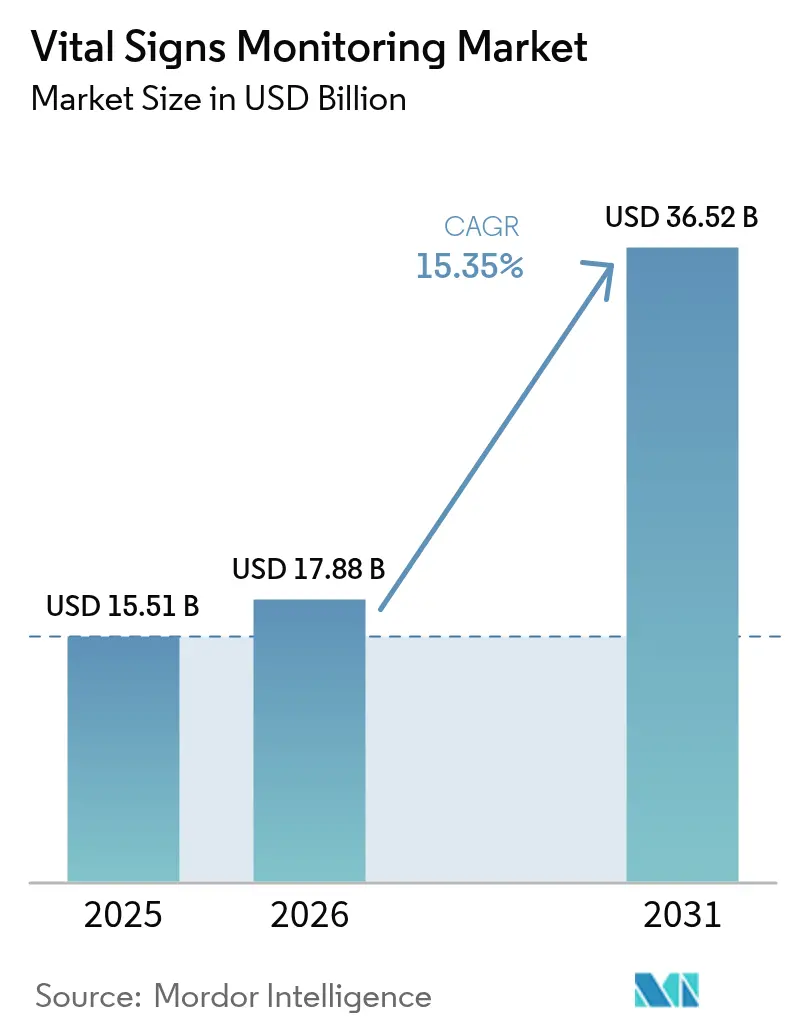
The Vital Signs Monitoring Market size is projected to expand from USD 15.51 billion in 2025 and USD 17.88 billion in 2026 to USD 36.52 billion by 2031, registering a CAGR of 15.35% between 2026 to 2031.
Steady reimbursement for remote patient monitoring, the rapid scaling of Hospital-at-Home programs, and AI-enabled early-warning scores are shifting purchasing decisions toward connected, multi-parameter devices. Hospitals are reallocating capital budgets from stand-alone bedside units to enterprise software bundles that feed directly into electronic health records, while employers and payers are accelerating direct-to-consumer supply chains to curb chronic-care expenses. Technology roadmaps now prioritize Bluetooth Low Energy 5.4 compatibility and multi-wavelength LED arrays that address pigmentation-related accuracy gaps. Competition is intensifying as consumer electronics brands parade FDA-cleared features once restricted to critical-care hardware, compelling legacy device makers to pivot toward subscription analytics and cybersecurity-hardened firmware.
Key Report Takeaways
- By product category, medical devices commanded 51.23% of the vital signs monitoring market share in 2025; consumer wearables are forecast to advance at a 16.78% CAGR through 2031.
- By form factor, table-top and bedside monitors retained 55.1% share of the vital signs monitoring market size in 2025, while wearable devices are projected to expand at 17.56% CAGR to 2031.
- By end-user, hospitals and clinics held 61.89% revenue share in 2025, yet home-care settings are set to grow at an 18.54% CAGR over 2026-2031.
- By geography, North America led with 45.3% revenue share in 2025; Asia-Pacific is positioned to grow at 18.11% CAGR over the forecast period.
Note: Market size and forecast figures in this report are generated using Mordor Intelligence’s proprietary estimation framework, updated with the latest available data and insights as of 2026.
Market Trends and Insights
Drivers Impact Analysis of Vital Signs Monitoring Market*
| Driver | % Impact on CAGR Forecast | Geographic Relevance | Impact Timeline |
|---|---|---|---|
| Rapid rise in chronic cardio-metabolic disorders | +3.2% | Global, with an acute burden in North America and Europe | Long term (≥ 4 years) |
| Expanding adoption of tele-health & RPM reimbursement | +4.1% | North America, Western Europe, Australia | Medium term (2-4 years) |
| Continuous sensor & wireless technology advances | +2.8% | Global, led by Asia-Pacific manufacturing hubs | Medium term (2-4 years) |
| Rising preference for home-based care & self-management | +3.5% | North America, Europe, Japan | Long term (≥ 4 years) |
| Hospital-at-Home programs creating ICU-grade domiciliary demand | +2.9% | United States, United Kingdom, Canada | Short term (≤ 2 years) |
| AI-driven early-deterioration algorithms bundled with devices | +2.6% | North America, Western Europe, select APAC metros | Medium term (2-4 years) |
| Source: Mordor Intelligence | |||
Rising Prevalence of Chronic and Lifestyle Diseases
Cardiovascular mortality climbed 18.6% globally between 2020 and 2024, prompting health systems to shift resources to continuous cardiac surveillance tools. As 48% of U.S. adults now live with some form of heart disease, ambulatory monitoring solutions that capture arrhythmia and nocturnal hypertension are gaining priority funding. Diabetes prevalence reached 537 million adults in 2024, reinforcing demand for multi-parameter monitors that track glucose alongside blood pressure and heart rate. Payers face a USD 4.1 trillion annual chronic-disease burden and are rewarding remote monitoring platforms that demonstrate outcome improvements, accelerating procurement of integrated vital-sign solutions. Collectively, these epidemiologic forces underpin the long-run expansion of the vital signs monitoring market [1].
Expanding Adoption of Tele-Health & RPM Reimbursement
CMS preserved core Remote Patient Monitoring (RPM) codes while private insurers mirrored coverage, guaranteeing a predictable fee schedule for data-driven care pathways. Although CPT 99457 faces a modest payment cut, large provider groups are offsetting the hit by scaling virtual nursing centers that can supervise hundreds of at-home patients simultaneously. In parallel, UnitedHealthcare and Anthem expanded RPM eligibility to nearly 20 million commercial members, stipulating ISO-validated accuracy for connected blood-pressure devices. Internationally, the United Kingdom’s NHS Digital earmarked GBP 450 million to supply 2.5 million citizens with connected monitors, cementing Europe’s reimbursement momentum. Sustained funding de-risks capital allocation for manufacturers, anchoring the volume growth that underpins the vital signs monitoring market.
Continuous Sensor & Wireless Technology Advances
The Bluetooth 5.4 specification slashes connection latency and device power draw, allowing patch-based sensors to operate for almost two weeks on coin-cell batteries. Improved motion-artifact compensation algorithms now deliver ±1.5% SpO₂ accuracy during patient ambulation, meeting the FDA’s stricter pigmentation benchmarks. Masimo’s W1 smartwatch highlights these improvements, doubling battery life relative to its predecessor while streaming three physiologic channels. R&D budgets are therefore skewing toward low-power silicon, advanced photonics, and edge-AI firmware, accelerating the technical refresh cycle across the vital signs monitoring market.
Hospital-at-Home Programs Creating ICU-Grade Domiciliary Demand
Hospital systems continue to shift acute-care episodes into domiciliary environments under CMS’s Acute Hospital Care at Home waiver. Deployed solutions must match ICU-accuracy in uncontrolled settings, prompting vendors to pair ruggedized sensors with cloud dashboards that triage alerts to remote nurses. Economic analyses show 30-day episode costs fall by nearly 40%, incentivizing wider rollout. Device makers that secure enterprise cybersecurity certifications and HL7-FHIR interoperability are winning long-term supply contracts, reinforcing corporate share in the vital signs monitoring market.
Restraints Impact Analysis of Vital Signs Monitoring Market*
| Restraint | (~) % Impact on CAGR Forecast | Geographic Relevance | Impact Timeline |
|---|---|---|---|
| Data-privacy / cyber-security compliance burden | -2.4% | Global, acute in North America and EU | Medium term (2-4 years) |
| High cap-ex & pricing pressure in commoditised SKUs | -1.8% | Global, most severe in Asia-Pacific and Latin America | Short term (≤ 2 years) |
| Accuracy bias on dark-skin tones & motion artefacts | -1.3% | Global, regulatory focus in North America | Medium term (2-4 years) |
| Battery-life limits for multi-parameter, always-on wearables | -0.9% | Global, R&D concentrated in North America and Europe | Long term (≥ 4 years) |
| Source: Mordor Intelligence | |||
Data-Privacy / Cyber-Security Compliance Burden
An upsurge in ransomware attacks has pushed regulators to tighten cybersecurity requirements. The FDA now demands a software bill-of-materials, proof of secure coding, and evergreen patching processes as part of every 510(k) submission. European MDR frameworks impose parallel obligations that include annual penetration testing and incident reporting within 72 hours. Compliance can lift pre-market development costs by up to USD 1.8 million for a single device family, diluting the margins of smaller entrants. Larger incumbents are scaling dedicated security teams and spreading overhead across wider portfolios, but startups face delayed launches or strategic exits, mildly dampening the overall CAGR of the vital signs monitoring market [2].
High Cap-Ex & Pricing Pressure in Commoditized SKUs
Group Purchasing Organizations are leveraging aggregated buying power to negotiate 18-25% price concessions on bedside monitors. At the same time, Asian manufacturers with 20-30% cost advantages are undercutting incumbent list prices, especially in emerging markets. Gross-margin compression forces Western OEMs to bundle analytics subscriptions or pivot toward high-acuity, multi-parameter devices where differentiation is harder to commoditize. Capital constraints in public health systems, particularly across India and Brazil, further limit uptake of premium AI-enabled hardware. These dynamics restrain near-term revenue growth but also accelerate portfolio transitions toward cloud-connected platforms within the vital signs monitoring market.
*Our forecasts treat driver/restraint impacts as directional, not additive. The impact forecasts reflect baseline growth, mix effects, and variable interactions.
Vital Signs Monitoring Market Segment Analysis
By Product:
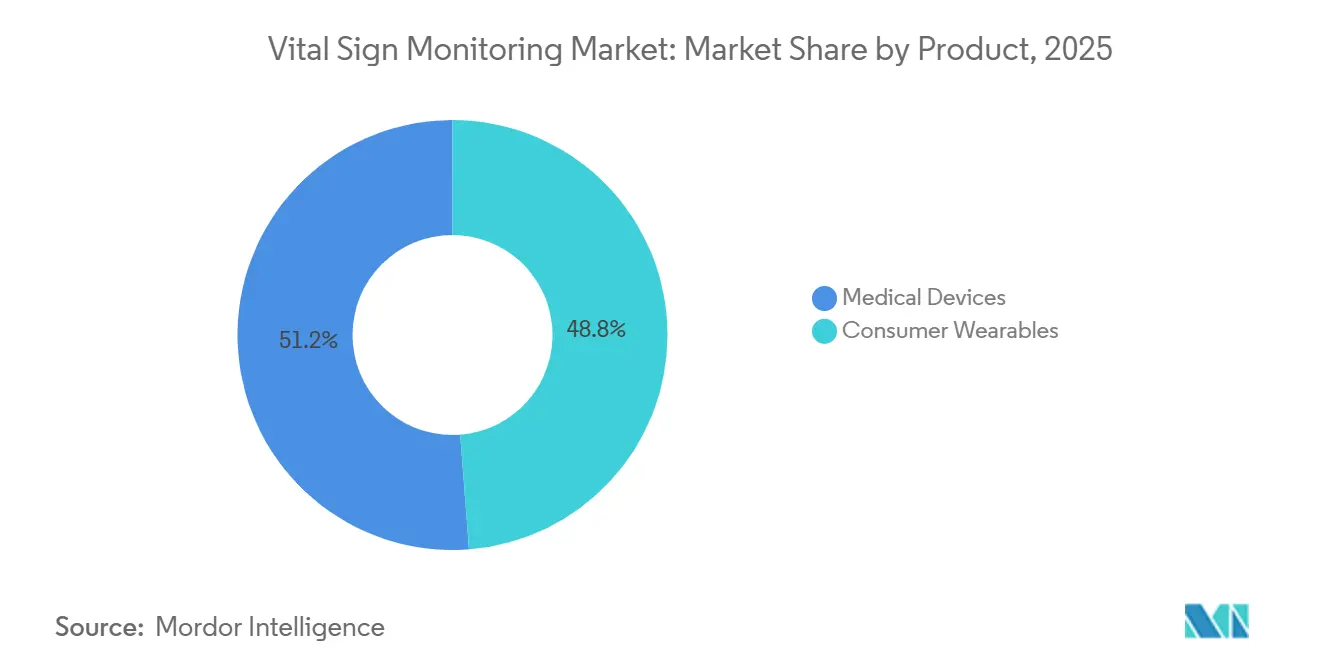
Consumer Wearables Outpace Medical DevicesMedical devices captured a dominant 51.23% share of the vital signs monitoring market and consumer wearables are projected to rise at a 16.78% CAGR, eroding the long-held dominance of regulated medical devices. Apple Watch Series 10 introduced FDA-cleared sleep-apnea screening at a mass-market price point, proving that consumer brands can meet clinical thresholds without hospital distribution. Smartwatches captured a notable share of 2025 consumer revenue, while patch-based monitors are scaling in post-surgical pathways where their adhesive form eliminates patient setup steps. Within regulated medical devices, pulse oximeters still held significant share of 2025 receipts, but mandatory pigmentation-stratified validation is adding six to nine months to approval queues, tilting R&D dollars toward multi-parameter platforms. Together, these shifts broaden addressable users and underpin sustained expansion of the vital signs monitoring market.
Hardware makers are also converging glucose, ECG, and blood-pressure sensors into unified kits. This consolidation simplifies app ecosystems and multiplies reimbursable billing codes, shortening return-on-investment cycles for providers. The vital signs monitoring market size linked to consumer wearables, therefore, stands to leapfrog that of single-parameter medical devices well before 2031.
By End-User:
Home-Care Settings SurgeHome-care environments are on course to record an 18.54% CAGR, the fastest across all user categories. Medicare’s RPM codes fueled USD 2.8 billion in 2025 claims, validating the economic case for continuous at-home surveillance over sporadic clinic visits. Device requirements include intuitive onboarding, voice prompts for older adults, and automatic data uplinks via cellular gateways to avoid Wi-Fi dependencies. Hospitals still accounted for 61.89% of 2025 spend, but their procurement teams increasingly buy enterprise cloud licenses rather than incremental bedside monitors, reshaping revenue composition inside the vital signs monitoring market.
Ambulatory care centers and employer clinics, are rapidly adopting wrist-based blood-pressure devices to manage hypertension between doctor visits. Their uptake illustrates how reimbursement certainty and user-friendly hardware funnel growth from acute facilities into lower-acuity settings, thereby expanding the overall vital signs monitoring market size.
By Form Factor:
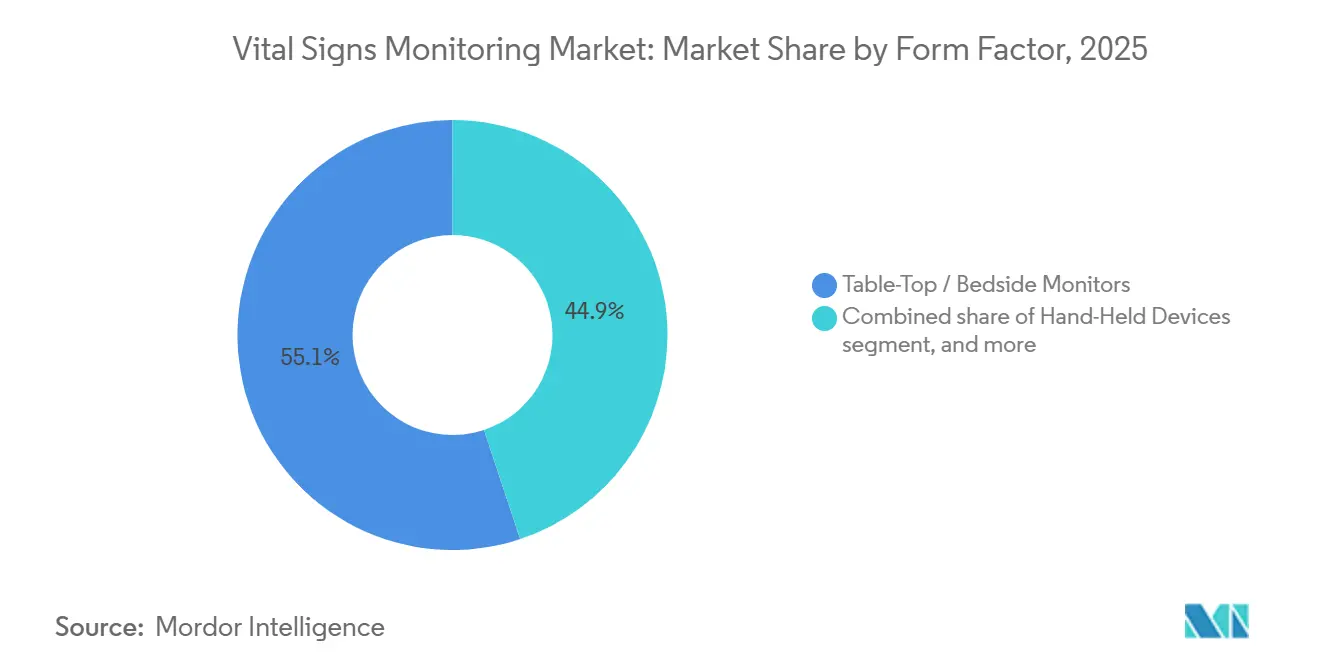
Wearables Displace Bedside MonitorsWearable devices are projected to grow at 17.56% CAGR, outstripping bedside systems that are tethered to fixed locations. Wrist-worn platforms like Apple and Samsung smartwatches provide photoplethysmography and single-lead ECG in packages acceptable to mainstream consumers. Patches and rings fill clinical niches such as post-surgical ambulation and nocturnal arrhythmia tracking. The vital signs monitoring market share for wearables, therefore, widens annually, eating into the legacy 55.1% stake of table-top monitors.
Power-management breakthroughs, spearheaded by Bluetooth 5.4, add seven or more battery days to multi-parameter streams, eliminating the last practical barrier to round-the-clock tracking. As firmware updates extend over-the-air, hospital IT teams accept wearables into electronic record systems, thereby reinforcing institutional demand and fortifying revenue diversity across the vital signs monitoring market.

Geography Analysis
North America and APAC Vital Signs Monitoring Market
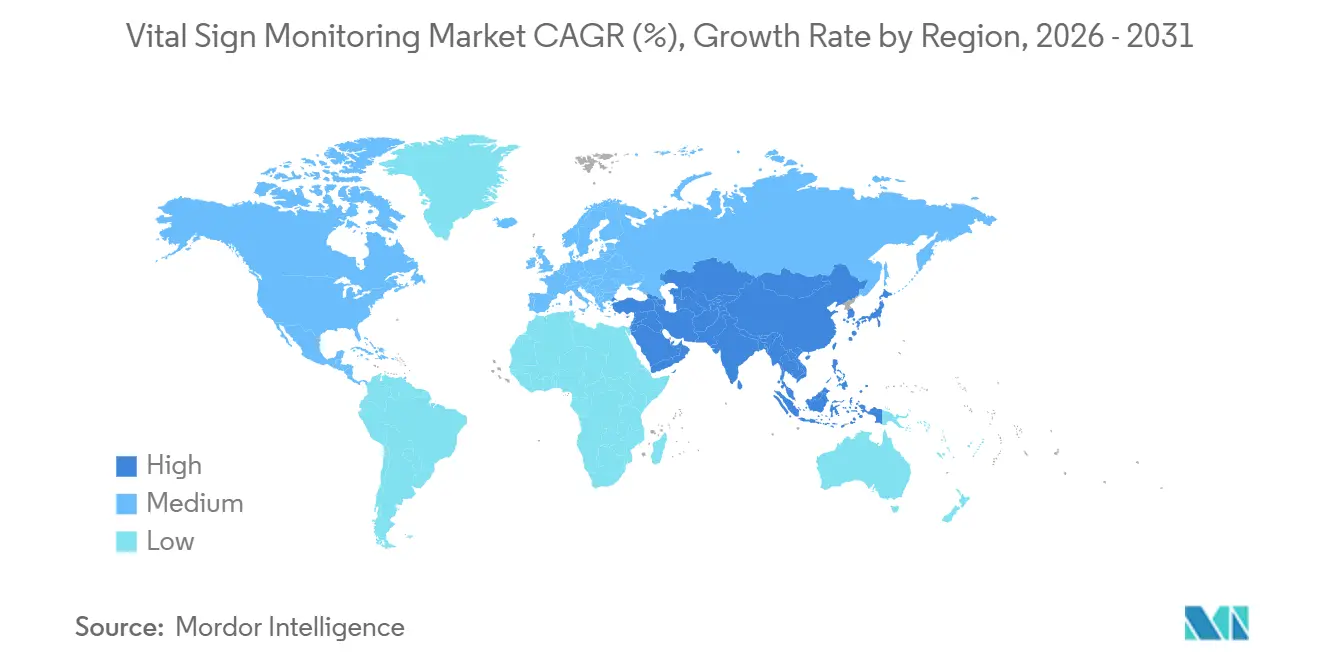
North America kept its 45.3% lead in 2025, benefiting from clear CPT codes, large employer wellness budgets, and 124 health systems that run Hospital-at-Home wards. Provincial efforts in Canada and emerging pilots in Mexico further lift regional unit volumes. Asia-Pacific is set for the fastest proportional climb, at 18.11% CAGR, powered by China’s RMB 1.2 trillion digital-health investment and India’s unified health-record rollout. Reimbursement expansions in Japan and South Korea support incremental device densification in super-aging societies, while Australia targets rural connectivity gaps with federal grants.
EMEA and South America Vital Signs Monitoring Market
Europe represents a significant share of 2025 revenue and is unified by national frameworks that reimburse connected devices for chronic heart failure, COPD, and diabetes. Germany’s Digital Healthcare Act saw EUR 380 million in 2025 claims, validating statutory insurance appetite. France’s centralized remote-monitoring platform pulls data from 18 device brands, proving interoperability at scale. South America and the Middle East & Africa collectively registered notable share, but strategic tender awards in Brazil and the Gulf states demonstrate the future upside for vendors that localize language support and battery-safety certifications. These regional nuances collectively orchestrate multi-speed expansion of the vital signs monitoring market.
Regulatory Landscape
Regulation is tightening around connected vital-sign devices as cybersecurity and measurement-bias concerns move from guidance into submission and post-market expectations. In the United States, FDA 510(k) submissions for monitoring devices increasingly need a software bill of materials, vulnerability processes, and patching plans. FDA also issued updated Clinical Decision Support guidance in January 2026, clarifying boundaries for software that uses episodic physiologic measurements. For pulse oximetry, FDA released draft performance-testing guidance in January 2025 aimed at updating legacy expectations, reinforcing a shift toward pigmentation-stratified validation and more rigorous clinical evidence packages.
In Europe, MDR and IVDR compliance continues to reshape lifecycle obligations, with manufacturers navigating Notified Body capacity and transition conditions tied to active application status. A key operational milestone is May 2026, when four EUDAMED modules (Actor registration, UDI/device registration, Notified Body certificate registration, and market surveillance) became mandatory under Commission Decision (EU) 2025/2371. This raises the urgency of internal data readiness and reporting integration. Standards also advanced with ISO 80601-2-61:2026, published in April 2026, updating basic safety and essential performance requirements for pulse oximeter equipment and influencing product design controls and verification test plans.
Competitive Landscape
The vital signs monitoring market remains moderately fragmented. Medtronic and Philips held significant share primarily through entrenched hospital estates and integrated software dashboards. Each is migrating toward recurring SaaS revenue to soften hardware margin erosion. Apple, Samsung, and Garmin weaponize consumer brand power, chipping away at low-acuity segments and forcing legacy OEMs into patent disputes, as seen in Masimo’s Section 337 campaign that temporarily blocked certain Apple imports.
Start-ups such as BioBeat and VivaLNK focus on patch-based devices that deliver 24/7 ambulatory accuracy without cuffs, carving premium sub-niches. M&A continues; Baxter’s earlier absorption of Hill-Rom fused infusion pumps with Welch Allyn monitors, indicating sustained appetite for vertically integrated portfolios. Asian entrants Mindray and Contec leverage double-digit cost advantages to win public-hospital tenders in South America and Africa, although FDA and CE hurdles still gate North American and EU penetration. Competitive dynamics therefore hinge on cybersecurity credentials, AI-enhanced analytics, and the agility to certify multi-parameter wearables under evolving home-use guidance, factors that collectively mold strategic posturing across the vital signs monitoring market
Vital Signs Monitoring Industry Leaders
-
Nihon Kohden Corporation
-
Koninklijke Philips N.V.
-
Apple Inc.
-
A&D Company
-
Medtronic plc
- *Disclaimer: Major Players sorted in no particular order

Vital Signs Monitoring Market Companies Covered in this Report
- A&D Company
- Abbott Laboratories
- Apple
- Baxter
- BioBeat Technologies
- Contec Medical Systems
- GE Healthcare
- iRhythm Technologies
- Koninklijke Philips
- Masimo
- Medtronic
- Microlife Corp.
- Mindray
- Nihon Kohden
- Nonin Medical
- OMRON
- ICU Medical
- SunTech Medical
- VivaLNK
Market Opportunities and Future Outlook
A whitespace is emerging around contactless and hardware-agnostic vital-sign extraction, as camera-based systems moved into regulated use cases through multiple FDA 510(k) clearances in 2026. Examples include Oxehealth (K251200), PanopticAI (K260066), and Presage Technologies SmartSpectra Vital Signs Monitor 1.0 SDK (K254169), which collectively establish predicates and accelerate vendor roadmaps for pulse and respiratory-rate monitoring delivered via mobile-device cameras or dedicated cameras. This shift supports new go-to-market models where software SDKs and analytics layers sit on top of existing installed bases (phones, tablets, USB cameras), changing procurement from capital equipment toward software licensing and integrated workflows.
Hospital operational programs also add pull-through for connected monitoring bundles across acute-to-home pathways. Region Stockholm selected a consortium including Philips for hospital-at-home remote monitoring capacity of up to 15,000 patients annually. The selection aligns device demand with enterprise dashboards, alarm management, and EHR connectivity requirements, rather than stand-alone bedside hardware. In parallel, in-hospital adoption is expanding beyond traditional monitors. National University Hospital (NUH) initiated smartwatch integration for inpatient vital-sign monitoring, creating opportunities for vendors that can meet clinical accuracy thresholds, interoperability requirements (including HL7-FHIR integration), and cybersecurity controls demanded by provider IT and regulators.
Recent Industry Developments in Vital Signs Monitoring Market
- June 2026: Philips launched the IntelliVue Patient Monitor 6000 Series, emphasizing core measurement capabilities with modular expansion and standardized one-piece construction. The design approach supports faster deployment and configuration across different care settings, aligning with hospital needs for flexible monitoring estates and streamlined infection-control workflows.
- June 2025: Cardinal Health launched Kendall DL Multi, a single-patient cable set that tracks cardiac activity, SpO2, and temperature through one port. The product targets workflow simplification and consumable-driven monitoring setups, supporting hospitals that want to reduce cable complexity and standardize bedside connections.
- September 2024: Nihon Kohden introduced RemoteSense to address healthcare staffing challenges through remote monitoring and centralized visibility of patient status. The shift reflects growing demand for continuous surveillance that scales clinician coverage and supports broader virtual-care and centralized monitoring models.
Vital Signs Monitoring Market Report Scope and Research Methodology
Market Definition and Coverage
For this methodology, the vital signs monitoring market covers equipment used to measure and track core physiological parameters, such as blood pressure, oxygen saturation, temperature, pulse rate, and respiratory rate, across care settings including hospitals, ambulatory sites, and home care.
Scope exclusions: The sizing excludes clinical monitoring that does not materially measure vital signs (for example, stand-alone fetal monitoring and imaging-led diagnostics).
Segments Covered in This Report
- By Product
- Consumer Wearables
- Smartwatches
- Fitness & Activity Trackers
- Smart Patches
- Other Wearables
- Medical Devices
- Blood Pressure Monitors
- Pulse Oximeters
- Temperature Monitoring Devices
- Respiratory-Rate Monitors
- Consumer Wearables
- By End-User
- Hospitals & Clinics
- Ambulatory & Health Centres
- Home-Care Settings
- By Form Factor
- Hand-Held Devices
- Table-Top / Bedside Monitors
- Wearables
- By Geography
- North America
- United States
- Canada
- Mexico
- Europe
- Germany
- United Kingdom
- France
- Italy
- Spain
- Rest of Europe
- Asia-Pacific
- China
- India
- Japan
- South Korea
- Australia
- Rest of Asia-Pacific
- Middle East and Africa
- GCC
- South Africa
- Rest of Middle East and Africa
- South America
- Brazil
- Argentina
- Rest of South America
- North America
Data Sources, Market Sizing, and Validation
Desk Research
Desk research was used to set the market boundaries, build demand anchors, and avoid overcounting across device categories that sometimes overlap in retail and clinical channels. We mainly relied on public health statistics and medical device reference information to understand where vital signs checks are performed most often, and how care is shifting toward home-based monitoring.
Typical sources we referred to include CDC and WHO disease and risk-factor statistics, OECD health system indicators, FDA device databases and safety communications, and peer-reviewed journals that report adoption and clinical use patterns for blood pressure and pulse oximetry. To pressure-test company-level assumptions, we also used company filings and investor presentations, press releases, and hospital and association websites. For financial normalization and timeline checks, we used selective paid subscriptions for company financials and for patents when helpful. These examples are not exhaustive, and other sources were also reviewed for data collection, validation, and clarification.
Primary Interviews and Surveys
Primary work was conducted to confirm what is being purchased and used in real settings, and to align the model with how procurement happens across hospital procurement, clinics, and homecare distributors. We spoke with a mix of device manufacturers, channel partners, biomedical teams, and clinicians, and then used structured surveys to validate typical replacement cycles, price ranges, and the split between bedside monitors, handheld devices, and wearables across regions.
Distribution of primary research fieldwork respondents
| Company type | Respondent position | Region |
|---|---|---|
| Top tier: 35% | CXOs: 14% | APAC: 47% |
| Mid tier: 48% | Functional/Unit leaders: 41% | EMEA: 33% |
| Smaller Players: 17% | Managers: 45% | Americas: 20% |
Market-Sizing & Forecasting
Sizing started from a top-down build where healthcare delivery volumes and monitoring adoption are reconstructed by setting, and then mapped to average device density and replacement rhythm. From there, totals were corroborated through selective bottom-up approximations, such as sampled ASP-by-product combined with estimated unit shipments, along with channel checks on the share of wearable monitoring versus traditional bedside systems.
Key inputs used in the model included hospital and outpatient procedure volumes, chronic disease prevalence trends that drive repeat vital checks, homecare penetration and telehealth-supported monitoring adoption, replacement cycles for monitors and sensors, and average selling price movement by form factor (handheld, tabletop, and wearable). Where coverage was thin for smaller countries, gaps were handled using proxy indicators like healthcare expenditure per capita and hospital bed stock, then adjusted using interview feedback.
For forecasting, scenario analysis was used so the outlook stays practical when reimbursement changes, hospital capex cycles, and consumer wearable upgrades move faster or slower than expected. The final run assumes variable-level direction is aligned with what respondents see in procurement and care pathway changes, and it is then converted to a consistent USD series using the same timing across regions.
Data Validation & Update Cycle
Outputs were checked against independent signals, including whether implied unit volumes per facility look realistic and whether price bands match what buyers and distributors report. We also ran variance checks across regions so growth does not contradict known adoption patterns, including faster uptake of remote monitoring in certain APAC markets and more replacement-led demand in mature hospital systems.
Before sign-off, the model goes through multi-step analyst review, and any sharp year-to-year jump triggers a re-check of the driver that caused it, followed by re-contact with select respondents when needed. Reports refresh annually, with interim updates when material events occur, and a final freshness pass is completed before delivery so clients receive the latest updated view.
Mordor Intelligence's Vital Signs Monitoring Market Size Measured Against Other Published Estimates
Published market sizes for vital signs monitoring often do not match, and the gap usually comes from what is counted as a vital signs device, how consumer wearables are treated, and whether revenues are captured at the manufacturer level or closer to end-user pricing.
Some estimates narrow the scope to hospital-grade monitors only, while others include a broader wearable universe without separating fitness tracking from clinical-grade monitoring. The spread also grows when price evolution is assumed as flat across years, when exchange rates are taken from a different point in time, or when forecasts are updated less often. In our build, the count expands only when a device is used to measure the defined vital signs set across hospitals, ambulatory settings, and home care, which explains why the 2025 value lands higher than device-only studies, a modeling choice applied by Mordor Intelligence.
Benchmark comparison
| Source | Market Size | Gaps in Research Methodology |
|---|---|---|
| Mordor Intelligence | USD 15.51 B (2025) | |
| Global Consultancy A | USD 11.56 B (2025) | Uses a devices-only scope and typically leaves out consumer wearables and related monitoring services, which reduces the addressable revenue pool even when end-use settings are similar. |
| Trade Journal B | USD 5.63 B (2024) | Anchors on a narrower device basket and an earlier base year, and it often applies conservative adoption rates for homecare and wearable form factors, which pulls down the current-year value. |
The table shows that scope is the biggest driver, followed by how adoption and pricing are carried forward year to year. By keeping the model tied to clear vital sign parameters, care-setting demand signals, and repeatable price and replacement assumptions, the resulting value stays easier to trace and update when market conditions change.
Key Questions Answered in the Report
How quickly are Hospital-at-Home programs adopting connected monitors?
By late 2025, 124 U.S. health systems had enrolled, treating 38,000 patients with ICU-grade wearables and driving fresh device orders.
Which product category is growing fastest?
Consumer wearables are projected to expand at a 16.78% CAGR, outpacing regulated medical devices through 2031.
What are the main cybersecurity requirements for new monitors?
The FDA now mandates a software bill-of-materials, vulnerability disclosure policies, and documented secure coding for all 510(k) filings.
Why is pigmentation bias a regulatory focus?
Pulse-oximeter accuracy can degrade by up to 5 percentage points on darker skin, prompting the FDA to require skin-type-stratified validation.
Which geography offers the highest incremental growth?
Asia-Pacific leads with an 18.11% CAGR, anchored by China’s RMB 1.2 trillion digital-health investment and India’s unified health-record rollout.