
Vietnam Cross-Border B2C E-commerce Market Size and Share
Market Overview
| Study Period | 2020 - 2031 |
|---|---|
| Forecast Data Period | 2026 - 2031 |
| Base Year Market Size (2025) | USD 4.45 Billion |
| Market Size (2026) | USD 5.5 Billion |
| Market Size (2031) | USD 13.39 Billion |
| Growth Rate (2026 - 2031) | 19.49 % |
| Market Concentration | High |
Major Players *Disclaimer: Major Players sorted in no particular order Image © Mordor Intelligence. Reuse requires attribution under CC BY 4.0. | |
Vietnam Cross-Border B2C E-commerce Market Analysis by Mordor Intelligence
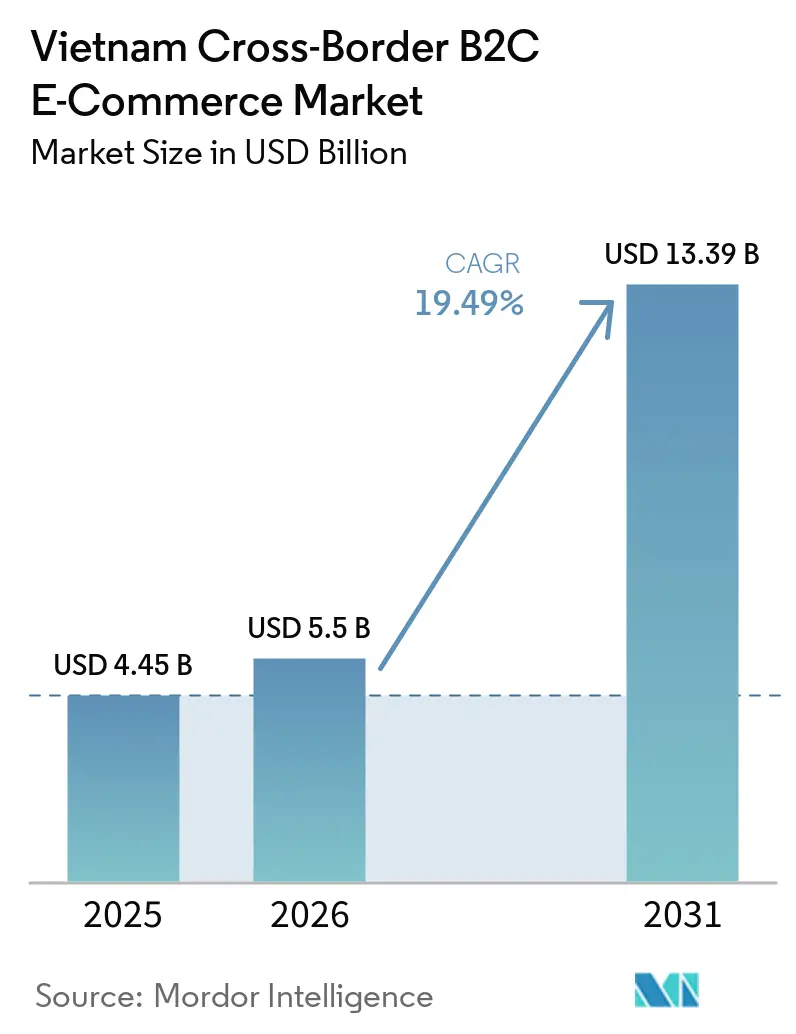
The Vietnam Cross-Border B2C E-commerce Market size was valued at USD 4.45 billion in 2025 and estimated to grow from USD 5.50 billion in 2026 to reach USD 13.39 billion by 2031, at a CAGR of 19.49% during the forecast period (2026-2031).
The Vietnam Cross-Border B2C E-commerce Market is still small relative to the country’s total import and export turnover of USD 930 billion in 2025, indicating that digital trade remains underpenetrated within Vietnam’s broader trade base. The broader domestic retail e-commerce market reached USD 31 billion in 2025, representing 10% of national retail sales, while cross-border volumes were only 14% of that level, leaving ample room for further expansion as online buying habits deepen. Growth continues to rest on wallet adoption, trade agreement coverage, platform-led shopper acquisition, and a larger pool of MSMEs that are becoming ready for export operations. The policy backdrop is also becoming more deliberate, as the National E-commerce Development Master Plan 2026-2030 places cross-border commerce within Vietnam’s export agenda and sets a target of USD 5.50 billion in online exports by 2027. The Vietnam Cross-Border B2C E-commerce Market is also moving toward a more formal operating model, as the new E-commerce Law and digital customs reforms reward compliant sellers with greater trust, smoother clearance, and a more stable path to scale.
Key Report Takeaways
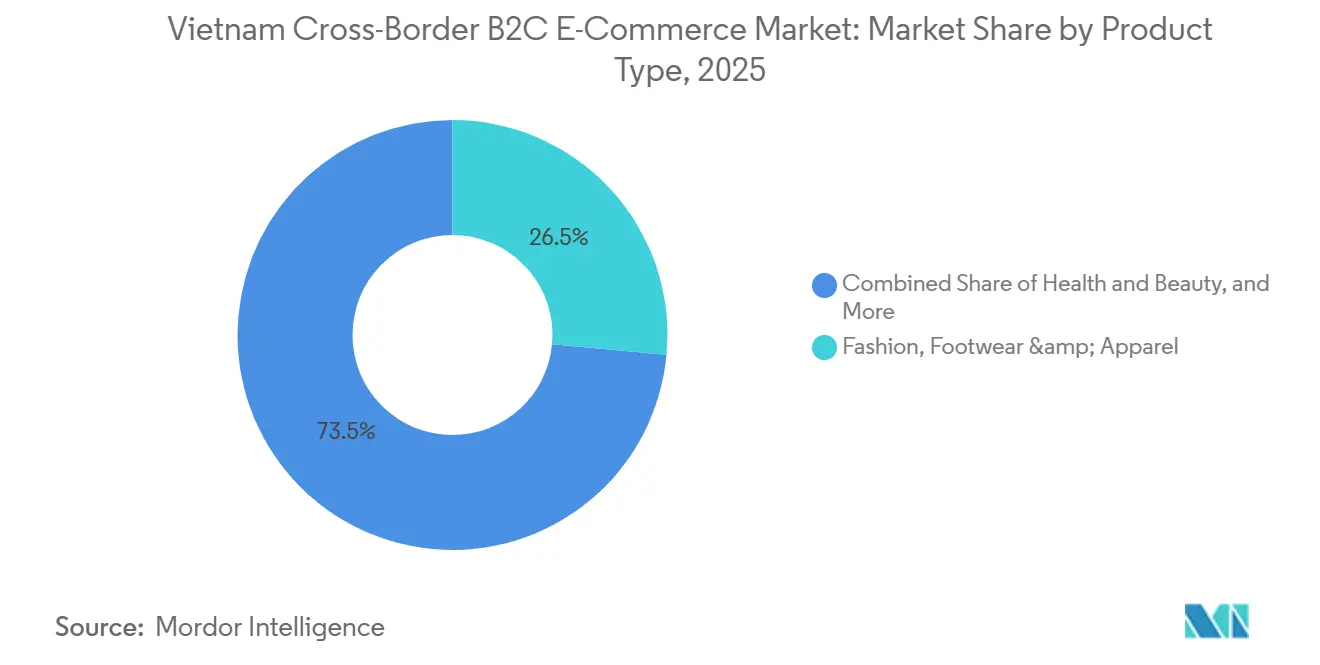
- By product category, fashion, footwear, and apparel held 26.47% of the Vietnam Cross-Border B2C E-commerce Market share in 2025, while health and beauty/personal care is forecast to grow at a 20.72% CAGR through 2031.
- By sales channel, online marketplaces held 72.64% of the Vietnam Cross-Border B2C E-commerce Market share in 2025, while social commerce is projected to expand at a 24.91% CAGR through 2031.
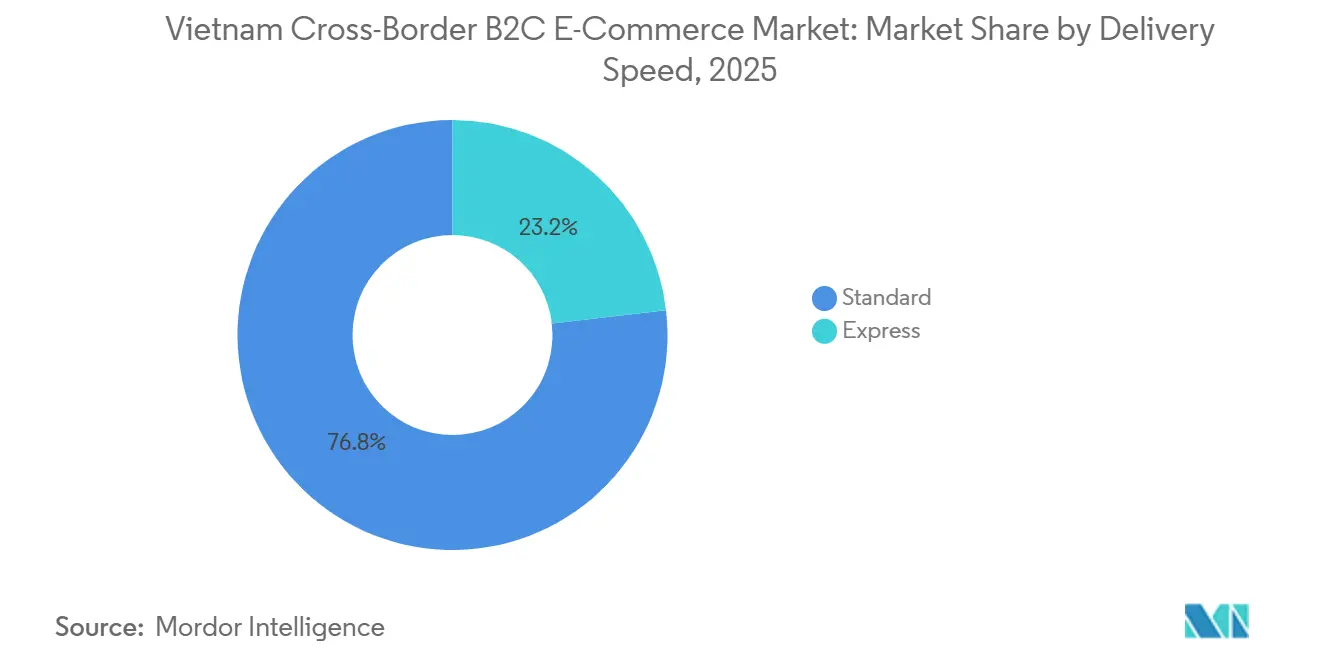
- By delivery speed, standard delivery accounted for 76.83% of the Vietnam Cross-Border B2C E-commerce Market size in 2025, while express delivery is projected to grow at a 22.08% CAGR through 2031.
- By country and flow direction, inbound imports accounted for 55.06% of the Vietnam Cross-Border B2C E-commerce Market size in 2025, while outbound exports are forecast to grow at a 22.76% CAGR through 2031.
Note: Market size and forecast figures in this report are generated using Mordor Intelligence’s proprietary estimation framework, updated with the latest available data and insights as of January 2026.
Vietnam Cross-Border B2C E-commerce Market Trends and Insights
Drivers Impact Analysis*
| Driver | (~) % Impact on CAGR Forecast | Geographic Relevance | Impact Timeline |
|---|---|---|---|
| Marketplace-Led shopper acquisition and social commerce scale | +4.80% | National, with concentration in Ho Chi Minh City and Hanoi; spill-over to Tier 2 cities | Short term (≤ 2 years) |
| Smartphone-First checkout and wallet Adoption | +3.20% | National; urban-first with rapid rural catchup via Mobile Money | Short term (≤ 2 years) |
| Export-push policies and trade agreements | +2.90% | Global with early outbound gains to US, EU, Japan, South Korea, and ASEAN | Medium term (2-4 years) |
| Rising demand for foreign beauty, fashion, and electronics | +3.00% | National; inbound imports concentrated in Hanoi and HCMC consumption zones | Short term (≤ 2 years) |
| Customs-platform-logistics data linkage | +1.80% | National; gains concentrated at major border crossings and express-delivery hubs | Medium term (2-4 years) |
| Seller formalization improves cross-border readiness | +1.50% | National; impact highest among MSME-dense provinces with manufacturing export capacity | Long term (≥ 4 years) |
| Source: Mordor Intelligence | |||
Marketplace-Led Shopper Acquisition and Social Commerce Scale
The Vietnam Cross-Border B2C E-commerce Market is being shaped by the way shoppers now discover products inside content feeds rather than through direct search. TikTok Shop’s revenue in Vietnam grew 93% in 2025, and its platform share rose from 26.90% to 39.60%, which showed how quickly social discovery moved into actual purchase behavior. In Q1 2026, the 4 largest platforms generated VND 148.60 trillion (USD 5.70 billion), up 46.60% year on year, confirming that platform traffic was still translating into strong transaction growth[1]. Fashion alone generated VND 23.40 trillion (USD 0.90 billion) on TikTok Shop in Q1 2025, which underlined how visual categories benefit from short-video and live-selling formats. The same concentration that helps the Vietnam Cross-Border B2C E-commerce Market scale also leaves sellers more exposed to fee changes, ranking changes, and platform rules, as Shopee and TikTok Shop together accounted for 97% of platform GMV in 2025.
Smartphone-First Checkout and Wallet Adoption
Vietnam’s mobile-first consumer base continues to lower payment friction for cross-border shopping. The country had 127 million mobile connections in early 2025, exceeding the population, because dual-SIM use remained common and helped keep digital access widespread. QR code payments rose 61.63% in volume and 150.67% in value in the first 9 months of 2025, which showed that digital checkout behavior had become far more normal across user groups. The Mobile Money pilot also expanded into rural and remote areas, and by 2025, 10.89 million accounts were active, with 70% of them outside urban centers. The Vietnam Cross-Border B2C E-commerce Market benefits directly from this shift because smartphone penetration reached 84%, 4G coverage extended to 99.80% of communes, and more sellers were required to adopt digital invoicing and formal payment tools from June 2025 onward.
Export-Push Policies and Trade Agreements
The export policy is becoming more aligned with digital trade execution. The National E-commerce Development Master Plan 2026-2030 aims to support at least 100 businesses in cross-border platform operations and to help at least 10 companies exceed USD 10 million in online export revenue, providing the Vietnam Cross-Border B2C E-commerce Market with a clearer supply-side growth path. Vietnam’s participation in CPTPP and RCEP also improves tariff conditions and rules-of-origin treatment in markets such as Japan, South Korea, Australia, and other key destinations. Prime Minister Directive 29/CT-TTg in 2025 pushed ministries to tie trade promotion more closely to digital transformation, which reduced the gap between export ambition and e-commerce execution. This matters because the Vietnam Cross-Border B2C E-commerce Market is growing on both the buyer and seller sides, as a larger base of Vietnamese firms gains the policy support needed to build direct online export channels[2].
Rising Demand for Foreign Beauty, Fashion, and Electronics
Inbound demand for imported goods remains one of the clearest sources of revenue for the Vietnam Cross-Border B2C E-commerce Market. Vietnamese consumers spent VND 74.40 trillion (USD 3 billion) on beauty and personal care products through e-commerce in 2025, a 30% year-on-year increase. Cosmetics revenue alone rose 23% in 2025, indicating that imported skincare and beauty labels still hold strong appeal among buyers who value brand origin and product trust. Platforms such as YesStyle, iHerb, and Lazada’s cross-border program are serving niche beauty and supplement demand that local supply has not fully matched in terms of price, quality, or brand recognition. The same demand pattern also supports imports of fashion and electronics, especially among younger consumers who use international brands as part of their identity and lifestyle choices, while tariff changes under RCEP keep some of these purchases economically attractive.
Restraints Impact Analysis*
| Restraint | (~) % Impact on CAGR Forecast | Geographic Relevance | Impact Timeline |
|---|---|---|---|
| Low-Value Import VAT and Tax-Compliance burden | -1.80% | National; most acute for small-parcel inbound imports from China and ASEAN | Short term (≤ 2 years) |
| Counterfeit risk and reverse-logistics Friction | -1.20% | National; enforcement concentrated at Hanoi, HCMC, and key border crossings | Medium term (2-4 years) |
| Data localization and Real-ID verification overhead | -0.90% | National for all cross-border platforms; compliance burden highest for foreign operators without Vietnam legal presence | Medium term (2-4 years) |
| Platform fee Inflation and algorithm dependence | -1.40% | National; impact most acute for SME sellers in FMCG, Fashion, and Health & Beauty categories | Short term (≤ 2 years) |
| Source: Mordor Intelligence | |||
Low-Value Import VAT and Tax-Compliance Burden
The tax treatment of small imported parcels changed materially in 2025, removing one of the long-standing cost advantages of inbound cross-border trade. Decision No. 01/2025/QD-TTg ended the VAT exemption for low-value imported goods sent by express delivery from February 18, 2025, which increased the landed cost of many small orders. The same year also brought tighter invoicing and withholding obligations, so the Vietnam Cross-Border B2C E-commerce Market now carries a heavier compliance load for smaller merchants using thin-margin parcel models. Vietnam Customs reported that the policy shift generated more than VND 1 trillion (USD 40 million) in additional tax revenue by mid-September 2025, confirming that the fiscal effect was meaningful and that part of the burden had shifted onto sellers and end prices. For high-frequency, low-ticket imports, this raises the risk that compliance costs grow faster than transaction value.
Counterfeit Risk and Reverse-Logistics Friction
Trust remains a practical barrier in product categories where authenticity matters most. More than 13,700 online shops were removed in 2025 for selling fake, banned, or untraceable goods, which showed the scale of monitoring still required across digital platforms. The Vietnam Cross-Border B2C E-commerce Market faces additional pressure as counterfeit activity is rising across cosmetics, supplements, and other fast-growing imported categories, where consumer trust is central to repeat buying. Returns are also more expensive in cross-border trade, since overseas goods often require multi-leg freight handling, customs processing, and tighter carrier coordination before a refund can be closed. As a result, some sellers either limit return options or raise prices, and both responses can slow conversion in categories where buyers already worry about quality and legitimacy.
*Our forecasts treat driver/restraint impacts as directional, not additive. The impact forecasts reflect baseline growth, mix effects, and variable interactions.
Segment Analysis
By Product Category: Health and Beauty Rebalancing a Fashion-Led Market
Fashion, footwear, and apparel accounted for 26.47% of the Vietnam Cross-Border B2C E-commerce Market share in 2025, keeping the category in the lead, as Vietnam already has a strong garment base and platforms can merchandise fashion efficiently through image-led and video-led formats. The category also benefits from cross-border models, which allow consumers to access international labels without relying on traditional retail distribution. VCCI and Access Partnership indicated that cross-border fashion exports from Vietnam are projected to grow 26% annually through 2029, which is far faster than legacy export channels and supports a larger direct-to-consumer route for sellers. Home and office, hobbies and toys, and automotive parts continue to serve narrower but steady use cases, including furniture exports, imported branded collectibles, and vehicle accessories that are not easily available in local retail.
Health and beauty/personal care is the fastest-growing product segment, with the Vietnam Cross-Border B2C E-commerce Market size for this segment projected to grow at a 20.72% CAGR through 2031. The segment draws strength from 2 directions at once: imported Korean and Japanese skincare on the inbound side, and rising export potential for Vietnamese wellness and herbal products on the outbound side. Cosmetics revenue rose in 2025, which supports the case that beauty is moving from a niche import play into a broader recurring purchase category across platforms. The Vietnam cross-border B2C e-commerce industry also sees increasing compliance differentiation in health supplements, cosmetics, and electronics, because documented and brand-verified sellers are better placed to absorb product checks and consumer protection rules under the new law.

By Sales Channel: Social Commerce Disrupting Marketplace Dominance
Online marketplaces accounted for 72.64% of the Vietnam Cross-Border B2C E-commerce Market size in 2025, supported by buyer trust in escrow tools, platform-led logistics, and the concentration of transaction volume around Shopee and TikTok Shop. The 4 largest platforms posted VND 148.60 trillion (USD 5.70 billion) in sales in Q1 2026, up 46.60% from a year earlier, which showed that infrastructure scale is still rising faster than the consumer base alone would suggest. That same scale also creates system-wide dependence, because platform decisions on commissions, visibility rules, and seller onboarding can shift the economics of a large share of the market almost immediately. The May 2026 scrutiny of Shopee’s fee approach reinforced that this concentration is now important enough to attract public-interest attention, even if the marketplace model remains dominant.
Social commerce is the fastest-growing channel and is forecast to expand at a 24.91% CAGR through 2031 as video, live selling, and chat-based conversion continue to pull discovery and purchase into the same session. TikTok Shop’s fast rise is the clearest proof of this model, but Shopee’s investment in Shopee Video also shows that incumbent platforms are adapting rather than yielding the space. Direct-to-consumer webstores still hold the smallest share, yet they are gaining more relevance among exporters in furniture, fashion, and artisan goods where storytelling and brand identity matter more than pure price comparison. Amazon’s 2026 rollout of AI-based tools for market research, demand analysis, and product development in Vietnam supports that move by helping sellers build more independent demand-generation capabilities. The Vietnam cross-border B2C e-commerce industry may therefore remain marketplace-led, but channel mix is likely to become more balanced as social conversion deepens and stronger exporters invest in owned storefronts.
By Delivery Speed: Standard's Volume Lead Masks Express Demand Signals
Standard delivery accounted for 76.83% of the Vietnam Cross-Border B2C E-commerce Market share in 2025, reflecting the clear price sensitivity of Vietnam’s mass-market buyers and the continued importance of low-value parcel flows from China and ASEAN. This delivery profile has fit inbound demand well because many popular categories, including fashion accessories, beauty products, and household items, do not always need premium speed to convert. At the same time, the Vietnam Cross-Border B2C E-commerce Market is gradually building the conditions for a faster-delivery mix, especially for outbound sellers serving consumers accustomed to short fulfillment windows. The customs clearance pilot launched in June 2026, and broader digitization of shipping documents is important here because they reduce some of the procedural delays that used to weaken the business case for faster services.
Express delivery is the fastest-growing option and is forecast to expand at an 22.08% CAGR through 2031. Amazon Global Logistics became available in Vietnam in November 2025 and made the country the 2nd FBA export origin point globally, which directly improves lead times for sellers shipping goods to the United States buyers through Amazon’s fulfillment network. TikTok’s plan to build a Vietnam-based logistics entity with the capacity to process 1 billion to 2 billion orders a year also points to more platform-controlled logistics depth over time. The removal of the low-value VAT exemption from February 2025 adds another reason for this shift, because sellers now have more incentive to move away from fragmented micro-shipments and toward fewer, larger consignments with better unit economics.
By Country and Flow Direction: Outbound Export Growth Challenging Inbound Import Dominance
Inbound (imports) accounted for 55.06% of the Vietnam Cross-Border B2C E-commerce Market size in 2025 and remained the largest segment, as China, South Korea, and Japan continue to supply many of the categories that Vietnamese consumers actively seek online. China is the largest source market because it combines scale, price competitiveness, geographic proximity, and strong platform access through AliExpress, Taobao Global, Temu, and DHgate. South Korea and Japan follow because beauty, skincare, and selected electronics categories continue to benefit from stronger buyer trust in origin-country branding. The end of the low-value VAT exemption from February 2025 raised the cost of the dominant China-origin small parcel model, which may slow some import growth and support substitution in selected domestic categories.
Outbound (exports) are the faster-growing direction, with the Vietnam Cross-Border B2C E-commerce Market size for outbound trade forecast to rise at a 22.76% CAGR through 2031. Online export revenue reached USD 2 billion in 2025, up 18% year on year, indicating that Vietnam’s manufacturing base is already connecting more directly with global consumers through digital channels. The United States is the largest outbound destination, and Vietnam’s total merchandise exports to that market reached USD 153.20 billion in 2025, giving Vietnamese sellers an established trade corridor to build on. The 2026-2030 master plan, together with CPTPP and RCEP tariff advantages, should keep garments, furniture, handicrafts, and selected electronics components at the center of this export expansion[3].
Geography Analysis
China remains the most influential trading partner in Vietnam's cross-border B2C e-commerce market, as it is the largest inbound source and an important two-way trade corridor for Vietnamese sellers. China-origin goods span electronics, fashion, beauty, and home accessories, and they continue to benefit from short transport routes and well-developed express networks. The Vietnam Cross-Border B2C E-commerce Market also feels China’s weight through platform reach, because AliExpress, Taobao Global, Temu, and DHgate all help anchor inbound product flow. The removal of low-value import VAT exemptions from February 2025 added cost pressure to the China parcel model, pushing some operators toward larger consolidated shipments rather than many small consignments. On the outbound side, RCEP simplifies rules of origin and customs procedures, which supports two-way trade with China and other member economies.
The United States is the most strategic outbound destination for the Vietnam Cross-Border B2C E-commerce Market because it offers scale, deep logistics, and strong buyer demand for Vietnamese-made products. VCCI and Access Partnership found that 82% of surveyed Vietnamese MSMEs viewed the United States as the most promising cross-border market. Vietnam’s goods exports to the United States reached USD 153.20 billion in 2025, which gives sellers a mature trade route and stronger buyer familiarity with Vietnamese supply. Amazon’s AGL launch in Vietnam strengthens this corridor because it reduces freight coordination barriers for SMEs using Fulfillment by Amazon. South Korea and Japan are also important because they are major inbound sources for K-beauty and J-beauty while serving as attractive export destinations for garments, wood furniture, and processed goods under favorable trade terms.
Within ASEAN, Singapore, Thailand, and Indonesia matter as both supply and destination markets in the Vietnam Cross-Border B2C E-commerce Market. Singapore functions as a management and capital node for regional platforms such as Shopee and Lazada, while Thailand operates as a two-way corridor for beauty, garments, and furniture. Australia, Germany, and the Netherlands remain relevant outbound destinations for furniture, handicrafts, and artisan products where tariff frameworks and diaspora demand support repeat purchasing. The United Kingdom also offers a more supportive digital trade setting under the UKVFTA and related commitments, which broadens Vietnam’s export options beyond Asia and North America[4].
Competitive Landscape
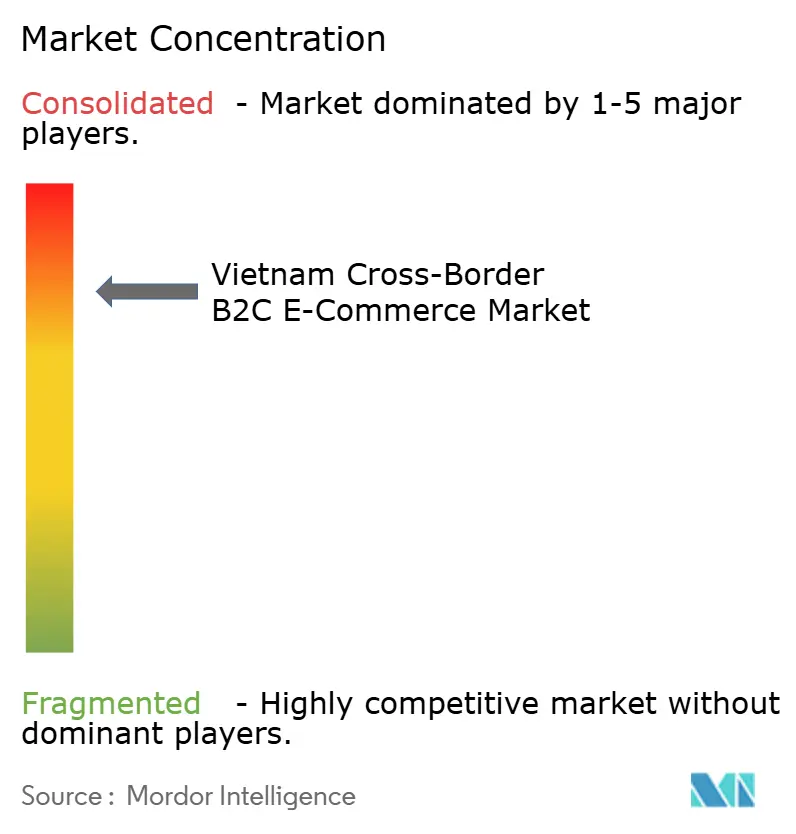
The Vietnam Cross-Border B2C E-commerce Market is highly concentrated at the marketplace layer, where Shopee held 56% of platform GMV in 2025, and TikTok Shop held 41%, taking their combined share to 97% of the top-4 platform market. That concentration gives the market fast user acquisition and strong liquidity, but it also gives a small number of platforms significant influence over seller visibility, fee structures, and operating standards. Outside the marketplace layer, the Vietnam Cross-Border B2C E-commerce Market remains more fragmented across import-focused specialists such as iHerb and YesStyle, export-focused enablers such as Amazon Global Selling and Etsy, and local cross-border operators such as Fado.vn. Newer entrants such as Temu and SHEIN are also increasing pressure in inbound discount categories, especially where low-ticket purchases and price-led buying remain strong. The E-commerce Law’s requirement for foreign platforms to establish or authorize a local legal entity in Vietnam should make future entry harder for smaller international operators without local infrastructure.
Competition is increasingly centered on logistics capability, seller tools, and content-led commerce. Amazon strengthened its outbound proposition in November 2025 by launching Amazon Global Logistics in Vietnam, which gave local sellers a more direct route into Amazon’s United States fulfillment system. Shopee also moved to deepen seller engagement in November 2025 through its EZXports program with Vietnam’s iDEA, which aims to train 2,000 MSMEs, create a Vietnam Pavilion, and run export campaigns across ASEAN. TikTok’s push to establish a domestic legal entity and apply for logistics and payment licenses in 2026 shows that the next competitive phase will rely on more local infrastructure and tighter regulatory fit. Sea Ltd’s proposal to expand further into banking, financial services, and logistics in Vietnam points in the same direction, where platform ecosystems widen beyond retail transactions alone.
The white-space opportunity is less visible in mass-market categories and clearer in specialist export niches. Vietnamese furniture, artisan goods, eco-certified agriculture, and selected wellness products fit markets where origin, authenticity, and product story matter more than the lowest listed price. That creates room for focused channels and premium positioning even inside a market dominated by large platforms. The Vietnam Cross-Border B2C E-commerce Market is therefore likely to stay concentrated in shopper traffic while becoming more diverse in how sellers reach global buyers and build brand value over time.
Vietnam Cross-Border B2C E-commerce Industry Leaders
-
Lazada
-
TikTok Shop
-
Amazon, Inc.
-
Etsy
-
Fado.vn
- *Disclaimer: Major Players sorted in no particular order
Recent Industry Developments
- June 2026: TikTok announced plans to establish a domestic legal entity in Vietnam to enhance data management and regulatory compliance, having invested nearly USD 5 billion in the country over 7 years of operation. TikTok additionally applied for licenses to operate a logistics entity (1-2 billion orders annually) and a digital payment service (TikTok Payment), reinforcing its intent to build a full-stack e-commerce infrastructure in Vietnam.
- April 2026: TikTok invested USD 125 million in Ho Chi Minh City as part of a wider expansion into Vietnam's digital economy, establishing TikTok Shop Vietnam LLC as a separate local entity with USD 100 million charter capital.
- November 2025: Amazon Global Selling officially launched Amazon Global Logistics (AGL) in Vietnam at its Annual Conference 2025 in Hanoi (attended by over 1,500 entrepreneurs), making Vietnam only the 2nd country globally designated as an FBA export origin point, directly enabling Vietnamese manufacturers to ship to the United States consumers through Amazon's warehousing and last-mile network.
- November 2025: Shopee signed a Memorandum of Understanding with Vietnam's Ministry of Industry and Trade (iDEA) to launch "EZXports: Vietnam Everywhere," a 2-year program to train 2,000 Vietnamese MSMEs in cross-border operations, create a dedicated Vietnam Pavilion on Shopee's regional app, and run Vietnam digital export week campaigns across ASEAN markets.
Vietnam Cross-Border B2C E-commerce Market Report Scope
| Fashion, Footwear and Apparel |
| Health and Beauty / Personal Care |
| Home and Office |
| Hobbies and Toys |
| Consumer Electronics and Appliances |
| Automotive Parts |
| Rest of the Product Categories |
| Online Marketplaces |
| Direct-to-Consumer (Webstores) |
| Social Commerce (Live, Chat) |
| Express |
| Standard |
| Outbound (Exports) | United States |
| China | |
| Japan | |
| South Korea | |
| Germany | |
| Australia | |
| United Kingdom | |
| Netherlands | |
| Thailand | |
| Singapore | |
| Rest of the Countries | |
| Inbound (Imports) | China |
| South Korea | |
| Japan | |
| United States | |
| Thailand | |
| Indonesia | |
| Hong Kong | |
| Singapore | |
| India | |
| Australia | |
| Rest of the Countries |
| By Product Category | Fashion, Footwear and Apparel | |
| Health and Beauty / Personal Care | ||
| Home and Office | ||
| Hobbies and Toys | ||
| Consumer Electronics and Appliances | ||
| Automotive Parts | ||
| Rest of the Product Categories | ||
| By Sales Channel | Online Marketplaces | |
| Direct-to-Consumer (Webstores) | ||
| Social Commerce (Live, Chat) | ||
| By Delivery Speed | Express | |
| Standard | ||
| By Country and Flow Direction | Outbound (Exports) | United States |
| China | ||
| Japan | ||
| South Korea | ||
| Germany | ||
| Australia | ||
| United Kingdom | ||
| Netherlands | ||
| Thailand | ||
| Singapore | ||
| Rest of the Countries | ||
| Inbound (Imports) | China | |
| South Korea | ||
| Japan | ||
| United States | ||
| Thailand | ||
| Indonesia | ||
| Hong Kong | ||
| Singapore | ||
| India | ||
| Australia | ||
| Rest of the Countries | ||
Key Questions Answered in the Report
What is the 2026 size of Vietnam cross-border B2C e-commerce?
The Vietnam Cross-Border B2C E-commerce Market stood at USD 5.50 billion in 2026 and is projected to reach USD 13.39 billion by 2031 at a 19.49% CAGR.
Which product category leads sales in Vietnam cross-border B2C e-commerce?
Fashion, footwear, and apparel led with a 26.47% share in 2025, supported by Vietnam’s garment base and strong platform merchandising.
Which channel is growing fastest in Vietnam cross-border online retail?
Social commerce is the fastest-growing sales channel, with a projected 24.91% CAGR through 2031, led by live selling and content-driven conversion.
Is Vietnam more import-led or export-led in cross-border B2C e-commerce?
The market was still import-led in 2025, with inbound imports representing 55.06% of value, but outbound exports are growing faster at a 22.76% CAGR.
Why is health and beauty growing so quickly in Vietnam’s cross-border online retail space?
Health and beauty/personal care is projected to grow at a 20.72% CAGR through 2031, supported by strong demand for imported beauty products and rising outbound potential for Vietnamese wellness brands.
How concentrated is the platform landscape in Vietnam cross-border B2C e-commerce?
It is highly concentrated at the marketplace layer, as Shopee and TikTok Shop together held 97% of platform GMV in 2025, which gives them strong influence over seller economics and visibility.