
India Cross-Border B2C E-commerce Logistics Market Size and Share
Market Overview
| Study Period | 2020 - 2031 |
|---|---|
| Forecast Data Period | 2026 - 2031 |
| Base Year Market Size (2025) | USD 280.96 Million |
| Market Size (2026) | USD 347.97 Million |
| Market Size (2031) | USD 880.60 Million |
| Growth Rate (2026 - 2031) | 20.41 % |
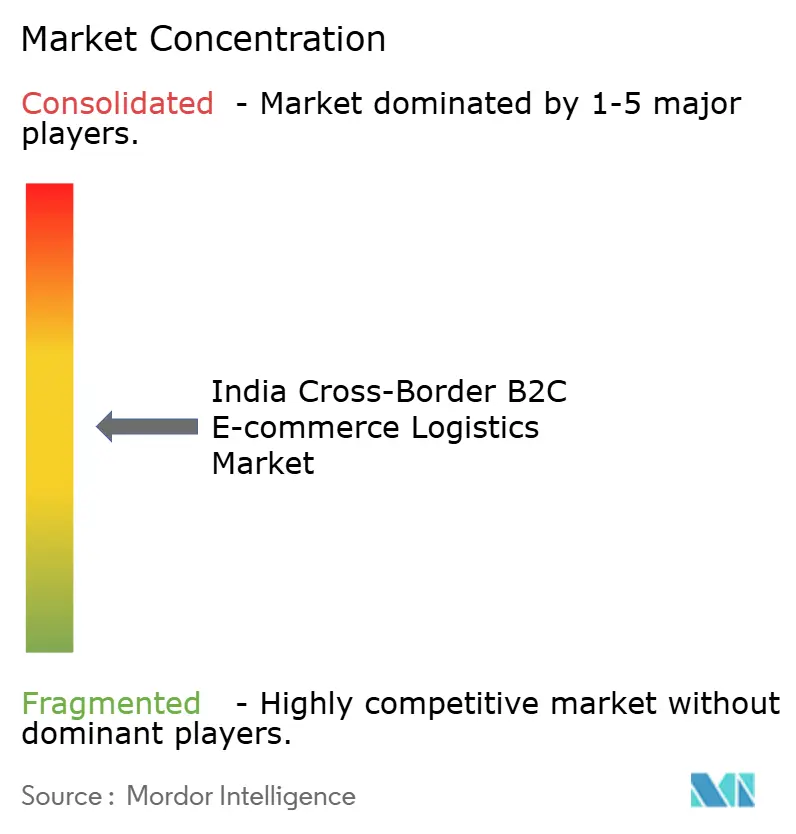
| Market Concentration | Medium |
Major Players *Disclaimer: Major Players sorted in no particular order Image © Mordor Intelligence. Reuse requires attribution under CC BY 4.0. | |
India Cross-Border B2C E-commerce Logistics Market Analysis by Mordor Intelligence
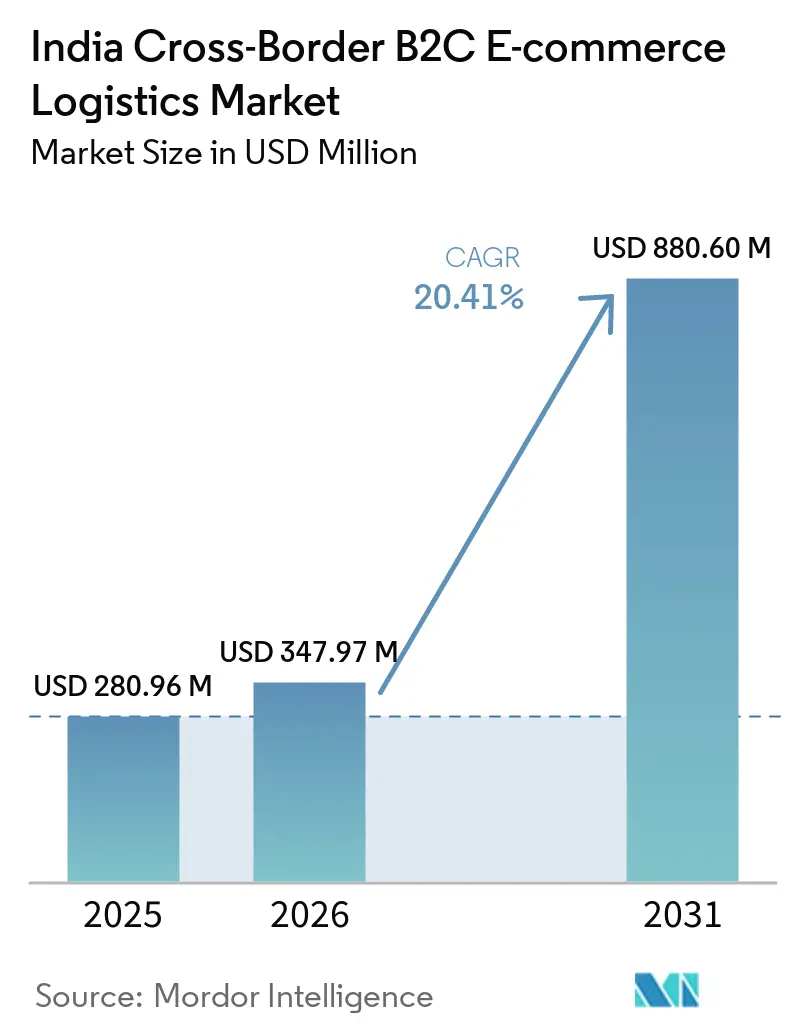
The India cross-border B2C e-commerce logistics market size was valued at USD 280.96 million in 2025, and is expected to reach USD 347.97 million in 2026 and USD 880.60 million by 2031, growing at a CAGR of 20.41% over 2026-2031.
The India cross-border B2C e-commerce logistics market is expanding as regulatory changes have made courier exports easier for merchants that previously had to split shipments or route them through slower cargo channels, and the 2026 reform also introduced a formal return-to-origin path for uncleared parcels. The market is also benefiting from wider postal export access and stronger payment connectivity, as India Post extended tracked export coverage to more countries and the Reserve Bank of India placed cross-border payment expansion inside its formal payments roadmap. The market is becoming more compliance-led because the United States ended the USD 800 de minimis exemption in 2025, and the European Union fully implemented ICS2 Release 3 across member states, raising the bar for operators to consistently handle duty payments, classification, and pre-arrival data filing.
Key Report Takeaways
- By product category, fashion and lifestyle accounted for 41.90% of the India cross-border B2C e-commerce logistics market share in 2025, while health and beauty is forecast to expand at a 21.39% CAGR through 2031.
- By logistics function, transportation accounted for 73.02% of the India cross-border B2C e-commerce logistics market size in 2025, while value-added services are projected to grow at 25.58% CAGR through 2031.
- By delivery speed, standard held 50.71% of the India cross-border B2C e-commerce logistics market share in 2025, while express is set to grow at 23.43% CAGR through 2031.
- By flow direction, outbound accounted for 59.50% of the India cross-border B2C e-commerce logistics market size in 2025, and is set to grow at 21.39% CAGR through 2031.
Note: Market size and forecast figures in this report are generated using Mordor Intelligence’s proprietary estimation framework, updated with the latest available data and insights as of January 2026.
India Cross-Border B2C E-commerce Logistics Market Trends and Insights
Drivers Impact Analysis*
| Driver | (~) % Impact on CAGR Forecast | Geographic Relevance | Impact Timeline |
|---|---|---|---|
| Courier Export Reform and Value-Cap Removal | +2.0% | Global, with near-term gains in North America, GCC, and EU lanes | Short term (≤ 2 years) |
| E-Commerce Export Hubs and Postal Export Rails | +1.5% | Global, with early gains in Africa, West Asia, and Central Asia corridors | Medium term (2-4 years) |
| Diaspora Demand for Indian Lifestyle Categories | +2.5% | USA, UK, UAE, Canada, Australia | Short term (≤ 2 years), Medium term (2-4 years) |
| UPI Global and Cross-Border Payment Enablement | +1.5% | South and Southeast Asia, the EU, GCC, and emerging markets | Medium term (2-4 years) |
| DDP-By-Default Adoption | +1.8% | North America, the EU, and the UK | Short term (≤ 2 years) |
| Compliance-Platform Aggregators | +1.2% | Global, strongest in regulated markets including the USA, the EU, and the UK | Short term (≤ 2 years), Medium term (2-4 years) |
| Source: Mordor Intelligence | |||
Courier Export Reform and Value-Cap Removal: Structural Unlocking of SME Export Corridors
On April 1, 2026, courier reform removed the long-standing INR 10 lakh (USD 10,510) per-consignment export cap, which had forced higher-value parcels into conventional cargo channels and reduced the speed and cost benefits of courier shipping for B2C sellers. This change matters in the India cross-border B2C e-commerce logistics market because merchants can now move larger orders through the same channel that already fits direct-to-consumer parcel flows, instead of breaking orders into smaller shipments and repeating documentation. The 2026 framework also introduced a formal return-to-origin mechanism for uncleared shipments after 15 days, helping reduce pileups at courier terminals and lowering operational uncertainty associated with failed deliveries. The working-capital effect is important because fewer parcel splits mean fewer handling cycles, fewer duplicate filings, and less cash trapped in fragmented export workflows. In practical terms, the India cross-border B2C e-commerce logistics market becomes more scalable for MSMEs when the legal framework supports higher-value courier consignments and clearer reverse handling.
Diaspora Demand for Indian Lifestyle Categories: Beyond Nostalgia and Into Repeat Cross-Border Demand
The India cross-border B2C e-commerce logistics market continues to draw volume from overseas demand for Indian-origin fashion, wellness, beauty, and household staples, especially in countries with large and affluent diaspora communities. This demand is not limited to occasional festive buying, because repeat purchases depend on product authenticity, fit, cultural familiarity, and availability gaps in overseas retail channels. The strongest effect is visible in fashion and lifestyle goods, where Indian sellers can compete on design relevance and assortment depth rather than only on discounting. Health and beauty are also moving beyond diaspora demand, as Ayurvedic and herbal formulations are reaching broader buyers seeking premium wellness and clean-label alternatives. As a result, the India cross-border B2C e-commerce logistics market benefits from a demand base that supports both frequent lower-ticket orders and more premium export baskets across multiple corridors.
UPI Global and Cross-Border Payment Enablement: Reducing Conversion Friction for Export Sellers
Cross-border parcel growth depends on successful payments, and the Reserve Bank of India has placed cross-border payment expansion at the center of Payments Vision 2028, providing the payment layer with clearer policy direction. The realization phase for UPI and Europe’s TARGET Instant Payment Settlement linkage began in late 2025, and India-Cambodia UPI connectivity went live on June 2, 2026, which shows that interoperability is moving from concept to execution. International UPI transactions crossed 6 lakh in the first 4 months of FY 26, suggesting rising user familiarity and stronger acceptance of India-linked payment flows outside the domestic market[1]. In the India cross-border B2C e-commerce logistics market, this matters because higher payment conversion reduces failed orders, lowers uncertainty around prepaid duty collection, and improves the economics of DDP shipments. Over time, payment reliability is likely to shape which operators can combine checkout, customs, and delivery into one smoother merchant workflow.
DDP-By-Default Adoption: Compliance Moves Closer to the Customer Checkout
The India cross-border B2C e-commerce logistics market is increasingly favoring DDP models because clear duty-inclusive pricing helps reduce surprises at delivery and makes sellers more competitive on international marketplaces. This shift is larger than a pricing change because DDP execution requires accurate classification, current tariff logic, and the operational ability to manage importer obligations in destination markets. Operators that can consistently offer this are moving into a stronger position, since compliance quality becomes part of the customer promise rather than just a back-end activity. The same transition is also pushing the market away from informal or postal-only approaches and toward a more professional operating model built around landed-cost transparency. In effect, the India cross-border B2C e-commerce logistics market is rewarding providers that can turn customs accuracy and duty prepayment into a predictable service rather than a manual exception process.
Restraints Impact Analysis*
| Restraint | (~) % Impact on CAGR Forecast | Geographic Relevance | Impact Timeline |
|---|---|---|---|
| Returns and Re-Import Complexity | -1.5% | Global, most acute for the USA and GCC export corridors | Short term (≤ 2 years), Medium term (2-4 years) |
| No-De-Minimis and Landed-Cost Burden | -1.2% | Primarily affects inbound flows into India, with pressure on outbound shipments to North America and the EU as well. | Medium term (2-4 years) |
| US De Minimis Loss and EU ICS2 Tightening | -2.0% | North America and the EU, India’s two largest outbound markets | Short term (≤ 2 years), Medium term (2-4 years) |
| Localization and Category-Compliance Burden | -1.0% | Global, with higher impact on electronics, food, and regulated categories | Medium term (2-4 years), Long term (≥ 4 years) |
| Source: Mordor Intelligence | |||
United States De Minimis Loss and EU ICS2 Tightening: Compliance Costs Rise in India’s Largest Export Corridors
The United States suspended the USD 800 de minimis exemption globally on August 29, 2025, ending a long period during which low-value commercial shipments could enter with a reduced customs burden. For Indian B2C exporters, this raises landed costs for lower-value categories because every commercial parcel now faces more thorough classification, duty assessment, and entry requirements. The pressure is especially visible in fashion accessories, beauty items, and handicrafts, where customs overhead can absorb a large share of the order value if the parcel is small. Europe is adding its own discipline: ICS2 Release 3 has been fully enforced across the European Union since September 1, 2025, and requires accurate pre-arrival Entry Summary Declarations across all transport modes. The India cross-border B2C e-commerce logistics market can still grow under these rules. Still, only operators with automated filing, better product data, and stronger customs discipline are likely to protect delivery speed and merchant margins.
Returns and Re-Import Complexity: Reverse Logistics Still Drains Margin
Reverse logistics remains one of the most challenging operational issues in the India cross-border B2C e-commerce logistics market, as international returns often cost several times as much as outbound shipments. NITI Aayog’s trade review highlighted that returned e-commerce exports were historically treated much like fresh imports unless exporters could satisfy burdensome identity checks, which made many returns uneconomic for small sellers[2]. The April 2026 reforms improved this environment by adding a dedicated return path to the Express Cargo Clearance System and shifting toward a risk-based approach rather than full consignment-level scrutiny for every case. Even so, the market still lacks the bonded returns infrastructure and duty-suspension frameworks that make reverse processing cheaper in some mature Western logistics systems. Until those gaps are reduced, categories with structurally higher return rates, such as fashion and electronics, will continue to face weaker realized margins than their forward shipment growth suggests.
*Our forecasts treat driver/restraint impacts as directional, not additive. The impact forecasts reflect baseline growth, mix effects, and variable interactions.
Segment Analysis
By Product Category: Fashion and Lifestyle Anchors Revenue, While Health and Beauty Accelerates
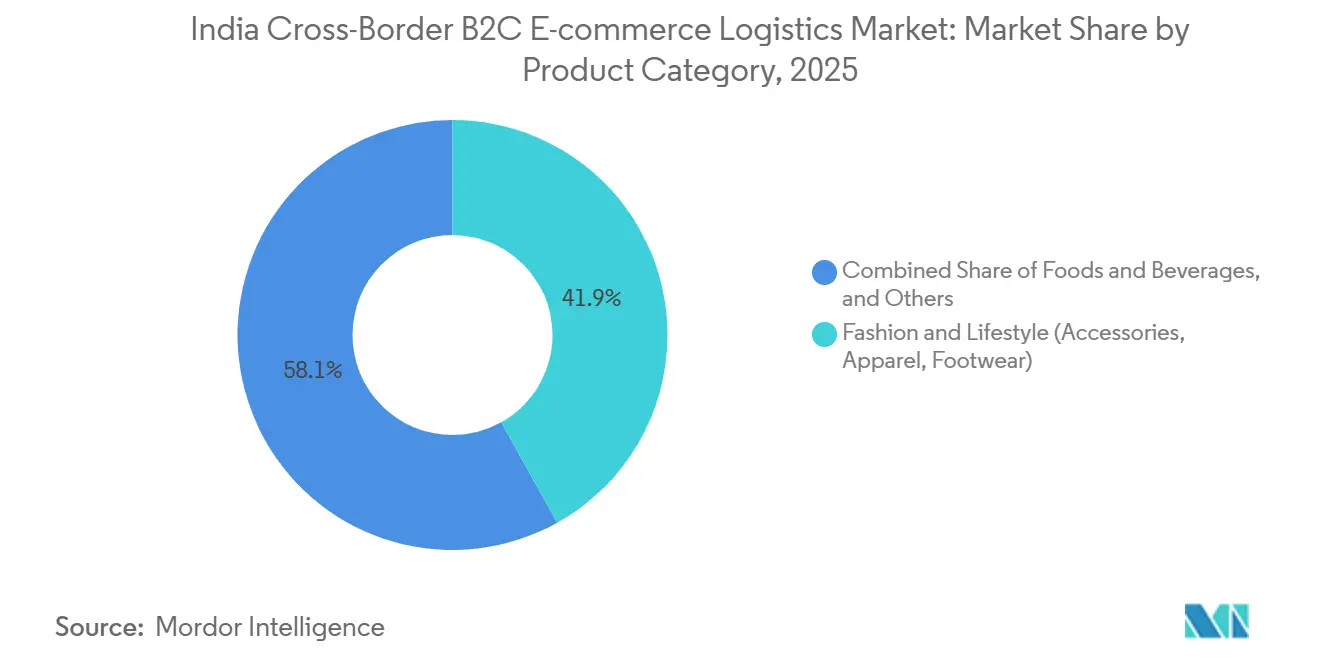
Fashion and lifestyle accounted for 41.90% of the India cross-border B2C e-commerce logistics market size in 2025, making it the largest product segment by revenue. The segment benefits from sustained overseas demand for Indian apparel, accessories, and footwear that are often difficult to source with the same variety and authenticity in destination markets. It also aligns with the economics of cross-border parcel shipping because many products are relatively light, can travel by air at a manageable cost, and usually face fewer certification hurdles than electronics or food.
Health and beauty is projected to grow at a 21.39% CAGR through 2031, placing it ahead of every other product category. Growth is tied to stronger demand for ayurvedic wellness products, herbal skincare, and premium beauty lines that carry a distinct Indian-origin identity in overseas channels. That positioning matters because the segment can sell on formulation and brand story rather than relying solely on low pricing, which supports a better export mix over time. Consumer electronics and household appliances are expanding more selectively, as tightening BIS requirements and the 2026 Quality Control Order add certification time and cost for many categories before they can scale cleanly through regulated channels.

By Logistics Function: Transportation Dominates While Value-added Services Build the Next Profit Layer
Transportation accounted for 73.02% of the India cross-border B2C e-commerce logistics market share in 2025, underscoring the industry's continued reliance on the basic need to move parcels quickly and reliably across borders. Air freight remains central because many cross-border B2C shipments are time sensitive, and platform sellers cannot easily compete with transit times that stretch into multiple weeks. Sea freight still has a role for bulky and less urgent categories, but it does not align well with the delivery expectations that shape most parcel-based online retail purchases.
Value-added services are forecast to grow at a 25.58% CAGR through 2031, the fastest rate among the logistics functions. This reflects a structural change because merchants increasingly need duty calculation, HS classification, importer support, customs visibility, and compliance guidance alongside physical parcel movement. In the India cross-border B2C e-commerce logistics market, those tasks are no longer optional extras for regulated corridors such as the United States and Europe.
By Delivery Speed: Standard Keeps Scale While Express Gains Strategic Importance
Standard delivery accounted for 50.71% of the India cross-border B2C e-commerce logistics market share in 2025, underscoring that price sensitivity continues to shape a large share of export parcel decisions. This tier suits MSMEs and sellers that prioritize lower landed cost over premium transit speed, especially on routes where consumers accept longer delivery windows or where postal networks remain the lowest-cost option. Standard delivery also fits categories with lower urgency and more modest order values, which helps explain its continued volume base despite rising competition from faster services.
Express delivery is projected to expand at 23.43% CAGR through 2031, making it the fastest-growing delivery-speed segment. The main reason is that international marketplace sellers increasingly need tighter delivery windows, stronger tracking, and fewer delays to achieve better conversion and repeat purchase rates. Global carriers still hold an advantage because their dedicated air networks, customs experience, and terminal infrastructure support more consistent express performance across major lanes. FedEx’s 2026 ground-breaking at Navi Mumbai International Airport shows how infrastructure is being added specifically to strengthen time-definite cross-border capacity from western India into high-priority global corridors[3].
By Flow Direction: Outbound Leads While Inbound Complexity Shapes Operating Models
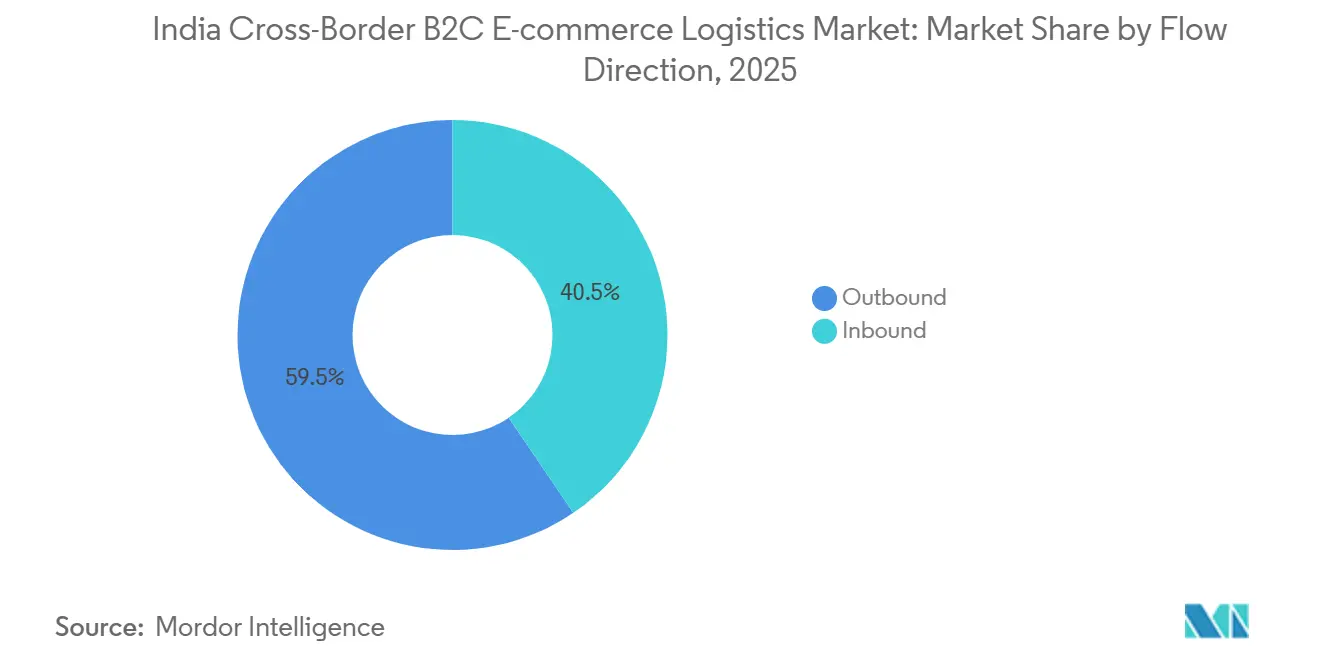
Outbound accounted for 59.50% of the India cross-border B2C e-commerce logistics market share in 2025 and is forecast to expand at a 21.39% CAGR through 2031, supported by strong demand from North America, the GCC, and Europe for Indian fashion, beauty, and consumer goods. This lead reflects India’s position as both a production base and a sourcing origin for culturally distinctive, wellness-led, and design-oriented products that travel well through parcel channels. Export growth is also aligning with policy attention on MSME-led international trade, which keeps outbound logistics at the center of merchant acquisition and platform investment. In the India cross-border B2C e-commerce logistics market, outbound flows therefore remain the main driver of corridor expansion, onboarding tools, and customs service development.
The asymmetry is important because India’s low de minimis threshold creates more friction on the inbound side than many consumers face in some other large markets. That pushes operators to build stronger landed-cost communication, classification discipline, and customer support, even when the transaction starts as a consumer import rather than an export order. Over time, the interaction between outbound and inbound corridors is likely to shape who can run bilateral networks efficiently rather than merely offering one-direction parcel movement.
Geography Analysis
The North America corridor is supported by a large and affluent Indian-origin population as well as broader consumer interest in Indian apparel, handicrafts, and wellness products. The United States' decision to suspend the de minimis exemption from August 29, 2025, raised customs formalities for every commercial shipment, increasing documentation and duty handling requirements for Indian exporters. Even so, the corridor remains attractive because Indian-origin goods are still seen as better placed than some Chinese-origin products, which face a heavier combined tariff and customs burden. Delhivery’s United States launch in December 2025 and its wider international rollout in 2026 show that operators still see this corridor as central to the India cross-border B2C e-commerce logistics market.
Europe is becoming more important as trade digitization and paperless documentation move higher on the India-EU agenda. The full enforcement of ICS2 Release 3 on September 1, 2025, has made the quality of advance shipment data more important, as vague product descriptions or weak filing discipline can trigger holds and inspection delays[4]. This creates a meaningful edge for operators that already have automated ENS filing, stronger HS libraries, and better merchant-side data capture. Delhivery’s UK expansion and DHL’s large investment in India indicate that Europe and the UK remain priority lanes for scale-driven service development.
The Middle East and Africa region is the most structurally favorable outbound corridor for many Indian sellers in 2026. The lane combines relatively strong diaspora demand, short transit times, and better cost conversion for lifestyle and beauty parcels than many longer-haul routes. The India-UAE trade relationship remains especially important, with CEPA-linked duty advantages and the MAITRI Virtual Trade Corridor supporting faster pre-arrival processing between customs and logistics platforms. The India-to-UAE lane carries only an 18% landed-cost premium for apparel and beauty, which helps explain why conversion is strong for Indian-origin lifestyle exports on this route. Asia-Pacific is also gaining steady ground as payment connectivity improves through UPI-linked arrangements and as services such as Delhivery International widen corridor coverage to Australia. South America remains a smaller, earlier-stage opportunity because restrictive import rules and limited last-mile depth limit scale. However, low-weight shipments can still use postal channels as an entry point.
Competitive Landscape
The India cross-border B2C e-commerce logistics market is moderately consolidated. Three competitive groups are active, each approaching the market with a different operating logic. Global integrators such as DHL, FedEx, and UPS compete on premium network reach, air capacity, and customs execution across major import corridors. DHL Express said SMEs account for nearly 60% of its India business, underscoring why global carriers are sharpening their focus on India rather than treating the market as a narrow corridor. Their strategy is being reinforced through infrastructure, as seen in DHL’s large investment in India and FedEx’s development of an automated hub at Navi Mumbai International Airport.
Domestic operators such as Delhivery, DTDC, Blue Dart, and Shiprocket X are competing on India-specific cost structures, faster digital onboarding, and better reach into SME-heavy production clusters beyond the largest metros. Delhivery’s international rollout in the United States, the United Kingdom, Canada, and Australia shows that domestic platforms are not staying confined to first-mile collection or domestic handoff roles. A third group is building around compliance and workflow control, where players such as iThink Logistics, NimbusPost, ShipGlobal.in, and Cogoport are packaging classification, landed-cost visibility, and cross-border shipment planning into a more unified merchant service. Cogoport’s 2026 launch of Cogoport OS reflects this direction, because the product is positioned around automation, carrier comparison, detention, and compliance control rather than only freight booking.
A clear gap still exists in reverse logistics, as no domestic operator is shown to offer a fully automated, duty-neutral returns solution comparable to mature reverse-commerce specialists in North America. The April 2026 return-related reforms improve the base layer. Still, they do not yet solve the infrastructure shortfall around bonded handling, duty suspension, and low-friction re-import processing for cross-border e-commerce returns. Payment capability is also becoming a competitive filter, because the Reserve Bank of India’s framework for cross-border payment aggregators favors operators that can connect logistics execution with compliant payment flows. That raises the value of integrated models where transport, customs, payments, and post-purchase service can be managed with fewer handoffs. The India cross-border B2C e-commerce logistics market is therefore likely to reward companies that can combine corridor capacity with software-led compliance and a cleaner merchant workflow, rather than those that compete solely on freight.
India Cross-Border B2C E-commerce Logistics Industry Leaders
-
Delhivery
-
Blue Dart Express
-
DHL Group
-
FedEx
-
UPS
- *Disclaimer: Major Players sorted in no particular order
Recent Industry Developments
- March 2026: Delhivery expanded its Delhivery International economy air parcel service to the United Kingdom, Canada, and Australia, following the December 2025 US corridor launch. The service, embedded in the Delhivery One platform, provides Indian MSMEs with real-time rate discovery, multiple delivery options, and end-to-end shipment visibility across 19,000 domestic pin codes feeding into international hubs.
- February 2026: FedEx and Adani Airport Holdings Limited (AAHL) formalized a long-term development contract for the 300,000 ft² automated air cargo hub at Navi Mumbai International Airport, establishing FedEx as the anchor cargo operator at NMIA's dedicated freight terminal.
- January 2026: India Post expanded its International Tracked Packet Service (ITPS) to 50 additional countries across Africa, Europe, Central Asia, and West Asia, bringing the total serviceable country count to 135. The expansion opens new low-cost tracked e-commerce corridors for MSMEs previously priced out of private-carrier-only markets in these regions.
- January 2026: India and the EU concluded a landmark Free Trade Agreement and signed an Administrative Arrangement on Advanced Electronic Signatures, enabling interoperability of e-signatures and PKI systems for cross-border digital trade. For logistics operators, this removes a key source of friction in India-EU commercial invoices and customs filings.
India Cross-Border B2C E-commerce Logistics Market Report Scope
| Foods and Beverages |
| Personal and Household Care |
| Fashion and Lifestyle (Accessories, Apparel, Footwear) |
| Furniture |
| Consumer Electronics and Household Appliances |
| Other Products |
| Transportation | Road |
| Air | |
| Sea and Inland Waterways | |
| Rail | |
| Warehousing, Distribution and Inventory Management | |
| Value-added Services and Others |
| Express |
| Standard |
| Outbound (Exports) | North America |
| Europe | |
| Asia-Pacific | |
| Middle East and Africa | |
| South America | |
| Inbound (Imports) | North America |
| Europe | |
| Asia-Pacific | |
| Middle East and Africa | |
| South America |
| By Product Category | Foods and Beverages | |
| Personal and Household Care | ||
| Fashion and Lifestyle (Accessories, Apparel, Footwear) | ||
| Furniture | ||
| Consumer Electronics and Household Appliances | ||
| Other Products | ||
| By Logistics Function | Transportation | Road |
| Air | ||
| Sea and Inland Waterways | ||
| Rail | ||
| Warehousing, Distribution and Inventory Management | ||
| Value-added Services and Others | ||
| By Delivery Speed | Express | |
| Standard | ||
| By Flow Direction | Outbound (Exports) | North America |
| Europe | ||
| Asia-Pacific | ||
| Middle East and Africa | ||
| South America | ||
| Inbound (Imports) | North America | |
| Europe | ||
| Asia-Pacific | ||
| Middle East and Africa | ||
| South America | ||
Key Questions Answered in the Report
What is the projected value of India's cross-border B2C e-commerce logistics by 2031?
The sector is projected to reach USD 880.6 million by 2031, up from USD 347.97 million in 2026, at a CAGR of 20.41% over 2026-2031.
Which product category leads export parcel demand from India?
Fashion and lifestyle led with 41.90% in 2025, supported by strong overseas demand for Indian apparel, accessories, and related lifestyle goods.
Which logistics function is growing the fastest in this space?
Value-added services are the fastest-growing logistics function, with a projected CAGR of 25.58% through 2031, reflecting rising demand for customs, duty, and compliance support.
Why is express delivery gaining importance for Indian cross-border sellers?
Express delivery is forecast to grow at 23.43% CAGR because merchants increasingly need faster transit, better tracking, and more reliable delivery performance on global platforms.
Why do regulatory changes matter so much for parcel operators serving overseas consumers?
United States de minimis removal and EU ICS2 enforcement have increased documentation and customs requirements, requiring operators to strengthen their classification, filing, and duty-management capabilities.
Which direction contributes more to revenue, exports or imports?
Outbound shipments led with 59.50% in 2025, and continue to shape customs, landed-cost, and service design decisions.