Vibrating Mesh Nebulizer Market Size and Share
Market Overview
| Study Period | 2020 - 2031 |
|---|---|
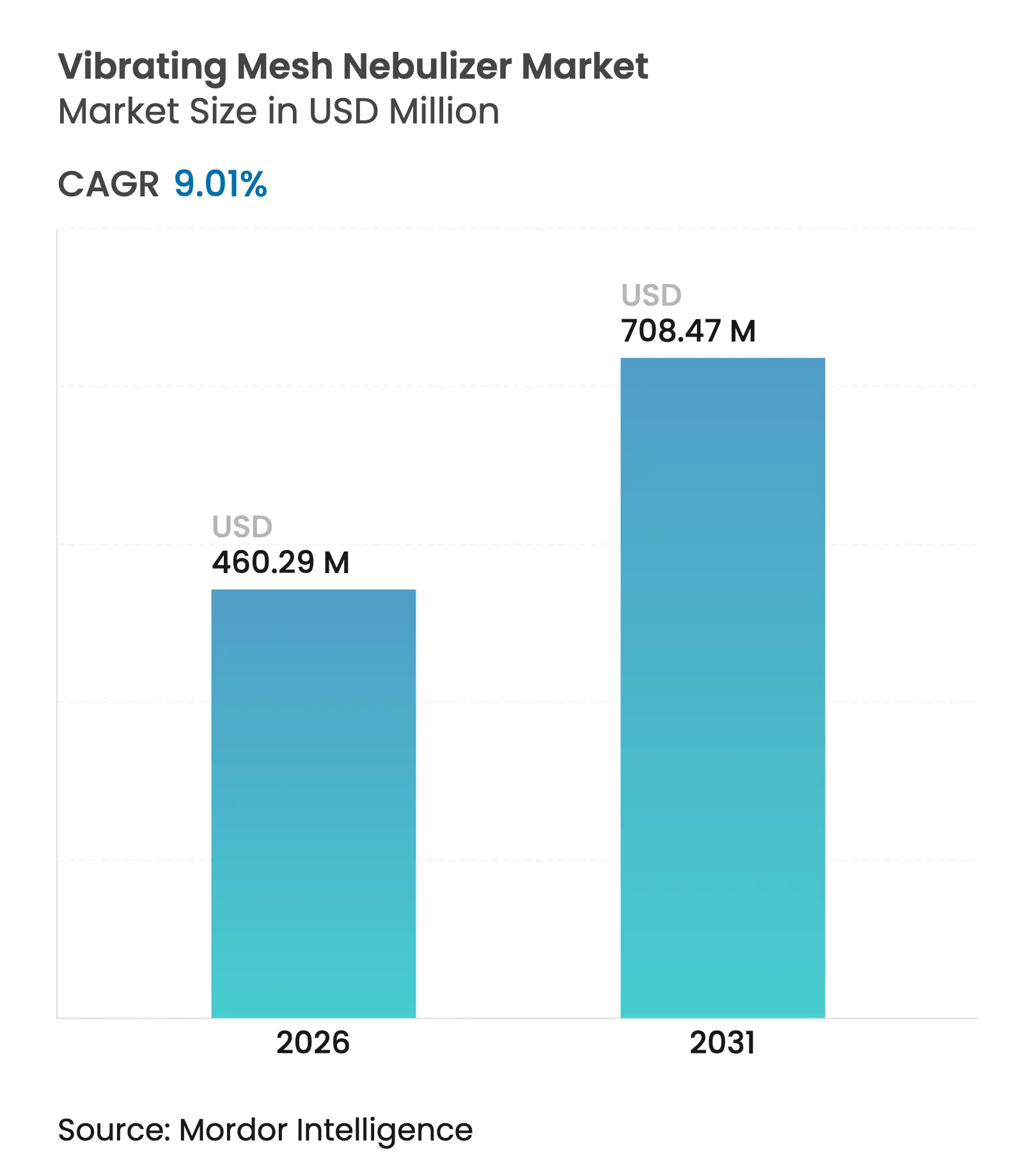
| Market Size (2026) | USD 460.29 Million |
| Market Size (2031) | USD 708.47 Million |
| Growth Rate (2026 - 2031) | 9.01 % CAGR |
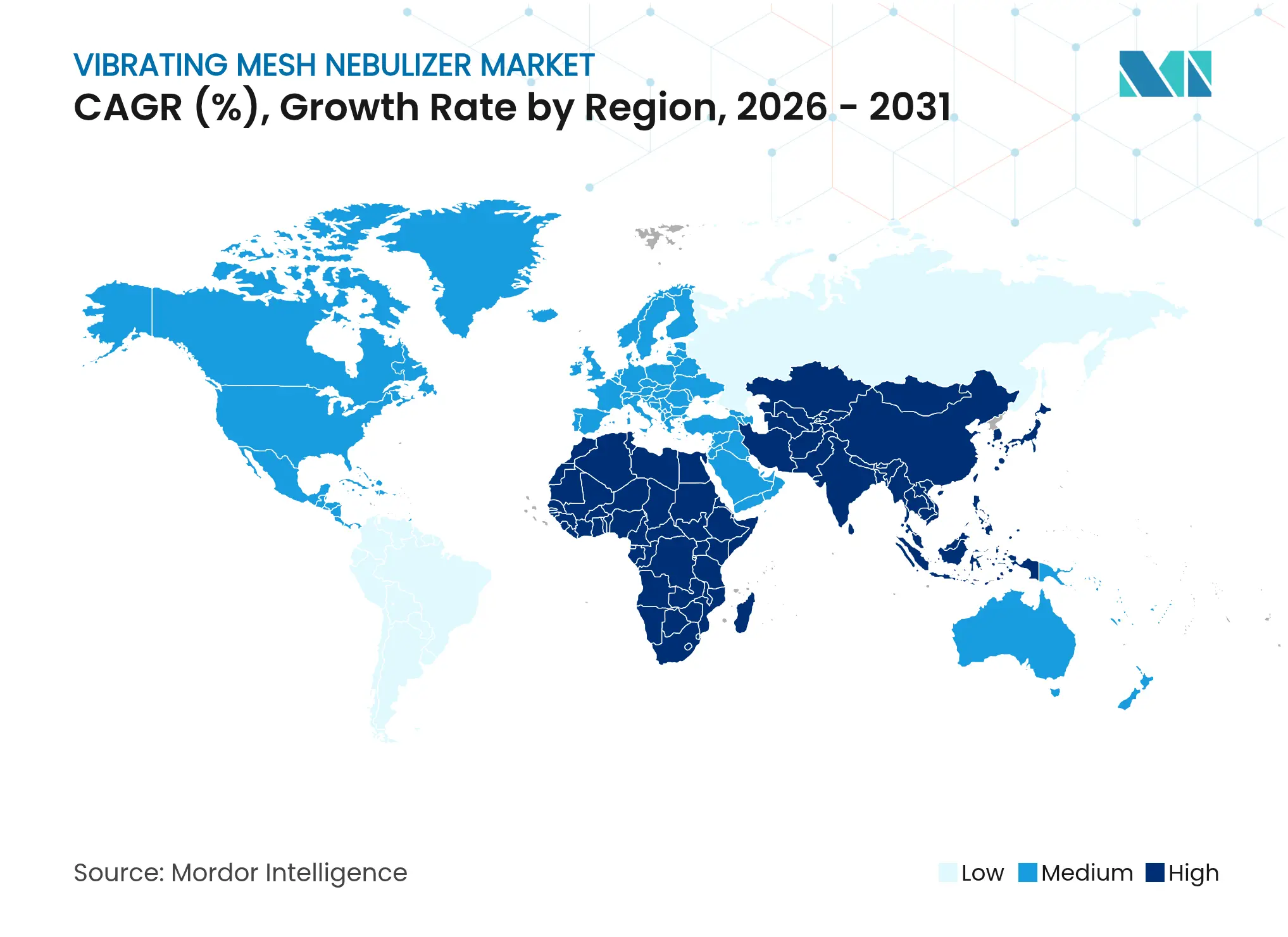
| Fastest Growing Market | Asia Pacific |
| Largest Market | North America |
| Market Concentration | Medium |
Major Players *Disclaimer: Major Players sorted in no particular order. Image © Mordor Intelligence. Reuse requires attribution under CC BY 4.0. |

Vibrating Mesh Nebulizer Market Analysis by Mordor Intelligence
The vibrating mesh nebulizer market size was valued at USD 422.23 million in 2025 and estimated to grow from USD 460.29 million in 2026 to reach USD 708.47 million by 2031, at a CAGR of 9.01% during the forecast period (2026-2031). The outlook remains favorable because the technology delivers uniform particle sizes, safeguards biologic drug integrity, and supports precise therapy across care settings. Demand accelerates as chronic respiratory diseases rise, manufacturers refine piezoelectric mesh designs, and payers expand coverage for home-based care. Competitive activity is moderate yet strategic, with consolidation moves such as OMRON’s 2024 purchase of 3A Health Care, while innovation in wearable patch devices and biologic-ready meshes differentiates offerings. Regionally, North America holds leadership through high clinical adoption, but Asia-Pacific posts the fastest gains on the back of urbanization-linked pollution and growing healthcare access. Battery-powered models, which already dominate sales, illustrate the broader decentralization shift toward patient-managed treatment at home.
Key Report Takeaways
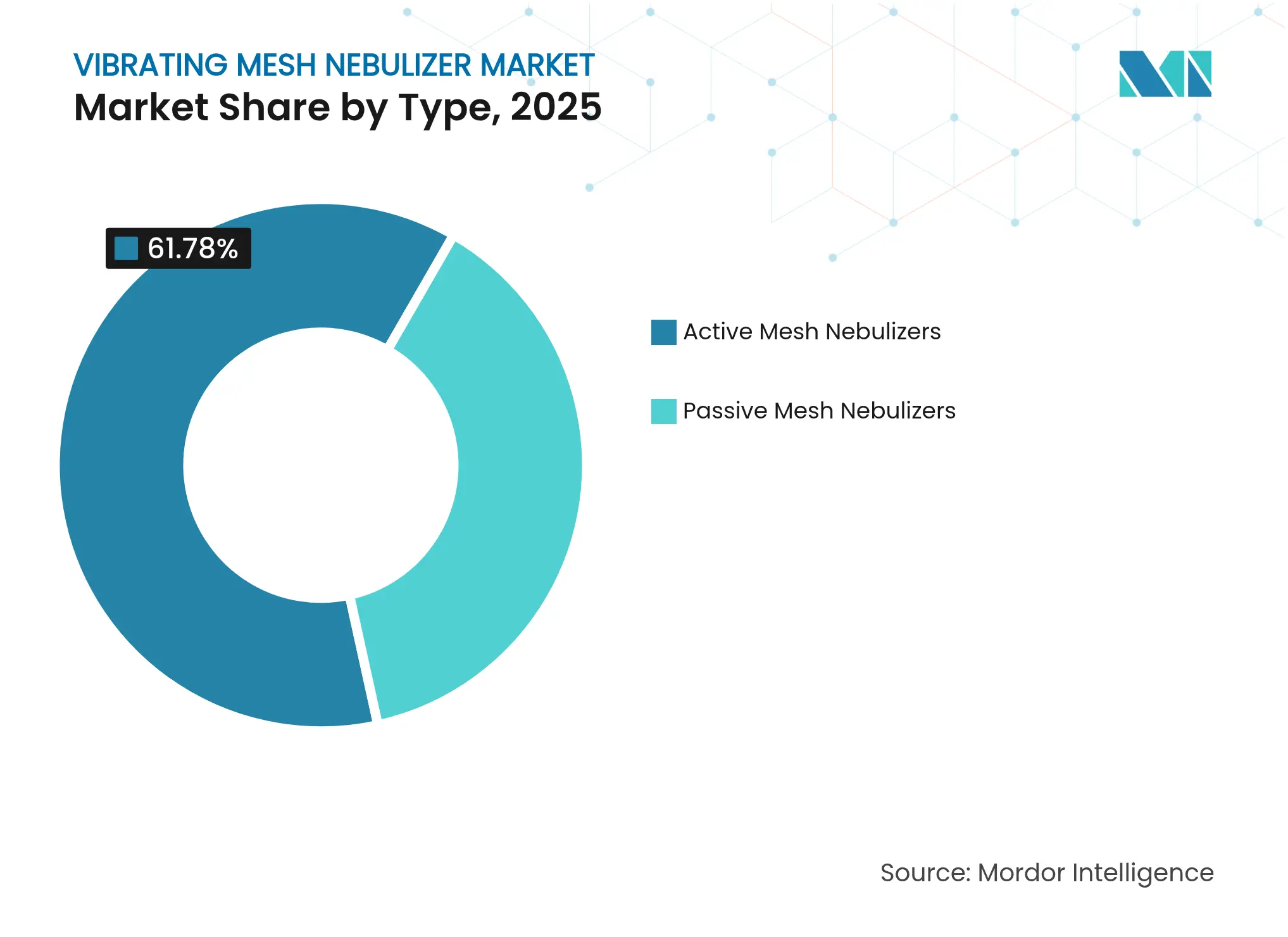
- By type, active mesh nebulizers led with 61.78% of vibrating mesh nebulizer market share in 2025; passive mesh models are forecast to grow at a 12.49% CAGR to 2031.
- By operation mode, battery-powered units commanded 65.62% share of the vibrating mesh nebulizer market size in 2025 and are projected to expand at 12.18% CAGR through 2031.
- By drug-formulation compatibility, standard-viscosity solutions accounted for 76.35% share of the vibrating mesh nebulizer market size in 2025, while high-viscosity biologic suspensions exhibit the highest projected CAGR at 11.62% to 2031.
- By patient age group, adults captured 52.12% of vibrating mesh nebulizer market share in 2025; the geriatric segment is advancing at an 10.98% CAGR during 2026-2031.
- By application, COPD held 37.02% of vibrating mesh nebulizer market share in 2025; cystic fibrosis is set to post a 11.86% CAGR through 2031.
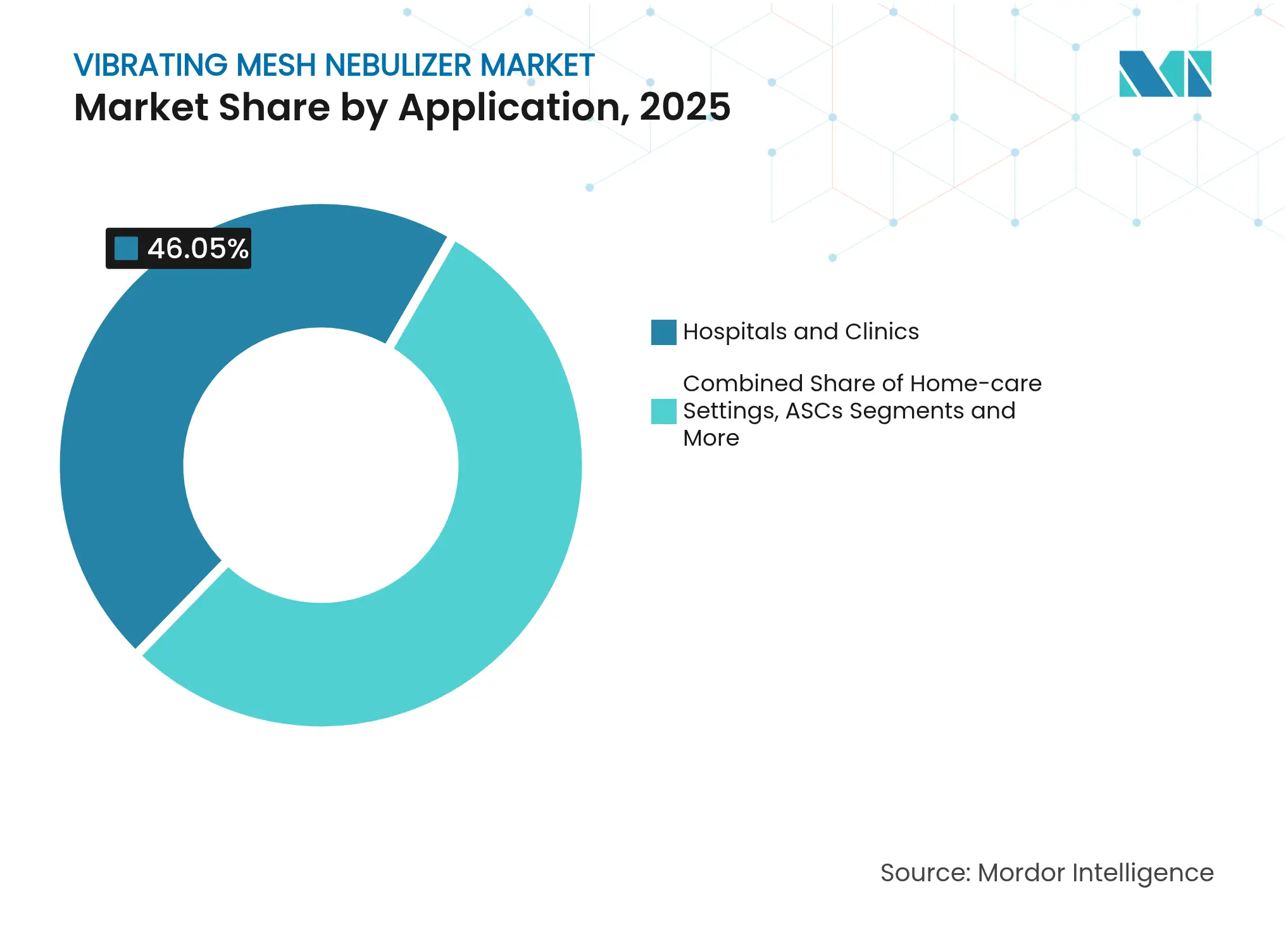
- By end user, hospitals and clinics represented 46.05% of the vibrating mesh nebulizer market size in 2025, while home-care settings show the fastest growth at 11.71% CAGR.
- By geography, North America accounted for 36.98% revenue share in 2025; Asia-Pacific is projected to expand at an 11.41% CAGR up to 2031.
Note: Market size and forecast figures in this report are generated using Mordor Intelligence's proprietary estimation framework, updated with the latest available data and insights as of 2026.
Global Vibrating Mesh Nebulizer Market Trends and Insights
Drivers Impact Analysis
| Driver | (~) % Impact on CAGR Forecast | Geographic Relevance | Impact Timeline |
|---|---|---|---|
Rising burden of respiratory
disorders
|
+2.1%
|
Global, highest in APAC and MEA
|
Medium term (2-4 years)
|
Technological advancements in mesh
design
| +1.8% | North America & EU leading, spill-over to APAC | Short term (≤ 2 years) |
Growing preference for portable
home-care devices
| +1.6% | Global, pronounced in developed markets | Medium term (2-4 years) |
Ageing population & chronic
disease prevalence
| +1.4% | Global, concentrated in developed regions | Long term (≥ 4 years) |
Drug–device co-development for
biologics
| +1.2% | North America & EU core markets | Long term (≥ 4 years) |
ICU integration with high-flow
ventilation
| +0.9% | Global, hospital-centric adoption | Short term (≤ 2 years) |
| Source: Mordor Intelligence | |||
Rising Burden of Respiratory Disorders
COPD affected 213.39 million individuals in 2024, and pollution alongside smoking contributed 34.8% and 22.2% of related disability-adjusted life years, respectively.[1] Urbanization heightens exposure to fine particulates, forcing health systems to adopt precise aerosol therapies that work independent of patient effort. Vibrating mesh nebulizer market demand rises as clinicians favor devices that maintain consistent doses for mucolytics and anti-inflammatory drugs across fluctuating breathing patterns.
Technological Advancements in Mesh Design
Enhanced piezoelectric grids now push the share of droplets smaller than 5 µm from 54.6% to 59.25%, improving lung deposition rates.[2] Passive meshes gain synchronized vibration functions, unlocking discreet wearable patches, while active models add durable alloys that extend service life. These refinements strengthen clinician confidence and stimulate broader formulation compatibility within the vibrating mesh nebulizer market.
Growing Preference for Portable Home-Care Devices
Battery-powered models account for two-thirds of 2024 shipments and continue to grow at a double-digit pace as payers recognize cost savings from avoided readmissions. Device noise reduction and compact footprints align with patient demands forged during the COVID-19 pandemic, and updated COPD Foundation safety guidelines validate home use.
Ageing Population & Chronic Disease Prevalence
The geriatric cohort expands at 11.23% CAGR, bringing higher incidences of compromised lung mechanics and coordination deficiencies. Vibrating mesh units that deliver aerosol regardless of inspiratory force suit seniors who struggle with inhaler actuation, thereby deepening penetration in long-term care environments.
Restraints Impact Analysis
| Restraint | (~) % Impact on CAGR Forecast | Geographic Relevance | Impact Timeline |
|---|---|---|---|
Stringent regulatory & approval
hurdles
|
-1.3%
|
Global, most stringent in North
America & EU
|
Medium term (2-4 years)
|
High price versus jet nebulizers
| -0.9% | Primarily APAC & MEA price-sensitive markets | Short term (≤ 2 years) |
Device contamination &
infection-control issues
| -0.7% | Global, heightened in hospital settings | Short term (≤ 2 years) |
Limited compatibility with
high-viscosity formulations
| -0.5% | Global, affecting specialized applications | Long term (≥ 4 years) |
| Source: Mordor Intelligence | |||
Stringent Regulatory & Approval Hurdles
Stringent regulatory and approval hurdles add 12-18 months to launch timelines because the FDA’s 2024 guidance now demands performance proof across broader flow, temperature, and viscosity ranges.[3] Smaller firms often lack the capital to endure such delays, pushing them toward licensing deals with larger partners.
High Price Versus Jet Nebulizers
Mesh devices cost three-to-five times more than jet models, and many payers still reimburse at a ceiling that favors cheaper legacy units, slowing near-term adoption in price-sensitive markets. Manufacturers bundle service contracts to illustrate lifetime savings, but prior-authorization rules can still force clinicians to try jet devices first.
Segment Analysis
By Type: Active Mesh Dominance Faces Passive Innovation
Active designs captured 61.78% of vibrating mesh nebulizer market share in 2025 owing to proven reliability in high-acuity care. Passive versions are rising at 12.49% CAGR as synchronized vibration lowers power draw and supports discreet patches. Hospitals rely on active units for ventilated patients, yet chronic-care programs gravitate to passive wearables that ease daily dosing. The intersecting feature sets hint that future allocation of vibrating mesh nebulizer market size between the two will hinge on case-specific performance rather than legacy labels.
Momentum for passive variants comes from refined stainless-steel meshes that deliver tighter droplet distributions and from cost-optimized controller chips. In parallel, active systems adopt tougher alloy plates and self-cleaning cycles to lengthen maintenance intervals. This competitive push increases overall product breadth, allowing prescribers to match device to therapy with minimal compromise.
Note: Segment shares of all individual segments available upon report purchase
By Operation Mode: Battery Power Drives Portability Revolution
Battery models owned 65.62% share of the vibrating mesh nebulizer market size in 2025, and the subcategory is on track for 12.18% CAGR through 2031. Rechargeable lithium-ion packs with fast-charge ability underpin this surge, letting users complete multi-dose regimens without wall power. AC-powered versions hold relevance in intensive care wards where round-the-clock runtime is critical, yet their share is projected to taper as battery density advances.
Wearable patches exemplify the battery segment’s edge. Systems provide 24-48 hour autonomy, log inhalation events, and sync to mobile dashboards, cementing their role in connected care ecosystems. Payers increasingly reimburse these smart devices because adherence data supports value-based care metrics, boosting longer-term vibrancy of the vibrating mesh nebulizer market.
By Drug-Formulation Compatibility: Biologics Drive Innovation
Standard-viscosity fluids made up 76.35% of 2025 revenues, remaining the backbone for bronchodilators and mucolytics. High-viscosity biologic suspensions, though smaller today, represent the most dynamic frontier, expanding at 11.62% CAGR, and steering R&D investment in aperture geometry and gentle vibration modes.
Developers are also exploring liposomal and nano-formulation channels that demand uniform shear forces to preserve carrier integrity. Successful rollouts here will unlock new revenue streams and reinforce the position of vibrating mesh nebulizer market players that tailor devices to demanding molecules.

Recognized by Experts. Trusted by Leaders.
A trusted intelligence partner to global decision-makers across 90+ countries.







By Patient Age Group: Geriatric Growth Outpaces Adult Stability
Adults dominate current unit shipments with 52.12% vibrating mesh nebulizer market share. Geriatric demand outstrips all age cohorts in growth as multimorbidity calls for dependable, low-coordination delivery. Pediatric uptake maintains incremental gains aided by quieter motors and cartooned housings that ease therapy acceptance.
Designers respond with adjustable dose cups and intuitive controls, ensuring one platform can flex across age ranges, thereby maximizing asset utilization for providers.
By Application: COPD Leadership Challenged by Cystic Fibrosis Growth
COPD generated 37.02% revenue in 2025, yet cystic fibrosis is slated for the fastest 11.86% CAGR amid evolving regimens that integrate mucolytic enzymes, hypertonic saline, and gene-targeted agents. Asthma persists as a sizeable segment where rescue inhalation benefits from rapid mesh activation. Pulmonary hypertension and transplant aftercare offer niche yet strategic footholds as biologic pipelines mature.
Manufacturers that validate devices with multiple therapy classes reinforce stickiness by letting clinics standardize on a single hardware range.
Note: Segment shares of all individual segments available upon report purchase
By End User: Home Care Disrupts Hospital Dominance
Hospitals and clinics still purchased 46.05% of devices in 2025, but accelerated reimbursement for home programs drives 11.71% CAGR in domiciliary channels. Emergency services prize compact, rapid-start units that perform in transit, while ambulatory surgical centers employ them for short-stay postoperative pulmonary hygiene.
The shift toward home has strategic implications: firms must bundle remote monitoring, tutorial videos, and responsive customer support to maintain clinical outcomes outside institutional walls.
Geography Analysis
North America retained 36.98% share in 2025, anchored by advanced infrastructure, clear FDA pathways, and payer alignment with technology that lowers downstream costs. Hospital protocols now routinely specify vibrating mesh devices for ventilated COPD exacerbations, reinforcing baseline demand. The region will still expand, albeit slower than Asia-Pacific, as penetration nears maturity and growth comes chiefly from device replacement cycles and application diversification.
Asia-Pacific, forecast to post 11.41% CAGR to 2031, benefits from urban air-quality degradation, bigger middle classes, and policies aimed at strengthening domestic med-tech production. China’s centralized volume-based procurement lowers device cost, widening eligibility among provincial clinics, while India’s Ayushman Bharat insurance expansion pushes advanced nebulizers into secondary cities. Multinationals often adopt joint-venture assembly to sidestep tariffs and meet localization quotas, reinforcing the regional base of the vibrating mesh nebulizer market.
Europe enjoys stable uptake supported by universal coverage schemes that emphasize evidence-backed therapies. Aging demographics sustain baseline demand, while the Medical Device Regulation drives design improvements and transparent performance reporting. Post-Brexit, dual UK-EU certification requirements modestly raise compliance spending, but clear guidance from both regulators maintains steady flow of new product approvals.
Elsewhere, Middle East, Africa, and South America register rising activity as tertiary hospitals modernize critical care wings and governments tackle pollution-related respiratory illness with targeted procurement support.

Competitive Landscape
Market Concentration

The market is moderately consolidated. Aerogen leverages patented palladium mesh technology to secure hospital contracts, while PARI advances ergonomics through spin-forming stainless meshes. Philips Respironics exploits its ventilator installed base to bundle in-line nebulizers, and OMRON’s acquisition of 3A Health Care in January 2024 bolsters its European foothold and complements its consumer health channels.
Strategic themes include biologic-ready platforms, software-driven adherence analytics, and connectivity to disease-management apps. Start-ups pursue miniaturized, patch-style designs that target specialty indications such as pulmonary arterial hypertension, challenging incumbents to fast-track similar products. Intellectual-property landscapes remain dense; nevertheless, expiring foundational patents open space for cost-optimized entrants focusing on mass-market home-care devices.
Partnerships with pharmaceutical firms accelerate drug-device combination filings under the FDA 505(b)(2) route, giving device makers access to co-promotion budgets while de-risking pharma launch timelines. Supply-chain resilience is another focus as geopolitical tensions encourage diversification away from single-country component sourcing.
Vibrating Mesh Nebulizer Industry Leaders

*Disclaimer: Major Players sorted in no particular order
Recent Industry Developments
- May 2024: Medline introduced the TurboMist small-volume nebulizer, offering an alternative aerosol pathway that may reshape comparative performance benchmarks.
- January 2024: OMRON Healthcare completed the acquisition of 3A Health Care S.R.L., expanding its respiratory device portfolio and geographic reach.
Table of Contents for Vibrating Mesh Nebulizer Industry Report
1. Introduction
- 1.1 Study Assumptions and Market Definition
- 1.2 Scope of the Study
2. Research Methodology
3. Executive Summary
4. Market Landscape
- 4.1 Market Overview
- 4.2 Market Drivers
- 4.2.1 Rising Burden Of Respiratory Disorders
- 4.2.2 Technological Advancements In Mesh Design
- 4.2.3 Growing Preference For Portable Home-Care Devices
- 4.2.4 Ageing Population & Chronic Disease Prevalence
- 4.2.5 Drug–Device Co-Development For Biologics
- 4.2.6 ICU Integration With High-Flow Ventilation
- 4.3 Market Restraints
- 4.3.1 Stringent Regulatory & Approval Hurdles
- 4.3.2 High Price Versus Jet Nebulizers
- 4.3.3 Device Contamination & Infection-Control Issues
- 4.3.4 Limited Compatibility With High-Viscosity Formulations
- 4.4 Value / Supply-Chain Analysis
- 4.5 Regulatory Landscape
- 4.6 Technology Outlook
- 4.7 Porter’s Five Forces Analysis
- 4.7.1 Bargaining Power of Suppliers
- 4.7.2 Bargaining Power of Buyers
- 4.7.3 Threat of New Entrants
- 4.7.4 Threat of Substitutes
- 4.7.5 Intensity of Competitive Rivalry
5. Market Size and Growth Forecasts (Value-USD)
- 5.1 By Type
- 5.1.1 Active Mesh Nebulizers
- 5.1.2 Passive Mesh Nebulizers
- 5.2 By Operation Mode
- 5.2.1 Battery-powered (Rechargeable)
- 5.2.2 AC-powered
- 5.3 By Drug-Formulation Compatibility
- 5.3.1 Standard-viscosity Solutions
- 5.3.2 High-viscosity Biologic Suspensions
- 5.3.3 Liposomal & Nano-formulation Compatible Devices
- 5.4 By Patient Age Group
- 5.4.1 Pediatric
- 5.4.2 Adults
- 5.4.3 Geriatric
- 5.5 By Application
- 5.5.1 Asthma
- 5.5.2 COPD
- 5.5.3 Cystic Fibrosis
- 5.5.4 Pulmonary Hypertension
- 5.5.5 Other Applications
- 5.6 By End User
- 5.6.1 Hospitals & Clinics
- 5.6.2 Emergency Care & EMS
- 5.6.3 Home-care Settings
- 5.6.4 Ambulatory Surgical Centers
- 5.7 By Geography
- 5.7.1 North America
- 5.7.1.1 United States
- 5.7.1.2 Canada
- 5.7.1.3 Mexico
- 5.7.2 Europe
- 5.7.2.1 Germany
- 5.7.2.2 United Kingdom
- 5.7.2.3 France
- 5.7.2.4 Italy
- 5.7.2.5 Spain
- 5.7.2.6 Rest of Europe
- 5.7.3 Asia-Pacific
- 5.7.3.1 China
- 5.7.3.2 Japan
- 5.7.3.3 India
- 5.7.3.4 Australia
- 5.7.3.5 South Korea
- 5.7.3.6 Rest of Asia-Pacific
- 5.7.4 Middle East and Africa
- 5.7.4.1 GCC
- 5.7.4.2 South Africa
- 5.7.4.3 Rest of Middle East and Africa
- 5.7.5 South America
- 5.7.5.1 Brazil
- 5.7.5.2 Argentina
- 5.7.5.3 Rest of South America
6. Competitive Landscape
- 6.1 Market Concentration
- 6.2 Market Share Analysis
- 6.3 Company profiles (includes Global level Overview, Market level overview, Core Segments, Financials as available, Strategic Information, Market Rank/Share for key companies, Products and Services, and Recent Developments)
- 6.3.1 Aerogen Ltd
- 6.3.2 PARI GmbH
- 6.3.3 Koninklijke Philips N.V. (Philips Respironics)
- 6.3.4 OMRON Healthcare Inc.
- 6.3.5 Vectura Group Ltd
- 6.3.6 BPL Medical Technologies
- 6.3.7 Feellife Medical Inc.
- 6.3.8 Trudell Medical International
- 6.3.9 Allied Healthcare Products Inc.
- 6.3.10 BD
- 6.3.11 Medtronic plc
- 6.3.12 Mindray Bio-Medical Electronics Co.
- 6.3.13 Wellink Electronics
- 6.3.14 Drive DeVilbiss Healthcare
- 6.3.15 Promed Technology Co.
- 6.3.16 Vapotherm Inc.
- 6.3.17 Phoenix Healthcare Solutions LLC
- 6.3.18 Timago International Group
7. Market Opportunities & Future Outlook
- 7.1 White-space & Unmet-need Assessment
Global Vibrating Mesh Nebulizer Market Report Scope
As per the scope of the report, a vibrating mesh nebulizer is a medical device that utilizes a mesh membrane with tiny holes to aerosolize liquid medication into fine mist particles for inhalation. This technology allows for efficient and targeted delivery of respiratory treatments, enhancing patient comfort and compliance.
The market is segmented by type, age group, application, and end user. Based on type, the market is segmented as active mesh nebulizers and passive mesh nebulizers. Based on age group, the market is segmented into adults and pediatric. Based on application, the market is segmented into COPD, asthma, cystic fibrosis, and other applications. Further, based on end users, the market is segmented as hospitals and clinics, emergency centers, and home care. By geography, the market is segmented as North America, Europe, Asia-Pacific, Middle East and Africa, and South America. The report also covers the market sizes and forecasts for the vibrating mesh nebulizer market in major countries across different regions. For each segment, the report offers market size and forecasts in terms of value (USD).
| By Type | Active Mesh Nebulizers | |
| Passive Mesh Nebulizers | ||
| By Operation Mode | Battery-powered (Rechargeable) | |
| AC-powered | ||
| By Drug-Formulation Compatibility | Standard-viscosity Solutions | |
| High-viscosity Biologic Suspensions | ||
| Liposomal & Nano-formulation Compatible Devices | ||
| By Patient Age Group | Pediatric | |
| Adults | ||
| Geriatric | ||
| By Application | Asthma | |
| COPD | ||
| Cystic Fibrosis | ||
| Pulmonary Hypertension | ||
| Other Applications | ||
| By End User | Hospitals & Clinics | |
| Emergency Care & EMS | ||
| Home-care Settings | ||
| Ambulatory Surgical Centers | ||
| By Geography | North America | United States |
| Canada | ||
| Mexico | ||
| Europe | Germany | |
| United Kingdom | ||
| France | ||
| Italy | ||
| Spain | ||
| Rest of Europe | ||
| Asia-Pacific | China | |
| Japan | ||
| India | ||
| Australia | ||
| South Korea | ||
| Rest of Asia-Pacific | ||
| Middle East and Africa | GCC | |
| South Africa | ||
| Rest of Middle East and Africa | ||
| South America | Brazil | |
| Argentina | ||
| Rest of South America | ||

