
Bronchoscope Market Size and Share
Market Overview
| Study Period | 2020 - 2031 |
|---|---|
| Market Size (2026) | USD 4.71 Billion |
| Market Size (2031) | USD 6.65 Billion |
| Growth Rate (2026 - 2031) | 7.15 % |
| Fastest Growing Market | Asia-Pacific |
| Largest Market | North America |
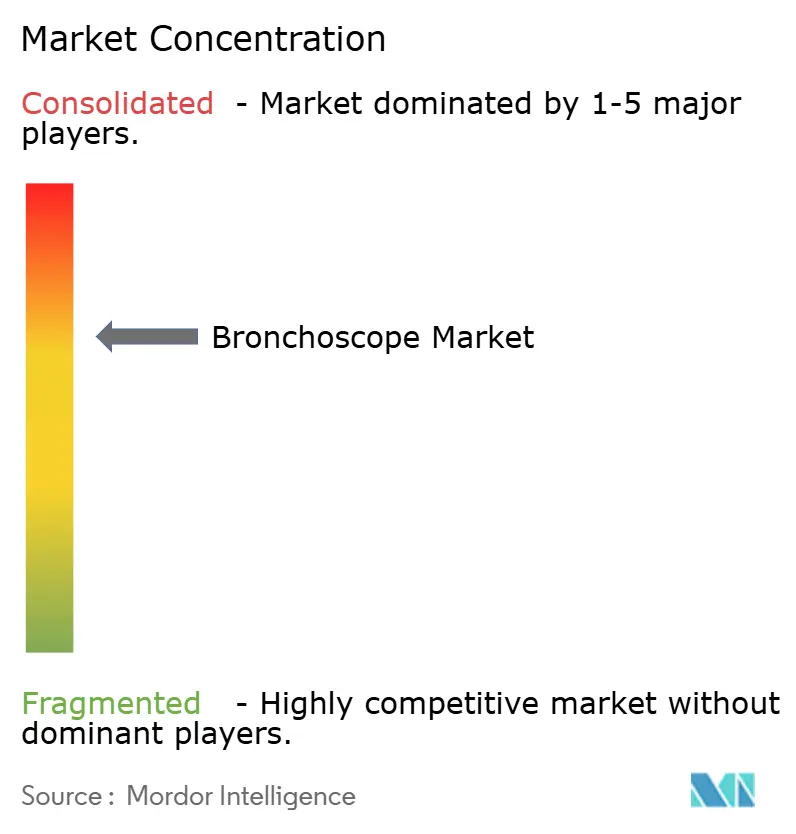
| Market Concentration | Medium |
Major Players *Disclaimer: Major Players sorted in no particular order Image © Mordor Intelligence. Reuse requires attribution under CC BY 4.0. | |
Bronchoscope Market Analysis by Mordor Intelligence
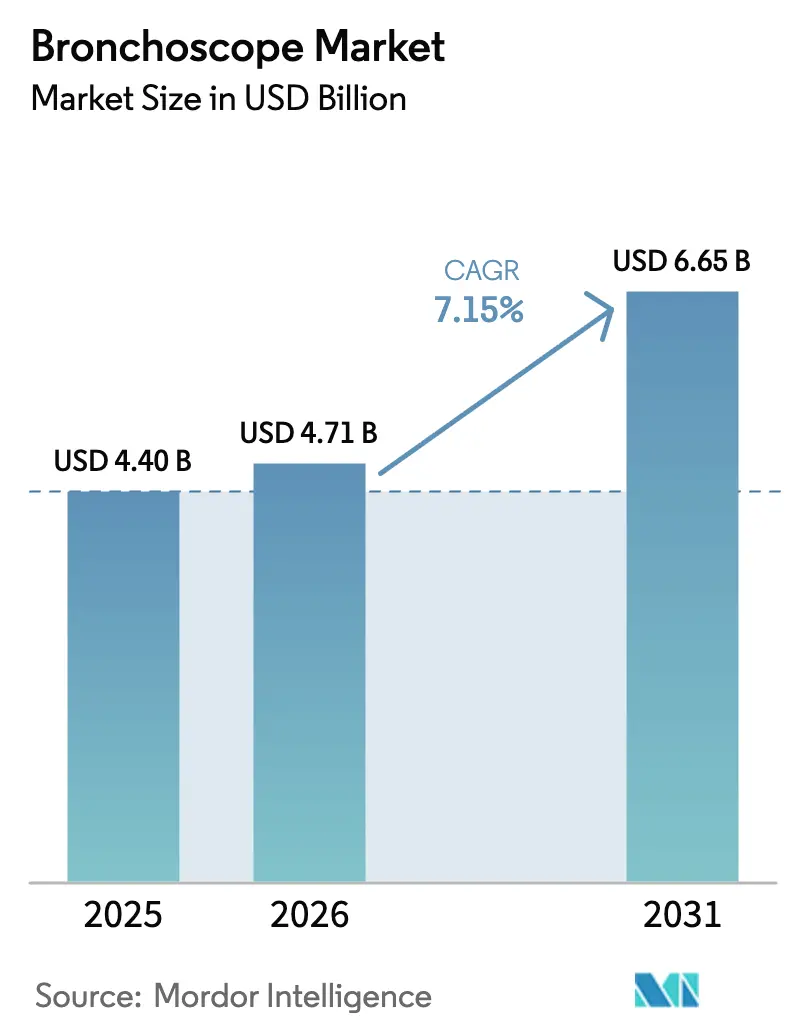
The Bronchoscope Market size is projected to expand from USD 4.40 billion in 2025 and USD 4.71 billion in 2026 to USD 6.65 billion by 2031, registering a CAGR of 7.15% between 2026 to 2031.
Structural tailwinds include the Centers for Medicare & Medicaid Services’ HCPCS C1601 pass-through payment, persistent infection-control pressures, and rising lung-cancer screening volumes that collectively accelerate the swing from reusable to single-use scopes. Hospitals continue to modernize bronchoscopy suites, but ambulatory surgical centers are capturing procedure growth as payers push site-of-care shifts to curb costs. Robotic platforms equipped with AI navigation are improving diagnostic yield, compressing the learning curve, and squeezing legacy flexible-scope differentiation. Asia-Pacific’s screening initiatives anchor long-term demand even as semiconductor and sterile-plastic shortages cloud near-term supply visibility.
Key Report Takeaways
- By product type, flexible bronchoscopes led with 62.56% of bronchoscope market share in 2025, while the same category is advancing at a 10.25% CAGR through 2031.
- By usage, reusable devices accounted for 65.53% share of the bronchoscope market size in 2025; single-use scopes are expanding at a 15.85% CAGR to 2031.
- By application, oncology represented 36.63% of the bronchoscope market size in 2025, whereas ICU airway management is tracking a 12.87% CAGR through 2031.
- By end user, hospitals held 73.33% share of the bronchoscope market size in 2025; ambulatory surgical centers are growing at an 11.7% CAGR to 2031.
- By geography, North America captured 42.13% of bronchoscope market share in 2025, yet Asia-Pacific is forecast to expand at a 9.51% CAGR to 2031.
Note: Market size and forecast figures in this report are generated using Mordor Intelligence’s proprietary estimation framework, updated with the latest available data and insights as of January 2026.
Global Bronchoscope Market Trends and Insights
Drivers Impact Analysis*
| Driver | (~) % Impact on CAGR Forecast | Geographic Relevance | Impact Timeline |
|---|---|---|---|
| Growing burden of respiratory diseases & lung cancer | +2.1% | Global, strongest in Asia-Pacific | Long term (≥ 4 years) |
| Growing hospital investment in bronchoscopy suites | +1.3% | North America & Europe, emerging APAC tier-2 cities | Medium term (2-4 years) |
| Technological advances in optics & imaging | +1.5% | Global, led by North America & Europe | Medium term (2-4 years) |
| Rapid adoption of AI-guided navigation bronchoscopy | +1.8% | North America & Europe, early APAC centers | Short term (≤ 2 years) |
| Reimbursement expansion for single-use bronchoscopes | +1.2% | North America, selective Europe | Short term (≤ 2 years) |
| Shift toward office-based/ASC bronchoscopy | +1.0% | North America, Australia, parts of Europe | Medium term (2-4 years) |
| Source: Mordor Intelligence | |||
Growing Burden of Respiratory Diseases & Lung Cancer
GLOBOCAN 2022 logged 2.48 million new lung-cancer cases worldwide and projects 4.62 million by 2050, with Asia responsible for 63% of the load. The 2024 U.S. screening-age reduction to 50 years added 6.4 million eligible adults, stretching interventional capacity and reinforcing robotic bronchoscopy adoption. Chronic obstructive pulmonary disease affects more than 390 million people, underpinning baseline diagnostic demand. Rising case volumes draw bronchoscopy closer to primary care, rewarding portable, single-use devices that avoid capital outlays. China’s 28% jump in lung-cancer diagnoses from 2019-2024 highlights a geographic imbalance that tele-mentored bronchoscopy may help address.
Rapid Adoption of AI-Guided Navigation Bronchoscopy
Johnson & Johnson’s MONARCH QUEST, cleared in March 2025, automates path planning and trims catheter repositioning by 35-40%. Intuitive Surgical’s Ion upgrade gained clearance in October 2025 and now tops 900 global installs, using shape-sensing fiber optics to lift diagnostic yield to roughly 82%. Meta-analysis data place robotic yield 8-11 percentage points above traditional electromagnetic navigation. Noah Medical’s single-use Galaxy system extends these gains to ambulatory settings by embedding real-time tomosynthesis imaging. The shorter 40-60-case proficiency curve alleviates workforce bottlenecks, a critical lever where trained specialists are scarce.
Reimbursement Expansion for Single-Use Bronchoscopes
HCPCS C1601, active January 2024 through December 2026, delivers separate payment for disposable scopes on top of procedure reimbursement, neutralizing their higher per-case price in outpatient sites[1]Centers for Medicare & Medicaid Services, “HCPCS C1601: Single-Use Pulmonary Bronchoscope,” cms.gov . UnitedHealthcare and Anthem adopted parallel coverage in 2024, citing reduced cross-contamination risk. ASCs, numbering 6,308 Medicare-certified centers in 2025, can now offer bronchoscopy without USD 40,000–60,000 capital spend per reusable scope. Manufacturers face a 2026 deadline to cement clinical evidence before pass-through expiration.
Shift Toward Office-Based/ASC Bronchoscopy
Eighty-two percent of U.S. hospitals owned or partnered with an ASC by 2024, anticipating migration of low-acuity procedures. Diagnostic bronchoscopy receives 35-45% lower Medicare payment in ASCs than hospital outpatient departments, creating a payer-driven push. Single-use scopes bypass sterilization, letting freestanding centers schedule same-day cases. Teleflex’s portable platform targets physician-office labs where procedure volumes are modest and capital budgets thin. Hospitals risk losing profitable diagnostics that subsidize complex therapeutics, challenging fellowship economics.
Restraints Impact Analysis*
| Restraint | (~) % Impact on CAGR Forecast | Geographic Relevance | Impact Timeline |
|---|---|---|---|
| High overhead cost of bronchoscopy procedure | -1.4% | Global, most acute in emerging markets | Long term (≥ 4 years) |
| Infection-control concerns with reusable scopes | -0.9% | North America & Europe | Short term (≤ 2 years) |
| Shortage of trained interventional pulmonologists | -1.1% | Global, severe in tier-2/3 regions | Long term (≥ 4 years) |
| Supply-chain tightness for CMOS sensors & sterile plastics | -0.8% | North America & Europe | Medium term (2-4 years) |
| Source: Mordor Intelligence | |||
High Overhead Cost of Bronchoscopy Procedure
A 2024 CHEST analysis placed U.S. outpatient bronchoscopy at USD 2,800–3,500 per case, dropping to USD 1,800–2,200 in ASCs yet still beyond reach in markets where annual per-capita health spend is under USD 500. India’s 48% out-of-pocket share limits access to urban insured populations. CMS trimmed payment by 2.8% in the 2025 fee schedule, intensifying throughput pressure. Robotic platforms partly offset cost by elevating first-pass success, but anesthesia and monitoring remain fixed expenses.
Shortage of Trained Interventional Pulmonologists
Fewer than 1,500 board-certified specialists practice in the United States, and fellowship programs add only 80-90 graduates per year. China counts roughly 200-250 trained physicians for 1.4 billion people. Robotic systems cut the learning curve roughly in half, while remote proctoring on the Ion platform allows urban experts to supervise rural cases in real time[3]Intuitive Surgical, “Ion Navigation Software Clearance,” intuitive.com. Single-use scopes with simpler controls enable supervised procedures by nurse practitioners where regulations permit.
*Our forecasts treat driver/restraint impacts as directional, not additive. The impact forecasts reflect baseline growth, mix effects, and variable interactions.
Segment Analysis
By Product Type: Flexible Scopes Dominate Innovation
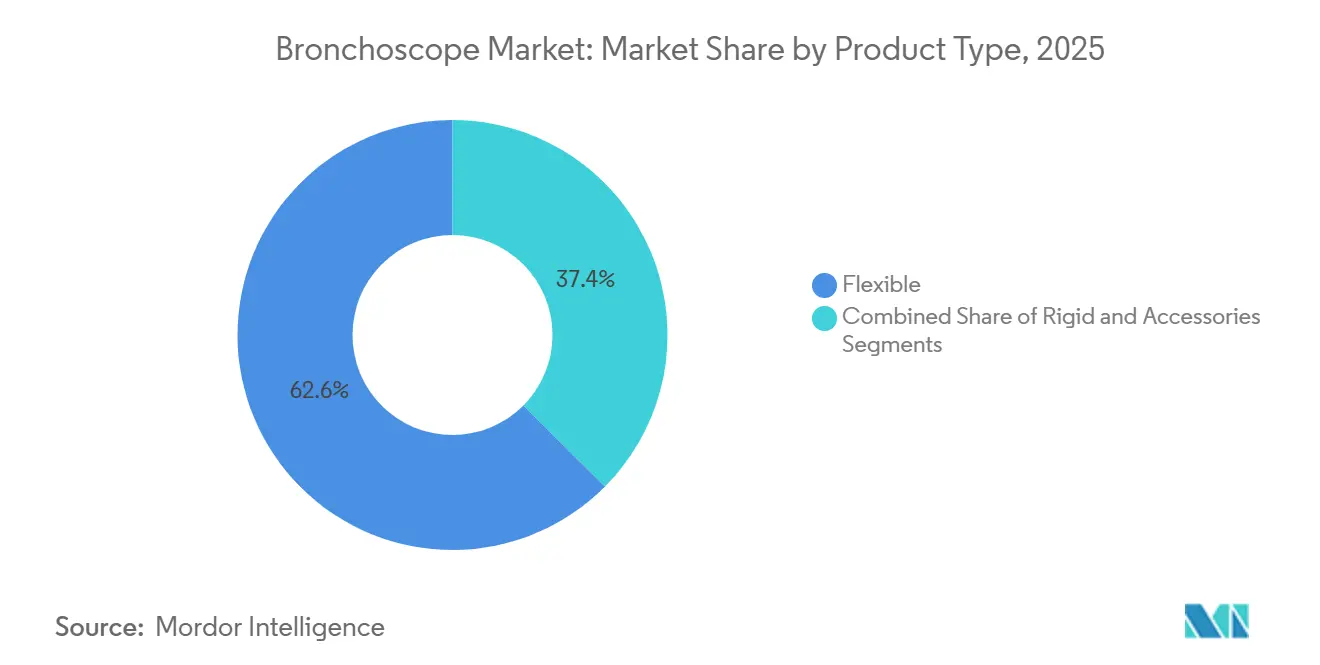
Flexible bronchoscopes owned 62.56% of bronchoscope market share in 2025 and are projected to expand at 10.25% CAGR to 2031, buoyed by robotic platforms that reach peripheral nodules previously inaccessible to manual scopes[2]Johnson & Johnson, “MONARCH QUEST FDA Clearance,” jnj.com. Rigid scopes stay confined to central airway work in operating rooms and therefore grow slowly. Accessory disposables, ranging from biopsy forceps to cryoprobes, create a recurring revenue layer that scales with every additional procedure.
Robotic navigation raises diagnostic accuracy from about 70% with standard flexible scopes to 80-84%, pivoting clinical preference toward the new generation of intelligent instruments. Disposable accessories align with infection-control policies and avoid reprocessing downtime. Medtronic’s cryobiopsy probes, introduced in 2024, are expanding tissue-sampling indications, further lifting procedure complexity and volume.



By Usage: Single-Use Gains Despite Reusable Dominance
Reusable devices represented 65.53% of the bronchoscope market size in 2025 because hospitals still rely on installed capital fleets. Yet single-use scopes are accelerating at 15.85% CAGR, thanks to pass-through reimbursement that offsets their higher variable cost. Ambu and Boston Scientific command early traction in ASCs that lack centralized sterilization.
A reusable scope amortized across 400-500 uses averages USD 150-250 per case; contamination incidents and labor costs tilt the equation as FDA alerts increase board scrutiny. Single-use options deliver 1080p imaging in models such as Ambu’s aScope 5, removing historic performance gaps. When pass-through payments sunset in 2026, device makers must prove long-term economic value to sustain adoption.
By Application: ICU Airway Management Surges
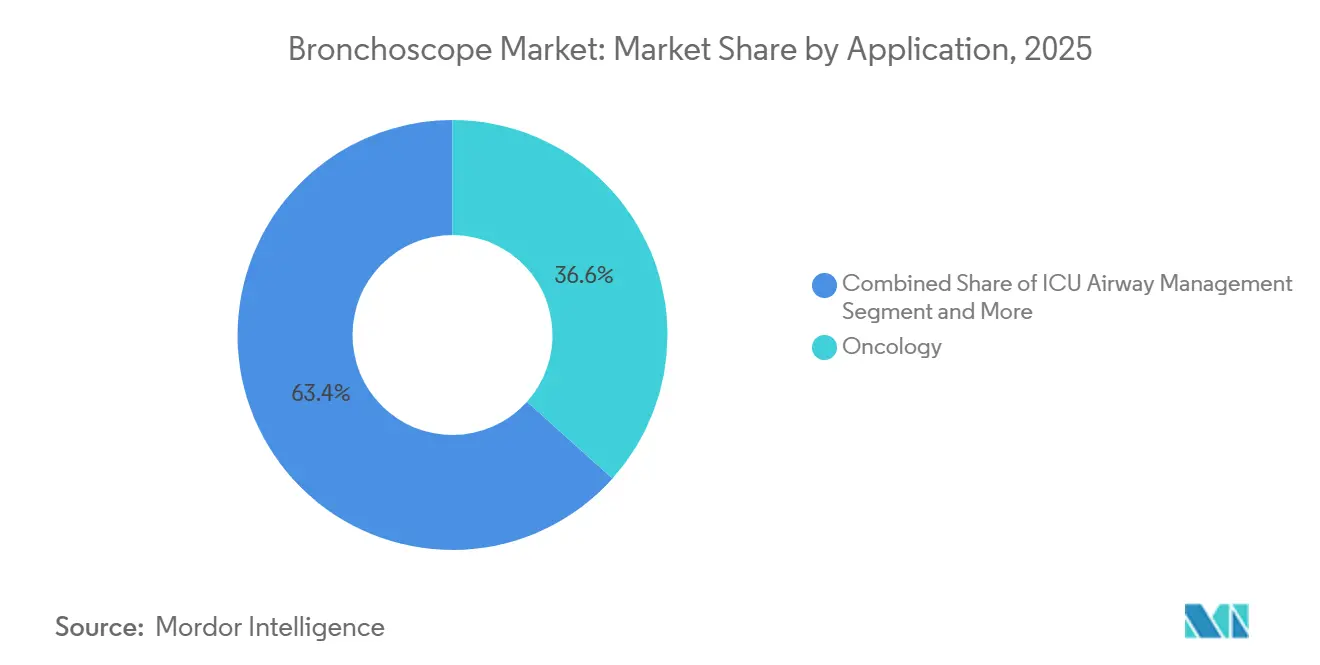
Oncology sustained 36.63% of bronchoscope market size in 2025, but ICU airway management is rushing forward at 12.87% CAGR on the back of ventilator-associated pneumonia protocols. Guidelines now endorse bronchoscopy when imaging is inconclusive, making bedside access crucial.
Point-of-care systems such as Ambu’s aView let intensivists avoid moving unstable patients, limiting cross-infection. Diagnostic yield for opportunistic infections in immunocompromised patients surpasses 80% compared with roughly 55% for non-invasive tests. Oncology growth moderates due to rising prior-authorization hurdles, but early-stage detection keeps overall procedure numbers firm.
By End User: ASCs Gain as Hospitals Dominate
Hospitals retained 73.33% of end-user demand in 2025 given their dominance in complex therapeutic work and robotic installations. Ambulatory surgical centers, however, are on an 11.7% CAGR trajectory, fueled by payer directives and single-use economics that bypass sterilization infrastructure.
ASCs focus on diagnostic and simple therapeutic cases with <2% complication rates, while hospitals guard advanced interventions such as airway stenting. Office-based labs remain nascent but are growing where nurse practitioners can conduct supervised procedures. The decentralization trend threatens hospital revenue streams that subsidize fellowship training and capital amortization.
Geography Analysis
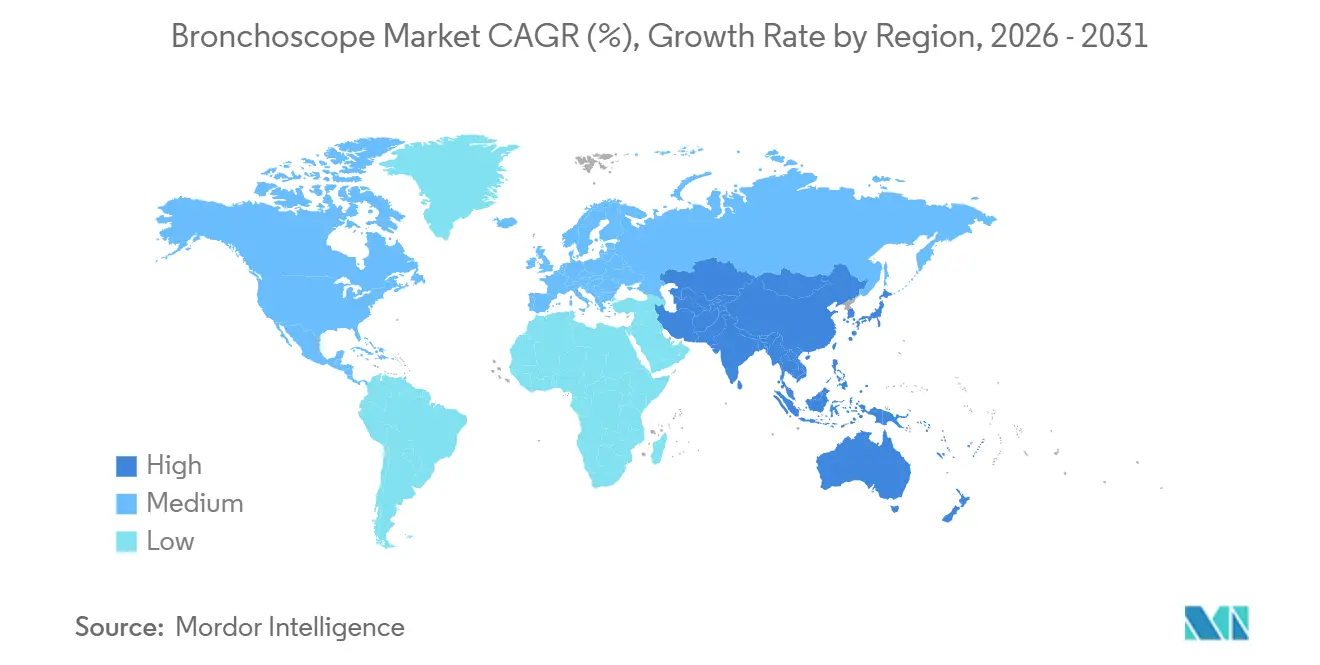
North America captured 42.13% of bronchoscope market share in 2025 on the back of 180–220 procedures per 100,000 population and early robotic uptake. The 2024 screening-age drop expanded the eligible pool by 6.4 million, yet trained-specialist shortages lengthened waitlists in many states. HCPCS C1601 accelerates single-use adoption across 6,308 ASCs, while Canada’s capped reimbursement and 4-8-week waits are spawning private clinics. Mexican demand divides between urban private hospitals and under-equipped public centers.
Asia-Pacific outpaces all regions at 9.51% CAGR through 2031. China’s state screening pushes, India’s respiratory-care expansion, and South Korea’s 2024 coverage of robotic bronchoscopy drive volume. Japan’s 28% senior population sustains COPD-related demand; however, 2024 reimbursement cuts encourage disposable-scope adoption to save labor costs. Australia’s 2024 clearance of Ambu’s aScope 5 extends services to remote clinics lacking sterilization.
Europe holds roughly one-quarter of global revenue and sees heterogeneous policy environments. Germany’s DRG incentives promote robotics for efficiency; Charité reported a 22% volume spike after installing Ion in 2024. NHS England pilots single-use scopes in community centers to cut 12-week waits. France added outpatient reimbursement in 2024 after a contamination scare. Fiscal limits in Italy and Spain postpone capital upgrades. Middle East programs in the UAE and Saudi Arabia broaden screening, whereas Latin American growth hinges on Brazilian and Argentine private sectors amid public-sector shortfalls.

Regulatory Landscape
In the United States, most flexible bronchoscopes and bronchoscope systems continue to reach market through the FDA 510(k) pathway, with multiple recent clearances underscoring active product refresh cycles across both reusable and single-use categories. Examples include FDA 510(k) clearances in April 2026 for MacroLux Medical Technology Co., Ltd. (LoopView Single-Use Digital Flexible Bronchoscope, K260420) and Olympus Medical Systems Corp. (EVIS EXERA III Bronchovideoscope BF-Q190, K252341), following earlier clearances such as Hunan Vathin Medical Instrument Co., Ltd. (January 2025, K242416) and Contra Healthcare Solutions, LLC (April 2025, K243541). This steady cadence of submissions reflects manufacturers using substantial equivalence to expand portfolios while addressing infection-control priorities that favor sterile, disposable designs in outpatient and critical care settings.
In Europe, the Medical Device Regulation, MDR (EU) 2017/745, remains the central compliance framework for bronchoscopes, and conformity strategies are closely tied to harmonized standards used to demonstrate General Safety and Performance Requirements. Commission Implementing Decision (EU) 2026/193 (adopted January 2026) updated the list of harmonized standards referenced under MDR, including standards associated with biocompatibility (ISO 10993 series) and small-bore connectors (ISO 80369-2:2024), which are relevant to bronchoscopy accessories and interfacing components. On the standards side, ISO 8600-1:2025 (published March 2025) defines general requirements for medical endoscopes and endotherapy devices, providing a current benchmark manufacturers can use in technical documentation for both reusable and single-use bronchoscopy platforms.
Competitive Landscape
The bronchoscope market features a core reusable triad of Olympus, Pentax Medical, and Fujifilm, versus rising single-use leaders Ambu and Boston Scientific. Robotic entrants intensify rivalry. MONARCH QUEST’s 260% computing-power jump and 35-40% repositioning cut shave procedure time, eroding classical flexible-scope loyalty. Intuitive Surgical’s Ion exceeds 900 installs, fighting on diagnostic-yield superiority backed by 18 navigation patents. Noah Medical targets ASCs with a disposable robotic platform that eliminates fluoroscopy and eases capital hurdles.
Two strategic camps emerge. Capital-equipment vendors pursue razor-and-blade revenue via catheter disposables and software subscriptions. Disposable-scope makers battle on infection-control, variable cost, and site-of-care flexibility. Olympus and Pentax defend turf with trade-in deals and extended warranties, but CMS pass-through support for single-use scopes compresses price latitude until 2026.
Tele-mentored bronchoscopy surfaces as whitespace; Ion’s remote proctoring permits urban experts to guide rural operators, partially offsetting workforce gaps. Patent landscapes center on AI path-planning and shape-sensing fiber optics, raising entry barriers for latecomers. Market participants must decide between licensing navigation tech or focusing on cost-efficient, single-use expansion as capital budgets disperse across more sites of care.
Bronchoscope Industry Leaders
Teleflex Inc.
Olympus Corporation
Ambu A/S
Fujifilm Holdings Corporation
Karl Storz GmbH & Co. KG
- *Disclaimer: Major Players sorted in no particular order

Market Opportunities and Future Outlook
Opportunity concentrates around specialized single-use designs and workflow add-ons that reduce ICU and outpatient friction, where infection-control and rapid room turnover directly impact provider economics. In 2026, multiple manufacturers expanded single-use and procedural-adjacent offerings, including KARL STORZ receiving FDA clearance (March 2026) for the FIVE S 6.5 sterile single-use bronchoscope with a 3.0 mm working channel positioned for critical care use, and Verathon introducing SamplePro (May 2026) as a closed-system specimen collection solution for the BFlex 2 single-use platform to reduce spill risk and streamline sampling steps. These moves highlight whitespace in integrated bronchoscopy kits that bundle scope, collection, and bedside workflow tools for ICU airway management and infection diagnosis.
A second whitespace area is clinical-segment expansion and modality redesign within EBUS and pediatrics, where differentiation comes from setup simplification and indication breadth rather than incremental imaging specs alone. FUJIFILM Healthcare Americas launched the EB-710US balloon-less EBUS bronchoscope in May 2026, targeting elimination of balloon preparation steps and reducing contamination concerns tied to balloon use, while Olympus announced a pediatric use indication (February 2026) for two single-use bronchoscopes (Zero BCV1-02 and Slim BCV1-C2) manufactured by Hunan Vathin Medical Instrument Co., Ltd., widening access to disposable platforms in smaller-airway care. Parallel R&D signals point to deeper AI integration in robotic bronchoscopy, including published work on hierarchical learning approaches for autonomous navigation using intraluminal visual-spatial cues, reinforcing a development pathway that reduces operator variability and supports broader adoption beyond high-volume tertiary centers.
Recent Industry Developments
- May 2026: FUJIFILM Healthcare Americas launched the EB-710US balloon-less EBUS bronchoscope, eliminating balloon preparation steps and reducing contamination concerns tied to balloon use. The move strengthens operational efficiency in mixed-use ICU and outpatient settings by simplifying workflow and reducing cross-contamination risks.
- September 2025: Olympus BF-UCP190F EBUS bronchoscope was rolled out across the Europe, Middle East and Africa region, expanding real-time ultrasound visualization for endobronchial ultrasound guided procedures and reinforcing platform standardization in oncology workflows.
- March 2025: Johnson and Johnson secured US FDA clearance for MONARCH QUEST, adding AI path planning and higher computational power to its robotic bronchoscopy platform, sharpening navigation efficiency and procedural consistency in peripheral-nodule biopsy.


Research Methodology Framework and Report Scope
Market Definition and Coverage
This market covers revenues generated from bronchoscopes and their related accessories used to visualize, diagnose, or treat the airways during bronchoscopy procedures, in hospital departments and outpatient care settings.
Scope exclusions: This sizing excludes bronchoscopy procedure fees, anesthesia services, and broader endoscopy towers or imaging systems that are not sold as part of the bronchoscope device and accessory revenue.
Segmentation Overview
- By Product Type
- Rigid
- Flexible
- Accessories
- By Usage
- Single-use Bronchoscope
- Reusable Bronchoscope
- By Application
- Oncology (biopsy & staging)
- Pneumonia & Infection Diagnosis
- Foreign-body Removal
- ICU Airway Management
- By End User
- Hospitals
- Ambulatory Surgical Centers
- Specialty Clinics & Office-based Labs
- Geography
- North America
- United States
- Canada
- Mexico
- Europe
- Germany
- United Kingdom
- France
- Italy
- Spain
- Rest of Europe
- Asia-Pacific
- China
- India
- Japan
- Australia
- South Korea
- Rest of Asia-Pacific
- Middle East and Africa
- GCC
- South Africa
- Rest of Middle East and Africa
- South America
- Brazil
- Argentina
- Rest of South America
- North America
Data Sources, Market Sizing, and Validation
Desk Research
Desk work was used to build the basic demand picture and to set practical boundaries on what is counted as bronchoscope revenue. We referenced public healthcare utilization and disease burden indicators from the World Health Organization, the US CDC, OECD health statistics, and national health ministry dashboards, focusing on procedure volumes and respiratory trends where available.
On the supply side, we reviewed product clearances and safety communications from regulators such as the US FDA and similar public registries in major markets. We also checked customs and trade statistics where available to understand cross-border device flows. Annual reports, filings, and investor decks were reviewed to map product portfolios and reported business exposure. We also used paid subscriptions for company financials and intelligence, patent lookups, and shipment level import and export checks. The sources listed here are not exhaustive because additional references were used for data collection, validation, and clarification.
Primary Interviews and Surveys
Primary work was conducted through expert interviews and structured surveys with device OEM staff, distributors, clinicians, and stakeholders from procurement and sterile processing, since pricing and replacement logic differ by setting. To keep the model usable across regions, we validated assumptions on procedure mix, reusable versus single use adoption, and expected ASP movement, then reconciled outlier inputs through follow-up calls so assumptions stayed consistent across major geographies.
Distribution of primary research fieldwork respondents
| Company type | Respondent position | Region |
|---|---|---|
| Top tier: 34% | CXOs: 15% | APAC: 53% |
| Mid tier: 50% | Functional/Unit leaders: 32% | EMEA: 29% |
| Smaller Players: 16% | Managers: 53% | Americas: 18% |
Market-Sizing & Forecasting
The market was sized using a top-down build that starts from the treated and diagnosed patient pool and the related bronchoscopy activity in key countries, then translates activity into device demand using realistic utilization and replacement patterns. In the model, unit demand is driven by procedure mix and setting, and revenue is then derived through ASP bands.
To keep totals grounded, we cross-checked results with selective bottom-up approximations such as supplier and channel feedback on unit shipments, sampled ASP quotes for reusable scopes versus single use units, and accessory attachment rates. Key inputs used in the model included bronchoscopy procedure volumes by care setting, single use penetration in infection sensitive settings, average scope life and repair frequency, accessory consumption per procedure, and regional pricing differences after currency normalization.
For forecasting, we used scenario analysis supported by simple multivariate relationships between procedure growth, hospital capital cycles, and the pace of single use adoption. The final trajectory was then adjusted using consensus ranges from primary experts. Where bottom-up checks had gaps, we filled missing pieces using conservative interpolation based on adjacent country benchmarks and validated price bands before final totals were produced.
Data Validation & Update Cycle
Validation was handled through multiple checks to reduce drift from real-world signals. We compared modeled revenue against independent indicators such as procedure growth trends, regulatory product activity, and reported business exposure in public filings. When variances were sharp, we rechecked price assumptions and adoption rates.
Before sign-off, the model and assumptions go through stepwise analyst reviews, and respondents are re-contacted when inputs fall outside expected ranges for utilization, replacement, or pricing. Reports are refreshed annually, and interim updates are made when material events occur, such as major guideline changes, product recalls, or notable shifts in reimbursement or procurement patterns. Right before delivery, a fresh data pass is completed so clients get the most current view supported by clearly documented inputs.
Mordor Intelligence's Bronchoscope Market Size Compared With Other Published Estimates
Published market sizes for bronchoscopes can differ widely, even when the scope appears similar, because timing and the pricing logic are not always aligned. Differences often come from how exchange rates are applied within the year, whether ASPs are assumed to move too quickly, and whether validation relies on broad device counts instead of procedure-linked demand.
In this study, the refresh cadence is tied to new regulatory signals and procedure trend updates, and ASP bands are rechecked using channel and hospital procurement inputs before annual numbers are locked. This also explains why the 2026 estimate of USD 4.71 B is higher than some narrower device-only views, a modeling choice applied by Mordor Intelligence.
Benchmark comparison
| Source | Market Size | Gaps in Research Methodology |
|---|---|---|
| Mordor Intelligence | USD 4.71 B (2026) | |
| Global Consultancy A | USD 0.87 B (2024) | Uses a narrower device revenue boundary that emphasizes bronchoscopes as a product line with limited accessory pull-through, and the base year is earlier, which can understate the later-period mix shift toward higher value single-use units. |
| Industry Publisher B | USD 3.65 B (2024) | Applies a faster growth curve to reach the long-term forecast and does not clearly separate pricing by reusable versus single-use adoption by care setting, which can change the revenue curve when ASP normalization and replacement cycles are modeled differently. |
The comparison shows that scope boundaries and update timing can move the number more than expected, particularly when accessories, usage mix, and currency conversion assumptions differ. By keeping the model traceable to procedure-linked demand, replacement behavior, and refreshed price bands, the final view stays balanced and repeatable for planning and tracking.


Key Questions Answered in the Report
What is the global bronchoscope market size in 2026 and its forecast value for 2031?
Revenue stands at USD 4.71 billion in 2026 and is projected to reach USD 6.65 billion by 2031, supported by a 7.15% CAGR.
How quickly are single-use bronchoscopes expanding compared with reusable units?
Disposable scopes are rising at a 15.85% CAGR through 2031, while reusable devices remain dominant but grow more slowly.
Which geographic region is expected to post the strongest growth through 2031?
Asia-Pacific leads with a 9.51% CAGR, driven by lung-cancer screening programs in China and respiratory-care expansion in India and Southeast Asia.
What CAGR is forecast for flexible bronchoscopes over the next five years?
Flexible platforms, already holding 62.56% share, are forecast to advance at a 10.25% CAGR through 2031 as robotic navigation boosts peripheral-nodule reach.
How does HCPCS C1601 influence device economics in ambulatory surgical centers?
The CMS pass-through payment, active until December 2026, provides separate reimbursement for each single-use bronchoscope, effectively neutralizing higher per-procedure costs for ASCs.
What diagnostic-yield advantage do robotic systems deliver over conventional navigation?
Meta-analyses place robotic-assisted bronchoscopy yields at roughly 80-84%, about 8-11 percentage points higher than traditional electromagnetic navigation.
Page last updated on:


 Your data is secure and never sold or shared.


