
Veterinary Vaccine Adjuvants Market Size and Share
Market Overview
| Study Period | 2020 - 2031 |
|---|---|
| Market Size (2026) | USD 517.70 Million |
| Market Size (2031) | USD 792 Million |
| Growth Rate (2026 - 2031) | 8.88 % |
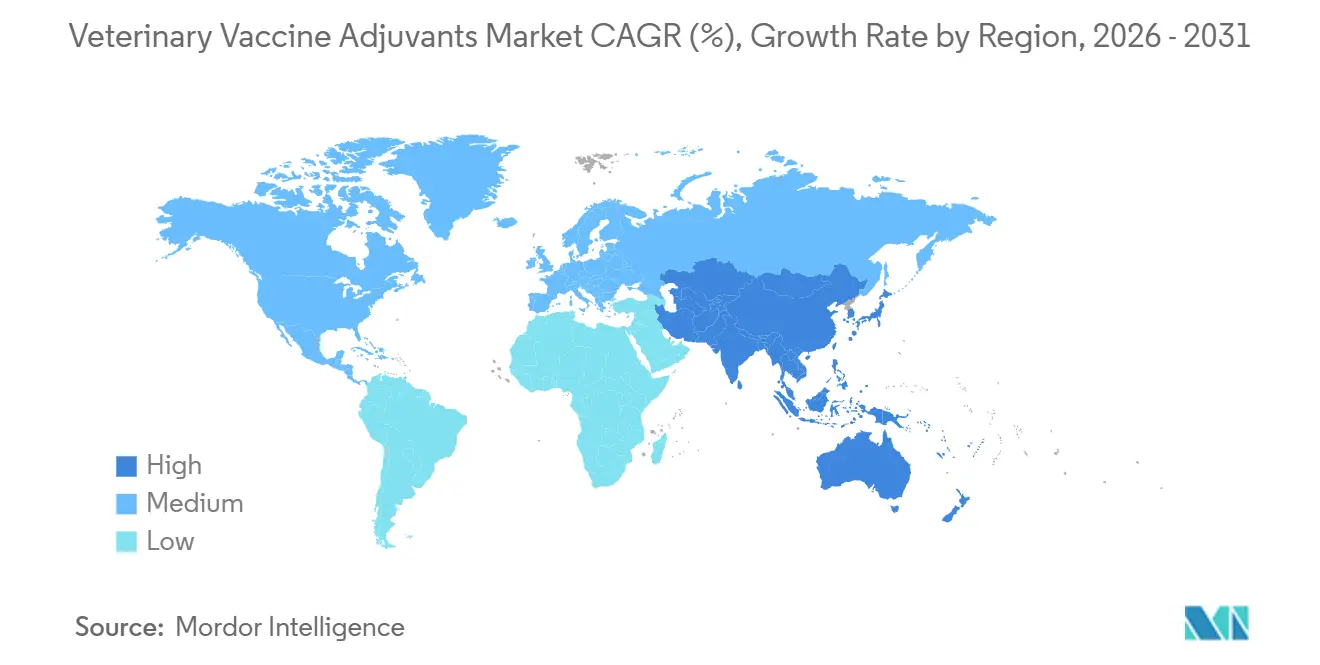
| Fastest Growing Market | Asia Pacific |
| Largest Market | North America |
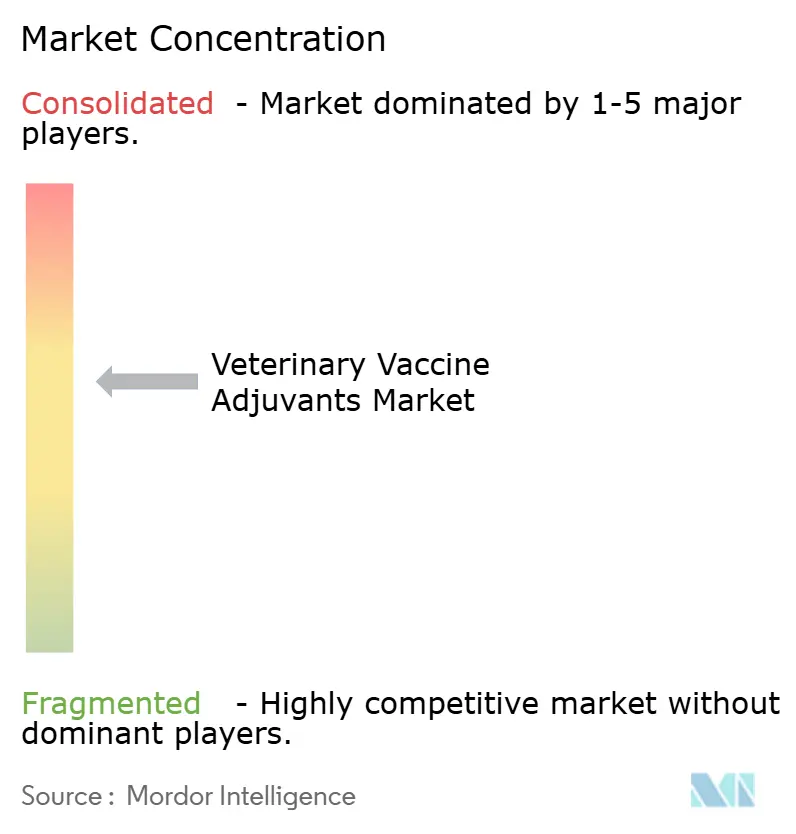
| Market Concentration | Medium |
Major Players *Disclaimer: Major Players sorted in no particular order Image © Mordor Intelligence. Reuse requires attribution under CC BY 4.0. | |
Veterinary Vaccine Adjuvants Market Analysis by Mordor Intelligence
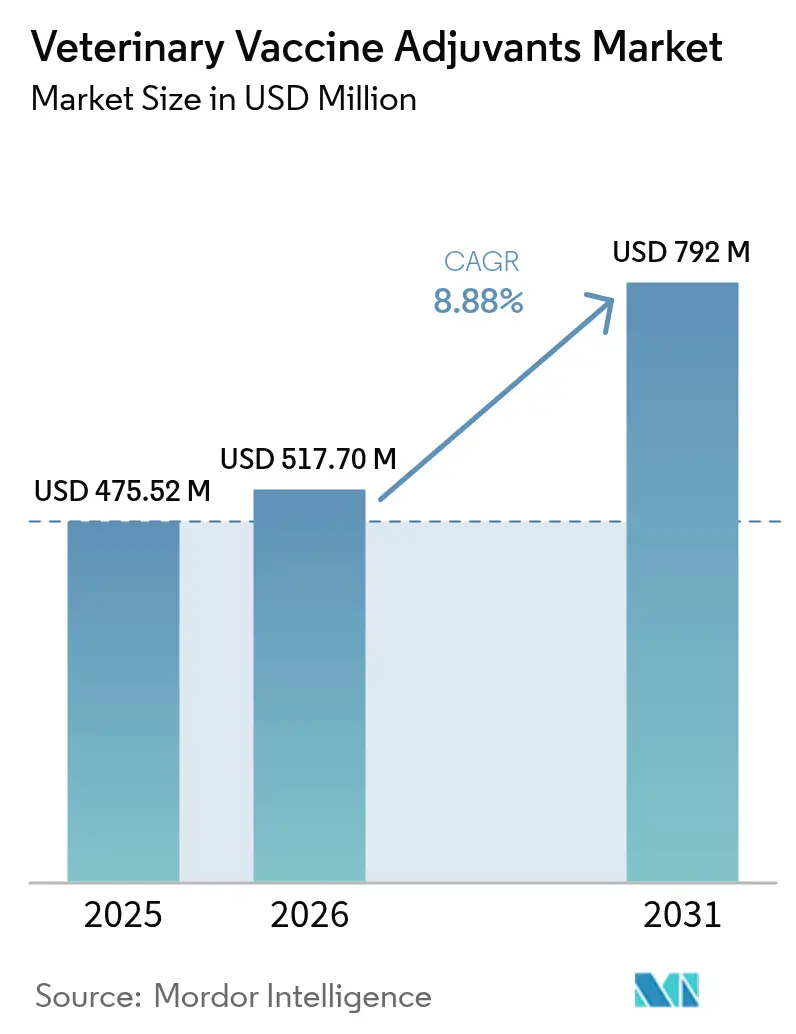
The veterinary vaccine adjuvants market size was valued at USD 475.52 million in 2025 and estimated to grow from USD 517.73 million in 2026 to reach USD 792.08 million by 2031, at a CAGR of 8.88% during the forecast period (2026-2031). Demand accelerates as emerging livestock diseases expose the limits of alum-only formulations, governments intensify One-Health surveillance, and Asia-Pacific subsidies favor oil-emulsion technologies. Simultaneously, the veterinary vaccine adjuvants market faces a 24- to 36-month regulatory lag between pre-clinical proof and commercial launch, compressing innovation cycles while demand rises. Market leaders allocate record capital to emulsion capacity, yet squalene supply shocks, safety scrutiny, and temperature-stable needs shape investment toward nanoparticle and polymer systems. The convergence of these forces positions the veterinary vaccine adjuvants market for sustained, innovation-led expansion, particularly in companion-animal and aquaculture niches.
Key Report Takeaways
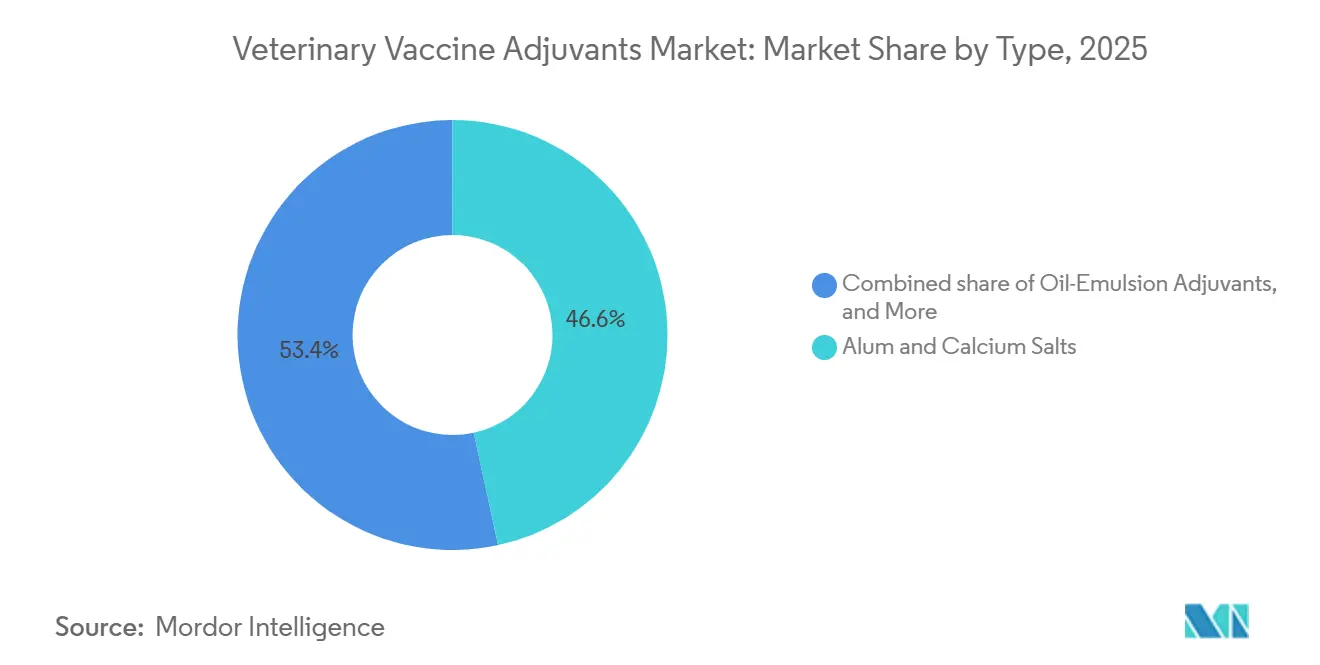
- By type, alum and calcium salts commanded 46.55% of the veterinary vaccine adjuvants market share in 2025, while particulate and nanoparticle systems are projected to expand at a 10.85% CAGR through 2031.
- By route, oral delivery accounted for 49.53% of 2025 revenue, but intranasal platforms are forecast to grow at a 9.75% CAGR through 2031.
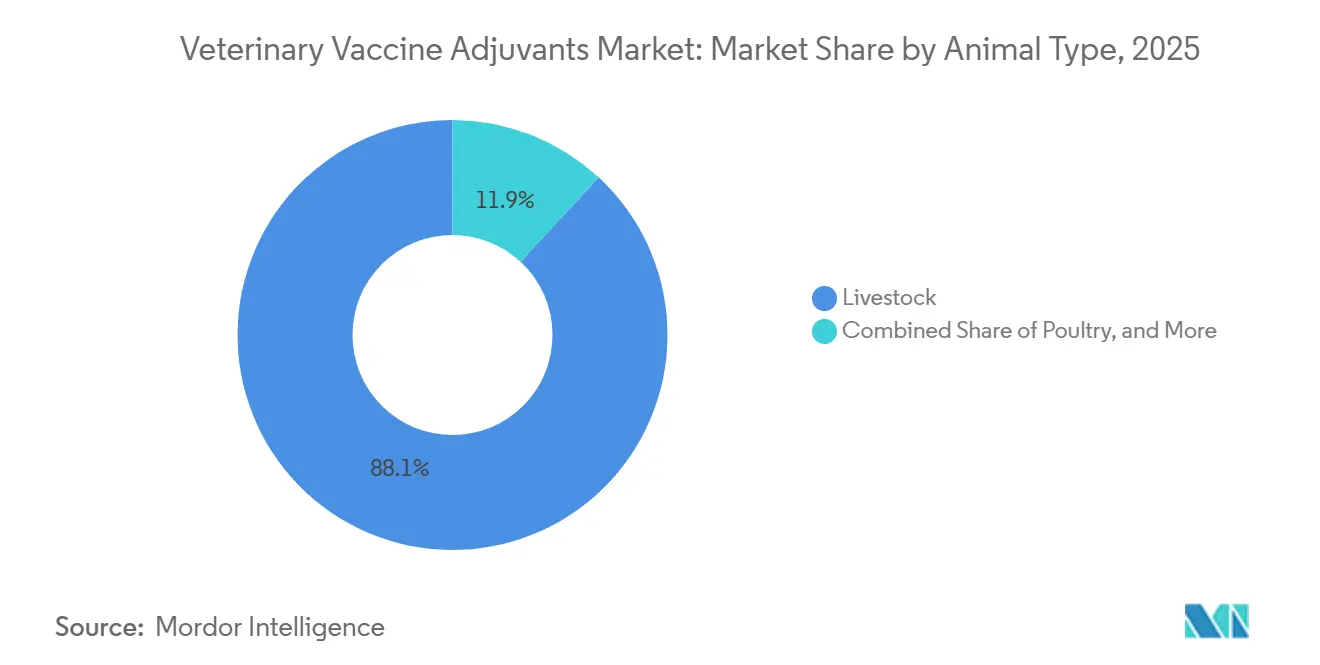
- By animal type, livestock dominated with an 88.15% share in 2025, whereas companion animals are advancing at a 9.82% CAGR to 2031.
- Geographically, North America led with 37.21% of 2025 revenue, yet Asia-Pacific is expected to expand at 9.89% CAGR through 2031.
Note: Market size and forecast figures in this report are generated using Mordor Intelligence’s proprietary estimation framework, updated with the latest available data and insights as of 2026.
Market Trends and Insights
Drivers Impact Analysis of Veterinary Vaccine Adjuvants Market*
| Driver | (~)% Impact on CAGR Forecast | Geographic Relevance | Impact Timeline |
|---|---|---|---|
| Expanding Global Animal Protein Consumption | +1.8% | Global, with strongest growth in Asia-Pacific and Middle East | Long term (≥ 4 years) |
| Rising Incidence of Emerging & Re-Emerging Livestock Diseases | +2.1% | Global, concentrated in North America (H5N1), Europe (FMD), Asia (ASF) | Short term (≤ 2 years) |
| Strengthening Government Immunization Mandates & Subsidies | +1.5% | North America, Europe, India | Medium term (2-4 years) |
| Growing Focus on One-Health & Zoonosis Prevention | +1.2% | Global, led by North America and Europe regulatory frameworks | Medium term (2-4 years) |
| Shift Toward High-Value Subunit & mRNA Veterinary Vaccines | +1.4% | North America, Europe, select Asia-Pacific markets | Long term (≥ 4 years) |
| ESG-Driven Transition to Plant-Derived Squalene & Sustainable Emulsifiers | +0.9% | Europe, North America | Long term (≥ 4 years) |
| Source: Mordor Intelligence | |||
Expanding Global Animal Protein Consumption
Global meat output is projected to climb by 12% between 2024 and 2034, boosting stocking densities and reliance on vaccines. India’s 5.2 billion-bird poultry flock now adheres to mandatory Newcastle disease immunization, and Montanide ISA 71 VG cut mortality by 18 percentage points versus alum in large broiler houses[1]. Southeast Asian aquaculture producers adopt chitosan-adjuvanted immersion vaccines, raising efficacy to 70% from 45%, underscoring the adjuvant's value despite regulatory fragmentation.
Rising Incidence of Emerging and Re-Emerging Livestock Diseases
The 2024 H5N1 incursion into 129 U.S. dairy herds triggered USD 98 million in emergency vaccine procurement after alum-based shots failed to curb shedding. Oil-emulsion plus TLR7/8 agonist combinations lowered nasal viral titers by 2.3 log10 in experimental cattle, while Europe’s 2025 foot-and-mouth flare-up compelled purchase of 4.5 million oil-adjuvanted doses. Persistent African swine fever outbreaks are accelerating the development of saponin-adjuvanted subunit vaccines now in Phase II trials.
Strengthening Government Immunization Mandates and Subsidies
USDA’s modernized surveillance network requires adjuvants that meet VICH stability criteria, disqualifying non-adjuvanted biologics from federal tenders. India subsidizes 75% of vaccine costs for smallholders if formulations deliver immunity beyond six months, favoring oil-emulsion and polymer systems. The EU Animal Health Law obliges member states to hold strategic reserves, harmonizes adjuvant dossiers, and shortens time-to-market.
Growing Focus on One-Health & Zoonosis Prevention
The U.S. National One Health Framework mandates human-safety assessment for food-animal adjuvants, elevating interest in biodegradable PLGA nanoparticles and plant-derived saponins. Japan now requires disclosure of adjuvant composition to monitor allergen exposure in farm workers, while the WHO calls for adjuvanted veterinary vaccines to curb zoonotic spillover.
Restraints Impact Analysis of Veterinary Vaccine Adjuvants Market*
| Restraint | (~)% Impact on CAGR Forecast | Geographic Relevance | Impact Timeline |
|---|---|---|---|
| Adverse Reactions & Safety Concerns with Oil-Based Adjuvants | -1.1% | Europe, North America | Short term (≤ 2 years) |
| Complex & Fragmented Regulatory Approval Pathways | -0.8% | Asia-Pacific, Latin America | Medium term (2-4 years) |
| Volatile Pharmaceutical-Grade Squalene Supply | -0.7% | Europe, North America | Short term (≤ 2 years) |
| GMP Scale-Up Bottlenecks for Nanoparticle & Polymer Adjuvants | -0.6% | North America, Europe | Long term (≥ 4 years) |
| Source: Mordor Intelligence | |||
Adverse Reactions and Safety Concerns with Oil-Based Adjuvants
EMA surveillance recorded 127 granuloma cases in cattle vaccinated with Montanide ISA 206 during 2024, slicing carcass value by EUR 45-60 per head and driving producers toward alum despite shorter protection[2]. Companion-animal veterinarians cite a 14% sterile abscess rate in dogs receiving oil-adjuvanted leptospirosis vaccines, versus 2% with alum-adjuvanted vaccines, reshaping purchasing decisions.
Complex and Fragmented Regulatory Approval Pathways
FDA-CVM can green-light conditional licenses within 12 months, whereas China demands 36-month field trials, forcing multinationals to maintain region-specific adjuvant variants and inflating costs by up to 22%[3]. Brazil’s requirement for local-breed toxicity testing delayed an oil-adjuvanted FMD vaccine by 14 months.
*Our forecasts treat driver/restraint impacts as directional, not additive. The impact forecasts reflect baseline growth, mix effects, and variable interactions.
Veterinary Vaccine Adjuvants Market Segment Analysis
By Type:
Alum Anchors Volume, Nanoparticles Capture Premium TiersAlum and calcium salts held 46.55% of 2025 revenue, supported by USD 0.08-0.12 per-dose costs and a robust safety record. Particulate and nanoparticle systems are forecast to advance at a 10.85% CAGR, supported by companion-animal demand for formulations with minimal injection-site reactions. Oil-emulsion products such as Montanide and Emulsigen remain essential for inactivated viral vaccines that require strong cell-mediated immunity. Saponin platforms like Quil-A and the emerging Matrix-M add premium options, while pathogen-derived CpG and MPLA adjuvants remain niche due to manufacturing cost. Combination approaches—alum plus TLR agonists are emerging fastest, propelled by Ingelvac CircoFLEX’s double-digit growth. Polymer systems, however, must overcome endotoxin contamination incidents that led to FDA warnings in 2024. Venture-backed startups are funneling capital into thermostable virus-like particles, hinting at future cost parity with alum if scale hurdles are overcome.

By Route of Administration:
Oral Dominance Masks Intranasal DisruptionOral delivery commanded 49.53% share in 2025, led by wildlife rabies baits and drinking-water poultry vaccines that often dispense with conventional adjuvants. Yet chitosan micro-particles improved Newcastle disease seroconversion to 68% from 52%, illustrating incremental value. Intramuscular and subcutaneous routes remain preferred for precise dosing, but intranasal platforms are sprinting at a 9.75% CAGR as producers pursue needle-free labor savings. Bovilis Intranasal RSP Live secured 12% of the EUR 85 million European calf-vaccine market within 18 months, validating mucosal immunity economics. Intradermal jet injectors in aquaculture are scaling throughput tenfold, while dual-route formulations under development could let producers toggle between oral and intranasal pathways, shaving 3-5 percentage points from oral share by 2031.
By Animal Type:
Livestock Lock-In Versus Companion-Animal PremiumizationLivestock absorbed 88.15% of demand in 2025, reflecting global herd scale and cost pressure that lock in alum and basic emulsions. Cattle programs fighting FMD and brucellosis drive volume, whereas swine vaccines pivot to combination adjuvants that cut handling time. Poultry segments increasingly adopt oil emulsions for breeder flocks requiring extended immunity. The veterinary vaccine adjuvants market for companion animals is smaller but expanding at a 9.82% CAGR, with canine vaccines adopting premium polymers that reduce pain at USD 25-45 per dose. Feline formulations shift toward recombinant antigens amid sarcoma concerns, while equine owners pay top dollar, USD 38 per shot, for carbomer-enhanced West Nile protection. Aquaculture, though the smallest, is set for acceleration as oil-emulsion immersion vaccines trim white-spot mortality by 62% in Pacific white shrimp, strengthening the segment’s contribution to the veterinary vaccine adjuvants industry.
Geography Analysis
North America Veterinary Vaccine Adjuvants Market
North America led with 37.21% of 2025 revenue, underpinned by USDA’s rapid-response procurement and FDA-CVM’s conditional-license pathway that cleared 14 novel adjuvants during 2024-2025. The H5N1 emergency validated domestic manufacturing: Zoetis and Elanco expanded plants with in-house emulsion suites, insulating the supply chain. Canada’s research universities punch above their weight in nanoparticle science, while Mexico’s privatizing vaccine market offers a USD 55 million window for thermostable adjuvants suited to warm regions.
APAC Veterinary Vaccine Adjuvants Market
Asia-Pacific, forecast to grow at 9.89% CAGR, is on track to surpass North America by 2029. China’s aquaculture subsidy reimburses 60% of oil-emulsion vaccines, adding 22 million doses in its first year. India’s National Livestock Mission funds adjuvant procurement and cold-chain upgrades, thereby expanding the veterinary vaccine adjuvant market at the state level. Japan and South Korea approve liposome-adjuvanted canine vaccines, signaling premiumization, while Australia’s A$350 million Zoetis plant expansion cements regional export capacity.
EMEA and South America Veterinary Vaccine Adjuvants Market
Europe maintains a significant share but faces higher compliance costs after EMA’s 2025 surveillance rule for oil-emulsions. Emergency FMD outbreaks in Bulgaria and Romania sparked a rapid draw-down of 4.5 million oil-adjuvanted doses, spotlighting cold-chain gaps in Eastern states. Ceva’s new French plant, ISO-14001 certified, anchors the continent’s shift toward plant-derived squalene. South America streamlines dossiers Brazil cut approval time to 18 months for adjuvants vetted in the U.S. or EU potentially lifting imports by USD 20 million by 2027. The Middle East and Africa show the greatest unmet need; thermostable carbomer vaccines stored at 25 °C posted 74% efficacy in Kenyan trials, 22 percentage points above alum, hinting at latent demand once affordability improves.
Regulatory Landscape
Veterinary vaccine adjuvants are regulated as integral components of veterinary biologicals or immunological veterinary medicinal products, and regulators expect safety, efficacy contribution, and batch-to-batch consistency data to be included in the marketing authorization or licensure package. In the United States, oversight is anchored in 9 CFR Part 113 by the USDA APHIS Center for Veterinary Biologics, with manufacturers submitting an Outline of Production and batch protocol data for standardized testing, while FDA CVM also publishes VICH-related guidance and animal biologicals regulatory information for developers aligning dossiers to harmonized expectations.
Internationally, the Veterinary International Conference on Harmonisation (VICH) continues to converge technical requirements across key markets (EU, Japan, United States). In Europe, EMA guidance on data requirements for adjuvants in veterinary vaccines emphasizes characterization of the adjuvant, local and systemic tolerance, and considerations such as biodegradability and residue or tissue accumulation for food-producing animals, which shapes how oil-emulsions, saponins, and next-generation particulate or polymer systems are documented and justified in dossiers.
Competitive Landscape
The veterinary vaccine adjuvants market remains moderately fragmented. The five integrated leaders, Zoetis, Boehringer Ingelheim, Elanco, Merck Animal Health, and Ceva, control the bulk of revenue, leveraging vertical plants that blend proprietary emulsions and nanoparticles. Zoetis’s USD 590 million Georgia build-out includes squalene purification that shields margins from supply shocks. Boehringer Ingelheim’s 2023 aquaculture portfolio buy unlocked cross-species deployment of carbomer technology. Mid-tier specialists such as SEPPIC, Croda, and Phibro capture margin in custom formulations but face feedstock volatility and stricter quality audits.
Disruptors focus on thermostable and needle-free solutions. VaxLiant raised USD 28 million in 2025 to commercialize a virus-like particle adjuvant stable at 37 °C for 1 year, potentially unlocking the 18-country African market. Phibro screened 1,200 saponin derivatives, producing three leads now in pre-clinical swine trials. Patent filings for TLR agonists hit 47 during 2024-2025, yet costs above USD 2 per dose constrain livestock uptake. Regulatory agility becomes decisive: Merck secured a May 2025 conditional license for a nanoparticle-adjuvanted bovine respiratory vaccine, seizing an 8-10% share of the USD 180 million U.S. calf segment before rivals could file.
Consolidation pressures will intensify as integrated firms acquire adjuvant innovators to secure inputs and compress time-to-market. The 2024 Zoetis purchase of Jurox’s adjuvant platform foreshadows this trajectory, while sustainable squalene sourcing emerges as a differentiator in tenders and ESG scorecards.
Veterinary Vaccine Adjuvants Industry Leaders
-
Merck Animal Health
-
Boehringer Ingelheim Vetmedica
-
Ceva Santé Animale
-
Elanco Animal Health
-
Zoetis
- *Disclaimer: Major Players sorted in no particular order
Veterinary Vaccine Adjuvants Market Companies Covered in this Report
- Bioveta
- Boehringer Ingelheim
- Ceva Santé Animale
- Croda International (Avanti / Brenntag Biosector)
- Elanco
- Merck
- OZ Biosciences
- Phibro Animal Health
- SEPPIC (Air Liquide)
- SPI Pharma
- Thermo Fisher Scientific
- Vaxine Pty
- VaxLiant
- Zoetis
Market Opportunities and Future Outlook
Technology and product-mix opportunities are being reinforced by 2026 regulatory and scientific milestones that raise the value of higher-performing adjuvant systems. In April 2026, EMA CVMP adopted a positive opinion for Nobivac NXT HCPChFeLV, described as the first veterinary vaccine recommended for EU authorisation using self-amplifying RNA technology, which increases the importance of adjuvant and delivery approaches that manage reactogenicity while improving immune amplitude and durability across companion animal indications. This development also tracks the broader movement toward polymer- and nanomaterial-based platforms in the technical literature (including chitosan derivatives, squalene-in-water emulsions, and polymer hydrogels) that aim for sustained release and improved tolerability, particularly where injection-site reactions limit uptake of oil-based systems.
Manufacturing and supply-chain whitespace is also emerging through geographically distributed capacity build-outs and specialized sourcing models. Merck Animal Healths May 2025 USD 895 million De Soto, Kansas expansion program, including manufacturing capacity additions and a plant-based squalene suite, and Cevas November 2024 French facility with ISO 14001-certified adjuvant blending underscore continued investment in controlled, compliant adjuvant blending and fill-finish adjacency. In volume hubs, MEVACs June 2025 inauguration of a New Salhia City, Egypt complex with 12 billion doses of annual capacity highlights scale-oriented regional manufacturing that can broaden access to established emulsion and alum systems, while Europes autogenous vaccine infrastructure is also expanding, as reflected in Dopharma Group and Ripac-Labors April 2026 topping-out milestone for a new Potsdam, Germany autogenous vaccine production facility planned for commissioning in late 2026. These additions support customized vaccine workflows that still depend on reliable adjuvant sourcing and quality documentation.
Recent Industry Developments in Veterinary Vaccine Adjuvants Market
- April 2026: EMA CVMP adopted a positive opinion for Nobivac NXT HCPChFeLV, described as the first veterinary vaccine recommended for EU authorisation using self-amplifying RNA technology. The milestone elevates demand for adjuvant and delivery strategies that balance potency with reactogenicity controls in companion-animal vaccines. It also signals a broader shift toward next-generation platforms where adjuvant selection becomes a differentiator in regulatory dossiers.
- August 2025: Kemin Industries acquired Hennessy Research Associates, a contract research organization focused on animal vaccine development, including biological manufacturing processes and in vitro test development. The acquisition strengthens Kemin's position in services that underpin scale-up and regulatory-ready evidence generation for veterinary vaccines.
- January 2024: SPI Pharma and Q-Vant Biosciences formed a strategic partnership to expand Q-SAP technology and accelerate adoption of high-purity saponin adjuvants for veterinary and human vaccines. The collaboration includes an exclusive commercial agreement to enable broader access to premium adjuvant inputs and related analytics.
Veterinary Vaccine Adjuvants Market Report Scope and Research Methodology
Market Definition and Coverage
This market covers substances added to veterinary vaccines to improve or shape the immune response, measured as the value of adjuvant materials used across animal health vaccination programs.
Scope exclusions: It excludes the value of finished veterinary vaccines, delivery devices, and non-veterinary vaccine adjuvants used only in human vaccines or research reagents.
Segments Covered in This Report
- By Type
- Alum & Calcium Salts
- Oil-Emulsion Adjuvants (W/O, O/W, W/O/W)
- Saponin-based (Quil A, QS-21, flavonoid)
- Pathogen-derived (MPLA, CpG, TLR agonists)
- Particulate / Nanoparticle (liposomes, Nano-11, VLPs)
- Polymer & Carbomer Systems
- Combination / Next-Gen Emulsions
- Other Types
- By Route of Administration
- Intramuscular
- Subcutaneous
- Intradermal
- Intranasal / Mucosal
- Oral
- By Animal Type
- Livestock
- Cattle & Buffalo
- Sheep & Goat
- Swine
- Poultry
- Companion Animals
- Canine
- Feline
- Equine
- Aquaculture
- Livestock
- Geography
- North America
- United States
- Canada
- Mexico
- Europe
- Germany
- United Kingdom
- France
- Italy
- Spain
- Rest of Europe
- Asia-Pacific
- China
- Japan
- India
- Australia
- South Korea
- Rest of Asia-Pacific
- Middle East and Africa
- GCC
- South Africa
- Rest of Middle East & Africa
- South America
- Brazil
- Argentina
- Rest of South America
- North America
Data Sources, Market Sizing, and Validation
Desk Research
Desk work starts by mapping demand-side signals for animal vaccination and the supply-side availability of common adjuvant chemistries. We rely on public, non-paywalled sources such as USDA animal health updates, FAO livestock and aquaculture statistics, WOAH disease and vaccination guidance, CDC zoonotic disease overviews, and peer-reviewed veterinary immunology journals to understand usage patterns and technical adoption.
To anchor the commercial view, we also review annual reports, investor presentations, and regulatory and product information posted by animal health companies, followed by reputable press and association pages on livestock and companion animal health. When needed, we use paid subscriptions focused on company financials and news, plus patent databases and import-export shipment-level data to cross-check manufacturing activity and ingredient trade flows. These sources are not exhaustive, and many other public references were used for data collection, validation, and clarification.
Primary Interviews and Surveys
Primary work is used to pressure-test desk assumptions around which adjuvant types are actually used by species and route, and how pricing and formulation shifts are evolving. We interview a mix of adjuvant suppliers, vaccine formulators, contract manufacturers, and animal health specialists across major regions so the final model reflects practical procurement constraints and regulatory realities.
Distribution of primary research fieldwork respondents
| Company type | Respondent position | Region |
|---|---|---|
| Top tier: 25% | CXOs: 15% | APAC: 48% |
| Mid tier: 56% | Functional/Unit leaders: 34% | EMEA: 31% |
| Smaller Players: 19% | Managers: 51% | Americas: 21% |
Market-Sizing & Forecasting
Sizing is built using top-down and bottom-up logic together, where regional veterinary vaccination activity and animal population trends are translated into an adjuvant demand pool, and then reconciled with supplier and channel signals. The top-down side uses indicators such as livestock and poultry inventories, aquaculture volumes, vaccine dosing intensity by species, the mix of injectable versus oral routes, and observed shifts toward oil emulsions or particulate systems for specific disease targets.
Once this is set, we corroborate totals with selective bottom-up checks like sampled price per kilogram for common adjuvant classes, distributor markups where relevant, and a reasonability check against the scale of adjuvant-linked product lines disclosed in public materials. If a country-level gap appears, it is bridged using proxy vaccination intensity and species mix from comparable markets, and then rechecked with expert feedback.
Forecasting is run using scenario analysis supported by a light multivariate regression, where drivers like animal protein demand, disease incidence pressure, and vaccination program expansion are varied within realistic bands. Assumptions are then tuned to expert consensus on formulation trends, regulatory timelines, and supply availability for key inputs.
Data Validation & Update Cycle
Validation is handled through triangulation across independent signals so that one data stream does not drive the whole outcome. We compare regional outputs against animal population totals, vaccination program visibility, trade and patent activity, and the implied spend per vaccinated animal, and then anomalies are flagged for a second pass.
Before sign-off, the model and assumptions go through multi-step analyst reviews, and re-contacts are triggered when a key variable moves sharply, such as sudden raw material tightness or a material change in route mix. Reports refresh annually, and interim updates are made when major events can shift adoption or pricing. Right before delivery, a final check is completed so clients receive the latest updated view.
Mordor Intelligence's Veterinary Vaccine Adjuvants Market Sizing Compared With Other Published Estimates
Published market numbers for veterinary vaccine adjuvants can differ even when the topic appears identical, because firms pick different base years, forecast windows, and what they count as commercial adjuvant value. Currency timing and whether pricing is treated as stable or rising also create visible spreads.
The key gaps usually come from scope choices, such as whether only veterinary-use adjuvant inputs are counted, or if adjacent immunostimulant materials and broader animal vaccine components are included. Another driver is how demand is reconstructed, where some estimates rely more heavily on supplier-side supply assumptions, while others lean more on animal vaccination intensity and route mix (injectable versus oral) to build the spend pool.
Benchmark comparison
| Source | Market Size | Gaps in Research Methodology |
|---|---|---|
| Mordor Intelligence | USD 517.70 M (2026) | |
| Industry Publisher A | USD 431.40 M (2024) | Uses an earlier estimate year and a longer forecast window, and the value basis can understate near-term pricing changes in oil-emulsion and particulate adjuvant systems when demand is rising. |
| Global Publisher B | USD 522.98 M (2025) | Starts from a different base year and applies a longer growth runway, and the sizing can shift depending on whether research and commercial-use volumes are blended without fully separating veterinary vaccine production demand. |
Taken together, the spread is mainly explained by different base years and how closely pricing and route-of-administration mix are refreshed, with veterinary-only commercial adjuvant demand being separated more explicitly in the approach used by Mordor Intelligence.
Key Questions Answered in the Report
How fast is the veterinary vaccine adjuvants market expected to grow between 2026 and 2031?
It is projected to expand at an 8.88% CAGR, moving from USD 517.73 million in 2026 to USD 792.08 million by 2031.
Which adjuvant type currently holds the largest share?
Alum and calcium salts led with 46.55% of 2025 revenue because of low cost and a long safety record.
Which route of administration is growing the quickest?
Intranasal platforms are forecast to rise at a 9.75% CAGR as producers seek needle-free, labor-saving options.
How are sustainability trends affecting oil-emulsion adjuvants?
EU and California bans on shark-derived squalene have pushed suppliers toward plant-based alternatives, raising costs until production scales.
Which companies dominate the competitive landscape?
Zoetis, Boehringer Ingelheim, Elanco, Merck Animal Health, and Ceva collectively command about two-thirds of global revenue.