
Saudi Arabia Hospitality Market Size and Share
Market Overview
| Study Period | 2020 - 2031 |
|---|---|
| Forecast Data Period | 2026 - 2031 |
| Base Year Market Size (2025) | USD 27.14 Billion |
| Market Size (2026) | USD 29.02 Billion |
| Market Size (2031) | USD 40.58 Billion |
| Growth Rate (2026 - 2031) | 6.93 % |
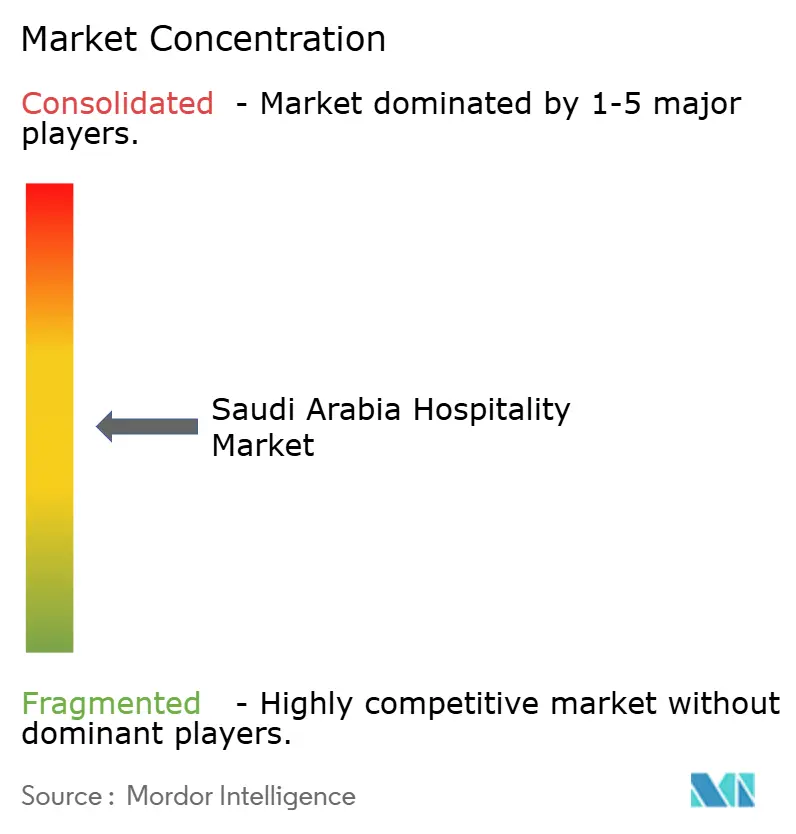
| Market Concentration | Medium |
Major Players *Disclaimer: Major Players sorted in no particular order Image © Mordor Intelligence. Reuse requires attribution under CC BY 4.0. | |
Saudi Arabia Hospitality Market Analysis by Mordor Intelligence
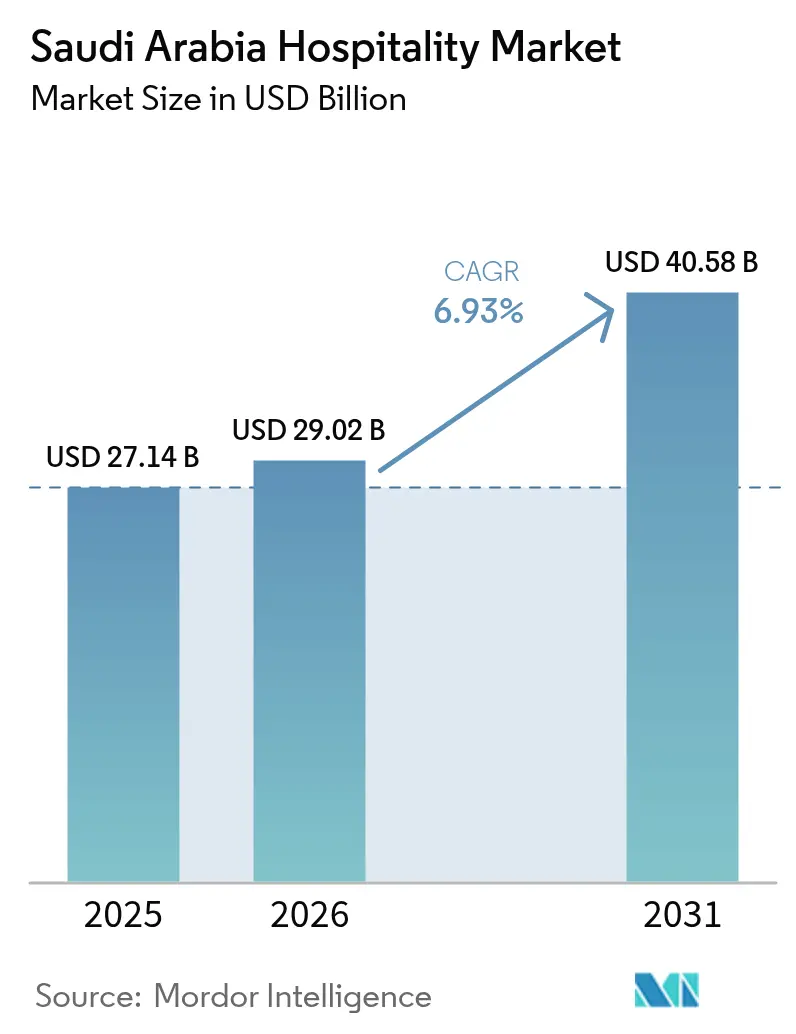
The Saudi Arabia Hospitality Market size in 2026 is estimated at USD 29.02 billion, growing from 2025 value of USD 27.14 billion with 2031 projections showing USD 40.58 billion, growing at 6.93% CAGR over 2026-2031.
Demand continues to broaden as Vision 2030 funnels fresh capital into giga-projects, strengthens domestic leisure infrastructure, and simplifies visa processes, all of which lift both business and leisure arrivals. Chain operators accelerate brand rollouts to secure prime sites, while luxury and serviced-apartment formats diversify the offer, ensuring alignment with shifting traveller preferences. Digital distribution strategies deepen hotel-to-guest engagement, prompting an upswing in direct bookings and loyalty-program enrolments even as OTAs retain a large share of transactional volume. Continuous RevPAR outperformance relative to pre-2019 levels underscores healthy pricing power in key cities despite an intensive construction pipeline.
Key Report Takeaways
- By type, chain hotels commanded 57.74% of the Saudi Arabia hospitality market share in 2025; independent hotels are forecast to trail as chain operators outpace them with a 11.62% CAGR through 2031.
- By accommodation class, the luxury segment led with 36.92% of the Saudi Arabia hospitality market size in 2025, whereas serviced apartments are advancing at a 12.57% CAGR through 2031.
- By booking channel, OTAs captured 41.65% of transactions of the Saudi Arabia hospitality industry share in 2025, while direct digital channels are growing at 14.78% CAGR as hoteliers invest in proprietary platforms.
- By geography, the Makkah–Jeddah corridor held 26.62% of the Saudi Arabia hospitality market size in 2025, yet the Red Sea and wider western coast are set to expand at a 18.20% CAGR to 2031.
Note: Market size and forecast figures in this report are generated using Mordor Intelligence’s proprietary estimation framework, updated with the latest available data and insights as of 2026.
Saudi Arabia Hospitality Market Trends and Insights
Drivers Impact Analysis*
| Driver | (~) % Impact on CAGR Forecast | Geographic Relevance | Impact Timeline |
|---|---|---|---|
| Pilgrimage Capacity Expansion Supporting Hospitality Demand | 1.30% | Holy city accommodation zones | Short term (≤ 2 years) |
| Red Sea Coastal Tourism Creating New Resort Markets | 1.00% | Red Sea giga-project resorts | Medium term (2–4 years) |
| Heritage Destination Development Through Diriyah and AlUla | 0.80% | Heritage tourism destinations | Long term (≥ 4 years) |
| Entertainment Tourism Creating New Domestic Travel Patterns | 0.70% | Entertainment and leisure districts | Short term (≤ 2 years) |
| International Hotel Brand Entry Transforming Market Standards | 0.60% | Luxury hotel development corridors | Medium term (2–4 years) |
| Religious Tourism Modernization Improving Visitor Experience | 0.50% | Smart pilgrimage infrastructure | Short term (≤ 2 years) |
| Source: Mordor Intelligence | |||


Pilgrimage Capacity Expansion Supporting Hospitality Demand
Saudi Arabia’s expansion of pilgrimage infrastructure is driving strong hospitality demand in Makkah and Madinah. Hajj attendance reached approximately 2.1 million in 2025 and stood at 1.71 million in 2026, with projections of ~2.3 million. The Vision 2030 target is 30 million Hajj and Umrah pilgrims annually by 2030[1]The Middle East Insider, “Business of Hajj: Saudi Arabia’s USD 12 Billion Transformation 2026,” The Middle East Insider, themiddleeastinsider.com. Umrah pilgrims totalled 18 million in 2025 and are expected to exceed 20 million in 2026, with average spending of USD 5,400 per pilgrim. Religious tourism generated ~USD 30 billion in 2025 and is projected to reach ~USD 34 billion in 2026. The Ministry of Tourism’s online portal enabled the temporary addition of 566,000 beds for Hajj 2025. Kidana Development added capacity to accommodate 209,000 pilgrims, increasing space per pilgrim from 1.2 sqm to 4.5 sqm. The King Salman Gate mega-project aims to provide ~900,000 prayer spaces. Makkah’s hotel room count reached ~250,000 in 2025, on track to reach 500,000 by 2030. Hajj-season rates in prime properties range from SAR 2,500 (USD 666.15) to SAR 4,500 (USD 1,199.07) per night, with hotels earning 40–60% of annual revenue during the season.
Red Sea Coastal Tourism Creating New Resort Markets
Red Sea Global is establishing a new ultra-luxury coastal hospitality market. As of mid-2026, 11 hotels are operating on Shura Island, including the Four Seasons Resort and InterContinental Red Sea Resort. All 11 Shura Island resorts are targeted for completion by end-2026. The long-term pipeline includes 50 hotels with ~8,000 rooms, capable of welcoming 1 million visitors annually by 2030[2]Newswav, “Maldives of the Middle East: Saudi Arabia’s Red Sea Project Takes Shape,” Newswav, newswav.com. AMAALA, positioned as an ultra-luxury wellness destination, opened Six Senses AMAALA in 2026, with six more resorts scheduled for 2026, delivering over 1,600 rooms across nine properties. NEOM’s Sindalah Island entered operational phases in 2026 with luxury hotels and a mega-marina. While RSG recalibrated the original 81-resort target, operational resorts have successfully positioned the Saudi Red Sea as a credible international ultra-luxury destination.
Heritage Destination Development Through Diriyah and AlUla
Saudi Arabia is developing heritage tourism at Diriyah and AlUla to diversify hospitality demand. In Diriyah, cumulative contracts exceed SAR 100 billion (USD 26.65 billion), including SAR 20 billion (USD 5.33 billion awarded in H1 2025. A USD 827 million agreement for the Four Seasons Hotel was signed in January 2026[3]Newswav, “Maldives of the Middle East: Saudi Arabia’s Red Sea Project Takes Shape,” Newswav, newswav.com. Diriyah Season 25/26 attracted strong visitation. First residential and hotel openings are expected in the next 18 months. AlUla welcomed ~320,000 visitors in 2025 and aims to reach 1 million annually by 2030. The Royal Commission for AlUla launched a USD 1.6 billion investment roadshow for 21 projects to triple hotel capacity to at least 3,000 rooms. New assets include a contemporary art museum and the Museum of the Incense Road. The master plan features 5,000 additional hotel keys, cultural restoration, and a 46-km tramway. Together, these destinations extend visitor stays and broaden demand beyond religious tourism.
Entertainment Tourism Creating New Domestic Travel Patterns
Domestic entertainment is reshaping Saudi travel behaviour. Domestic tourism reached 93.3 million trips in 2025, generating SAR 127.1 billion (USD 33.87 billion). In Q1 2026, 28.9 million domestic tourists visited. Total tourism spending hit SAR 304 billion in 2025, with over 52% of inbound visitors travelling for non-religious purposes[4]Gulf News, “Saudi Tourism Hits New High with 123 Million Visitors and SAR 304 Billion in Spending,” Gulf News, gulfnews.com. Qiddiya commenced initial openings in 2025–2026. The General Entertainment Authority hosted over 1,600 events in 2025, attracting 75+ million attendees. Saudi Summer 2025 drew 32 million visitors. The Kingdom is also building an esports hub with the Esports Nations Cup in November 2026 and the Esports Olympics in Riyadh in 2027. These initiatives reduce outbound leisure spending and create year-round hospitality demand across multiple cities.
Restraints Impact Analysis*
| Restraint | (~) % Impact on CAGR Forecast | Geographic Relevance | Impact Timeline |
|---|---|---|---|
| Rapid Expansion of Room Supply Creates Future Competition and Absorption Challenges | −0.8% | Hotel supply absorption risk | Medium term (2–4 years) |
| Tourism Ecosystem Still Under Development Outside Major Cities | −0.7% | Tourism ecosystem development gaps | Long term (≥ 4 years) |
| Seasonal Demand Concentration Creates Revenue Management Challenges | −0.6% | Seasonal revenue volatility | Short term (≤ 2 years) |
| Infrastructure and Accessibility Gaps Persist in Emerging Tourism Destinations | −0.5% | Transport and connectivity deficits | Long term (≥ 4 years) |
| Source: Mordor Intelligence | |||
Rapid Expansion of Room Supply Creates Future Competition and Absorption Challenges
Saudi Arabia has one of the world’s largest hotel pipelines. Quality hotel stock stood at 171,650 rooms as of September 2025, with 18% growth projected by 2027. The total pipeline is ~358,000 rooms, including 94,500 at advanced stages and 83,275 under construction. 2026 alone is expected to add 18,511 rooms. 75% of new supply through 2030 is luxury or upper-upscale, while many residents cap spending at ~USD 140 per night. Riyadh occupancy fell 17.9% YoY to 49.3% in early 2026, with RevPAR down 18.3%. National room rates declined 11% YoY in Q1 2026. Major Holy Cities projects will add over 252,000 rooms, intensifying competition in seasonally dependent markets.
Tourism Ecosystem Still Under Development Outside Major Cities
Hospitality development remains concentrated in Makkah, Riyadh, and Jeddah despite 29.3 million international arrivals in 2025. Tier-two cities like Taif and Abha account for 23% of visitors but see limited investment. The Aseer region aims to attract over 3 million visitors in 2026, supported by new projects worth SAR 444 million (USD 118.31 million). Secondary destinations face challenges, including governance issues, limited local linkages, and poor coordination. AlUla (320,000 visitors in 2025) is pursuing PPPs to accelerate growth. Officials emphasise the need to build complete destination ecosystems rather than isolated assets to avoid stranded supply.
*Our forecasts treat driver/restraint impacts as directional, not additive. The impact forecasts reflect baseline growth, mix effects, and variable interactions.
Segment Analysis
By Type: Chain Hotels Accelerate Market Consolidation
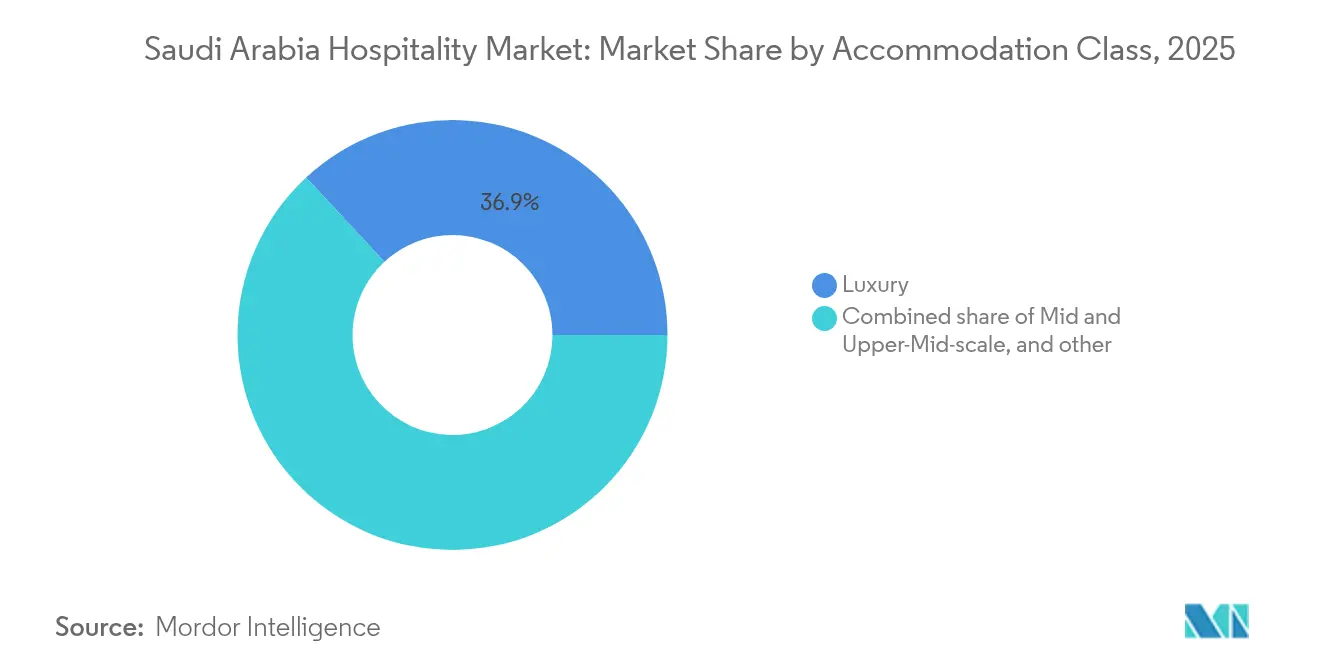
Chain hotels held 57.74% of the Saudi Arabia hospitality market share in 2025 and are projected to advance at a 11.62% CAGR through 2031 as international groups race to secure flagship locations. Portfolio depth enables multi-brand clusters in mega-projects, granting operators economies of scale across staffing, procurement, and technology. Loyalty ecosystems amplify direct-booking growth, reducing reliance on high-commission intermediaries. Independent hotels respond by spotlighting hyper-local experiences in cultural destinations such as AlUla yet face distribution-cost headwinds absent chain affiliation. As Vision 2030 accelerates project openings, the Saudi Arabia hospitality market size associated with chain hotels is poised to nearly double, reinforcing branded dominance.
Momentum favours chains because they leverage global pipelines and standardized training programs to meet Saudization requirements efficiently. Cross-segment brand families from economy concepts to ultra-luxury flags allow chains to absorb oversupply stresses by flexing rate fences across their portfolios. Joint ventures with sovereign-backed developers accelerate capital deployment, while asset-light management contracts safeguard balance sheets. Independent operators must carve out niches in heritage or eco-resort segments where authenticity trumps corporate uniformity.


By Accommodation Class: Serviced Apartments Emerge as Growth Leaders
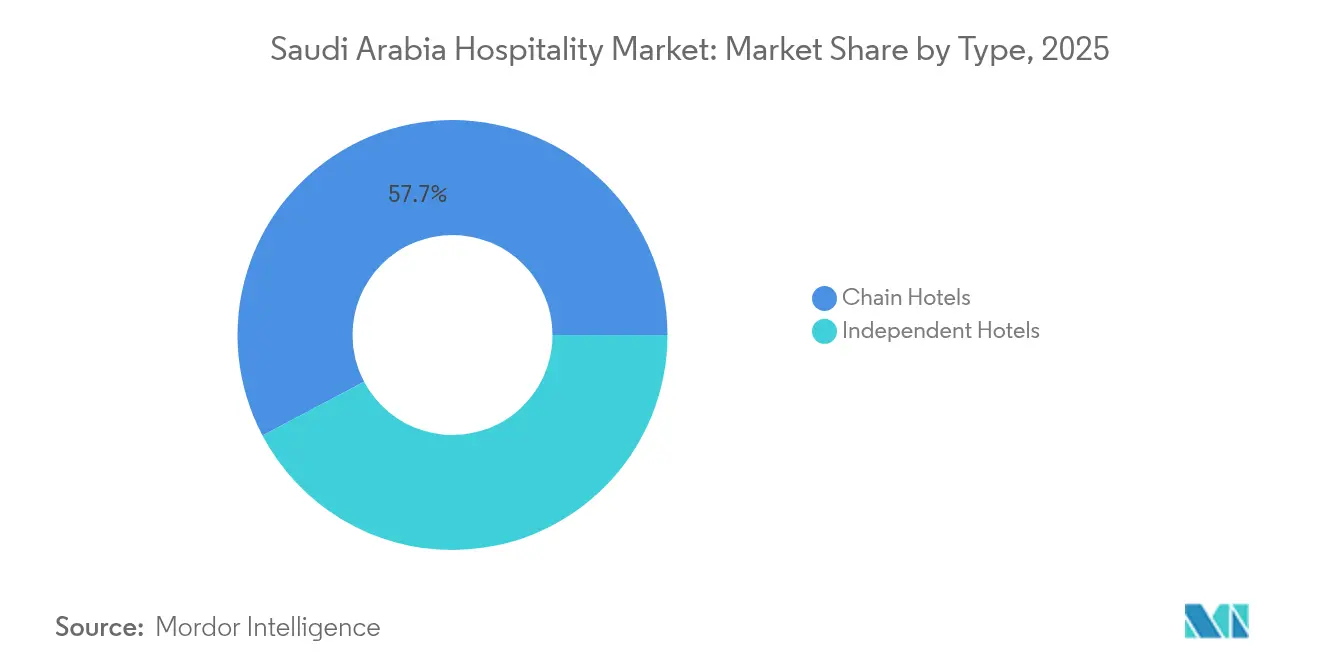
Luxury accommodations commanded 36.92% of the Saudi Arabia hospitality market size in 2025, underpinned by giga-project resorts that target high-net-worth travellers with experiential value propositions. However, serviced apartments post the fastest expansion at a 12.57% CAGR, fuelled by extended-stay demand from construction and corporate workforces attached to Vision 2030 sites. Residential-style layouts cater to longer average lengths of stay, while integrated digital platforms support self-service guest journeys. Mid-scale and economy stock remains thin, limiting affordability for domestic travellers and pilgrims outside peak seasons. Brands such as Wyndham’s Super 8 seek to close this gap, signalling latent upside in budget supply as disposable incomes diversify.
Serviced apartments benefit from lower operating costs per available unit, enabling competitive pricing while preserving margins. Investors are attracted to favourable lease structures and reduced seasonality volatility compared with traditional hotels. Luxury’s pipeline remains sizable but is increasingly scrutinized for sustainability and experiential authenticity metrics that justify premium ADRs. Budget-segment whitespace persists, offering room for disruptive models to capture under-served price-sensitive segments in the Saudi Arabia hospitality market. Consequently, room-count contributions from serviced apartments could triple by 2031, recalibrating product-mix economics across the sector.
By Booking Channel: Direct Digital Channels Surge Despite OTA Dominance
OTAs controlled 41.65% of bookings in 2025, sustained by price transparency and regional super-app integrations. Yet direct digital transactions are projected to climb at a 14.78% CAGR as hotels deploy mobile-first engines, dynamic packaging, and personalized promotions. Loyalty-linked rate parity and member-only perks improve conversion, enhancing net revenue through commission savings. MICE and corporate travel leverage centralized procurement tools that favour direct connections for duty-of-care compliance and spend analytics. Wholesale agents remain relevant in group pilgrimage tourism where tailored pre- and post-sales support is critical.
Technology adoption across revenue-management, CRM, and payment-gateway stacks accelerates digital shift momentum, particularly given the Kingdom’s young, high-smartphone-penetration demographic. Government digitization campaigns streamline identity verification and e-visa issuance, further simplifying direct booking flows. OTAs respond by bundling value-added services and strengthening Arabic-language content to sustain engagement. As direct channels gain ground, the Saudi Arabia hospitality market will likely witness net-rate improvement and stronger brand-to-guest relationships, reinforcing long-run profitability.
Geography Analysis
In the Saudi Arabia hospitality market, the Makkah & Jeddah Corridor is projected to remain the largest geographic sub-segment in 2025, accounting for 26.62% of the market, while the Red Sea & Western Coast region is expected to be the fastest-growing between 2026 and 2031, with a CAGR of 18.20%. The Riyadh Region continues to serve as the Kingdom's central hub for political and corporate activities, with ADRs reaching unprecedented levels during high-profile events such as the Future Investment Initiative. A robust pipeline of projects indicates substantial room-count growth; however, the concurrent development of the King Abdullah Financial District and the addition of new convention facilities are expected to mitigate oversupply risks by driving consistent corporate demand throughout the year. Uptake of mixed-use precincts combining offices, retail, and entertainment prolongs visitor stay and spend. Meanwhile, leisure-oriented mega-developments like Qiddiya broaden appeal beyond weekday corporate traffic, smoothing weekend occupancy dips.
Peak performance during Hajj underscores reliable compression periods for rate yield, though pronounced seasonality warrants agile revenue strategies. Upcoming airport expansions and cruise-terminal upgrades will likely channel additional leisure traffic into the corridor outside pilgrimage seasons. Six Senses Southern Dunes’ LEED Platinum certification sets sustainability benchmarks for future openings, while Sindalah Island’s phased roll-out positions the archipelago as a year-round yachting hub. International airport connectivity and renewable-energy infrastructure underscore the region’s long-range viability and premium pricing profile. Secondary coastal cities eye spill-over prospects, prompting early-stage feasibility studies for mid-scale beach resorts. Altogether, the western seaboard is poised to emerge as a credible alternative to traditional sun-and-sand destinations across the Mediterranean.
Competitive Landscape
International hotel groups drive the pace of development in Saudi Arabia, collectively managing approximately half of the market share. These operators demonstrate varied strengths across luxury, lifestyle, and mid-scale segments. While asset-light management and franchise models dominate, some players are taking equity stakes in marquee projects to align closely with sovereign partners. Meanwhile, domestic consolidation is gaining momentum, highlighted by Taiba Investments’ merger with Dur Hospitality, creating a sizable 7,700-room platform that enhances negotiation leverage with global distribution networks. Technology adoption is accelerating, with innovations like Mandarin Oriental Al Faisaliah’s AI-driven mobile ordering app boosting guest personalization and ancillary revenues.
Strategic partnerships and market segmentation are shaping growth, as seen with Wyndham’s rollout of 100 Super 8 economy properties and Hilton’s introduction of the Tapestry Collection in Madinah. These moves deepen brand presence across diverse market tiers. Collaborations with digital distribution providers such as Sabre’s SynXis and SHR’s loyalty platforms strengthen revenue management and reduce reliance on online travel agencies (OTAs). Boutique hotels are also making their mark by leveraging cultural heritage, exemplified by The Chedi Hegra in AlUla, which achieves premium rates through immersive local experiences. This diversification in offerings reflects a maturing and increasingly sophisticated market landscape.
Labor market dynamics and regulatory compliance play a critical role in operational success. Operators who effectively implement Saudization policies and integrate local supply chains gain a cost advantage amid tightening labor conditions. The steady conversion of development pipelines and entry of prominent global brands signal strong market confidence. As brand storytelling and operational excellence become key competitive differentiators, Saudi Arabia’s hospitality sector is poised for sustained growth. The industry’s focus on innovation, strategic alliances, and cultural relevance positions it well for future challenges and opportunities.
Saudi Arabia Hospitality Industry Leaders
Accor SA
Radisson Hotel Group
Marriott International Inc.
Hilton Worldwide Holdings
InterContinental Hotels Group (IHG)
- *Disclaimer: Major Players sorted in no particular order

Recent Industry Developments
- July 2025: Hilton signed its first Tapestry Collection by Hilton in Saudi Arabia, the 221-room Diyar Ajwa in Madinah, slated to open late 2025.
- May 2025: IHG entered into agreements with Ashaad Company for three properties in Jeddah and Al Khobar, adding over 1,700 rooms scheduled between 2028 and 2030.
- May 2025: Wyndham and Le Park Concord announced a 100-hotel Super 8 development plan spanning a decade, with first delivery in 2026.
- April 2025: HMH confirmed expansions in Al Khobar and Makkah, including a flagship 460-room project in the holy city.


Saudi Arabia Hospitality Market Report Scope
Hospitality falls under the broad umbrella of the service industry, a tertiary sector of the economy. It includes food & beverages, stay, travel, theme parks, hotels, and event planning, amongst others. The Saudi Arabian hospitality industry is segmented by type and segment. By type, the market is segmented into chain hotels & independent hotels. By segment, the market is segmented into service apartments, budget and economy hotels, and mid-scale and upper-mid-scale luxury hotels. The report offers market size and forecasts for the Saudi Arabian Hospitality Market in value (USD) for all the above segments.
| Chain Hotels |
| Independent Hotels |
| Luxury |
| Mid & Upper-Mid-scale |
| Budget & Economy |
| Serviced Apartments |
| Direct Digital |
| OTAs |
| Corporate / MICE |
| Wholesale & Traditional Agents |
| Riyadh Region |
| Makkah & Jeddah Corridor |
| Medina |
| Eastern Province (Dammam/Al-Khobar) |
| Red Sea & Western Coast (incl. NEOM) |
| Southern Highlands (Asir & Abha) |
| Northern Frontier (Tabuk/Al-Ula) |
| By Type | Chain Hotels |
| Independent Hotels | |
| By Accommodation Class | Luxury |
| Mid & Upper-Mid-scale | |
| Budget & Economy | |
| Serviced Apartments | |
| By Booking Channel | Direct Digital |
| OTAs | |
| Corporate / MICE | |
| Wholesale & Traditional Agents | |
| By Geographic Region | Riyadh Region |
| Makkah & Jeddah Corridor | |
| Medina | |
| Eastern Province (Dammam/Al-Khobar) | |
| Red Sea & Western Coast (incl. NEOM) | |
| Southern Highlands (Asir & Abha) | |
| Northern Frontier (Tabuk/Al-Ula) |


Key Questions Answered in the Report
How large is the Saudi Arabia hospitality market in 2026?
The market is valued at USD 29.02 billion in 2026 and is forecast to reach USD 40.58 billion by 2031, growing at 6.93% CAGR.
Which segment shows the highest growth through 2031?
Serviced apartments lead with a 12.57% CAGR, fuelled by extended-stay demand from giga-project workforces.
Why are direct digital bookings rising so quickly?
Hotels invest heavily in mobile-first engines and loyalty programs, pushing direct channels toward a 14.78% CAGR while reducing OTA commission costs.
Which region is projected to grow fastest?
The Red Sea and western coast are set to expand at a 18.20% CAGR, driven by eco-luxury resorts and new international gateway airports.
What is the main risk to average daily rates in key cities?
A pipeline of 83,275 rooms—especially luxury inventory concentrated in Riyadh and Jeddah could temporarily pressure ADRs until demand fully absorbs new supply.
How concentrated is the competitive landscape?
The top five global operators hold about half of existing rooms, indicating moderate concentration and room for differentiated new entrants.
Page last updated on:


 Your data is secure and never sold or shared.


