
Veterinary Anesthesia Market Size and Share
Market Overview
| Study Period | 2020 - 2031 |
|---|---|
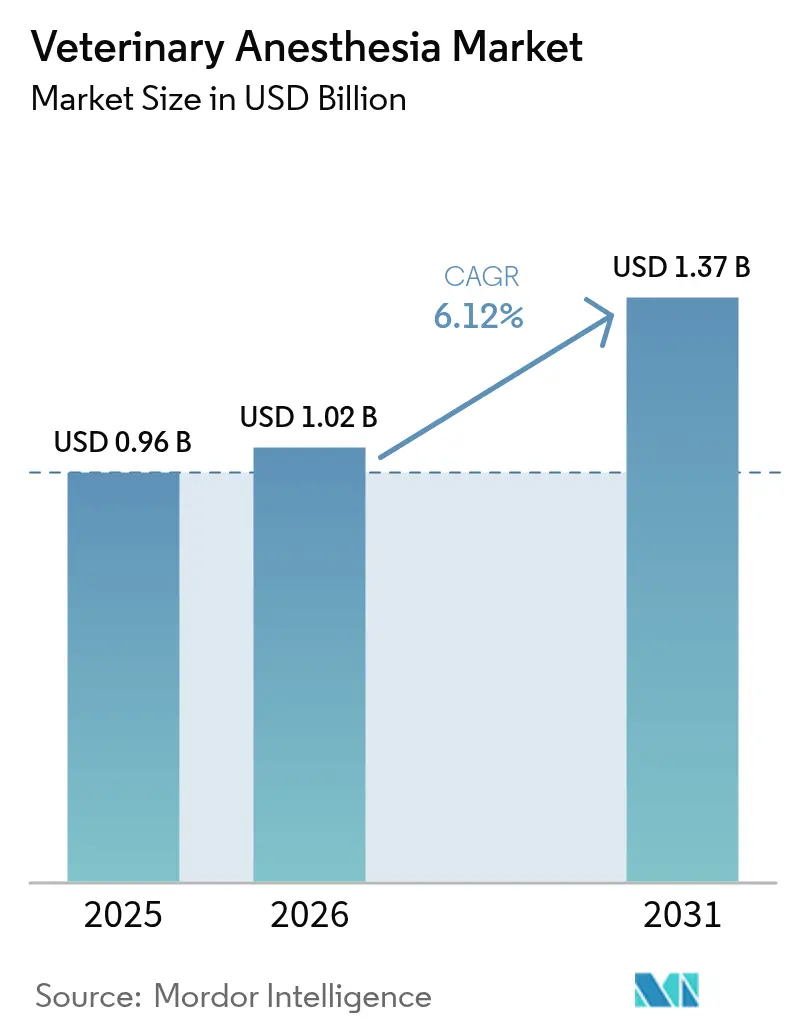
| Market Size (2026) | USD 1.02 Billion |
| Market Size (2031) | USD 1.37 Billion |
| Growth Rate (2026 - 2031) | 6.12 % |
| Fastest Growing Market | Asia Pacific |
| Largest Market | North America |
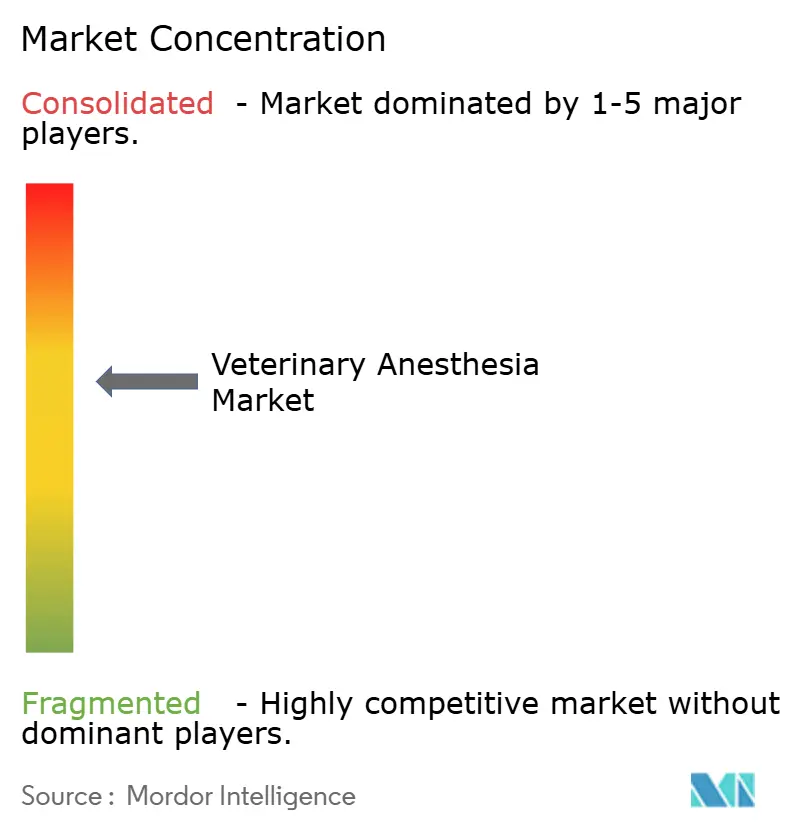
| Market Concentration | Medium |
Major Players *Disclaimer: Major Players sorted in no particular order Image © Mordor Intelligence. Reuse requires attribution under CC BY 4.0. | |
Veterinary Anesthesia Market Analysis by Mordor Intelligence
Veterinary anesthesia market size in 2026 is estimated at USD 1.02 billion, growing from 2025 value of USD 0.96 billion with 2031 projections showing USD 1.37 billion, growing at 6.12% CAGR over 2026-2031. Rising global pet ownership, stricter surgical safety protocols, and rapid upgrades in vaporizer and ventilator designs are the three strongest demand catalysts. Integrated AI dosing modules, now available even on portable consoles, allow practices to treat senior pets with chronic conditions more safely, while remote diagnostics reduce downtime for rural clinics. Environmental rules that limit desflurane and reward low-flow techniques are reshaping purchase criteria. Finally, supply-side digitalization—especially predictive maintenance via cloud connectivity—helps clinics stretch capital budgets, sustaining refresh cycles even when operator shortages persist.
Key Report Takeaways
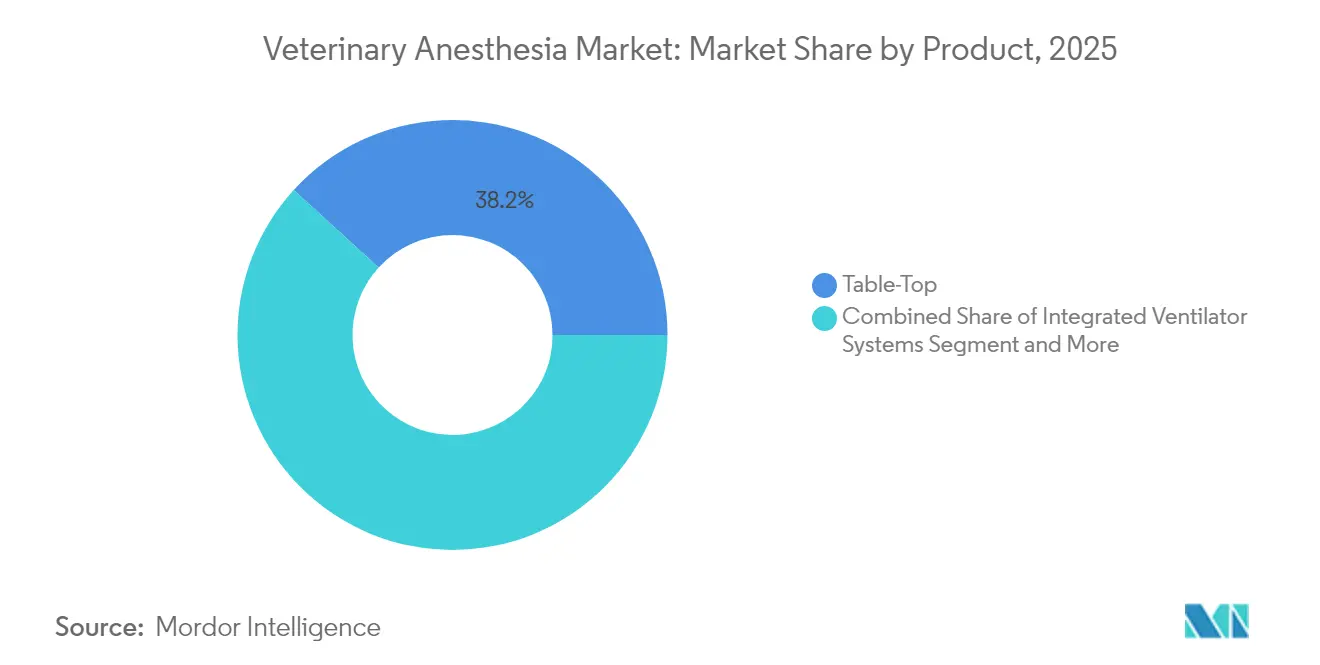
- By product, table-top/portable units captured 38.22% of veterinary anesthesia market share in 2025, whereas integrated ventilator platforms are projected to grow at a 11.6% CAGR through 2031.
- By animal type, companion animals accounted for 62.10% of the veterinary anesthesia market size in 2025; zoo and wildlife applications are forecast to expand at a 10.32% CAGR to 2031.
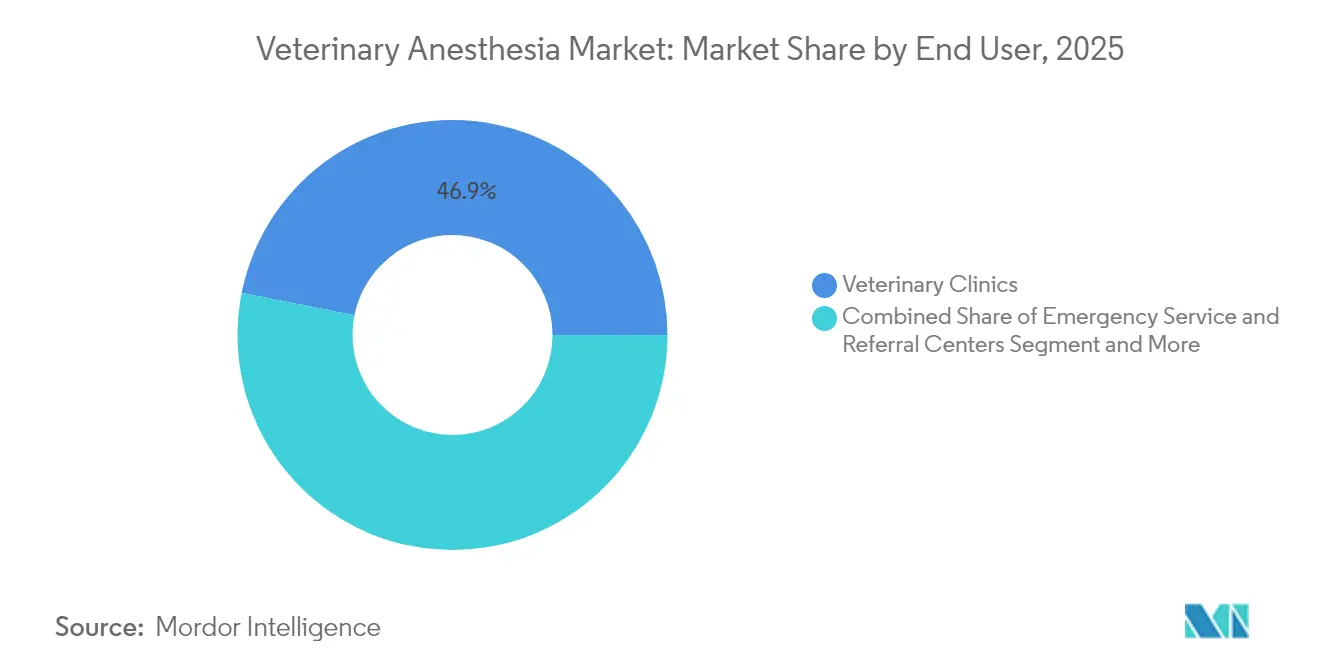
- By end user, veterinary clinics held 46.85% revenue share in 2025, while emergency service and referral centers are advancing at an 10.74% CAGR to 2031.
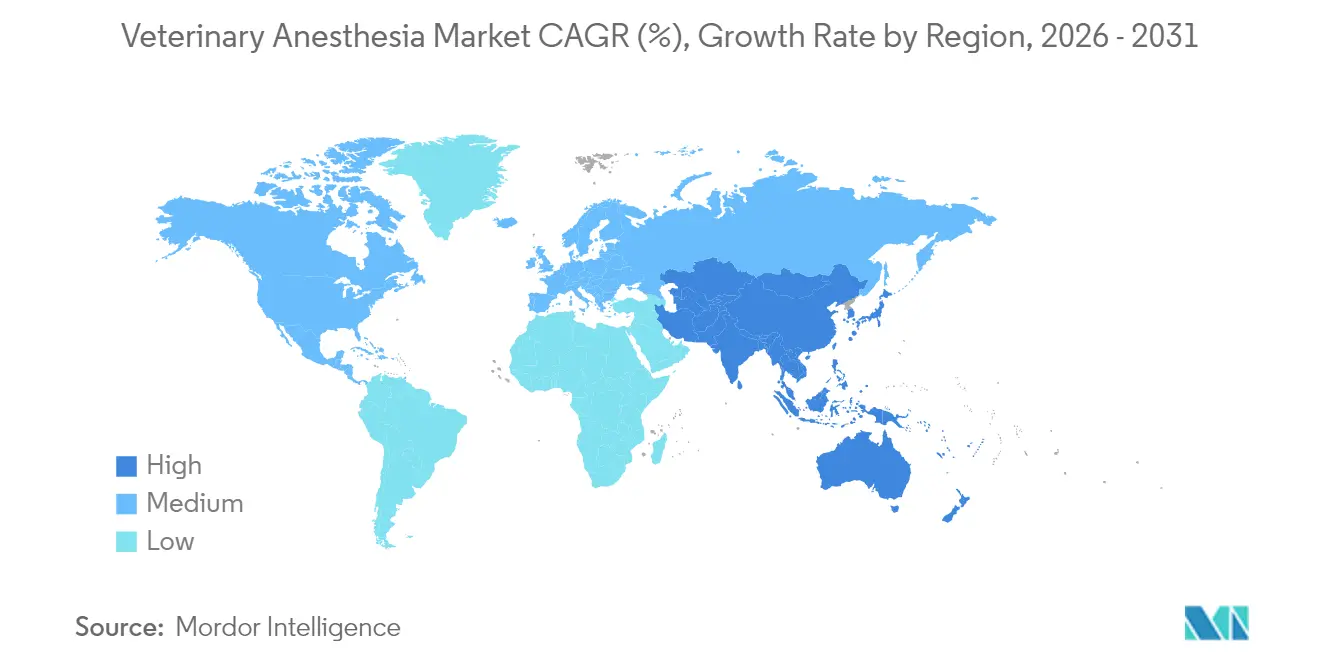
- By geography, North America led with a 43.05% slice of the veterinary anesthesia market in 2025; Asia-Pacific is growing fastest at a 9.28% CAGR through 2031.
Note: Market size and forecast figures in this report are generated using Mordor Intelligence’s proprietary estimation framework, updated with the latest available data and insights as of 2026.
Market Trends and Insights
Drivers Impact Analysis of Veterinary Anesthesia Market*
| Driver | (~) % Impact on CAGR Forecast | Geographic Relevance | Impact Timeline |
|---|---|---|---|
| Rising chronic diseases & associated surgical procedures | +1.2% | North America, Europe | Medium term (2–4 years) |
| Growth in pet ownership & expenditure on companion animals | +1.8% | Global, strong in Asia-Pacific | Long term (≥ 4 years) |
| Technological leap in integrated ventilator-anesthesia platforms | +1.1% | North America, EU, APAC | Medium term (2–4 years) |
| Sustainability push toward low-flow, climate-friendly systems | +0.7% | EU, North America | Long term (≥ 4 years) |
| AI-guided dosing for exotic & small mammals | +0.5% | North America, EU | Long term (≥ 4 years) |
| Remote tele-anaesthesia maintenance services in rural clinics | +0.4% | North America, Australia/NZ | Medium term (2–4 years) |
| Source: Mordor Intelligence | |||
Rising Chronic Diseases & Associated Surgical Procedures
Two-thirds of U.S. households owned pets in 2024, and annual veterinary spend rose to USD 580 per dog and USD 433 per cat[1]American Veterinary Medical Association, “U.S. Pet Ownership Statistics,” avma.org. The older pet cohort now presents multiple comorbidities that demand delicate anesthetic plans. Integrated multi-parameter monitors track capnography, temperature, and neuromuscular blockade simultaneously, supporting clinicians through longer orthopedic and oncology surgeries. Because geriatric cases carry higher cardiovascular risk, clinics increasingly specify dual-vaporizer workstations to switch rapidly between isoflurane and sevoflurane. Incremental revenue from such complex surgeries directly lifts the veterinary anesthesia market, while AI-based drug calculators reduce dosing errors and help newer graduates manage chronic-disease caseloads confidently.
Growth in Pet Ownership & Expenditure on Companion Animals
Global pet care spending climbed 7.5% in 2023 to USD 147 billion, with Gen Z households posting a 43.5% jump in ownership[2]American Pet Products Association, “2025 State of the Industry Report,” americanpetproducts.org. Younger owners view advanced surgery as an expected service, propelling clinics to upgrade vaporizers and ventilators capable of neonatal tidal volumes. Pet insurance premiums topped USD 3.9 billion in 2023, covering 5.7 million animals and effectively underwriting high-ticket procedures that rely on modern anesthesia consoles. This financial cushioning accelerates the replacement cycle for aging machines, especially in suburban start-up practices that want plug-and-play portability.
Technological Leap in Integrated Ventilator-Anesthesia Platforms
Hypothermia contributed to 72.63% of intra-operative incidents, and hypercapnia to 49.47%, in a 2025 complications audit. New integrated platforms synchronize vaporizer output with ventilator settings via closed-loop algorithms, cutting both risks. Touch-screen UIs offer species presets, while AI engines learn from previous waveforms to predict hypoventilation 30 seconds before it occurs. Such tangible safety gains shorten recovery times and reduce post-operative oxygen demand, elevating the veterinary anesthesia market as specialty hospitals retire legacy standalone units.
Sustainability Push Toward Low-Flow, Climate-Friendly Systems
Desflurane’s global warming potential led the EU to schedule a complete ban by January 2026. Practices now purchase low-flow workstations that cut volatile agent consumption up to 44% at 1 L/min fresh-gas flow. Capture canisters that reclaim 65% of waste isoflurane help clinics market “green anesthesia” and tap corporate ESG budgets. Consequently, sustainability features have become RFP checkpoints, steering demand toward premium models with automatic flow-rate governors.
Restraints Impact Analysis of Veterinary Anesthesia Market*
| Restraint | (~) % Impact on CAGR Forecast | Geographic Relevance | Impact Timeline |
|---|---|---|---|
| High upfront cost of advanced machines | -0.8% | Global, acute in emerging markets | Short term (≤ 2 years) |
| Shortage of certified veterinary anaesthetists & technicians | -1.1% | North America, EU | Medium term (2–4 years) |
| Supply-chain bottlenecks in vaporizer sensors & rare-earth valves | -0.6% | Asia-Pacific manufacturing | Short term (≤ 2 years) |
| Emerging GHG regulations on volatile agents raise OPEX | -0.4% | EU, North America | Medium term (2–4 years) |
| Source: Mordor Intelligence | |||
Shortage of Certified Veterinary Anaesthetists & Technicians
Only 7,500 candidates clear the U.S. Veterinary Technician National Exam each year, nowhere near the 33% demand surge expected by 2030. Average pay of USD 53,759 fails to stem attrition; 39% cite compensation as their primary grievance. Colorado State University’s VPA program will add mid-level providers, but its first graduates will not enter the workforce until 2027. Under-staffed clinics often delay adopting complex workstations, dampening near-term gains for the veterinary anesthesia market.
High Upfront Cost of Advanced Machines
A fully loaded ventilator-anesthesia combo can cost five times a basic tabletop vaporizer. Semiconductor tariffs announced in 2025 may raise device prices another 6–8%, because more than half of machine controllers rely on Taiwanese chips. Thin clinic margins and limited leasing options prolong replacement cycles, particularly in Latin America and Southeast Asia, restraining the veterinary anesthesia market in the short run.
*Our forecasts treat driver/restraint impacts as directional, not additive. The impact forecasts reflect baseline growth, mix effects, and variable interactions.
Veterinary Anesthesia Market Segment Analysis
By Product:
Portable Solutions Drive Market AccessibilityMobile and table-top units generated 38.22% of the global revenue in 2025, underscoring how portability aligns with mixed-animal practice workflows. Clinics value quick set-ups, and ambulatory equine services can run these units from vehicle inverters. The veterinary anesthesia market size for table-top units is projected to reach USD 0.53 billion by 2031 as new graduates open suburban clinics and prefer entry-level capital outlays. AI-ready circuit boards are now pre-installed even on compact boxes, letting owners subscribe to software upgrades without swapping hardware. Conversely, integrated ventilator workstations, although only 20.6% of shipments today, will post a 11.6% CAGR, as specialty centers require synchronized ventilation and hemodynamic monitoring.
Integrated platforms add animal-friendly touches: heated breathing hoses curb the hypothermia that raises mortality, and color-coded touch panels guide technicians through pre-use checks. American College of Veterinary Anesthesia and Analgesia guidelines now list capnography as mandatory in general anesthesia, propelling demand for machines with built-in side-stream analyzers. Fragmentation persists among lower-end devices, but mid-tier vendors are consolidating software ecosystems, raising switching costs and driving long-term stickiness in the veterinary anesthesia market.



By Animal Type:
Companion Animals Sustain Core DemandCompanion species account for 62.10% of 2025 revenue because emotionally motivated owners pursue advanced orthopedics, dentistry, and cancer surgeries. This dominance translates into a veterinary anesthesia market share advantage that guides design priorities toward small-volume vaporizers and feline-specific circuits. The zoo and wildlife segment, although less than USD 62 million today, is advancing at a 10.32% CAGR thanks to conservation grants and growing ecotourism. Field veterinarians in Kenya and India deploy battery-operated ventilator modules weighing under 8 kg, broadening the veterinary anesthesia market into non-traditional settings.
Feline protocols released in 2024 highlight cats’ heightened sensitivity to dead-space volume and hypoxemia. Equipment makers responded with micro-cuff endotracheal tubes and low-compliance circuits. Livestock remains a price-sensitive arena; producers favor rugged evaporative vaporizers over electronic ones, suppressing premium adoption. Equine practices need tilting tables and high-flow ventilators, creating a stable niche that commands premium prices though limited unit volumes, ensuring a steady but smaller contribution to the veterinary anesthesia market size.
By End User:
Emergency Centers Lead Growth TrajectoryEmergency and referral facilities logged the fastest growth at 10.74% CAGR because complex trauma and cardiac cases demand fast-switch dual-agent vaporizers and high-rate ventilators. These centers frequently replace machines every 5 years for warranty alignment, accelerating unit churn in the veterinary anesthesia market. Clinics still form the largest buyer group with 46.85% share, primarily absorbing portable systems. Teaching hospitals combine clinical and academic missions; simulators linked to live workstations allow students to practice crisis scenarios without sedating animals, expanding the functional footprint of each machine.
The 2024 RECOVER CPR update stresses end-tidal CO₂ monitoring immediately post-resuscitation. As a result, emergency departments order bundles that include in-line capnographs and Bluetooth data export. Research labs demand GLP-compliant data capture for dose-response protocols, purchasing software licenses that augment hardware revenue and contribute sticky SaaS streams to the veterinary anesthesia market.
Geography Analysis
North America, Europe and LATAM Veterinary Anesthesia Market
North America leads revenues with 43.05% share owing to high pet spending, insurance penetration, and early adoption of AI modules. Mandatory state inspection regimes shorten retirement cycles, boosting replacement demand. Europe follows, guided by stringent GHG and welfare directives that favor low-flow machines, though unit volumes plateau in mature economies. Latin America’s cattle sector supports steady sales of rugged, large-animal units; Brazilian rules for drug residue testing push ranchers toward precise vaporizer calibration.
APAC and MEA Veterinary Anesthesia Market
Asia-Pacific records the fastest 9.28% CAGR as urbanization lifts disposable income in China, India, and Indonesia. Veterinary schools in Thailand and Vietnam have doubled anesthesia lab hours since 2023, stimulating institutional purchases. Regulatory harmonization under VICH eases cross-border device approvals. The veterinary anesthesia market size for Asia-Pacific is projected to exceed USD 0.34 billion by 2031. Middle East and Africa benefit from NGO-funded rabies programs that require mobile inhalation units. Population density of production animals in Egypt and South Africa opens future pathways for hybrid small-ruminant ventilators, sustaining global momentum.

Regulatory Landscape
Veterinary anesthesia demand is shaped by controls on veterinary drugs and medical-device safety requirements. In the European Union, the Veterinary Medicinal Products Regulation (EU) 2019/6 continues to harmonize authorization rules and links product oversight to digital reporting through the Union Product Database, while food-animal use remains bounded by residue compliance, including Commission Implementing Regulation (EU) 2026/892 establishing maximum residue limits for lidocaine, effective April 23, 2026. In the United Kingdom, the Veterinary Medicines Directorate updated guidance in March 2026 covering authorized veterinary medicines containing controlled drugs, affecting handling and compliance practices around ketamine-based anesthetic products.
On the equipment side, manufacturers and clinics align procurement and validation with recognized safety and performance benchmarks. ISO 80601-2-13:2022 is used as a consensus reference for anesthetic workstation basic safety and essential performance, reinforcing design and testing expectations for vaporizers, ventilators, and integrated workstations. In the United States, FDA device oversight for anesthesiology devices under 21 CFR Part 868 includes classification pathways relevant to gas-machine anesthesia systems, supporting standardized compliance documentation for suppliers selling into veterinary settings.
Competitive Landscape
The competitive field is moderately fragmented; the top five producers account for the majority of global revenue. Midmark and Patterson Scientific maintain broad North American distribution networks and turnkey service contracts, cementing recurrent parts revenue. Patterson’s 2024 acquisitions of Infusion Concepts and Mountain Vet Supply deepen its critical-care catalog, bundling fluid therapy with anesthesia machines in one invoice. Midmark promotes federal purchasing portals to win military and research contracts.
Emerging players differentiate through AI and eco-credentials: start-ups license capture canister IP to big OEMs for royalty streams, while cloud-first maintenance dashboards appeal to chain hospitals. The FDA’s first generic propofol approval underlines maturing peri-operative ecosystems and price sensitivity among clinics. Private-equity roll-ups, including an USD 8.6 billion merger that formed a 750-hospital network, create centralized procurement hubs, shifting bargaining power toward buyers. Vendors therefore offer multi-year service-plus-software bundles to lock in contract renewals, lifting total contract value in the veterinary anesthesia market.
White-space opportunities center on lightweight wildlife units, integrated AI dosing for small mammals, and circular-economy capture technology. Strategic alliances—such as Dechra’s planned USD 520 million acquisition of Invetx—signal the next wave of convergence between pharmaceuticals and equipment, enabling turnkey peri-operative solutions.
Veterinary Anesthesia Industry Leaders
Midmark Corporation
Patterson Scientific
JD Medical Distribution Co.
Kent Scientific Corp.
Mindray Medical Intl. Ltd
- *Disclaimer: Major Players sorted in no particular order
Veterinary Anesthesia Market Companies Covered in this Report
- Midmark
- Mindray Medical Intl. Ltd
- Patterson Scientific
- JD Medical Distribution Co.
- Kent Scientific Corp.
- ICU Medical
- Supera Anesthesia Innovations
- Avante Health Solutions
- Vetland Medical Sales & Service
- Dispomed
- Prunus Medical
- Burtons Medical Equipment
- Hallowell Engineering
- RWD Life Science
- Smiths Group
- Eickemeyer Veterinary Equipment
- DRE Veterinary
- KeeboVet
- Yuesen Medical
- TechVet Industria Veterinaria
- Patterson Companies

Market Opportunities and Future Outlook
Product innovation and regulatory clarity in inhalant anesthetics are creating room for portfolio expansion and bundled peri-operative offerings. In June 2026, Parnell announced the commercial launch of an FDA-approved sevoflurane inhalation anesthetic for use in dogs, adding another branded option in a core agent category tied directly to vaporizer utilization, scavenging, and low-flow workflow upgrades within clinics and referral centers. That launch also increases the emphasis on training and protocol standardization to differentiate suppliers beyond hardware specifications.
White space is also building around precision and safety tooling that reduces anesthesia variability, aligning with the market shift toward integrated monitoring and AI-assisted dosing described in the report context. 2026 peer-reviewed work has highlighted approaches such as total intravenous anesthesia using propofol paired with a vaporizer-free ventilator for high-risk canine cases, alongside new procedural frameworks for brachycephalic dog extubation to mitigate peri-anesthetic respiratory events. Research evaluating portable analytic platforms for rapid quantification of multiple anesthetic agents points to adjacent opportunities in connected diagnostics and data capture that can be packaged with anesthesia workstations and service contracts, particularly for specialty centers and academic users that need consistent documentation.
Recent Industry Developments in Veterinary Anesthesia Market
- July 2026: JD Medical Distributing Company was highlighted for equipment supply and onsite team training support for Clarity Veterinary Surgical Center in Denver. The combination of device fulfillment with staff enablement reflects a service-led distribution model that helps specialty providers standardize anesthesia room workflows and accelerate utilization of advanced systems.
- April 2026: Patterson Veterinary launched a spring equipment financing promotion covering anesthesia systems, with program deadlines extending through May 29, 2026 and installation and invoicing requirements into July 30, 2026. Time-bound financing programs can pull forward capital purchases for clinics and create a window for distributors to bundle anesthesia machines with monitoring, scavenging, and service coverage.
- September 2024: Patterson Companies invested in Infusion Concepts (UK) and Mountain Vet Supply (US), strengthening its animal health platform. The added capabilities broaden catalog depth around peri-operative care, enabling more integrated purchasing bundles that pair anesthesia equipment with adjacent critical-care and fluid-therapy needs.


Veterinary Anesthesia Market Report Scope and Research Methodology
Market Definition and Coverage
For this study, the market covers revenues from veterinary anesthesia equipment used to induce and maintain anesthesia during animal procedures, including anesthesia delivery systems and their core configurations sold to veterinary settings.
Scope exclusions: The sizing excludes anesthetic drugs, disposables and accessories that are routinely replaced, and procedure fees charged by clinics or hospitals.
Segments Covered in This Report
- By Product
- On-Trolley (Mobile)
- Wall-Mounted
- Table-Top / Portable
- Integrated Ventilator Systems
- By Animal Type
- Companion
- Livestock
- Equine
- Zoo & Wildlife
- By End User
- Veterinary Clinics
- Veterinary Hospitals & Teaching Institutions
- Emergency Service & Referral Centers
- Research & Academic Labs
- Geography
- North America
- United States
- Canada
- Mexico
- Europe
- Germany
- United Kingdom
- France
- Italy
- Spain
- Rest of Europe
- Asia-Pacific
- China
- Japan
- India
- South Korea
- Australia
- Rest of Asia-Pacific
- Middle East and Africa
- GCC
- South Africa
- Rest of Middle East and Africa
- South America
- Brazil
- Argentina
- Rest of South America
- North America
Data Sources, Market Sizing, and Validation
Desk Research
Desk work was used to frame demand drivers and to keep the model linked to visible procedure and animal health signals. Public sources, such as USDA animal health and livestock statistics, AVMA practice and pet ownership snapshots, FDA Center for Veterinary Medicine approvals, and OECD health indicators, were reviewed to understand where procedure volumes and clinic capacity are moving. We also checked peer-reviewed veterinary anesthesia and surgery journals to map common anesthetic approaches and how monitoring intensity changes by species and procedure type.
On the supply side, we relied on company annual reports, investor presentations, and regulatory filings to capture product positioning, geographic exposure, and reported growth cues. News and financials subscriptions were used mainly to track facility expansions, product launches, and distribution changes, and a patent database was referenced to sanity check innovation intensity in vaporizers and ventilator integration. This list is illustrative only, and other sources were used for data collection, validation, and clarification during the research process.
Primary Interviews and Surveys
Primary inputs came from discussions with equipment manufacturers, distributors, veterinary hospital administrators, and practicing vets and technicians who routinely use anesthesia machines and monitoring set-ups. We covered a mix of large referral hospitals and smaller clinics across APAC, EMEA, and the Americas, so utilization patterns, replacement cycles, and price ranges could be checked against desk assumptions and then aligned to the final model.
Distribution of primary research fieldwork respondents
| Company type | Respondent position | Region |
|---|---|---|
| Top tier: 31% | CXOs: 15% | APAC: 40% |
| Mid tier: 53% | Functional/Unit leaders: 41% | EMEA: 37% |
| Smaller Players: 16% | Managers: 44% | Americas: 23% |
Market-Sizing & Forecasting
Sizing started with a top-down build that reconstructs demand from the veterinary care base, the share of clinics and hospitals equipped for surgery, and the typical equipment density per facility. Once the demand pool was framed, pricing ranges were applied by product configuration, and the totals were rolled up by region, then cross-checked back to the global number.
To keep the estimates practical, a few market fingerprints were treated as core inputs, such as the number of veterinary clinics and hospitals, surgical and dental procedure intensity in small animals, equipment replacement cycles, and the adoption rate of integrated ventilator systems in higher-acuity settings. Average selling price movements were adjusted using feedback on inflation pass-through, discounting in tenders, and the mix shift between tabletop units and trolley-based systems. Where bottom-up data was available, we used selective roll-ups based on sampled supplier revenues and distributor channel checks to validate the top-down totals, and gaps were handled using conservative penetration assumptions that were then re-tested in interviews.
For forecasting, scenario analysis was used so growth could be flexed across procedure growth, facility expansion, and upgrade timing, which tends to be lumpy by year. Inputs were moderated using expert consensus on likely capital spending appetite in veterinary practices, followed by region-level sense checks on affordability and installed-base maturity.
Data Validation & Update Cycle
Validation was done through repeated cross-checks between model outputs and independent signals, such as procedure growth indicators, facility counts, and reported sales commentary from public filings. When a region or product line produced an outlier, the assumptions were re-opened, and respondents were re-contacted to confirm whether the variance was real or created by mix or pricing effects. Before sign-off, the work goes through a multi-step analyst review so calculations, unit conversions, and regional roll-ups are checked consistently.
Reports are refreshed annually, and interim updates are triggered when there are material events like major regulatory changes, notable product introductions, or step changes in clinic investment activity. Right before delivery, we run a fresh pass to ensure the final numbers reflect the latest available public information and confirmed interview learnings.
Mordor Intelligence's Veterinary Anesthesia Market Sizing Compared With Other Published Estimates
Published market sizes for veterinary anesthesia often do not match because each publisher draws the line differently on what counts as anesthesia, and because the years and currency timing used for conversion are not always aligned. Differences also come from how upgrades and replacement demand are treated, since equipment purchases can be uneven across years.
Some external estimates group anesthesia drugs and monitoring together with equipment, which pushes the total up even if procedure volumes are similar. In Mordor Intelligence, only veterinary anesthesia equipment revenues are counted, and anesthetic agents, disposables, and service fees are left out so the figure tracks capital equipment demand more cleanly.
Benchmark comparison
| Source | Market Size | Gaps in Research Methodology |
|---|---|---|
| Mordor Intelligence | USD 1.02 B (2026) | |
| Industry Publisher A | USD 1.40 B (2026) | Uses a wider definition that bundles anesthetic drugs and monitoring equipment with anesthesia machines, which inflates the equipment-only spend implied by procedure activity. |
| Industry Publisher B | USD 0.23 B (2025) | Limits the scope to anesthesia devices but appears to cover a narrower equipment set and a different base year, which can understate totals when broader machine configurations are included. |
The spread is mainly explained by scope and timing, not by a disagreement that procedures are growing. By keeping the model tied to facility counts, surgical utilization, replacement cycles, and realistic price bands, we can offer a market total that is traceable and easier to re-check when conditions change.


Key Questions Answered in the Report
What is the current size of the veterinary anesthesia machines market?
The market is valued at USD 1.02 billion in 2026 and is on track to reach USD 1.37 billion by 2031.
What compound annual growth rate (CAGR) is projected for this market?
Industry revenues are forecast to expand at a 6.12% CAGR between 2026 and 2031.
Which product category holds the largest share today?
Table-top and other portable units lead with 38.22% revenue share thanks to their mobility and lower upfront cost.
Which geographic region is expected to grow the fastest?
Asia-Pacific is poised for the strongest expansion, advancing at a 9.28% CAGR through 2031.
What emerging technologies are shaping future demand?
Integrated ventilator-anesthesia workstations with AI-guided dosing, low-flow climate-friendly vaporizer systems, and cloud-based remote diagnostics are driving next-generation purchases.
Page last updated on:


 Your data is secure and never sold or shared.


