
Vertical Lift Module (VLM) Market Size and Share
Market Overview
| Study Period | 2020 - 2031 |
|---|---|
| Market Size (2026) | USD 1.95 Billion |
| Market Size (2031) | USD 3.08 Billion |
| Growth Rate (2026 - 2031) | 9.58 % |
| Fastest Growing Market | Asia Pacific |
| Largest Market | Europe |
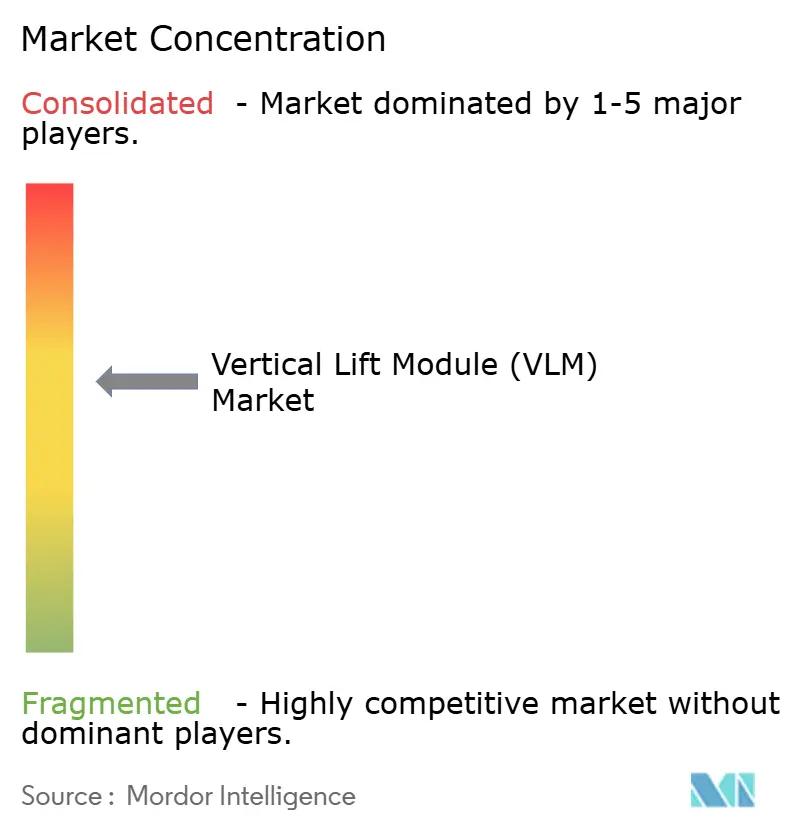
| Market Concentration | Medium |
Major Players
*Disclaimer: Major Players sorted in no particular order Image © Mordor Intelligence. Reuse requires attribution under CC BY 4.0. |
|
Vertical Lift Module (VLM) Market Analysis by Mordor Intelligence
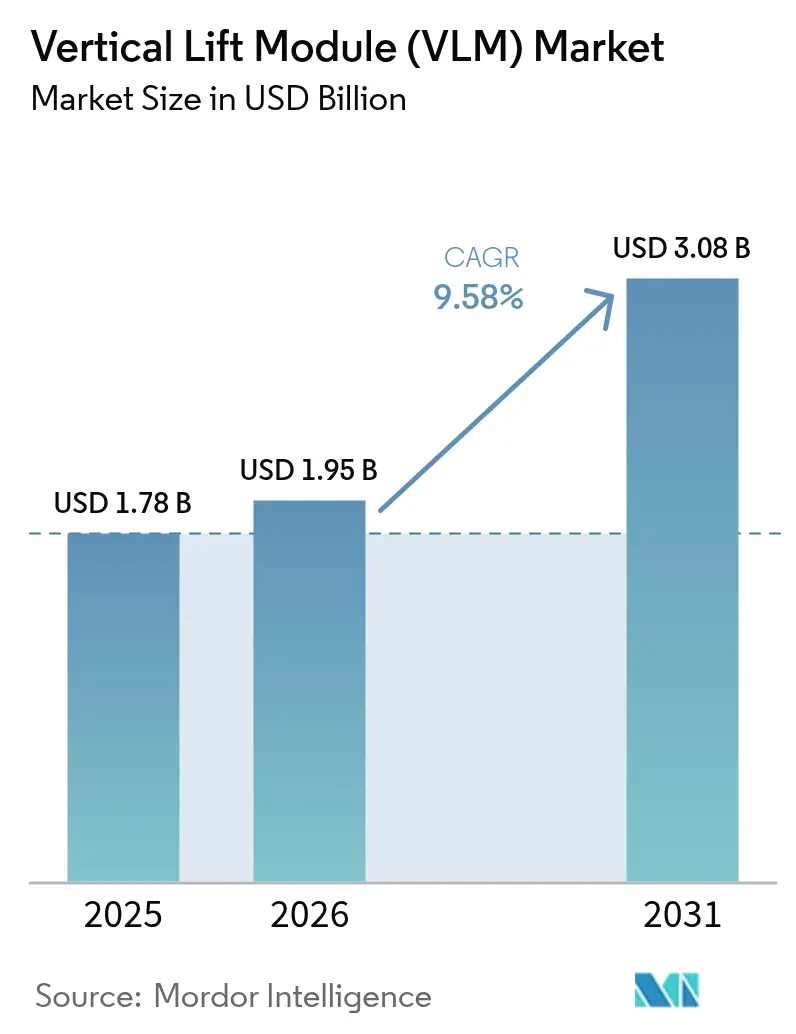
The vertical lift module market size was valued at USD 1.78 billion in 2025 and estimated to grow from USD 1.95 billion in 2026 to reach USD 3.08 billion by 2031, at a CAGR of 9.58% during the forecast period (2026-2031). Demand accelerates as e-commerce firms replace bulky pallet racking with goods-to-person systems that compress fulfillment cycles from days to hours. Automakers add automated buffer storage to sustain just-in-time production rhythms, while life-sciences cleanrooms adopt enclosed modules that meet traceability and contamination-control mandates. Cold-chain operators view energy-efficient dual-drive motors as a route to ROI in less than 24 months, and predictive-maintenance software packages open an after-sales revenue stream for equipment makers.
Key Report Takeaways
- By type, single-level delivery systems held 56.65% of the vertical lift module market share in 2025, whereas dual-level delivery is projected to grow at an 11.74% CAGR to 2031.
- By load capacity, 20-50 ton units accounted for 42.55% of the vertical lift module market size in 2025; above-50-ton units are poised to expand at a 12.42% CAGR through 2031.
- By application, storage and buffering contributed 47.25% of deployments in 2025, while order-picking and kitting is advancing at a 13.18% CAGR to 2031.
- By end-user, automotive operations represented 23.60% revenue share in 2025; e-commerce fulfillment is the fastest-growing end-user segment at a 14.32% CAGR.
- By region, Europe commanded a 35.70% share of the vertical lift module market in 2025; Asia-Pacific is the fastest-growing region at a 12.14% CAGR to 2031.
Note: Market size and forecast figures in this report are generated using Mordor Intelligence’s proprietary estimation framework, updated with the latest available data and insights as of 2026.
Global Vertical Lift Module (VLM) Market Trends and Insights
Drivers Impact Analysis*
| Driver | (%) Impact on CAGR Forecast | Geographic Relevance | Impact Timeline |
|---|---|---|---|
| E-commerce-led micro-fulfillment expansion | 2.10% | Global, concentrated in North America & EU urban centers | Medium term (2-4 years) |
| Accelerating VLM adoption in urban warehouses | 1.80% | APAC core, spill-over to MEA | Short term (≤ 2 years) |
| OEM push for fully automated, closed-loop spare-parts storage in European automotive sector | 1.40% | Europe; expansion to North America | Medium term (2-4 years) |
| Compliance-driven traceability needs in U.S. life-sciences cleanrooms | 1.20% | North America; regulatory adoption in EU | Long term (≥ 4 years) |
| Rising labor-cost differentials in South-East Asia driving AS/RS retrofits | 0.90% | APAC, particularly Southeast Asia | Short term (≤ 2 years) |
| Energy-efficient dual-drive motors enabling ROI < 24 months in cold-storage facilities | 0.80% | Global; early adoption in North America | Medium term (2-4 years) |
| AI-enabled predictive-maintenance bundles from VLM OEMs boosting after-sales revenues | 0.60% | Global; led by developed markets | Long term (≥ 4 years) |
| Source: Mordor Intelligence | |||
E-commerce-led micro-fulfillment expansion
Retailers are shifting from regional distribution centers to automated micro-fulfillment nodes located inside or adjacent to existing stores. More than 7,300 automated micro-fulfillment centers are expected to be operational worldwide by 2030, almost half of them in the United States, creating sustained demand for compact, high-density modules that fit within 10,000 square-foot footprints . VLMs integrate with robotic pickers to achieve 99.99% order-accuracy rates while reducing labor needs by up to 66% . Although supply-chain constraints have slowed some retailer roll-outs, early adopters demonstrate rapid payback by compressing last-mile delivery lead times.
Accelerating VLM adoption in urban warehouses
Industrial rents in key Asian capitals outpace regional averages, forcing operators to reclaim vertical space. VLMs that reach ceiling heights of 98 feet quadruple storage density while shifting work from travel to picking, essential where labor is scarce and expensive. Daifuku’s new manufacturing plant in India was commissioned to satisfy this surge in urban automation demand. Real-estate constraints and wage inflation thus act in tandem to move VLM investments higher on management priority lists.
OEM push for fully automated, closed-loop spare-parts storage in European automotive sector
Automotive OEMs embed VLMs in parts centers to maintain production rhythm and reduce inventory. Emil Frey Logistik boosted storage capacity 300% and secured 99.76% uptime after implementing an AutoStore-based solution. Stellantis targets 40% manufacturing cost cuts by 2030 through automation, underscoring management commitment to digital logistics. Closed-loop traceability also supports quality audits and warranty management.
Compliance-driven traceability needs in U.S. life-sciences cleanrooms
Modules provide sealed environments, integrate air-particle monitoring, and maintain audit trails compliant with FDA 21 CFR Part 11. Beckman Coulter’s MET ONE 3400+ counter links directly to storage systems, automating batch documentation. ASYS Group delivers GMP-compatible handling units that synchronize with manufacturing-operations platforms, reinforcing the vertical lift module market’s appeal in regulated spaces.
Restraints Impact Analysis*
| Restraint | (%) Impact on CAGR Forecast | Geographic Relevance | Impact Timeline |
|---|---|---|---|
| Facility roof-height limitations in brownfield European sites | -1.30% | Europe; industrial legacy sites | Short term (≤ 2 years) |
| High up-front investment vs. multi-shuttle alternatives in APAC tier-2 cities | -1.10% | APAC tier-2 cities; emerging markets | Medium term (2-4 years) |
| Power-quality variations in emerging African logistics hubs | -0.70% | Sub-Saharan Africa; select MEA markets | Long term (≥ 4 years) |
| Limited retrofit-ready ERP/WMS interfaces in SME segments | -0.90% | Global SME markets; developing regions | Medium term (2-4 years) |
| Source: Mordor Intelligence | |||
Facility roof-height limitations in brownfield European sites
Many European plants built before 1990 lack the 25-foot clear height that unlocks peak VLM efficiency. Retrofitting involves floor reinforcement and structural checks that inflate project costs; in some locations, heritage rules bar vertical alterations. AutoStore estimates that 65% of its European installs occur in such retrofit scenarios, highlighting both opportunity and constraint
High up-front investment vs. multi-shuttle alternatives in APAC tier-2 cities
Operators in secondary Asian metros often favor shuttle-based systems that scale gradually. Budget uncertainties stem from fluctuating e-commerce penetration and the need for simultaneous facility upgrades. Limited payback visibility therefore delays some vertical lift module market deployments despite long-term throughput advantages.
*Our forecasts treat driver/restraint impacts as directional, not additive. The impact forecasts reflect baseline growth, mix effects, and variable interactions.
Segment Analysis
By Type: Single-level delivery dominates traditional applications
Single-level systems captured 56.65% of 2025 revenue, a reflection of their compatibility with existing building heights and straightforward operations. Typical throughput averages 250 items per hour, adequate for medium-velocity environments. Dual-level variants, however, post an 11.74% CAGR through 2031. They hit 350 items per hour by allowing simultaneous extraction and presentation trays, making them a preferred choice when brownfield sites possess sufficient vertical clearance. Kardex has upgraded controller firmware to harmonize either configuration within the same WMS, giving operators flexibility to mix system types as order profiles evolve. The vertical lift module market continues to tilt toward dual-level investments as facilities chase higher picks-per-square-foot.
A modular design framework lowers engineering costs and accelerates installation. OEMs now offer plug-and-play conveyor docks and robotic interfaces, allowing single-level modules to serve as buffers for adjacent high-throughput zones while dual-level units handle fast movers. This hybrid strategy ensures continuity during seasonal spikes without oversizing equipment for average demand, reinforcing the vertical lift module market’s value proposition for balanced capex planning.


By Load Capacity: Mid-range systems balance versatility and performance
Units rated for 20-50 tons held 42.55% market share in 2025, reflecting their suitability for boxed automotive parts, tote-handled e-commerce inventory, and pharmaceutical payloads that rarely exceed 1,000 pounds per tray. These systems form the backbone of multi-industry deployments because they require no special flooring or crane assistance. Above-50-ton modules record a 12.42% CAGR, fueled by aerospace and heavy-machinery suppliers consolidating oversized components into single storage points. Conversely, sub-20-ton machines occupy niche roles in electronics and medical device assembly lines where cleanliness and precision outweigh weight metrics.
Schaefer’s LOGIMAT illustrates the trend, offering capacities up to 1 ton per tray with ERP connectors that reduce integration times by 30%. As Industry 4.0 spreads, facilities select load classes based on digital-twin simulations rather than generic rules of thumb. Consequently, procurement cycles extend to include data modeling, yet adoption momentum sustains because the vertical lift module market size aligns closely with quantifiable productivity gains.
By Application: Storage transitions to dynamic fulfillment
Storage and buffering still account for 47.25% of deployments, a legacy of early projects that replaced traditional shelving. Yet order-picking and kitting shows a 13.18% CAGR to 2031 as omnichannel retailers prioritize throughput. The vertical lift module market size attributed to fulfillment functions gains from integrated pick-to-light, ergonomic lift tables, and AMR hand-offs that cut labor travel distance to zero. Spare-parts handling remains steady, underpinned by automotive and industrial OEM service networks that demand serialized traceability for warranty audits.
Modules now ship with embedded APIs that link picker data to customer-facing dashboards, shortening promised lead times. Flaschenpost’s automated beverage fulfillment center achieved more than 2,000 robot movements per hour by pairing VLM storage with shuttle bots. The outcome demonstrates how application evolution pivots the vertical lift module market toward real-time, order-driven logic rather than static stocking.

By End-User Industry: Automotive leadership faces e-commerce challenge
Automotive plants held 23.60% share in 2025, leveraging modules for kit-sequencing lines and warranty parts hubs. The vertical lift module market share in this segment reflects strict uptime targets and mature MES interfaces. E-commerce-centric retailers, however, register the fastest expansion at 14.32% CAGR through 2031. They treat VLMs as micro-fulfillment engines that slash urban delivery windows to same-hour benchmarks. Life-sciences cleanrooms, electrical assembly, and food logistics maintain consistent uptake as industry-specific variants gain certifications such as GMP or ISO 14644.
Interstate Cold Storage documented 35% energy savings after integrating VFD-equipped hoist motors, proving relevance for temperature-controlled goods. As climate-controlled logistics proliferate, end-user diversification helps insulate the vertical lift module industry from cyclical shocks in any single sector.
Geography Analysis
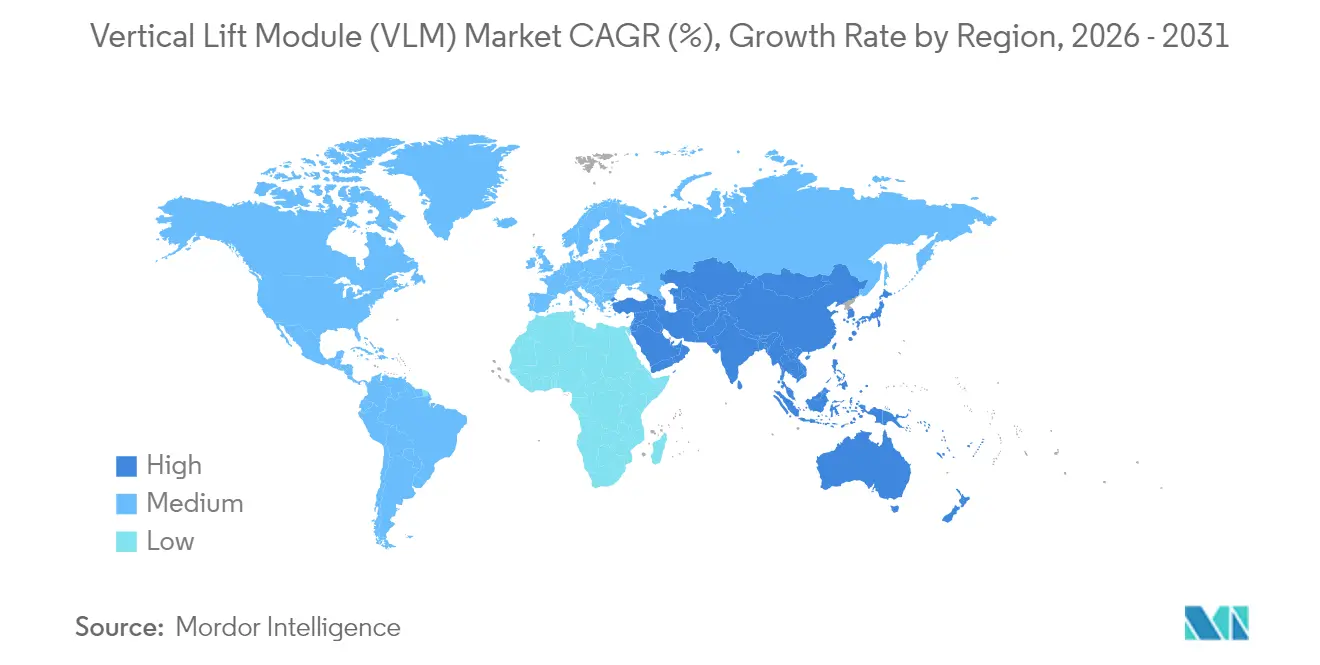
Europe leads with 35.70% revenue share in 2025, anchored by automotive manufacturing corridors in Germany, Spain, and France. Brownfield retrofits dominate because many facilities predate modern ceiling-height norms. OEM mandates for traceability and energy-footprint reduction, combined with strict worker-safety codes, keep the regional vertical lift module market growing even when new-build projects slow. Germany’s Tier-1 suppliers integrate AI-based motor diagnostics to prevent unscheduled line stops, a feature now embedded in most European purchase specifications.
Asia-Pacific posts the fastest 12.14% CAGR through 2031. China deploys VLMs in greenfield smart factories where cell-based manufacturing needs compact point-of-use stores. India’s logistics automation spending is climbing as new industrial corridors receive public funding for integrated supply-chain parks, reinforcing regional appetite for high-density vertical storage. Japan and South Korea apply modules to alleviate labor shortages caused by aging demographics. The region’s scale and greenfield nature mean suppliers sell complete ecosystems—VLM hardware, WMS, and AMR fleets—in one turnkey package, bolstering the vertical lift module market size across the decade.
North America maintains a steady expansion track. Retailers retrofit suburban outlets with micro-fulfillment nodes, and life-sciences clusters in the U.S. Northeast adopt GMP-compliant modules for biologics. Cold-storage operators in the U.S. Midwest and Canada appreciate dual-drive hoist efficiencies that curb utility bills during peak tariffs. Latin America and the Middle East & Africa are emerging but uneven. Brazil’s contract-logistics firms explore leasing models to bypass capex barriers, while South African distributors face power-quality issues that necessitate voltage-regulation add-ons, a factor that suppresses near-term vertical lift module market penetration.
Regulatory Landscape
Regulatory requirements for vertical lift modules are dominated by machinery safety, electrical safety, and storage-structure integrity rules that vary by region. In Europe, VLMs shipped as machinery must align with the EU Machinery Directive 2006/42/EC and the associated CE-marking obligations, while functional safety for guarding, sensors, and safety-rated controls commonly references ISO 13849-1 and IEC 62061, and machine electrical equipment practices align with IEC 60204-1. For racking and structural considerations that interface with VLM installations, European users and engineering teams also refer to FEM guidance (for example, FEM 9.754 for storage equipment assessment).
In North America, compliance commonly ties to ANSI MH16.1 for industrial steel storage racks (when the solution includes or interacts with rack-like structural components), and control-panel builds frequently reference UL 508A for industrial control panels, alongside workplace storage and handling requirements enforced through OSHA frameworks (for example, OSHA 1926.250 on storage requirements). Beyond technical compliance, procurement cycles for automated systems have been influenced by trade-policy uncertainty: the Federal Reserve Bank of San Francisco highlighted reciprocal tariff announcements in April 2025 as a contributor to capital spending uncertainty for automation, and research published in 2026 (CEPR) discussed how tariffs can shift demand toward domestically produced goods, affecting sourcing decisions for automation hardware and components.
Value Chain Analysis
The VLM value chain starts with component suppliers for steel structures, lift mechanisms, motors and drives, sensors, safety devices, and industrial control electronics, then moves into OEM design and manufacturing where modules are configured by tray size, load rating, height, and options such as ESD protection or environmental sealing. Global OEMs such as Modula, Han̈el, ICAM, and SSI SCHAEFER anchor the upstream-to-midstream chain through in-house engineering, factory assembly, and software stacks that package machine control with WMS/ERP connectivity; Modula also highlights multi-region manufacturing presence (Italy, the United States, and China), supporting localization of supply and service.
Downstream, value is created by distributors and channel partners that scope projects, sell standardized configurations, and provide installation and maintenance coverage, including regional specialists such as Vertical Storage USA, ISS Material Handling, and MSK Canada. Systems integrators and IT partners execute the highest-risk portion of deployments by connecting VLMs to customer ERP/WMS environments (often requiring bidirectional data flows for real-time inventory, traceability, and production picking), and by linking VLMs to broader automation cells with conveyors, robots, AMRs, and AGVs. The main bottlenecks remain software and controls integration in legacy environments and the ability to sustain uptime via local service networks; partnerships help close these gaps, exemplified by ISS Material Handlings May 2025 sales-channel partnership with Han̈el to broaden local availability of VLMs and service support.
Competitive Landscape
The market remains moderately fragmented. Kardex, Hänel, and Modula retain legacy brand equity, yet cross-segment entrants such as AutoStore and SSI SCHAEFER challenge incumbents by bundling cube storage or shuttle systems with VLM offerings. Product differentiation now centers on software. Kardex’s tie-up with Berkshire Grey integrates robotic picking to achieve 99.99% accuracy without teach-in periods, underscoring a shift toward AI-enabled workflows .[1] Likewise, SPARETECH’s parts-identification platform leverages a 10-million-item database to cut spare-parts inventory costs, extending value beyond physical equipment .[2]
Energy-optimized drives and predictive diagnostics serve as additional battlegrounds. Modula’s next-gen controller employs load-adaptive acceleration curves that trim electricity use by 15%, addressing ESG scorecard pressures . AutoStore’s Thai robot plant doubles production capacity, shrinking lead time to 20 weeks and giving the firm supply-chain resilience that competitors lack .[3] Regional manufacturing footprints also influence total landing cost, a factor that favors vendors with diversified assembly locations such as Daifuku and SSI SCHAEFER. Pricing tactics vary: some suppliers bundle long-term service agreements at discounted rates to lock in annuity revenue, while others offer modular service tiers targeting SME budgets.
Vertical Lift Module (VLM) Industry Leaders
-
Kardex Group
-
Hänel Storage Systems
-
Ferretto Group S.p.a
-
Modula Inc.(System Logistics)
-
AutoCrib Inc.
- *Disclaimer: Major Players sorted in no particular order
Market Opportunities and Future Outlook
A clear opportunity sits in turning VLMs from standalone storage assets into connected intralogistics nodes that can be deployed incrementally and then integrated into higher levels of warehouse automation. Modula has published how its VLMs connect with anthropomorphic robots, AMRs, AGVs, and conveyors under a single WMS ecosystem, which directly addresses goods-to-person picking, line feeding, and buffering workflows where customers want orchestration rather than isolated machines. This integration demand also aligns with the reports core adoption themes in e-commerce micro-fulfillment and in automotive closed-loop spare parts storage, where reduced walking time, dense storage, and digital traceability drive purchasing decisions.
Regulated and audit-driven environments offer additional whitespace because sealed, access-controlled, and software-integrated storage supports traceability and contamination-control procedures already highlighted in life-sciences cleanrooms (for example, alignment to FDA 21 CFR Part 11 for electronic records and audit trails). Recent product direction reinforces this pull toward software-led deployments: Kardex started a North American rollout of its Kardex Shuttle VLM with the Total Intelligence Concept control system and an Intralogistics API, aligning with customer requirements to integrate equipment data into WMS/ERP layers and analytics. Across regions, safety and compliance requirements (CE marking in Europe and OSHA-aligned workplace safety in the United States) keep pushing OEMs to standardize sensors, access control, and safeguarding, creating differentiation in certified, integration-ready platforms rather than purely mechanical performance.
Recent Industry Developments
- April 2026: Han̈el Storage Systems announced a strategic scale-up of its VLM production and a regional expansion plan, signaling a push toward higher throughput and broader service coverage. The move signals intent to strengthen manufacturing capabilities and service reach to support larger deployments and faster delivery cycles.
- December 2025: Kardex acquired a controlling majority stake in Rocket Solution GmbH and consolidated it as a fourth Business Unit within its Standardized Systems segment. The transaction broadens Kardexs standardized intralogistics portfolio and strengthens its ability to bundle complementary material handling solutions alongside VLM offerings. With more capabilities under one segment, Kardex can pursue larger, multi-technology automation tenders where integration scope and service coverage influence vendor selection.
- June 2026: Kardex announced the deployment of its Kardex Shuttle VLM at a major automotive manufacturer's regional distribution campus, representing a large-scale integration across multiple sites and illustrating the growing role of automated storage in just-in-time warehousing.
Research Methodology Framework and Report Scope
Market Definition and Coverage
This market covers vertical lift modules (VLMs), which are enclosed automated storage systems that store trays vertically and use a central inserter-extractor to bring the required tray to an access opening for picking and replenishment.
Scope exclusions: We exclude non-VLM warehouse automation such as horizontal carousels, AGVs/AMRs, conveyors, and full aisle-based AS/RS cranes when they are sold and priced as separate systems.
Segmentation Overview
-
By Type
- Single-Level Delivery
- Dual-Level Delivery
-
By Load Capacity
- Up to 20 Tons
- 20 - 50 Tons
- Above 50 Tons
-
By Application
- Storage and Buffering
- Order-Picking and Kitting
- Spare-Parts Handling
-
By End-User Industry
- Automotive
- Metal and Machinery
- Electrical and Electronics
- Retail / Distribution and E-commerce
- Life-Sciences (Pharma Medical Devices)
- Food and Beverage
- Other Industries
-
By Geography
-
North America
- United States
- Canada
- Mexico
-
Europe
- Germany
- United Kingdom
- France
- Italy
- Spain
- Rest of Europe
-
Asia-Pacific
- China
- Japan
- South Korea
- India
- Rest of Asia-Pacific
-
South America
- Brazil
- Argentina
- Rest of South America
-
Middle East and Africa
- Turkey
- Saudi Arabia
- South Africa
- United Arab Emirates
- Rest of Middle East and Africa
-
North America
Data Sources, Market Sizing, and Validation
Desk Research
Desk work starts with building the demand map for VLM adoption and the supply picture for shipments and installed base. We use public sources such as US Census Bureau manufacturing and trade series, Eurostat short-term business statistics, UN Comtrade for import-export patterns of material handling equipment, and World Bank macro indicators for cross-country normalization. We also reference standards and safety guidance from bodies such as ISO and OSHA to confirm typical system configurations and how VLMs are described in procurement.
The size model is then anchored using company filings, annual reports, and investor presentations, followed by reputable press coverage on warehouse automation projects and capacity expansions. When needed, paid subscriptions for company financials and intelligence, patent databases, and shipment-level trade data are used to cross-check product focus, pricing direction, and the pace of technology upgrades. This desk source list is illustrative, and many additional public and paid references were reviewed to validate assumptions and close data gaps.
Primary Interviews and Surveys
Primary work is used to pressure-test the desk assumptions on VLM pricing, typical module sizing, delivery timelines, and replacement cycles. We speak with a mix of manufacturers, system integrators, distributors, and end users from warehousing, manufacturing, and life sciences, and then we reconcile differences across APAC, EMEA, and the Americas so regional shares are not driven by a single viewpoint.
Distribution of primary research fieldwork respondents
| Company type | Respondent position | Region |
|---|---|---|
| Top tier: 28% | CXOs: 12% | APAC: 42% |
| Mid tier: 53% | Functional/Unit leaders: 34% | EMEA: 35% |
| Smaller Players: 19% | Managers: 54% | Americas: 23% |
Market-Sizing & Forecasting
Our core sizing is built using a top-down approach where warehouse automation demand is reconstructed by linking logistics activity and facility expansion to the share of sites that can practically deploy goods-to-person vertical storage. To keep the model tied to real buying behavior, results are corroborated with selective bottom-up approximations, such as sampled ASP x unit volumes from channel checks and supplier level revenue splits where disclosures are available.
Key inputs are kept practical and market-specific, including average selling price ranges by load capacity and height class, typical number of trays per module, penetration of VLMs in space-constrained warehouses, lead-time and installation constraints that cap annual deliveries, and replacement or retrofit cadence for motors, controls, and predictive maintenance add-ons. Where volume signals are incomplete for smaller countries, gaps are handled by using proxy indicators like warehousing floor space growth, manufacturing output, and trade intensity, and then adjusted using interview feedback.
For forecasting, scenario analysis is used so the base case can be flexed with drivers that buyers actually cite, such as e-commerce fulfillment throughput needs, labor availability and wage inflation, energy costs that influence enclosed system preference, and capital spending cycles in automotive and life sciences. Assumptions are reviewed with experts, and we only shift the growth curve when the same directional signal repeats across regions and respondent types.
Data Validation & Update Cycle
Validation is done by triangulating the model against independent signals like warehouse construction trends, industrial production, and import-export movement for related equipment categories, followed by checks on implied unit counts and implied pricing so totals do not drift unrealistically. Outliers are flagged, and the underlying drivers are rechecked before sign-off, which often triggers follow-up outreach when a region shows a sudden shift that cannot be explained by known demand events.
Each study goes through multiple analyst review steps so assumptions, formulas, and currency conversions are consistent across regions and years. Reports are refreshed annually, and interim updates are made when material events occur, such as policy changes affecting automation investment or sharp pricing movements in controls and electrical components. Before delivery, a final pass is completed so clients receive the latest updated view.
Mordor Intelligence's Vertical Lift Module Market Sizing Compared With Other Published Estimates
Published market sizes for vertical lift modules can look far apart even when everyone is talking about the same equipment. The main reasons are differences in what gets counted as a VLM sale, whether software and installation are included, the base year chosen, and how aggressively price and penetration are pushed forward.
By tracking shipment-to-installation lead times and refreshing the ASP ladder by load capacity, Mordor Intelligence keeps the total focused on VLM systems revenue rather than wider warehouse automation bundles, which is why some estimates land lower or higher. A second driver is geography handling, since some studies extrapolate smaller markets from a single region, while our model uses country indicators and then reconciles them with interview based adoption checks. Currency timing also matters, because exchange-rate windows can change the stated USD value even when local demand is stable.
Benchmark comparison
| Source | Market Size | Gaps in Research Methodology |
|---|---|---|
| Mordor Intelligence | USD 1.95 B (2026) | |
| Global Consultancy A | USD 1.65 B (2024) | Uses an earlier base year and appears to anchor sizing to an ASRS-oriented scope, which can undercount VLM-only revenue when projects are booked inside broader automation program totals. |
| Industry Publisher B | USD 1.79 B (2024) | Uses a long-horizon forecast window with a single base-year value and may apply faster penetration lift assumptions without clearly separating hardware revenue from adjacent automation and warehouse services. |
The comparison shows that most of the spread comes from scope boundaries and how pricing and penetration are moved forward year by year. When the model is built around repeatable variables like module ASP bands, realistic delivery capacity, and adoption by warehouse type, the resulting number is easier to trace and recheck as new data points come in.
Key Questions Answered in the Report
What is the current size of the vertical lift module market?
The vertical lift module market size is valued at USD 1.95 billion in 2026 and is projected to reach USD 3.08 billion by 2031 at a 9.58% CAGR.
Which segment holds the largest vertical lift module market share?
Single-level delivery systems hold the largest share at 56.65% of 2025 revenue.
Which application area is growing fastest?
Order-picking and kitting applications are expanding at a 13.18% CAGR through 2031 as retailers push for rapid fulfillment.
Why is Asia-Pacific the fastest-growing region?
Robust e-commerce growth and greenfield smart-factory investments drive a 12.14% CAGR for Asia-Pacific through 2031.