
Market Overview
| Study Period | 2021 - 2031 |
|---|---|
| Forecast Data Period | 2026 - 2031 |
| Base Year Market Size (2025) | 37.46 gigawatt |
| Market Volume (2026) | 38.67 gigawatt |
| Market Volume (2031) | 45.31 gigawatt |
| Growth Rate (2026 - 2031) | 3.22 % |
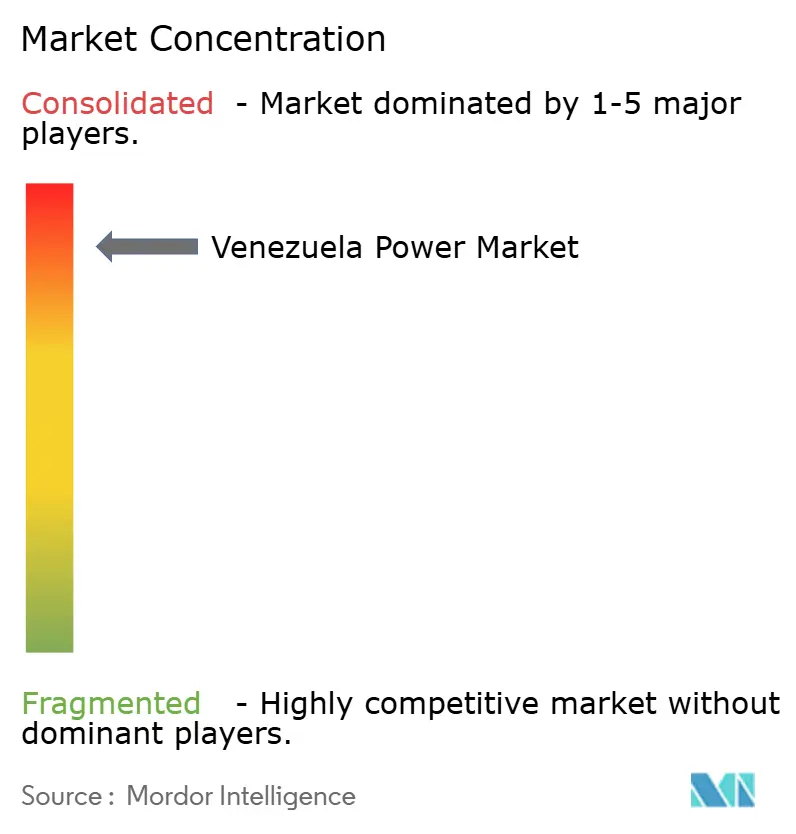
| Market Concentration | High |
Major Players *Disclaimer: Major Players sorted in no particular order Image © Mordor Intelligence. Reuse requires attribution under CC BY 4.0. | |
Venezuela Power Market Analysis by Mordor Intelligence
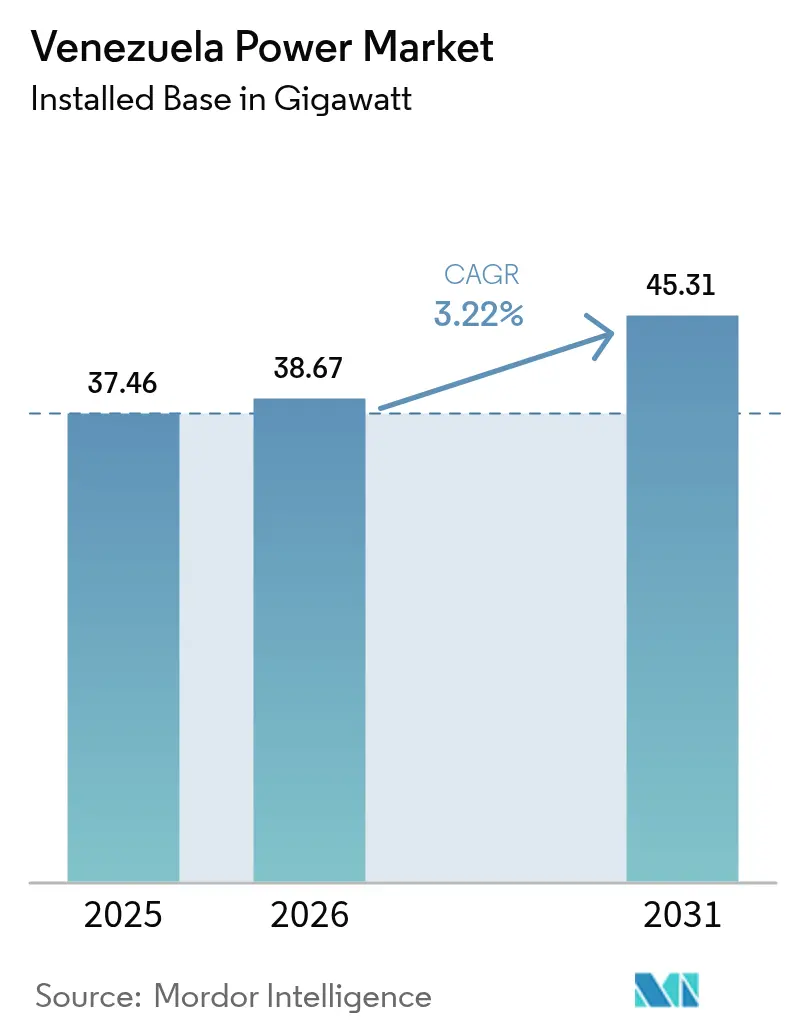
The Venezuela Power Market size was valued at 37.46 gigawatt in 2025 and estimated to grow from 38.67 gigawatt in 2026 to reach 45.31 gigawatt by 2031, at a CAGR of 3.22% during the forecast period (2026-2031).
This outlook hides stark structural contrasts: abundant hydro resources counterbalanced by chronic fuel shortages, hyperinflation running at 180.0% for 2025, and renewed U.S. sanctions that restrain procurement for thermal fleets.[1] Capacity factors for hydro assets slide below 40%, thermal plants operate at roughly one-quarter of nameplate, and the Venezuela power market endures a recurring generation deficit of 1,600-1,800 MW at peak demand. Rehabilitation of the 10,200 MW Guri complex, a 3,000 MW Andean solar program, and dual-fuel retrofits of thermal stations anchor near-term supply additions, while distributed solar and micro-grids reshape demand in outage-prone regions. Competitive intensity remains low: CORPOELEC’s statutory monopoly crowds out private entrants and forces foreign OEMs into narrow rehabilitation niches. Still, white-space opportunities in self-generation, electric-mobility charging, and hybrid micro-grids keep the Venezuela power market on investors’ watchlists despite macro-political headwinds.
Key Report Takeaways
- By power source, thermal generation led with 50.02% of the Venezuela power market share in 2025, yet renewables are forecast to expand at a 5.55% CAGR through 2031.
- By end user, utilities commanded a 66.55% share of the Venezuela power market size in 2025 and are projected to grow at a 6.18% CAGR through 2031.
Note: Market size and forecast figures in this report are generated using Mordor Intelligence’s proprietary estimation framework, updated with the latest available data and insights as of 2026.
Venezuela Power Market Trends and Insights
Drivers Impact Analysis*
| Driver | (~) % Impact on CAGR Forecast | Geographic Relevance | Impact Timeline |
|---|---|---|---|
| Abundant hydropower potential & refurbishment of Guri Dam | +0.8% | National, concentrated in Bolívar state (Guri) and Caroní basin | Medium term (2-4 years) |
| Government renewable-diversification targets amid oil-price volatility | +1.2% | National, with early gains in Mérida, Táchira, Trujillo (Andes solar), Paraguaná (wind) | Long term (≥ 4 years) |
| Rehabilitation & dual-fuel conversion of ageing thermal fleet | +0.6% | National, priority in Zulia (Termozulia, Ramón Laguna), Bolívar (Sidor) | Medium term (2-4 years) |
| Gradual economic stabilisation driving electricity-demand rebound | +0.9% | National, with spillover to cross-border trade (Colombia, Brazil) | Short term (≤ 2 years) |
| Untapped cross-border interconnection capacity (Colombia & Brazil) | +0.4% | Border regions, particularly Zulia (Colombia), Bolívar (Brazil), with national grid benefits | Long term (≥ 4 years) |
| Growing micro-grid initiatives in remote Orinoco & Amazonas regions | +0.3% | Remote areas in Orinoco Basin, Amazonas state, Delta Amacuro | Medium term (2-4 years) |
| Source: Mordor Intelligence | |||
Abundant Hydropower Potential & Refurbishment of Guri Dam
Venezuela’s technical hydro potential approaches 20,000 MW, yet actual output hovers near 30% of that ceiling.[2] The 10,200 MW Guri complex anchors the Caroní cascade, but deferred maintenance, sedimentation, and drought have eroded performance. Refurbishment campaigns, focused on turbine overhauls, valve modernization, and sediment control, could reclaim 800-1,000 MW, erasing the structural deficit without green-field construction.[3] Financing relies on oil-for-infrastructure agreements with Chinese policy banks, while technical execution rotates among Andritz, Voith, and Siemens Energy under Ministry supervision.
Government Renewable-Diversification Targets Amid Oil-Price Volatility
At COP29 (Nov 2024), Caracas pledged to source 30% of electricity from photovoltaics and unveiled a 3,000 MW solar roadmap for the Andes states. This pivot shields exportable hydrocarbons and hedges against fuel-supply shocks that routinely idle thermal plants. Early projects include a 50 MW facility in Mara, Zulia, and a twin 50 MW site in El Vigía, Mérida. Execution leans on turnkey EPC contracts with Chinese, Indian, and Turkish suppliers, yet the stalled Renewable and Alternative Energy (RAE) Bill still clouds power-purchase agreement (PPA) design and tariff certainty.
Rehabilitation & Dual-Fuel Conversion of Ageing Thermal Fleet
Thermal assets such as the 770 MW Termozulia station and the 660 MW Ramón Laguna plant run at 25% utilization or remain dormant. Dual-fuel retrofits allow switching between scarce gas and imported diesel, raising availability when associated-gas flows fluctuate—an acute risk since the 2024 Muscar gas-complex explosion. Contracts center on Siemens Energy and Wärtsilä for burner re-engineering and digital controls, but OFAC licensing and bolívar depreciation inflate costs and elongate delivery cycles.
Gradual Economic Stabilization Driving Electricity-Demand Rebound
GDP grew 5.3% in 2024, yet is projected to contract 4.0% in 2025 as hyperinflation persists. Still, activity in refining, petrochemicals, and mining propels localized demand, particularly in Orinoco Belt operations operated by Chevron and Eni under specific licenses. Distributed solar installers, 13 at last count, and 5,000 EVs show latent elasticity in commercial and mobility segments, offering buffers against grid instability.
Restraints Impact Analysis*
| Restraint | (~) % Impact on CAGR Forecast | Geographic Relevance | Impact Timeline |
|---|---|---|---|
| Prolonged political instability & US sanctions limiting FDI | -1.1% | National, with acute effects on oil/gas-dependent regions (Zulia, Anzoátegui, Monagas) | Long term (≥ 4 years) |
| Hyper-inflation and bolívar volatility inflating project costs | -0.6% | National, most severe impact on import-dependent projects and hard-currency financing | Short term (≤ 2 years) |
| Ageing T&D infrastructure causing chronic outages & losses | -0.7% | National, most severe in eastern states, Margarita Island, and peripheral distribution networks | Medium term (2-4 years) |
| Skilled-worker exodus constraining O&M capacity | -0.5% | National, particularly affecting CORPOELEC operations and specialized maintenance at Guri, thermal plants | Medium term (2-4 years) |
| Source: Mordor Intelligence | |||
Prolonged Political Instability & U.S. Sanctions Limiting FDI
General License 44A (Apr 2024) reinstated sectoral sanctions, curbing equipment imports and deterring multiyear finance. Although Chevron, Repsol, and Maurel & Prom hold narrow exemptions, sovereign default status and governance risks elevate Venezuela’s cost of capital well above regional peers. The IEA notes that Venezuela captured none of the USD 185 billion in Latin American power-sector inflows during 2024.
Ageing T&D Infrastructure Causing Chronic Outages & Losses
Service-failure rates leapt from 25.9% in 2022 to 61.9% in 2023 as corroded conductors, overloaded transformers, and weak protection schemes induced cascading blackouts. CORPOELEC’s consolidation of 14 regional utilities has not reversed attrition of skilled labor, and technical plus non-technical losses soak up revenue needed for capital replacement. A World Bank extra-high-voltage upgrade remains undisbursed, underscoring lender reluctance.[4]
*Our forecasts treat driver/restraint impacts as directional, not additive. The impact forecasts reflect baseline growth, mix effects, and variable interactions.
Segment Analysis
By Power Source: Hydro Dominance Masks Fuel-Supply Fragility
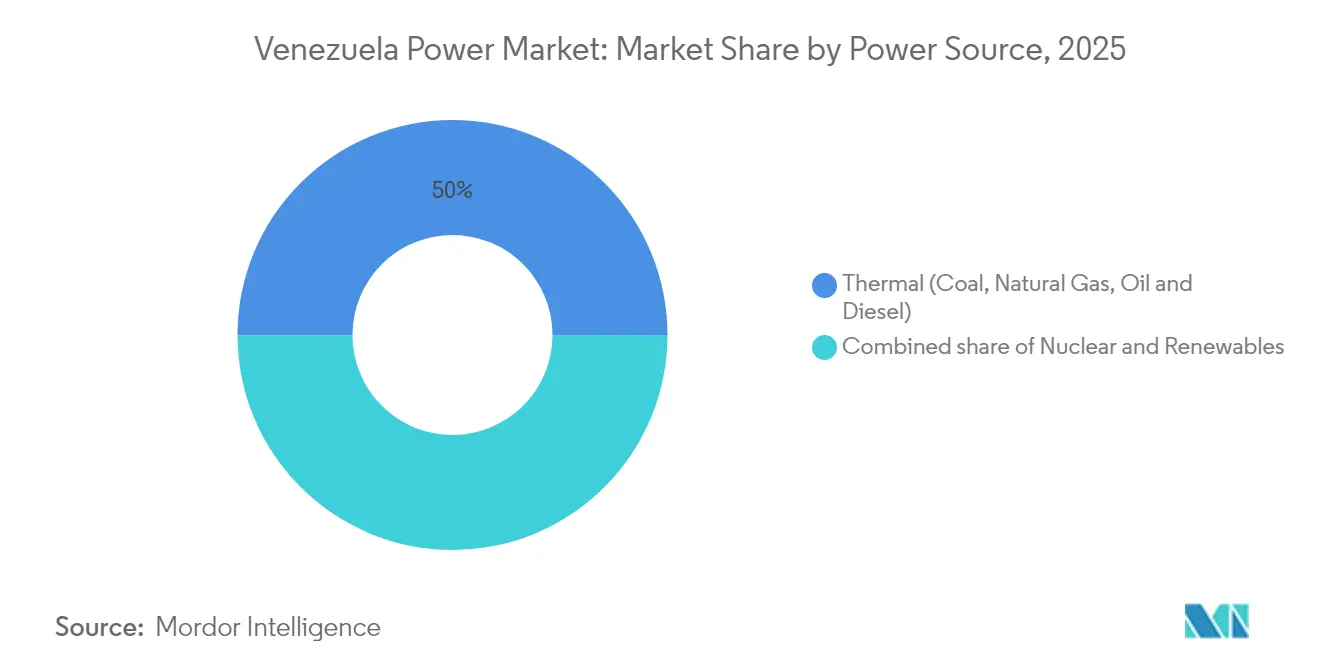
Hydro supplied 62,516 GWh of 2022 generation and remains the backbone of the Venezuela power market. The hydro-heavy mix commands 49.98% of the Venezuela power market size, while thermal assets account for the remaining 50.02% yet contribute disproportionately less energy because of fuel bottlenecks. Renewables excluding legacy hydro are set to grow at a 5.55% CAGR through 2031, led by the 3,000 MW Andean solar cluster and incremental wind at Paraguaná. The Venezuela power industry faces concentration risk from the single 10,200 MW Guri plant: a repeat of 2020-2021 drought conditions could slice national output by double digits. Dual-fuel conversions promise partial mitigation but hinge on reliable diesel imports or flared-gas capture, both vulnerable to sanctions drag.
Solar, at merely 5 MW in 2023, will acquire a toehold through 100 MW of approved projects and distributed rooftops. Wind’s 40-50 MW addition in July 2024 augurs further coastal build-outs if logistics hurdles ease. Biomass and geothermal stay embryonic, the former stymied by feedstock aggregation costs and the latter by vague tariff signals under the shelved RAE Bill.

By End User: Utilities Dominate Amid Industrial Self-Generation Surge
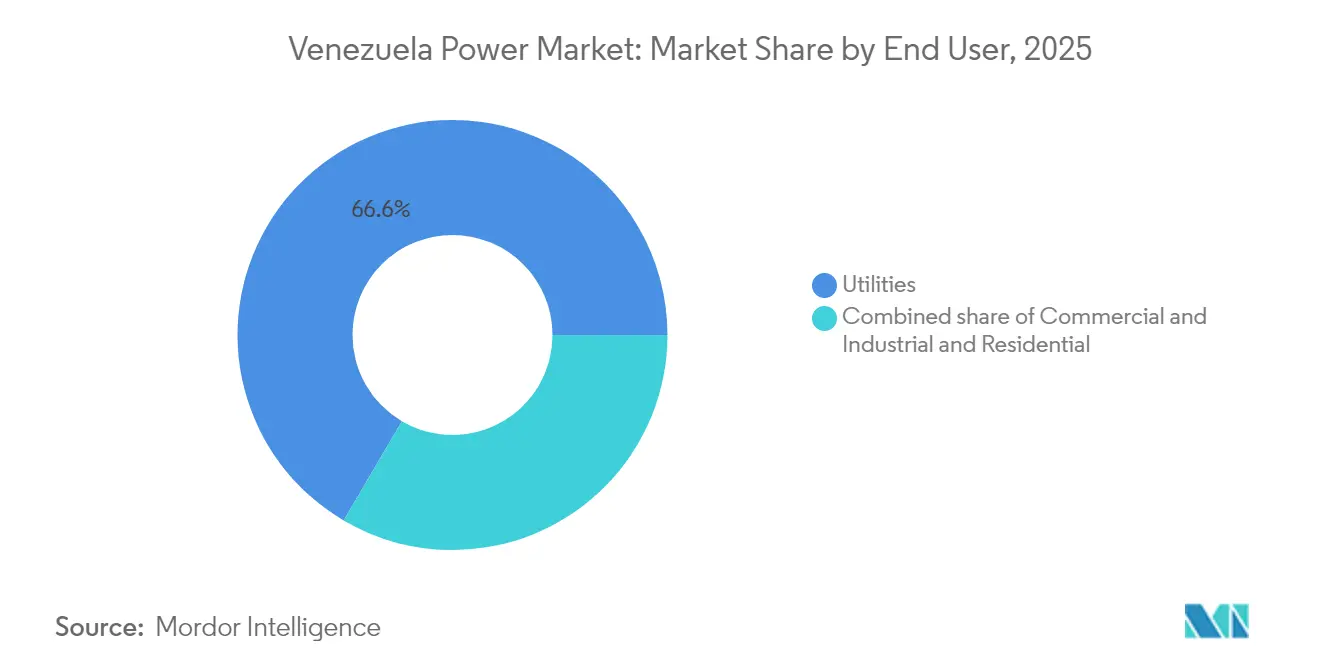
Utilities controlled 66.55% of installed capacity in 2025 and will expand at a 6.18% CAGR as state-led solar plants funnel into the grid. The Venezuela power market size for utilities equates to roughly 24.9 GW today and rises to 35.7 GW by 2031. Commercial and industrial users, facing outages up to 12 hours daily in eastern regions, ramp up self-generation with rooftop solar, diesel gensets, and nascent battery storage. The Venezuela power market share held by this segment remains below 30%, but growth outpaces the grid as miners and refiners in the Orinoco Belt deploy captive gas turbines exempt from CORPOELEC tariffs. Residential adoption of rooftop PV lags because of high dollar-denominated costs and absent net-metering, yet pilot programs in Caracas and Nueva Esparta suggest a slow climb if financing tools emerge. EV charging loads, now trivial, could add 50-100 MW by 2030, contingent on grid resilience and a modest acceleration in electric mobility.
Geography Analysis
Bolívar state hosts the 10,200 MW Guri complex plus a cascade of smaller dams totaling 16,829 MW, making it the keystone of the Venezuela power market. Drought volatility and sedimentation cut capacity factors below 40% in recent years. Zulia, once a thermal powerhouse, now imports power via vulnerable extra-high-voltage lines that often trip, exposing Maracaibo to frequent curtailments. The Andean trio of Mérida, Táchira, and Trujillo will house the 3,000 MW solar program, leveraging 5.35 kWh/m² of average global horizontal irradiance and proximity to load centers.
Eastern states, Anzoátegui, Monagas, and Sucre, depend on thermals running on associated gas, yet the Muscar explosion cut supply, demonstrating fragility. Coastal Falcón benefited from 38 new wind turbines in 2024, signaling a diversification path. Cross-border interconnections with Colombia and Brazil remain underutilized; price disparities and political risk stall expansion. Remote Orinoco and Amazonas communities rely on diesel and micro-hydro pilot projects; solar-plus-storage could gradually displace liquid fuels pending concessional finance and streamlined permits.
Regulatory Landscape
Venezuela's power sector is primarily governed by the Organic Law of the Electrical System and Service (Ley Organica del Sistema y Servicio Electrico), which reserves generation, transmission, distribution, and commercialization to the State and underpins CORPOELEC's central role as system operator and service provider. Sector policy and oversight sit with the Ministry of People Power for Electrical Energy (MPPEE), reinforcing a single-buyer, state-led market structure that affects procurement, dispatch, and investment pathways.
In 2026, the broader energy-policy backdrop shifted with hydrocarbon-law updates published in the Gaceta Oficial. This includes a reform published in January 2026 (Gaceta Oficial No. 6.978 Extraordinario) and a follow-on framework for application published in July 2026 (Gaceta Oficial No. 7.052 Extraordinario), covering technical, operational, and fiscal controls. While these reforms are upstream, they affect power-sector fuel availability, contract structures, and state control narratives that shape thermal generation rehabilitation, dual-fuel conversions, and the bankability of long-lead equipment imports under sanctions-compliance constraints.
Competitive Landscape
The Venezuela power market is highly concentrated: CORPOELEC monopolizes transmission and distribution and dominates generation under a state-ownership rule requiring a 60% stake in any joint venture. Siemens Energy, ABB, Schneider Electric, Andritz, Voith, and Chinese state-owned EPC contractors engage mainly via legacy maintenance agreements, turbine rehabilitation, or turnkey solar EPCs financed through oil-for-infrastructure swaps. Dual-fuel retrofits at Termozulia and Ramón Laguna place Wärtsilä and Siemens Energy as front-runners, while Andritz retains a service franchise on Guri’s Francis turbines.
White-space revolves around solar micro-grids in Orinoco and Amazonas, EV charging by Swing Energy, and Verdi’s electric taxi fleet. Barriers stem from OFAC compliance, bolívar convertibility, and the absence of bankable PPA templates. Digitalization of hydro dispatch and thermal controls offers incremental gains; Siemens Energy’s T-3000 control retrofit at Termozulia delivers early evidence of efficiency lift. New entrants gravitate toward distributed solar and storage to skirt transmission bottlenecks rather than contest CORPOELEC’s grid hegemony.
Venezuela Power Industry Leaders
-
CORPOELEC
-
PDVSA Electricidad
-
Enel Green Power LATAM
-
Eletronorte
-
Siemens Energy (O&M contracts)
- *Disclaimer: Major Players sorted in no particular order
Market Opportunities and Future Outlook
The near-term opportunity set centers on rehabilitation and performance recovery across hydro and thermal fleets, where availability, controls, and spares limit delivered energy more than nameplate capacity. In June 2026, Venezuela signed a memorandum of understanding with GE Vernova focused on repairing, modernizing, and stabilizing the national power grid and restoring generation capacity at scale. This widens addressable demand for OEM services, controls upgrades, and critical-component supply. CORPOELEC's return of Termocarabobo Unit 3 (150 MW) to service in June 2026 also signals the market's preference for brownfield returns, favoring contractors with commissioning capability, parts logistics, and fuel-flexibility solutions.
Hydropower refurbishment and completion works further define entry points for electromechanical packages and long-term service. In June 2026, the announcement of an agreement with IMPSA to rehabilitate the Manuel Piar (Tocoma) and Antonio Jose de Sucre (Macagua) projects points to plans to inject 2,640 MW into the grid. Alongside utility-scale rehabilitation, outage-driven self-generation continues to open whitespace for distributed solar, storage-backed micro-grids, and captive-power systems for industrial loads, especially where grid reliability and tariff design remain uncertain. The first-reading approval in June 2026 of reforms to the Organic Law of the Electric System and Service, structured around long-term concessions, adds a pathway for private capital to participate across generation, networks, and commercialization. That shift increases the weight of tariff frameworks, payment security mechanisms, and creditworthy offtake structures in determining how quickly projects move into execution.
Recent Industry Developments
- July 2026: CORPOELEC launched its Plan de Alivio Preventivo 2026 in the Bajo Caroni, starting July 13 at the Guri, Caruachi, and Macagua hydroelectric dams, using preventative reservoir and discharge management to support system stability. The action reflects the operational priority placed on safeguarding the Caroni hydropower backbone, where reliability events can quickly translate into nationwide supply shortfalls.
- October 2025: Venezuela updated its Nationally Determined Contribution (NDC), committing to a 20% reduction in greenhouse gas emissions by 2035 versus a 2024-2030 business-as-usual scenario, and signaling a planned allocation of over USD 18.4 billion for mitigation, including USD 7.8 billion for electricity. This formalizes a policy anchor for grid and generation investments, and strengthens the case for renewables and efficiency-linked rehabilitation programs where funding channels materialize.
- June 2024: The government approved a 50 MW solar park in Mara, Zulia, with a 10-month build schedule. The project adds a concrete utility-scale solar pipeline reference in a system where solar penetration has been minimal, supporting supplier and EPC activity tied to first-wave interconnection, permitting, and operations know-how.
Research Methodology Framework and Report Scope
Market Definition and Coverage
For this study, the market is defined as Venezuela's power system in terms of installed electricity generation capacity, measured in gigawatts, across grid connected and utility scale assets that supply the national electricity network.
Scope exclusions: We exclude fuel extraction and refining, retail electricity billing services, and behind the meter backup sets that are not tied to the grid.
Segmentation Overview
- By Power Source
- Thermal (Coal, Natural Gas, Oil and Diesel)
- Nuclear
- Renewables (Solar, Wind, Hydro, Geothermal, Biomass & Waste, Tidal)
- By End User
- Utilities
- Commercial and Industrial
- Residential
- By T&D Voltage Level (Qualitative Analysis only)
- High-Voltage Transmission (Above 230 kV)
- Sub-Transmission (69 to 161 kV)
- Medium-Voltage Distribution (13.2 to 34.5 kV)
- Low-Voltage Distribution (Up to 1 kV)
Data Sources, Market Sizing, and Validation
Desk Research
Desk work started with public capacity and electricity system indicators, which help anchor the model before assumptions are tested in calls. We referenced sources such as IEA country statistics, World Bank energy and macro series, IRENA renewable capacity tables, and OLADE regional energy balances, which together provide consistent time series for capacity additions and demand pressure.
To stay close to what can be validated, we also reviewed utility and ministry releases, grid and power sector documents, reputable press coverage on outages and rehabilitation projects, and company filings and investor presentations where available. In parallel, we used paid subscriptions for company financials and intelligence, plus news and financials screening, mainly to verify changes in project status and ownership updates. These desk research sources are illustrative only, and other public documents were also used for data collection, validation, and clarification.
Primary Interviews and Surveys
Within Venezuela, interviews and surveys with generation, grid, equipment, utility, commercial, industrial, and regulatory professionals help assess reported capacity and identify units that are unavailable or operating below nameplate levels. Respondents also clarify planned additions, retirements, demand recovery, and hydropower availability where public records are incomplete. We reconcile these inputs with the desk data before final analysis.
Distribution of primary research fieldwork respondents
| Company type | Respondent position |
|---|---|
| Top tier: 27% | CXOs: 15% |
| Mid tier: 51% | Functional/Unit leaders: 30% |
| Smaller Players: 22% | Managers: 55% |
Market-Sizing & Forecasting
Sizing was built using a top-down reconstruction where public capacity baselines and announced additions are translated into an installed capacity pathway by year, and then adjusted for realistic commissioning and retirement timing. To keep the totals grounded, we corroborated the output with selective bottom-up checks, such as rolling up a sample of known plants and projects and sanity checking the implied annual net additions.
Key inputs that shaped the model included nameplate capacity by technology, rehabilitation and expansion timelines, outage and availability signals that affect what gets built next, electricity demand direction using macro indicators, and grid investment constraints that influence project slippage. For forecasting, scenario analysis was used because outcomes depend strongly on investment pace, hydrology sensitivity, and execution risk, and the scenarios were stress tested with expert views on what is actually deliverable in the next five years. Where project level details were incomplete, we applied conservative timing ranges and only counted capacity when evidence of progress was consistent across desk sources and primary validation.
Data Validation & Update Cycle
Outputs were validated through cross checks against independent signals like historical capacity benchmarks, reported additions, and whether year to year changes look plausible versus known project pipelines. Variances were reviewed in steps, first at the input level, then at the model roll up level, and finally through an internal analyst review before sign off.
When large swings appeared, follow ups were triggered with domain respondents to confirm whether the change came from scope, timing, or a one-off event. Reports are refreshed annually, and interim updates are made when material policy shifts, large commissioning events, or major outages materially change the capacity outlook. Before delivery, a fresh review pass is completed so the client receives the latest view consistent with the defined scope.
Mordor Intelligence's Venezuela Power Market Sizing Compared With Other Published Estimates
Published estimates for Venezuela's power market often do not match because the underlying unit and boundary are not always the same. Some sources express the market as installed capacity in gigawatts, while others convert activity into a revenue number, which naturally produces different looking totals even for the same country and period.
By tracking installed capacity additions and retirements year by year, checking project timing with field feedback, and refreshing the conversion rules, Mordor Intelligence keeps the Venezuela power total tied to a capacity based definition rather than mixing in equipment and service spending.
Benchmark comparison
| Source | Market Size | Gaps in Research Methodology |
|---|---|---|
| Mordor Intelligence | USD 37.46 B (2025) | |
| Global Data Provider A | USD 33.86 B (2020) | Uses an earlier base year and presents cumulative capacity for 2020, and the published snapshot does not show how additions and retirements are rolled forward across the forecast window. |
| Market Research Portal B | USD 9.50 B (2024) | Reported in revenue terms with a different base year, and the scope likely blends value pools beyond installed capacity, so the number is not directly comparable to a gigawatt based market definition. |
The spread is mainly explained by unit choice and the base year used, and then amplified by whether project timing rules are shown clearly. A capacity pathway rebuilt from public system signals and rechecked through interviews is easier to reproduce and audit, which helps decision makers compare years on a like for like basis.
Key Questions Answered in the Report
What is the current size of the Venezuela power market?
Installed capacity reached 38.67 GW in 2026 and is forecast to climb to 45.31 GW by 2031.
Which segment supplies most electricity in Venezuela?
Hydropower, led by the 10,200 MW Guri Dam, accounted for 62,516 GWh of the 2022 output.
How fast are renewables growing?
Non-hydro renewables are expected to rise at a 5.55% CAGR between 2026 and 2031 under the 3,000 MW Andean solar program.
Why do blackouts persist despite adequate capacity?
Ageing transmission and distribution assets drive outages, with failure rates affecting 61.9% of households in 2023.
How do U.S. sanctions affect the sector?
Sanctions restrict equipment imports, financing, and foreign participation, reducing inflows and slowing rehabilitation projects.
Where are investment opportunities emerging?
Distributed solar, micro-grids in Orinoco and Amazonas, and EV charging infrastructure offer niches insulated from state monopoly risk.