
User-Generated Content Platform Market Size and Share
Market Overview
| Study Period | 2020 - 2031 |
|---|---|
| Market Size (2026) | USD 12.63 Billion |
| Market Size (2031) | USD 43.92 Billion |
| Growth Rate (2026 - 2031) | 28.32 % |
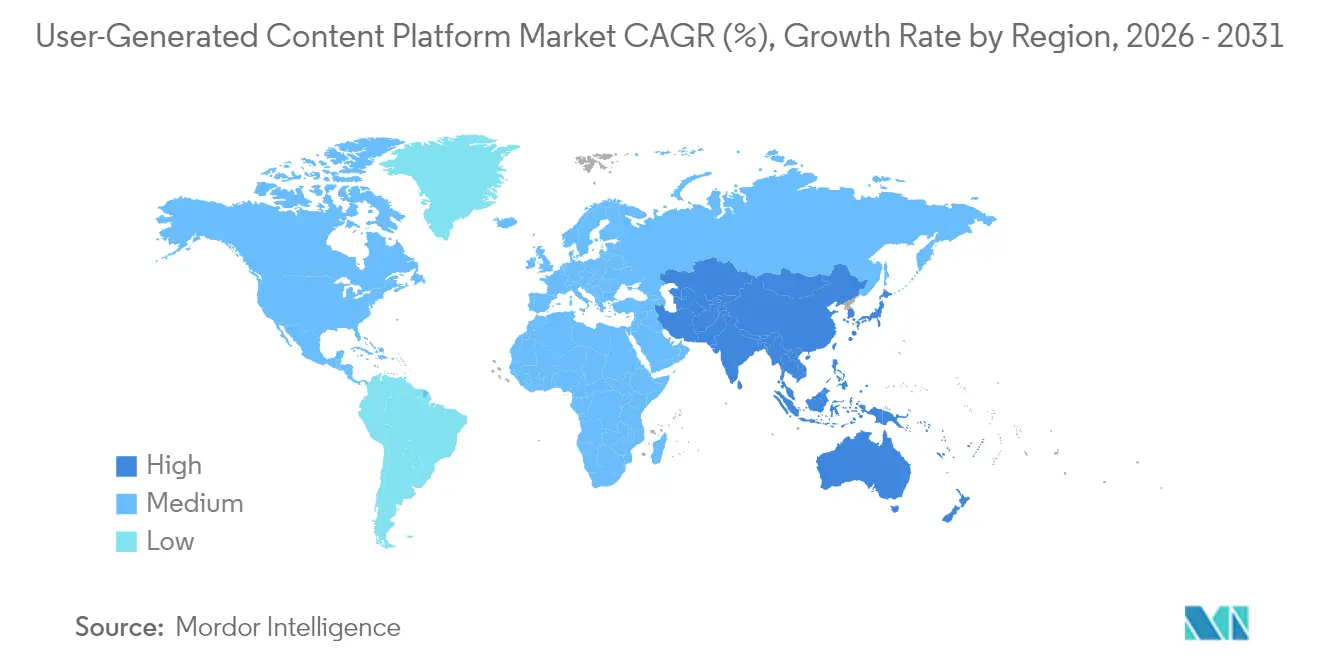
| Fastest Growing Market | Asia Pacific |
| Largest Market | North America |
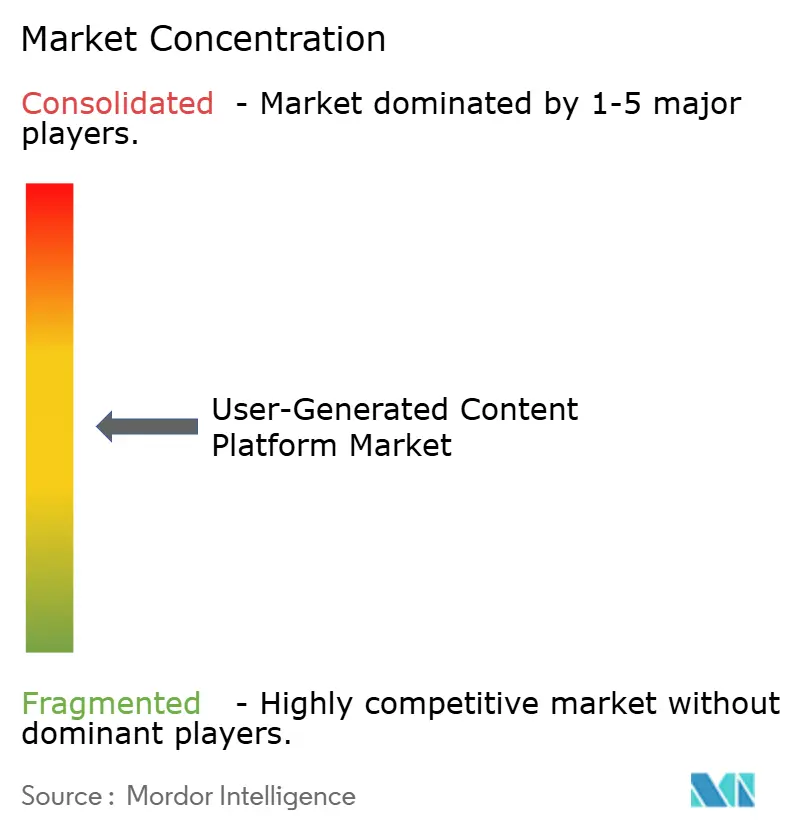
| Market Concentration | Medium |
Major Players *Disclaimer: Major Players sorted in no particular order Image © Mordor Intelligence. Reuse requires attribution under CC BY 4.0. | |
User-Generated Content Platform Market Analysis by Mordor Intelligence
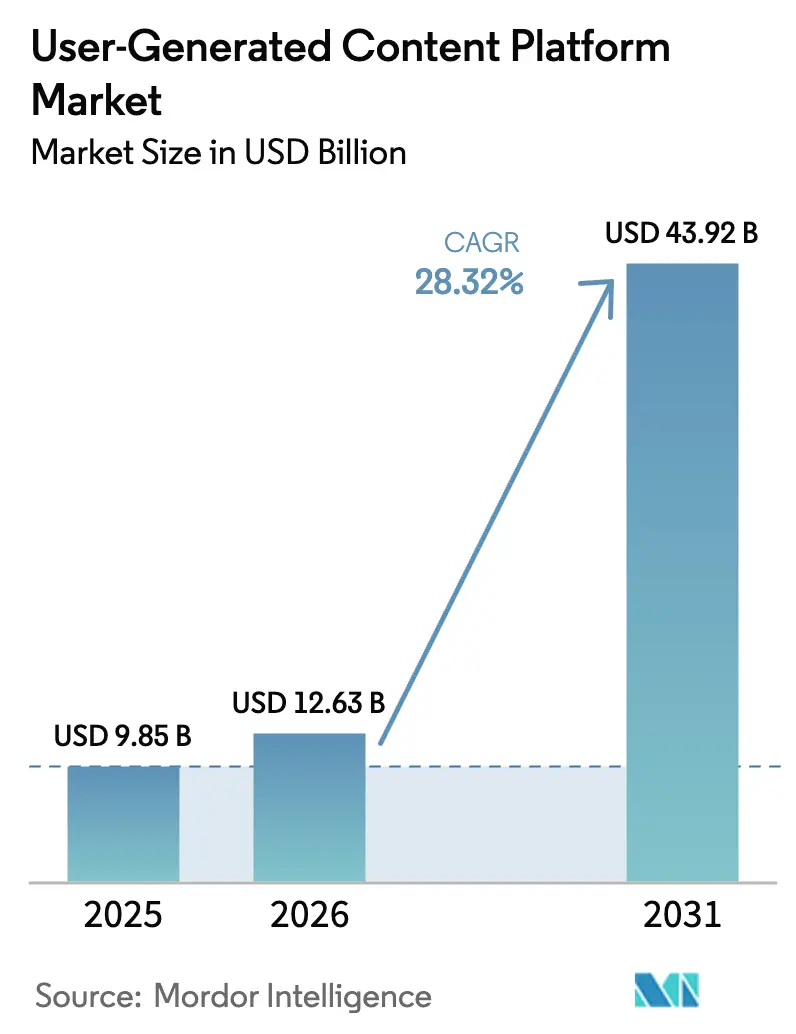
The user-generated content platform market size is expected to grow from USD 9.85 billion in 2025 to USD 12.63 billion in 2026 and is forecast to reach USD 43.92 billion by 2031 at 28.32% CAGR over 2026-2031. This dynamic growth comes as brands pivot from traditional advertising to community-driven storytelling that delivers 6.9 times higher engagement than branded content. Influencer-commerce momentum, short-form video proliferation, and AI-powered creator tools are steadily reshaping how enterprises capture authentic consumer voices. Platform providers are prioritizing cloud-native architectures that streamline scalable, real-time moderation while lowering entry barriers for small and medium enterprises. Meanwhile, regulatory scrutiny is steering investment toward privacy-preserving analytics and automated compliance capabilities that differentiate offerings across the user-generated content platform market.
Key Report Takeaways
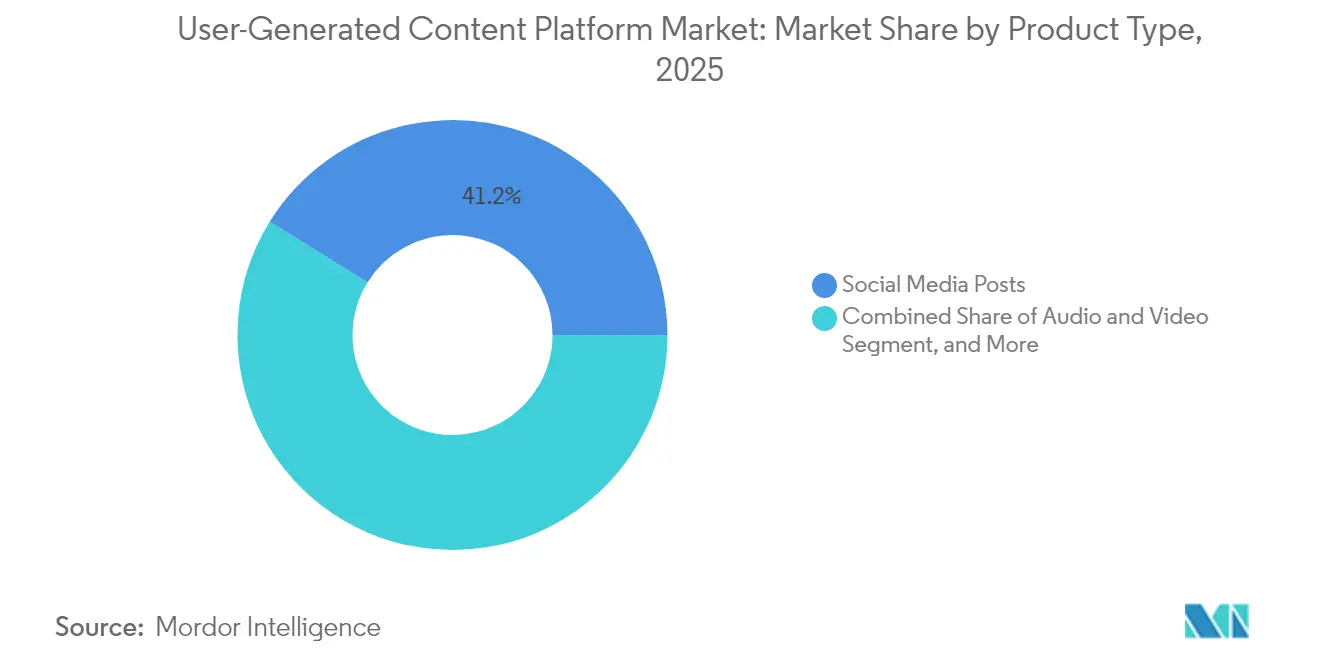
- By product type, social media posts led with 41.18% revenue share in 2025 in the user-generated content platform market, whereas live-streaming is advancing at a 30.12% CAGR through 2031.
- By end-user segment, large enterprises commanded 43.21% of the 2025 user-generated content platform market share, while SMEs are projected to grow at 30.25% CAGR to 2031.
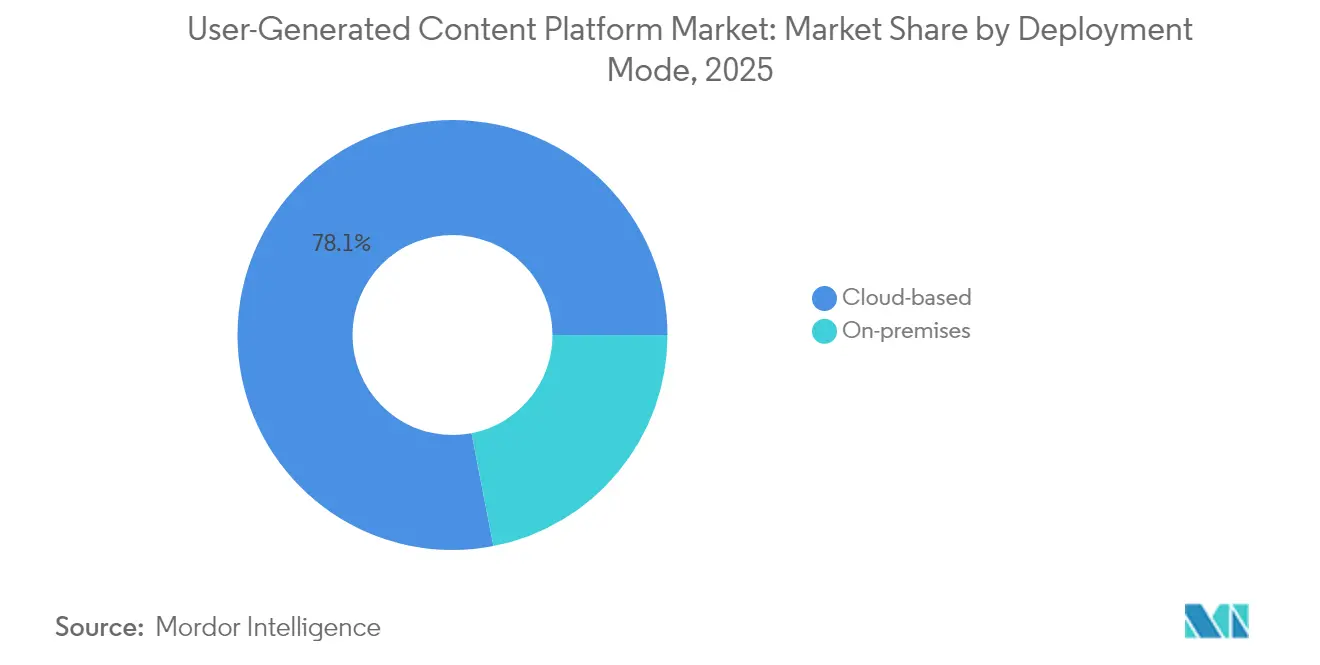
- By deployment mode, cloud-based solutions accounted for 78.05% of the user-generated content platform market size in 2025 and are set to rise at a 31.02% CAGR over the forecast horizon.
- By revenue model, the advertising-supported approach retained 61.15% share in 2025 in the user-generated content platform market; freemium offerings show the fastest climb at 30.86% CAGR through 2031.
- By geography, North America contributed 38.12% of 2025 revenue in the user-generated content platform market, but the Middle East and Africa region is poised for a 30.08% CAGR up to 2031.
Note: Market size and forecast figures in this report are generated using Mordor Intelligence’s proprietary estimation framework, updated with the latest available data and insights as of 2026.
Market Trends and Insights
Drivers Impact Analysis of User-Generated Content Platform Market*
| Driver | (~) % Impact on CAGR Forecast | Geographic Relevance | Impact Timeline |
|---|---|---|---|
| Influencer-driven commerce acceleration | +8.2% | Global, with concentration in North America and APAC | Medium term (2-4 years) |
| Short-form video platforms fueling UGC volumes | +7.8% | Global, led by APAC and North America | Short term (≤ 2 years) |
| Social-commerce integrations by major retailers | +6.4% | North America and EU, expanding to APAC | Medium term (2-4 years) |
| Generative-AI-assisted content creation | +5.9% | Global, early adoption in North America and EU | Long term (≥ 4 years) |
| Web3 token-based creator monetisation models | +4.3% | Global, strongest in APAC and North America | Long term (≥ 4 years) |
| Privacy-centric first-party data advantages | +3.7% | EU and North America, expanding globally | Medium term (2-4 years) |
| Source: Mordor Intelligence | |||
Influencer-Driven Commerce Acceleration
Brands fusing creator networks with integrated checkout features are shortening purchase funnels and driving measurable ROI improvements. Influencer marketing platforms generated USD 21 billion in 2024 revenue, with micro-influencers producing 60% higher engagement than macro creators. Enterprise demand for scalable identification of niche creators is propelling investment in AI-based discovery engines. Shoppable content integrations are eliminating an average of 2.3 customer touchpoints, reinforcing the strategic imperative for real-time UGC activation. Updated FTC endorsement guidelines are encouraging platforms that automate disclosure compliance, boosting trust and reinforcing growth across the user-generated content platform market.
Short-Form Video Platforms Fueling UGC Volumes
Platforms processed more than 720,000 video hours daily in late 2024.[1]“Video Content Surge Drives Platform Infrastructure Investment,” Financial Times, ft.com This surge increases the need for intelligent curation systems that surface relevant clips for brands drowning in content abundance. Vertical-video formats optimized for mobile use now deliver 40% higher engagement, prompting platforms to redeploy recommendation algorithms. Meta’s September 2024 AI studio rollout accelerated creator productivity and preserved hallmark authenticity, fueling additional demand for analytics that validate performance while filtering deceptive content. These forces collectively expand platform stickiness and monetization opportunities inside the user-generated content platform market.
Social-Commerce Integrations by Major Retailers
Retailers embedding UGC into product pages experience tangible gains: Walmart reported 28% higher conversions and 15% fewer returns during 2024 when showcasing customer videos. Complex rights management, speedy moderation, and unified analytics requirements are driving platform consolidation as merchants favor end-to-end solutions. Privacy laws such as GDPR inform consent workflows and data portability features that are now core purchasing criteria. Providers delivering turnkey integrations that respect privacy and support omnichannel merchandising continue to outpace generic offerings within the user-generated content platform market.
Generative-AI-Assisted Content Creatio
Meta’s Movie Gen announcement in October 2024 underscored how text-to-video tools can lower production barriers while introducing authenticity concerns. Early detection frameworks boast 94% accuracy in flagging synthetic clips, reducing misinformation risks and elevating trust. Fragmented global regulation, EU mandates explicit AI labeling, whereas U.S. rules concentrate on preventing deception, creates compliance complexity that only technology-rich platforms can manage. Long-term, generative AI is likely to expand creator pools and diversify content formats, lifting engagement and revenue across the user-generated content platform market.
Restraints Impact Analysis of User-Generated Content Platform Market*
| Restraint | (~) % Impact on CAGR Forecast | Geographic Relevance | Impact Timeline |
|---|---|---|---|
| Brand-safety and content-moderation costs | -4.8% | Global, highest impact in EU due to DSA requirements | Short term (≤ 2 years) |
| Rising regulatory scrutiny on data use | -3.2% | EU and North America, expanding globally | Medium term (2-4 years) |
| Decline of third-party cookies reducing ad yields | -2.1% | Global, most severe in North America and EU | Short term (≤ 2 years) |
| Generative-AI misinformation risks | -1.7% | Global, regulatory focus in EU and North America | Medium term (2-4 years) |
| Source: Mordor Intelligence | |||
Brand-Safety and Content-Moderation Costs
Industry-wide moderation spend surpassed USD 25 billion in 2024, with more than 1 million human moderators supplementing AI filters. The EU Digital Services Act heightened obligations, forcing sophisticated classification and 24-hour takedown windows that add USD 2.8 billion in annual compliance expenses for dominant firms. AI tools trim per-item costs by 35%, yet nuanced contextual evaluation still demands human oversight, especially for enterprise campaigns where a single unsafe placement can void contracts. These operating burdens temper profitability and slow near-term expansion in the user-generated content platform market.
Rising Regulatory Scrutiny on Data Use
The demise of third-party cookies reduced advertising yield by 20-30% on major networks, spurring urgent pivots toward first-party data strategies.[2]Privacy Regulations Impact on Digital Advertising,” Financial Times, ft.com GDPR, CCPA, and emerging state statutes oblige continuous investment in consent orchestration and auditing infrastructure. Smaller platforms, lacking dedicated legal teams, face proportionally heavier fixed costs, elevating barriers to entry. Cross-border data transfer uncertainty further complicates architecture decisions, nudging some providers toward localization that fragments scale advantages and constrains margin expansion inside the user-generated content platform market.
*Our forecasts treat driver/restraint impacts as directional, not additive. The impact forecasts reflect baseline growth, mix effects, and variable interactions.
User-Generated Content Platform Market Segment Analysis
By Product Type:
Social Media Posts Sustain Leadership, Live-Streaming RisesSocial media posts contributed 41.18% of 2025 revenue, underscoring their entrenched role in brand storytelling. Live-streaming boasts the highest 30.12% CAGR through 2031, reflecting consumer appetite for real-time interaction and tipping-based monetization. Gaming-centric broadcasts produced USD 4.2 billion in creator revenue during 2024. Audio-video hybrids continue steady growth as production kits become affordable. Ratings and reviews remain foundational trust signals, especially when embedded in e-commerce checkouts. Blogs, while mature, are regaining momentum through AI-enhanced multimedia inserts.
Cloud-native AI tagging systems ensure compliance with evolving classification standards set by the EU’s Digital Services Act, reducing manual workload. Vertical video algorithms optimized for smartphones are lifting dwell times and click-throughs. As these mobile-first experiences proliferate, providers capable of cross-format orchestration gain share, sustaining the user-generated content platform market expansion.



By End-User:
Enterprise Dominance, SME AccelerationLarge enterprises held 43.21% of 2025 revenue, leveraging integrations with CRM and martech stacks to measure full-funnel ROI. SMEs, however, post a 30.25% CAGR to 2031 as subscription tiers remove upfront investment hurdles. Authentic customer photos and videos drive 45% higher SME engagement than brand-authored assets, closing performance gaps with larger competitors.
Enterprise buyers demand robust brand-safety dashboards and API-level data transfers for attribution modeling. SMEs prioritize quick onboarding, guided workflows, and bundled rights management. Platforms offering tiered configurations appease both cohorts, broadening the user-generated content platform market addressable base.
By Deployment Mode:
Cloud AscendancyCloud deployments represented 78.05% of the 2025 user-generated content platform market size, advancing at 31.02% CAGR on scalability and instant global reach advantages. Elastic resource provisioning accommodates viral content spikes without service degradation. Hybrid architectures are emerging where sensitive data remains on-premise while compute-heavy rendering and moderation shift to cloud edge nodes.
Edge acceleration lowers latency for live-streams and delivers uniform quality in bandwidth-constrained geographies. Region-specific clouds address data sovereignty, boosting adoption among privacy-minded enterprises. Collectively, these factors cement cloud’s dominance within the user-generated content platform market.
By Revenue Model:
Advertising Holds Sway, Freemium AcceleratesAdvertising-supported platforms captured 61.15% share in 2025, leveraging mature targeting ecosystems. Freemium models grow fastest at 30.86% CAGR, as illustrated by Character.AI’s pivot that quadrupled active users without revenue dilution. Subscription tiers anchor predictable enterprise cash flows, while transaction fees tie platform gains to merchant success.
Hybrid monetization now prevails: ad-funded reach underpins creator discovery, whereas premium analytics or exclusive content drive incremental upsells. Contextual advertising and first-party audience pools mitigate cookie deprecation, sustaining revenue resilience across the user-generated content platform market.
Geography Analysis
North America User-Generated Content Platform Market
North America’s user-generated content platform market size benefited from USD-denominated brand budgets and broad enterprise SaaS penetration, sustaining higher average revenue per user. The region’s stringent brand-safety demands foster advanced moderation tooling, elevating barrier-to-entry for smaller competitors. Ongoing state privacy bills create parallel compliance tracks that platforms must harmonize without sacrificing agility.
APAC User-Generated Content Platform Market
Asia-Pacific’s explosive content volume and creator population underpin a vibrant competitive field. Localized payment rails and super-app ecosystems catalyze micro-transactions within live-streams, driving monetization innovation. Government support programs in South Korea and Indonesia subsidize digital-skills training, expanding the creator base and demand for platform services. However, content censorship guidelines require adaptable classification engines to avert takedowns.
MEA User-Generated Content Platform Market
The Middle East and Africa records the highest forecast CAGR, propelled by smartphone affordability and carrier-backed zero-rating of social platforms that amplify reach. E-commerce rollouts across Gulf Cooperation Council states integrate shoppable UGC feeds, translating social discovery into purchase at unprecedented speed. Local languages and dialects challenge global AI filters, incentivizing regional partnerships that supply contextual training data. Collectively, divergent regional dynamics reinforce the heterogeneity of the global user-generated content platform market.

Regulatory Landscape
The regulatory environment for user-generated content (UGC) platforms is tightening around online safety, advertising disclosures, and AI transparency. In the European Union, the Digital Services Act (DSA) is fully enforceable from January 2026, raising requirements for documented content-moderation processes, faster response to illegal content notices, and stronger auditability for platforms serving EU users. At the same time, privacy enforcement (GDPR in the EU and CCPA-style state laws in the United States) continues to push platforms toward explicit consent workflows, first-party data governance, and defensible data-processing logs, which in turn shapes ad-supported monetization and enterprise procurement.
AI-created and AI-manipulated UGC is emerging as a compliance hotspot. The EU AI Act introduces disclosure obligations under Article 50 effective August 2, 2026, and California has an AI transparency law with the same operative date, both reinforcing the need for conspicuous labeling of synthetic media and AI-generated outputs used in commerce and marketing contexts. In the United Kingdom, the Online Safety Act 2023 framework expands with The Online Safety (CSEA Content Reporting by Regulated User-to-User Service Providers) Regulations 2026, effective April 7, 2026, which mandates reporting of child sexual exploitation and abuse (CSEA) content to the National Crime Agency, increasing the importance of detection, escalation, and reporting pipelines across global UGC workflows. These changes are accompanied by updated U.S. Federal Trade Commission (FTC) endorsement guidance and enforcement attention on undisclosed or deceptive review and testimonial practices, which raises the bar for automated disclosure, provenance checks, and review-integrity controls in UGC platforms.
Value Chain Analysis
The user-generated content platform value chain connects creators, audiences, and buyers of attention (advertisers, brands, and merchants) across multiple stages. Upstream, creators produce photos, videos, ratings, and reviews, often shaped by brand incentives or creator programs. The platform layer then ingests content, manages identity and permissions, runs automated and human-in-the-loop moderation, and packages UGC for distribution across owned channels (brand sites and apps) as well as external surfaces (social commerce and search). Downstream, enterprises activate UGC through syndication, shoppable integrations, and analytics that link content to conversion, with monetization flowing through advertising-supported models, subscriptions, and transaction-linked fees.
Infrastructure and compliance layers increasingly sit within the core value chain rather than operating as optional add-ons. Cloud and edge infrastructure providers supply scalable storage, compute, and delivery for high-volume short-form video and live-streaming, while UGC vendors such as Bazaarvoice, Yotpo, and CrowdRiff provide the application stack for collection, moderation, and syndication. Regulatory obligations, including the EU DSA from January 2026 and AI disclosure duties effective August 2, 2026 under the EU AI Act, push platforms to embed consent-management and compliance logging into standard workflows, including auditable moderation decisions, disclosure tooling for AI-generated content, and reporting capabilities. As a result, integration partners such as consent-management platforms (for example, OneTrust in enterprise stacks) and identity, fraud, and brand-safety tooling increasingly influence total cost, time-to-deploy, and enterprise-grade governance.
Competitive Landscape
Consolidation is redefining vendor standings as Getty Images combined with Shutterstock in a USD 3.7 billion deal, creating a multimedia behemoth blending stock and real-time UGC. Disney’s USD 1.5 billion stake in Epic Games embeds metaverse storytelling tools that marry entertainment franchises with creator-built worlds. Meanwhile, blockchain-native upstarts like The Sandbox secured USD 20 million to pursue decentralized creator monetization, challenging centralized incumbents with tokenized revenue sharing.
AI leadership now differentiates offerings: predictive performance scoring, automated rights clearance, and real-time harmful-content detection augment brand confidence. Platforms excelling at privacy-compliant first-party data capture gain negotiating leverage with advertisers grappling with signal loss. Conversely, legacy providers anchored to on-premise codebases confront modernization urgency as cloud-native entrants iterate faster.
White-space opportunities persist in regulated verticals, healthcare, finance, education, where bespoke compliance logic deters horizontal providers. Vendors crafting domain-specific ontologies and auditable content trails position for premium pricing and sticky enterprise contracts. Against this backdrop, providers balancing rapid feature shipping with escalating compliance demands secure share within the evolving user-generated content platform market.
User-Generated Content Platform Industry Leaders
Grin Technologies Inc.
Bazaarvoice Inc.
CrowdRiff Inc.
Monotype Imaging Holdings Inc.
Yotpo Ltd.
- *Disclaimer: Major Players sorted in no particular order
User-Generated Content Platform Market Companies Covered in this Report
- Bazaarvoice Inc.
- Yotpo Ltd.
- Pixlee TurnTo Corp.
- CrowdRiff Inc.
- Grin Technologies Inc.
- Upfluence SAS
- Taggbox Private Limited
- Stackla Pty Ltd (a Nosto company)
- Olapic Inc.
- TINT (Filestack Inc.)
- Social Native Inc.
- Khoros LLC
- Sprinklr Inc.
- Nosto Solutions Oy
- Adobe Inc. (UGC Framework)
- Hootsuite Inc.
- Later Media Inc.
- Dash Hudson Inc.
- Curalate, LLC
- Monotype Imaging Holdings Inc.
- Pancake Laboratories Inc.

Market Opportunities and Future Outlook
Compliance-first productization is a clear whitespace as global requirements increasingly favor provable controls over best-effort policies. With DSA enforcement starting January 2026 and AI disclosure mandates effective August 2, 2026 (EU AI Act Article 50 and California AI transparency requirements), platforms face rising demand for built-in moderation logging, transparency-report workflows, and UI-level AI disclosure badges across reviews, photos, and short-form video. Vendors that package these controls as configurable modules by region, industry, and channel tend to fit enterprise procurement needs for auditable UGC pipelines across multiple storefronts and social-commerce endpoints.
Commerce distribution partnerships are also expanding the addressable surfaces for UGC, particularly where verified reviews and customer media can be reused across retail and discovery contexts. Bazaarvoice moving deeper into commerce enablement, including its May 2026 Shopify Certified Technology Partner status and its May 2026 collaboration with Google to surface verified reviews and photos in Google Shopping Graph and AI-driven shopping experiences, illustrates an opportunity to make UGC portable, rights-cleared, and integrity-checked across retailer networks and AI-assisted discovery. Another opportunity is channel-ready syndication into social commerce and livestream ecosystems, where rights management, disclosure compliance, and latency-aware moderation act as differentiators. At the same time, regulated verticals highlighted in enterprise buying patterns, such as healthcare, finance, and education, remain underpenetrated for horizontal UGC tooling, supporting demand for domain-specific moderation ontologies, record retention, and approval workflows that allow UGC activation without compromising compliance.
Recent Industry Developments in User-Generated Content Platform Market
- June 2026: Broad availability of partner licensing feature for eligible Creators plans. The feature expands UGC licensing across partner networks and enhances creator monetization across ecosystems.
- May 2026: Google partnership to integrate verified reviews and photos into Google Shopping Graph, Gemini, and AI Overviews. The collaboration strengthens Bazaarvoice's network effects and visibility in AI-assisted shopping surfaces.
- May 2026: Becomes Shopify Certified Technology Partner to provide deep customization and authenticity moderation for merchants. Deepens merchant adoption and reduces compliance risk in UGC feeds.


User-Generated Content Platform Market Report Scope and Research Methodology
Market Definition and Coverage
This market covers the revenues generated from platforms and software that help brands, publishers, or creators collect, manage, moderate, curate, and distribute user-generated content across digital channels, with revenues counted in USD at the platform level.
Scope exclusions: We exclude pure content production services, standalone social networking ad spend, and general-purpose creative tools that do not run a UGC platform workflow.
Segments Covered in This Report
- By Product Type
- Blogs
- Social Media Posts
- Audio and Video
- Ratings and Reviews
- Live-Streaming
- By End-user
- Individuals
- Small and Medium Enterprises
- Large Enterprises
- By Deployment Mode
- Cloud-based
- On-premise / Private Cloud
- By Revenue Model
- Advertising-supported
- Subscription / SaaS
- Freemium and Transaction-based
- By Geography
- North America
- South America
- Europe
- Asia-Pacific
- Middle East and Africa
Data Sources, Market Sizing, and Validation
Desk Research
Desk research is used to set the market boundaries and to anchor the model to measurable demand signals that can be tracked year to year. For this topic, we lean on public digital economy and internet adoption indicators, plus advertising and media spend context, from sources such as the World Bank, OECD, ITU, and UNCTAD. These help explain where UGC activity and platform buying capacity are rising.
We also review standard documents such as annual reports, earnings notes, product documentation, pricing pages, and reputable press coverage to map typical revenue models, packaging, and customer types. Where available, we add support from paid subscriptions focused on company financials and intelligence, news and financials, and patent databases to cross-check product breadth and investment direction. This desk research list is illustrative, and many other public and paid sources are also used for data collection, validation, and clarification.
Primary Interviews and Surveys
Primary work is used to pressure-test what we saw in public sources, especially around how vendors price (seat based, usage based, or contract tiers) and how buyers budget across moderation, rights management, and content syndication needs. We speak with platform-side leaders, product and sales roles, agencies, and enterprise buyers across major regions so the final assumptions reflect how UGC programs are bought and renewed in practice.
Distribution of primary research fieldwork respondents
| Company type | Respondent position | Region |
|---|---|---|
| Top tier: 37% | CXOs: 16% | APAC: 41% |
| Mid tier: 47% | Functional/Unit leaders: 26% | EMEA: 36% |
| Smaller Players: 16% | Managers: 58% | Americas: 23% |
Market-Sizing & Forecasting
Sizing starts with a top-down build where digital commerce activity, content engagement intensity, and enterprise marketing and CX software spend are used to reconstruct a realistic demand pool for UGC platform adoption across regions. Once the demand pool is set, it is converted into revenue using market-facing price points, typical contract values, and expected attach rates for features like moderation workflows, rights requests, and content distribution.
To keep the totals practical, we corroborate them with selective bottom-up approximations, such as sampled pricing and packaging checks, channel feedback on average deal sizes, and a limited roll-up of supplier revenues where reporting is clear. Key inputs used in the model include social and digital traffic growth, creator and influencer activity trends, changes in short-form video usage, adoption of AI-assisted moderation and tagging, and the mix shift between subscription and usage-linked billing. When bottom-up signals are missing for smaller regions or smaller providers, the gap is handled through peer-group pricing ranges and adoption curves that are adjusted only after primary feedback.
For forecasting, scenario analysis is applied around conversion rates from engagement to shoppable or monetized content, moderation cost pressure, and enterprise renewal behavior. We then use a multivariate regression to translate these drivers into yearly growth paths. The resulting trajectory is reviewed with interviewed experts so aggressive and conservative cases stay tied to what buyers are actually planning.
Data Validation & Update Cycle
Outputs are validated through triangulation across independent checks, including comparing implied revenue per customer against observed pricing bands and sanity checking growth against broad digital advertising and commerce indicators. Outliers are flagged early, then reviewed in a multi-step analyst workflow where assumptions, math, and year-to-year movements are checked before sign-off.
The report is refreshed annually, and interim updates are triggered when material events can change market direction, such as major policy moves on content safety, sharp platform pricing shifts, or step changes in AI tooling adoption. Before delivery, we run a last pass on currency conversion timing, the latest public filings, and primary call-backs where needed so clients receive the most current view.
Mordor Intelligence's User Generated Content Platform Market Sizing Compared With Other Published Estimates
Published market sizes for UGC platforms often do not match because the underlying boundaries are not consistent, and because pricing and currency choices can swing the total even when the same growth story is being told. Differences also come from whether the estimate is anchored to platform software revenue only, or whether adjacent services and influencer marketplace activity are blended into the number.
In refresh-led checks, the biggest spread usually comes from when exchange rates are applied, how subscription ASP changes are carried forward (discounting, usage overages, and renewals), and whether the model is revalidated after quarterly shifts in deal sizes and buyer churn. These are the points where the latest update cycle used by Mordor Intelligence can change the current-year total.
Benchmark comparison
| Source | Market Size | Gaps in Research Methodology |
|---|---|---|
| Mordor Intelligence | USD 9.85 B (2025) | |
| Trade Journal A | USD 10.40 B (2024) | Often presented as a single-point value without showing how currency timing and price changes are normalized, and it may blend creator-economy spending signals into platform revenue. |
| Regional Consultancy B | USD 18.60 B (2025) | Likely uses a broader scope that can fold in adjacent creator marketplace or managed service revenues, and it can assume faster ASP expansion without buyer-side validation of renewal discounts. |
The comparison shows that scope control and repeatable pricing logic drive most of the variance, not the direction of growth. By keeping revenue counting rules clear, normalizing currency assumptions to a defined timing point, and rechecking ASP and renewal behavior with primary feedback, the estimate stays traceable to practical inputs that can be updated each cycle.


Key Questions Answered in the Report
How large is the user-generated content platform market in 2026?
The market is valued at USD 12.63 billion in 2026 and is projected to hit USD 43.92 billion by 2031 at a 28.32% CAGR.
Which product segment is growing fastest?
Live-streaming leads with a 30.12% CAGR to 2031, reflecting heightened demand for real-time creator-audience interaction.
Why are SMEs adopting UGC platforms so rapidly?
Cloud-based subscription tiers lower entry costs and deliver 45% higher engagement from authentic customer content compared with branded assets.
How does regulation affect platform growth?
EU and U.S. privacy laws increase compliance spending and push providers toward first-party data strategies that preserve targeting effectiveness.
What region offers the highest growth potential?
The Middle East and Africa region is forecast to grow at 30.08% CAGR through 2031, driven by mobile-first adoption and expanding social commerce.
Page last updated on:





