
Carbon Nanotubes Market Size and Share
Market Overview
| Study Period | 2021 - 2031 |
|---|---|
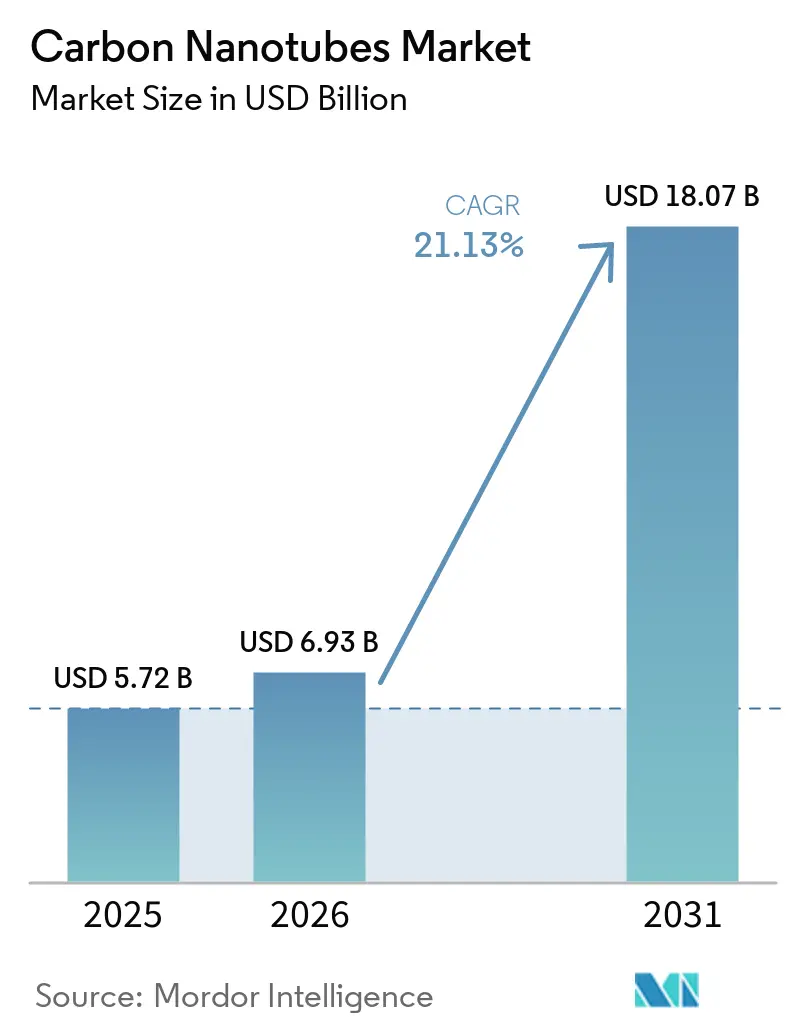
| Market Size (2026) | USD 6.93 Billion |
| Market Size (2031) | USD 18.07 Billion |
| Growth Rate (2026 - 2031) | 21.13 % |
| Fastest Growing Market | Asia-Pacific |
| Largest Market | Asia-Pacific |
| Market Concentration | Medium |
Major Players *Disclaimer: Major Players sorted in no particular order Image © Mordor Intelligence. Reuse requires attribution under CC BY 4.0. | |
Carbon Nanotubes Market Analysis by Mordor Intelligence
The Carbon Nanotubes Market size is expected to grow from USD 5.72 billion in 2025 to USD 6.93 billion in 2026 and is forecast to reach USD 18.07 billion by 2031 at 21.13% CAGR over 2026-2031. Demand surges as lithium-ion cell makers replace carbon black with nanotube additives that lift electrical conductivity by 10% while trimming additive loading by 30%. The shift feeds multi-walled variants that balance performance and cost for battery electrodes, polymer composites, and conductive plastics. Continuous-flow chemical vapor deposition (CVD) lines now deliver eight-fold yield gains over fixed-bed reactors, compressing production costs and widening gross margins for high-volume suppliers. Asia-Pacific leads capacity expansion, spearheaded by China and South Korea, where gigawatt-hour battery plants anchor long-term offtake commitments.
Key Report Takeaways
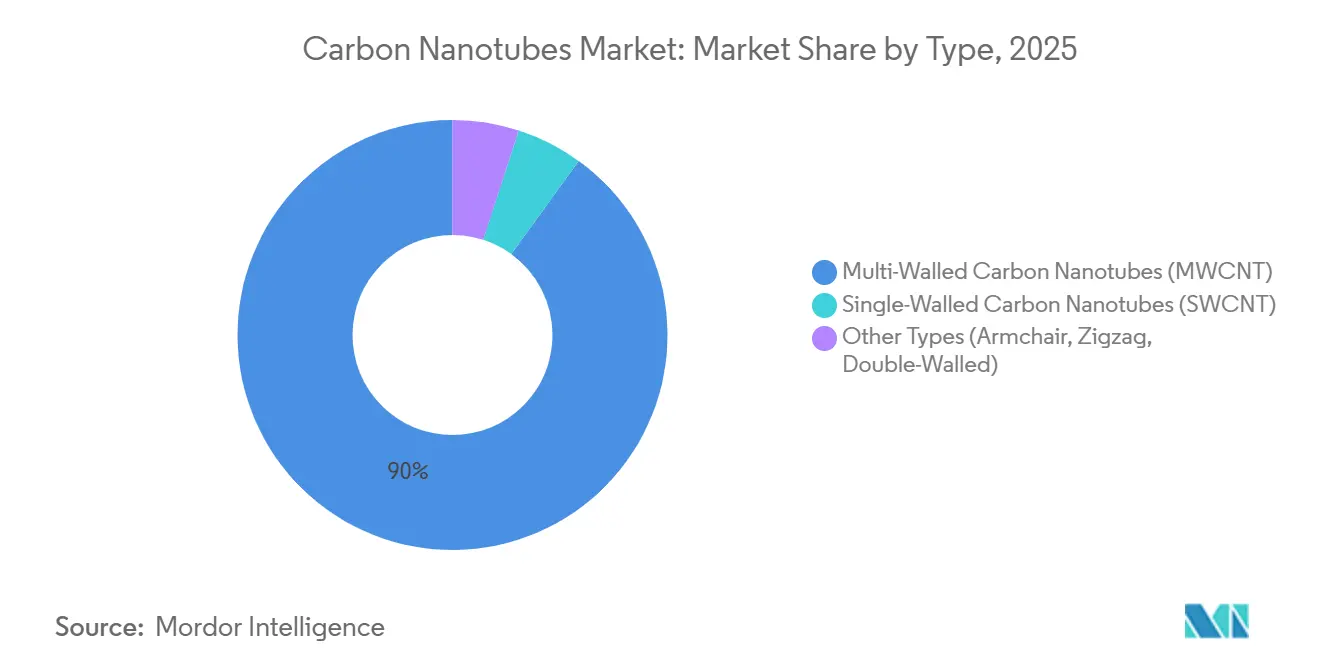
- By type, multi-walled variants held 90.03% of the carbon nanotubes market share in 2025 and are anticipated to grow at a CAGR of 20.67% during 2026-2031.
- By manufacturing method, chemical vapor deposition (CVD) accounted for 70.21% share of the carbon nanotubes market size in 2025 and is expected to grow at a 21.80% CAGR during 2026-2031.
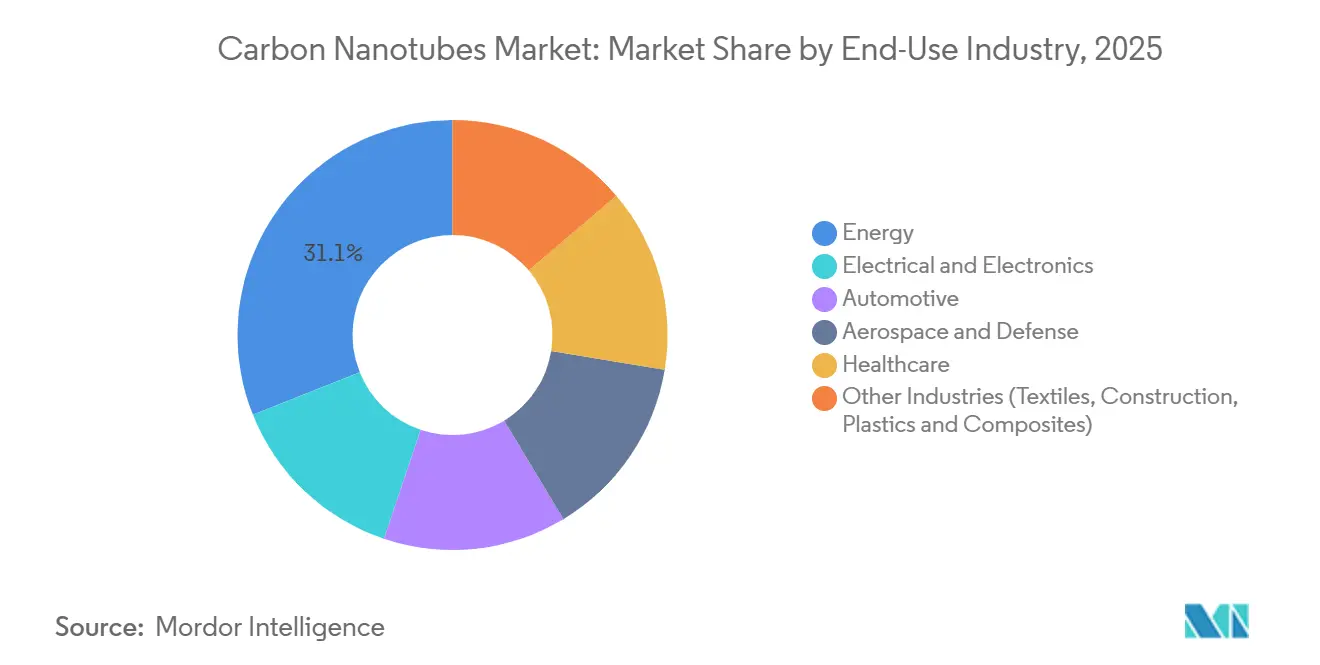
- By end-use industry, energy applications led with 31.06% revenue share in 2025; healthcare is forecast to expand at a 32.42% CAGR during 2026-2031.
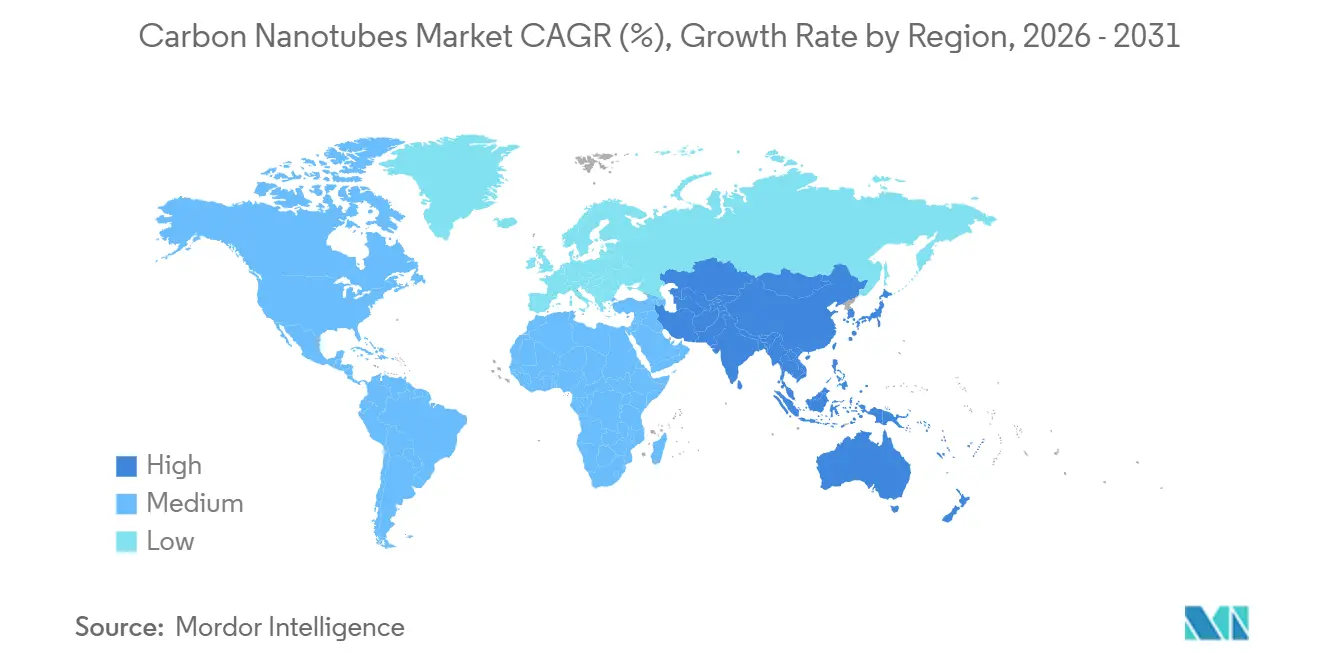
- By geography, Asia-Pacific captured 54.45% of the carbon nanotubes market share in 2025 and is projected to record a 21.67% CAGR during 2026-2031.
Note: Market size and forecast figures in this report are generated using Mordor Intelligence’s proprietary estimation framework, updated with the latest available data and insights as of January 2026.
Market Trends and Insights
Drivers Impact Analysis of Carbon Nanotubes Market*
| Drivers | (~) % Impact on CAGR Forecast | Geographic Relevance | Impact Timeline |
|---|---|---|---|
| E-mobility boom accelerating CNT demand | +6.2% | Global, strong in China, EU, North America | Medium term (2-4 years) |
| Leap in high-energy-density Li-ion and supercapacitor production | +5.8% | APAC core, spill-over to North America and EU | Medium term (2-4 years) |
| Aerospace push for ultra-light structural composites | +3.1% | North America, EU, emerging Middle East | Long term (≥ 4 years) |
| Additive manufacturing integration for conductive filaments | +2.4% | North America, EU, Japan | Medium term (2-4 years) |
| Quantum-computing interconnect wiring requirements | +1.2% | North America, select EU and APAC research hubs | Long term (≥ 4 years) |
| Source: Mordor Intelligence | |||
E-mobility Boom Accelerating CNT Demand
Electric-vehicle battery packs now incorporate 0.5-2.0 wt% CNTs to maintain electron pathways across silicon-graphite anodes that swell during cycling. LG Chem’s four South Korean plants deliver 6,100 tons/year output under multi-year contracts with Tier-1 automakers, locking in supply for global platform launches. China’s New Energy Vehicle plan sets a 50,000 tons/year CNT requirement by 2025, already matched by Jiangsu Cnano’s 12,000 tons/year single-site capacity. The migration toward lithium-iron-phosphate chemistries intensifies demand because LFP cells need higher conductive-additive loadings. Solid-state prototypes from QuantumScape and Samsung SDI embed nanotube current collectors, positioning CNTs as a bridging solution through the 2030s.
Leap in High-Energy-Density Li-ion and Supercapacitor Production
Vertically aligned CNT forests deliver surface areas above 1,000 m²/g that drive supercapacitor power densities of 10-15 kW/kg. Resonac Holdings supplies dispersions for 48-V mild-hybrid modules that buffer load spikes and extend pack life. Laboratory CNT-sulfur cathodes have reached 400 Wh/kg, though commercial timelines depend on polysulfide mitigation. Kumho Petrochemical operates a 1,200-ton/year plant delivering ultra-pure grades with <100 ppm metals for supercapacitors. Grid projects in California and Germany pilot CNT-supercapacitor banks that could absorb 5,000 tons/year by 2030 once costs fall below USD 200/kWh.
Aerospace Push for Ultra-Light Structural Composites
Toray Industries invested JPY 5 billion from 2024-2026 to scale CNT-enhanced prepregs that cut airframe weight by 20% while adding EMI shielding above 60 dB[1]Toray Industries, “Annual Report 2025,” toray.com . NASA tests show 1 wt% CNT in epoxy raises lightning-strike resistance by 40%, easing certification hurdles. Airbus and Boeing evaluate CNT-doped resins for wing spars that can deliver 12% lifetime fuel savings. Defense programs seek CNT radomes that survive Mach 5 heat loads while staying radar transparent. Nanocyl’s NC7000 functionalization improves laminate dispersion, although aerospace qualification extends three to five years.
Additive Manufacturing Integration for Conductive Filaments
CNT-filled 3D-printing filaments enable rapid production of antenna housings, EMI gaskets, and flexible circuits, shrinking prototyping cycles from weeks to hours. Applied Nanostructures supplies single-walled grades for aerospace tooling where static dissipation is critical. Automotive plants print CNT-PLA sensor enclosures, achieving 10^6 S/m conductivity at 10 wt% loading, eliminating secondary metallization steps. Stratasys and Ultimaker ship printers with CNT filament profiles, moving technology from lab to factory. Nozzle abrasion challenges spurred ruby-tip designs that quintuple lifespan, cutting the total cost of ownership. ISO/ASTM 52900 amendments to cover CNT composites will speed adoption in regulated sectors.
Restraints Impact Analysis of Carbon Nanotubes Market*
| Restraints | (~) % Impact on CAGR Forecast | Geographic Relevance | Impact Timeline |
|---|---|---|---|
| Occupational toxicology and nano-regulation tightening in EU and US | -2.8% | EU, North America, monitoring in APAC | Short term (≤ 2 years) |
| Competition from graphene and boron-nitride nanotubes in thermal apps | -1.9% | Global, intense in electronics and composites | Medium term (2-4 years) |
| Volatility in petro-chemical feedstock supply during green transition | -1.5% | Global, acute where gas imports dominate | Short term (≤ 2 years) |
| Source: Mordor Intelligence | |||
Occupational Toxicology and Nano-Regulation Tightening in EU and US
The European Chemicals Agency listed multi-walled CNTs as substances of very great concern under REACH Annex XIV in 2024, triggering costly authorization filings for users above 1 ton/year[2]European Chemicals Agency, “REACH Annex XIV Decision 2024,” echa.europa.eu. NIOSH set a 1 µg/m³ exposure limit that forces enclosed handling and real-time aerosol monitoring, adding USD 2-5 million in capex for mid-scale plants. Long CNT fibers longer than 15 µm show asbestos-like inflammation in rodent lungs, though human epidemiology remains limited. Smaller European firms see compliance costs topping 15% of revenue, accelerating consolidation. ISO 80004 terminology harmonization helps, but divergent national rollouts still hamper cross-border supply chains. Producers invest in surface treatments that shorten aspect ratios below 10:1, a strategy that early in vitro assays suggest lowers cytotoxicity.
Competition from Graphene and Boron-Nitride Nanotubes in Thermal Apps
Graphene nanoplatelets reach in-plane thermal conductivities of 3,000-5,000 W/m-K, surpassing CNT composites in two-dimensional heat spreaders for smartphones and LED modules. Boron-nitride nanotubes deliver similar heat conduction while remaining electrically insulating, preferred in high-voltage power electronics. Scaled Chinese graphene plants cut multi-layer prices to USD 100-200/kg in 2025, squeezing CNT cost advantage in non-conductive roles. Hybrid graphene-CNT blends add complexity to supply chains and quality assurance. Patent filings for graphene conductive inks rose 40% YoY in 2024, hinting at displacement risk in printed electronics if print resolution issues resolve. CNT suppliers counter by stressing superior aspect ratios for percolation, flexibility for wearables, and validated aerospace pedigrees.
*Our forecasts treat driver/restraint impacts as directional, not additive. The impact forecasts reflect baseline growth, mix effects, and variable interactions.
Carbon Nanotubes Market Segment Analysis
By Type:
Multi-Walled Variants Dominate Cost-Sensitive VolumesMulti-walled nanotubes commanded 90.03% of carbon nanotubes market share in 2025 and are forecast to advance at a 20.67% CAGR through 2031. Pricing between USD 50-300/kg secures traction in battery, composite, and plastics lines where cost sensitivity overrides ultimate conductivity. Single-walled grades’ USD 1,500-2,000/kg prices confine them to semiconductor and quantum-computing uses that prize purity and narrow diameter spread. Emerging few-walled variants from OCSiAl preserve 70% of SWCNT conductivity at 40% of the cost, enticing battery makers aiming to slash additive loadings without sacrificing performance. Armchair SWCNTs target OLED conductive films once sheet resistance falls below 100 Ω/sq, a milestone expected within three years.
Supply scalability favors multi-walled feedstock because CVD mega-plants deliver volumes unattainable with HiPco or laser ablation. The carbon nanotubes market size for multi-walled products is projected to exceed USD 13 billion by 2031 under base-case demand scenarios. Regulatory clearance is smoother as larger diameters reduce fiber biopersistence. Yet premium single-walled lines keep margins high through IP-protected purification, commanding 30-40% EBIT. Producers that straddle both tiers hedge revenue streams, capturing high-volume commodity sales while cultivating specialty niches in photonics and quantum devices.



By Manufacturing Method:
CVD Scales While Arc Discharge RetreatsCVD processes generated 70.21% of 2025 output and will sustain a 21.80% CAGR, cementing leadership as gas-looping reactors lift conversion efficiency to 95% and recycle catalysts. HiPco maintains a considerable market size for electronics-grade single-wall lines, although batch limits and high CO pressures cap daily throughput. Arc discharge shrank, and laser ablation volume is relegated to laboratory supply, where purity trumps economics. Raymor’s closed-loop methane recovery slashes feedstock costs by 60%, underpinning a USD 25 million battery-sector contract signed in 2025.
Prospects hinge on energy intensity and regulatory compliance. Plasma-enhanced CVD at 400 °C promises direct growth on polymer films for wearable electronics, a niche that could capture 5% of the carbon nanotubes market size over the forecast period if scalability tests succeed. Arc discharge remains essential for prototype research as it yields pristine crystals, yet the electricity use of 10 kWh/g undermines commercial viability. Producers pivot toward modular CVD lines that can track regional demand, trimming logistics lead times from quarters to weeks.
By End-Use Industry:
Energy Leads While Healthcare SurgesEnergy applications absorbed 31.06% of the 2025 volume, reflecting entrenched use in lithium-ion batteries and supercapacitors. Healthcare posts the fastest 32.42% CAGR as CNT-based biosensors and drug carriers move through Phase I trials. Electrical and electronics demand is propelled by conductive inks for PCBs and radio-frequency shielding films. In automotive, CNT-reinforced composites cut part weight without sacrificing stiffness. Demand from aerospace and defense is driven by lightning-strike protection and radar-transparent composites.
By 2031, the carbon nanotubes market size for healthcare is anticipated to gain significant momentum once biosensing, imaging, and targeted delivery platforms gain regulatory clearance. Automotive demand scales with EV output; 50-200 g CNTs per battery pack translates to multikiloton volumes when global EV production reaches 30 million units. Aerospace growth depends on qualification timelines, yet Boeing’s 777X wing-spar specification could consume 500 ton/year from 2027 onward. Construction and textiles remain niche but expand steadily as smart fabrics and RF-shielded concrete find new adopters.
Geography Analysis
APAC Carbon Nanotubes Market
Asia-Pacific dominated with 54.45% of the 2025 volume and is forecast to rise at a 21.67% CAGR during 2026-2031. China’s 12,000-ton/year Jiangsu Cnano complex and South Korea’s 6,100 tons/year LG Chem network anchor regional supply pipelines to CATL, BYD, Samsung SDI, and SK Innovation. Japan prioritizes high-purity lines for aerospace and semiconductors, leveraging Toray’s ¥5 billion prepreg expansion. India relies on imports today, but incentives under its PLI scheme could spark domestic CVD projects by 2028. Regional pricing sits at USD 50-80/kg for multi-walled grades due to integration into petrochemical feedstocks and scale economies.
North America Carbon Nanotubes Market
North America's market growth is influenced by domestic sourcing from the aerospace, defense, and energy storage industries. Inflation Reduction Act tax credits support potential 2,000-ton/year new capacity colocated with battery gigafactories. Canada’s Raymor markets low-carbon plasma-torch CNTs powered by hydropower, while Mexico offers dispersion and compounding services for automotive suppliers.
EMEA and South America Carbon Nanotubes Market
Europe's captured CNT demand is bolstered by the European Battery Alliance’s drive for local conductive additives. Nanocyl and Arkema operate mid-scale plants serving Airbus and Stellantis platforms, yet REACH compliance adds cost layers that pressure smaller entrants. Thomas Swan’s U.K. lines secure defense demand where ITAR rules deter Asian imports. South America and the Middle East-Africa are witnessing gradual market growth, with Brazil importing CNTs for agrochemicals and Saudi Arabia studying petrochemical integration as part of Vision 2030.

Regulatory Landscape
Regulation for carbon nanotubes is tightening around nanoform-specific identification, workplace exposure control, and standardized hazard communication. In the European Union, the European Chemicals Agency (ECHA) enforces REACH nanoform requirements for characterization and registration, and the report context notes multi-walled CNTs being listed as substances of very great concern in 2024, which increases authorization and compliance burdens for users above volume thresholds. In the United States, the US Environmental Protection Agency (EPA) finalized Significant New Use Rules (SNURs) for certain multi-walled carbon nanotubes (effective February 10, 2025), which expands notification and risk management obligations for designated new uses.
Standards bodies are also shaping market access by defining how CNTs are measured and documented. ISO/TS 13329:2024 provides guidance for preparing Safety Data Sheets (SDS) for nanomaterials, while ISO/TS 23690:2023 supports impurity testing for multi-walled CNTs, helping harmonize customer qualification and cross-border shipment documentation. In May 2026, ISO/TC 229 approved a new project focused on characterization of multiwall carbon nanotube powder samples, reinforcing the shift toward traceable, method-backed specifications that large battery, aerospace, and electronics buyers increasingly require.
Value Chain Analysis
The value chain starts with hydrocarbon and carbon feedstocks (natural gas, petrochemical streams) and catalyst or consumable suppliers, then moves into CNT synthesis, primarily chemical vapor deposition (CVD) for commercial volumes, followed by purification, functionalization, and formulation into powders, slurries, and masterbatches. Formulation and dispersion capabilities are key value-add nodes because they translate CNT performance into electrode slurries, polymer compounds, conductive inks, and silicone systems that downstream converters can process at scale. The chain extends into battery materials and cell manufacturing, plastics and composite compounders, aerospace prepreg and resin formulators, electronics materials suppliers, and, in smaller volumes, biomedical and sensor developers.
Recent partnerships also point to regionalized and application-specific supply chains. CHASM Advanced Materials and Ingevity signed a license agreement (November 2025) for CHASM's NTeC-E CNT production technology to manufacture battery-oriented CNT additives in North America and select European countries, reflecting localization for gigafactory ecosystems. In Asia, UP Catalyst and SGC Energy announced a South Korea demonstration partnership (April 2026) for local CNT and graphite production, while OCSiAl tied its Serbia facility into an automotive battery platform via a customer selection for PowerCo (Volkswagen Group) announced in June 2026. These moves highlight where bargaining power concentrates: high-volume battery platforms and qualified dispersions pull value downstream, while scale CVD assets, analytical quality control, and compliance-ready SDS and characterization data support supplier positioning upstream.
Competitive Landscape
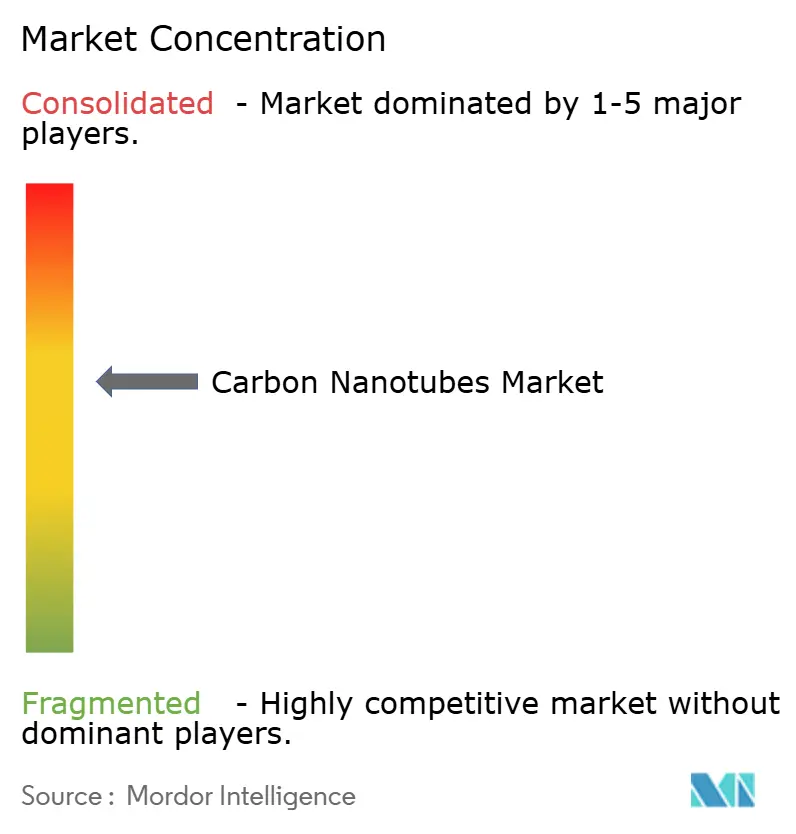
The carbon nanotubes market is moderately fragmented. Asian leaders pursue scale and price leadership, integrating feedstocks and locking customers under multi-year battery contracts. Western counterparts focus on high-margin aerospace, defense, and semiconductor niches where certifications and security-of-supply mandates outweigh price. Patent races center on catalyst design and functionalization; OCSiAl owns 180 floating-catalyst patents, Toray holds 95 composite-interface filings, and Hyperion Catalysis guards foundational fiber.
Disruptors emerge in methane pyrolysis and plasma-enhanced CVD. C-Zero targets negative-cost feedstocks via hydrogen coproducts, while FutureCarbon pursues low-temperature deposition on polymers. Vertical integration intensifies as LG Chem back-integrates into ethylene crackers and OCSiAl forward-integrates into masterbatches, capturing value across the chain. ISO 80004 standardization eases customer multisourcing, tilting the advantage toward cost-competitive suppliers. Companies offering ready-to-use dispersions in customer solvents capture 20-30% price premiums by simplifying downstream processing.
Carbon Nanotubes Industry Leaders
OCSiAl
LG Chem
Jiangsu Cnano Technology Co., Ltd.
Cabot Corporation
Toray Industries, Inc.
- *Disclaimer: Major Players sorted in no particular order
Carbon Nanotubes Market Companies Covered in this Report
- Applied Nanostructures, Inc.
- Arkema
- Cabot Corporation
- Carbon Solutions, Inc.
- CHASM
- Cheap Tubes
- Chengdu Organic Chemicals Co., Ltd.
- CNT Co., Ltd.
- FutureCarbon GmbH
- Hanwha Group
- Hyperion Catalysis International
- Jiangsu Cnano Technology Co., Ltd.
- Kumho Petrochemical
- LG Chem
- Meijo Nano Carbon Co.,Ltd
- Nano-C
- Nanocyl SA
- OCSiAl
- Raymor Industries Inc.
- Resonac Holdings Corporation
- Thomas Swan & Co., Ltd.
- Toray Industries, Inc.
- Zyvex Technologies

Market Opportunities and Future Outlook
Battery conductive additives remain the most visible volume opportunity, with a clear shift from CNTs as a performance enhancer in premium cells toward integration into mass-market EV platforms and more regionalized supply. OCSiAl's June 2026 supply agreement to provide single-wall CNT additives for PowerCo (Volkswagen Group) and its Unified Cell battery platform indicates a direct pathway for CNT pull-through from standardized cell architectures. Capacity actions reinforce this trend: Zeon Corporation announced in April 2026 that it will expand single-walled CNT production at its Tokuyama Plant by more than tenfold, with the initiative certified by Japan's Ministry of Economy, Trade and Industry (METI) under its Ensuring Supply Plan for Storage Batteries, linking CNT supply build-out to national battery supply-chain programs.
New manufacturing pathways and localized facilities broaden the opportunity set beyond incumbent CVD mega-plants, particularly where carbon intensity and supply security are procurement constraints. China Petroleum Engineering & Construction Corp. (CPECC) commissioned a thousand-ton-scale line in January 2026 using natural gas cracking with hydrogen co-product, while NAWAH inaugurated a vertically aligned carbon nanotube (VACNT) manufacturing facility in Ohio in June 2026 with a stated commercial capacity target (by area) for 2026. Alongside licensing and localization moves in North America and Europe, these developments create whitespace for suppliers that can deliver verified nanoform characterization, low-metal purity grades, and drop-in dispersions for anode systems, conductive plastics, and silicone and elastomer applications, where qualification and processing convenience shape adoption speed.
Recent Industry Developments in Carbon Nanotubes Market
- June 2026: OCSiAl was selected by PowerCo (Volkswagen Group) to supply TUBALL single-wall carbon nanotube additives for graphite anodes used in the Unified Cell battery platform, with material produced at OCSiAl's Stara Pazova facility in Serbia. The selection embeds CNTs into a standardized, high-volume EV cell architecture and strengthens Europe-focused supply chains for conductive additives.
- December 2025: OCSiAl opened a new laboratory in Serbia focused on developing graphene nanotube solutions for liquid silicone rubber (LSR) and room-temperature-vulcanising (RTV) systems. The move expands CNT-adjacent formulation and application-development capability, supporting diversification into industrial elastomers and higher-value specialty compounds.
- July 2025: Imerys Graphite & Carbon and Cnano Technology announced a partnership to provide commercial-scale products, combining carbon material and CNT capabilities for downstream customers. The collaboration targets more complete solutions for battery and industrial material supply chains, where buyers increasingly prefer qualified, application-ready carbon additive portfolios.


Carbon Nanotubes Market Report Scope and Research Methodology
Market Definition and Coverage
For this study, the carbon nanotubes market is the revenue from selling CNT materials (including powders, dispersions, slurries, and masterbatches) to end users and compounders across major regions, measured at the point of first commercial sale.
Scope exclusions: We exclude the value of downstream finished parts and devices where CNTs are only an embedded additive and are not sold as a CNT material line item.
Segments Covered in This Report
- By Type
- Multi-Walled Carbon Nanotubes (MWCNT)
- Single-Walled Carbon Nanotubes (SWCNT)
- Other Types (Armchair, Zigzag, Double-Walled)
- By Manufacturing Method
- Chemical Vapor Deposition (CVD)
- High-Pressure Carbon Monoxide (HiPco)
- Arc Discharge
- Laser Ablation
- By End-Use Industry
- Electrical and Electronics
- Energy
- Automotive
- Aerospace and Defense
- Healthcare
- Other Industries (Textiles, Construction, Plastics and Composites)
- By Geography
- Asia-Pacific
- China
- India
- Japan
- South Korea
- Rest of Asia-Pacific
- North America
- United States
- Canada
- Mexico
- Europe
- Germany
- United Kingdom
- Italy
- France
- Spain
- Rest of Europe
- South America
- Brazil
- Argentina
- Rest of South America
- Middle East and Africa
- Saudi Arabia
- South Africa
- Rest of Middle East and Africa
- Asia-Pacific
Data Sources, Market Sizing, and Validation
Desk Research
Desk research was used to set the market boundaries, map demand by application, and anchor assumptions that can be checked outside interviews. We relied on public sources such as USGS mineral and materials statistics, the US Census Bureau and UN Comtrade for trade signals, IEA battery and energy storage publications, and technical papers from sources like NIST and peer reviewed journals that discuss CNT performance and use rates.
We also reviewed company annual reports, investor presentations, product brochures, and press releases to understand capacity expansions, grade positioning, and typical shipment forms. Where needed, we used paid subscriptions for company financials and intelligence, patent databases, and shipment level import export records to cross check active producers and trade movements. These desk sources are illustrative only, and we used additional public references during data collection and follow up validation.
Primary Interviews and Surveys
Primary work focused on structured interviews and short surveys with CNT producers, distributors, compounders, and large end users in batteries, electronics, and polymers, then callbacks when answers did not align. For a global view, inputs were balanced across APAC, EMEA, and the Americas so pricing, adoption timing, and grade mix assumptions could be tested against actual buying and selling behavior.
Distribution of primary research fieldwork respondents
| Company type | Respondent position | Region |
|---|---|---|
| Top tier: 26% | CXOs: 13% | APAC: 45% |
| Mid tier: 56% | Functional/Unit leaders: 28% | EMEA: 29% |
| Smaller Players: 18% | Managers: 59% | Americas: 26% |
Market-Sizing & Forecasting
Sizing started with a top-down build, where production, trade movements, and application level adoption signals were used to reconstruct a regional addressable CNT material demand pool, then value was derived through a blended price approach. We also checked results with selective bottom-up approximations, such as sampling supplier revenues where available, channel checks on typical ASP ranges, and volume times ASP sanity checks for key applications, which were used to adjust totals when gaps appeared.
Key model inputs included battery manufacturing growth and conductive additive intensity, EV and stationary storage penetration, polymer compounding output where conductive plastics are relevant, average selling price differences by material form (powder versus dispersion or masterbatch), and the pace of capacity additions and utilization changes. Forecasting used scenario analysis, with the core case anchored to expert consensus on adoption timing and price progression, then stress tested with slower qualification cycles or faster battery demand ramps. When bottom-up coverage was incomplete for smaller producers, we applied conservative gap factors tied to observed trade and capacity signals, and then rechecked in follow-up interviews.
Data Validation & Update Cycle
Model outputs were triangulated against independent checks, including trade direction, announced capacity expansions, and the implied volume demand from large application areas, then variances were investigated before totals were accepted. Where an input created an abnormal jump (for example, an ASP shift that did not match customer feedback), it was flagged, reworked, and sometimes revalidated through a quick re-contact.
Each deliverable went through multi-step analyst review to keep assumptions, units, and conversions consistent across regions and years. The report is refreshed annually, and interim updates are made when material events occur, such as major plant start-ups, supply disruptions, or sharp feedstock and energy cost moves. Before delivery, a final pass is completed so clients receive the most current view supported by traceable inputs.
Mordor Intelligence's Carbon Nanotubes Market Estimate Compared With Other Published Estimates
Published CNT market values can look far apart because the boundary is not always consistent, and because price and volume assumptions move quickly in this space. Differences also come from the year selected as the starting point, the way dispersions and masterbatches are treated, and how strictly downstream part value is excluded.
By tracking first sale CNT material revenues and refreshing the price and form mix assumptions with validation checks, Mordor Intelligence keeps the estimate tied to what is actually traded as CNT material rather than counting the value of finished components that only contain CNTs.
Benchmark comparison
| Source | Market Size | Gaps in Research Methodology |
|---|---|---|
| Mordor Intelligence | USD 6.93 B (2026) | |
| Global Consultancy A | USD 3.71 B (2024) | Uses an earlier base year and can undercount newer battery-led demand if adoption and capacity ramp timing are not updated, which pulls down the starting market size versus a later-year snapshot. |
| Industry Publisher B | USD 7.75 B (2025) | May include a broader revenue boundary, where value from downstream finished goods or wider nanomaterials adjacencies is partially captured, and this can lift the total even before year-to-year growth is applied. |
The spread across sources mainly reflects year selection and what exactly is being priced, meaning CNT material at first sale versus value that sits further downstream. Using a clearly defined boundary and repeatable checks on adoption, form mix, and ASP progression helps keep the final number explainable and practical for planning.


Key Questions Answered in the Report
How large is the carbon nanotube market in 2026?
The carbon nanotubes market size is USD 6.93 billion in 2026 with a projected 21.13% CAGR to 2031.
Which segment holds the biggest share of global demand?
Multi-walled variants dominate with 90.03% of carbon nanotubes market share in 2025, driven by battery and composite use.
What region leads production and consumption?
Asia-Pacific accounts for 54.45% of 2025 volume and continues to expand as China and South Korea add large-scale CVD capacity.
Why are CNTs important for electric-vehicle batteries?
Adding 0.5-2.0 wt% CNTs boosts electrode conductivity, enabling higher rate capability and longer cycle life in lithium-ion packs.
What are the main regulatory challenges facing producers?
EU REACH classification as a substance of very high concern and NIOSH exposure limits require costly containment and compliance systems.
Which companies are investing in new capacity?
OCSiAl is building a 10,000 ton/year plant in Luxembourg, LG Chem raised South Korean output to 6,100 ton/year, and Jiangsu Cnano expanded to 12,000 ton/year.
Page last updated on:


 Your data is secure and never sold or shared.


