
Landscaping Tools Market Size and Share
Market Overview
| Study Period | 2021 - 2031 |
|---|---|
| Market Size (2026) | USD 37.22 Billion |
| Market Size (2031) | USD 49.21 Billion |
| Growth Rate (2026 - 2031) | 5.74 % |
| Fastest Growing Market | Asia Pacific |
| Largest Market | North America |
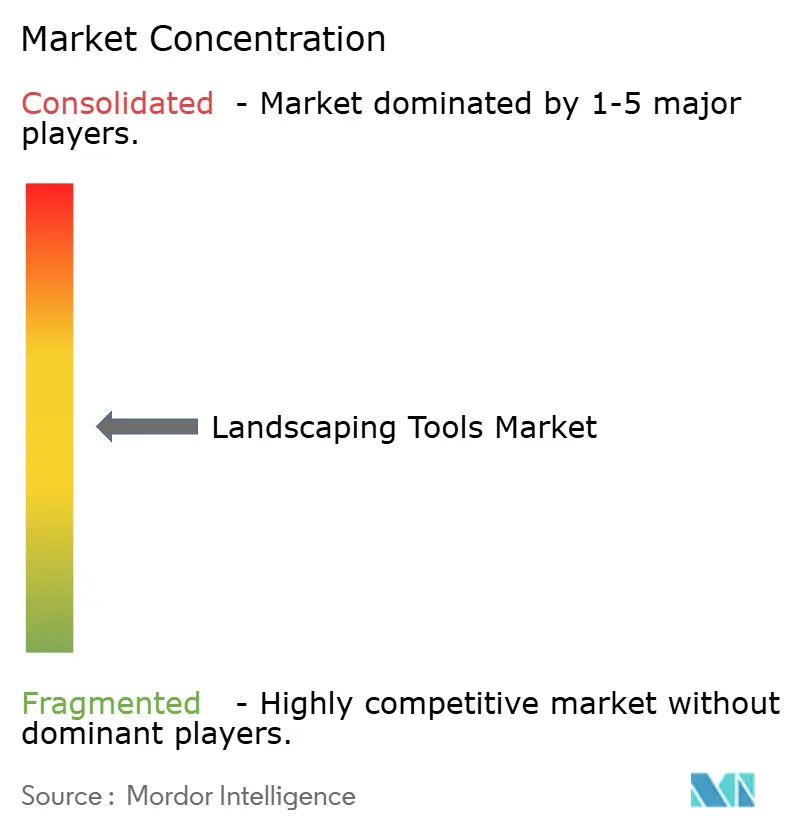
| Market Concentration | Medium |
Major Players *Disclaimer: Major Players sorted in no particular order Image © Mordor Intelligence. Reuse requires attribution under CC BY 4.0. | |
Landscaping Tools Market Analysis by Mordor Intelligence
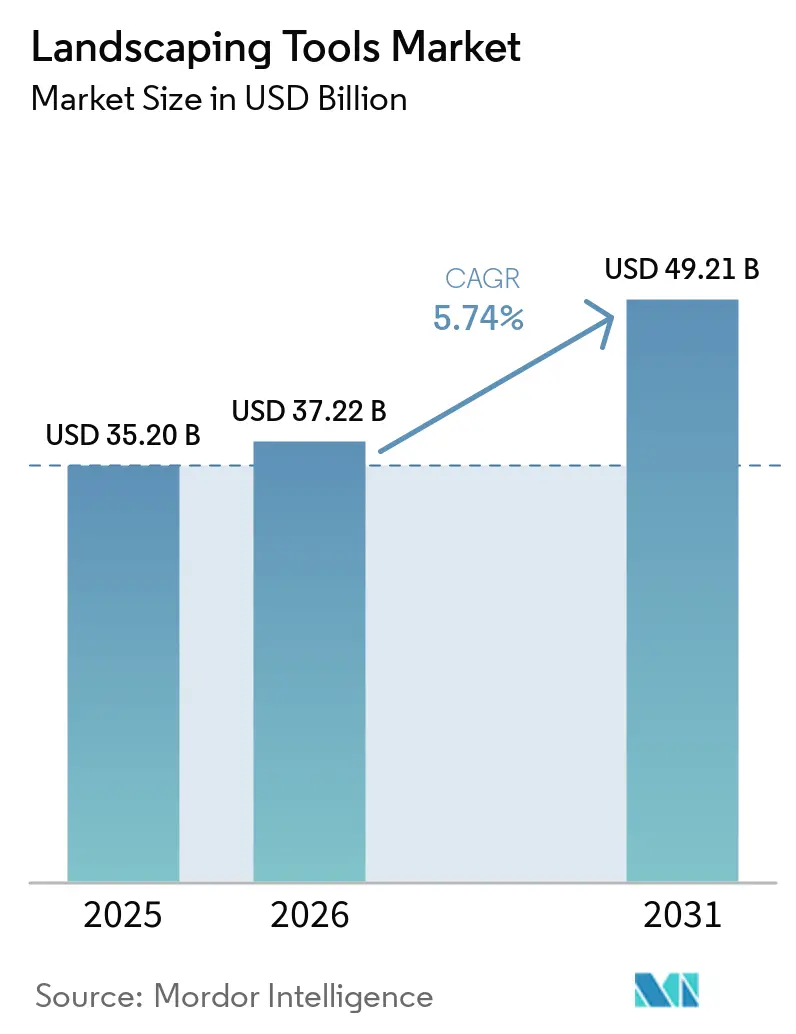
The landscaping tools market size is expected to grow from USD 35.20 billion in 2025 to USD 37.22 billion in 2026 and is forecast to reach USD 49.21 billion by 2031 at 5.74% CAGR over 2026-2031. Rising do-it-yourself lawn care, public-sector carbon-neutral targets, and rapid battery cost declines are reshaping product demand, with North America maintaining its market leadership, while the Asia-Pacific region shows the highest growth rate. Equipment electrification is accelerating as lithium-ion prices fall below USD 100 per kWh, pushing battery-powered models toward cost parity with gasoline units. Municipal rebate schemes in California and similar initiatives in Europe are boosting zero-emission purchases, and robotic mowers are gaining traction as labor shortages constrain contractor capacity[1]Source: California Air Resources Board, “Zero-Emission Landscaping Equipment Incentive Programs,” arb.ca.gov. Competitive intensity remains moderate, the top five companies control half of global revenue, yet category fragmentation still creates entry points for specialists focused on automation and connected-fleet services.
Key Report Takeaways
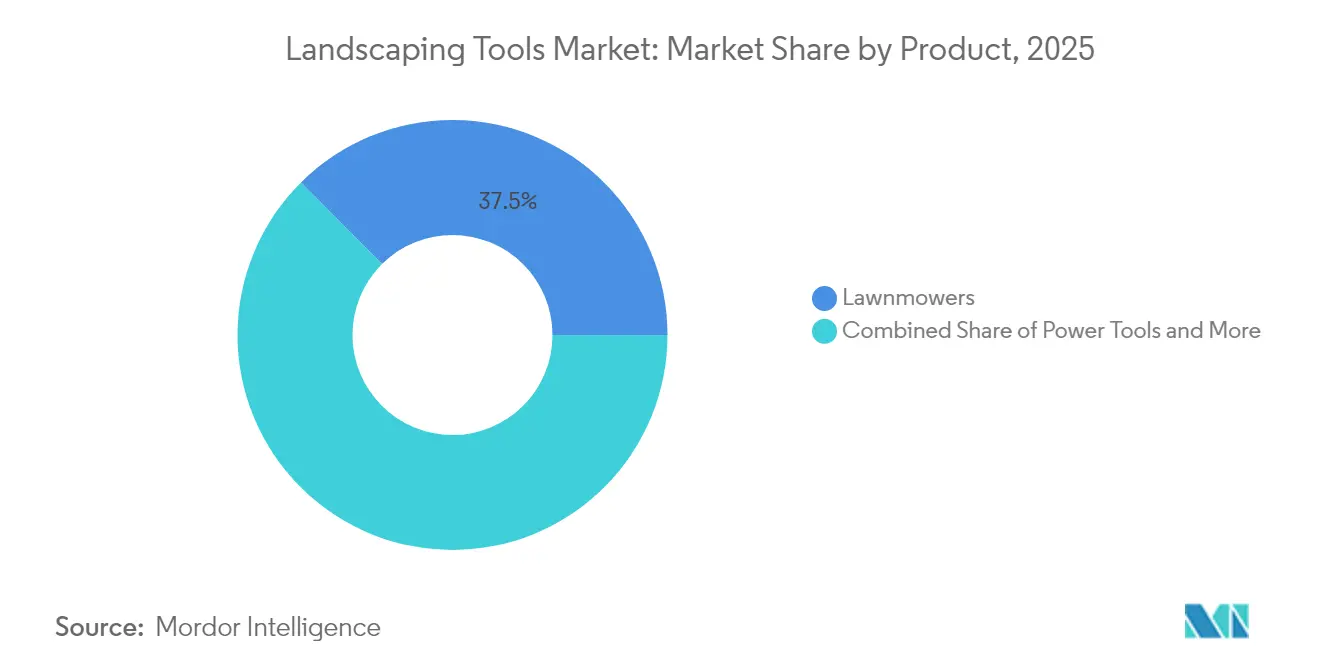
- By product, lawn mowers maintain dominance with a 37.45% of the Landscaping tools market share in 2025, while Power tools emerge as the fastest-growing category at 9.28% CAGR through 2031.
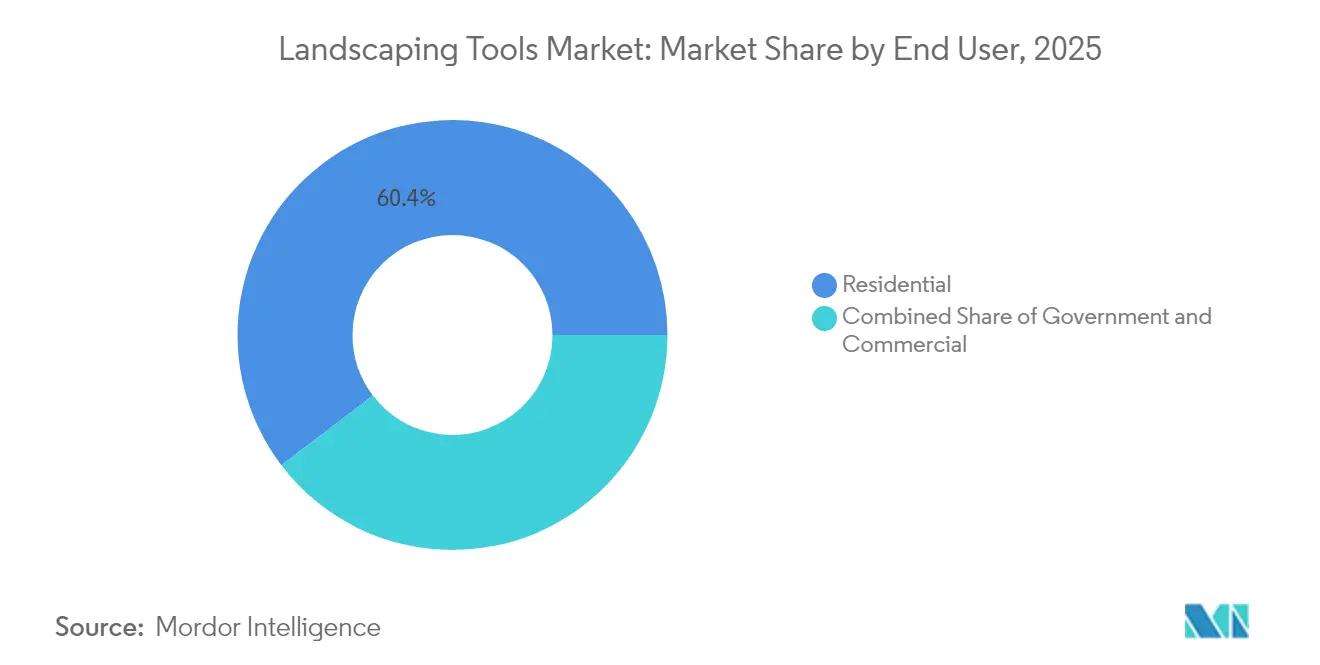
- By end user, residential users account for 60.35% of the Landscaping tools market share in 2025, while the Government represents the fastest-growing segment at 8.49% CAGR through 2031.
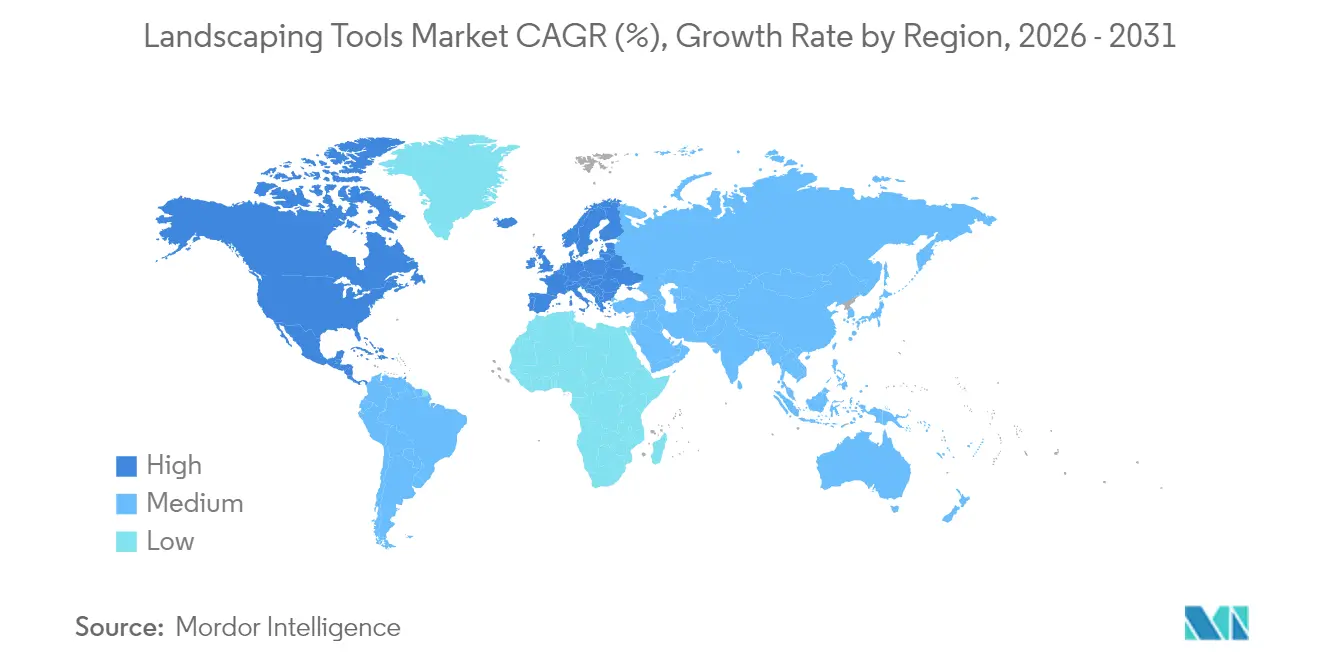
- By Geography, North America generated 37.62% of the Landscaping tools market share in 2025, while Asia-Pacific represents the fastest-growing segment at a 7.30% CAGR through 2031.
- The top five manufacturers, Deere and Company, Husqvarna AB, The Toro Company, Stanley Black and Decker Inc., and Robert Bosch GmbH collectively hold the largest share of worldwide revenue, indicating a moderately concentrated competitive environment.
Note: Market size and forecast figures in this report are generated using Mordor Intelligence’s proprietary estimation framework, updated with the latest available data and insights as of 2026.
Global Landscaping Tools Market Trends and Insights
Drivers Impact Analysis*
| Driver | (~) % Impact on CAGR Forecast | Geographic Relevance | Impact Timeline |
|---|---|---|---|
| Surging DIY (Do it Yourself) lawn‐care culture in suburban housing | +1.2% | North America, Western Europe, high-income Asia | Medium term (2-4 years) |
| Rapid urban adoption of green roofs and vertical gardens | +0.8% | Global tier-one metros | Long term (≥ 4 years) |
| Battery pack price declines below USD 100 /kWh | +1.5% | Global | Short term (≤ 2 years) |
| Integration of IoT-enabled fleet management for commercial landscaping | +0.7% | North America, and Europe | Medium term (2-4 years) |
| Municipal carbon-neutral targets boosting electric tool procurement | +1.0% | North America, Europe, and select Asia | Medium term (2-4 years) |
| Landscaping robots bundled with subscription-maintenance services | +0.6% | North America, Europe, and premium Asia | Long term (≥ 4 years) |
| Source: Mordor Intelligence | |||
Surging DIY (Do it Yourself) Lawn‐Care Culture in Suburban Housing
Suburban housing expansion across developed markets is driving unprecedented demand for residential landscaping tools as homeowners increasingly embrace DIY (Do it Yourself) maintenance practices. Work-from-home trends established during 2020-2021 have created sustained engagement with outdoor property improvement, with homeowners investing in professional-grade equipment previously reserved for commercial users. The shift toward DIY (Do it Yourself) culture reflects both cost consciousness and lifestyle preferences, as property owners seek greater control over maintenance schedules and quality standards. Dealers report rising demand for modular power-head systems that accept multiple attachments. Manufacturers able to bundle batteries with cross-platform compatibility gain repeat sales as consumers expand their tool sets.
Rapid Urban Adoption of Green Roofs and Vertical Gardens
Urban sustainability mandates are creating specialized demand for lightweight, precision landscaping tools designed for green infrastructure applications. Green roof installations require equipment capable of operating in weight-constrained environments, typically limiting loads to 80-150 pounds (36.3-68.0 kg) per square foot compared to traditional ground-level applications. This constraint drives demand for compact, battery-powered tools with specialized attachments for irrigation system maintenance, drainage management, and plant care in vertical growing systems. Compact cordless trimmers and irrigation-service attachments now feature quick-swap batteries and compact transport cases that fit standard roof access hatches.
Battery Pack Price Declines Below USD 100 /Kwh
Lithium-ion battery cost reductions are fundamentally altering the total cost of ownership equation between gasoline and electric landscaping equipment. Battery pack prices approaching USD 100 per kilowatt-hour enable electric tools to achieve cost parity with gasoline alternatives over 3-5 year ownership periods, particularly when factoring in reduced maintenance requirements and fuel costs. EGO Power Plus demonstrates this shift with cost analysis showing 5-year savings of EUR 5,068 (USD 5,947.80) for professional users switching from petrol to cordless equipment, driven primarily by the elimination of fuel and servicing costs after the initial year.
Integration of Iot-Enabled Fleet Management for Commercial Landscaping
Commercial landscaping operations are adopting IoT-enabled fleet management systems to address labor shortages and improve operational efficiency through real-time equipment monitoring and route optimization. Contractors deploy telematics modules that report location, run-time hours, and battery state of charge, improving route planning and proof-of-service documentation. Platforms from equipment makers now push over-the-air firmware updates that fine-tune cutting algorithms and extend runtime through optimized blade speed. The integration of IoT capabilities directly into landscaping tools creates opportunities for subscription-based service models and predictive maintenance programs that enhance customer retention and recurring revenue streams.
Restraints Impact Analysis*
| Restraint | (~) % Impact on CAGR Forecast | Geographic Relevance | Impact Timeline |
|---|---|---|---|
| Shortage of trained landscaping labor | −0.8% | North America, and Europe | Short term (≤ 2 years) |
| High upfront cost of commercial-grade cordless tools | −1.2% | Global | Medium term (2-4 years) |
| Grid-edge power limitations in large parks restricting electrification | −0.4% | North America, and Europe | Long term (≥ 4 years) |
| Rising noise-pollution bylaws curbing gas-powered tool usage windows | −0.6% | North America, Europe, select Asia-Pacific | Medium term (2-4 years) |
| Source: Mordor Intelligence | |||
Shortage of Trained Landscaping Labor
The landscaping industry's labor shortages restrict market growth by limiting service capacity and increasing operational costs across equipment categories. In 2024, H-2B visa applications for seasonal workers exceeded the United States cap of 66,000 by nearly 50%. While contractors are increasing automation adoption to address crew shortages, they continue to face challenges in meeting peak-season schedules, which affects equipment turnover. The National Association of Landscape Professionals advocates changing statutory language from "may authorize" to "shall authorize" for presidential H-2B visa approvals to improve workforce planning certainty. This labor constraint simultaneously drives automation adoption while restricting market expansion, as contractors cannot scale operations despite equipment availability.
High Upfront Cost of Commercial-Grade Cordless Tools
Capital cost barriers significantly constrain electric equipment adoption among small contractors and price-sensitive market segments, despite favorable total cost of ownership over multi-year periods. Commercial electric riding mowers range from USD 30,000-40,000 compared to USD 13,000 for equivalent gasoline models, while battery replacement costs add USD 10,000-15,000 every 3-5 years. The Inflation Reduction Act of 2022 (IRA) commercial clean vehicle tax credit provides partial relief with 30% coverage up to USD 7,500 for qualifying commercial mowers, but this still leaves substantial cost gaps for smaller operators. Financing and leasing programs are emerging as critical adoption enablers, with equipment rental companies like Ashtead Group expanding into landscaping tool categories to provide flexible access models that reduce upfront capital requirements [2]Source: Ashtead Group, “Annual Report 2024,” ashtead-group.com.
*Our forecasts treat driver/restraint impacts as directional, not additive. The impact forecasts reflect baseline growth, mix effects, and variable interactions.
Segment Analysis
By Product: Lawnmowers Maintain Leadership While Power Tools Accelerate
Lawnmowers maintain market dominance with a 37.45% market share share in 2025, driven by essential lawn maintenance needs across residential and commercial segments. Traditional walk-behind and riding mowers benefit from established distribution networks and proven reliability, and face increasing competition from robotic alternatives that eliminate labor requirements and reduce operational complexity.
Power tools emerge as the fastest-growing category at 9.28% CAGR through 2031, led by battery-powered hedge trimmers, chainsaws, and blowers. Power tools capitalize on electrification trends and regulatory mandates that favor battery-powered alternatives over gasoline engines, with manufacturers like STIHL launching multi-tool systems such as the KMA 120 R that connect to 12 interchangeable implements through quick-coupling mechanisms.



By End User: Residential Leadership Meets Commercial Growth
Residential users account for 60.35% market share in 2025, driven by suburban housing expansion, DIY (Do it Yourself) culture adoption, and work-from-home trends that increase property maintenance engagement among homeowners. The residential segment benefits from equipment rental growth, with companies like Ashtead Group expanding into landscaping tool categories to serve occasional-use customers who prefer rental over ownership
Government segments exhibit the fastest-growth potential at 8.49% CAGR through 2031 as public sector sustainability commitments drive electric equipment procurement and carbon-neutral operational mandates. Government procurement increasingly specifies environmental criteria and lifecycle cost considerations that favor electric equipment despite higher upfront costs, creating market signals that influence private sector adoption decisions.
Geography Analysis
North America retained 37.62% of the 2025 global market share. Widespread suburban lawns, mature contractor networks, and state-level zero-emission regulations combine to support sustained demand. Market volatility is tied to H-2B visa allocations that cap seasonal labor, nudging firms toward autonomous platforms. SiteOne Landscape Supply, the region’s largest distributor, posted USD 4.54 billion in 2024 sales after 66 acquisitions, illustrating ongoing consolidation.
Europe holds a significant market share due to stringent sustainability regulations and high disposable incomes. Ireland's 2025 procurement regulations increase the demand for battery-powered equipment in public tenders. European suppliers benefit from their proximity to regional buyers, while the United Kingdom faces import challenges due to post-Brexit trade barriers.
Asia-Pacific is the fastest-growing region at a 7.30% CAGR. Urbanization and rising middle-class incomes underpin residential sales, while local manufacturers scale robotic exports. Chinese producer Ninebot reported RMB 595 million (USD 82 million) in lawn-mower robot revenue for the first nine months of 2024. Japan and South Korea show early adoption of high-precision cordless platforms, whereas India presents upside once infrastructure for battery charging advances.

Regulatory Landscape
Emissions, noise, and safety requirements are tightening for outdoor power equipment and adjacent non-road machinery, which is pushing buyers and OEMs toward lower-emission powertrains and stronger compliance documentation. In the United States, California Air Resources Board (CARB) programs such as the statewide Zero-Emission Landscaping Equipment Incentive Programs (implemented in 2023) have provided rebates for commercial equipment purchases, reinforcing procurement pull from municipalities and contractors shifting away from gasoline units.
In the European Union, updates related to machinery access and conformity continue to shape product design and market entry processes. The European Commission published Implementing Decision (EU) 2026/546 in March 2026, adopting new harmonised standards relevant to agricultural machinery, while Regulation (EU) 2025/14 introduced technical requirements and approval procedures for non-road mobile machinery intended to circulate on public roads. Separately, the EU Machinery Regulation (EU) 2023/1230 has a full application date in January 2027, requiring manufacturers and importers to align technical files and conformity assessment procedures with the updated health and safety framework.
Competitive Landscape
The landscaping tools market is moderately consolidated with many large, small, and medium-sized manufacturers. The top players in the market include Deere and Company, Husqvarna AB, The Toro Company, Stanley Black and Decker Inc., and Robert Bosch GmbH. Product innovations and acquisitions are the primary strategies followed by these companies to increase their market share and improve their production capabilities using innovative technology.
Market moderately consolidates, reflecting diverse customer needs across residential, commercial, and municipal segments that favor different product attributes, price points, and service models. The competitive landscape increasingly emphasizes electrification capabilities, with companies investing heavily in battery technology, autonomous features, and IoT connectivity to differentiate offerings and capture premium pricing.
Strategic activity centers on electrification and digital integration. Husqvarna partnered with Flex in 2025 to divest a United States factory while securing long-term supply at a lower cost. Deere introduced its first autonomous stand-on mower earlier the same year, positioning itself for high-margin software upgrades. Chinese entrants pressure price points in robotic categories, compelling incumbents to emphasize brand reputation and after-sales service. Distributor consolidation, exemplified by SiteOne’s acquisition roll-up, creates purchasing scale that shifts bargaining power away from smaller suppliers.
Landscaping Tools Industry Leaders
Deere and Company
Husqvarna AB
The Toro Company
Stanley Black and Decker Inc.
Robert Bosch GmbH
- *Disclaimer: Major Players sorted in no particular order

Market Opportunities and Future Outlook
Electrification and battery-platform standardization create room for manufacturers to reduce total cost of ownership and simplify mixed-tool fleets for residential and professional users. With lithium-ion prices falling below USD 100 per kWh in the market context, shared battery ecosystems and cross-platform compatibility support purchase decisions, especially in high-turn categories such as cordless trimmers, blowers, and multi-tool power heads. OEMs and distributors can also expand financing, leasing, and rental access for commercial-grade cordless equipment where upfront cost remains a barrier, and equipment rental expansion into landscaping categories is already visible through players such as Ashtead Group.
Automation, connected tools, and subscription services are aligning with contractor labor constraints and government procurement criteria. The market context points to IoT-enabled fleet management adoption for proof-of-service, route optimization, and over-the-air updates, while robotic mowers gain traction as labor shortages constrain contractor capacity. The clearest opportunities center on integrated offerings that combine autonomous operation (robotic mowing or semi-autonomous cutting), telematics, and maintenance bundles for municipalities and large commercial accounts, particularly where carbon-neutral operational mandates and tender specifications are favoring electric equipment.
Recent Industry Developments
- April 2026: Robert Bosch GmbH introduced a new range of four cordless lawn mowers under its 18V Power for All System. By extending the shared-battery ecosystem deeper into lawn care, Bosch reinforced cross-category stickiness for users building multi-tool fleets and reduced friction around battery standardization.
- March 2025: Stanley Black and Decker expanded the DEWALT outdoor power equipment lineup to address more demanding landscaping applications. The broadened range supports contractors and serious DIY users looking for cordless alternatives across multiple tasks, reinforcing the competitive push toward higher-output battery platforms.
- March 2024: Sunseeker launched the Orion X7 wire-free robotic lawn mower series in North America, featuring its AONavi positioning and navigation system that combines RTK with VSLAM. The release advanced cable-free robotic mowing for complex yards and underscored how precision navigation is becoming a differentiator for reducing manual labor and improving cut consistency.


Research Methodology Framework and Report Scope
Market Definition and Coverage
This market covers the value of tools and equipment used to create and maintain lawns, gardens, and managed green spaces, across residential and commercial users, and across major global regions.
Scope exclusions: The sizing excludes landscaping services and labor, along with plants, seeds, fertilizers, and other consumable garden inputs.
Segmentation Overview
- By Product
- Lawnmowers
- Power Tools
- Hand Tools
- Other Landscaping Tools
- By End User
- Residential
- Commercial
- Government
- By Geography
- North America
- United States
- Canada
- Mexico
- Rest of North America
- Europe
- Germany
- United Kingdom
- France
- Russia
- Spain
- Rest of Europe
- Asia-Pacific
- China
- Japan
- India
- South Korea
- Rest of Asia-Pacific
- South America
- Brazil
- Argentina
- Rest of South America
- Middle East
- Saudi Arabia
- United Arab Emirates
- Rest of Middle East
- Africa
- South Africa
- Egypt
- Rest of Africa
- North America
Data Sources, Market Sizing, and Validation
Desk Research
Desk work starts by mapping the demand signals that drive tool purchases and by aligning definitions so the numbers do not mix tools with adjacent categories. We referenced public sources such as the US Census Bureau (housing and renovation indicators), the Bureau of Labor Statistics (employment and wage signals linked to landscaping activity), and USDA publications that describe yard and green-space upkeep patterns.
To keep the model tied to observed product movement, we also reviewed trade statistics such as UN Comtrade and USITC data for relevant tool and equipment flows, along with public policy and standards updates that influence electrification and emissions rules for outdoor equipment. Company annual reports, investor presentations, and reputable press coverage were used to understand product mix and channel shifts. When needed, we used paid subscriptions for company financials and news and for patent databases to confirm technology direction. The sources listed here are illustrative only, and additional public references were used across collection, validation, and clarification.
Primary Interviews and Surveys
Primary interviews and surveys were used to check what desk signals could not fully explain, especially the split between residential DIY buying and contractor purchasing, and how quickly battery-powered products are replacing gas models. We spoke with tool manufacturers and component suppliers, distributors and retailers, and professional landscaping buyers across the Americas, EMEA, and APAC so key assumptions could be tested and corrected before final sizing.
Distribution of primary research fieldwork respondents
| Company type | Respondent position | Region |
|---|---|---|
| Top tier: 32% | CXOs: 12% | APAC: 43% |
| Mid tier: 54% | Functional/Unit leaders: 41% | EMEA: 32% |
| Smaller Players: 14% | Managers: 47% | Americas: 25% |
Market-Sizing & Forecasting
The core sizing uses a top-down approach where household and commercial landscaping activity, along with equipment ownership and replacement cycles, is translated into an annual demand pool by region. Once that demand pool is formed, we apply product mix and pricing logic to estimate value, and then we corroborate totals with selective bottom-up checks such as sampled average selling price ranges multiplied by estimated unit volumes and channel information.
Inputs used in the model include the mix between manual and powered tools, the share shift toward battery-powered units, replacement and repair behavior for key equipment, and housing and renovation activity that drives yard upgrades. We also incorporate regional seasonality that changes annual purchasing patterns. Where data gaps exist for smaller categories, proxy indicators such as trade direction and product availability are used, and then the split is tightened through respondent feedback so the result remains explainable. For forecasting, we used scenario analysis supported by a multivariate view of drivers such as housing activity, landscaping labor availability, and electrification policy, then aligned it to expert expectations on pricing and adoption.
Data Validation & Update Cycle
Outputs are checked against independent signals such as category growth rates, import and export direction, and the implied per-user spending levels, and then we review any large variances until the numbers and narrative are consistent. When a region shows an unusual jump, we re-check the input series, confirm currency conversion timing, and revisit interview notes so the adjustment can be traced.
Before sign-off, the work goes through a multi-step analyst review where assumptions, calculations, and the final narrative are checked for internal consistency. If a material event occurs, such as a major change in emissions rules or a sharp shift in battery and component pricing, we re-contact relevant sources to refresh the assumption set. Reports refresh annually, with interim updates for material events, and before delivery an analyst performs a final pass so clients receive the latest updated view.
Mordor Intelligence's Landscaping Tools Market Size Compared With Other Published Estimates
Published market values for landscaping tools can differ even when the topic sounds the same, because year choices, inclusions, and price assumptions are not aligned across publishers. The gaps also come from how firms treat manual tools versus powered tools, whether online and offline channels are both included, and how currency and inflation effects are timed.
The most common drivers behind the spread are scope and forecasting posture. Some estimates expand coverage into broader gardening equipment baskets, and others rely on long-range growth rates without re-checking replacement cycles, battery adoption pace, and regional policy impacts that shape gasoline-to-battery switching.
Benchmark comparison
| Source | Market Size | Gaps in Research Methodology |
|---|---|---|
| Mordor Intelligence | USD 35.20 B (2025) | |
| Industry Data Provider A | USD 31.80 B (2024) | Uses a 2024 base year and a longer forecast window, and the headline roll-up can smooth near-term mix changes when powered categories shift toward battery models. |
| Global Publisher B | USD 36.73 B (2026) | Anchors the series at a later year and often emphasizes powered equipment definitions, which can move totals when manual tools and replacement timing are treated with broader averages. |
The table shows that timing and what gets counted as a tool purchase explain most of the spread. In Mordor Intelligence's model, the value is counted for landscaping tools and equipment purchases only, excluding landscaping services and consumable garden inputs, which keeps the total tied to a clear demand pool. With that clarity, the estimate stays traceable through repeatable checks such as replacement behavior, the battery-powered mix shift, and region-level pricing assumptions.


Key Questions Answered in the Report
How large is global spending on landscaping tools in 2026?
The market totals USD 37.22 billion in 2026 and is projected to reach USD 49.21 billion by 2031.
Which product category generates the most revenue?
Lawnmowers lead with 37.45% of global sales in 2025, although power tools are growing fastest.
What region is expanding the quickest?
Asia-Pacific posts the highest growth at a 7.30% CAGR driven by urbanization and green infrastructure projects.
Who are the top five players hold largest shares in this market?
Asia-Pacific posts the highest growth at a 7.30% CAGR driven by urbanization and green infrastructure projects.
Page last updated on:


 Your data is secure and never sold or shared.


