
United States Digital Avatar Market Size and Share
Market Overview
| Study Period | 2019 - 2030 |
|---|---|
| Forecast Data Period | 2025 - 2030 |
| Historical Data Period | 2019 - 2023 |
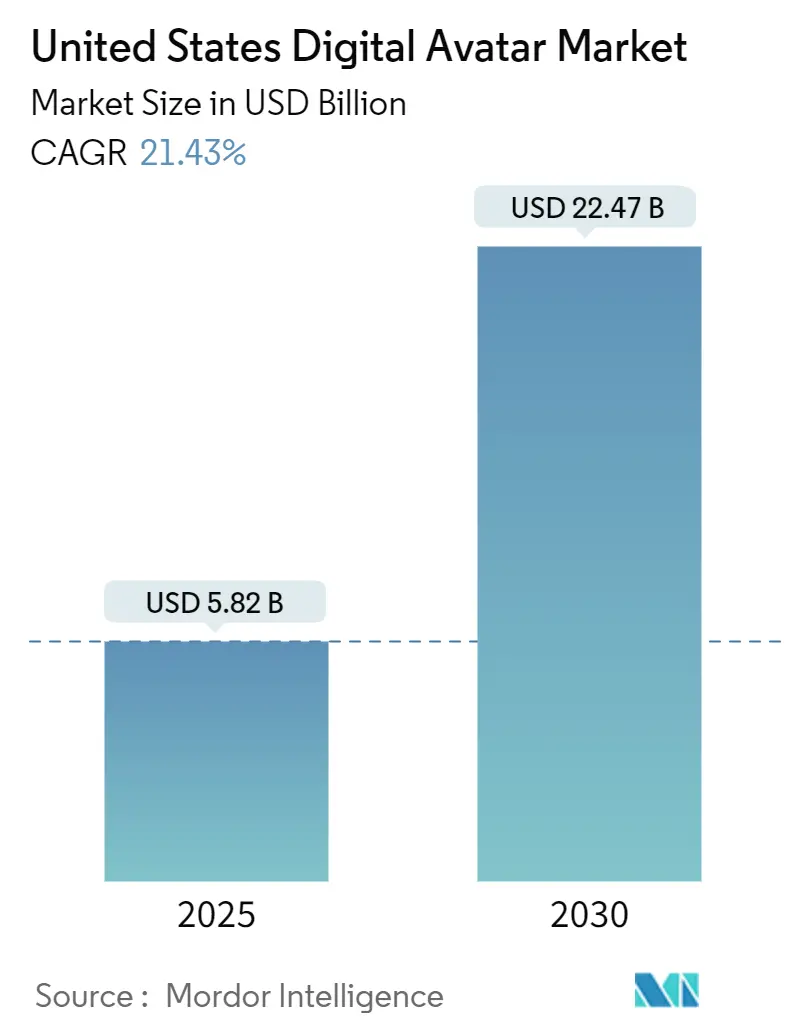
| Market Size (2025) | USD 5.82 Billion |
| Market Size (2030) | USD 22.47 Billion |
| Growth Rate (2025 - 2030) | 21.43 % |
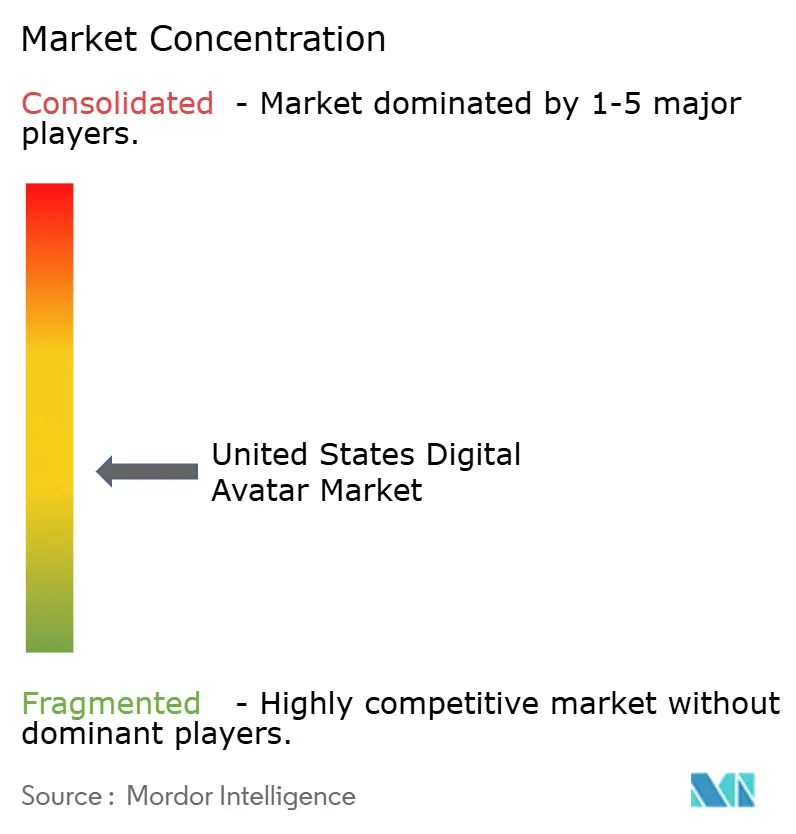
| Market Concentration | Medium |
Major Players *Disclaimer: Major Players sorted in no particular order Image © Mordor Intelligence. Reuse requires attribution under CC BY 4.0. | |
United States Digital Avatar Market Analysis by Mordor Intelligence
The United States digital avatar market size is USD 5.82 billion in 2025 and is forecasted to reach USD 22.47 billion by 2030, expanding at a 21.43% CAGR. Sustained advances in generative AI and natural language processing (NLP) continue to raise avatar realism and functional versatility, encouraging enterprises to shift routine customer interactions, employee training, and virtual brand experiences to avatar-based channels. Federal telehealth reimbursement codes, accessibility mandates, and state privacy statutes shape adoption roadmaps, while a maturing metaverse and gaming ecosystem anchors consumer demand. Investments in domestic semiconductor production and cloud GPU scaling help mitigate infrastructure constraints, although supply tightness is expected to persist in the near term. Competitive differentiation centers on real-time facial animation, domain-trained language models, and compliance toolkits that meet biometric privacy regulations.
Key Report Takeaways
- By product type, non-interactive avatars held 57.69% revenue share in 2024; interactive avatars are projected to advance at a 22.14% CAGR through 2030.
- By technology, 3D avatars commanded 51.32% of the United States digital avatar market share in 2024, while AI-generated realistic avatars are set to expand at a 21.91% CAGR to 2030.
- By application, gaming and entertainment led with a 42.31% share of the United States digital avatar market size in 2024; healthcare and telehealth are forecast to post the fastest 21.63% CAGR between 2025 and 2030.
- By end-user industry, the media and entertainment sector captured a 38.63% share of the United States digital avatar market size in 2024, and healthcare providers are projected to progress at a 21.69% CAGR through 2030.
- By geography, the South region accounted for a 34.71% share in 2024, whereas the West region is projected to grow at a 21.77% CAGR over the forecast period.
United States Digital Avatar Market Trends and Insights
Drivers Impact Analysis*
| Driver | (~) % Impact on CAGR Forecast | Geographic Relevance | Impact Timeline |
|---|---|---|---|
| Advancements in AI Generative Models and NLP | +8.2% | National, concentration in West and Northeast tech hubs | Medium term (2-4 years) |
| Growing Adoption of Digital Avatars in Customer Service | +6.7% | National, early uptake in South and West | Short term (≤ 2 years) |
| Expansion of Metaverse and Gaming Ecosystem | +5.9% | National, gaming hubs in West | Medium term (2-4 years) |
| Increasing Demand for Personalized Marketing Content | +4.8% | National, advertising clusters in Northeast | Short term (≤ 2 years) |
| Federal Grants for Virtual Accessibility in Government Services | +2.1% | National, contractor base in Northeast | Long term (≥ 4 years) |
| Integration of Digital Avatars into Telehealth Reimbursement Codes | +3.4% | National, healthcare systems in Northeast and South | Medium term (2-4 years) |
| Source: Mordor Intelligence | |||
Advancements in AI Generative Models and NLP
NVIDIA’s ACE microservices platform, introduced in 2024, generates facial expressions, gestures, and context-aware dialogue with sub-100 millisecond latency, reducing user-perceived lag and the uncanny valley effect.[1]NVIDIA Corporation, “Introducing NVIDIA ACE for Digital Humans,” nvidia.com Stanford’s 2025 AI Index reports a 34% improvement in avatar quality scores compared to the previous year. Combining vision models with large language models enables avatars to interpret visual cues, maintain emotional context, and personalize responses during complex interactions, such as medical triage or financial planning. Early enterprise pilots report 20-30% shorter staff training cycles when customer service workflows embed these multimodal avatars. Continued optimization of inference engines for edge devices is expected to widen deployment options beyond high-end desktops.
Growing Adoption of Digital Avatars in Customer Service
Rising wage pressures and 24/7 service expectations are prompting enterprises to automate Tier-1 queries with avatars that speak, gesture, and deliver knowledge-base answers. Azure-hosted deployments cut average annual support costs by USD 2.3 million, according to internal Microsoft case studies.[2]Microsoft Corporation, “Customer Stories – Avatar Powered Support,” microsoft.com Retailers leverage consent-driven facial analytics to tailor recommendations, but must comply with the Federal Trade Commission’s 2024 biometric guidance, which classifies facial geometry data as sensitive information that requires explicit consumer consent. Larger enterprises gain a compliance edge through dedicated governance teams, accelerating nationwide rollouts.
Expansion of Metaverse and Gaming Ecosystem
Roblox distributed USD 35 million in creator earnings during 2024, illustrating how avatar customization drives virtual goods sales and recurring revenues. Entertainment studios integrate avatars into immersive storylines, encouraging persistent identities that carry across virtual concerts, e-sports, and branded social hubs. Cross-engine compatibility, exemplified by Unity integrations with Ready Player Me, enables developers to import a single avatar across multiple platforms, thereby reducing asset duplication time. Enterprise metaverse pilots utilize the same toolsets for workforce collaboration, safety training, and digital twin simulations, thereby broadening the total addressable portion of the United States digital avatar market.
Increasing Demand for Personalized Marketing Content
Marketing teams adopt avatar video generators to localize campaigns quickly and cost-effectively. HeyGen’s platform cuts production expenses by 75% compared to studio shoots, enabling brands to refresh their messaging in real-time.[3]HeyGen, “Platform Pricing and ROI,” heygen.com As third-party cookies phase out, avatar interactions create rich first-party datasets that refine segmentation models. State biometric laws, such as Illinois’ BIPA and Colorado’s 2024 amendments, add compliance overhead; however, conversion rates improve by 15-40% when personalized avatar presentations replace static ads, supporting sustained ROI.
Restraints Impact Analysis*
| Restraint | (~) % Impact on CAGR Forecast | Geographic Relevance | Impact Timeline |
|---|---|---|---|
| Data Privacy and Biometric Regulation Compliance Pressure | -4.3% | National, stricter enforcement in Northeast and West | Short term (≤ 2 years) |
| High Development and Maintenance Costs | -3.8% | National, larger burden on small enterprises | Medium term (2-4 years) |
| Creator Unionization Demands Impacting Avatar Licensing | -2.1% | National, concentrated in entertainment centers | Long term (≥ 4 years) |
| GPU Supply Chain Volatility from Domestic Semiconductor Fabrication Shifts | -2.9% | National, manufacturing nodes | Medium term (2-4 years) |
| Source: Mordor Intelligence | |||
Data Privacy and Biometric Regulation Compliance Pressure
The Federal Trade Commission’s 2024 policy statement mandates explicit opt-in consent for facial recognition data, requiring platforms to maintain auditable data minimization workflows. State patchworks compound complexity, with Colorado now imposing statutory damages for non-compliant processing of facial geometry. Mid-market firms spend an estimated USD 150,000 to USD 500,000 annually on legal reviews and tool re-engineering, which can delay product launches by up to 12 months. Healthcare deployments add HIPAA encryption and audit layers, heightening the barrier to entry for newcomers in the United States digital avatar market.
High Development and Maintenance Costs
Enterprise-grade avatar builds typically demand USD 500,000-2 million up-front for data capture, rigging, and real-time rendering pipelines. Ongoing updates consume 20-30% of the initial budget yearly, as model refreshes, language pack expansions, and GPU scaling push cloud fees to USD 0.15-0.35 per interaction minute. While subscription-based avatar-as-a-service offerings are emerging, performance trade-offs and limited customization still steer larger organizations toward bespoke builds.
*Our forecasts treat driver/restraint impacts as directional, not additive. The impact forecasts reflect baseline growth, mix effects, and variable interactions.
Segment Analysis
By Product Type: Interactive Variants Accelerate Uptake
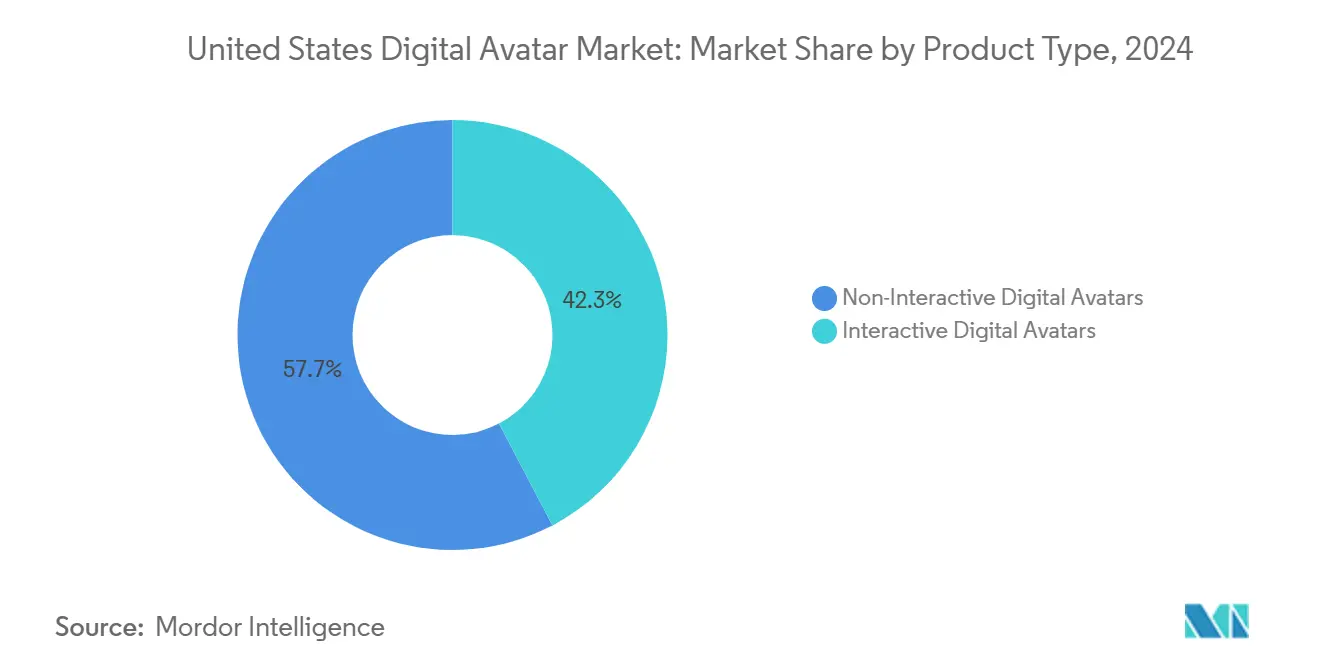
Interactive avatars are forecast to expand at a 22.14% CAGR, propelled by rising enterprise demand for conversational interfaces across customer care, human resources, and training environments. Non-interactive avatars retained a 57.69% share of the United States digital avatar market size in 2024, fulfilling asynchronous video, marketing, and e-learning roles where scripted content outranks real-time dialogue. Interactive solutions command premium subscription tiers, capitalizing on complex language models and low-latency rendering.
Heightened accessibility expectations under Section 508 encourage interactive modalities that respond to voice commands and text prompts, broadening user reach among visually or verbally impaired audiences. Hybrid architectures now allow organizations to toggle between static clips and real-time exchanges, optimizing bandwidth and GPU usage without disrupting brand consistency in the United States digital avatar market.


By Technology: AI-Generated Realism Redefines Benchmarks
Three-dimensional avatars held a 51.32% market share in 2024, as virtual worlds and training simulations prioritized depth perception and spatial accuracy. The AI-generated realistic human segment is projected to deliver a 21.91% CAGR, as diffusion models and high-fidelity facial capture mitigate the uncanny valley. Two-dimensional avatars remain viable for mobile contexts with constrained GPU resources.
DeepBrain AI reports that 45.2% of its worldwide user base now operates from the United States, highlighting domestic appetite for photorealistic digital staff. The National Institute of Standards and Technology’s AI Risk Management Framework encourages vendors to incorporate disclosure toggles that label synthetic footage, thereby fostering end-user trust. Continued cloud cost reductions are bolstering adoption for mid-tier enterprises assessing the total cost of ownership in the United States digital avatar market.
By Application: Healthcare Leads Growth Curve
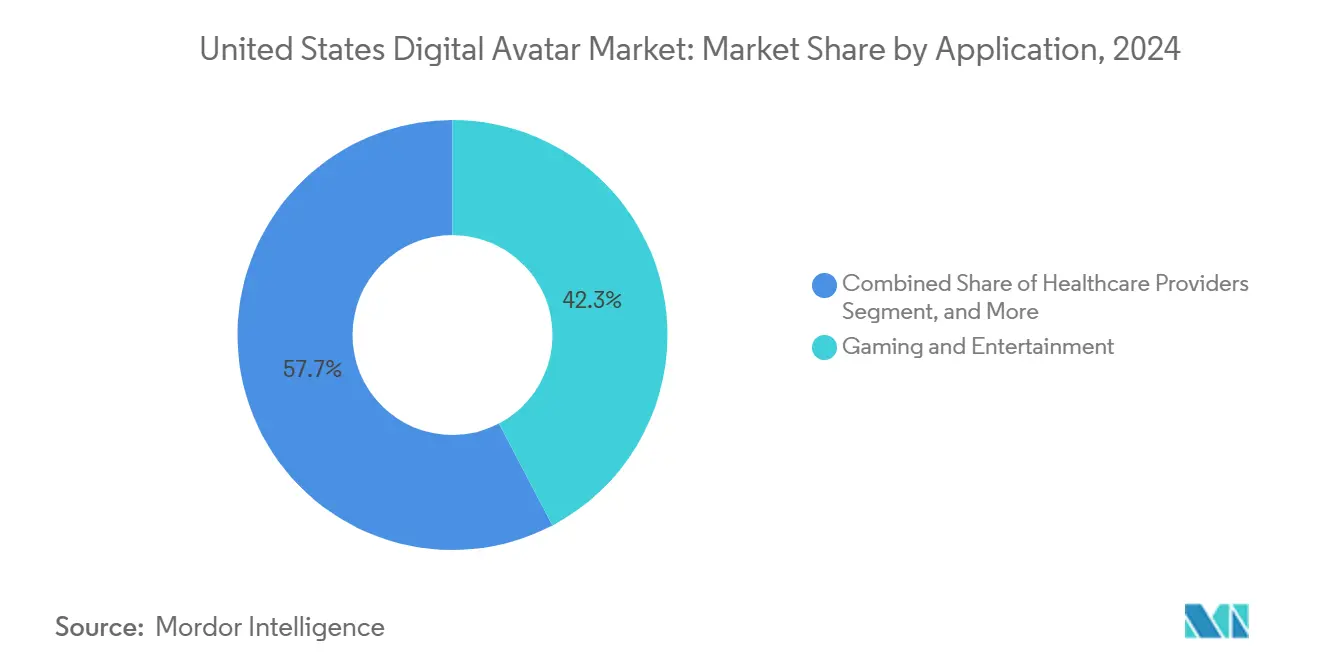
Gaming and entertainment accounted for 42.31% of 2024 revenue, driven by entrenched consumer familiarity with avatar customization, battle passes, and virtual goods. Healthcare and telehealth exhibit the steepest 21.63% CAGR, enabled by Centers for Medicare and Medicaid Services telehealth codes that recognize avatar-mediated visits. Customer service implementations deliver cost efficiencies, while marketing teams exploit avatars to personalize cross-channel campaigns.
Clinical pilots show higher medication adherence when patients receive animated instructions, and mental health platforms use therapist avatars to reduce social stigma. E-learning deployments are gaining traction as avatar instructors adjust their tone and pace dynamically, resulting in a 25-35% increase in knowledge retention compared to standard slide decks. These multifaceted benefits secure healthcare’s role as the primary growth engine for digital avatar applications in the United States.

By End-User Industry: Healthcare Providers Gather Momentum
Media and entertainment led with a 38.63% share, owing to the adoption of broadcasters, studios, and influencers for scalable content creation. Healthcare providers are on track for a 21.69% CAGR, driven by virtual care mandates, clinician shortages, and demand for multilingual patient education. Retail, education, banking, and government entities are implementing avatars for storefront assistance, remote proctoring, anti-fraud verification, and digital public services.
Mayo Clinic’s pilot indicates improved patient satisfaction when avatar educators explain complex procedures. Financial institutions leverage facial-gesture-driven biometric checks to expedite onboarding while curbing fraud. Government agencies bundle avatars into digital portals to meet federal accessibility targets, ensuring sustained cross-industry adoption within the United States digital avatar market.
Geography Analysis
The South captured 34.71% of the United States digital avatar market share in 2024, a lead supported by large hospital networks, regional financial hubs, and business-friendly incentives that trim deployment costs. State Medicaid programs that reimburse avatar-mediated telehealth sessions encourage hospitals to integrate virtual clinicians, while retail and hospitality groups adopt avatars to expand multilingual customer support. Tech talent migrating to Texas and Florida strengthens local development ecosystems, enabling service providers to quickly scale proofs of concept. Ongoing investment in broadband infrastructure further widens the addressable user base across suburban and rural counties.
The West is set to expand at a 21.77% CAGR through 2030, and its slice of the United States digital avatar market size is projected to rise faster than any other region. Venture capital density in California and Washington accelerates startup formation, and cloud hyperscalers headquartered along the Pacific coast offer early access to optimized GPU instances. Entertainment studios in Los Angeles fuel demand for photorealistic avatars that cross over into films, games, and social media tie-ins, creating spillover opportunities for enterprise training and marketing use cases. California privacy rules shape nationwide compliance toolkits, while proximity to semiconductor fabs helps vendors mitigate supply disruptions.
The Northeast anchors adoption in highly regulated verticals such as finance, healthcare, and public services, benefiting from New York’s fintech corridor and Washington D.C.’s federal contractor ecosystem. Academic medical centers deploy avatars for resident simulation and patient engagement, and Wall Street firms integrate biometric avatars to streamline client onboarding. The Midwest records steady, though slower, growth as manufacturers leverage avatars for safety training and universities embed virtual instructors into remote learning programs. Collectively, these dynamics sustain a balanced regional outlook even as coastal hotspots capture outsized investment flows.
Competitive Landscape
Competitive intensity is moderate, with the top five players collectively holding a share of under 35%. Technology giants such as Microsoft, NVIDIA, and Meta harness cloud ecosystems and proprietary AI stacks to embed avatars into productivity suites, gaming engines, and collaboration tools. Niche vendors, including Synthesia, UneeQ, Hour One, and DeepBrain AI, focus on enterprise video, digital staffing, and localized content. Patent filings for facial animation and multimodal fusion increased by 47% in 2024, indicating a sustained commitment to R&D.
Strategic partnerships shape go-to-market models: ServiceNow teams with NVIDIA to integrate avatars into workflow automation, while Ready Player Me aligns with Unity for developer tooling. Vendors differentiate via latency optimization, model transparency, and compliance modules that streamline consent capture under federal and state biometric statutes.
White-space opportunities persist in legal testimony, assistive communication for disabilities, and federated avatar identity standards. As revenue concentrations shift toward healthcare and government, suppliers with HIPAA and FedRAMP certifications gain a bidding advantage. Overall, the pace of innovation and the complexity of compliance underpin competitive dynamics in the United States digital avatar market.
United States Digital Avatar Industry Leaders
Synthesia Inc.
Soul Machines Inc.
Hour One AI Corp.
UneeQ Inc.
DeepBrain AI Inc.
- *Disclaimer: Major Players sorted in no particular order

Recent Industry Developments
- September 2025: Microsoft debuted Teams Avatar Companion, embedding generative avatars into live meetings for on-camera privacy and adaptive presence.
- June 2025: Synthesia launched a real-time bilingual avatar translation engine, allowing corporate users to switch languages instantly during live broadcasts.
- March 2025: NVIDIA opened a new GPU megafarm in Austin, Texas dedicated to low-latency inference for enterprise avatar workloads.
- January 2025: Meta released a photorealistic avatar creator for all Horizon Worlds users, enabling full-body tracking and custom facial scans.


United States Digital Avatar Market Report Scope
| Interactive Digital Avatars |
| Non-Interactive Digital Avatars |
| 2D Avatars |
| 3D Avatars |
| AI-Generated Realistic Human Avatars |
| Customer Service and Virtual Agents |
| Marketing and Advertising |
| Gaming and Entertainment |
| E-Learning and Training |
| Healthcare and Telehealth |
| Social Media and Content Creation |
| Retail and E-Commerce |
| Media and Entertainment |
| Healthcare Providers |
| Education Institutions |
| Banking and Financial Services |
| Government and Public Services |
| By Product Type | Interactive Digital Avatars |
| Non-Interactive Digital Avatars | |
| By Technology | 2D Avatars |
| 3D Avatars | |
| AI-Generated Realistic Human Avatars | |
| By Application | Customer Service and Virtual Agents |
| Marketing and Advertising | |
| Gaming and Entertainment | |
| E-Learning and Training | |
| Healthcare and Telehealth | |
| Social Media and Content Creation | |
| By End-User Industry | Retail and E-Commerce |
| Media and Entertainment | |
| Healthcare Providers | |
| Education Institutions | |
| Banking and Financial Services | |
| Government and Public Services |


Key Questions Answered in the Report
How large is the United States digital avatar market in 2025?
The market is valued at USD 5.82 billion in 2025, with a 21.43% CAGR projected through 2030.
Which product type is growing fastest within U.S. digital avatars?
Interactive avatars post the highest 22.14% CAGR thanks to real-time conversational capabilities.
What region of the United States shows the strongest growth momentum?
The West region leads with a 21.77% CAGR, driven by tech sector concentration and venture funding.
Why are healthcare providers adopting digital avatars rapidly?
Federal reimbursement codes now cover avatar-mediated telehealth visits, boosting ROI for hospitals and clinics.
What principal regulation influences biometric data use in avatars?
The Federal Trade Commission’s 2024 biometric policy requires explicit opt-in consent and strict data minimization.
Which technology trend most improves avatar realism?
Advances in generative AI models that merge large language frameworks and real-time facial animation significantly enhance realism and user engagement.
Page last updated on:





