
United States Daybeds Market Size and Share
Market Overview
| Study Period | 2020 - 2031 |
|---|---|
| Forecast Data Period | 2026 - 2031 |
| Base Year Market Size (2025) | USD 1.56 Billion |
| Market Size (2026) | USD 1.62 Billion |
| Market Size (2031) | USD 2 Billion |
| Growth Rate (2026 - 2031) | 4.21 % |
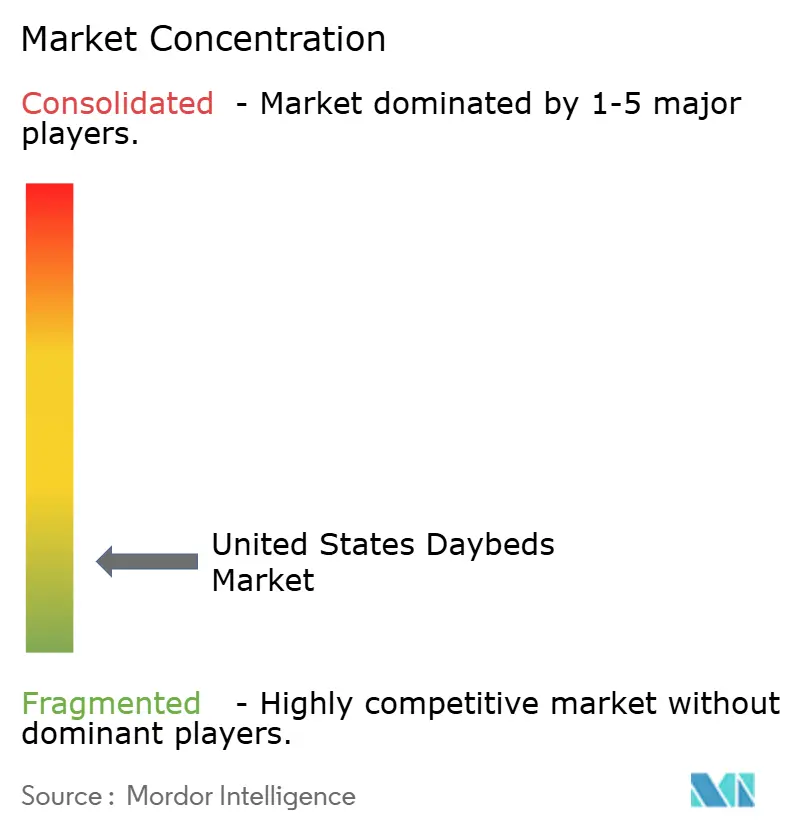
| Market Concentration | Low |
Major Players *Disclaimer: Major Players sorted in no particular order Image © Mordor Intelligence. Reuse requires attribution under CC BY 4.0. | |
United States Daybeds Market Analysis by Mordor Intelligence
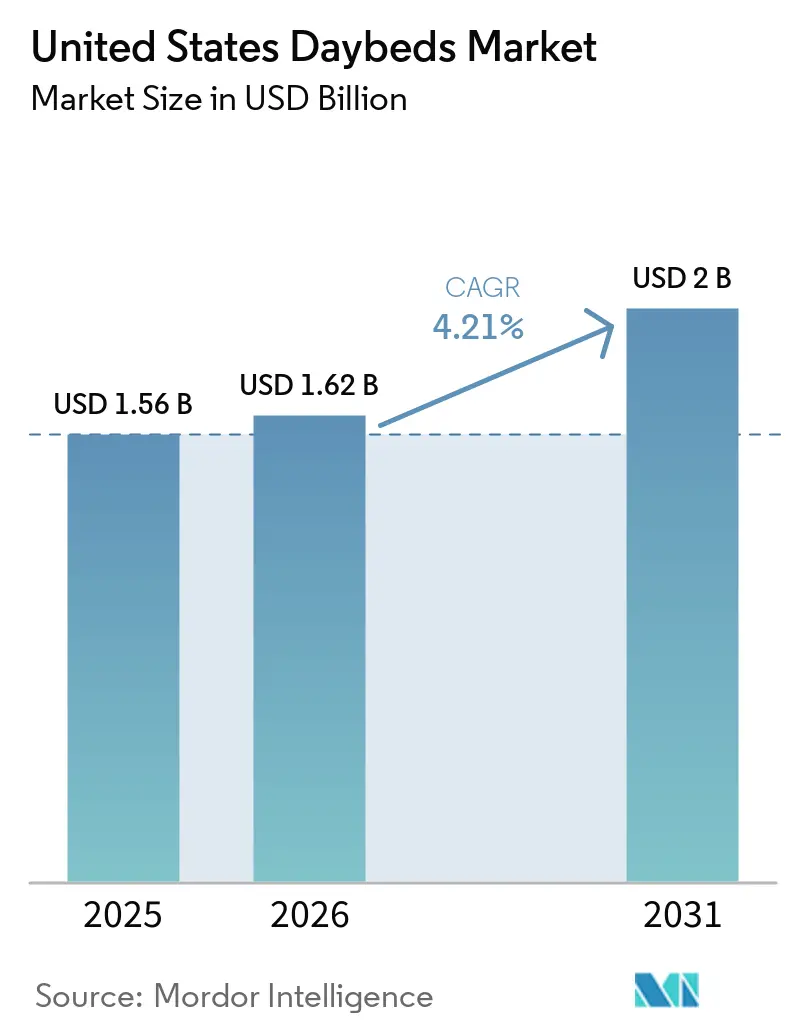
The United States day beds market size was valued at USD 1.56 billion in 2025 and is estimated to grow from USD 1.62 billion in 2026 to reach USD 2.0 billion by 2031, at a CAGR of 4.21% during the forecast period 2026 to 2031. Furniture production signals remained steady entering 2026, with manufacturers’ shipments at USD 7,566 million in June 2025 and an inventory-to-shipments ratio of 1.45, indicating careful production planning as household composition trends favor compact and flexible spaces. Headline furniture and related products posted year-to-date shipment growth of 0.7% through June 2025 versus 2024, which aligns with sustained purchases of multi-use furnishings that serve seating and sleeping needs in denser homes. Demand is concentrated around three macro currents that shape the United States daybed market in 2026. Multigenerational living supports flexible sleeping setups, aging in place increases the need to adapt existing rooms without structural changes, and municipal short-term rental registration and tax rules nudge hosts to configure spaces to comply with capacity limits without significant remodeling. Import dynamics also shape pricing, since antidumping duties on wooden bedroom furniture from China remain in place and continue to affect landed costs for wooden frames and trundles.
Key Report Takeaways
- By bed type, Indoor captured 73.61% of the United States day beds market in 2025, while Outdoor is projected to grow at 6.67% CAGR between 2026 to 2031.
- By material type, Wood captured 32.56% of the United States day beds market in 2025, while Wicker or Rattan is projected to grow at 7.20% CAGR between 2026 to 2031.
- By functionality, Convertible captured 39.01% of the United States day beds market in 2025, while Foldable is projected to grow at 7.71% CAGR between 2026 to 2031.
- By end user, Residential captured 64.47% of the United States day beds market in 2025, while Commercial is projected to grow at 6.36% CAGR between 2026 to 2031.
- By distribution channel, B2C or Retail captured 41.56% of the United States day beds market in 2025, while B2B or Project is projected to grow at 7.90% CAGR between 2026 to 2031.
- By geography, the Northeast captured 29.36% of the United States day beds market in 2025, while the Southeast is projected to grow at 6.11% CAGR between 2026 to 2031.
Note: Market size and forecast figures in this report are generated using Mordor Intelligence’s proprietary estimation framework, updated with the latest available data and insights as of January 2026.
United States Daybeds Market Trends and Insights
Drivers Impact Analysis*
| Driver | (~) % Impact on CAGR Forecast | Geographic Relevance | Impact Timeline |
|---|---|---|---|
| Outdoor living upgrade cycle lifts lounge or daybed demand | +1.2% | Sun Belt states Florida, California, Texas, Arizona, and coastal resort markets | Medium term 2 to 4 years |
| Smaller home sizes push multi functional furniture adoption | +0.9% | National, concentrated in urban metros such as New York City, San Francisco, Chicago, Boston | Long term ≥ 4 years |
| Multigenerational living raises need for flexible sleeping and seating | +0.8% | National, with early gains in Northeast and Midwest urban centers | Long term ≥ 4 years |
| Feature rich daybeds with trundle, storage, and charging expand use cases and ASPs | +0.7% | National, faster among millennial and Gen Z households | Medium term 2 to 4 years |
| Short term rentals use daybeds to optimize occupancy and guest comfort | +0.5% | National, highest density in tourist metros | Short term ≤ 2 years |
| Aging in place shifts more lounge or sleep solutions into homes | +0.4% | National, especially suburban and rural areas with older populations | Long term ≥ 4 years |
| Source: Mordor Intelligence | |||
Outdoor living upgrade cycle lifts lounge or daybed demand
Outdoor recreation remained a strong contributor to activity, with the BEA’s satellite account reporting USD 639.5 billion of value added in 2023 and a real growth rate of 3.6% for the category, supporting continued investment in backyard and lanai seating areas that accommodate daybeds and convertible loungers in 2026[1]. Florida and California anchored this theme with significant outdoor recreation value added. At the same time, Sun Belt homeowners extended covered patios, pool decks, and shaded courtyards with weather-resilient cushions and frames that double as seating by day and sleeping at night. Custom builders in markets such as Southwest Florida have reported growing prevalence of outdoor kitchens and lounge areas, which naturally include space-efficient lounges and daybeds that remain in use across more months of the year in warmer climates. At the same time, real personal consumption expenditures on furnishings showed modest pressure into late 2025. However, the Southeast experienced smaller drags compared with some Mountain West states, supporting regional differentiation in outdoor furnishing demand as 2026 begins. As homeowners blend indoor and outdoor living areas in the United States day beds market, product choices that offer fade resistance, quick-dry performance, and easy-care features become more central to purchase decisions in 2026.
Smaller home sizes push multi functional furniture adoption
Household formation patterns and delayed independence among young adults sustain interest in furniture that converts from seating to sleep to handle guests within constrained square footage. Convertible daybeds that function as sofas during the day while providing sleeping space at night maintained category leadership by share in 2025, supported by customer willingness to invest in models with trundles, under-seat storage, and integrated charging that raise average selling prices relative to basic frames. Large multichannel players have sharpened merchandising for multi-functional pieces, with Wayfair noting strong engagement from paid loyalty members and continued share capture as 2026 opens[2]. IKEA continues to emphasize small-format stores and planning points in high-density areas, linking online discovery with pickup and delivery to support compact, modular daybed combinations for urban households. These dynamics keep the United States daybed market centered on space-saving value, which resonates in city apartments, accessory dwelling units, and smaller single-family homes in 2026.
Multigenerational living raises need for flexible sleeping and seating
The share of Americans in multigenerational households climbed over the past decade, and this arrangement is now an important part of the demand for flexible sleeping surfaces that can switch to seating without dedicating a full bedroom[3]. Home offices and dens that convert into guest rooms with a daybed and trundle help families accommodate relatives without structural renovations or zoning hurdles. Caregiving trends support purchasing motivations, since a meaningful share of adults provide or expect to provide care, and many prefer to do so in their own homes, where flexible furniture simplifies overnight stays. Income pooling in multigenerational homes can create budgets capable of supporting higher-quality, durable pieces that retain utility across changing life stages. As these conditions remain relevant in 2026, the United States daybeds market benefits from multipurpose layouts that hold up to daily seating while supplying comfortable sleep when needed.
Feature-rich daybeds expand use cases and ASPs
Manufacturers continue to add integrated storage drawers, pop-up trundles, wireless charging, and reading lights to widen customer appeal and support better margins at accessible price points. One large producer expanded domestic foam and mattress capacity through a Mississippi investment scheduled for completion by the end of 2025, a move that enhances the supply of feature-dense options with in-house components as 2026 demand develops. Retailers have also grown curated collections that balance function and style for a wide range of budgets, addressing consumers who expect more utility per square foot from living room and bedroom furniture[4]. Large merchants are investing in store remodels and digital displays that organize assortments by room and style, helping customers visualize convertible and storage daybeds across dens, spare rooms, and small apartments. The product roadmap increasingly focuses on durable materials, hardware that withstands daily use, and simple upkeep, which supports a higher average selling price mix in the United States daybeds market in 2026.
Restraints Impact Analysis*
| Restraint | (~) % Impact on CAGR Forecast | Geographic Relevance | Impact Timeline |
|---|---|---|---|
| PFAS bans in textiles add compliance cost and complexity for upholstered daybeds | -0.6% | Maine, California, Vermont, Connecticut, Minnesota with national compliance adjustments | Short term ≤ 2 years |
| Antidumping duties on wooden bedroom furniture from China pressure import costs and mix | -0.5% | National, strongest impact for import reliant retailers | Long term ≥ 4 years |
| Cleaning and care burden deters outdoor upholstered purchases and replacement cycles | -0.3% | Sun Belt and humid coastal regions with high UV and moisture exposure | Medium term 2 to 4 years |
| Urban short term rental restrictions slow host furnishing purchases in key metros | -0.2% | National, early effect in large tourist and regulatory intensive cities | Medium term 2 to 4 years |
| Source: Mordor Intelligence | |||
PFAS bans in textiles add compliance cost and complexity for upholstered daybeds
Maine’s program prohibits intentionally added PFAS in upholstered furniture beginning January 1, 2026, which drives reformulation and testing for stain or water resistance while adding filing and compliance costs for suppliers. California’s SB 730 extends PFAS restrictions to textiles and upholstery, with an effective date of January 1, 2027, shaping national assortments to align with the strictest state rules and nudging brands toward PFAS-free or clearly defined alternatives. Minnesota’s Amara’s Law extended PFAS prohibitions to upholstered furniture while updating reporting requirements, reinforcing a broader state-led compliance framework as federal reporting also ramps up. EPA’s TSCA Section 8(a)(7) reporting requires manufacturers and importers to disclose historic PFAS use, adding transparency that could inform future federal actions affecting upholstery treatments and related materials. These shifts introduce incremental testing costs, potential performance trade-offs for oil and water repellency, and staggered product launch timing as companies ensure compliance before scaling distribution in the United States daybeds market.
Antidumping duties on wooden bedroom furniture from China pressure import costs and mix
The antidumping order on wooden bedroom furniture from China remains active, and the recent administrative review results have preserved the China-wide dumping margin of 216.01% for exporters without separate rate eligibility, which materially increases landed costs for wooden frames, trundles, and coordinated case goods when sourced from non-certified manufacturers. Import-reliant retailers face margin compression if they absorb duties or potential share losses if they raise prices, which in turn can shift assortments toward domestically produced wood, metal, or wicker and rattan variants. Domestic capacity investments in foam and mattress lines positioned some producers to integrate more components and avoid import exposure for certain SKUs as of late 2025 and into 2026. Marketplaces are also diversifying supplier bases and leveraging fulfillment programs to speed delivery and reduce costs, including sourcing beyond China in categories where duties are in effect. In the United States day beds market, these trade dynamics influence price points and mix across wood-rich aesthetics relative to metal or synthetic wicker options.
*Our forecasts treat driver/restraint impacts as directional, not additive. The impact forecasts reflect baseline growth, mix effects, and variable interactions.
Segment Analysis
By Bed Type: Outdoor variants gain as lanai culture spreads beyond the Sun Belt
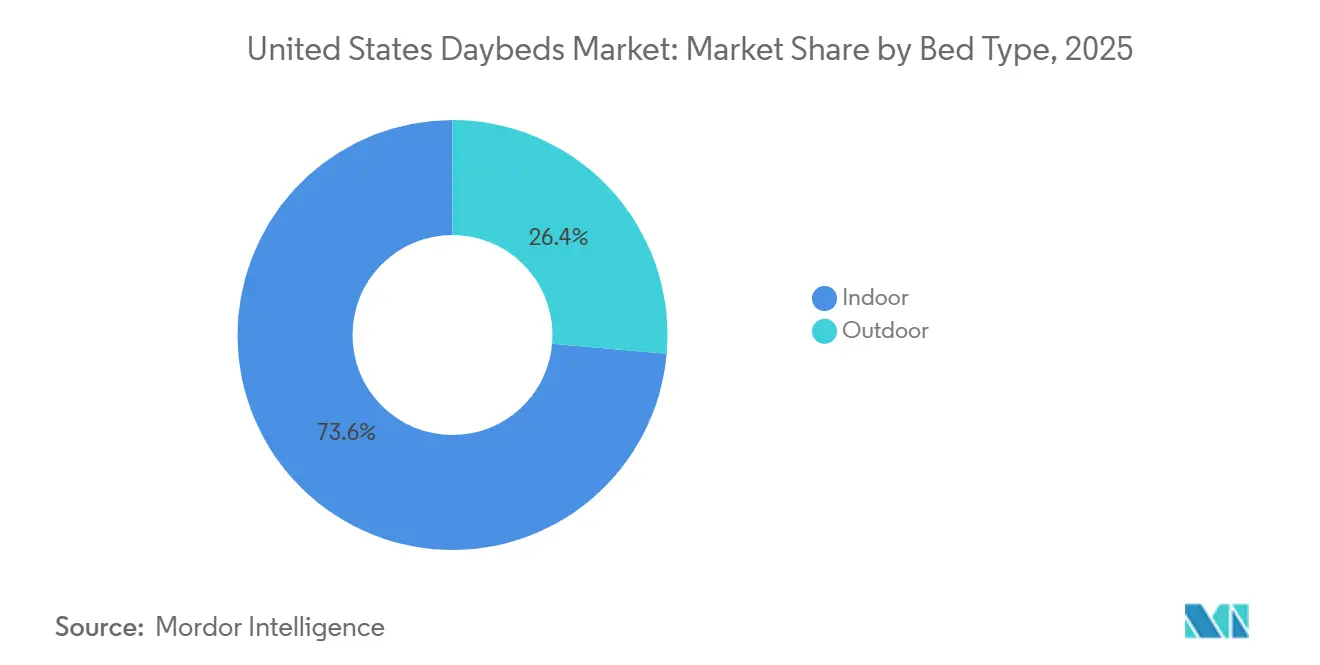
Indoor daybeds led the category with a 73.61% share in the United States daybed market in 2025, supported by use in guest rooms, converted home offices, and flexible dens where families host visitors or returning adult children. Outdoor models held the balance and are set to be the fastest-growing, with a 6.67% CAGR through 2031, as households expand covered patios and poolside seating into spaces that also support occasional sleep. The United States daybed market remains tied to outdoor recreation and favorable climates, with Florida and California anchoring outdoor living investments that require weather-resistant cushions, UV-stable fabrics, and easy-care frames. Builders in coastal and Sun Belt metros continue to include lounges and outdoor kitchens as design standards for new or renovated homes, which keeps demand for outdoor daybeds steady into 2026 and beyond. Even in markets with harsher winters, the indoor category sustains its advantage through year-round utility and compatibility with small-footprint rooms.
The indoor segment’s resilience also reflects multigenerational living and aging in place, since these trends favor furniture that upgrades living areas into temporary sleeping zones without remodeling or building additions. The indoor products segment is moving toward convertible frames with trundles, storage drawers, and integrated charging, which elevate average selling prices relative to basic options. Outdoor products must address the realities of cleaning and upkeep through better materials and removable covers, which shorten replacement cycles but increase satisfaction among buyers who choose premium constructions. The result is a bed type mix in the United States day beds market that maintains indoor leadership by share while expanding outdoor use, where climate and design trends support it.
By Material Type: Wicker or Rattan surge as poolside aesthetics challenge wood’s lead
Wood captured a 32.56% share of the United States daybed market in 2025, leveraging familiar aesthetics from traditional to modern farmhouse styles for buyers seeking a classic look. Yet wicker or rattan is the fastest-growing, with a 7.20% CAGR through 2031, as households invest in outdoor lounge and poolside areas, where resin wicker over aluminum frames offers better moisture resistance and lighter weight. Regional spending patterns on furnishings suggest the Southeast has maintained steadier demand relative to some Mountain West states, which supports the growth runway for outdoor-oriented materials in 2026. The shift toward solution-dyed fabrics and corrosion-resistant frames also supports premiumization in open-air settings where easy care and durability matter. This trajectory keeps wicker or rattan a bright spot in the material mix for the United States daybeds market.
Wood faces import pressures where sourcing depends on Chinese exporters without a separate rate, since the current antidumping margin of 216.01% remains in force and raises landed costs if duties apply. Domestic investments help offset this exposure for certain producers, while other retailers rebalance assortments toward metal, wicker, and rattan where substitution is feasible. Upholstered variants serve comfort-first indoor buyers as fabrics evolve to meet compliance in PFAS-restricted states, and metal frames support minimalist styles with durable finishes. The United States daybeds industry uses material diversity to insulate against trade and regulatory shocks, reinforcing a balanced growth outlook through 2031.
By Functionality: Foldable gains traction in ADU and micro living kits
Convertible daybeds held a 39.01% share in the United States daybed market in 2025, with pull-out trundles, flip-up platforms, and sofa-to-sleep mechanisms that transform rooms quickly based on daily needs. Fixed daybeds served buyers with dedicated guest rooms or children’s spaces and maintained a steady share on the strength of style and storage features. Storage daybeds often feature under-seat drawers or lift-up compartments for linens and seasonal items, a valued feature in smaller homes and city apartments. Foldable models represented a smaller base but are projected to grow fastest at 7.71% CAGR between 2026 and 2031, aligned with the spread of space-saving solutions in studios and accessory dwelling units that need furniture to move and stow easily. The United States daybed market remains oriented toward multi-purpose living, where foldable and convertible designs support tight layouts across rental and ownership settings.
Compact living and home-office conversion trends reinforce functionality as a core purchase criterion, and large retailers spotlight modular daybed storage desk combinations in city-center formats to help shoppers visualize use in small rooms. Commercial buyers in hospitality or multifamily segments prefer contract-grade versions of these functions to reduce field service and replacement frequency. For the United States day beds industry, the balance across convertible, storage, fixed, and foldable variants creates flexibility to meet shifting household forms, especially in 2026, as renovation and furnishing priorities continue to favor adaptable layouts.
By End User: Commercial growth reflects hospitality upgrades and student housing density
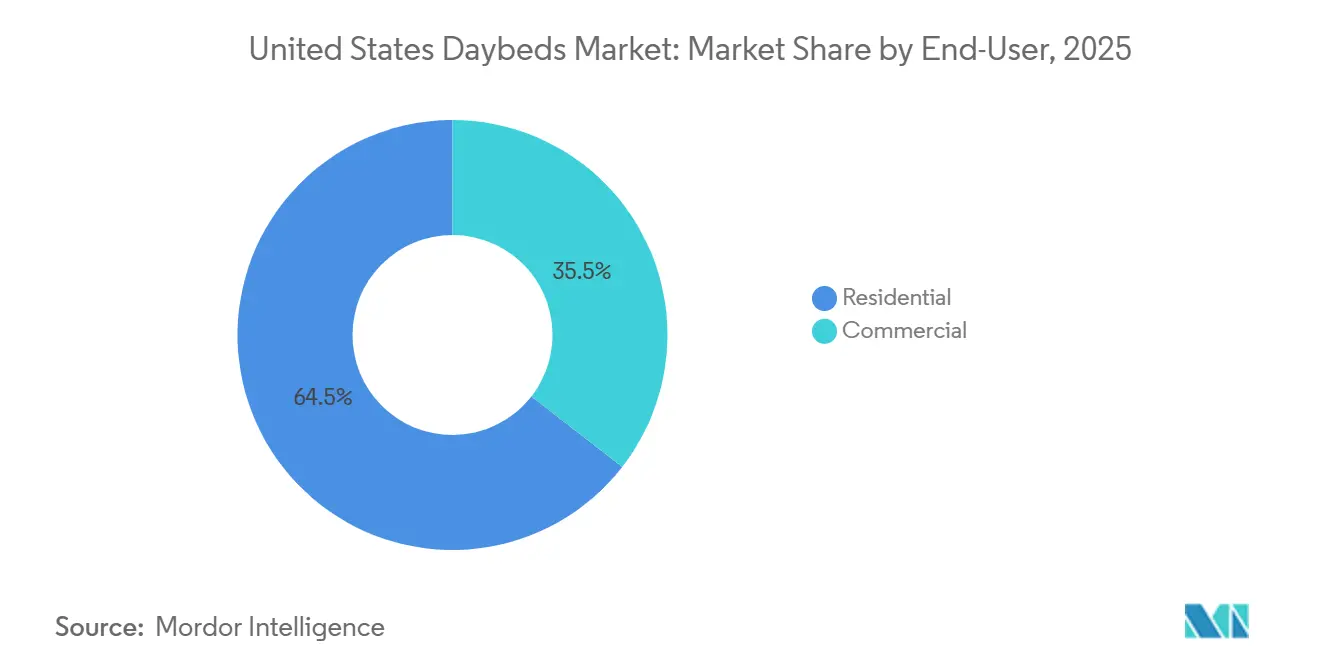
Residential buyers accounted for 64.47% of the United States day beds market in 2025, reflecting steady household formation, persistent multigenerational living, and aging-in-place projects that refresh dens and spare rooms. Commercial applications, including hotels, extended-stay properties, student housing, and multifamily amenity lounges, are projected to grow at a 6.36% CAGR through 2031, driven by refreshed rooms and common areas that require flexible seating and sleep options for guests and residents. Hospitality operators use sofa sleeper daybeds to increase sleeping capacity within the same footprint, thereby improving revenue per square foot in extended-stay and micro-suite formats. Student housing adds daybeds in shared lounges and high-density micro-living layouts to accommodate visitors during peak periods without expanding unit sizes. These end-user patterns reinforce a broad base of demand for the United States daybed market across the forecast period.
Compliance considerations for PFAS restrictions also shape commercial purchasing as buyers seek PFAS-free or compliant upholstery that meets fire safety standards while offering stain resistance in high-use environments. Platforms serving contract buyers highlight volume pricing, white-glove delivery, and procurement integrations to help operators standardize products across multiple properties. Residential buyers remain price-sensitive, and big-box chains emphasize affordability with curated collections that present daybeds as part of complete room packages. Together, these currents sustain diversified growth drivers for the United States daybeds market into 2031.
By Distribution Channel: B2B or Project surges on portfolio outfitting
B2C or retail channels accounted for 41.56% of 2025 revenue in the United States day beds market, spanning multi-brand stores, specialty stores, online platforms, and other outlets. Online continues to be a key growth engine in B2C, as large e-commerce platforms report brisk order volumes and high conversion rates among loyalty members for furniture categories. Big box retailers integrate marketplace and fulfillment services to serve both one-off consumer purchases and higher-volume orders, while modernized store formats support inspiration-led shopping for daybed configurations. B2B or project channels held 58.44% share and are projected to grow at 7.90% CAGR through 2031 as property managers, hospitality operators, and developers standardize furnishings across portfolios. This channel emphasizes negotiated pricing, logistics coordination, and consistent specifications, which align with operational needs in commercial and institutional settings.
The United States daybed industry is increasingly served by omnichannel models, where online discovery and planning tools lead to in-home delivery or consolidated shipments for multi-unit orders. Retailers and marketplaces continue to refine multichannel fulfillment capabilities to improve speed and lower costs across both consumer and contract buyers. These channel dynamics keep the United States daybeds market accessible to first-time buyers and large-scale operators alike, supporting steady growth over the forecast period.
Geography Analysis
The Northeast accounted for a 29.36% share of the United States daybeds market in 2025, with demand supported by dense urban living, smaller apartments, and continued multigenerational arrangements that benefit from convertible seating and sleeping solutions. The region is expected to post steady growth through 2031 as New York State phases in a county-based short-term rental registry and enforcement, which encourages standardized furnishing practices among compliant hosts and nudge commercial buyers toward contract-grade items. Population dynamics include elevated shares of young adults living with their parents in some large metros, reinforcing the need for multipurpose furniture in limited square footage. Retailers emphasize compact, modular offerings in the region, coupled with city-center planning points and pickup services that complement smaller-format stores. These characteristics sustain the United States daybeds market as a practical response to constrained indoor space.
The Southeast held a 23.78% share in 2025 and is projected to be the fastest-growing region at a 6.11% CAGR through 2031 in the United States day beds market, reinforced by strong outdoor living cultures that favor weatherable wicker or rattan daybeds and robust housing activity in Sun Belt metros. Outdoor recreation had significant value in Florida, supporting a culture of furnished lanais and poolside lounges that keep outdoor-oriented products in steady use. Retailers and manufacturers with regional production capacity have positioned supply chains to support this demand as 2026 begins. Aging in place also plays an important role in the Southeast, with older residents preferring to remain in their homes and thus investing in furniture that adapts spaces for both daytime and overnight use. This combination of residential and outdoor living dynamics sustains a balanced mix of indoor convertible and outdoor daybeds across the region.
The Midwest accounted for 18.64% of the United States daybeds market in 2025 and shows moderate growth tied to aging-in-place retrofits, university-town density, and affordability that encourages steady furniture upgrades. The West held 28.22% share, led by large coastal states where compact living and outdoor lifestyles coexist, producing demand for indoor convertible and outdoor wicker or rattan products. California’s contribution to outdoor recreation value added underscores a durable outdoor living culture that supports outdoor daybed use in covered patios and around pools. State-level restrictions on PFAS-treated textiles increase compliance requirements for upholstered products, which nudges assortments toward compliant treatments and clearly communicated material specifications. Across these regions, the United States daybed market aligns with local housing forms, climate, and regulatory context to maintain steady performance in 2026 and beyond.
Competitive Landscape
Innovation and Digital Presence Drive Success
Success in the US daybeds market increasingly depends on companies' ability to innovate in product design, embrace sustainable practices, and maintain a strong digital presence. Incumbents are focusing on expanding their product lines with customizable options, implementing advanced manufacturing technologies, and developing stronger relationships with suppliers to ensure consistent quality and timely delivery. Companies are also investing in customer analytics, virtual reality tools for product visualization, and enhanced logistics capabilities to improve the overall shopping experience and maintain a competitive advantage.
For new entrants and growing players, establishing a distinct market position through specialized product offerings, competitive pricing strategies, and efficient distribution networks is crucial. The market presents moderate substitution risk from alternative living room furniture solutions, underscoring the importance of product differentiation and a compelling value proposition for success. Companies must also navigate evolving consumer preferences for sustainable materials, multi-functional bedroom furniture, and smart home integration while maintaining compliance with safety regulations and industry standards. Building strong brand recognition through targeted marketing campaigns and leveraging social media platforms for customer engagement has become essential for market success.
United States Daybeds Industry Leaders
-
Ashley Furniture Industries Inc.
-
Inter IKEA Systems BV
-
Wayfair
-
Walmart
-
Pottery Barn
- *Disclaimer: Major Players sorted in no particular order
Recent Industry Developments
- April 2025: IKEA’s investment arm acquired a building in New York City’s SoHo neighborhood for a second Manhattan store, reinforcing a city center strategy that supports compact living assortments and online to store pickup. The move follows a year of U.S. expansion with small format openings and planning points tied to enhanced digital and fulfillment capabilities.
- November 2025: IKEA introduced a kitchen and laundry planning center shop in select Best Buy locations in Florida and Texas, broadening its U.S. retail touchpoints alongside investments in fulfillment automation and a delivery management platform.
- June 2025: Ashley acquired a 705,000-square-foot distribution center in Lakeland, Florida, to support its statewide store network, and opened a flagship facility in Las Vegas with a combined showroom and distribution footprint.
- April 2025: Walmart opened its first new ground-up Supercenter in four years in Cypress, Texas, highlighting a next-generation format with digital shelf labels, expanded services, and upgraded departments to support omnichannel growth.
United States Daybeds Market Report Scope
A daybed is a piece of furniture that can be used not only as a bed but also as a place to sit, recline, and relax in a shared living space.
The United States daybeds market is segmented by type (indoor and outdoor), by size (twin, queen size, and king size), by application (residential and commercial), by material (wood, metal, and other materials), and by distribution channel (online and offline).
The report offers market size and forecasts in value (USD) for all the above segments.
| Indoor |
| Outdoor |
| Metal |
| Plastic |
| Upholstered |
| Wicker/Rattan |
| Wood |
| Others |
| Convertible |
| Storage |
| Foldable |
| Fixed |
| Residential |
| Commercial |
| B2C/Retail Distribution Channel | Multi-Brand Stores |
| Specialty Stores | |
| Online | |
| Other Distribution Channel | |
| B2B/Project |
| Northeast |
| Southeast |
| Midwest |
| Southwest |
| West |
| By Bed Type | Indoor | |
| Outdoor | ||
| By Material Type | Metal | |
| Plastic | ||
| Upholstered | ||
| Wicker/Rattan | ||
| Wood | ||
| Others | ||
| By Functionality | Convertible | |
| Storage | ||
| Foldable | ||
| Fixed | ||
| By End-User | Residential | |
| Commercial | ||
| By Distribution Channel | B2C/Retail Distribution Channel | Multi-Brand Stores |
| Specialty Stores | ||
| Online | ||
| Other Distribution Channel | ||
| B2B/Project | ||
| By Geography | Northeast | |
| Southeast | ||
| Midwest | ||
| Southwest | ||
| West | ||
Key Questions Answered in the Report
What is the growth outlook for the United States day beds market through 2031?
The market is expected to rise from USD 1.62 billion in 2026 to USD 2.0 billion by 2031 at a 4.21% CAGR.
Which product type leads share in the United States day beds market?
Indoor daybeds led with 73.61% share in 2025 as households prioritized flexible guest sleeping in existing rooms.
Which segments are projected to grow fastest by 2031?
Outdoor by bed type at 6.67% CAGR, Wicker or Rattan by material at 7.20% CAGR, Foldable by functionality at 7.71% CAGR, Commercial by end user at 6.36% CAGR, and B2B or Project channels at 7.90% CAGR.
How are regulations affecting upholstered daybeds in the United States?
State PFAS rules and EPA reporting require reformulated treatments and added testing, raising compliance costs while pushing materials toward PFAS free or compliant alternatives.
Which regions show the strongest momentum within the United States day beds market?
The Southeast is projected to grow fastest at 6.11% CAGR to 2031, supported by outdoor living culture and Sun Belt housing trends, while the Northeast leads share with 29.36% in 2025.
What is the balance between B2C and B2B channels in the United States day beds market?
B2C or retail accounted for 41.56% of 2025 revenue, while B2B or project held 58.44% and is projected to grow fastest at 7.90% CAGR.