
United States Credit Agency Market Size and Share
Market Overview
| Study Period | 2020 - 2031 |
|---|---|
| Forecast Data Period | 2026 - 2031 |
| Base Year Market Size (2025) | USD 18.77 Billion |
| Market Size (2026) | USD 19.86 Billion |
| Market Size (2031) | USD 26.34 Billion |
| Growth Rate (2026 - 2031) | 5.82 % |
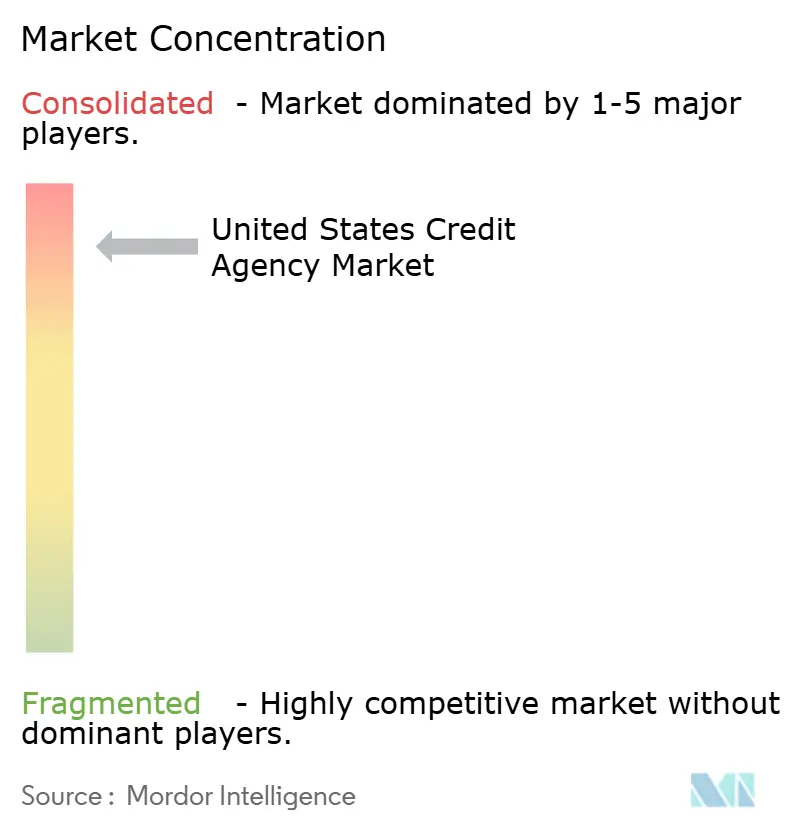
| Market Concentration | High |
Major Players *Disclaimer: Major Players sorted in no particular order Image © Mordor Intelligence. Reuse requires attribution under CC BY 4.0. | |
United States Credit Agency Market Analysis by Mordor Intelligence
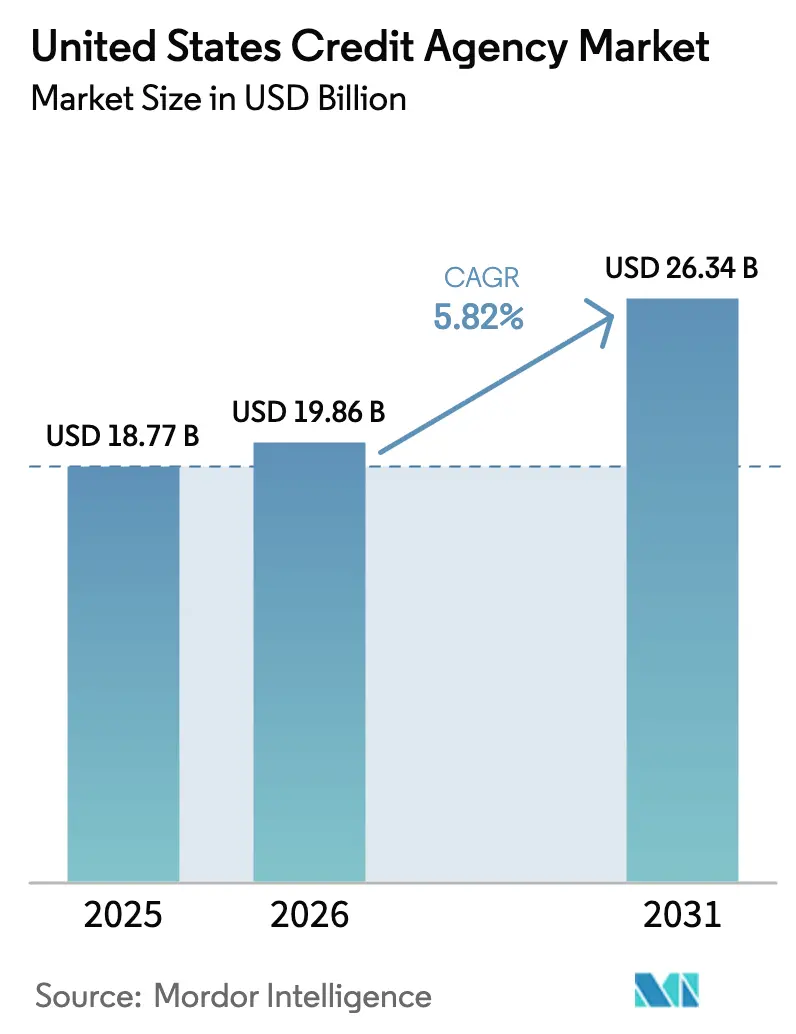
The U.S. credit agency market size was valued at USD 18.77 billion in 2025 and estimated to grow from USD 19.86 billion in 2026 to reach USD 26.34 billion by 2031, at a CAGR of 5.82% during the forecast period (2026-2031). Growth is driven by stable loan demand, increased use of alternative data, and subscription-based monitoring services, offsetting compliance costs from new Consumer Financial Protection Bureau (CFPB) and Federal Housing Finance Agency (FHFA) regulations. Lenders are adopting machine-learning models incorporating rental payments and utility bills, creating new revenue streams while meeting regulatory demands for algorithmic transparency. The CFPB’s data-broker proposal and state privacy laws are raising costs but pushing banks and fintechs toward first-party bureau files with Fair Credit Reporting Act protections. Cloud-native delivery models reduce latency, enabling instant approvals and supporting pricing stability as tri-bureau contracts shift to bi-merge formats in mortgage underwriting. The market is highly concentrated, with the top five bureaus leveraging scale to invest in AI, acquire niche platforms, and bundle identity protection with credit services. Key examples include Capital One’s acquisition of Discover, TransUnion’s OneTru launch, and Experian’s deal pipeline. Regional growth varies: the South anchors volume with a large borrower base, the West drives innovation through fintech demand, and the Northeast focuses on compliance-heavy analytics for low default variability.
Key Report Takeaways
- By service type, Credit Reporting Services held 57.05% United States credit agency market share in 2025, while Credit Scoring & Analytics is projected to grow at a 6.69% CAGR to 2031.
- By end-user industry, Financial Services accounted for 38.33% of the United States credit agency market size in 2025; Media & Technology leads future expansion at an 8.47% CAGR.
- By client type, Commercial customers represented 55.40% of the United States credit agency market size in 2025, whereas Individual services are advancing at a 6.22% CAGR.
- By geography, the South captured 37.75% revenue share of the United States credit agency market in 2025; the West region’s 6.98% CAGR through 2031 makes it the fastest-growing area.
Note: Market size and forecast figures in this report are generated using Mordor Intelligence’s proprietary estimation framework, updated with the latest available data and insights as of 2026.
United States Credit Agency Market Trends and Insights
Drivers Impact Analysis*
| Driver | (~) % Impact on CAGR Forecast | Geographic Relevance | Impact Timeline |
|---|---|---|---|
| AI-driven alternative-data scoring | +1.2% | National, early gains in West & Northeast | Medium term (2-4 years) |
| Rising BNPL & fintech lending volumes | +0.9% | National, urban focus | Short term (≤ 2 years) |
| Regulatory push for inclusive credit models | +0.8% | National, compliance hubs in Northeast | Long term (≥ 4 years) |
| Expansion of small-business credit data | +0.7% | National, strong in South & Midwest | Medium term (2-4 years) |
| Data-broker deprecation | +0.6% | California & Northeast | Medium term (2-4 years) |
| Cloud-native bureau platforms | +0.5% | National, led by West | Short term (≤ 2 years) |
| Source: Mordor Intelligence | |||
AI-Driven Alternative-Data Scoring Adoption
Machine-learning engines ingest rent, utilities, and mobile-usage records to score thin-file borrowers, supplying lenders with broader coverage while satisfying CFPB goals for fairness. Citigroup estimates AI could lift global banking profits by USD 170 billion by 2028, with credit underwriting gains supplying much of that upside [1]. Agencies are strategically leveraging previously untapped data assets to unlock new revenue opportunities and enhance their market positioning. They are also introducing comprehensive model-risk reports that provide in-depth analysis of bias control mechanisms, ensuring compliance with evolving regulatory standards. By prioritizing transparency in their operations, these agencies are strengthening their ability to mitigate regulatory risks and maintain credibility in the market. Moreover, this approach solidifies their role as essential facilitators of responsible AI implementation within the lending industry.
Rising BNPL and Fintech Lending Volumes
Apple began furnishing Pay Later trades to Experian in March 2024, signaling a shift from off-book installments to fully reported credit obligations [2]. CFPB research shows almost one in five BNPL users missed a payment in 2024, creating lender demand for bureau-grade oversight and loss forecasting. Agencies package BNPL attributes into specialty scores that track pay-in-four utilization and rollovers, then resell that insight to card issuers fighting share erosion. Direct-to-consumer dashboards let borrowers monitor BNPL history, generating subscription fees while easing dispute workloads. Early evidence suggests reported BNPL data raises average FICO by 10–12 points for punctual users, expanding access to mainstream credit lines.
Regulatory Push for Inclusive Credit Models
The FHFA will mandate bi-merge files and migrate to FICO 10T plus VantageScore 4.0 in Q4 2025, forcing lenders to reassess bureau mix and predictive power [3]. The CFPB’s December 2024 outline extends FCRA coverage to data brokers, channeling demand toward bureaus with established permissible-purpose workflows. State bans on medical debts under USD 500 require dynamic suppression filters that maintain file accuracy across jurisdictions. Agencies with cloud-native architectures can update exclusion rules in near real time, converting compliance into a value-added service. Inclusive scoring aligns commercial interests with public-policy goals, supporting continued growth even as fee caps loom.
Expansion of Small-Business Credit Data Products
Section 1071 of the Dodd-Frank Act compels lenders to collect demographic and geographic data on business applicants after July 2025, creating new data feeds that bureaus can sanitize and analyze. FinRegLab studies highlight persistent funding gaps for minority-owned firms, encouraging bureaus to develop alternative cash-flow and e-commerce-based scores. Initial pilot programs conducted with community banks in Texas demonstrated a significant reduction in the time and effort required for manual document reviews, while simultaneously achieving an increase in approval rates for newly established businesses. Agencies price these reports at a premium because they reduce fair-lending litigation risk and accelerate loan turnaround times. Diversifying into commercial datasets buffers revenue against consumer borrowing cycles.
Restraints Impact Analysis*
| Restraint | (~) % Impact on CAGR Forecast | Geographic Relevance | Impact Timeline |
|---|---|---|---|
| Intensifying data-privacy legislation | -0.8% | California, New York, Illinois | Medium term (2-4 years) |
| Mortgage-rate volatility | -0.7% | High-cost housing markets | Short term (≤ 2 years) |
| CFPB plan to open-source scores | -0.6% | National | Long term (≥ 4 years) |
| Tri-bureau pricing scrutiny | -0.5% | National | Medium term (2-4 years) |
| Source: Mordor Intelligence | |||
Intensifying Data-Privacy Legislation (US State Patchwork)
California’s Consumer Privacy Rights Act expansion, New York’s proposed Digital Fairness Bill, and Illinois’s Biometric Information Privacy Act each impose distinct consent, retention, and deletion rules. Agencies must run parallel workflows that check data provenance at state borders, inflating cloud-storage and compliance-audit spending. Delays in reconciling opt-out requests can trigger statutory fines as high as USD 7,500 per violation, eroding profit margins. Some bureaus respond by geofencing sensitive products or baking privacy surcharges into contracts. While privacy rules curb data breadth, they simultaneously heighten lender demand for vetted, FCRA-compliant sources, partially offsetting lost volume.
Mortgage-Rate Volatility Dampening Pull-Through Volumes
Thirty-year fixed mortgage rates hovered near 7% through early 2025, suppressing refinance activity and reducing tri-merge pulls by up to 35% versus 2021 peaks [4]. Lower pull-through weakens high-margin mortgage bundles that combine reports, scores, and fraud checks. Agencies shift sales attention toward home-equity lines, cash-out refis, and construction loans to replace lost volume. Fintech startups that specialize in rate-shopping APIs still consume bureau data but negotiate tighter prices, compressing yields. As rates stabilise, purchase loans will partially offset the refi slump, yet variability remains a swing factor for near-term revenue.
*Our forecasts treat driver/restraint impacts as directional, not additive. The impact forecasts reflect baseline growth, mix effects, and variable interactions.
Segment Analysis
By Service Type: Analytics Accelerates Revenue Mix
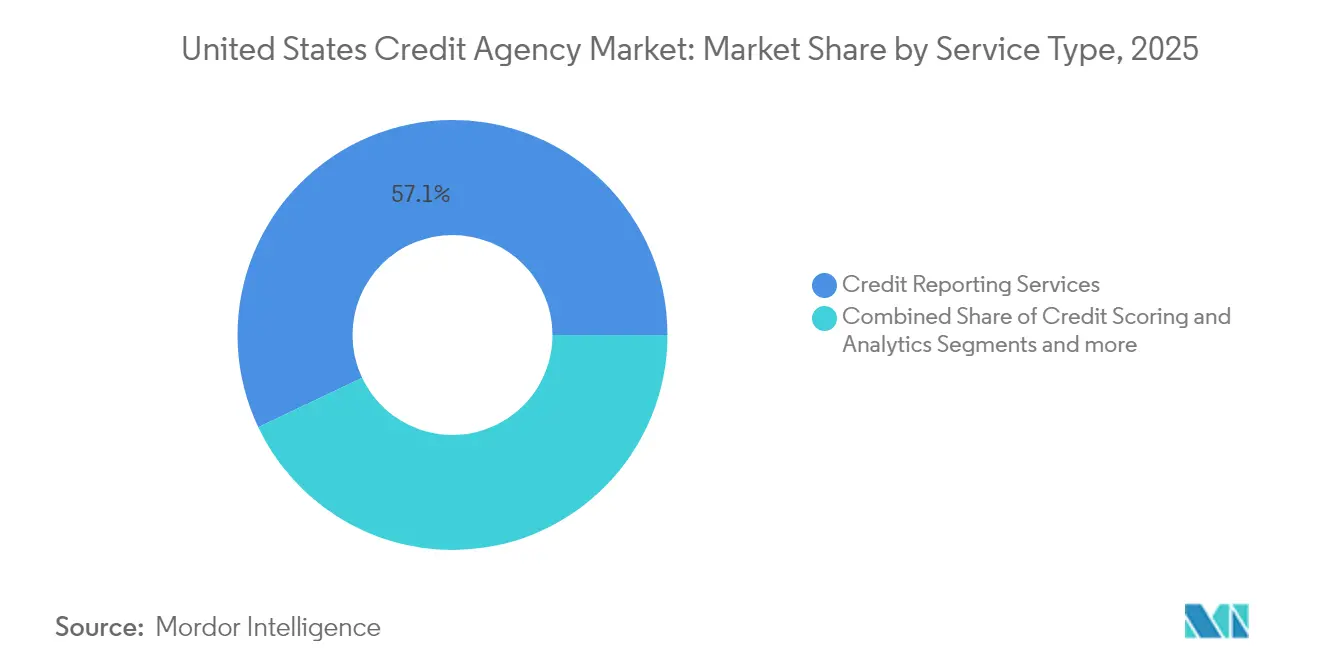
Credit Reporting Services captured 57.05% of the U.S. credit agency market, reinforcing its position as the primary data provider for lenders. The Credit Scoring & Analytics segment is projected to expand at a 6.69% CAGR, surpassing the growth rate of traditional reporting services. This growth reflects a notable increase in the analytics-driven segment of the U.S. credit agency market. Key factors driving this expansion include regulatory requirements for AI transparency, the proliferation of Buy Now Pay Later (BNPL) offerings, and heightened demand for real-time credit approvals. Furthermore, Subscription-based Monitoring & Identity Protection services mitigate risks associated with lending cycles. These services experience demand surges during data breach events, ensuring steady revenue streams.
As scoring models mature, bureaus bolt on behavioural features such as spending volatility, pay cheque cadence, and geospatial fraud indicators, fortifying predictive power. Agencies that pilot federated-learning techniques retain consumer privacy while training networks, preserving legal compliance. Proprietary algorithmic lift underpins premium prices, yet pending CFPB algorithm-transparency moves threaten to erode that moat. To hedge, bureaus prioritise unique data ownership—public-record liens, payroll feeds, and verified cash-flow series. Cloud delivery lowers compute cost per inquiry by roughly 25% and enables pay-as-you-go bundles that attract fintech upstarts.

By End User: Technology Verticals Power Next-Wave Demand
Financial Services accounted for a substantial 38.33% share of the U.S. credit agency market size, solidifying its leading position. Growth in this base slows to steady mid-single digits as credit card and auto loans mature. Conversely, Media & Technology customers—including streaming platforms, gig-work marketplaces, and software-as-a-service vendors—purchase bureau data at an 8.47% CAGR, seeking identity verification, account-sharing analytics, and purchase fraud scores. Employment-screening rules issued under CFPB Circular 2024-06 force big tech employers to demand FCRA-grade reports for algorithmic hiring, enlarging order volumes.
Healthcare providers, utilities, and telecom firms round out niche use cases with steady requisition patterns, particularly for deposit decisions and patient-finance plans. Automotive subscription programs leverage bureau scores to calibrate mileage overage penalties. The emerging breadth reduces concentration risk and pushes bureaus to build modular APIs tailored to each vertical. Cross-selling success hinges on integrating the data once, so each additional product drop incurs marginal costs rather than bespoke projects. This scale unlocks higher operating leverage and cushions pricing pressure in legacy segments of the United States credit agency industry.
By Client Type: Individual Subscriptions Lift Margins
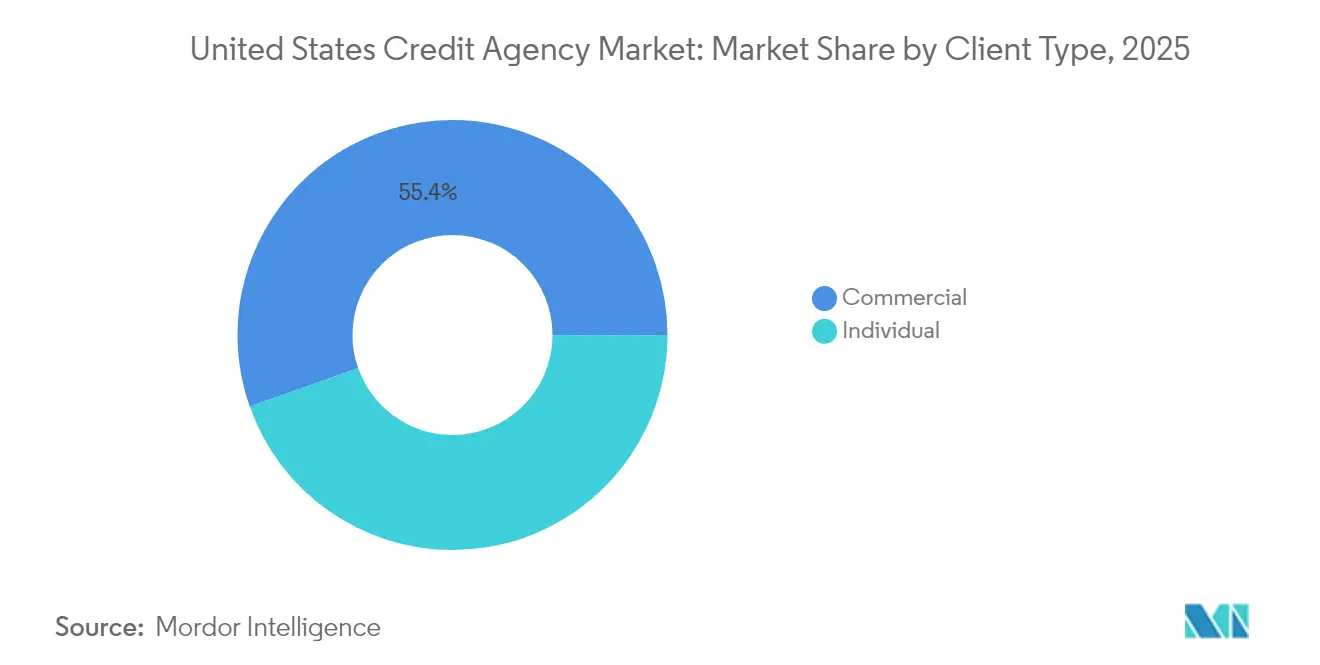
Commercial entities still consume 55.40% of 2025 revenue, but the Individual category grows faster at 6.22% through 2031 as privacy fears and credit-score literacy spread. Agencies convert regulatory file-disclosure rights into freemium apps that upsell score monitoring, dark-web scans, and identity-theft insurance. Customer-experience revamps—single-click freeze toggles, weekly VantageScore refresher,s and gamified credit-health tips—keep churn below 2% per month. Lifetime value rises because add-on services, such as loan-rate comparison engines and BNPL trackers, deepen wallet share.
Commercial clients remain indispensable for bulk data pulls that drive economies of scale; however, they push for rate concessions amid regulatory pressure to trim borrower fees. Agencies answer by bundling fraud, KYC, and anti-money-laundering modules that raise average revenue per unit while masking list-price declines. The individual expansion thus anchors overall margin resilience across the United States credit agency market.
Geography Analysis
Southern states captured 37.75% of 2025 bureau revenue, propelled by population inflows, robust mortgage origination, and extensive community-bank networks. Florida and Texas show double-digit growth in fintech loan applications, and lenders in those states purchase enhanced cash-flow analytics to accommodate non-traditional employment patterns. Housing inflation in Atlanta, Miami and Dallas heightens payment-shock risk, prompting demand for location-aware scoring rules. Agencies also partner with regional universities to test rental-payment data feeds, anticipating CFPB inclusivity mandates.
The Western region, while currently dominating turnover, is projected to achieve a significant compound annual growth rate (CAGR) of 6.98% by 2031. California’s Consumer Privacy Rights Act pushes companies toward privacy-by-design bureau APIs, allowing agencies to charge compliance premiums. Silicon Valley startups embed split-second decision tools into in-app finance offers, consuming high-frequency bureau calls that lift transaction counts. Oregon and Washington contribute as e-commerce hubs that utilise identity verification to stop account takeovers. Western adoption of rental, subscription, and buy-now-pay-later datasets provides fertile ground for new score variants tuned to gig-economy cash flows.
The Northeast combines longstanding financial-services depth with low delinquency risk. Regulatory proximity accelerates pilot programs on explainable AI scoring; agencies run model-risk user groups in New York and Massachusetts to solicit feedback before nationwide rollout. Midwestern demand remains moderate but steady. Community banks navigating industrial transitions buy commercial bureau files enriched with supplier-payment histories that gauge small-manufacturer resilience. These diverse regional patterns allow bureaus to tailor pricing and data-depth tiers, maximising value capture across the United States credit agency market.
Regulatory Landscape
The United States credit agency market operates primarily under the Fair Credit Reporting Act (FCRA) and its implementing rules under Regulation V, with the Consumer Financial Protection Bureau (CFPB) and Federal Trade Commission (FTC) acting as key federal overseers. The CFPB has maintained sustained regulatory focus through rulemaking, supervision, and enforcement, including defining and pursuing larger-participant oversight for the consumer reporting market (Federal Register, August 2025), along with ongoing actions tied to dispute reinvestigation, accuracy, and permissible-purpose controls (including the CFPB action involving Equifax in January 2025 and litigation activity involving Experian as of August 2025).
Policy developments at both federal and state levels continue to affect file content, scoring, and distribution mechanics. A notable 2025 inflection point was the vacatur of the CFPB medical-debt rule by the U.S. District Court for the Eastern District of Texas (July 11, 2025), highlighting the legal sensitivity of file-suppression mandates and the operational need for jurisdiction-aware compliance logic. Other pressure points include ongoing federal dialogue on FCRA preemption of state laws (Federal Register, October 2025) and additional enforcement follow-through by the FTC, including a modified decision and order involving Dun & Bradstreet in early 2026, which further emphasizes documented compliance for data quality and governance.
Value Chain Analysis
The value chain starts with data acquisition from furnishers, including banks, card issuers, fintech lenders, mortgage originators/servicers, debt collectors, and utility or telecom providers, with standardized furnishing workflows commonly aligned to industry formats such as Metro 2. Credit agencies then ingest, perform identity resolution, normalize and match records to consumer or business files, and apply governance controls that support FCRA obligations around accuracy, permissible purpose, and dispute reinvestigation. These compliance-heavy steps are not side functions, they shape cost-to-serve and help differentiate bureaus when clients face heightened audit demands.
Downstream, agencies package credit reports, scores, and analytics through batch files, web portals, and increasingly API-based orchestration into lender decisioning stacks for underwriting, KYC, fraud detection, and AML screening. The delivery layer interfaces with lender loan-origination systems and third-party decision engines, where routing and latency performance can affect conversion and abandonment in digital channels. On the consumer side, distribution also depends on secure access management and dispute workflows, since file disclosures, freezes, and subscription monitoring must be handled in a way that preserves file quality while scaling direct-to-consumer services.
Competitive Landscape
The five national players—Equifax, Experian, TransUnion, Dun & Bradstreet and LexisNexis Risk Solutions—command major market revenue, resulting in near-textbook oligopoly status. Their dominance is reinforced by vast historical datasets, lender integrations and compliance certifications that create formidable entry barriers. CFPB Director Rohit Chopra labelled the cohort a “credit bureau cartel” after observing report prices rise fourfold since 2022. This scrutiny accelerates platform upgrades designed to show audit trails, bias dashboards and dispute-resolution tracking.
Strategic moves underscore vertical expansion. TransUnion’s April 2025 Monevo acquisition plugs instant pre-qualification into its OneTru cloud, capturing referral lead revenue while reinforcing data moats. Equifax invests heavily in Workforce Solutions to cross-sell income verification as lenders embrace ability-to-repay rules. Experian pilots Buy-Now-Pay-Later performance scores, bundling them with mainstream FICO offerings to stay relevant with younger demographics. Dun & Bradstreet exploits Section 1071 datasets to revamp its small-business PAYDEX model. LexisNexis integrates public-record liens with consumer tradelines, arming insurers with combined property-credit insights.
Competitive intensity revolves around latency, model explainability, and depth of alternative assets rather than simple file count. Cloud migration chops average response times below 300 milliseconds and lowers the marginal cost of new data attributes. Agencies that achieve sub-second turnaround win embedded-finance contracts with fintech apps. However, concentration fuels antitrust talk; proposed anticompetitive-conduct cases could mandate data portability or pricing remedies. Bureaus prepare by lobbying on cybersecurity grounds and highlighting the systemic risk reduction they provide.
United States Credit Agency Industry Leaders
-
Equifax Inc.
-
Experian PLC
-
TransUnion
-
Dun & Bradstreet Holdings
-
Fair Isaac Corp. (FICO)
- *Disclaimer: Major Players sorted in no particular order
Market Opportunities and Future Outlook
Mortgage scoring competition and reporting workflow changes are creating near-term whitespace for bureaus and scoring providers that can operationalize model choice while preserving auditability. The FHFA move toward bi-merge files and the adoption path for FICO 10T and VantageScore 4.0 support demand for productized migration support, including model governance documentation, reason-code explainability, and lender validation tooling, as well as alternative-credit attributes that can improve decisioning within constrained bureau pull counts. In 2026, market activity around FICO Score 10T data availability for the GSE ecosystem further reinforces the commercial value of historical performance datasets and validation tooling tied to mortgage underwriting.
A second opportunity area is expanding identity, fraud, and alternative-data bundles within tighter privacy and permissible-purpose expectations, especially as pricing power and score usage draw more scrutiny (including a March 2026 Senate oversight letter to the FTC regarding FICO pricing practices for mortgage credit scores). As lenders and digital platforms reduce reliance on any single data source, orchestration platforms that support vendor portability and configurable routing based on cost, latency, and risk can create room for bureau partners that offer modular, API-first attributes (rent, utilities, payroll, and other cash-flow signals) backed by strong provenance and FCRA-grade controls. With regulatory pressure on data brokers and continued emphasis on verified, compliant data supply, providers that can document data lineage and deliver dispute-ready audit trails at scale face a clearer positioning advantage.
Recent Industry Developments
- July 2026: Equifax signs definitive agreement to acquire Círculo de Crédito in Mexico for $750 million. The cross-border expansion strengthens Equifax's regional footprint and data moat by entering an adjacent credit information market in Latin America.
- July 2026: TransUnion launches mortgage credit report enhancement integrating TruVision ACA 2.0 from FactorTrust. The integration expands alternative data capabilities for mortgage decisioning and improves underwriting accuracy, reinforcing lender integrations and competitive positioning in mortgage analytics.
- April 2026: Equifax statement on FHFA/HUD announcement enabling use of VantageScore 4.0 and FICO 10T for FHA insured mortgage underwriting. The regulatory acceptance of multiple scoring models broadens lender options in government backed mortgage programs and increases competition among scoring models.
Research Methodology Framework and Report Scope
Market Definition and Coverage
This market covers revenue earned in the United States from credit agency services that help lenders and other users evaluate credit risk and identity. It includes credit information, scoring-related services, and monitoring products sold to businesses and consumers.
Scope exclusions: It excludes non-credit market intelligence products that do not rely on credit file based risk information, along with purely in-house bank underwriting tools that are not sold as a service.
Segmentation Overview
- By Service Type
- Credit Reporting Services
- Credit Scoring & Analytics
- Credit Monitoring & Identity Protection
- By End User
- Direct-to-Consumer
- Government and Public Sector
- Healthcare
- Financial Services
- Software and Professional Services
- Media and Technology
- Automotive
- Telecom and Utilities
- Retail and E-Commerce
- Other Verticals
- By Client Type
- Individual
- Commercial
- By Geography
- Northeast
- Midwest
- South
- West
Data Sources, Market Sizing, and Validation
Desk Research
For the first cut of the model, we rely on public information that anchors what credit agencies do, how they are regulated, and how demand flows from lending and data usage in the United States. Common inputs include the Consumer Financial Protection Bureau for credit reporting topics, the Federal Reserve for consumer credit conditions, the Federal Reserve Bank of New York for household debt and credit trends, and the US Census Bureau for macro and business activity context.
We also review annual reports and investor presentations of listed participants, along with trade association publications and reputable press coverage that explain product mix shifts such as monitoring subscriptions and fraud related add-ons. Where available, paid database subscriptions are used for company financials and intelligence, plus patent databases to track changes in scoring signals, identity verification, and alternative data use cases. The source list above is illustrative only, and many other public and paid references were used to collect, cross-check, and clarify the final inputs.
Primary Interviews and Surveys
To validate what we saw in desk research, we conducted expert interviews and structured surveys with credit information providers, data partners, and buyer groups such as lenders, insurers, telecom, and property managers. Since this is a US-only market, we built coverage across key regions and customer types so pricing, renewal behavior, and shifts such as bi-merge usage in mortgage could be checked and then reflected in the market model.
Distribution of primary research fieldwork respondents
| Company type | Respondent position |
|---|---|
| Top tier: 31% | CXOs: 13% |
| Mid tier: 55% | Functional/Unit leaders: 43% |
| Smaller Players: 14% | Managers: 44% |
Market-Sizing & Forecasting
Sizing starts with a top-down build where credit activity and lending demand indicators are used to reconstruct the addressable pool for credit file, scoring, and monitoring usage, then translated into dollars using observed pricing patterns. To keep totals realistic, we corroborate outputs with selective bottom-up approximations, such as rolling up sampled supplier revenues, checking typical contract ranges by end user type, and validating volume assumptions with channel feedback.
Key inputs include consumer and commercial credit inquiry trends, the mix of lender use cases (origination versus account review), adoption of monitoring subscriptions among consumers, and the share of decisioning that uses bureau files versus niche data. We also factor in regulatory and compliance effects that can change product mix and delivery costs, along with shifts in mortgage underwriting workflows that influence how many bureau pulls occur. For forecasting, scenario analysis is used around lending cycles and underwriting demand, then the base case is aligned to expert consensus on how usage intensity and pricing are expected to move over the next few years. When bottom-up gaps appear for smaller private participants, we bridge missing pieces with conservative revenue per client assumptions that are cross-checked in follow-up calls.
Data Validation & Update Cycle
Model outputs are triangulated against independent signals such as lending volumes, credit inquiry direction, and public financial disclosures, and then any large variances are reviewed line by line before sign-off. We also run checks for unusual jumps in implied pricing or sudden share shifts, and if these are not supported by a clear market event, assumptions are revisited and experts are re-contacted.
Reports are refreshed annually, and interim updates are triggered when material regulatory changes, major product launches, or sharp credit cycle movements meaningfully alter the outlook. Before delivery, we complete a final review pass so the published numbers reflect the latest available information and consistent definitions.
Mordor Intelligence's United States Credit Agency Market Size Versus Other Published Estimates
Published market values for US credit agency services can differ because studies define the service set differently, pick different base years, and apply different pricing and volume assumptions across lender and consumer use cases. Differences also come from how firms treat monitoring subscriptions, identity and fraud add-ons, and the refresh timing used when new regulations or lending cycles change demand.
Credit scoring software sold as a standalone product sits outside Mordor Intelligence's scope here, which narrows the total versus estimates that bundle scoring platforms and broader risk analytics into the same revenue pool. A second gap driver is how mortgage workflow changes are modeled, because some estimates hold inquiry volumes flat, while others explicitly adjust for bi-merge adoption and lender policy shifts. Currency and inflation handling can also move totals, especially when older pricing benchmarks are carried forward without being rechecked with buyers.
Benchmark comparison
| Source | Market Size | Gaps in Research Methodology |
|---|---|---|
| Mordor Intelligence | USD 19.86 B (2026) | |
| Regional Consultancy A | USD 14.36 B (2024) | Uses an earlier base year and a tighter service interpretation that appears to undercount consumer subscription monitoring and value-added identity related revenue streams in the same period. |
| Trade Journal B | USD 17.73 B (2024) | Applies a broader label for credit agency services but relies on generalized lending growth assumptions, with less explicit adjustment for inquiry mix shifts and contract pricing updates by end user type. |
Taken together, the spread mainly reflects what revenue lines are counted and how quickly pricing and usage assumptions are refreshed when the credit cycle moves. By keeping inputs tied to observable inquiry and lending signals, and then pressure-testing the implied dollars with supplier and buyer checks, the market size can be replicated and explained in a straightforward way for planning.
Key Questions Answered in the Report
What is the projected size of the United States credit agency market by 2031?
The market is forecast to reach USD 26.34 billion by 2031, growing at a 5.82% CAGR.
Which service type is growing fastest?
Credit Scoring & Analytics leads with a 6.69% CAGR through 2031 as lenders seek AI-driven risk assessment tools.
Why is the West region expected to outpace others?
Technology-sector expansion and stringent data-privacy laws drive 6.98% CAGR growth in the West, boosting demand for advanced compliance and alternative-data solutions.
How will FHFA’s bi-merge requirement affect bureaus?
It reduces tri-bureau dependence, rewarding agencies that can prove higher predictive accuracy under FICO 10T and VantageScore 4.0 models.
What role does BNPL data play in bureau revenue?
Reporting BNPL trades, as Apple did with Pay Later, broadens consumer credit files and enables agencies to sell new analytics products to lenders monitoring short-term installment risk.
Are individual subscriptions becoming more important?
Yes. Identity-protection and credit-monitoring packages for consumers are expanding at a 6.22% CAGR, adding a higher-margin revenue stream beyond institutional clients.