
Market Overview
| Study Period | 2020 - 2031 |
|---|---|
| Forecast Data Period | 2026 - 2031 |
| Historical Data Period | 2020 - 2024 |
| Market Size (2026) | USD 37.62 Billion |
| Market Size (2031) | USD 47.71 Billion |
| Growth Rate (2026 - 2031) | 4.86 % |
| Market Concentration | Medium |
Major Players *Disclaimer: Major Players sorted in no particular order Image © Mordor Intelligence. Reuse requires attribution under CC BY 4.0. | |

United States Air Conditioning Equipment Market Analysis by Mordor Intelligence
The United States air conditioning equipment market size is USD 37.62 billion in 2026 and is projected to reach USD 47.71 billion by 2031, reflecting a 4.86% CAGR over the forecast period. Ongoing regulatory upgrades, accelerated replacement of aging units, electrification mandates, and rising demand for smart, connected systems underpin this trajectory. Variable-speed inverter platforms dominate due to January 2023 efficiency standards that sidelined fixed-speed compressors, while heat pump shipments now outstrip gas furnace sales. Commercial retrofits in data centers and mixed-use buildings complement robust residential replacement cycles, and federal as well as state incentives continue to compress the payback period for high-efficiency equipment. Supply side investments in Gulf Coast refrigerant production and domestic compressor plants further steady the value chain, even as skilled labor shortages and PFAS policy uncertainty temper near-term momentum.
Key Report Takeaways
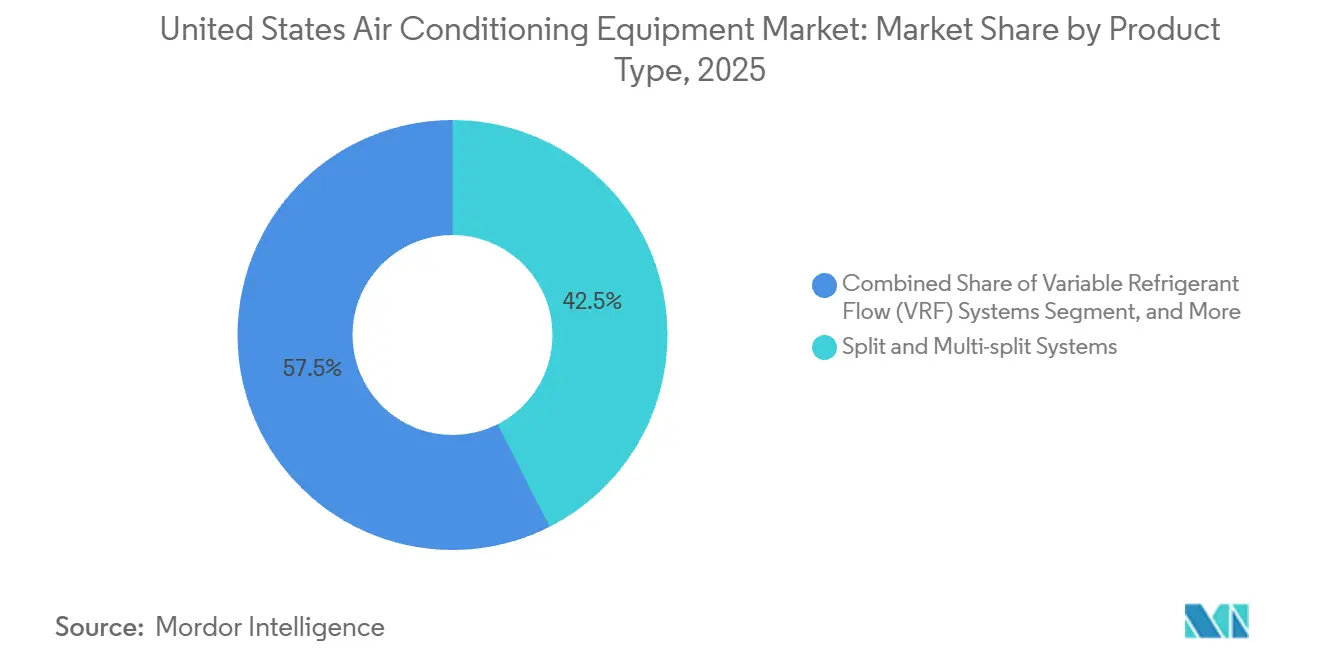
- By product type, split and multi-split systems led with 42.53% revenue share in 2025, while variable refrigerant flow systems are forecast to advance at a 5.73% CAGR through 2031.
- By technology, inverter platforms accounted for 68.86% of 2025 revenue and are projected to grow at a 5.53% CAGR to 2031.
- By end-user, residential applications captured 64.12% of the United States air conditioning equipment market share in 2025, whereas commercial installations are expected to expand at a 5.85% CAGR over 2026-2031.
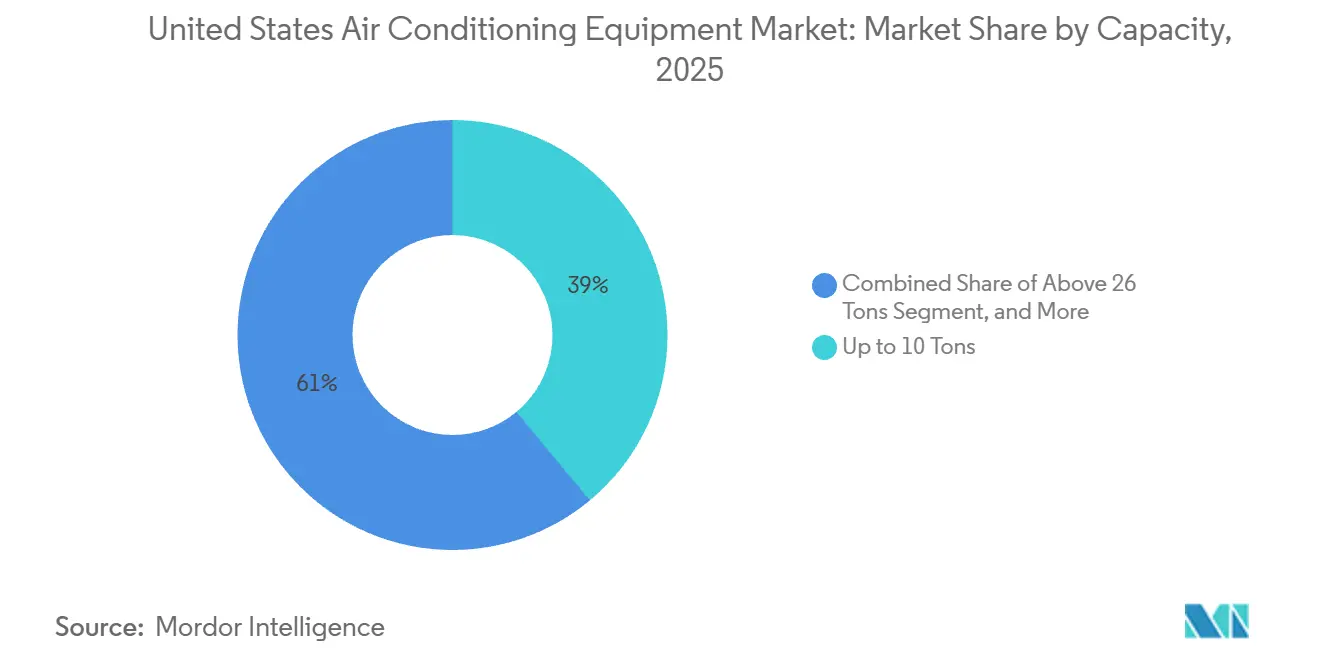
- By capacity, equipment up to 10 Tons accounted for 38.97% of the United States air conditioning equipment market share in 2025, and equipment above 26 tons of refrigeration is set to grow at a 6.01% CAGR, the fastest among all capacity bands between 2026 and 2031.
- By distribution channel, dealer and retail stores distributed 42.12% of units in 2025, yet direct sales are poised to increase at a 5.68% CAGR through 2031.
Note: Market size and forecast figures in this report are generated using Mordor Intelligence’s proprietary estimation framework, updated with the latest available data and insights as of January 2026.
United States Air Conditioning Equipment Market Trends and Insights
Drivers Impact Analysis*
| Driver | (~) % Impact on CAGR Forecast | Geographic Relevance | Impact Timeline |
|---|---|---|---|
| Replacement of Existing Systems with Energy-Efficient Units | +0.8% | National, concentration in Sun Belt states | Medium term (2-4 years) |
| Government Tax Credits and Efficiency Standards Adoption | +1.2% | National, amplified where additional rebates exist | Short term (≤ 2 years) |
| Rapid Penetration of Heat Pumps Driven by Electrification Goals | +1.4% | Northeast and Pacific Northwest, expanding to Mid-Atlantic and Upper Midwest | Long term (≥ 4 years) |
| Rising Demand for Smart and Connected AC Systems | +0.6% | National, early uptake in large metros | Medium term (2-4 years) |
| Electrification of Commercial Rooftops via Utility Thermal Energy Networks | +0.4% | Select urban cores with district energy | Long term (≥ 4 years) |
| Growth of Low-GWP Refrigerant Manufacturing Capacity in Gulf Coast | +0.3% | National supply, production in Texas and Louisiana | Short term (≤ 2 years) |
| Source: Mordor Intelligence | |||
Replacement of Existing Systems with Energy-Efficient Units
A base of more than 90 million units in 2025 translated into 35%-40% of systems operating past the 15-year design life, pushing emergency replacements toward compliant inverter equipment. Utilities in Texas and Florida reinforced this shift by paying USD 300-USD 500 for scrapping pre-2010 units, which lifted replacement volumes during peak cooling seasons. A 16 SEER2 inverter model cuts annual cooling bills by USD 200-USD 350 in hot-humid cities, yielding a five-to-seven-year payback even without tax credits. Manufacturers responded decisively, with Lennox and Rheem ending fixed-speed compressor production by mid-2024. The resulting inventory mix now steers contractors and homeowners toward higher-efficiency solutions as the default.
Government Tax Credits and Efficiency Standards Adoption
Homeowners may claim 30% of equipment and installation costs, up to USD 2,000 for heat pumps and USD 600 for central air conditioners, that meet Energy Star “Most Efficient” criteria through 2032.[1]Internal Revenue Service, “Energy Efficient Home Improvement Credit,” irs.gov Separately, the USD 8.8 billion Home Energy Efficiency Rebates Act offers point-of-sale incentives reaching USD 8,000 for qualifying heat pump projects, compressing the inverter premium from USD 3,500 to USD 1,200 in 2025.[2]U.S. Department of Energy, “Home Energy Rebate Programs,” energy.gov Commercial rules tightened as well, with the DOE mandating energy recovery ventilators on large packaged units, lifting upfront equipment prices by 8-12% but trimming lifetime operating costs 15-20%. States such as California and Washington, which prohibit fossil-fuel HVAC in most new construction after 2025, amplify these federal levers and effectively steer the specification base toward electric heat pumps and VRF systems.
Rapid Penetration of Heat Pumps Driven by Electrification Goals
Heat pump shipments reached 4.3 million units in 2024, eclipsing gas furnace volumes for the first time in five decades. Cold-climate designs that hold coefficients of performance above 2.0 at 5 °F unlocked adoption in the Northeast, where utility rebates of USD 10,000-USD 15,000 now offset 50%-60% of installed costs. New York will require all-electric new construction by 2027, while California’s Title 24 revisions raise the electric share of single-family HVAC installations to 85% in 2025.[3]California Energy Commission, “2022 Building Energy Efficiency Standards,” energy.ca.gov The Mid-Atlantic and Upper Midwest follow suit as volatility in natural gas prices and carbon penalty proposals cut into fossil fuel cost advantages. Equipment makers with proven cold-climate portfolios gain a first-mover edge in these expanding markets.
Rising Demand for Smart and Connected AC Systems
Connected thermostats and IoT-enabled controllers equipped 45% of new homes in 2025, up from 28% in 2022, reflecting builder standardization of smart packages and utility demand-response enrollment. Johnson Controls introduced OpenBlue in 2024, a cloud platform that merges HVAC, lighting, and security data, driving 12%-18% cooling energy savings in early deployments. Utilities in California, Texas, and New York together enrolled more than 2 million smart thermostats in automated curtailment programs, freeing USD 500 million in deferred grid investment. The National Institute of Standards and Technology's zero-trust architecture guidelines, published in 2024, catalyzed the segmentation of HVAC networks, limiting cyber-risk exposure. As predictive maintenance gains traction, contractors deploy data-driven service contracts that lift recurring revenue while cutting downtime for building owners.
Restraints Impact Analysis*
| Restraint | (~) % Impact on CAGR Forecast | Geographic Relevance | Impact Timeline |
|---|---|---|---|
| High Upfront Cost of Inverter and Heat Pump Technologies | -0.5% | National, acute in low-income and rural markets | Short term (≤ 2 years) |
| Supply Chain Bottlenecks in Semiconductor and Compressor Components | -0.4% | National, variable by distributor inventory | Medium term (2-4 years) |
| Skilled Labor Shortages for Installation and Service | -0.3% | National, most severe in Sun Belt states and rural areas | Long term (≥ 4 years) |
| Emerging PFAS Regulations Targeting HFO Refrigerants | -0.2% | State-level (Maine, California, Minnesota) with potential federal expansion | Long term (≥ 4 years) |
| Source: Mordor Intelligence | |||
High Upfront Cost of Inverter and Heat Pump Technologies
Installed costs for a 3-ton inverter heat pump range from USD 8,000 to USD 12,000, versus USD 5,500-USD 7,500 for a central air conditioner paired with a gas furnace, leaving a residual premium even after federal credits. Low-income households, which represent 35% of owner-occupied homes, often lack access to financing, and PACE programs remain unavailable in 22 states. Rollout delays in the Home Energy Efficiency Rebates Act meant only USD 1.2 billion of the USD 8.8 billion allocation had reached consumers by December 2025. Tariffs imposed in 2024 added 15%-25% to landed inverter controller costs, diluting manufacturer efforts to compress price premiums. Consequently, adoption lags in rural Southeast and Midwest communities, slowing near-term market penetration.
Supply Chain Bottlenecks in Semiconductor and Compressor Components
Inverter systems contain three to five times more semiconductor content than fixed-speed units, making them vulnerable to chip shortages that extended lead times to 18-24 weeks in early 2024. Domestic compressor output, even after Mitsubishi Electric’s 1.2 million-unit Kentucky plant opened in late 2024, still covers only 25%-30% of national demand. Port congestion on the West Coast added two to three weeks to shipping, prompting Carrier and Lennox to divert 15%-20% of imports to Eastern ports and Mexican assembly hubs. Component scarcity weighed heaviest on VRF projects, which integrate multiple inverter indoor units, forcing specifiers to favor traditional chiller solutions on tight timelines. Although multiple capacity expansions are underway, supply stability will take another one-to-two years to normalize.
*Our forecasts treat driver/restraint impacts as directional, not additive. The impact forecasts reflect baseline growth, mix effects, and variable interactions.
Segment Analysis
By Product Type: VRF Systems Capture Commercial Retrofit Wave
Variable refrigerant flow systems are projected to grow at a 5.73% CAGR, surpassing the broader United States air conditioning equipment market rate as building owners replace constant-volume rooftops with modular VRF architectures. In 2025, split and multi-split units held 42.53% revenue share thanks to deep penetration in single-family homes, yet multifamily developers and school districts increasingly specify VRF to cut energy use 30%-40% and free rooftop real estate.
A thriving retrofit pipeline in Class B office buildings and mixed-use properties accelerates VRF adoption. Trane Technologies partnered with Mitsubishi Heavy Industries in 2024 to localize VRF production and leverage Trane’s distribution footprint, unlocking access to a USD 4 billion commercial retrofit opportunity. Split systems remain the preferred choice in small homes, especially where ductless mini-split formats avoid costly ductwork. Packaged units keep a solid niche in light commercial spaces, though new DOE ventilation mandates raise their upfront cost and coax specifiers toward VRF for higher energy productivity.



By Technology: Inverter Dominance Reshapes Cost Structures
Inverter platforms controlled 68.86% of 2025 revenue and will expand at a 5.53% CAGR through 2031, powered by DOE minimum efficiency rules that effectively ban fixed-speed compressors in many applications. Limited pockets of resistance persist where builders push first-cost targets, yet utilities increasingly deny rebates to non-inverter products, reinforcing market migration.
Inverters vary compressor speed from 20%-100% of capacity, eliminating short-cycling and yielding 25%-35% residential and 30%-45% commercial energy savings. Electronic content rises 40%-50%, pressuring margins, yet scale economies and domestic sourcing gradually offset cost burdens. Twelve states had adopted code language by 2025 that requires inverter technology in all new residential HVAC systems, embedding the approach in future construction.
By End-User: Commercial Segment Outpaces Residential on Data Center Demand
Residential applications represented 64.12% of 2025 value, but commercial installations are set to post a 5.85% CAGR through 2031, faster than the United States air conditioning equipment market average. Hyperscale data centers from Amazon Web Services, Microsoft Azure, and Google Cloud installed 1,500 MW of new capacity in 2024-2025, each megawatt demanding up to 1.5 MW of cooling, driving record orders for large-tonnage chillers.
Single-family replacements still create a stable baseline of 6 million-7 million units per year. Yet electrification ordinances in California and New York shift new residential installations toward ducted and ductless heat pumps, marginally slowing traditional air conditioner volumes. Industrial cooling keeps pace with the overall United States air conditioning equipment market size as semiconductor fabs, food processors, and micro-fulfillment centers offset legacy plant closures.
By Capacity: Large-Tonnage Equipment Rides AI Infrastructure Wave
Units above 26 tons are forecast to grow at 6.01% CAGR, the highest among all capacity brackets, fueled by AI training clusters that release 50-70 kW of heat per rack and require high-efficiency centrifugal chillers for heat rejection. Trane’s 1,200-ton magnetic-bearing unit launched in 2024 captured roughly one-quarter of hyperscale project specs in 2025, illustrating demand for deep part-load efficiency.
Equipment up to 10 tons, which served 38.97% of 2025 revenue and underpins most single-family demand, expands at a slower 4.2%-4.5% CAGR as the installed base saturates. The 11-18 ton category, typical in restaurants and retail, grows alongside commercial construction, although VRF substitution trims rooftop counts by up to 40%. Mid-capacity machines between 19-26 tons deliver steady institutional replacement demand across schools and healthcare facilities.
By Distribution Channel: Direct Sales Gain as Contractors Consolidate
Dealer and retail stores accounted for 42.12% of 2025 unit flow, yet direct channels - spanning contractor procurement, builder supply agreements, and national accounts - are expected to expand at a 5.68% CAGR to 2031, outpacing the broader United States air conditioning equipment market. Carrier’s direct e-commerce portal, launched in 2024, already accounts for 12% of its residential shipments and offers next-day delivery to 85% of zip codes.
Contractor consolidation drives this channel shift as regional service firms acquire smaller outfits to unlock purchasing discounts and factory incentives. Production homebuilders leverage national deals with Lennox, Rheem, and Goodman, capturing 8%-10% volume rebates that wholesale distributors cannot match. Online marketplaces remain niche at 3%-5% of volume given installation complexity and state permitting, though mini-split kits sold via Amazon and Home Depot grew to 400,000 units in 2025 targeting do-it-yourself projects.
Geography Analysis
Sun Belt states, including Texas, Florida, Arizona, and California, account for more than half of residential cooling demand, with annual cooling degree days often exceeding 2,500. Heat pump adoption in these states rose to 65% of shipments in 2025, as mild winters enabled equipment to deliver space heating without backup resistance elements. California’s Title 24 update moved the share of heat pumps in new single-family homes to 85% in 2025, nearly doubling the 2022 level.
The Northeast and Mid-Atlantic are the fastest-growing regions for cold-climate models, with a 40% increase in shipments in 2024-2025, fueled by rebates covering up to 60% of installed costs. New York alone lifted orders from 120,000 units in 2023 to 280,000 in 2025 as the state accelerates toward its 2027 all-electric construction deadline. Washington and Oregon mimic this trajectory, though smaller populations cap absolute volume.
Data center build-outs in Iowa, Nebraska, Ohio, and Virginia underpin commercial growth across the Midwest and Mid-Atlantic. Urban cores such as New York City, Boston, Seattle, and Denver introduce utility thermal energy networks that replace rooftop units with centralized chilled-water service, opening opportunities for large-tonnage chillers. Rural Southeast and Plains markets lag on inverter adoption due to limited financing and workforce constraints, but manufacturing investments in Alabama, Tennessee, and Kentucky build regional supply resilience.
Regulatory Landscape
US air conditioning equipment regulation is anchored in U.S. Department of Energy (DOE) energy conservation standards and test procedures under 10 CFR Part 431 (including 10 CFR 431.97), which drive product redesign, certification, and labeling practices across commercial AC/HP and VRF categories. One key compliance waypoint is the updated efficiency standards for three-phase, less than 65,000 Btu/h air-cooled commercial package air conditioners and heat pumps and VRF equipment, requiring compliance from January 1, 2025 and reinforcing the market shift toward inverter-based architectures that can meet tighter part-load metrics.
Looking further out in the study period, DOE finalized amended standards for air-cooled commercial package air conditioners and heat pumps (ACUACs and ACUHPs) in May 2024, with mandatory compliance starting January 1, 2029. State-level policy actions that restrict fossil-fuel HVAC in certain new construction segments after 2025 add to the specification bias toward electric heat pumps and high-efficiency VRF systems, while emerging PFAS-focused scrutiny of certain HFO refrigerants increases planning uncertainty around refrigerant roadmaps and service practices.
Value Chain Analysis
The value chain runs from upstream refrigerants, copper and aluminum heat exchangers, electronics, and compressors through OEM manufacturing and assembly, followed by distribution via wholesalers, dealers, and direct-to-contractor channels, and then installation, commissioning, and multi-year service. The market-wide pivot toward inverter platforms raises the share of semiconductor and power-electronics content, increasing the influence of controller suppliers and compressor technology owners, and it has supported vertical integration and proprietary platform strategies. Large OEMs are also emphasizing in-house inverter compressor development and low-GWP refrigerant-ready system designs as they plan for the product mix shift.
Execution downstream continues to depend on logistics and labor availability, with persistent installation and service technician shortages influencing lead times and conversion of bookings to revenue. Manufacturers are responding by diversifying sourcing and expanding regional production footprints to reduce import exposure and stabilize availability for projects with rigid schedules, particularly as hyperscale data center build-outs absorb more commercial HVAC manufacturing capacity and can crowd out standard commercial retrofits when production slots are constrained.
Competitive Landscape
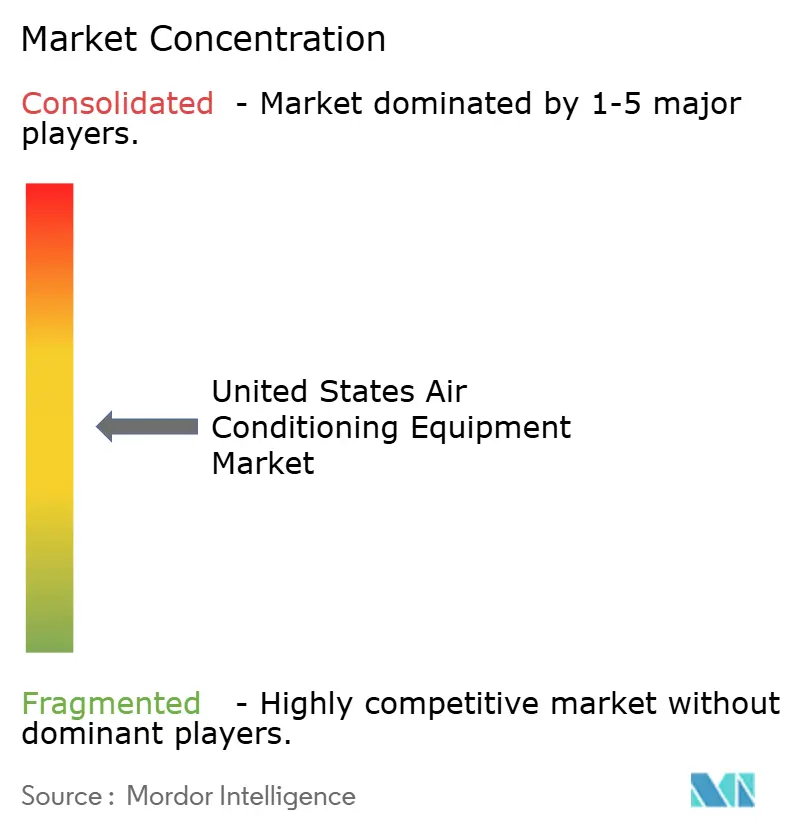
The United States Air Conditioning Equipment market is moderately consolidated, with a few major companies including Daikin Industries, Carrier Global, Trane Technologies, Johnson Controls, Lennox International, and others. Domestic manufacturing is the strategic thrust as firms attempt to derisk semiconductor and compressor imports: Carrier completed USD 1 billion of U.S. plant upgrades in January 2026, Daikin finished a USD 500 million Tennessee expansion in late 2025, and Trane is adding a USD 400 million VRF plant in North Carolina by 2027.
Japanese and South Korean brands such as Mitsubishi Electric, LG Electronics, and Samsung have significant market share in 2025, primarily through leadership in ductless mini-split and cold-climate heat pump systems. Chinese entrants Midea and Gree leverage cost advantages in inverter electronics to penetrate builder channels, eroding share in price-sensitive new construction.
Competitive differentiation now turns on inverter algorithms, low-GWP refrigerant readiness, and software ecosystems. Johnson Controls’ OpenBlue captured 8%-10% of commercial retrofits by layering machine learning over HVAC, lighting, and security controls. Patent filings concentrate on variable-speed compressors, microchannel heat exchangers, and predictive analytics, averaging 1,200-1,500 HVAC submissions to the U.S. Patent and Trademark Office annually. Emerging disruptors explore CO₂ and propane refrigerants and integrate HVAC assets into virtual power plants, yet they remain below 1% of current volume.
United States Air Conditioning Equipment Industry Leaders
Daikin Industries, Ltd.
Gree Electrical Appliances Inc.
Emerson Electric Company
Hitachi-Johnson Controls Air Conditioning Inc.
Carrier Global Corporation
- *Disclaimer: Major Players sorted in no particular order

Market Opportunities and Future Outlook
Commercial and applied opportunities are increasingly concentrated around data center cooling, where operators are procuring higher-tonnage chillers, controls, and integrated thermal systems to manage dense compute loads. That demand is visible in how leading OEMs are elevating data center cooling as a strategic pillar, including Daikin communicating an internal growth target for its North American data center cooling business (from JPY 100 billion in 2025 to JPY 300 billion by 2030), alongside broader industry evidence of faster applied-systems ordering tied to AI infrastructure build-outs.
On the residential and light-commercial side, the current incentive stack, including federal tax credits for qualifying high-efficiency equipment through 2032 alongside state and utility rebates, creates space for OEMs and channel partners to reduce installed-cost barriers through bundled financing, contractor-ready productization, and simplified commissioning. In parallel, the refrigerant transition and safety requirements around A2L handling increase the need for training, compliant tools, and service-first offerings, and contractors that standardize IoT-enabled monitoring and maintenance workflows can expand recurring service attachment as connected, inverter-driven systems grow.
Recent Industry Developments
- July 2026: Blackstone completed the acquisition of a majority stake in Emerson's climate technologies unit, now operating as Copeland. The acquisition consolidates Copeland's climate tech capacity and market footprint. It also points to changing leverage within the HVAC supply chain.
- July 2026: Daikin launches the NEXIO Max inverter-driven rooftop heat pump for light commercial applications. The product expands the inverter-driven rooftop segment in the US market. It supports Daikin’s position in energy-efficient cooling solutions for small to mid-size commercial projects.
- May 2026: Daikin introduces the VRV EMERION commercial heat pump and heat recovery systems using R-32 refrigerant. The release advances VRF adoption in commercial retrofits and new builds. It also reinforces Daikin’s refrigerant transition strategy.


Research Methodology Framework and Report Scope
Market Definition and Coverage
For this study, the market covers air conditioning equipment sold and installed in the United States, and it is sized in value terms based on equipment revenue across residential, commercial, and industrial uses.
Scope exclusions: We exclude installation labor, aftermarket service contracts, and most standalone replacement parts that are not sold as part of an equipment unit.
Segmentation Overview
- By Product Type
- Split and Multi-Split Systems
- Variable Refrigerant Flow (VRF) Systems
- Packaged and Rooftop Units
- Chillers
- By Technology
- Inverter Systems
- Non-Inverter Systems
- By End-User
- Residential
- Commercial
- Industrial
- By Capacity (Tons of Refrigeration)
- Up to 10 Tons
- 11 - 18 Tons
- 19 - 26 Tons
- Above 26 Tons
- By Distribution Channel
- Direct Sales
- Dealer / Retail Stores
- Online
Data Sources, Market Sizing, and Validation
Desk Research
Desk work started by mapping how cooling equipment demand is created in the United States, and then tying it to measurable signals like construction activity, replacement cycles, and shipment momentum. We relied on public, non-paywalled references such as U.S. Census Bureau construction and housing series, U.S. Energy Information Administration electricity and weather series, Bureau of Labor Statistics price indices for relevant equipment groups, and U.S. International Trade Commission trade statistics.
To make the scope practical, we also used technical and standards context from sources such as the Department of Energy efficiency rule updates, the Environmental Protection Agency refrigerant transition information, and industry shipment releases from associations such as AHRI. Company filings, annual reports, investor presentations, and reputable press were used to understand product mix shifts and pricing narratives. Where needed, we also used paid subscriptions for company financials and news screening, and an import or export shipment-level database to sanity check directional volume trends. This list of desk sources is illustrative, and many other references were consulted to collect data, validate assumptions, and clarify unclear points.
Primary Interviews and Surveys
Primary work was used to test our assumptions on replacement timing, channel margins, pricing progression, and how efficiency and refrigerant changes affect product mix. We spoke with a mix of manufacturers and distributors, contractors and installers, and large commercial buyers so the model reflects what is actually moving through channels and projects across the country.
Distribution of primary research fieldwork respondents
| Company type | Respondent position |
|---|---|
| Top tier: 30% | CXOs: 14% |
| Mid tier: 53% | Functional/Unit leaders: 28% |
| Smaller Players: 17% | Managers: 58% |
Market-Sizing & Forecasting
Sizing was built using a top-down and bottom-up approach, where national demand was first reconstructed from a demand pool view and then cross-checked using selective supplier and channel math. On the top-down side, we connected building additions and retrofits to expected cooling system penetration, and then applied equipment replacement rates to the installed base, which is where the largest part of US demand typically sits.
Inputs that shaped the model included housing starts and completions, commercial floor space additions and retrofit intensity, AHRI shipment trend direction as a reality check for unit flow, efficiency standard changeovers that influence average selling prices, and refrigerant transition timing that can pull forward replacement or raise equipment prices. We also tracked mix indicators such as ducted versus ductless adoption and the share of inverter-based systems to avoid overstating value when volume grows but pricing compresses, or the reverse.
For forecasting, scenario analysis was used so that cooling degree days, construction outlook, and replacement spending pressure could be flexed, and then an expected case was selected based on what interviewees described for near-term projects and distributor inventory behavior. Where bottom-up detail was missing for smaller channels, gaps were handled by applying conservative coverage ratios and then validating the implied totals against independent shipment and construction signals.
Data Validation & Update Cycle
Outputs were checked in steps so that the final value is consistent with more than one market signal. We compared implied unit flows and pricing to association shipment direction, trade patterns, and macro indicators such as construction and relevant producer price indices, and then investigated any sharp jumps that did not match real-world triggers.
Before sign-off, the model and its assumptions were reviewed by another analyst, followed by targeted re-contacts when large variances appeared by end use or channel. Reports are refreshed annually, and interim updates are made when material events occur, such as major regulation changes or sudden demand shifts. Right before delivery, a final pass is completed so the numbers reflect the latest available inputs.
Mordor Intelligence's United States Air Conditioning Equipment Market Size Measured Against Other Published Estimates
Published market sizes often differ because they do not always count the same equipment boundary, and because the price and volume assumptions are not built from the same demand signals. The spread usually shows up when one estimate leans more toward manufacturing revenue or shipments, while another follows installed equipment value through channels.
The benchmark table shows a tighter band around mid-decade value because, in Mordor Intelligence's model, only air conditioning equipment revenue sold into the United States is counted, and related services and broader HVAC items are kept outside the market total, with shipment and construction indicators used as consistency checks.
Benchmark comparison
| Source | Market Size | Gaps in Research Methodology |
|---|---|---|
| Mordor Intelligence | USD 37.62 B (2026) | |
| Industry Dataset A | USD 65.30 B (2026) | This figure aligns to broader heating and air-conditioning equipment manufacturing revenue, which can include non-AC product lines and factory-gate value that does not match installed market scope. |
| Sector Summary B | USD 27.60 B (2030) | This estimate appears centered on central AC system shipments and shipment value, which can undercount other equipment types and channels, and it is sensitive to unit-value assumptions. |
Taken together, the differences come down to what is counted as equipment, whether the lens is manufacturing revenue versus installed market value, and how pricing is carried forward year to year. Our approach stays traceable to demand drivers like replacement and construction, and it is kept in check using external shipment and pricing signals so the final number is explainable and repeatable.


Key Questions Answered in the Report
How large is the United States air conditioning equipment market in 2026?
The United States air conditioning equipment market size is USD 37.62 billion in 2026 and is projected to reach USD 47.71 billion by 2031.
What is the forecast CAGR for United States air conditioning equipment between 2026 and 2031?
The market is expected to expand at a 4.86% CAGR during the 2026-2031 period.
Which product category is growing fastest?
Variable refrigerant flow systems are projected to rise at a 5.73% CAGR, the highest among major product types.
Why are heat pumps gaining share over traditional systems?
Federal tax credits, state rebates, and cold-climate technology advances have cut initial cost gaps and delivered strong operating savings, driving shipments past gas furnaces in 2024.
How will data center expansion affect equipment demand?
Hyperscale and AI data centers require large-tonnage chillers and precision cooling, pushing equipment above 26 tons to a 6.01% CAGR through 2031.
What role do direct sales play in distribution?
Contractor and builder direct purchasing is set to outpace dealer channels, growing at a 5.68% CAGR as consolidation boosts buying power and manufacturers launch e-commerce portals.
Page last updated on:


 Your data is secure and never sold or shared.


