
Market Overview
| Study Period | 2021 - 2031 |
|---|---|
| Forecast Data Period | 2026 - 2031 |
| Historical Data Period | 2021 - 2024 |
| Growth Rate | 0.89 % |
| Market Concentration | High |
Major Players *Disclaimer: Major Players sorted in no particular order Image © Mordor Intelligence. Reuse requires attribution under CC BY 4.0. | |
United Kingdom Oil And Gas Midstream Market Analysis by Mordor Intelligence
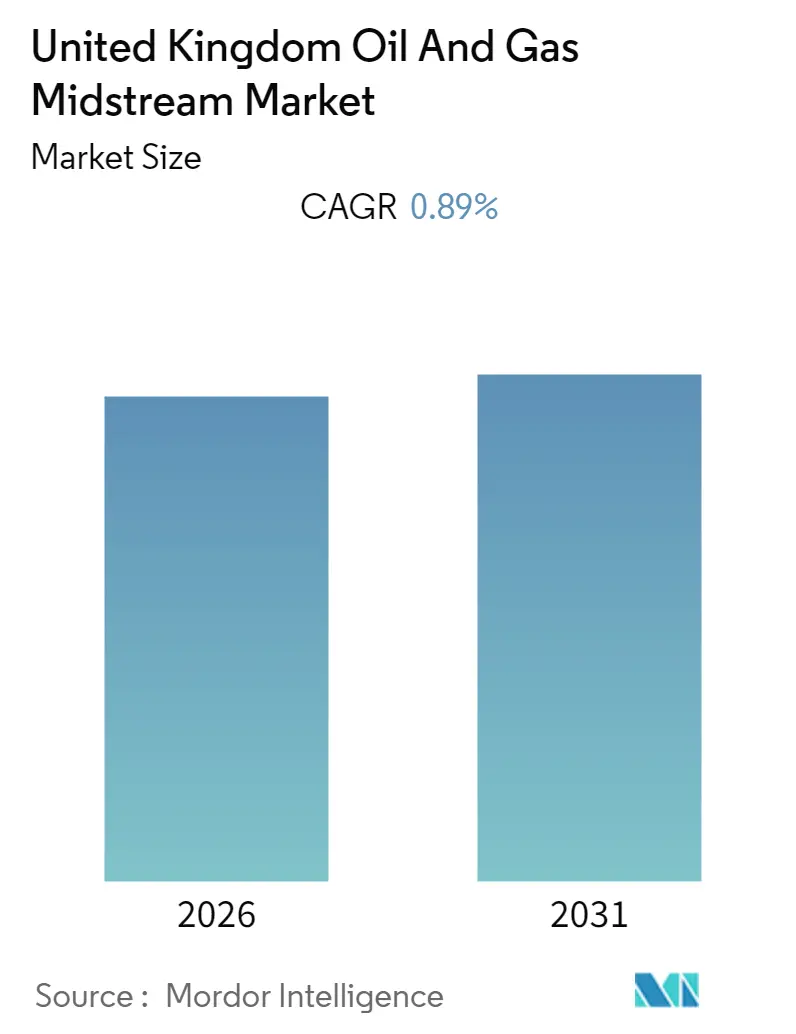
The United Kingdom Oil and Gas Midstream Market size is expected to register a CAGR of 0.89% during the forecast period.
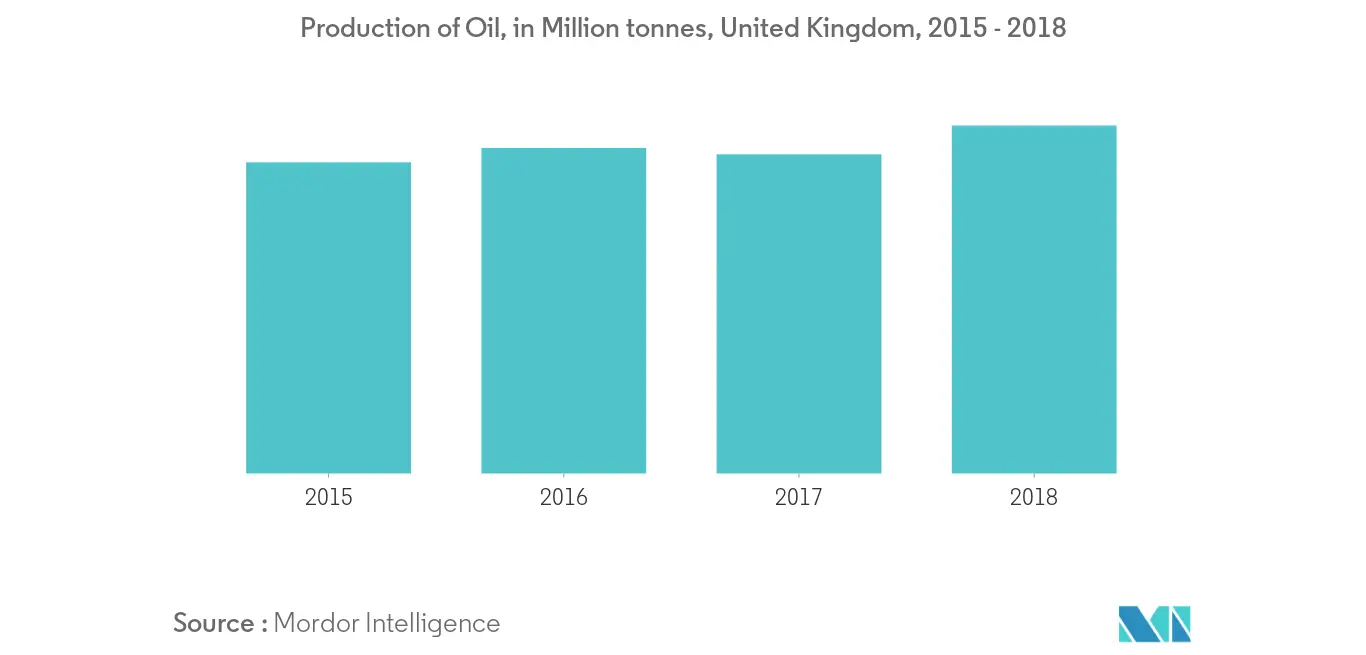
- The transportation industry prospects in the United Kingdom seem quite optimistic because of the increase in the production levels of the oil in the country in the 2015 - 2018 period and an increase in imports through the pipelines from countries like Norway.
- Significant discoveries have been made, in 2019, West of Shetland, in the United Kingdom. In the exclusive economic zone (EEZ) of the United Kingdom. New pipelines may be used to connect the region to the mainland of the United Kingdom and act as an opportunity for the midstream companies in the region.
- Increasing production of oil in the United Kingdom is expected to increase the growth in the the United Kingdom oil and gas midstream market and act as a driver for the market.
Note: Market size and forecast figures in this report are generated using Mordor Intelligence’s proprietary estimation framework, updated with the latest available data and insights as of 2026.
United Kingdom Oil And Gas Midstream Market Trends and Insights
Transportation Sector to Witness Growth
- The United Kingdom has an extensive network of pipelines that carry oil extracted from North Sea platforms to coastal terminals in Scotland and in northern England.
- In 2018, natural gas imported by The United Kingdom in the form of LNG was 7.3 billion cubic meters (bcm), and the natural gas pipeline was to 42.8 bcm, this is an increase with respect to LNG imported, in 2017. Primarily due to the increasing demand for gas in the country.
- Consumption of natural gas increased in the country, by 2.3%, year on year, to 67.8 mtoe, in 2018 from 61.9 million tons of oil equivalent (mtoe), in 2015. Oil consumption in the United Kingdom has increased by 0.56 %, year on year, rising to 77.0, in 2018 from 75.3, in 2015. Increasing consumption is indicative of increasing economic growth of the country
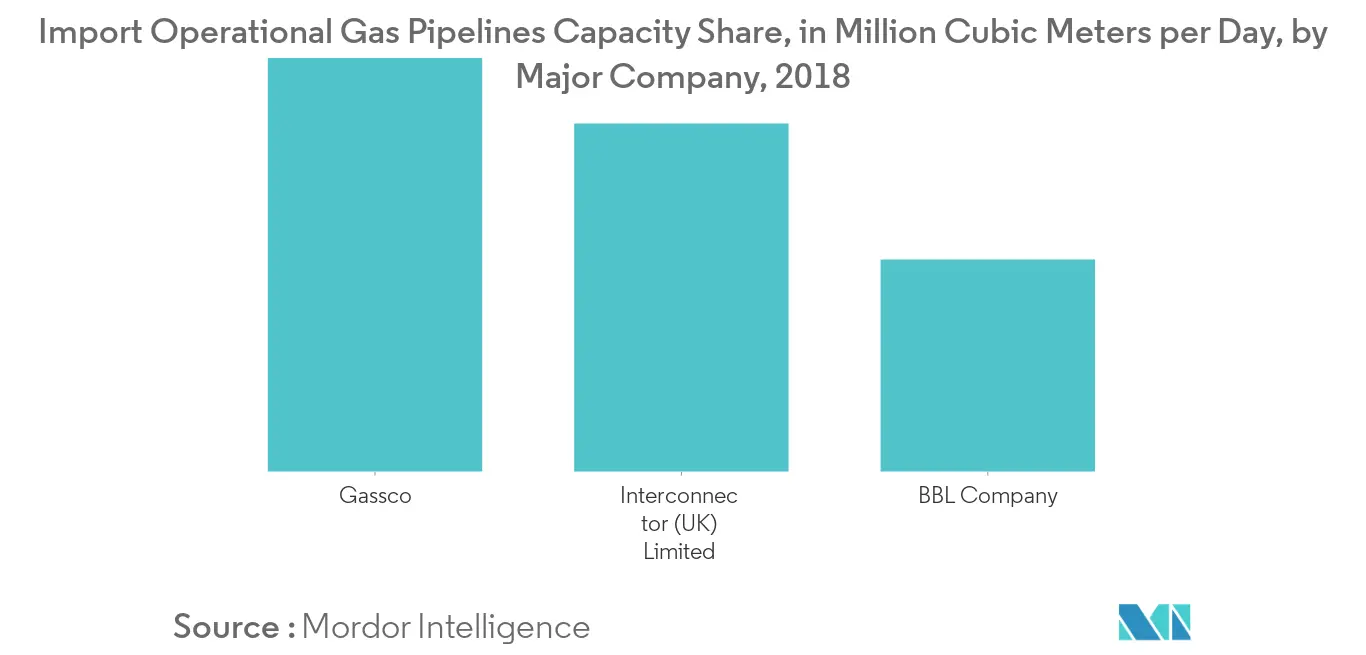
- In 2018, Bacton-Zeebrugge Interconnector and Langeled Pipeline are the most significant operational gas pipelines in the country with 74 cubic meters and 72 cubic meters of max flow capacity, respectively.
- The United Kingdom's pipeline capacity is expected to grow slightly in the forecast period due to an increase in oil production in the country and increase in demand for oil and natural gas.
Increasing OIl Production to Drive the Market
- The United Kingdom depends on oil and gas supply prominently from its resources in the North Sea and Neighbouring countries like Norway. In 2019, most of the pipelines that the United Kingdom imports from are linked with the oil and gas fields in the North Sea.
- Oil production in the United Kingdom increased substantially, by 9.0%, to 50.8, in 2018 from 46.6, in 2017.
- In 2018, crude stocks and product stocks account for around 14.5 million tons of storage in the United Kingdom. The oil is stored in many places, including terminals and refineries.
- In 2018, Forties Oil and Gas Pipeline System (FPS) is currently under construction for an increase in distribution safety and reliability. The pipeline transports around 600,000 barrels of oil per day, which accounts for about 40% of the UK's production of oil.
- Hence, increasing the production of oil is expected to increase the growth of the sector in the forecast period.
Regulatory Landscape
The United Kingdom oil and gas midstream regulatory environment is split across offshore and onshore regimes. The North Sea Transition Authority (NSTA) administers licensing and consents for upstream activity and associated offshore infrastructure, including Pipeline Works Authorisations (PWAs) under the Petroleum Act 1998 for offshore oil and gas pipelines (and also for hydrogen and carbon dioxide pipelines). Environmental regulation for offshore developments is handled through a separate consenting track led by the Offshore Petroleum Regulator for Environment and Decommissioning (OPRED), which adds a distinct compliance layer for terminals and pipelines tied to offshore projects.
On the gas transmission and downstream side, Ofgem regulates licensed gas transportation under the Gas Act 1986, with the Uniform Network Code (UNC) providing the core commercial framework for capacity, entry/exit arrangements, and balancing interfaces. In April 2025, Ofgem issued a statutory consultation to modify special conditions in the National Transmission System Gas Transporter Licence, covering capacity reservation and incremental entry and exit capacity obligations, indicating active refinement in how capacity is planned and allocated. Policy for repurposed gas assets and new molecules is also progressing, with DESNZ leading the hydrogen economic regulatory framework work for pipeline networks, while signaling continuity with existing gas licensing constructs and hydrogen-specific code arrangements.
Value Chain Analysis
The United Kingdom oil and gas midstream value chain starts with offshore production in the North Sea (including West of Shetland), where hydrocarbons move through offshore gathering systems and export pipelines into coastal reception points. Flows then concentrate through entry terminals and processing hubs such as St Fergus and Bacton, alongside LNG import infrastructure (including Isle of Grain and Milford Haven) that supplements pipeline imports and influences seasonal and security-of-supply use of the transmission network. Gas is then transported through the National Transmission System operated by National Gas Transmission, which comprises around 7,630 km of pipelines, before being delivered to distribution networks, power generators, large industrial users, and interconnectors supporting cross-border trade.
Supporting activities include storage (notably salt cavern and other storage assets), integrity management, metering, compression, and terminal operations, alongside services and fabrication activity clustered in established industrial hubs. UK-based supply chain participants include fabrication and service providers such as Global Energy Group (Port of Nigg), Maraen, and other North Sea-focused contractors that support maintenance, brownfield modifications, and equipment packages for terminals and pipeline systems. Consenting and planning gates for new or modified infrastructure, including PWAs offshore and planning thresholds for nationally significant pipeline and storage projects, can shift investment toward tie-ins and upgrades of existing corridors rather than greenfield systems.
Competitive Landscape
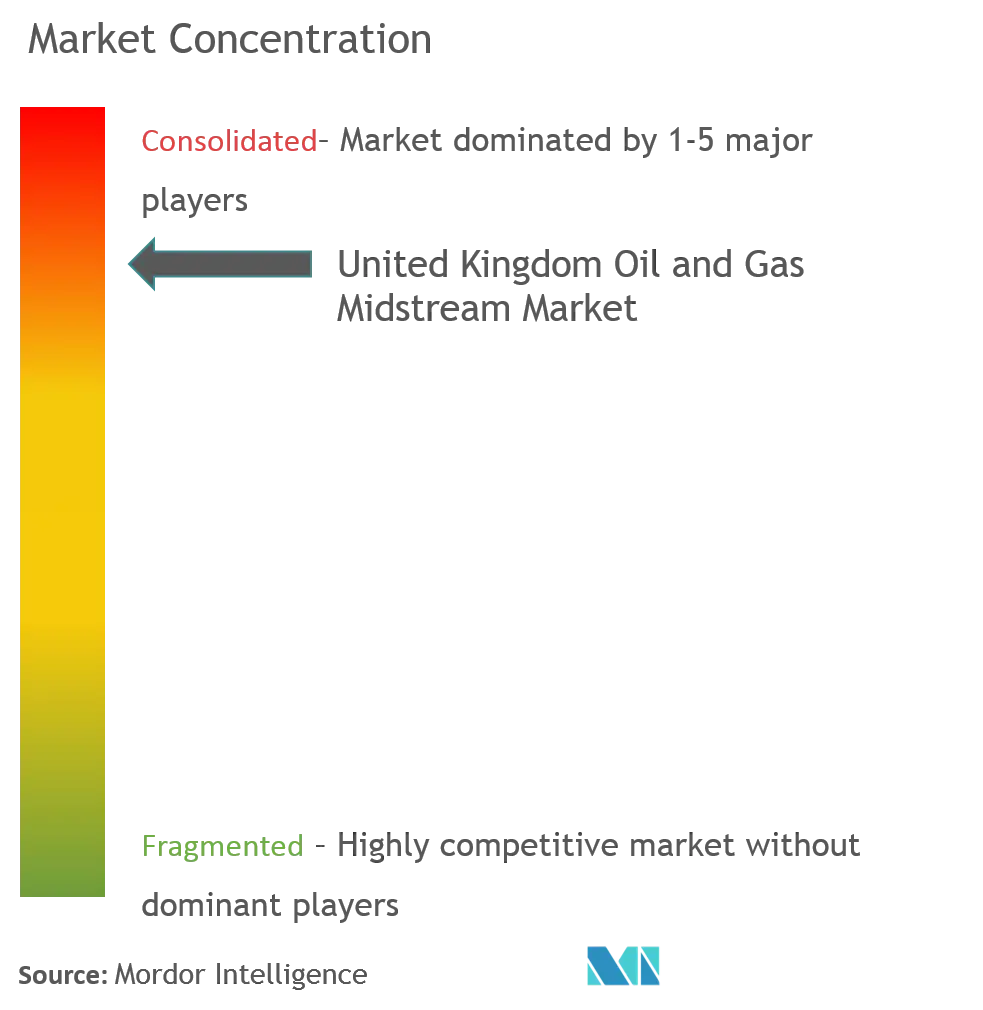
The United Kingdom oil and gas midstream market is moderately consolidated. The major companies include Storengy SA, GASSCO , E.ON UK plc , SSE PLC , and Interconnector Limited.
United Kingdom Oil And Gas Midstream Industry Leaders
-
Storengy SA
-
GASSCO
-
E.ON UK plc
-
SSE PLC
-
Interconnector Limited
-
ConocoPhillips Company
- *Disclaimer: Major Players sorted in no particular order
Market Opportunities and Future Outlook
Operational flexibility and resilience investments around existing terminals, interconnectors, and storage assets are a primary opportunity set as the gas system adapts to changing supply patterns. DESNZs June 2025 Midstream Gas System Update to the Market frames the need to address infrastructure challenges during the gas transition, while Ofgems April 2025 statutory consultation on the Gas Transporter licence highlights that capacity reservation and incremental capacity obligations remain active policy levers for network access and reinforcement. The Planning Act 2008 also defines thresholds for nationally significant gas infrastructure, including underground storage (43 million standard cubic metres capacity or 4.5 million standard cubic metres per day flow rate), which creates clearer pathways for scale projects when commercial cases are supported.
Hydrogen and wider energy-system planning also create near-term whitespace for midstream owners and service providers through repurposing and hybrid-use concepts. DESNZ has been developing the hydrogen economic regulatory framework for pipeline networks, using an approach that retains familiar gas licensing constructs while building hydrogen-specific arrangements, which supports early-stage investment decisions for hydrogen-ready assets such as storage and pipelines. System-planning reforms add additional signals, including movement toward a Gas Network Capability Needs Report under the National Energy System Operator and government work on strategic spatial energy planning, both of which increase emphasis on coordinated siting and network readiness. Evidence of shifting priorities also shows up in industry-led risk identification, with Offshore Energies UK (February 2026) highlighting early-closure risks for major pipeline infrastructure and processing terminals such as the Shetland Gas Plant and FUKA terminal, reinforcing the commercial importance of life-extension, integrity, and repurposing programs to keep connected fields and import routes viable.
Recent Industry Developments
- May 2026: Gassco AS UK issued a tender for a lightning protection system upgrade at its Easington gas transportation facility (LRF). The procurement reflects continued emphasis on electrical and safety-critical upgrades at key receiving terminals, supporting reliability for pipeline import flows into the UK.
- April 2026: Storengy UK reported an all-time daily withdrawal record at the Stublach Gas Storage facility of 342 GWh (April 1, 2026), following targeted investments such as filtration and ultrasonic cleaning. The performance underscores the role of storage deliverability upgrades in managing short-term system variability and security-of-supply needs.
- July 2025: Ofgem granted E.ON UK Network Assets Limited an independent distribution network operator (IDNO) licence to build, adopt, and operate energy networks. While focused on electricity distribution, the licence supports E.ONs broader UK infrastructure footprint and connection capabilities, which can influence integrated energy network development as gas infrastructure planning evolves.
Research Methodology Framework and Report Scope
Market Definition and Coverage
This market covers midstream activities in the United Kingdom that move and hold crude oil and natural gas between production sites and end markets. For sizing, we treat it as revenue generated from transportation systems, storage assets, and LNG terminal services operating in-country.
Scope exclusions: We exclude upstream production, downstream refining and retail fuel distribution, and non-hydrocarbon logistics that do not directly serve crude oil, natural gas, or LNG flows.
Segmentation Overview
- Transportation
- Overview
- Existing Infrastructure
- Projects in pipeline
- Upcoming projects
- Overview
- Storage
- Overview
- Existing Infrastructure
- Projects in pipeline
- Upcoming projects
- Overview
- LNG Terminals
- Overview
- Existing Infrastructure
- Projects in pipeline
- Upcoming projects
- Overview
Data Sources, Market Sizing, and Validation
Desk Research
Desk work starts with public infrastructure and flow indicators, so the model stays anchored to what is actually in operation in the United Kingdom and how it is used. We review sources such as UK government energy statistics and system updates, pipeline and upstream regulator publications, and National Grid style network and balancing information that signals gas throughput and constraint points.
To connect activity to value, we also use company annual reports, investor presentations, and project announcements for tariff logic, expansion phasing, and shutdown timelines. Where needed, patent databases are used to sanity check technology shifts like monitoring and metering. For LNG, we use an import and export shipment level database selectively to validate cargo patterns and timing. These examples are not exhaustive, and many other public and paid sources were reviewed for data collection, cross-checking, and clarification.
Primary Interviews and Surveys
Primary work is used to confirm what the desk data cannot clearly show, especially tariff movements, utilization ranges, and how operators classify midstream service revenues in practice. We spoke with a mix of asset owners, service providers, and large buyers of transport and storage capacity, then used follow-up checks to close open points on LNG terminal services and storage seasonality for the United Kingdom.
Distribution of primary research fieldwork respondents
| Company type | Respondent position |
|---|---|
| Top tier: 31% | CXOs: 19% |
| Mid tier: 49% | Functional/Unit leaders: 27% |
| Smaller Players: 20% | Managers: 54% |
Market-Sizing & Forecasting
Sizing starts from a top-down reconstruction of the demand pool using UK midstream fingerprints, and then gets pressure-tested with selective bottom-up approximations so the total does not drift. In practice, we map the installed base of pipelines, storage, and LNG terminals and relate it to throughput and utilization signals, which are then translated into value using tariff and service pricing ranges validated in interviews.
Key inputs used in the model include LNG terminal send-out and cargo timing, storage injection and withdrawal seasonality, system balancing needs, major planned expansions and decommissioning schedules, and crude and gas production and import dependence that changes the load on transport assets. For forecasting, scenario analysis is applied because policy, supply mix, and infrastructure availability can shift the base case in steps rather than in smooth lines. Where bottom-up checks are needed, we use sampled asset level revenue ranges and capacity times utilization times average price logic to spot gaps, and any missing pieces are filled using conservative proxy ranges that are re-tested with expert feedback before finalizing.
Data Validation & Update Cycle
Validation is done in layers so a single data point cannot swing the result too far. Model outputs are compared against independent signals like system flow updates, announced capacity changes, and observed LNG activity, and then unusual jumps are reviewed again before sign-off.
If an assumption changes materially, such as a tariff reset, a large outage, or a new project timeline, we re-contact sources and re-run the affected parts of the model. Reports are refreshed annually, and interim updates are made when a material event changes the outlook. Before delivery, one more review pass is completed so clients receive the latest updated view that reflects the current market context in the United Kingdom.
Mordor Intelligence's United Kingdom Oil and Gas Midstream Market Size Versus Other Published Estimates
Published market values for UK midstream do not always match because the scope line is drawn differently, and because price and utilization assumptions are refreshed on different schedules. Differences also come from how LNG services are treated, and whether the estimate is built from asset activity signals or from broad energy infrastructure totals.
Some external figures bundle midstream with wider energy infrastructure services and a broader set of products and modes, which pushes the headline number up. In Mordor Intelligence modeling, the value is counted only for transportation, storage, and LNG terminal services tied to oil and gas midstream in the United Kingdom, and adjacent downstream distribution and non-hydrocarbon infrastructure are kept out so the signals stay consistent year to year.
Benchmark comparison
| Source | Market Size | Gaps in Research Methodology |
|---|---|---|
| Mordor Intelligence | USD 2.19 B (2025) | |
| Global Consultancy A | USD 8.80 B (2024) | Uses a wider midstream scope that includes wholesale selling and multiple transport modes plus liquefaction and regasification services, and it anchors the valuation to a 2024 base which can lift totals versus an asset-service-only view. |
| Regional Consultancy B | USD 8.70 B (2026) | Includes processing and distribution within midstream and starts from a forward year estimate, which can embed more optimistic utilization and price progression and results in a larger number than a service-defined UK midstream total. |
The spread in the table is mainly explained by scope and timing, not by small math differences. When the market is kept to UK transportation, storage, and LNG terminal service revenues and checked against throughput and utilization signals, the estimate stays easier to trace back to real operating drivers and to update in a repeatable way.
Key Questions Answered in the Report
What is the current United Kingdom Oil and Gas Midstream Market size?
The United Kingdom Oil and Gas Midstream Market is projected to register a CAGR of 0.89% during the forecast period (2026-2031)
Who are the key players in United Kingdom Oil and Gas Midstream Market?
Storengy SA, GASSCO, E.ON UK plc, SSE PLC, Interconnector Limited and ConocoPhillips Company are the major companies operating in the United Kingdom Oil and Gas Midstream Market.
What years does this United Kingdom Oil and Gas Midstream Market cover?
The report covers the United Kingdom Oil and Gas Midstream Market historical market size for years: 2020, 2021, 2022, 2023, 2024 and 2025. The report also forecasts the United Kingdom Oil and Gas Midstream Market size for years: 2026, 2027, 2028, 2029, 2030 and 2031.