
United Kingdom Glass Bottles And Containers Market Size and Share
Market Overview
| Study Period | 2020 - 2031 |
|---|---|
| Forecast Data Period | 2026 - 2031 |
| Base Year Market Size (2025) | 3.13 Thousand kilotons |
| Market Volume (2026) | 3.21 Thousand kilotons |
| Market Volume (2031) | 3.61 Thousand kilotons |
| Growth Rate (2026 - 2031) | 2.41 % |
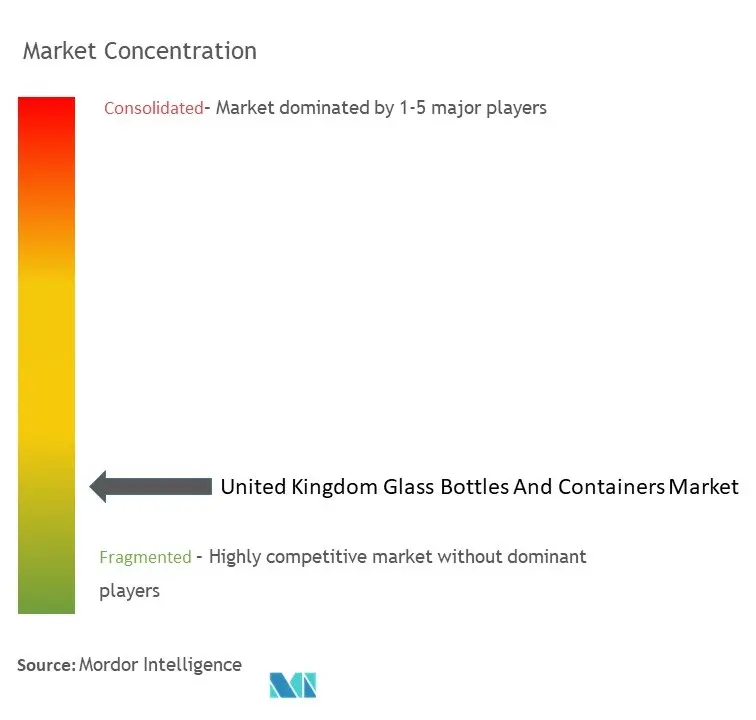
| Market Concentration | Low |
Major Players *Disclaimer: Major Players sorted in no particular order Image © Mordor Intelligence. Reuse requires attribution under CC BY 4.0. | |
United Kingdom Glass Bottles And Containers Market Analysis by Mordor Intelligence
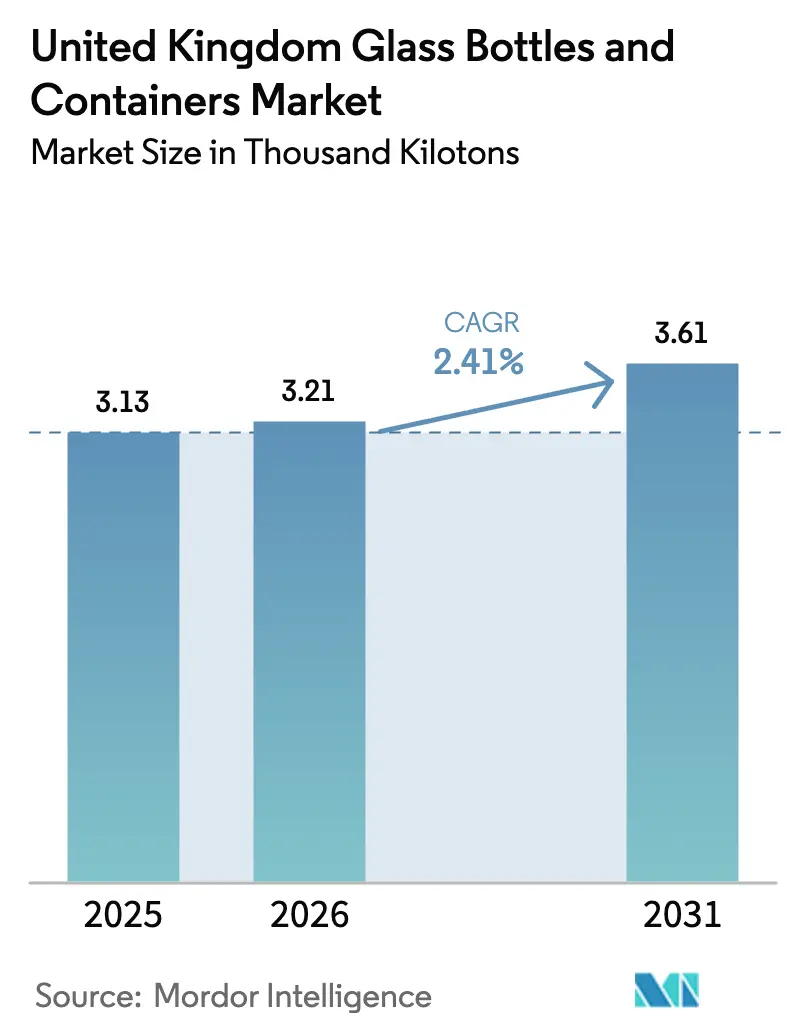
The United Kingdom Glass Bottles And Containers Market size is expected to grow from 3.13 Thousand kilotons in 2025 to 3.21 Thousand kilotons in 2026 and is forecast to reach 3.61 Thousand kilotons by 2031 at 2.41% CAGR over 2026-2031. The United Kingdom glass packaging industry is experiencing significant transformation driven by evolving consumer preferences and macroeconomic challenges. According to trade data from April 2023, the UK's glass bottle imports totaled £40.7 million while exports stood at £15.8 million, resulting in a trade deficit of £24.9 million. This trade imbalance reflects the growing domestic demand and the need for increased local production capacity. The industry has witnessed substantial investments in glass bottle manufacturing capabilities, with several companies expanding their facilities to meet the rising demand. The sector's evolution is further shaped by changing consumer behavior, as evidenced by the increase in consumer spending on food and beverages, which reached £126.74 billion in 2022.
Energy costs and sustainability considerations are reshaping the industry's operational landscape. In 2022, industry surveys revealed that 72% of manufacturers were very concerned about rising energy prices, compared to just 33% in 2021. This has prompted significant investments in energy-efficient technologies and alternative energy sources. In July 2023, Encirc announced plans to develop a hydrogen-powered furnace at its Elton plant, demonstrating the industry's commitment to reducing energy consumption while maintaining production capacity. These initiatives are transforming the manufacturing processes while addressing both economic and environmental concerns.
Technological advancements are driving innovation in glass packaging solutions and manufacturing. Companies are increasingly focusing on lightweight glass solutions and enhanced decoration capabilities to meet evolving market demands. In July 2023, Croxsons manufactured innovative primary packaging for Necessary Good, featuring sophisticated design elements and sustainable characteristics. The industry is witnessing a shift toward more specialized and premium packaging solutions, particularly in the spirits and cosmetics sectors, where brand differentiation through packaging design has become crucial.
The industry is experiencing a significant shift toward circular economy principles and sustainable practices. British Glass reports that the UK's glass sector has achieved a recycling rate of 68.8%, one of the highest compared to other packaging materials. In 2023, several manufacturers have implemented closed-loop recycling systems, with companies like Beatson Clark incorporating up to 45% recycled content in their amber glass production. The industry's commitment to sustainability is further evidenced by initiatives such as the Glass Futures project, which aims to develop innovative, low-carbon manufacturing technologies.
Note: Market size and forecast figures in this report are generated using Mordor Intelligence’s proprietary estimation framework, updated with the latest available data and insights as of 2026.
Market Trends and Insights
Increased Demand for Glass Packaging in the Beverage Industry
The beverage industry's growing preference for glass packaging is driven by both consumer demands and product quality considerations. Glass bottles are increasingly favored for alcoholic beverages due to their ability to preserve aroma and flavor, particularly in the premium spirits and wine segments. According to the UN Comtrade report, the value of wine exports in the United Kingdom reached approximately £557 million in 2022, significantly up from £467 million in 2021, indicating a robust demand for glass packaging in the wine sector.
The beer segment continues to be a significant driver of glass packaging demand. According to the Office for National Statistics (UK), beer remains the most popular alcoholic drink in the country, with consumers spending more than £76.4 billion on the beverage in 2022. This trend is further supported by the growing craft beer movement, where glass packaging is preferred for its premium appearance and product preservation capabilities. Additionally, in 2023, on-premise drink sales showed significant growth, with beer and cider sales in managed venues increasing by 7% compared to 2022, while cider sales alone saw a remarkable 25% year-over-year increase.
Recyclability Benefits Offered by Glass Packaging Drive Sustainability
Recyclable glass packaging's infinite recyclability without quality degradation has become a crucial driver in the market's growth. According to British Glass, making new glass from recycled glass reduces CO2 emissions and energy use, saving 580 kg of carbon dioxide emissions with every ton of glass re-melted. The industry has demonstrated strong commitment to sustainability, with manufacturers like Beatson Clark incorporating an average of 45% recycled material in amber glass containers and 30% in white flint production.
The push toward sustainability is further evidenced by significant industry initiatives and investments. In December 2022, Encirc announced its partnership with Diageo to produce net zero glass at scale by 2030, with plans to build a new furnace at its Elton plant that would reduce carbon emissions by 90% using a combination of green electricity, low-carbon hydroxide, and carbon capture technology. This commitment to sustainability is reinforced by consumer preferences, as demonstrated by recent surveys showing that 64% of UK consumers are more likely to purchase from retailers offering sustainable packaging, and approximately 50% are willing to pay extra for sustainable packaging and delivery.
United Kingdom Glass Bottles And Containers Market Segment Analysis
Beverages Segment in United Kingdom Glass Bottles and Containers Market
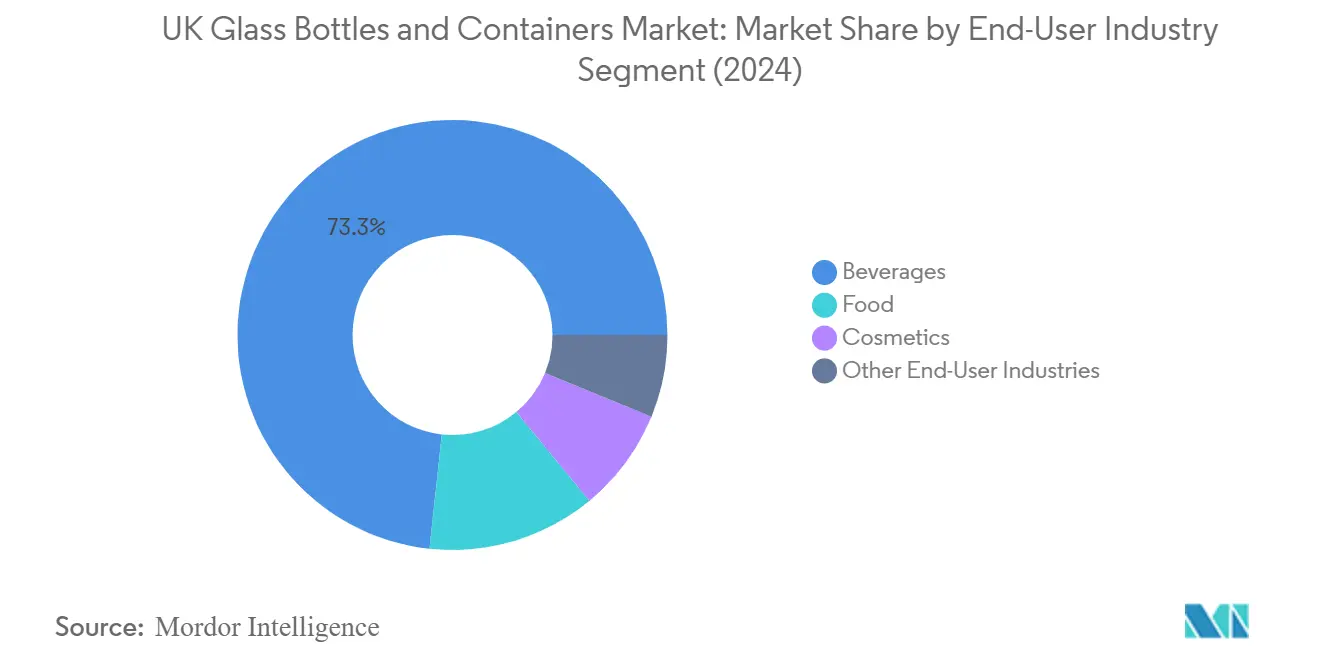
The beverages segment dominates the UK glass bottles and containers market, commanding approximately 72.60% market share in 2025. This substantial market presence is primarily driven by the extensive use of glass packaging containers in both alcoholic and non-alcoholic beverages. The segment's dominance is particularly evident in the alcoholic beverages category, where glass bottle packaging remains the preferred packaging material for premium spirits, wines, and craft beers due to its ability to preserve product quality and enhance brand perception. The non-alcoholic beverage sector, including carbonated soft drinks and premium water brands, also significantly contributes to this segment's leadership position. Glass packaging containers' inherent properties of chemical inertness, non-porosity, and impermeability make them particularly suitable for beverage applications, especially for premium food and beverage brands that prefer glass containers over other packaging options.
Food Segment in United Kingdom Glass Bottles and Containers Market
The food segment is emerging as the fastest-growing category in the UK glass bottles and containers market, with a projected growth rate of approximately 3.82% from 2025 to 2031. This robust growth is driven by increasing consumer demand for sustainable packaging solutions in food products, particularly in categories such as instant coffee, processed baby foods, dry mixes, spices, dairy products, sugar preserves, syrups, spreads, and processed fruits and vegetables. The segment's growth is further supported by the rising preference for food glass packaging in premium food products, as glass containers offer superior product preservation capabilities and align with the growing consumer emphasis on eco-friendly packaging solutions. The food industry's increasing focus on premium packaging and sustainable solutions continues to drive innovation in glass container designs and specifications, particularly for specialty food products and gourmet items.
Remaining Segments in End-User Industry
The cosmetics and other end-user industries segments complete the market landscape, each serving distinct applications and consumer needs. The cosmetics segment has established a strong presence in premium beauty and personal care products, where cosmetic glass packaging adds a luxurious appeal and maintains product integrity. Glass containers in this segment are particularly valued for their ability to preserve sensitive formulations and enhance brand positioning. The other end-user industries segment, which includes pharmaceuticals and specialty chemicals, relies on pharmaceutical glass packaging for its chemical stability and protective properties. These segments continue to evolve with increasing emphasis on sustainable packaging solutions and innovative design approaches to meet specific industry requirements and changing consumer preferences.
Segment Analysis: By Color
Flint Segment in United Kingdom Glass Bottles and Containers Market
The flint glass market segment dominates the UK glass bottles and containers market, commanding approximately 63% market share in 2024. The segment's prominence is driven by the increasing utilization of transparent packaging for food items such as wine, milk, beer, and juice, as consumers prefer to inspect products before purchase. Flint glass bottles are particularly favored in the wine industry, especially for rosé and white wines, where highlighting the product's color and improving overall aesthetics is crucial. The segment's growth is further supported by technological advancements in glass manufacturing, with companies like Beatson Clark incorporating up to 45% recycled material in their production processes. While there are stricter quality requirements for white or flint glass compared to other colors, with a maximum recycled glass content of 60% due to contamination risks, manufacturers are continuously innovating to maintain product quality while meeting sustainability goals.
Remaining Segments in Glass Bottles and Containers Market by Color
The amber and green segments play vital complementary roles in the UK glass bottles and containers market. Amber glass is particularly valued in the pharmaceutical and beer industries due to its superior UV protection properties, capable of absorbing the broadest range of light waves across the spectrum. This makes it ideal for protecting light-sensitive products and preventing beer from developing unpleasant tastes due to photooxidation. Green glass bottles, while offering less UV protection than amber, are widely used in the beer industry, especially by European breweries, for their aesthetic appeal and brand differentiation. Both colors support the industry's sustainability initiatives, with amber glass being infinitely recyclable without quality loss and green glass bottles capable of incorporating high percentages of recycled content, contributing to the circular economy goals of the packaging industry.
Competitive Landscape
Top Companies in United Kingdom Glass Bottles and Containers Market
The UK glass bottle manufacturers market features several prominent players, including Verallia Packaging, Encirc Ltd., O-I Glass, Ardagh Group, and Beatson Clark, among others. These companies are driving market evolution through a sustained focus on product innovation, particularly in developing lightweight and sustainable glass packaging solutions. Strategic investments in new furnace technologies and manufacturing facilities demonstrate the industry's commitment to operational excellence and environmental sustainability.
Companies are actively pursuing expansion through both organic growth and acquisitions, with a notable trend toward enhancing premium packaging capabilities, especially in the spirits segment. The market is characterized by continuous technological advancement in areas such as automated inspection systems, decorative techniques, and eco-friendly production methods, while companies are increasingly emphasizing circular economy principles through improved recycling infrastructure and processes.
Consolidated Market with Strong Local Presence
The UK glass container manufacturers market exhibits a relatively consolidated structure dominated by both global conglomerates and established local specialists. Global players like O-I Glass and Ardagh Group leverage their international expertise and extensive resource networks, while local manufacturers such as Beatson Clark maintain strong regional positions through specialized product offerings and deep customer relationships. The market has witnessed significant merger and acquisition activity, exemplified by strategic moves such as Verallia's acquisition of Allied Glass and TricorBraun's purchase of Continental Bottles, indicating a trend toward market consolidation.
The competitive dynamics are shaped by a mix of long-established manufacturers with historical presence and newer entrants bringing fresh perspectives and technologies. Companies are increasingly focusing on vertical integration and strategic partnerships across the value chain to strengthen their market positions. The industry structure promotes healthy competition while maintaining barriers to entry through high capital requirements and technical expertise needed for quality glass container production, leading to a stable competitive environment where successful players combine manufacturing excellence with customer-centric innovation.
Innovation and Sustainability Drive Future Success
Success in the UK glass packaging market increasingly depends on companies' ability to balance sustainability initiatives with operational efficiency and customer responsiveness. Incumbent players must focus on developing proprietary technologies for reduced carbon emissions, enhanced recycling capabilities, and improved production efficiency to maintain their market positions. The ability to offer customized glass packaging solutions while maintaining scale economies, combined with strong relationships across the beverage, food, and cosmetics sectors, has become crucial for market leadership.
New entrants and challenger brands can gain ground by focusing on niche segments and innovative packaging solutions, particularly in premium categories where brand differentiation is crucial. The industry faces moderate substitution pressure from alternative packaging materials, making it essential for companies to emphasize glass's unique benefits in terms of sustainability, product preservation, and premium positioning. Future success will increasingly depend on companies' ability to navigate evolving regulatory requirements, particularly regarding carbon emissions and recycling targets, while maintaining cost competitiveness and meeting changing customer preferences for sustainable packaging solutions.
United Kingdom Glass Bottles And Containers Industry Leaders
-
O-I Glass Inc.
-
Ardagh Group SA
-
Verallia S.A.
-
Encirc Ltd.
-
Beatson Clark
- *Disclaimer: Major Players sorted in no particular order
United Kingdom Glass Bottles And Containers Market Companies Covered in this Report
- Verallia S.A.
- O-I Glass Inc.
- Encirc Ltd.
- Beatson Clark
- Ardagh Group SA
- Glassworks International
- Gaasch Packaging
- Berlin Packaging
- Vidrala SA
- Ciner Glass Ltd
- Stoelzle Flaconnage
Recent Industry Developments in United Kingdom Glass Bottles And Containers Market
- May 2026: Encirc outlined the scope of its BioNet initiative at the Derrylin site, centered on using farm slurry and other agricultural waste as a renewable energy source for glass manufacturing. The initiative supports lower-carbon, more energy-resilient operations, which is material for UK container-glass cost competitiveness given high energy intensity.
- April 2026: First Minister Michelle O'Neill and deputy First Minister Emma Little-Pengelly visited Encirc's Derrylin manufacturing facility to review its economic contribution and discuss future investment. The high-level engagement signals stakeholder support for maintaining and upgrading domestic glass production capacity and infrastructure.
- April 2026: Beatson Clark expanded its general sale portfolio with the launch of Optima, a lightweight food jar range with a premium finish. This adds a new option for food brands seeking material reduction and improved shelf appeal, reinforcing lightweighting as a key product-development lever in UK glass packaging.
United Kingdom Glass Bottles And Containers Market Report Scope and Research Methodology
Market Definition and Coverage
For this methodology, the market covers glass bottles and glass containers used as packaging within the United Kingdom, with market size expressed mainly in shipped and consumed volume (tons) across the domestic market.
Scope exclusions: We exclude pharmaceutical glass vials and ampoules, and we do not count non-container glass such as flat glass, technical glass, or fiberglass.
Segments Covered in This Report
- By End-user Vertical
- Beverages
- Alcoholic
- Beer
- Wine
- Spirits
- Other Alcoholic Beverages (Cider and Other Fermented Drinks)
- Non-Alcoholic
- Juices
- Carbonated Drinks (CSDs)
- Dairy Product Based Drinks
- Other Non-Alcoholic Beverages
- Alcoholic
- Food (Jam, Jelly, Marmalades, Honey, Sausages and Condiments, Oil, Pickles)
- Cosmetics and Personal Care
- Pharmaceuticals (excluding Vials and Ampoules)
- Perfumery
- Beverages
- By Color
- Green
- Amber
- Flint
- Other Colors
Data Sources, Market Sizing, and Validation
Desk Research
Desk research was used to set the market boundaries and build the starting data series that can be checked and repeated. We typically review public UK releases such as Office for National Statistics datasets, UK government and regulator updates on packaging and recycling, and HM Revenue and Customs trade statistics that show import and export direction for glass containers.
To keep the inputs grounded, we also use open publications from packaging and glass industry associations, environmental reporting on cullet collection and recycling performance, and peer-reviewed journal articles on lightweighting and furnace efficiency impacts. Company annual reports, investor presentations, and reputable press coverage are used to cross-check capacity announcements, furnace rebuild timing, and major demand shifts by end use. Select paid subscriptions are referenced only for company financials, patent lookups, and shipment-level import-export checks where they help validate the direction of specific flows. The sources listed above are not exhaustive, and several other public documents were also consulted for data collection, validation, and clarification.
Primary Interviews and Surveys
Primary interviews and surveys were used to confirm pack format trends and to fill gaps that public datasets do not explain well, such as how quickly customers shift between glass, PET, and cans in specific beverage and food categories. We spoke with a mix of manufacturers, distributors, converters and fillers, and large end users across beverages, food, personal care, and pharmaceuticals (excluding vials and ampoules) so the model assumptions stay realistic.
Because this is a United Kingdom-only market, responses were balanced across key demand centers and manufacturing locations, and we did follow-ups when a volume or pricing signal did not match trade or production indicators.
Distribution of primary research fieldwork respondents
| Company type | Respondent position |
|---|---|
| Top tier: 32% | CXOs: 14% |
| Mid tier: 50% | Functional/Unit leaders: 29% |
| Smaller Players: 18% | Managers: 57% |
Market-Sizing & Forecasting
Market sizing uses top-down and bottom-up logic, and the final total is accepted only after it aligns with simple, independent checks. On the top-down side, UK production and trade series are used to reconstruct the domestic availability pool for container glass, which is then allocated to end-use demand using packaging intensity indicators that reflect beverages, food, personal care, and pharmaceuticals (excluding vials and ampoules).
Selective bottom-up approximations are then used to corroborate the totals, such as roll-ups of major bottle and jar formats, sampled demand pools multiplied by typical weight-per-unit ranges, and channel checks for import penetration in certain container types. Where a sub-segment has thin data, the gap is handled with conservative interpolation from nearby years, then adjusted using interview feedback, so one-off shocks do not distort the total.
Forecasting is based on scenario analysis anchored to a small set of drivers that interviewees can validate. Inputs used in the model include beverage output trends (beer, spirits, wine, and soft drinks), food pack volumes for sauces and condiments, cullet collection and recycling rates, expected lightweighting adoption, and the timing of furnace rebuild cycles that can temporarily shift supply and product mix.
Data Validation & Update Cycle
Validation is done through triangulation across more than one data angle, followed by structured variance checks before sign-off. We compare the model outputs with production and trade direction, visible capacity changes, and end-use activity signals, and then investigate anomalies that do not have a clear operational explanation.
If a mismatch persists, respondents are re-contacted and the key assumptions are reworked until the numbers and the market story line up. Reports are refreshed annually, with interim updates triggered by material events such as major furnace shutdowns, capacity additions, or policy shifts that affect packaging demand. Before delivery, an analyst completes a final review pass so clients receive the latest updated view.
Mordor Intelligence's United Kingdom Glass Bottles and Containers Market Size Versus Other Published Estimates
Published market sizes often diverge even when the category name is similar, because the unit of measure and the included product list can change quietly from one publisher to another. For UK glass bottles and containers, the biggest gaps tend to come from mixing value and volume, using different treatment of imports and exports, and folding in adjacent glass packaging items that are not strictly bottles and containers.
Some external estimates lean on manufacturing revenue, which can rise or fall mainly with energy costs and selling prices rather than true container usage. Others proxy the market from import values, which can miss domestically produced supply and can also move sharply with currency conversion timing. Some published figures also widen the pharma scope into vials and ampoules. In contrast, Mordor Intelligence limits the count to UK glass bottles and containers in volume terms and keeps pharmaceuticals consistent by excluding vials and ampoules.
Benchmark comparison
| Source | Market Size | Gaps in Research Methodology |
|---|---|---|
| Mordor Intelligence | USD 3.13 T (2025) | |
| Trade Journal A | USD 0.56 B (2024) | Typically built from import value totals for glass containers, which can understate domestic production and can fluctuate with exchange rates and unit price changes more than with real usage. |
| Industry Directory B | USD 1.90 B (2026) | Often proxied from hollow-glass manufacturing revenue, which can mix in non-packaging output and does not separate demand growth from energy-driven selling price movement. |
The table shows that differences are mainly explained by measurement choices, meaning trade value and manufacturing revenue can point to different totals than a usage-oriented volume model. By using repeatable volume checks against production, trade, and end-use indicators, the sizing remains easier to audit and to update when conditions shift.
Key Questions Answered in the Report
How big is the United Kingdom Glass Bottles and Containers Market?
The United Kingdom Glass Bottles and Containers Market size is expected to reach 3.21 thousand kilotons in 2026 and grow at a CAGR of 2.41% to reach 3.61 thousand kilotons by 2031.
What is the current United Kingdom Glass Bottles and Containers Market size?
In 2026, the United Kingdom Glass Bottles and Containers Market size is expected to reach 3.21 thousand kilotons.
What years does this United Kingdom Glass Bottles and Containers Market cover, and what was the market size in 2025?
In 2025, the United Kingdom Glass Bottles and Containers Market size was estimated at 3.21 thousand kilotons. The report covers the United Kingdom Glass Bottles And Containers Market historical market size for years: 2019, 2020, 2021, 2022, 2023 and 2024. The report also forecasts the United Kingdom Glass Bottles And Containers Market size for years: 2026, 2027, 2028, 2029, 2030 and 2031.