
Market Overview
| Study Period | 2020 - 2031 |
|---|---|
| Forecast Data Period | 2026 - 2031 |
| Base Year Market Size (2025) | 28.33 Million tonnes |
| Market Volume (2026) | 29.29 Million tonnes |
| Market Volume (2031) | 34.61 Million tonnes |
| Growth Rate (2026 - 2031) | 3.39 % |
| Market Concentration | Low |
Major Players *Disclaimer: Major Players sorted in no particular order Image © Mordor Intelligence. Reuse requires attribution under CC BY 4.0. | |
Asia-Pacific Glass Bottles And Containers Market Analysis by Mordor Intelligence
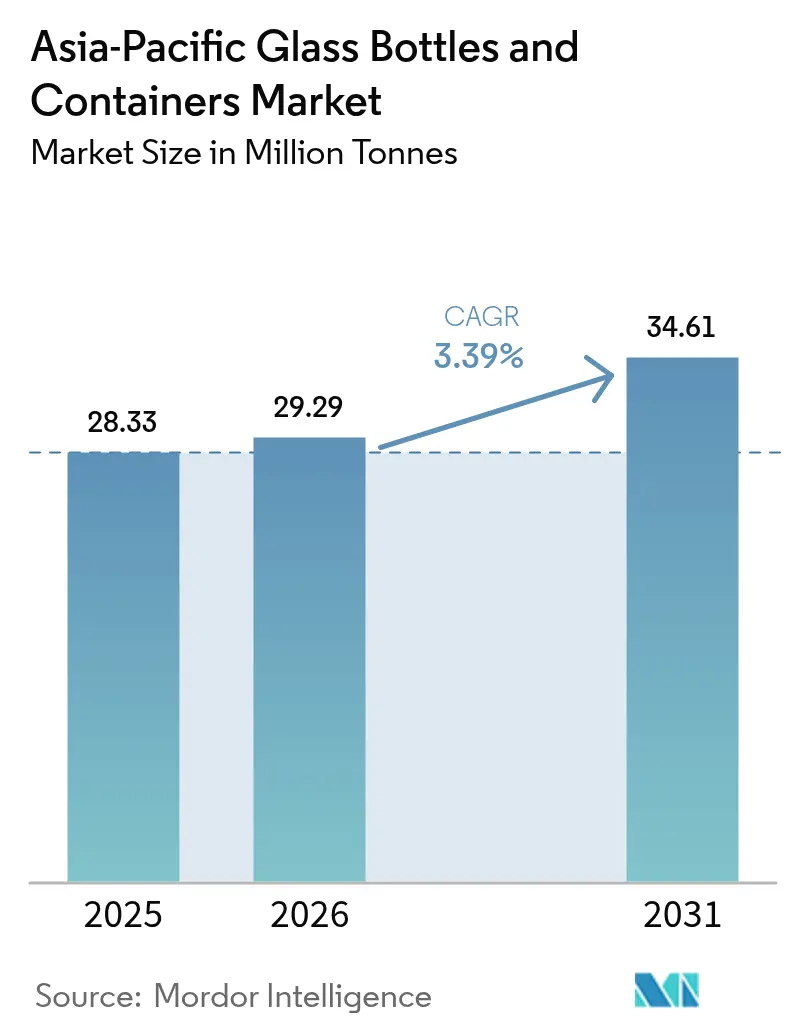
The Asia-Pacific Glass Bottles and Containers Market size was valued at 28.33 million tonnes in 2025 and estimated to grow from 29.29 million tonnes in 2026 to reach 34.61 million tonnes by 2031, at a CAGR of 3.39% during the forecast period (2026-2031). This growth trajectory signals a gradual shift away from purely volume-driven expansion toward value-enhancing, premium, and sustainability-focused applications that can command higher margins. The region’s beverage producers have historically underpinned baseline demand, yet alternative substrates such as lightweight metal and multilayer plastic increasingly challenge glass in mass-market segments. Counterbalancing that pressure, new regulatory incentives for recycling, rising consumer environmental awareness, and premiumization in cosmetics, specialty food, and craft beverages are opening higher-value demand pockets. Competitive strategies, therefore, revolve around operational efficiency, decarbonization technologies, and higher cullet utilization, placing technologically advanced manufacturers in a favorable position to capture incremental share within the Asia-Pacific container glass market.
Key Report Takeaways
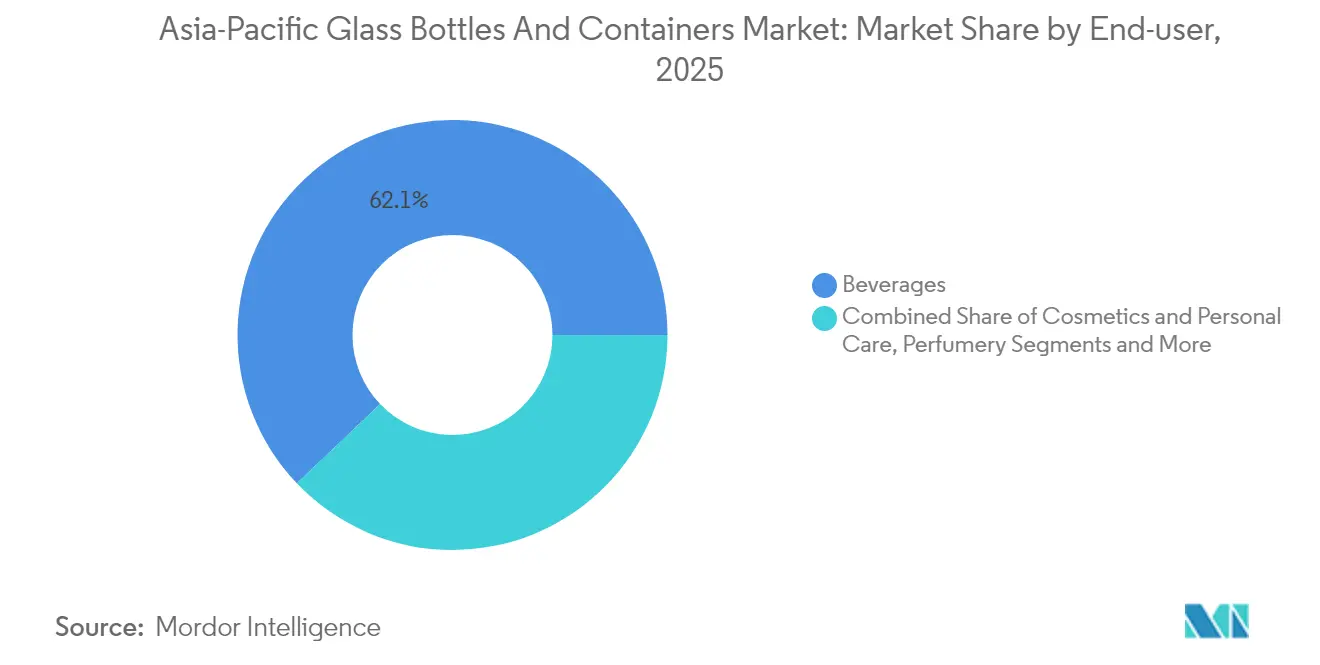
- By end-user, beverages captured 62.12% of the Asia-Pacific glass bottles and containers market share in 2025.
- By color, the Asia-Pacific glass bottles and containers for amber glass are projected to grow at a 4.86% CAGR between 2026-2031.
- By country, China captured 37.89% of the Asia-Pacific glass bottles and containers market share in 2025.
Note: Market size and forecast figures in this report are generated using Mordor Intelligence’s proprietary estimation framework, updated with the latest available data and insights as of 2026.
Market Trends and Insights
Drivers Impact Analysis of Asia-Pacific Glass Bottles And Containers Market*
| Driver | (~) % Impact on CAGR Forecast | Geographic Relevance | Impact Timeline |
|---|---|---|---|
| China and India ramping up glass container exports | +0.8% | China, India, spillover to ASEAN | Medium term (2–4 years) |
| Technological advancements in glass manufacturing | +0.6% | Global; early adoption in Japan, South Korea | Long term (≥ 4 years) |
| Government regulations supporting recycling | +0.5% | Core APAC markets; led by Japan, Australia | Medium term (2–4 years) |
| Rising demand from food and beverage sector | +0.7% | Strongest in India, Vietnam, Thailand | Short term (≤ 2 years) |
| Consumer preference for premium and sustainable packaging | +0.4% | Developed APAC urban centers | Long term (≥ 4 years) |
| Expansion of recycling infrastructure in developed APAC | +0.3% | Japan, South Korea, Australia, New Zealand | Long term (≥ 4 years) |
| Source: Mordor Intelligence | |||
China and India Ramping Up Glass Container Exports
China leverages decades of large-scale furnace capacity and cost-optimized logistics to serve neighboring import-dependent ASEAN markets, while India capitalizes on lower labor costs and newer assets tailored for global quality standards. PGP Glass’s 1,600 tons-per-day capacity across India and Sri Lanka illustrates an export-oriented model that has begun diverting share away from smaller Southeast Asian producers, although the permanence of these gains hinges on maintaining energy-cost advantages and access to cullet at competitive prices. Such bilateral export momentum collectively adds roughly 0.8 percentage points to the regional CAGR by improving furnace utilization in both countries and narrowing unit costs for overseas shipments.
Technological Advancements in Glass Manufacturing
Hybrid furnaces operating on 80% renewable electricity and 20% gas combustion have moved from pilot to commercial scale, notably at facilities operated by Gerresheimer and Ardagh.[1] Verallia’s fully electric furnace in Cognac demonstrates the feasibility of 100% electrification, signaling a path toward drastically lower Scope 1 emissions. Coupled with Industry 4.0 controls, predictive maintenance, digital quality inspection, and real-time energy optimization, these innovations can lower energy consumption per ton by up to 30%, directly lifting margins and regulatory compliance readiness across the Asia-Pacific container glass market.
Government Regulations Supporting Recycling
Vietnam’s Extended Producer Responsibility rules, introduced in January 2024, Australia’s proposed packaging reform, and Singapore’s forthcoming container deposit system collectively raise the cost of non-recyclable substrates while making glass’s theoretically infinite recyclability economically attractive. Mandatory recycled-content targets also stimulate demand for high-quality cullet, favoring vertically integrated glassmakers that operate their own sorting and beneficiation units. As compliance deadlines tighten, brand owners gravitate toward glass in premium ranges to ensure regulatory alignment and maintain high-end aesthetics, incrementally adding 0.5 points to the Asia-Pacific container glass market’s growth rate.
Rising Demand from Food and Beverage Sector
Premium spirits, craft beer, artisanal sauces, and functional beverages are emphasizing brand story and shelf appeal, elevating glass from a commodity vessel to a key marketing asset. In India, rising disposable incomes and consumer experimentation spur volume growth, whereas in Japan and South Korea, the narrative centers on premium positioning and sustainability credentials. Glass’s inert nature and perceived health advantages resonate with consumers pivoting away from single-use plastics, underpinning a 0.7 point lift to regional CAGR. Producers able to offer low-carbon, lightweight bottles stand to capture disproportionate value within the Asia-Pacific container glass market.
Restraints Impact Analysis of Asia-Pacific Glass Bottles And Containers Market*
| Restraint | (~) % Impact on CAGR Forecast | Geographic Relevance | Impact Timeline |
|---|---|---|---|
| High energy consumption in glass production | −0.9% | Most severe in China, India | Short term (≤ 2 years) |
| Volatility in raw material prices | −0.6% | Global; acute in import-dependent markets | Short term (≤ 2 years) |
| Infrastructure limitations in emerging markets | −0.4% | Vietnam, Thailand, emerging ASEAN | Medium term (2–4 years) |
| Competitive pressure from plastic and metal alternatives | −0.7% | Global; strongest in price-sensitive segments | Medium term (2–4 years) |
| Source: Mordor Intelligence | |||
High Energy Consumption in Glass Production
Furnace operations can consume 60-70% of total plant energy, exposing manufacturers to elevated electricity tariffs and gas price volatility. China’s winter power-rationing episodes and India’s grid reliability challenges add immediate cost pressure, compelling operators to accelerate cullet utilization and experiment with alternative fuels such as bio-LNG and green hydrogen. O-I’s 100% biofuel trial at its Harlow plant demonstrated an 88% cullet rate and sizable CO₂ reductions, hinting at a realistic mitigation pathway even though feedstock availability remains a hurdle.[2]
Volatility in Raw Material Prices
Sharp swings in soda ash and silica sand prices, notably the 30–50 RMB per ton increase observed in China in early 2025, compress margins for producers unable to hedge inputs or secure long-term contracts. Vertically integrated players and those operating beneficiation plants enjoy cost buffers, while smaller firms reliant on spot purchasing face sharper profit erosion. These input gyrations can subtract roughly 0.6 percentage points from the Asia-Pacific container glass market’s potential CAGR in the near term.
*Our forecasts treat driver/restraint impacts as directional, not additive. The impact forecasts reflect baseline growth, mix effects, and variable interactions.
Asia-Pacific Glass Bottles And Containers Market Segment Analysis
By End-user:
Cosmetics Drives Premium TransformationThe cosmetics and personal care segment is projected to outpace all others at a 4.63% CAGR, even though beverages still commanded 62.12% of the Asia-Pacific container glass market share in 2025. Perfumery bottles yield the highest unit margins and often require complex shapes, embossing, and colored glass, pushing average selling prices well above commodity beverage containers.
Premium spirits and craft beer also specify custom flint and amber bottles that align with brand storytelling, further diversifying revenue streams within the Asia-Pacific container glass market. Although pharmaceutical demand outside vials and ampoules remains stable, regulatory integrity requirements keep glass as the substrate of choice, preserving a dependable baseline business.

By Color:
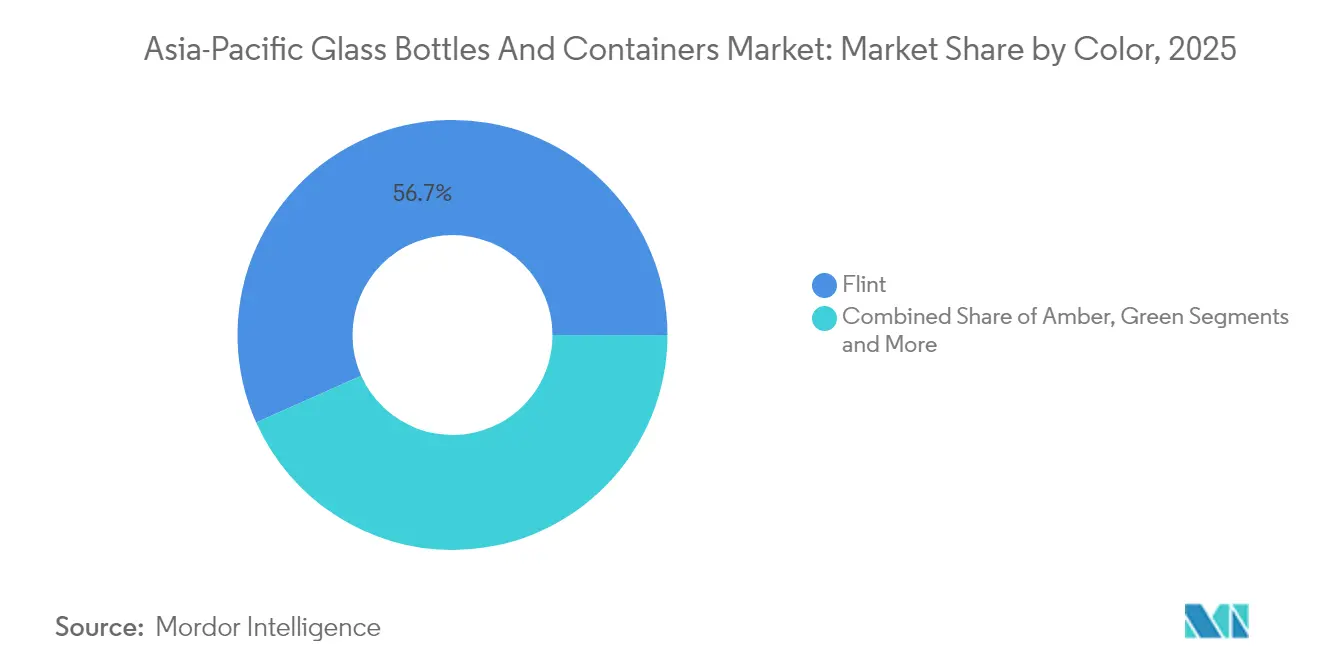
Amber Gains Ground on SustainabilityFlint glass maintained 56.68% of the Asia-Pacific container glass market size in 2025 due to its versatility and product visibility advantages. Yet amber’s superior UV-blocking properties are attracting brands concerned with light-sensitive formulations, from serums and essential oils to specialty brews, resulting in a 4.86% forecast CAGR for the color segment. Green glass continues to dominate legacy beer and wine categories where heritage aesthetics remain central, while niche hues fulfill bespoke brand requirements. Economies of scale still favor flint, but tightening quality standards in high-value categories accelerate amber’s penetration across the Asia-Pacific container glass market.
Geography Analysis
China Glass Bottles and Containers Market
China’s leadership rests on extensive capacity, integrated supply chains, and established export corridors, yet the 30-50 RMB per ton glass price hikes in early 2025 expose the vulnerability of energy-intensive plants to cost inflation. Strategic priorities now focus on value-added, lighter-weight bottles that can offset operating cost creep.
APAC Glass Bottles and Containers Market
India rides urbanization and premiumization waves, yet infrastructure bottlenecks and capital constraints occasionally cap furnace utilization. Japan and South Korea showcase best-in-class recycling rates, with Japan operating 26 dedicated plants that feed cullet back into domestic furnaces, reinforcing circular supply loops.
Australia and New Zealand Glass Bottles and Containers Market
Australia and New Zealand exhibit modest volume but high per-capita consumption of premium beverages packaged in glass, ensuring steady demand for specialty, low-carbon bottles.
Regulatory Landscape
Regulation affecting glass bottles and containers in Asia-Pacific is tightening around packaging circularity and food-contact safety, with requirements varying by country. In Singapore, the Ministry for Sustainability and the Environment put the Resource Sustainability (Beverage Container Return Scheme) Regulations 2026 into operation on 1 April 2026, which increases the weight of compliant labeling, collection readiness, and reverse logistics for beverage packaging suppliers. Vietnam also advanced EPR implementation through Decree No. 110/2026/ND-CP in 2026, adding clearer recycling responsibilities and documentation expectations that shape material choices and recycled-cullet planning for brand owners and glassmakers.
Food-contact compliance remains a parallel gatekeeper for market access. China continues to rely on mandatory national food safety standards for glass products (for example, GB 4806.5-2016), while ASEAN offers non-binding alignment via its General Guideline on Food Contact Materials, leaving multinational suppliers to manage country-specific testing and declarations. In 2026, Thailand's FDA initiated consultation on updating MOPH Announcement No. 92 with proposed migration limits for lead and cadmium in glassware, and Hong Kong's Environmental Protection Department administers the Glass Beverage Container Producer Responsibility Scheme, which requires beverage suppliers to register and submit audited reporting. This structure is pushing more formal compliance processes across the regional value chain.
Competitive Landscape
The Asia-Pacific container glass industry is moderately consolidated. Global majors O-I Glass, Verallia, and Ardagh continue optimizing furnace footprints; O-I closed 14% of capacity in 2024 and is exploring an additional 7% reduction by mid-2025 to yield USD 300 million in savings by 2027.
Decarbonization investments are escalating: the U.S. Department of Energy granted O-I USD 125 million to advance electrification and hybrid furnaces in 2024.[3] Ardagh and CAP Glass allocated undisclosed sums in April 2025 to bolster regional cullet processing capacity.
Technology-rich firms differentiate through higher cullet ratios. O-I’s biofuel trial achieved an 88% cullet blend and digitally enabled furnaces that reduce downtime, reinforcing a virtuous cycle of lower emissions and lower costs within the Asia-Pacific container glass market.
Asia-Pacific Glass Bottles And Containers Industry Leaders
-
Gerresheimer AG
-
PGP Glass Private Limited
-
Hindusthan National Glass & Industries Ltd.
-
O-I Glass, Inc.
-
Ardagh Group S.A.
- *Disclaimer: Major Players sorted in no particular order

Asia-Pacific Glass Bottles And Containers Market Companies Covered in this Report
- O-I Glass, Inc.
- Ardagh Group S.A.
- Verallia S.A.
- PGP Glass Private Limited
- Hindusthan National Glass & Industries Ltd.
- Feemio Glass Co., Ltd.
- Toyo Glass Co., Ltd.
- Nihon Yamamura Glass Co., Ltd.
- Gerresheimer AG
- Saverglass SAS
- Vitro S.A.B. de C.V.
- BA Glass Portugal, S.A.
- Stoelzle Glass Group GmbH
- Heinz-Glas GmbH & Co. KGaA
- Vetropack Holding AG
- Zignago Vetro S.p.A.
- Park Cam Sanayi ve Ticaret A.Ş.
- Orora Limited
- Koa Glass Co., Ltd.
- Bormioli Luigi S.p.A.
Read Analysis of Asia-Pacific Glass Bottles And Containers Companies
Market Opportunities and Future Outlook
Decarbonization-linked process upgrades and higher cullet utilization are becoming direct commercial opportunities as brands respond to EPR and deposit-return schemes with measurable recycling outcomes. Japan provides a visible proof point for technology migration in container glass production: in March 2026, TOYO GLASS commenced full-scale operation of a large oxygen combustion glass melting furnace at its Kashiwa plant (over 200 tonnes/day capacity) and disclosed a 20% greenhouse-gas reduction. That disclosure supports a clearer pathway for premium and regulated end uses that increasingly ask for lower-carbon packaging claims backed by manufacturing changes.
India is also standing out for capacity additions tied to premiumization and export-oriented supply. In March 2025, AGI Greenpac's board approved an INR 700 crore greenfield container glass facility in Madhya Pradesh (500 tonnes/day), highlighting investment appetite for localized supply that can shorten lead times for beverages and fast-growing premium segments such as cosmetics and perfumery. Capability building adds a second lever for competitiveness: in 2026, the All India Glass Manufacturers Federation ran a multi-day program on energy conservation and decarbonization at CDGI (Firozabad), aligning with the market need for combustion optimization, furnace efficiency retrofits, and tighter quality control in extra flint and colored glass where margins are higher and specifications are more demanding.
Recent Industry Developments in Asia-Pacific Glass Bottles And Containers Market
- June 2026: Hindusthan National Glass & Industries Ltd. disclosed a post-insolvency operational ramp-up in India, including restarting furnaces at Rishra and Rishikesh and resuming operations at its Puducherry plant. The restarts increase available domestic supply and can reduce dependence on imports for standard container formats while supporting quicker response times for beverage and food customers.
- July 2025: PGP Glass deployed Armis Centrix to help secure manufacturing operations for glass packaging. The deployment highlights rising cybersecurity requirements in digitally enabled plants, where protected production data and uptime support consistent quality for premium cosmetics and perfumery packs.
- June 2024: O-I Glass announced a USD 65 million electrification upgrade at its Veauche site in France. While outside Asia-Pacific, it added another large-scale reference for electrification and hybrid-furnace direction among global majors that also operate and transfer process know-how across the region.
Asia-Pacific Glass Bottles And Containers Market Report Scope and Research Methodology
Market Definition and Coverage
This market covers glass bottles and glass containers used as packaging across Asia Pacific, measured as the volume of container glass supplied into end-use applications during the study period.
Scope exclusions: Excludes: glass vials and ampoules used in pharmaceutical packaging.
Segments Covered in This Report
- By End-user
- Beverages
- Alcoholic
- Beer
- Wine
- Spirits
- Other Alcoholic Beverages (Cider and Other Fermented Drinks)
- Non-Alcoholic
- Juices
- Carbonated Drinks (CSDs)
- Dairy Product Based Drinks
- Other Non-Alcoholic Beverages
- Alcoholic
- Food (Jam, Jelly, Marmalades, Honey, Sausages and Condiments, Oil, Pickles)
- Cosmetics and Personal Care
- Pharmaceuticals (excluding Vials and Ampoules)
- Perfumery
- Beverages
- By Color
- Green
- Amber
- Flint
- Other Colors
- By Country
- China
- India
- Japan
- Thailand
- Australia and New Zealand
- South Korea
- Vietnam
- Rest of Asia-Pacific
Data Sources, Market Sizing, and Validation
Desk Research
To set the base structure of the model, we pull public data that explains container glass demand, trade flows, and the pace of packaging output across Asia Pacific. Common starting points include sources such as UN Comtrade trade statistics, national statistical offices, central bank inflation releases, and production indicators from industry ministries and customs departments.
We also use information that translates volume drivers into demand signals, such as published packaging and beverage consumption data, alcohol and soft drink output statistics, and public sustainability and recycling targets that shape cullet use. Supporting context is taken from company annual reports, investor presentations, reputable press coverage, and, when needed, paid databases focused on company financials, shipment-level import and export data, and patent databases for packaging and furnace technology trends. The desk sources listed are illustrative only, and we reviewed additional public references for data collection, validation, and clarification.
Primary Interviews and Surveys
Primary work was used to check how demand shifts across beverage, food, and personal care packaging, and to clarify where pharmaceutical containers are counted differently across countries. We spoke with participants across the value chain, including container glass producers, converters, distributors, and large end users, then used these inputs to pressure-test utilization, import reliance, and typical mix by color and application across APAC.
Distribution of primary research fieldwork respondents
| Company type | Respondent position |
|---|---|
| Top tier: 32% | CXOs: 18% |
| Mid tier: 50% | Functional/Unit leaders: 25% |
| Smaller Players: 18% | Managers: 57% |
Market-Sizing & Forecasting
Sizing was built using a top-down and bottom-up logic, where regional demand was reconstructed from container glass supply signals and then cross-checked with selective roll-ups. For the top-down build, we linked country-level packaging demand pools to container glass output and trade, then mapped volumes into end-use applications and color mix, keeping totals consistent at each step.
Key inputs that kept the model grounded include container glass production and capacity utilization cues, import and export movements for glass containers, beverage packaging trends (alcoholic and non-alcoholic), food and condiment packing volumes, and cullet availability trends that can influence effective output. When bottom-up checks were needed, we used sampled volume runs by application and country, channel checks on typical container weights and pack formats, and proportional allocation for smaller markets anchored to trade and consumption indicators.
For forecasting, scenario analysis was applied around demand drivers such as beverage mix shifts, recycling policy enforcement, and capacity additions or furnace rebuild cycles. We then adjusted the path using interview-based consensus on timing and magnitude. Results were kept reproducible by using variables that can be refreshed annually from public series, backed by repeat interview checks.
Data Validation & Update Cycle
Model outputs were reviewed through triangulation across production, trade, and end-use signals, so that one noisy series did not drive the total on its own. We run variance checks at country and application levels, and outliers are reworked by revisiting assumptions such as utilization, import dependence, and the split between bottles and other containers.
Before sign-off, a second analyst reviews the calculations and logic, and follow-up calls are triggered when a major discrepancy is seen versus independent indicators such as sudden trade spikes or capacity announcements. Reports are refreshed annually, with interim updates for material events, and a final pre-delivery pass so clients receive the most current view available.
Mordor Intelligence's Asia Pacific Glass Bottles Containers Market Size Compared Against Other Published Estimates
Published market numbers for Asia Pacific glass bottles and containers often do not match, even when the titles look the same. The gaps usually come from differences in what is counted as a container, whether the measure is value or volume, and how trade and production are converted into a single regional total.
Glass vials and ampoules are included in some published totals, but they sit outside Mordor Intelligence's scope. That changes the pharmaceutical portion and shifts the implied mix across colors and end uses. Other differences usually come from converting volume to value using broad average prices, using aggressive capacity ramp assumptions, or keeping older currency and inflation factors that do not reflect recent energy-driven cost swings in container glass.
Benchmark comparison
| Source | Market Size | Gaps in Research Methodology |
|---|---|---|
| Mordor Intelligence | USD 28.33 M (2025) | |
| Regional Consultancy A | USD 19.28 B (2025) | Often presented as value for container glass with limited visibility into volume reconciliation, and price assumptions may be averaged across countries without adjusting for import mix and cullet content differences. |
| Industry Publisher B | USD 28.70 B (2026) | Typically blends bottles, jars, and broader glass packaging value pools, and may include adjacent pharmaceutical formats and apply a single growth curve from a short base window. |
The comparison shows that most variance is explained by unit choice and what gets grouped into the definition of containers, followed by how prices and growth assumptions are applied. By keeping the scope tied to container glass volumes and checking totals against production and trade signals, our estimate stays traceable to clear inputs that can be refreshed each year.
Key Questions Answered in the Report
What is the projected CAGR for Asia-Pacific container glass demand between 2026 and 2031?
The Asia-Pacific Glass Bottles and Containers Market is forecast to register a 3.39% CAGR, rising from 29.29 million tonnes in 2026 to 34.61 million tonnes by 2031.
Which end-user segment is expected to grow the fastest through 2031?
Cosmetics and personal care packaging is anticipated to expand at a 4.63% CAGR, outpacing other segments despite beverages holding the largest share in 2025.
Why are amber bottles gaining traction in the region?
Amber glass offers superior UV protection for light-sensitive formulations, making it increasingly popular among premium cosmetics, pharmaceuticals, and craft beverage brands that emphasize product integrity and shelf life.
How are manufacturers addressing high energy costs in glass production?
Leading producers are investing in hybrid and fully electric furnaces, upping cullet ratios, and trialing alternative fuels such as bio-LNG and 100% biofuel to cut energy intensity and lower carbon footprints.