
United Kingdom Data Center Networking Market Size and Share
Market Overview
| Study Period | 2020 - 2031 |
|---|---|
| Forecast Data Period | 2026 - 2031 |
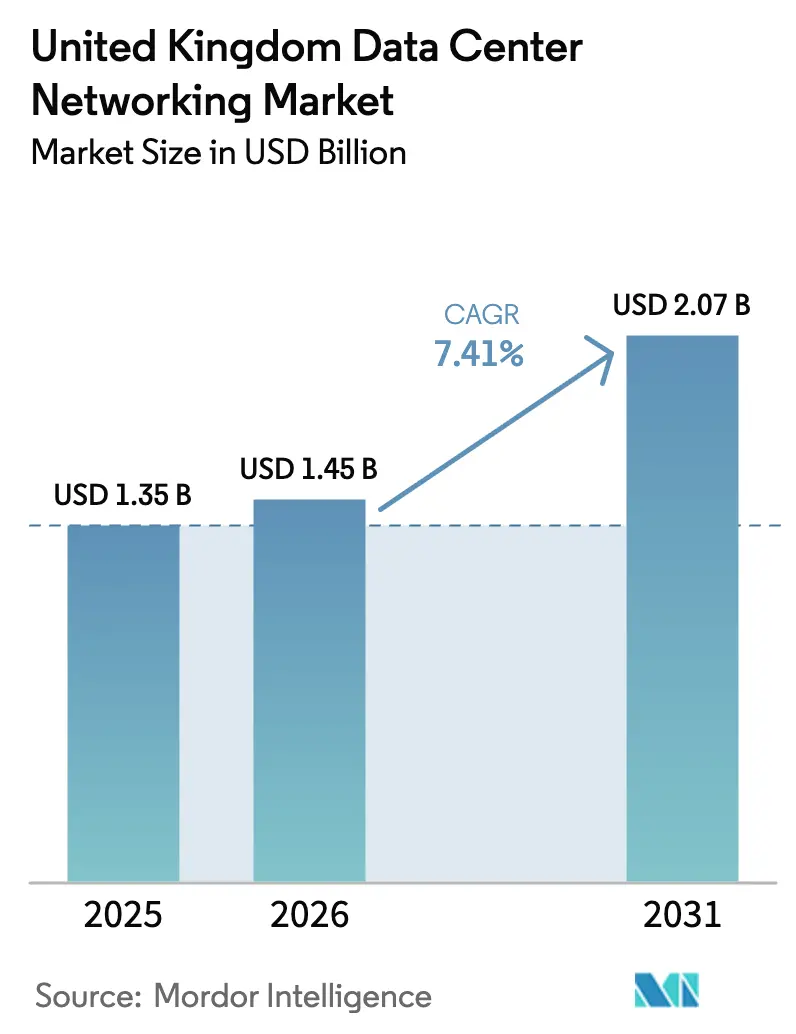
| Base Year Market Size (2025) | USD 1.35 Billion |
| Market Size (2026) | USD 1.45 Billion |
| Market Size (2031) | USD 2.07 Billion |
| Growth Rate (2026 - 2031) | 7.41 % |
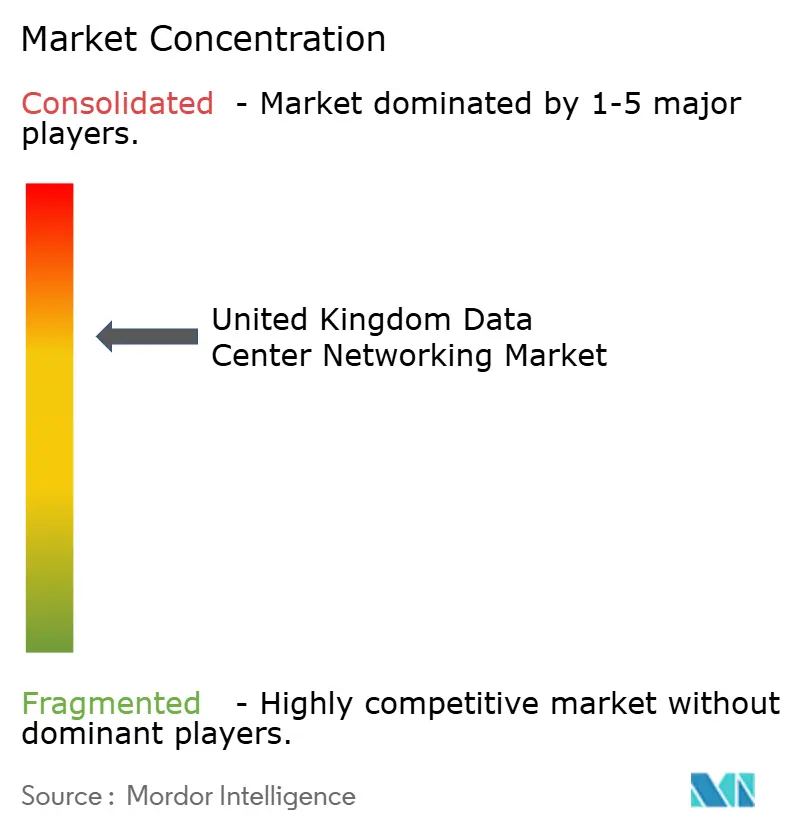
| Market Concentration | Medium |
Major Players *Disclaimer: Major Players sorted in no particular order Image © Mordor Intelligence. Reuse requires attribution under CC BY 4.0. | |
United Kingdom Data Center Networking Market Analysis by Mordor Intelligence
The United Kingdom data center networking market size is expected to grow from USD 1.35 billion in 2025 to USD 1.45 billion in 2026 and is forecast to reach USD 2.07 billion by 2031 at 7.41% CAGR over 2026-2031. This expansion stems from the government’s Critical National Infrastructure (CNI) designation for data centers, a GBP14 billion (USD 19.21 billion) AI investment pledge, and private-sector hyperscale commitments that jointly raise expectations for resilient, high-bandwidth, low-latency fabrics. Enterprises are redesigning network topologies to support AI training clusters that push port-density limits and mandate lossless, RDMA-capable Ethernet. Power-supply constraints around London are pushing new builds toward regional hubs, which in turn accelerates demand for more energy-efficient 400G and 800G hardware. Ongoing consolidation typified by the HPE Juniper proposal signals a market tilt toward end-to-end platforms bundling switching silicon, optics, automation software, and managed services offerings.
Key Report Takeaways
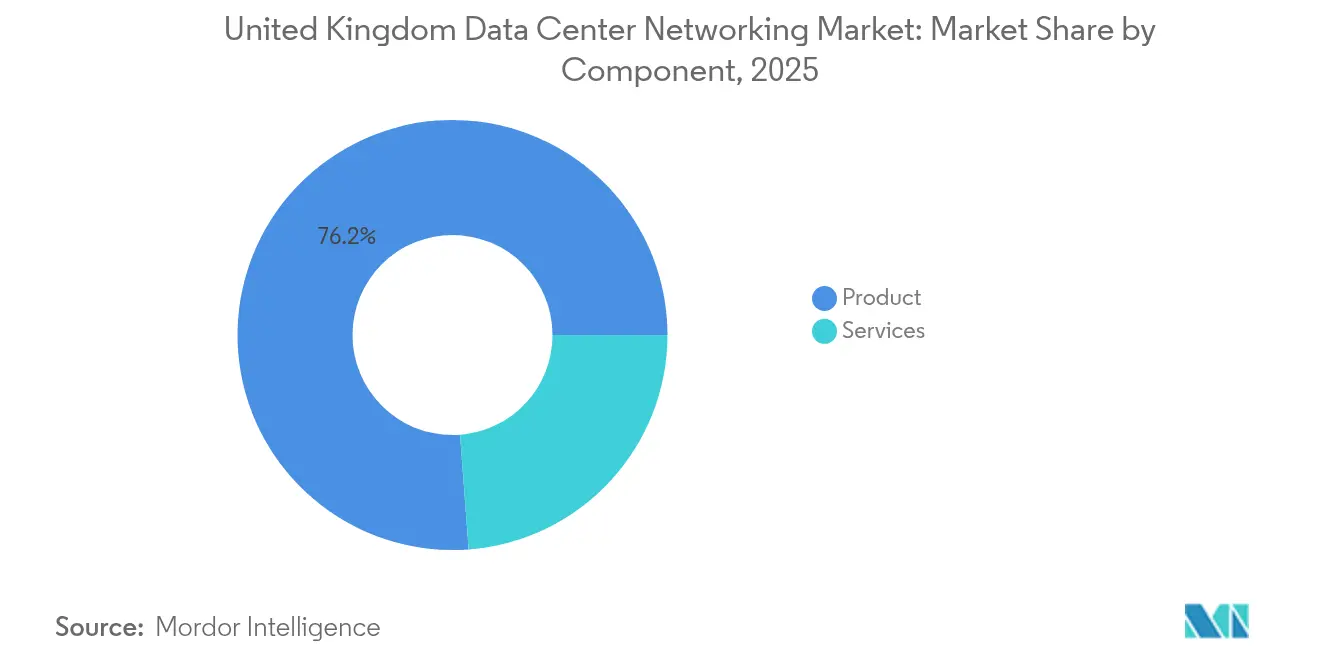
- By component, products commanded 76.20% of the United Kingdom data center networking market share in 2025, while services are projected to advance at a 7.55% CAGR to 2031.
- By end-user, IT and telecommunications led with 36.80% revenue share in 2025; manufacturing is forecast to expand at an 7.95% CAGR through 2031.
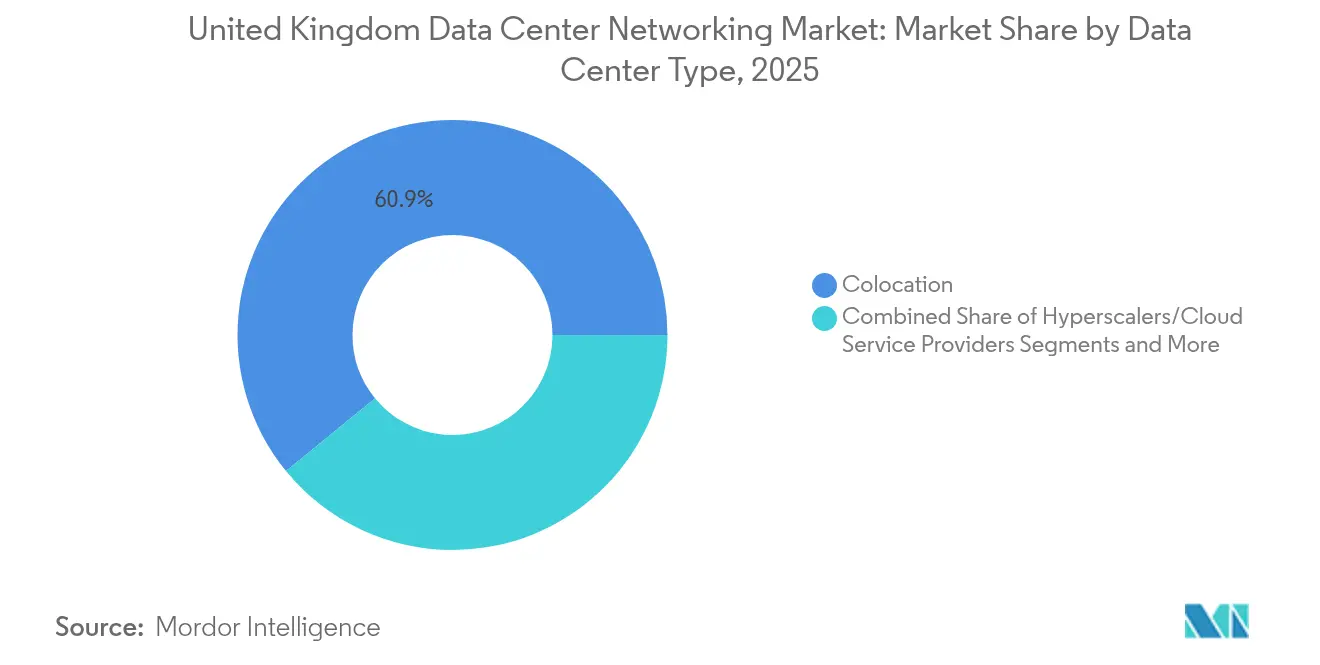
- By data-center type, colocation facilities held 60.90% of the United Kingdom data center networking market size in 2025, whereas hyperscalers are set to grow at 9.15% CAGR to 2031.
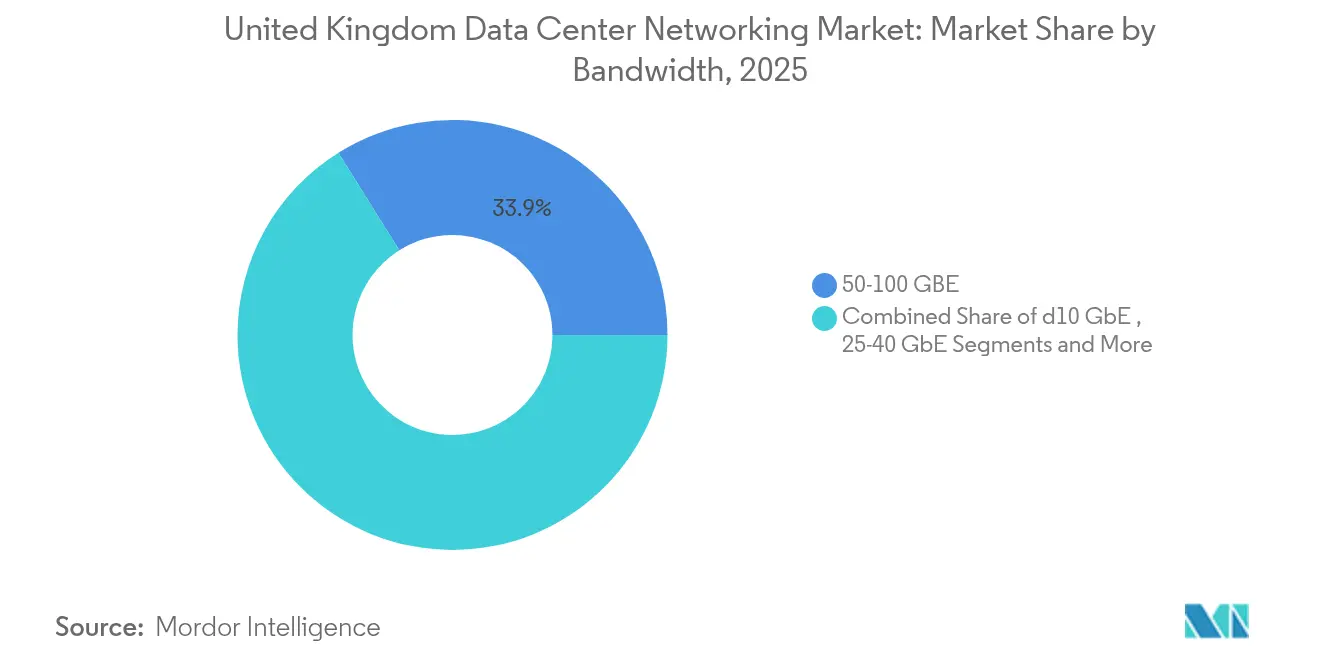
- By bandwidth, 50–100 GbE accounted for 33.90% share of the United Kingdom data center networking market size in 2025; greater than 100 GbE is poised for an 8.12% CAGR to 2031.
Note: Market size and forecast figures in this report are generated using Mordor Intelligence’s proprietary estimation framework, updated with the latest available data and insights as of 2026.
United Kingdom Data Center Networking Market Trends and Insights
Drivers Impact Analysis*
| Driver | (~) % Impact on CAGR Forecast | Geographic Relevance | Impact Timeline |
|---|---|---|---|
| Surge in AI/ML and HPC driving 400/800 G upgrades | +2.1% | London, Manchester, Leeds | Medium term (2–4 years) |
| Government CNI status and GBP 14 billion AI plan | +1.8% | Nationwide; early activity in Culham, Oxfordshire | Short term (≤ 2 years) |
| Cloud and hybrid-multi-cloud traffic explosion | +1.5% | National; spill-over to emerging edge locations | Long term (≥ 4 years) |
| Sustainability push for spine-leaf architectures | +0.9% | Focus on South-East England | Medium term (2–4 years) |
| Regional edge DC build-out outside London | +0.7% | Manchester, Cardiff, Leeds, Birmingham | Long term (≥ 4 years) |
| Silicon-photonics 1.6 T Ethernet roadmap | +0.6% | Early hyperscale adoption | Long term (≥ 4 years) |
| Source: Mordor Intelligence | |||
Surge in AI/ML and HPC driving 400/800 G upgrades
Rising generative-AI clusters require ultra-low-latency fabrics that traditional 10/25 G links cannot sustain. NVIDIA’s Spectrum-X platform posts 1.6 × throughput gains versus prior Ethernet fabrics, while Arista’s 7060X6 AI Leaf and 7800R4 AI Spine supply up to 51.2 Tbps and 460 Tbps, respectively, to meet pod-level aggregation demand.[1]NVIDIA Corporation, “Spectrum-X Ethernet Platform,” nvidia.comMeta’s adoption of distributed 400 G switches further demonstrates hyperscalers’ shift to deeper leaf-spine tiers that shorten east-west paths and minimize tail-flow latency. Cisco’s decision to embed Silicon One ASICs inside NVIDIA’s Ethernet stack exemplifies convergence between merchant silicon and AI-centric software pipelines that enterprises now consider a prerequisite for future readiness.
Government CNI status and GBP 14 billion AI plan catalyzing spend
The September 2024 CNI designation grants data-center operators priority access to planning and security support, directly unlocking record capital pledges such as Vantage’s GBP 12 billion (USD 16.47 billion) multi-campus build and Nscale’s USD 2.5 billion sovereign AI facility. The Action Plan also inaugurates AI Growth Zones with dedicated power-allocation corridors, starting in Culham, which accelerates permit approvals that historically delayed capacity. A twentyfold expansion in public compute by 2030, including a GBP 750 million (USD 1029.15 million) Scottish supercomputer, underpins multi-year demand for 800 G interconnects across public-sector and academia workloads.
Cloud and hybrid-multi-cloud traffic explosion
Hybrid architectures intensify east-west movement between IaaS, PaaS, and on-prem environments, demanding deterministic 400 G port performance at internet exchanges and private cloud on-ramps. AWS’s GBP 8 billion (USD 10.98 billion) UK expansion, Google’s USD 1 billion Waltham Cross site, and Microsoft’s GBP 106 million (USD 145.45 million) Leeds hyperscale build all aim to keep cloud latency under 10 milliseconds for UK end-users.[2]Amazon, “Amazon’s one-of-a-kind machine ushering in the next generation of AI,” amazom.com Decommissioning of NHS data rooms following full AWS migration showcases the public sector’s role in fueling interconnect traffic, while BT’s Juniper-based cloud-native core illustrates telecom adoption of spine-leaf topologies for mass 5G offload.
Sustainability push for spine-leaf architectures
The EU Energy Efficiency Directive compels UK operators to disclose PUE and carbon metrics, prompting investments in flatter fabrics with fewer hops and lower watt/Gbps ratios. Dropbox’s 400 G roll-out reports double-digit reductions in power per bit, and Equinix’s digital dashboards let customers track traffic energy intensities that shape procurement decisions. National Grid’s 1.8 GW Buckinghamshire substation will funnel cleaner power into West-London clusters, aligning with net-zero goals while enabling denser switch deployments.
Restraints Impact Analysis*
| Restraint | (~) % Impact on CAGR Forecast | Geographic Relevance | Impact Timeline |
|---|---|---|---|
| Grid-power constraints in South-East England | −1.2% | London and surrounding counties | Short term (≤ 2 years) |
| Cost and lead-time spikes for 800 G optics/ASICs | −0.8% | Nationwide | Medium term (2–4 years) |
| New energy-/water-use disclosure rules | −0.5% | Large facilities countrywide | Long term (≥ 4 years) |
| Hyperscaler egress fees and lock-in | −0.3% | Enterprise customers across the UK | Medium term (2–4 years) |
| Source: Mordor Intelligence | |||
Grid-power constraints in South-East England
National Grid warns data-center electricity demand could rise sixfold this decade, yet the capital’s transmission corridors already operate near capacity. A recent Secretary of State refusal for a West London green belt campus highlights how planning curbs add to grid scarcity, prompting shifts to East London’s Romford, where Green Mountain’s 30 MW project secured faster hookups. Ofgem’s queue-reform program may shave connection wait times, but meaningful substation builds require multi-year cycles, tempering near-term rollout velocities.[3]Ofgem, “Electricity Transmission Queue Reform,” ofgem.gov.uk
Cost and lead-time spikes for 800 G optics/ASICs
Shortages in MTP/MPO fibre assemblies and high-speed driver ICs inflate per-port prices by up to 25% compared with 2023 levels, while Broadcom’s 100 Tbit/s Tomahawk 6 silicon moves remain supply-constrained for at least two quarters. Integrated-photonics value chains resemble microelectronics in complexity; a single foundry hiccup can ripple through module availability and delay planned migrations from 100 G to 800 G fabrics across UK sites.
*Our forecasts treat driver/restraint impacts as directional, not additive. The impact forecasts reflect baseline growth, mix effects, and variable interactions.
Segment Analysis
By Component: Services Growth Outpaces Products Dominance
Products held 76.20% of the United Kingdom data center networking market in 2025, reflecting entrenched demand for switches, routers, application delivery controllers, security appliances, and optical interconnects that anchor physical infrastructure. Cisco’s Nexus 9364E-SG2 64-port 800 G switch exemplifies hardware tuned for AI-scale clusters, boasting 51.2 Tbps bandwidth and sizable on-die buffers to mask microbursts. Storage area networks now transition to NVMe-over-Fabrics, while security gateways embed AI-driven inspection engines capable of decrypt-at-line-rate, keeping hardware demand buoyant.
The services segment is smaller yet set for 7.55% CAGR as enterprises outsource design, integration, and managed operations of complex AI fabrics. Consulting firms deploy software-defined controllers such as Cisco ACI or VMware NSX to automate policy across hybrid clouds, whereas open-source OpenDaylight appeals to firms pursuing vendor-agnostic postures. Adoption of silicon-photonics optics like Coherent’s 2×400 G-FR4 Lite transceiver further nudges organisations to rely on specialist service providers for optical-layer tuning and lifecycle management.



By End-User: Manufacturing Drives Fastest Adoption
IT and telecom operators commanded 36.80% share of the United Kingdom data center networking market size in 2025 owing to continual refresh cycles that sustain broadband and cloud service quality. Banks and insurers also invest heavily; Starling Bank’s use of Digital Realty interconnects underpins mobile-only operations with sub-20 millisecond transaction latency.
Manufacturing posts the fastest 7.95% CAGR to 2031 as Industry 4.0 ties operational-technology sensors to cloud analytics. Reckitt Group links factory assets via Azure IoT to derive predictive-maintenance insights that cut downtime 10% and energy loads 3%. Government, defence, healthcare, and media verticals likewise pivot to AI-assisted workflows yet trail manufacturing’s velocity because of regulatory procurement cycles.
By Data-Center Type: Hyperscalers Accelerate Infrastructure Expansion
Colocation facilities secured 60.90% United Kingdom data center networking market share in 2025 by offering carrier-dense, cloud-neutral meet-me rooms that let enterprises blend public and private workloads seamlessly. Digital Realty’s Docklands-to-Slough campuses host latency-sensitive trading platforms, underscoring colocation’s ongoing relevance for high-frequency financial flows.
Hyperscalers expand at 9.15% CAGR fuelled by AWS’s Elastic Fabric Adapter and UltraCluster 2.0 networks, Google’s carbon-free Waltham Cross build, and Microsoft’s Leeds complex, each engineered for AI superpod topologies spanning tens of thousands of accelerators. Edge and micro sites ride 5G densification; EE activated 1,000+ small cells and Virgin Media O2 added backhaul upgrades that drop latency below 5 milliseconds, enabling content caching and AR/VR workloads near users.
By Bandwidth: High-Speed Transitions Accelerate
The 50–100 GbE tier remained the single largest at 33.90% share in 2025 because it balances throughput with capex for mainstream workloads. Dell’s 64 × 400 GbE fabric proves that even mid-size enterprises pursue fourfold uplifts in rack-to-leaf capacity without line-card sprawl.
Segments above 100 GbE will grow 8.12% CAGR; Ciena’s WaveLogic 6 Extreme 1.6 Tbps coherent optics allow metro reach at lower watts per bit, while Marvell’s 400 G/lane SerDes speeds roadmap to 1.6 T chassis by 2027. Lumentum’s indium-phosphide chipsets enabling 400 Gbps-per-lane herald a pivot toward co-packaged optics that could collapse power budgets by double digits once commercialised.
Geography Analysis
London and the South-East host most of the United Kingdom data center networking market, with 263 facilities and 1,753 MW capacity rooted in Docklands, Slough, and West London clusters that connect to transatlantic subsea cables. National Grid’s 1.8 GW Buckinghamshire substation will alleviate congestion, yet planning headwinds keep operators scanning alternative sites.
Edge initiatives reinforce this mosaic; AI Growth Zones such as Culham streamline permits within science parks that already house advanced-compute tenants. Operators weigh fiber-route diversity, renewable-energy mix, and local talent density when selecting new plots, ensuring interconnection ecosystems mature in tandem with power infrastructure so that traffic can stay within sub-10 millisecond round-trip bands nationwide.
Regulatory Landscape
The UK policy environment has shifted toward treating data centers as nationally important digital infrastructure, anchored by the September 2024 designation of data centers as Critical National Infrastructure (CNI). Alongside this, the Cyber Security and Resilience (Network and Information Systems) Bill brings data centers into an essential-services-style framework and names Ofcom as the primary operational regulator, with thresholds that capture third-party facilities at or above 1 MW and enterprise data centers at or above 10 MW. This raises expectations for network security, resilience controls, and incident readiness across operators and their networking supply chains.
Planning and sustainability requirements are also tightening. New 2026 regulations enable certain data center schemes to be routed into the Nationally Significant Infrastructure Projects (NSIP) consenting regime, changing how large campuses secure approvals. Separately, mandatory biodiversity net gain requirements for data centers apply from 2 November 2026, and DSIT's Digital Standards Strategy (2026 to 2030) stresses standards leadership in AI, cybersecurity, and advanced connectivity, which supports adoption of higher-speed Ethernet and more standardized automation and security controls in UK facilities.
Competitive Landscape
Vendor dynamics are in flux. Incumbent switch makers face new competition from AI-centric silicon suppliers and optics specialists. The proposed USD 14 billion HPE-Juniper merger would fuse compute, storage, routing, and automation portfolios, creating a full-stack alternative to Cisco and Arista. NVIDIA’s Spectrum-X strategy positions the GPU vendor as a credible Ethernet challenger, while Cisco becomes its exclusive ASIC supplier, tightening interdependence within the ecosystem.
Optics innovation alters boundaries between component and system players. Coherent and Lumentum lead silicon-photonics transceiver advances vital for 1.6 T roadmaps, which could compress port power to near 10 pJ/bit and thus lower TCO for hyperscalers. Intel’s 4 Tbps optical chiplet demonstration hints at co-packaged optics entering mainstream switch-SKU cycles within three years, potentially redrawing vendor pecking orders for leaf-spine deployments
United Kingdom Data Center Networking Industry Leaders
Arista Networks Inc.
Broadcom Inc.
Cisco Systems Inc.
Dell Technologies Inc.
Extreme Networks Inc.
- *Disclaimer: Major Players sorted in no particular order

Market Opportunities and Future Outlook
Network spend is being pulled by UK projects that explicitly target AI-capable capacity and by financing structures that reduce risk for new campus builds outside the most constrained power corridors. Examples include the SEGRO and Pure DC joint venture to develop a 56 MW facility at Premier Park in West London, and Siemens Financial Services taking a stake in UK data center operator Kao Data (July 2026). These moves reinforce demand for high-density leaf-spine switching, higher-rate optics, and automation software for AI clusters and HPC-oriented traffic patterns.
Opportunities are also emerging around power-adjacent site strategies and sovereign AI service delivery models, which place a premium on resilient, multi-site interconnect and secure east-west fabrics. Viridor and Rivington Energy have partnered to plan 200 MW of AI-ready data center capacity across locations including Bristol, Greater London, Oxfordshire, and Fife using Energy from Waste power, while Argyll and SambaNova launched a sovereign AI inference cloud using a disaggregated platform across multiple UK data center locations. Together, these initiatives raise the bar for vendors and service providers looking to integrate high-speed Ethernet switching, optics, and security with multi-site operations, while operators try to manage watt-per-Gbps under tighter sustainability and reporting expectations.
Recent Industry Developments
- May 2026: Cisco reported that quarterly AI orders reached $2 billion in Q3 FY26, with a total of $9 billion in recent AI orders, driven by demand from hyperscalers for Silicon One-based networking systems. The information indicates growing demand for silicon-based networking in large-scale data center deployments. The momentum reinforces Cisco's position in hyperscale data center networking and could shape competitive dynamics.
- February 2026: Cisco unveiled the Silicon One G300, a 102.4 Tbps switching silicon designed for massive AI cluster buildouts, intended to power new Cisco N9000 and Cisco 8000 systems. The launch extends Cisco's high performance switching capability for AI-driven infrastructures. The capacity addition strengthens Cisco's end-to-end platform strategy for hyperscale networks and supports adoption of advanced silicon in data center fabrics.
- September 2024: Cisco opened a second UK data center in Manchester to support Webex Calling services, complementing an existing facility in London. The expansion increases Cisco's UK data center footprint for collaboration workloads. The added capacity improves service reliability and regional reach for enterprise communications across the United Kingdom.


Research Methodology Framework and Report Scope
Market Definition and Coverage
For this report, the market covers spending in the United Kingdom on networking equipment and related software used inside data centers to connect servers, storage, and interconnect layers, including upgrades and expansions tied to new rack deployments and traffic growth.
Scope exclusions: We exclude customer premise enterprise LAN hardware that is not deployed in a data center, and we also exclude standalone compute, storage, and facility power or cooling systems.
Segmentation Overview
- By Component
- Products
- Ethernet Switches
- Routers
- Storage Area Network (SAN)
- Application Delivery Controllers (ADC)
- Network Security Appliances
- Software-Defined Networking (SDN) Controllers
- Optical Interconnects
- Services
- Installation and Integration
- Training and Consulting
- Support and Maintenance
- Managed Network Services
- Products
- By End-User
- IT and Telecommunications
- Banking, Financial Services and Insurance (BFSI)
- Government and Defense
- Media and Entertainment
- Healthcare and Life Sciences
- Manufacturing and Industrial
- Other End-Users
- By Data-Center Type
- Colocation
- Hyperscalers/Cloud Service Providers
- Edge/Micro Data Centers
- By Bandwidth
- Less than or Equal to 10 GbE
- 25-40 GbE
- 50-100 GbE
- Greater than 100 GbE
Data Sources, Market Sizing, and Validation
Desk Research
Desk work started with mapping the UK data center buildout and the main traffic drivers, and then translating that into likely network refresh cycles and bandwidth needs. Public sources were used to anchor the environment and the pace of change, including UK Government and Ofcom publications, National Grid and related grid capacity updates, IEA energy data, and OECD digital economy indicators.
To turn context into measurable inputs, we also reviewed company annual reports, investor presentations, product announcements, and reputable press coverage on UK data center expansions. Where useful, we checked paid subscriptions for company financials and intelligence, patent databases, and a global contracts and tenders database to validate directionally whether spend and procurement activity matched the model assumptions. The desk sources listed here are illustrative, and we used additional public and paid references for data collection, cross-checking, and clarification.
Primary Interviews and Surveys
Primary interviews and surveys were used to confirm what buyers typically purchase for UK data center networking and how refresh timing is decided, including port speeds and support contract expectations. We spoke with operators, integrators, distributors, and technical decision-makers to pressure test assumptions on upgrades from 100G to 400G and early 800G planning, and to validate which demand pockets looked strongest across major UK data center hubs.
Themes from these discussions were then used to tighten price ranges, check adoption timing for fabric automation and telemetry, and resolve gaps where public sources do not separate networking from broader data center infrastructure spend.
Distribution of primary research fieldwork respondents
| Company type | Respondent position |
|---|---|
| Top tier: 34% | CXOs: 14% |
| Mid tier: 51% | Functional/Unit leaders: 39% |
| Smaller Players: 15% | Managers: 47% |
Market-Sizing & Forecasting
The sizing model was built using a top-down approach that reconstructs a UK demand pool from data center capacity additions, average rack density, and expected network ports per rack, and then converts that into spending using price bands by speed class. After forming the demand pool, we cross-checked totals with selective bottom-up approximations from sampled configuration quotes, channel checks on typical bill of materials, and supplier revenue exposure patterns, and then adjusted where the two views diverged.
The inputs with the most impact in this market were planned new data hall capacity in the United Kingdom, estimated server and rack shipments into data centers, mix shifts from 100G to 400G and early 800G, the share of leaf-spine versus legacy architectures, and average support and software attach rates in networking purchases. Forecasts were generated using scenario analysis supported by expert views on AI driven clustering, public cloud expansion, and power availability constraints that can delay deployments. Where bottom-up coverage was incomplete, we used conservative penetration ranges and checked them against procurement signals and upgrade cycle logic.
Data Validation & Update Cycle
Outputs were validated through triangulation across multiple signals to avoid relying on any single source. We checked year over year changes against independent indicators such as data center capacity additions, network speed transition timing, and observed pricing movement, then ran variance checks to flag any unrealistic jumps.
A multi-step internal review was used before sign-off, and follow-up calls were triggered when primary feedback did not match desk findings or when a major expansion plan changed. Reports are refreshed annually, with interim updates when material events occur, such as large project delays, regulatory shifts, or notable procurement waves. Before delivery, an analyst completes a fresh update pass so clients receive the most current view.
Mordor Intelligence's United Kingdom Data Center Networking Market Size Compared Against Other Published Estimates
Published market sizes can look far apart because the market boundary is not always set the same way, and because pricing and speed mix assumptions can change results quickly in data center networking. Differences also come from whether studies count only data center switching and interconnect, or whether adjacent items like security appliances, campus networking, or broader data center infrastructure are blended into one total.
By tracking port speed mix, refresh timing, and UK data center capacity signals, Mordor Intelligence keeps the estimate focused on in-data-center networking spend and avoids inflating totals with non-data-center LAN purchases or unrelated infrastructure categories.
Benchmark comparison
| Source | Market Size | Gaps in Research Methodology |
|---|---|---|
| Mordor Intelligence | USD 1.45 B (2026) | |
| Regional Consultancy A | USD 1.90 B (2026) | Often includes a wider bundle of data center infrastructure spend, and may count adjacent enterprise networking and security equipment used around facilities, which increases the total beyond pure in-data-center networking. |
| Trade Journal B | USD 1.10 B (2025) | Typically uses shipment-led snapshots and narrower hardware-only coverage, and may undercount software and support attach as well as mid-cycle upgrades inside existing data halls. |
The comparison shows that the biggest spread is explained by what gets included and how pricing and attach are treated, not by a disagreement that demand exists. Our approach stays traceable to repeatable variables like UK capacity additions, port speed transitions, and realistic price bands, which makes the final number easier to audit and update over time.


Key Questions Answered in the Report
What is the current size of the United Kingdom data center networking market?
The United Kingdom data center networking market size is USD 1.45 billion in 2026.
How fast will the market grow by 2031?
It is forecast to reach USD 2.07 billion by 2031, advancing at a 7.41% CAGR.
Which segment shows the fastest growth?
Hyperscale and cloud service provider facilities expand at 9.15% CAGR as AI workloads scale.
How is the power grid affecting new data center builds?
South-East England grid constraints delay London projects, steering operators toward regional hubs with available capacity.
Page last updated on:
- Data Center Server Market Servers across the global market, covering tier, facility size and facility type.
- Artificial Intelligence (AI) Data Center Market Global AI facilities demand, split by facility type, component and tier.
- Data Center Cooling Market Global cooling demand, split by cooling technology, cooling component and facility type.
- UK Data Center Storage Market Storage in the UK, split by facility size and tier.
- Spain Data Center Storage Market Spain storage, split by facility size and tier.
- France Data Center Storage Market Storage in France, split by facility size and tier.
- Mexico Data Center Cooling Market Cooling demand across Mexico, covering cooling technology, type and end-user industry.





