
Market Overview
| Study Period | 2020 - 2031 |
|---|---|
| Forecast Data Period | 2026 - 2031 |
| Base Year Market Size (2025) | USD 2.42 Billion |
| Market Size (2026) | USD 2.62 Billion |
| Market Size (2031) | USD 3.42 Billion |
| Growth Rate (2026 - 2031) | 5.51 % |
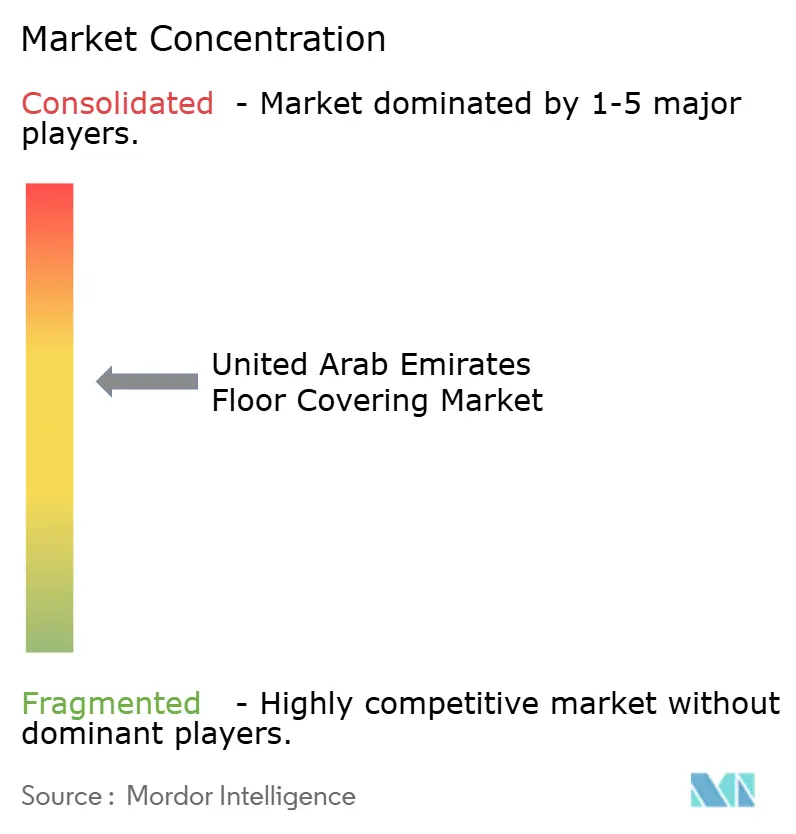
| Market Concentration | Medium |
Major Players *Disclaimer: Major Players sorted in no particular order Image © Mordor Intelligence. Reuse requires attribution under CC BY 4.0. | |
United Arab Emirates Floor Covering Market Analysis by Mordor Intelligence
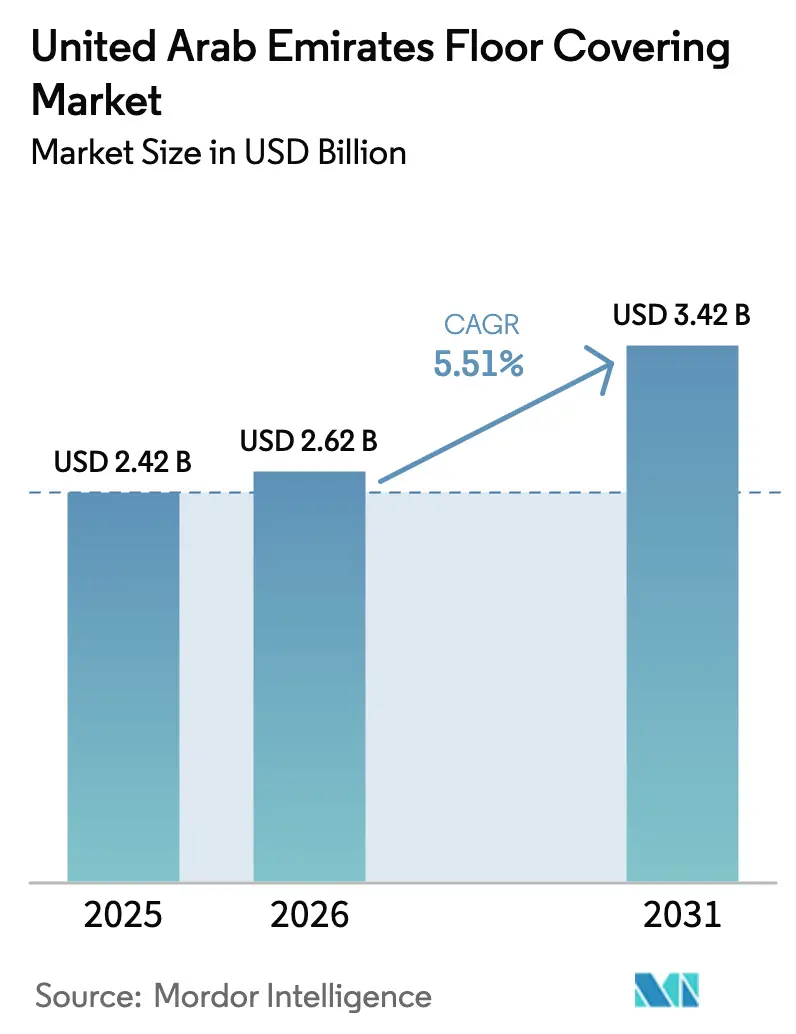
The United Arab Emirates Floor Covering Market size is expected to grow from USD 2.42 billion in 2025 to USD 2.62 billion in 2026 and is forecast to reach USD 3.42 billion by 2031 at a 5.51% CAGR over 2026–2031. This expansion aligns with a shift from discretionary residential upgrades toward public infrastructure, hospitality-led construction, and compute-heavy facilities that sustain multi-year flooring demand in the United Arab Emirates floor covering market. Federal capital expenditure in 2025 totals USD 1,378 million (AED 5,065 million), with the report highlighting federal roads construction and maintenance projects of USD 206.8 million (AED 760 million) for 2024–2025, alongside multiple distinct federal building projects and USD 0.15 billion (AED 0.58 billion) in maintenance expenditures for buildings and roads[1]. Visitor volumes also sustain contract activity, with Dubai recording 9.88 million overnight visitors in H1 2025 and maintaining occupancy above 79%, which tightens project timelines and drives the selection of durable, low-maintenance surfaces across the United Arab Emirates floor covering market[2]. Indoor air quality rules add a second layer of specification discipline that guides material selection for large buildings in both Dubai and Abu Dhabi, which raises the threshold for product compliance and favors proven brands and tested formulations. Data infrastructure plans also create a specialized demand pool for modular raised flooring systems that are engineered for dense electrical and cooling loads, expanding the application mix addressed by the United Arab Emirates floor covering market.
Key Report Takeaways
- By product type, ceramic and porcelain tiles led with 37.32% revenue share in the United Arab Emirates floor covering market in 2025, while vinyl flooring is projected to expand at a 9.76% CAGR through 2031.
- By end user, residential accounted for a 56.37% share in the United Arab Emirates floor covering market in 2025, and the commercial segment recorded the highest projected growth with a 9.26% CAGR through 2031.
- By distribution channel, B2C retail represented 63.67% of transactions in the United Arab Emirates floor covering market in 2025, while B2B contractors are projected to grow at a 9.87% CAGR during 2026 to 2031.
- By geography, Dubai held 36.37% of market revenue in the United Arab Emirates floor covering market in 2025, and Abu Dhabi is projected to grow at a 10.38% CAGR from 2026 to 2031.
Note: Market size and forecast figures in this report are generated using Mordor Intelligence’s proprietary estimation framework, updated with the latest available data and insights as of January 2026.
United Arab Emirates Floor Covering Market Trends and Insights
Drivers Impact Analysis*
| Driver | (~) % Impact on CAGR Forecast | Geographic Relevance | Impact Timeline |
|---|---|---|---|
| Compliance-driven public housing programmes | +0.7% | National, concentrated in Abu Dhabi, Sharjah, and the Northern Emirates | Medium term (2-4 years) |
| Tourism-led hospitality expansion | +1.2% | Dubai core, Abu Dhabi growth node, Ras Al Khaimah emerging | Long term (≥ 4 years) |
| Shift toward premium LVT & SPC flooring | +1.4% | Global, with early gains in the Dubai and Abu Dhabi luxury segments | Long term (≥ 4 years) |
| Demand surge from mega mixed-use projects | +0.9% | Dubai (Palm Jebel Ali, Dubai Islands), Abu Dhabi (Saadiyat), Sharjah | Medium term (2-4 years) |
| Mandatory Estidama low-VOC specifications | +0.6% | Abu Dhabi mandatory, Dubai voluntary adoption | Long term (≥ 4 years) |
| Data-centre modular raised-floor boom | +0.8% | Spill-over to Dubai, Abu Dhabi free zones | Short term (≤ 2 years) |
| Source: Mordor Intelligence | |||
Compliance-Driven Public Housing Programmes Anchor Baseline Demand and Compress Upgrade Cycles
Public housing programs maintain steady unit delivery and increase predictability for flooring volumes, although they can limit room for product premiumization at the point of specification. The Sheikh Zayed Housing Programme disbursed USD 523.22 million (AED 1,922.5 million) across 2,442 beneficiaries in 2024 for new residences and modifications, which channelled demand toward compliant, value-priced materials suitable for baseline codes and rapid handover timelines. Process efficiency improved through VAT refunds for new-build residences, where the Federal Tax Authority processed 6,971 applications in 2024 via the Maskan smart application, which helped accelerate completion milestones and cash-flow clarity for homeowners[3]. The UAE’s specification environment complements these financial measures, since minimum indoor air quality criteria in new buildings steer product selection toward tested formulations that carry recognized certifications. This integrated policy and regulatory framework supports predictable demand patterns in the United Arab Emirates floor covering market through a combination of steady public-housing throughput and compliance-led specifications. These dynamics sustain a consistent baseline for residential installations while enabling scale efficiencies for suppliers that maintain compliant inventories across multiple emirates in the United Arab Emirates floor covering market.
Tourism-Led Hospitality Expansion Elevates Foot-Traffic Resilience and Aesthetic Benchmarks
Demand from hospitality remains an important growth node for the United Arab Emirates floor covering market, with Dubai recording 9.88 million overnight visitors in H1 2025 and maintaining occupancy above 79%, which drives robust refurbishment cycles and steady new-build fit-out activity. Property operators continue to emphasize low-VOC specifications and surfaces that balance durability with guest experience, which pushes the adoption of certified resilient flooring in high-traffic areas and suites where noise attenuation and ease of maintenance matter. This preference aligns with global wellness positioning in upper-tier hospitality, making third-party certification and verifiable product documentation common preconditions in design submittals for the market. The cumulative effect is visible in project tendering that prioritizes reliable lead times and compliant materials, especially for corridors, lobbies, and amenity zones that experience constant footfall. This environment reinforces a long-term volume base for resilient and hard-surface categories within the market, as destination branding and steady visitor flows sustain continuous investment in accommodation assets.
Shift Toward Premium LVT & SPC Flooring Redefines Material Hierarchy and Margin Distribution
Premium LVT and SPC formats continue to gain share due to fast-installation systems, moisture impermeability, and realistic textures that meet aesthetic briefs without structural load penalties common to heavier materials. On the specification side, opacity around subfloor conditions is reduced by rigid cores that maintain dimensional stability across temperature swings, which improves performance in air-conditioned interiors exposed to sand ingress and humidity variations. Pricing ladders show a clear premium tier for commercial-grade SPC offerings that include thicker wear layers and integrated acoustic underlay, reinforcing the value proposition when downtime costs are factored into the total installed price. Resilient flooring growth across the region also creates a favourable backdrop for LVT and SPC adoption in healthcare and education assets, where ease of sanitation and certification trails are critical. These attributes collectively lift the share of resilient formats within project specifications across the market as owners and contractors standardize on quick-turn, compliant solutions.
Data-Center Modular Raised-Floor Boom Multiplies High-Density Infrastructure Demand
Growth in AI-ready and sovereign cloud capacity underpins a specialized demand pool for modular raised floors designed for heavy loads and advanced cable access. The Stargate United Arab Emirates initiative announced by G42 and partners adds a major supercomputing footprint with phased capacity, which accelerates procurement of steel-panel systems with integrated grounding and load-bearing specifications for dense racks. A separate expansion announcement by Microsoft and G42 in November 2025 introduced an additional 200 MW of data center capacity to meet AI and cloud workloads, which reinforces the volume outlook for raised-flooring packages in the United Arab Emirates floor covering market[4]. Project schedules emphasize fast delivery for compute workloads, making factory-ready modular systems attractive to EPC contractors and operators. This build-out influences supplier strategies around local inventory, installation training, and quality assurance to meet commissioning windows in 2026 and beyond. The long-tailed nature of digital infrastructure in free zones and industrial districts broadens the addressable mix for the United Arab Emirates floor covering market into technical flooring solutions that differ from standard commercial applications.
Restraints Impact Analysis*
| Restraint | (~) % Impact on CAGR Forecast | Geographic Relevance | Impact Timeline |
|---|---|---|---|
| PVC & timber price volatility | -0.9% | Global supply chain, direct impact on UAE imports | Short term (≤ 2 years) |
| Influx of low-cost Asian tile imports | -0.6% | National, competitive pressure on RAK Ceramics, Emirates Ceramics | Medium term (2-4 years) |
| Tight indoor-air-quality emission caps | -0.4% | Abu Dhabi Estidama, Dubai Municipality IAQ guidelines | Long term (≥ 4 years) |
| Shortage of certified master installers | -0.7% | National, acute in specialized segments (SPC, raised floor) | Short term (≤ 2 years) |
| Source: Mordor Intelligence | |||
Tight Indoor-Air-Quality Emission Caps Exclude Non-Certified Products and Elevate Testing Overhead
Dubai Municipality’s IAQ guidelines set clear limits on formaldehyde and total VOC concentrations for new buildings, which compels the use of flooring products and adhesives that comply with independent testing protocols. Field studies in Dubai have highlighted the role of interior materials in cumulative indoor emissions profiles and reinforced the need for certified components across floors, finishes, and furnishings in residential and mixed-use assets. Abu Dhabi planning and sustainability programs further codify expectations for high-performance buildings, as evidenced by Masdar City’s project delivery model that targets Estidama and LEED certifications, which increases documentation and product-selection rigor for the United Arab Emirates floor covering market. Suppliers that can provide consistent testing documentation and environmental product declarations gain an advantage under these rules, particularly for government-linked developments. The net effect narrows supplier pools to firms with robust compliance track records and increases the emphasis on transparent certification in the market.
Shortage of Certified Master Installers Delays Premium Projects and Inflates Labor Budgets
Skill gaps in construction logistics and specialized installation work have measurable impacts on project timelines across the region. A 2025 scholarly assessment of Middle East construction logistics ranked sudden labour shortages and limited expertise among the more influential challenges, underscoring the need for targeted training and skill development in construction processes used by flooring contractors. UAE labour market structure adds complexity since the workforce is predominantly expatriate, which requires ongoing credentialing programs to maintain a pipeline of qualified craft workers for specialized flooring systems. The federal priority on workforce development includes accreditation frameworks for professional skills, which aim to alleviate bottlenecks in certified trades that are relevant to complex installations in the United Arab Emirates floor covering market. Technical flooring categories like click-lock SPC or modular raised floors require trained crews with precise tolerances, which shape contractor selection and on-site supervision practices. These labour dynamics influence procurement and scheduling strategies along the supply chain for the United Arab Emirates floor covering market, where project delivery depends on proven installer credentials.
*Our forecasts treat driver/restraint impacts as directional, not additive. The impact forecasts reflect baseline growth, mix effects, and variable interactions.
Segment Analysis
By Product Type: Vinyl Surges as Ceramics Hold but Shift to Slabs
Ceramic and porcelain tiles led the category mix with a 37.32% share in 2025, which reflects specification compatibility with strict indoor air quality and durability criteria in public and hospitality assets in the United Arab Emirates floor covering market. RAK Ceramics’ domestic capacity and active project channel participation underpin this position, supported by ongoing upgrades and capital investments disclosed in the 2025 releases. The company also scaled slab formats for large areas and premium settings, which enables designers to minimize joints and reduce grout maintenance in high-visibility zones. In parallel, the regulatory environment in Dubai and Abu Dhabi keeps a premium on tested and certifiable surfaces, which helps ceramic and porcelain retain a core role in institutional and hospitality specifications. This mix positions porcelain slabs and high-performance gres variants as complementary to resilient formats in the United Arab Emirates floor covering market.
Vinyl flooring, which includes LVT and SPC, is projected to grow the fastest at a 9.76% CAGR from 2026 to 2031, as click systems and waterproof cores shorten renovation cycles and simplify installation planning in the United Arab Emirates floor covering market. Regional production investments by global brands improved availability and lead times for rigid LVT, supporting adoption across commercial and residential renovations. The performance of rigid-core planks in climate-controlled interiors and sandy conditions is a practical driver for facility managers to commit to resilient surfaces in high-traffic corridors. Premium SPC products position above mid-range alternatives on wear-layer thickness and integrated acoustics, which fit hotel and healthcare needs for quiet and durable surfaces with lower disruption risk during turnaround windows. The resulting convergence between performance, compliance, and lifecycle cost reinforces the format’s multi-year growth profile within the United Arab Emirates floor covering market.


By End User: Residential Absorbs Subsidies, while Commercial Rides Hospitality Momentum
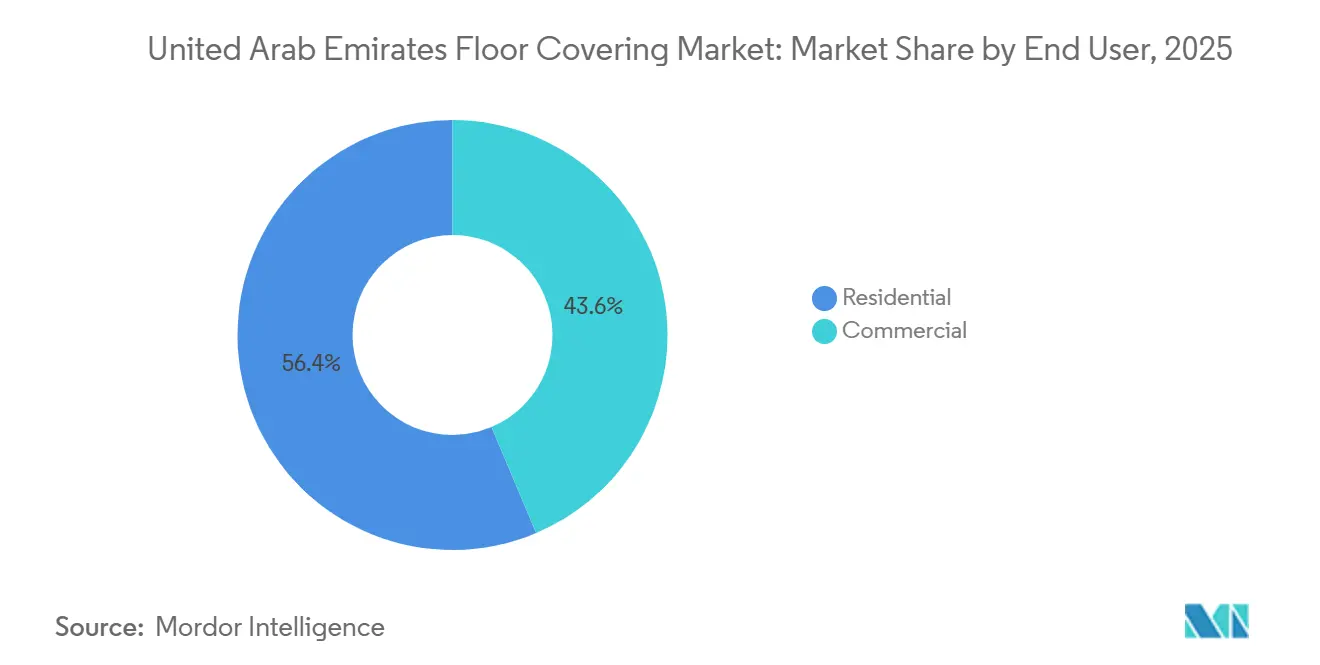
Residential accounted for 56.37% of installations in 2025, consistent with state-backed housing programs, VAT refunds for new homes, and consumer preferences for value-aligned products that meet code and IAQ requirements in the United Arab Emirates floor covering market. Funding flows under the Sheikh Zayed Housing Programme totalled USD 523.22 million (AED 1,922.5 million) in 2024, which kept volume steady and sustained procurement predictability for compliant flooring selections in new units and modifications. Administrative support accelerated handover cycles as 6,971 VAT refund applications were processed by the Federal Tax Authority, which helped to de-bottleneck delivery and installation scheduling in residential projects. This baseline supports consistent throughput in the United Arab Emirates floor covering market across villas and multi-family units when coupled with showroom-driven product selection for finishes. The distribution of spend favors ceramic and resilient alternatives that provide predictable performance under code and warranty conditions for occupied homes.
Commercial is projected to grow at a 9.26% CAGR through 2031, driven by hospitality fit-outs and refurbishments, as well as compute-related facilities that require technical flooring systems in the United Arab Emirates floor covering market. Hotel occupancy and visitor growth in Dubai through H1 2025 support frequent refresh cycles for lobbies and corridors, where resilient surfaces with low VOC profiles and realistic textures meet brand standards for guest experience. In data infrastructure, multi-hundred-megawatt capacity additions announced by Microsoft and G42 for the United Arab Emirates, signalling 2026 readiness, create a distinct demand for modular raised floors designed for high-density cooling and power. This subsegment resides alongside retail and office fit-outs, which prize reconfigurable surfaces that support tenant changes with limited disruption. Together, these drivers diversify commercial flooring demand beyond hospitality and increase the share of specialized systems within the United Arab Emirates floor covering market.
By Distribution Channel: Retail Showrooms Dominate Yet Contractor Direct Gains on Mega-Project Velocity
Retail showrooms handled 63.67% of transactions in 2025, reflecting the role of in-store selection for texture, finish, and acoustic performance in large residential purchases within the United Arab Emirates floor covering market. Domestic brands also integrate retail presence with project channels, leveraging capacity, compliance, and design curation to influence both trade and end-consumer decisions in the United Arab Emirates floor covering market. This model encourages larger ticket sizes that combine floor coverings with adjacent categories, particularly in new-home packages. The result maintains high showroom relevance even as commercial demand accelerates.
Contractors are projected to grow at a 9.87% CAGR as public tenders and hospitality fit-outs compress lead times and tighten specification control in the United Arab Emirates floor covering market. Procurement teams value just-in-time deliveries, certified documentation, and consistent lot quality as they stage materials for multi-building master plans and large hospitality assets. Suppliers with regional inventory and robust certification stacks gain an advantage in contractor-direct frameworks that lock in technical details during design development. Framework agreements and staged delivery arrangements support price certainty and coordination across phases, which strengthens contractor-direct purchasing. This supports a gradual channel shift toward wholesale project execution in the United Arab Emirates floor covering market.
Geography Analysis
Dubai held 36.37% of market revenue in 2025, supported by large hospitality capacity and steady visitor throughput that together sustain frequent refurbishment and expansion cycles in the United Arab Emirates floor covering market. Dubai welcomed 9.88 million overnight visitors in H1 2025 and maintained occupancy above 79%, which kept hotel operators on a consistent upgrade cadence across public areas and guestrooms. The city’s compliance environment complements these cycles, since indoor air quality rules steer product choices toward low-emission solutions that support guest comfort and operational standards. Developers and operators coordinate specifications to balance aesthetic outcomes with durability under high footfall and environmental factors. These conditions set stable foundations for project volume within the UAE floor covering market in Dubai.
Abu Dhabi is projected to post the highest growth at a 10.38% CAGR from 2026 to 2031 as public-sector commitments and sustainability mandates shape a defined pipeline for compliant flooring solutions in the United Arab Emirates floor covering market. The combination of citizen housing support and VAT refund processing for new residences accelerates build-and-handover cycles, which supports consistent demand for compliant surfaces in new communities. Masdar City’s emphasis on Estidama and LEED delivery sets a template for city-scale sustainability requirements that cascade to flooring product specifications. Large cultural and innovation districts replicate these documentation standards for quality and emissions, tightening supplier pools to firms with comprehensive test records. These elements work together to support a durable growth profile for the United Arab Emirates floor covering market in Abu Dhabi.
The rest of the United Arab Emirates includes emirates with targeted tourism and industrial initiatives that broaden the demand profile for floor coverings beyond the two largest markets. Data infrastructure and sovereign cloud capacity expansions announced by G42 and partners strengthen the case for technical flooring systems in free zones and industrial campuses, which adds a specialized component to regional demand. This growth layer complements residential and retail projects that follow local development strategies. Suppliers that maintain compliant inventories and installation readiness across multiple emirates capture these multi-track opportunities in the United Arab Emirates floor covering market. The resulting mosaic makes the regional demand base more resilient than single-sector models. It also supports a distribution footprint aligned with public-sector timelines and regulatory expectations.
Regulatory Landscape
Floor-covering products used in UAE construction are subject to federal product-conformity controls and emirate-level material approval pathways, which shape specification choices, import clearance, and tender eligibility. At the federal level, the Ministry of Industry and Advanced Technology (MoIAT) administers the Emirates Conformity Assessment Scheme (ECAS) and the Emirates Quality Mark (EQM), and regulated products need accredited test reports and conformity certificates.
For project execution, Dubai Municipality runs product conformity assessment and technical approval processes, while Abu Dhabi requirements often route through Department of Municipalities and Transport (DMT) technical approval practices and the Abu Dhabi Quality and Conformity Council (QCC) for applicable conformity programs. Compliance and trade administration also affect landed cost and documentation discipline for imported floor coverings and related installation materials. From August 1, 2025, the UAE moved to a 12-digit Integrated Customs Tariff aligned with GCC harmonization, which increases the need for accurate HS classification for tiles, vinyl (LVT/SPC), wood flooring, carpets, underlays, and adhesives to avoid clearance delays. Imports generally face a standard 5% customs duty on CIF value, while preferential arrangements, such as the India-UAE CEPA for qualifying goods, can change duty outcomes and influence sourcing strategies for distributors and project contractors.
Value Chain Analysis
The UAE floor covering value chain begins with upstream raw materials and semi-finished inputs, including ceramic bodies and glazes, PVC resins and stabilizers for resilient floors, wood and engineered substrates, backing materials, adhesives, and underlays. Manufacturing is anchored by domestic tile capacity, with players such as RAK Ceramics and other local ceramic producers, while the market also relies on imported LVT/SPC and specialty products from Asian and European hubs. Logistics and warehousing are concentrated around major gateways and storage clusters, with Jebel Ali Port acting as a primary entry point for imported flooring and accessories, supported by emirate-level distribution hubs that serve both project and retail channels.
Downstream, demand is fulfilled through a mix of B2C retail showrooms and B2B contractor-led procurement. Many UAE operators run end-to-end models that bundle technical consultation, subfloor preparation, supply, and installation across emirates. In 2026, supply-chain resilience and route optionality have become clearer differentiators, with building-material groups using alternate routes via Oman and the port of Khor Fakkan to manage maritime disruptions and freight-cost volatility, while manufacturers such as RAK Ceramics have emphasized domestic-market focus amid shipping constraints. The most persistent execution bottleneck remains labor and certification availability for specialized installations, including click-lock SPC and modular raised floors, which lifts the value of trained installer networks, QA processes, and predictable on-site scheduling for large hospitality, infrastructure, and data-center packages.
Competitive Landscape
The United Arab Emirates floor covering market features moderate concentration with meaningful roles for domestic manufacturers and international brands that localize supply and compliance. RAK Ceramics anchors local tile supply with extensive installed capacity and disclosed capital programs that include slab production capabilities to serve premium and large-area projects. The company’s project and retail exposure across the United Arab Emirates enables coordinated fulfillment and increases responsiveness to developer schedules in the United Arab Emirates floor covering market. International manufacturers are also bolstering regional access, as evidenced by Tarkett’s JV setup to manufacture rigid LVT in the Gulf, which supports quick-turn resilient offerings and improves control over certification and documentation. Compliance leadership factors into competitive advantage, particularly on large public or hospitality projects that operate under strict IAQ rules. These dynamics maintain room for multiple players across categories in the United Arab Emirates floor covering market.
Strategic moves in 2025 illustrate expansion, integration, and product capability upgrades that align with priority segments. RAK Ceramics increased its capital expenditure and reported steady project and retail momentum while commissioning slab production to serve high-end applications and reduce installation joints. The company’s portfolio breadth supports combined bathroom and flooring packages for project owners, which can simplify procurement in the United Arab Emirates floor covering market. Tarkett’s regional manufacturing plan for rigid LVT synchronizes with the rising adoption of premium resilient formats in hospitality and healthcare across the Gulf. Sustainability-focused building environments in Abu Dhabi and Dubai reward surfacing solutions with validated emissions profiles, which narrows approval lists and favours brands with extensive test libraries. These steps underpin a competitive field that balances scale production, design, and compliance within the United Arab Emirates floor covering market.
Category adjacency and innovation are also visible. RAK Porcelain Group broadened its European presence with a 2025 brand acquisition that leverages related distribution and design ecosystems relevant to premium interior specifications. Local innovators are moving to meet emissions constraints in wood-based subfloors and parquet components, as seen in DesertBoard’s formaldehyde-free certification milestone in 2025. This progress complements the market’s emphasis on compliance for interior surfaces and supports a broader supply base that can answer diverse project needs in the United Arab Emirates floor covering market. Microsoft and G42’s data centre expansion announcement adds a technology-led demand pathway for modular raised-floor systems that rely on specialized suppliers, which further diversifies the competitive canvas. The combined set of moves points to a market in which scale, compliance, and application specialization shape competitive outcomes.
United Arab Emirates Floor Covering Industry Leaders
-
RAK Ceramics
-
Carpet Land
-
AB Gustaf Kahr
-
Emirates Ceramic
-
Terrazzo
- *Disclaimer: Major Players sorted in no particular order
Market Opportunities and Future Outlook
Green-building compliance and documentation-led procurement create a practical opportunity for suppliers that can offer verifiable low-emission and transparent-material portfolios for government and premium private tenders. In Abu Dhabi, the Estidama Pearl Building Rating System (PBRS) under the Department of Municipalities and Transport (DMT) uses a 1 to 5 Pearl scale and places weight on material transparency, supporting demand for Environmental Product Declarations (EPDs) aligned with ISO 14025 and EN 15804. In Dubai, Administrative Resolution No. (154) of 2020 mandates the Al Sa\'fat Green Building System, where the Silver level is the mandatory baseline and raises indoor air quality (IAQ) and low-VOC requirements for interior finishes, favoring suppliers with third-party certifications and strong submittal packages.
Beyond compliance, application demand is expanding in technical and non-traditional flooring categories tied to investment themes already present in the market. Data-center build-outs linked to G42 partnerships, including the November 2025 Microsoft and G42 announcement of an additional 200 MW capacity expansion with commissioning targeted before end-2026, support modular raised-floor systems engineered for dense power and cooling loads, along with installation services requiring tight tolerances and QA. At the same time, hospitality refurbishment and retrofit cycles increase pull-through for fast-turn, durable surfaces such as premium LVT/SPC, while industrial and warehousing activity broadens the need for chemical-resistant, high-durability systems, including epoxy and polyurethane floors, where safety and compliance requirements shape material selection and contractor capability.
Recent Industry Developments
- June 2026: RAK Ceramics signed an exclusive multi-year licensing agreement with Roberto Cavalli to manufacture and distribute branded ceramic tiles, sanitaryware, and faucets across the Middle East and other regions, with UAE flagship showrooms planned for exclusive previews. The collaboration strengthens premium positioning in project and retail channels and supports higher-value specification wins where design differentiation and brand pull influence selection.
- February 2026: Commercial production at its new slab production facility in the UAE commenced by the end of February 2026. Bringing slab output closer to local demand improves lead times for large-format specifications used in hospitality and high-visibility commercial areas, while also increasing control over quality and compliance documentation for tender submittals.
- November 2025: Microsoft and G42 announced an additional 200 MW UAE data center capacity expansion to serve AI and cloud workloads, with commissioning targeted before end-2026. The build program reinforces demand for specialized flooring packages, particularly modular raised-floor systems and related installation services needed to manage cabling, airflow, and heavy rack loads in high-density compute environments.
Research Methodology Framework and Report Scope
Market Definition and Coverage
For this methodology, the UAE floor covering market is defined as the value of materials sold and installed as finished floor surfaces across residential and commercial buildings in the country, covering both contract and retail purchase routes.
Scope exclusions: This sizing excludes floor cleaning chemicals, installation tools and machinery, and other non-covering maintenance services that do not represent the floor covering material value.
Segmentation Overview
- By Product Type
- Carpet & Area Rugs
- Wood Flooring
- Ceramic & Porcelain Tiles
- Laminate Flooring
- Vinyl Flooring (LVT, Sheet, VCT)
- Stone Flooring
- Other Products
- By End User
- Residential
- Commercial
- Hospitality & Leisure
- Retail & Shopping Centers
- Healthcare Facilities
- Education
- Corporate Offices
- Public & Government Buildings
- Other Commercial Users
- By Distribution Channel
- B2C / Retail
- Home Centers
- Specialty Flooring Stores
- Online
- Other Distribution Channels
- B2B / Contractors
- B2C / Retail
- By Region
- Dubai
- Abu Dhabi
- Rest of UAE
Data Sources, Market Sizing, and Validation
Desk Research
Desk research is used to set the UAE demand environment and to make sure the model reflects what is getting built and renovated in practice. We mainly anchor the market context using public construction and trade signals, followed by checks on housing, tourism, and large project pipelines that influence flooring consumption.
Helpful public sources include official construction and macro releases from UAE government entities and local statistical centers, customs and trade portals for import patterns, and building and real estate indicators from organizations such as Dubai Statistics Center, Statistics Centre Abu Dhabi, and the UAE Federal Competitiveness and Statistics Centre. We also refer to industry bodies and standards references, such as ISO publications and relevant building and indoor air quality guidance, as well as peer reviewed materials science and construction journals for product performance trends. For company level reality checks, we use annual reports, investor presentations, and reputable business press, and then supplement gaps with paid subscriptions for company financials and intelligence, patent databases, and shipment level import and export data where it is applicable. This list is not exhaustive, and many other sources were also consulted for data collection, validation, and clarification.
Primary Interviews and Surveys
Primary work is used to confirm what drives spend in the UAE, and where the mix is shifting between tiles, resilient formats, wood look options, and soft coverings. We speak with manufacturers, importers, distributors, contractors, designers, and large buyers across Dubai, Abu Dhabi, and the rest of the country, so assumptions on channel split, project timing, and pricing movement can be adjusted and then rechecked.
Distribution of primary research fieldwork respondents
| Company type | Respondent position |
|---|---|
| Top tier: 35% | CXOs: 15% |
| Mid tier: 49% | Functional/Unit leaders: 40% |
| Smaller Players: 16% | Managers: 45% |
Market-Sizing & Forecasting
Market sizing starts with a top-down build where construction activity and renovation demand in the UAE are translated into a flooring spend pool, and then filtered by typical floor area needs and product adoption by building type. To keep it practical, the model uses a small set of inputs that can be refreshed each year, such as residential handovers and occupied stock, hotel keys and new openings, commercial and public project announcements, import reliance for key categories, and pricing direction by material type.
Those totals are then corroborated using selective bottom-up checks, like sample contractor bill of quantities, distributor channel checks on category mix, and simple volume times average selling price approximations for high-velocity items where price points are reasonably observable. When direct data is thin, especially for smaller retail channels, we use proxy shares based on retailer and installer feedback, and then normalize results so they align with trade and construction signals.
For forecasting, we use scenario analysis supported by a light multivariate regression on construction completions, tourism and hospitality activity, and renovation propensity indicators, then temper the outputs with what experts expect for pricing and product substitution. The final forecast is produced in current USD, with assumptions on inflation and currency timing applied consistently across the series.
Data Validation & Update Cycle
Outputs are checked in multiple steps so unusual jumps do not pass through without explanation. We compare the model against independent signals like category import direction, new project starts, and contractor workload feedback, and then revisit any outliers at the product and channel level before internal review sign-off.
The dataset is refreshed once a year, and interim updates are made when material events occur, such as major regulation changes, a sharp construction cycle shift, or sudden pricing moves in key inputs. Before delivery, a final analyst pass is completed so clients receive the most current view available at the time.
Mordor Intelligence's United Arab Emirates Floor Covering Market Size Measured Against Other Published Estimates
Published estimates for the UAE floor covering market can look far apart because firms do not always count the same things, and they also select different timing for prices and demand. Differences show up quickly when one study tracks only retail sales, while another includes contract supply into new builds and refurbishments.
A common gap driver is scope, where some numbers fold adjacent categories like installation service revenue or broader interior finish packages into flooring, which pushes totals upward. Another driver is how price movement is handled, since ceramic and porcelain tiles, vinyl, and wood look products do not move at the same pace, and aggressive price ramps can lift the value forecast more than real volume growth would suggest. When the model is tied to building handovers, project pipelines, and trade signals, and then corrected through installer and distributor checks, the total tends to stay closer to the addressable demand pool, which is the approach applied by Mordor Intelligence.
Benchmark comparison
| Source | Market Size | Gaps in Research Methodology |
|---|---|---|
| Mordor Intelligence | USD 2.42 B (2025) | |
| Industry Publisher A | USD 4.40 B (2024) | Often presented as a broad flooring figure that may mix in wider interior fit-out spending and may not separate material value from installation and project services, which can raise the total. |
| Regional Consultancy B | USD 4.95 B (2025) | Typically uses a wider product basket and a longer horizon with different price assumptions, where faster assumed ASP growth across categories can inflate value even if underlying renovation and new build volumes are similar. |
The spread across sources is mainly explained by what is counted as flooring and how contract project value is treated versus material-only value. By keeping inclusions tied to finished floor covering materials across retail and contract channels, and by pressure testing pricing and mix with field feedback, the result stays transparent and easier to reproduce when assumptions change.
Key Questions Answered in the Report
What is the size and growth outlook for the United Arab Emirates floor covering market through 2031?
The United Arab Emirates floor covering market size is USD 2.62 billion in 2026 and is projected to reach USD 3.42 billion by 2031 at a 5.51% CAGR, reflecting steady public, hospitality, and data-infrastructure demand.
Which product categories are leading, and which are growing fastest in the United Arab Emirates floor covering market?
Ceramic and porcelain tiles lead with a 37.32% share in 2025, while vinyl formats, including LVT and SPC, are projected to expand at a 9.76% CAGR through 2031.
How is end-user demand split in the United Arab Emirates floor covering market, and where is growth strongest?
Residential accounts for 56.37% of installations in 2025, supported by housing programs and VAT refunds, while commercial is projected to grow fastest at a 9.26% CAGR due to hospitality and data-centre fit-outs.
Which distribution channels are most relevant in the United Arab Emirates floor covering market?
B2C retail showrooms handle 63.67% of transactions for in-person selection, while B2B contractor-direct is projected to grow at a 9.87% CAGR on public and hospitality tenders with tight specification control.
What geographic patterns define demand in the United Arab Emirates floor covering market?
Dubai holds 36.37% of 2025 revenue on the back of tourism throughput and steady refurbishment cycles, while Abu Dhabi is projected to lead growth at a 10.38% CAGR with sustainability-led development.
Which regulations matter most for product selection in the United Arab Emirates floor covering market?
Dubai IAQ guidelines and Abu Dhabi sustainability mandates drive low-emission material selection, favouring flooring with robust certification and documentation across major public and hospitality projects.