
Pyrolysis Oil Market Size and Share
Market Overview
| Study Period | 2025 - 2031 |
|---|---|
| Market Size (2026) | USD 1.75 Billion |
| Market Size (2031) | USD 3.68 Billion |
| Growth Rate (2026 - 2031) | 16.04 % |
| Fastest Growing Market | Asia Pacific |
| Largest Market | Europe |
| Market Concentration | Medium |
Major Players *Disclaimer: Major Players sorted in no particular order Image © Mordor Intelligence. Reuse requires attribution under CC BY 4.0. | |
Pyrolysis Oil Market Analysis by Mordor Intelligence
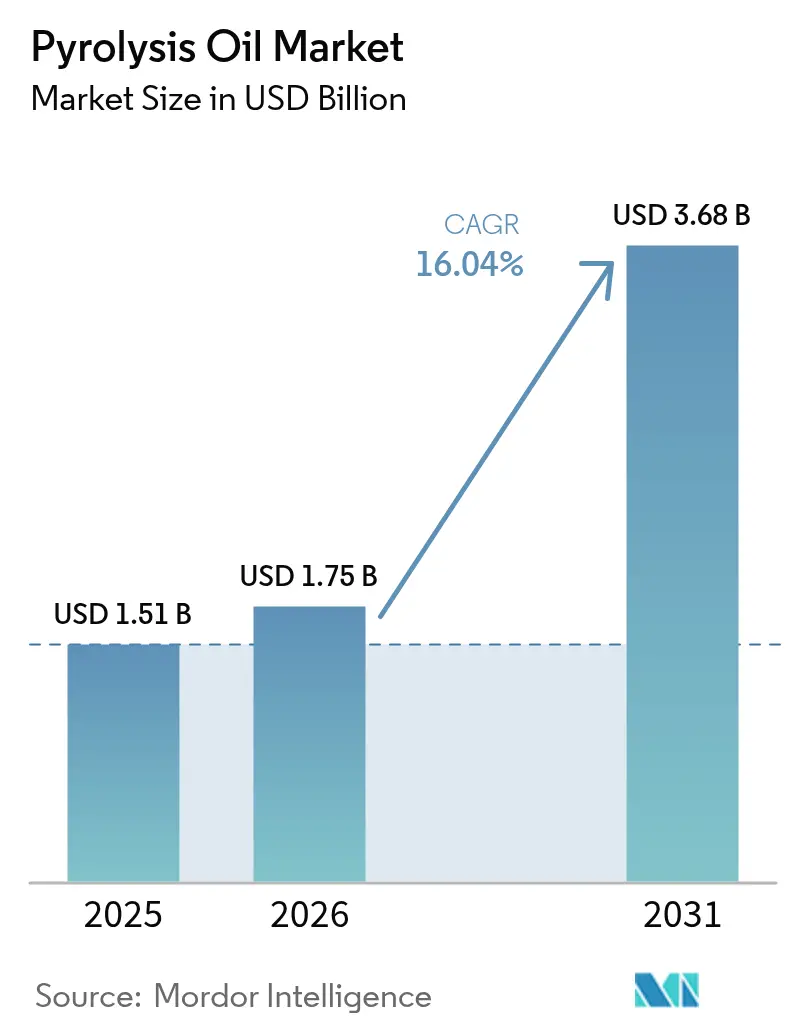
The Pyrolysis Oil Market size is expected to grow from USD 1.51 billion in 2025 to USD 1.75 billion in 2026 and is forecast to reach USD 3.68 billion by 2031 at 16.04% CAGR over 2026-2031. Heightened plastic-waste regulations, circular-economy mandates and refinery co-processing breakthroughs together accelerate demand, while generous carbon-credit schemes improve plant economics. Strategic funding from Europe’s Innovation Fund and Japan’s NEDO program underpins capacity additions that shift the competitive balance toward regions with supportive policy ecosystems. Producers pursue vertical integration with refiners to reduce capital outlays and secure guaranteed offtake, and technology licensors are racing to commercialize microwave-assisted or supercritical routes that improve yield and cut emissions. At the same time, contaminant management, particularly for polycyclic aromatic hydrocarbons, remains the key operational hurdle as specification-driven customers tighten acceptance limits.
Key Report Takeaways
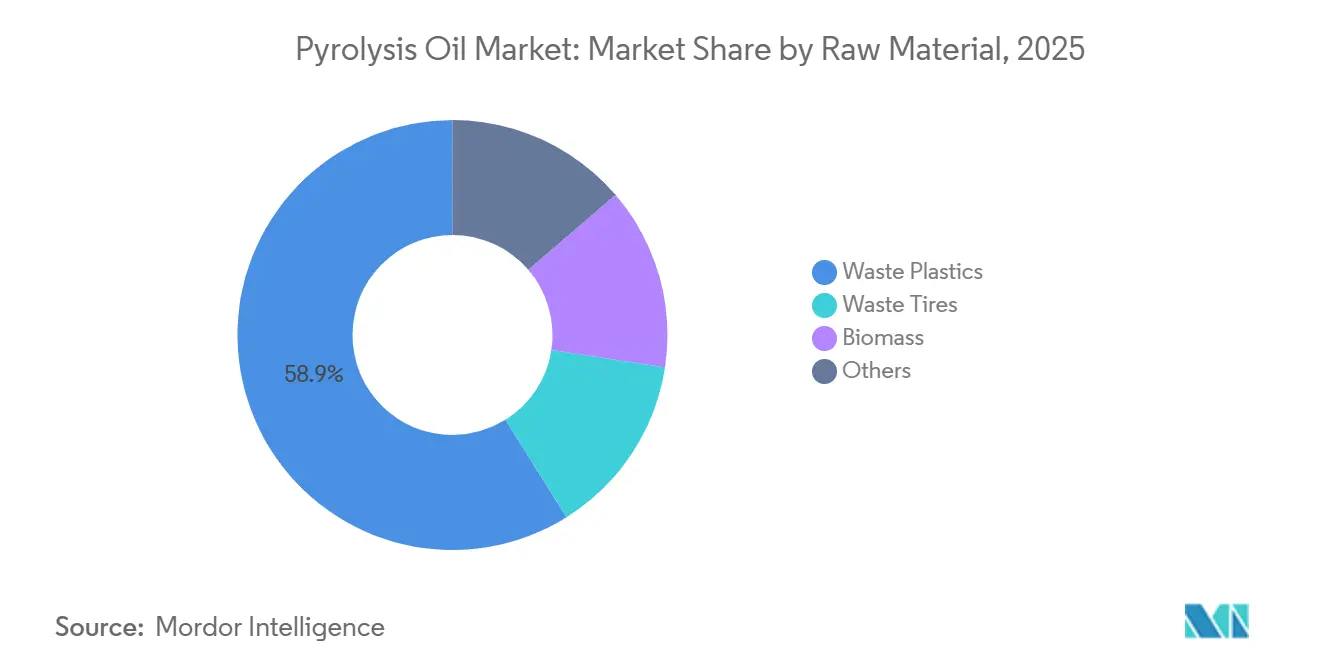
- By raw material, waste plastics captured 58.90% pyrolysis oil market share in 2025 and are expanding at a 16.76% CAGR through 2031.
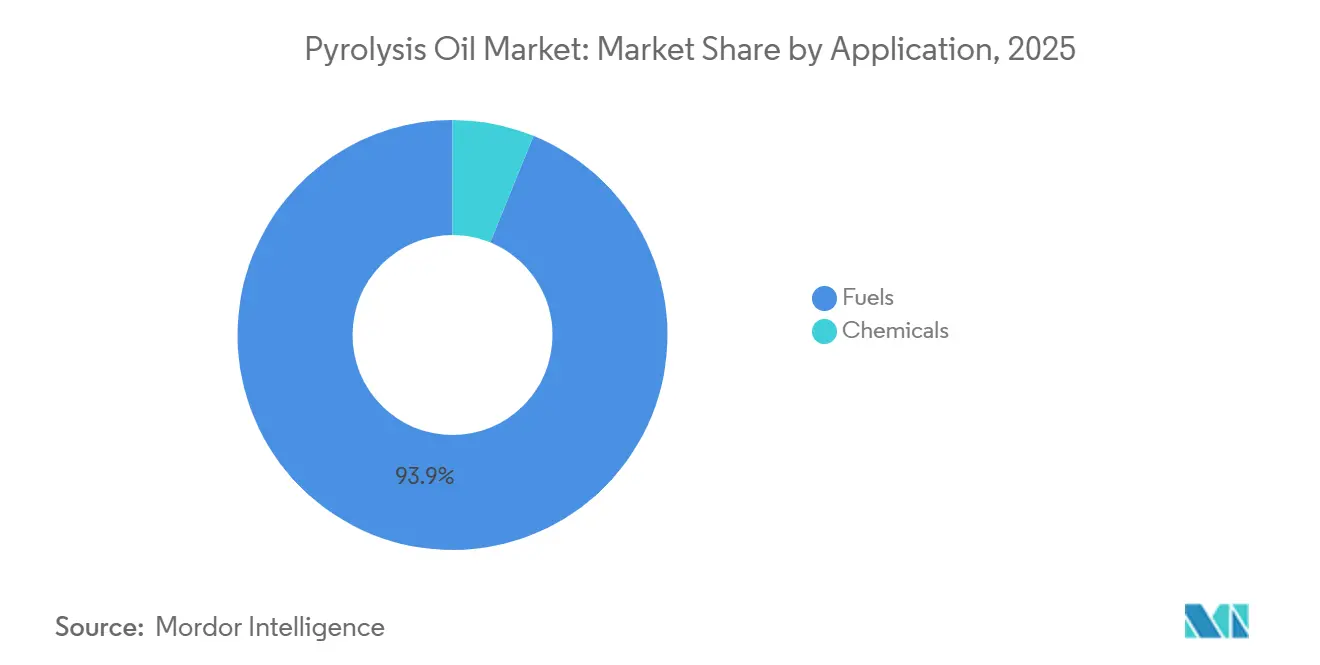
- By application, fuels controlled 93.85% of the pyrolysis oil market size in 2025 and will advance at a 16.22% CAGR through 2031.
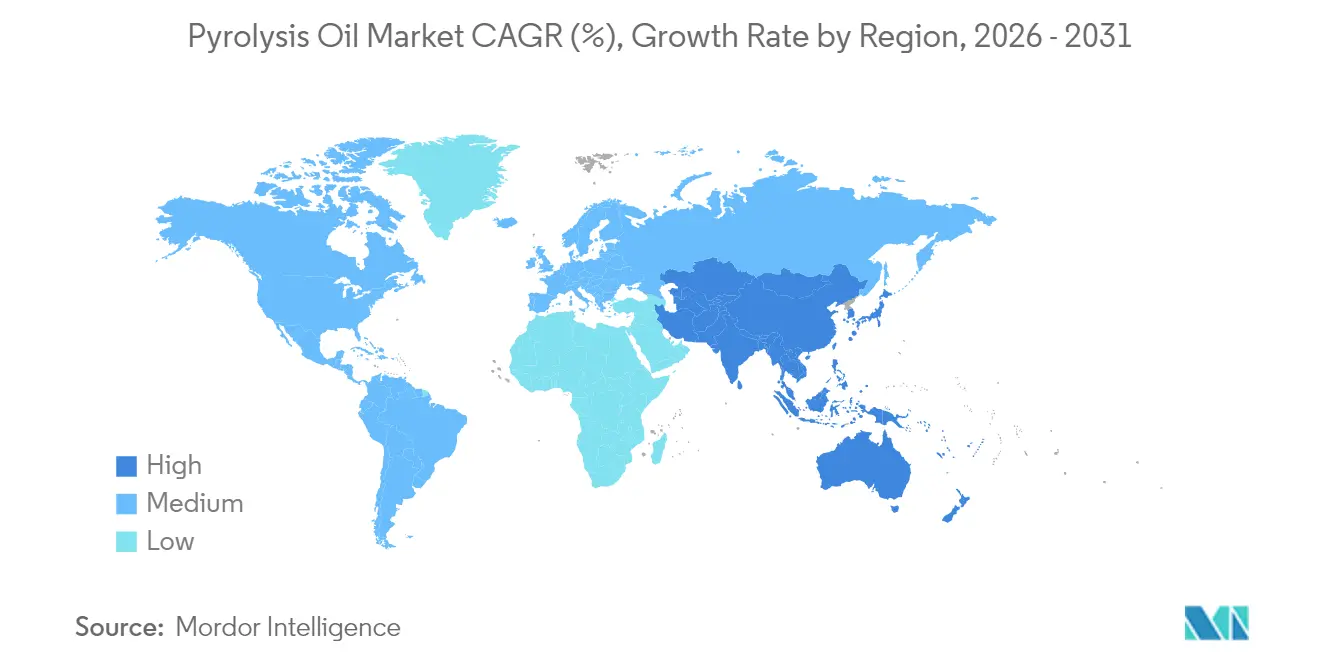
- By geography, Europe led with 33.70% revenue share in 2025; Asia-Pacific is poised for the fastest 17.70% CAGR to 2031.
Note: Market size and forecast figures in this report are generated using Mordor Intelligence’s proprietary estimation framework, updated with the latest available data and insights as of 2026.
Market Trends and Insights
Drivers Impact Analysis of Pyrolysis Oil Market*
| Drivers | (~) % Impact on CAGR Forecast | Geographic Relevance | Impact Timeline |
|---|---|---|---|
| Rising demand for renewable and circular fuel substitutes | +4.2% | Global, with early adoption in EU and California | Medium term (2-4 years) |
| Stricter plastic-waste regulations and bans worldwide | +3.8% | EU, North America, Asia-Pacific core markets | Short term (≤ 2 years) |
| Rising chemical-recycling investment pipelines | +3.1% | North America and EU, spill-over to APAC | Medium term (2-4 years) |
| FCC/hydro-processing co-feeding lowers refinery CAPEX | +2.7% | Global refining hubs, concentrated in Gulf Coast and Rotterdam | Long term (≥ 4 years) |
| Carbon-credit monetisation for low-carbon pyrolysis oil | +2.9% | California, Canada, EU markets with established LCFS frameworks | Short term (≤ 2 years) |
| Source: Mordor Intelligence | |||


Rising Demand for Renewable and Circular Fuel Substitutes
California’s Low Carbon Fuel Standard now targets a 30% carbon-intensity cut by 2030, issuing high-value credits that make waste-derived pyrolysis oil competitive with petroleum inputs[1]California Air Resources Board, “LCFS Data Dashboard,” arb.ca.gov. Canada’s Clean Fuel Regulations set a 15% reduction goal and earmark USD 1.5 billion for domestic production, reinforcing North American demand. In parallel, Japan’s plastics resource-circulation strategy and U.S. sustainable aviation-fuel tax credits position pyrolysis oil as a qualifying feedstock with direct financial upside. Together these measures transform waste oil from an environmental liability into a compliance-grade decarbonization commodity.
Stricter Plastic-Waste Regulations and Bans Worldwide
Europe’s mandate for 100% recyclable packaging by 2030 and China’s push to recycle 4 billion tons of bulk solid waste by 2025 sharply raise demand for processing routes beyond mechanical recycling. Canada’s Federal Plastics Registry, effective September 2025, adds transparent feedstock tracking that favors advanced facilities capable of quality certification. Indonesia’s 30% waste-reduction target further broadens the raw-material pool. These regulatory forces provide predictable long-term feedstock streams and catalyze investments in high-efficiency thermal decomposition.
FCC/Hydro-Processing Co-Feeding Lowers Refinery CAPEX
Shell’s Singapore upgrader integrates pyrolysis oil directly with existing cracking units, sidestepping greenfield plant costs. The global shift toward crude-to-chemical complexes unlocks natural feedstock entry points, while ENEOS and Mitsubishi Chemical demonstrated commercial-scale co-processing via supercritical hydrothermal decomposition in Ibaraki. Such integration extends asset life, maximizes throughput and offers refiners an immediate low-carbon option.
Carbon-Credit Monetization for Low-Carbon Pyrolysis Oil
Under California’s LCFS, credit price escalation clauses tighten benchmarks and raise upside for low-intensity producers. Canada’s framework similarly links credits to hydrogen and advanced biofuels, broadening eligibility[2]Natural Resources Canada, “Policy Ecosystem,” nrcan.gc.ca. Emerging sustainable aviation-fuel pathways register 41-89% emission cuts, further validating waste-oil feedstocks for premium credit generation. Carbon revenue now forms a core line item in project financial models, quickening payback.
Restraints Impact Analysis of Pyrolysis Oil Market*
| Restraints | (~) % Impact on CAGR Forecast | Geographic Relevance | Impact Timeline |
|---|---|---|---|
| Corrosivity and instability during storage/transport | -2.8% | Global, with acute challenges in humid climates | Short term (≤ 2 years) |
| High CAPEX and scale-up execution risk | -3.4% | Emerging markets and first-time deployers globally | Medium term (2-4 years) |
| PAH/contaminant concerns triggering regulatory delays | -2.1% | EU and North America with stringent environmental standards | Long term (≥ 4 years) |
| Source: Mordor Intelligence | |||
Corrosivity and Instability During Storage/Transport
Tire-derived oils often contain more than 10% polycyclic aromatic hydrocarbons such as benzo[a]pyrene, requiring stainless or lined tanks and inert-gas blanketing, which inflate logistics costs. Mixed-plastic oils exhibit elevated sulfur, oxygen and chloride levels that foul refinery catalysts unless pre-treated. Ongoing post-production reactions alter viscosity and acidity during long-haul shipment, demanding stabilizers and temperature control. These technical complications restrict cross-border trade and limit standardization, slowing global adoption.
PAH/Contaminant Concerns Triggering Regulatory Delays
EPA regulation 40 CFR 721.10939 sets strict exposure limits for benzene and naphthalene in pyrolyzed products, compelling expensive monitoring and worker-protection protocols. Canada’s decision to list coal tars and related distillates as toxic escalates classification risk for high-aromatic oils. Divergent state-level standards in the U.S. further muddy compliance pathways, causing permitting timelines to lengthen and adding cost buffers to project budgets.
*Our forecasts treat driver/restraint impacts as directional, not additive. The impact forecasts reflect baseline growth, mix effects, and variable interactions.
Pyrolysis Oil Market Segment Analysis
By Raw Material:
Waste Plastics Dominate Capacity Build-OutWaste plastics held 58.90% of the pyrolysis oil market share in 2025, and the segment is tracking a 16.76% CAGR through 2031. The pyrolysis oil market size attributable to waste-plastic feedstock is projected to rise in tandem as global plastic waste exceeds 380 million t y while mechanical recycling stalls below 10% recovery.
Advances in mixed-plastic processing, such as Resonac’s more than or equal to 60% yield technology and synergistic co-pyrolysis of polypropylene with biomass, simplify feed preparation and cut sorting costs. Tire waste, the second-largest input group, benefits from well-organized collection but suffers from higher PAH contamination that commands price discounts. Biomass streams face oxygen-removal challenges that require costly hydrotreatment, limiting immediate scale-up. As regulators tighten chloride and sulfur limits for refinery feed, demand is rising for high-purity plastic oils, creating a premium segment within overall feedstock markets.


By Application:
Fuels Retain the Economic Upper HandFuels commanded 93.85% of 2025 revenue and will maintain leadership at a 16.22% CAGR to 2031, keeping the pyrolysis oil market aligned with legacy refinery value chains. Bench trials show HDPE- and PP-derived oils match diesel brake-thermal efficiency, while PS oils trend toward gasoline-range volatility, widening the product slate.
Sustainable aviation fuel is emerging as the fastest-growing subapplication as life-cycle studies report 41-89% emission savings, unlocking federal tax credits and airline offtake agreements. Chemical-grade oil currently represents only 6.85% of demand, yet high-value pathways are multiplying. BioBTX is spending EUR 80 million on a Groningen plant that will convert 20 000 tons per year waste plastic into benzene, toluene and xylene, signaling premium-aromatics potential
Geography Analysis
Europe Pyrolysis Oil Market
Europe accounted for 33.70% of global sales in 2025, underpinned by policy clarity and dedicated funding streams. The region hosts LyondellBasell’s 50,000 tons per year Wesseling unit and OMV’s 16,000 tons per year ReOil plant, both demonstrating scalable output with lower carbon footprints versus incineration.
APAC Pyrolysis Oil Market
Asia-Pacific is the fastest-growing market at a 17.70% CAGR, fueled by Japan’s NEDO funding, China’s 4 billion-t waste-utilization target and breakthrough projects such as ENEOS-Mitsubishi Chemical’s hydrothermal plant in Ibaraki. Southeast Asia is following suit, with Indonesian partners JGC and Marubeni evaluating modular Pyro-Blue systems to tackle rising marine-plastic inflows.
North America Pyrolysis Oil Market
North America shows accelerating potential through long-term offtake contracts and robust LCFS credit structures. Dow’s supply deal with Freepoint anchors a 180,000 tons per year Arizona complex, and NOVA Chemicals will add 66,000 tons per year of capacity in Ontario using Plastic Energy’s Tacoil process, supporting its 30% recycled content pledge by 2030.

Regulatory Landscape
Policy support for pyrolysis oil is increasingly tied to how it is classified under waste, fuels, and chemical-recycling definitions, along with traceability and sustainability schemes that affect market access. In the United States, the EPA proposed in March 2026 to remove pyrolysis units from the Clean Air Act definition of Other Solid Waste Incinerators, and the public comment period closed in May 2026. This regulatory process can materially affect permitting pathways for plastic-to-oil facilities.
In Europe, member states use EU TRIS notifications to set national end-of-waste criteria, helping determine when plastic pyrolysis oil can be treated as a product rather than a waste, which in turn shapes cross-border shipment and refinery acceptance. ASTM D7544 specifies quality requirements for pyrolysis liquid biofuel from biomass, China applies GB/T 40009-2021 for waste tire and rubber pyrolysis oil specifications, and ISCC PLUS certification is used to validate sustainability and mass-balance claims for waste- and residue-derived pyrolysis oil under frameworks aligned with EU directives.
Value Chain Analysis
The value chain starts with feedstock sourcing (post-consumer plastics, end-of-life tires, biomass residues) and collection, then moves through sorting and pre-treatment to reduce halogens, metals, moisture, and inerts. Core conversion occurs in pyrolysis units producing crude pyrolysis oil, gases, and char, and upgrading steps (filtration, dechlorination, distillation or fractionation, and hydrotreatment) are often required to meet refinery and steam cracker impurity limits. Co-processing in refinery units is a key integration point, since it reduces the need for standalone finishing assets, but it also increases the need for consistent feed quality and contaminant management.
Downstream offtake typically runs through refiners and petrochemical producers that can blend or co-feed upgraded oil into crackers, FCC, or hydroprocessing units, while fuels and industrial burners remain important outlets where specifications allow. Bottlenecks cluster around variable feedstock composition, logistics for hazardous or unstable liquids, and the capital intensity of upgrading units. Projects increasingly manage these risks through long-term offtake and supply agreements and by pursuing vertical integration with petrochemical partners. Pilot and plant actions reflect this shift: Clariant demonstrated upgrading using HDMax catalysts with Borealis and SINTEF to produce cracker-compatible feedstock (March 2026), Neste commissioned an upgrading facility at Porvoo (March 2026), and TotalEnergies launched an advanced plastics recycling plant at Grandpuits with 15,000 tons per year capacity (March 2026), reinforcing upgrading and integrated offtake as core chain requirements.
Competitive Landscape
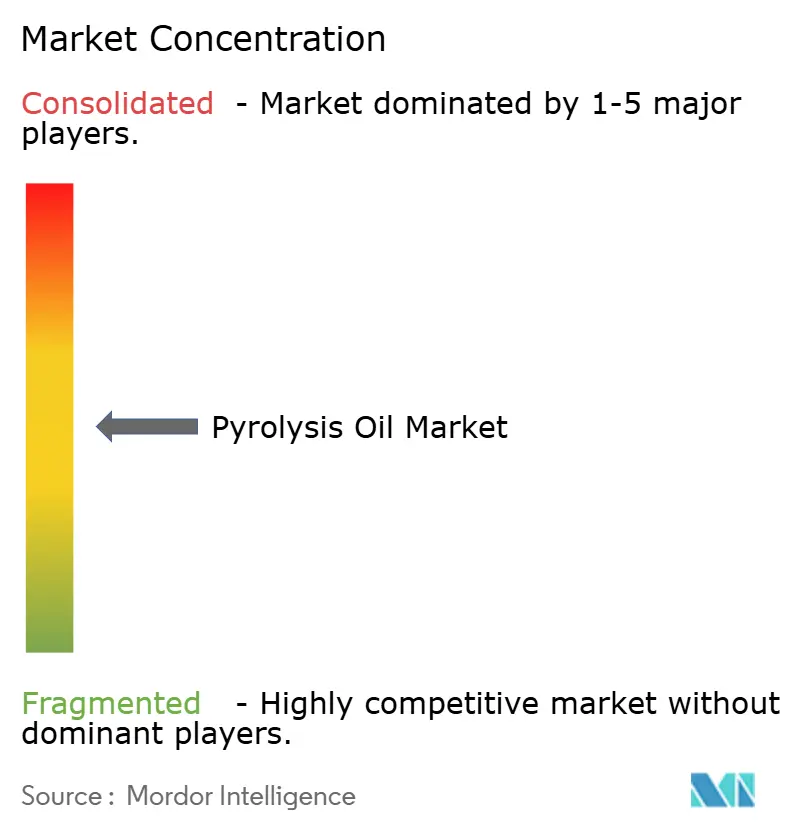
The pyrolysis oil market is moderately fragmented yet trending toward consolidation as petrochemical majors acquire or partner with technology specialists. Technology differentiation is sharpening competitive edges. Lummus-Resynergi microwave reactors promise more than 30% energy savings and rapid modular installation, attracting USD 18 million for pilot clusters. Patent filings reveal focus on continuous hydrocracking and dual-reactor schemes to handle variable feed quality. Licensing revenue streams are rising as independent developers lacking downstream outlets prefer royalty models over greenfield builds, further shaping consolidation trajectories.
Pyrolysis Oil Industry Leaders
Alterra Energy, LLC
BTG Bioliquids (Green Fuel Nordic Oy)
Nexus Circular
Plastic Energy
Viridor Limited
- *Disclaimer: Major Players sorted in no particular order
Pyrolysis Oil Market Companies Covered in this Report
- Agilyx
- Alterra Energy, LLC
- Arbios Biotech
- Bioenergy AE Côte-Nord
- BTG Bioliquids (Green Fuel Nordic Oy)
- Kerry Group plc
- New Energy Kft.
- New Hope Energy
- Nexus Circular
- Plastic Energy
- Pyrocell (Setra)
- Scandinavian Enviro Systems AB
- Trident Fuels pty ltd
- Twence
- Viridor Limited

Market Opportunities and Future Outlook
A near-term opportunity is in converting more pyrolysis oil volumes into specification-compliant refinery and steam-cracker feed, where acceptance depends on halogen, oxygenate, sulfur, and metals control. The market is responding with dedicated upgrading and validation steps that go beyond pilot claims. Neste commissioned an upgrading facility at its Porvoo refinery in March 2026 to integrate liquefied waste plastic into chemicals production, and Clariant, Borealis, and SINTEF reported a pilot demonstration in March 2026 producing steam cracker-compatible feedstock using catalyst-based upgrading. These actions create whitespace for pretreatment, stabilization additives, analytical testing, and modular upgrading packages that can be deployed close to fragmented waste-sourcing regions.
Tire-derived pyrolysis oil (TPO) provides another addressable lane where regulatory recognition and certification can improve bankability and broaden end uses. France formally recognized TPO as a chemical industry raw material in January 2026, and Pyrum Innovations received ISCC EU certification for thermolysis oil in March 2026, enabling pathways linked to EU biofuels and mass-balance claims. Industrial-scale capacity moves in Asia also underline the need for standardized product quality, logistics solutions, and offtake structures that reduce exposure to PAH-related constraints and classification risk, including Niutech breaking ground on a 100,000 TPY tire pyrolysis expansion project (April 2026) and Hi-Green Carbon commencing operations at a 100 TPD tire pyrolysis plant in Dhar, Madhya Pradesh (May 2026).
Recent Industry Developments in Pyrolysis Oil Market
- June 2026: Alterra, Technip Energies, and Neste launched Nerea, a standardized modular solution for chemical recycling of plastic waste. The offering targets repeatable plant designs instead of bespoke engineering, which can shorten front-end timelines and improve bankability for pyrolysis oil projects. Standardization also helps align equipment, QA/QC, and integration requirements for refinery and petrochemical offtakers.
- October 2025: Houston American Energy Corp. and BTG Bioliquids executed a binding term sheet to develop biomass-to-liquid and sustainable aviation fuel projects in Texas using BTG fast pyrolysis technology. The move links fast-pyrolysis oil production to downstream upgrading and aviation-fuel demand, expanding the addressable outlet beyond industrial heat and blending. It also signals rising interest in pairing pyrolysis platforms with long-term project development structures in North America.
- April 2024: Neste completed its first processing run of tire-derived pyrolysis oil, producing chemical feedstock for plastics. The run demonstrated co-processing feasibility for a challenging, high-contaminant stream, supporting broader offtake discussions for TPO in petrochemical value chains. It also underscored the importance of upgrading and specification control to access premium chemical applications.


Pyrolysis Oil Market Report Scope and Research Methodology
Market Definition and Coverage
For this methodology, the pyrolysis oil market covers the revenues generated from selling liquid oil produced via pyrolysis of waste or biomass feedstocks, including material used as a fuel blendstock and as a chemical feedstock.
Scope exclusions: It excludes pyrolysis gas and char revenues, equipment and plant construction EPC value, and any downstream refining margin after the oil is further upgraded.
Segments Covered in This Report
- By Raw Material
- Waste Plastics
- Waste Tires
- Biomass
- Others
- By Application
- Fuels
- Chemicals
- By Geography
- Asia-Pacific
- China
- India
- Japan
- South Korea
- Malaysia
- Thailand
- Indonesia
- Vietnam
- Rest of Asia-Pacific
- North America
- United States
- Canada
- Mexico
- Europe
- Germany
- United Kingdom
- France
- Italy
- Spain
- Nordic Countries
- Turkey
- Russia
- Rest of Europe
- South America
- Brazil
- Argentina
- Colombia
- Rest of South America
- Middle-East and Africa
- Saudi Arabia
- South Africa
- Nigeria
- Qatar
- Egypt
- United Arab Emirates
- Morocco
- Rest of Middle-East and Africa
- Asia-Pacific
Data Sources, Market Sizing, and Validation
Desk Research
Desk work starts by setting the physical and policy context around feedstock availability and end-use pull. We referenced public sources such as national energy statistics and balances (for fuel mix and consumption), environmental agency publications on waste generation and management, customs trade data where relevant to fuel oils, and standards and regulatory notes that influence blending and emissions compliance. We also reviewed peer-reviewed papers that report typical yields by feedstock type and process conditions so the model stays realistic.
To ground company and project activity, we used annual reports, investor decks, permitting announcements, and reputable industry press to identify capacity additions, commissioning timing, and typical product slate. In parallel, approved paid subscriptions were used selectively for company financials and intelligence, patent databases, and import and export shipment-level signals when public disclosures were thin. The desk sources listed here are illustrative only, and many other public references were checked to validate, clarify, and cross-check data points.
Primary Interviews and Surveys
Primary work focused on speaking with technology providers, plant operators, feedstock aggregators, fuel blenders, and chemical off-takers across major regions so we could test assumptions that are hard to read from public data. Inputs gathered included typical yield ranges, uptime expectations after commissioning, realized pricing versus benchmarks, and the share of output that is actually sold into fuels versus chemicals, which then tightened the market model.
Distribution of primary research fieldwork respondents
| Company type | Respondent position | Region |
|---|---|---|
| Top tier: 28% | CXOs: 12% | APAC: 39% |
| Mid tier: 56% | Functional/Unit leaders: 31% | EMEA: 34% |
| Smaller Players: 16% | Managers: 57% | Americas: 27% |
Market-Sizing & Forecasting
Sizing was built using a top-down approach where feedstock pools and conversion rates are used to reconstruct producible pyrolysis oil volumes, which are then translated into value using observed price ranges by application. The output is then checked with selective bottom-up approximations like sampled plant capacity times utilization, channel checks on typical sales volumes, and simple ASP times volume math from interview ranges, and then adjusted if the two views drift.
A few inputs that matter in this market, and were explicitly modeled, include available waste plastic and tire volumes, effective collection rates, pyrolysis oil yield by feedstock, average operating days and uptime after start-up, and the split of output sold into fuels versus chemical feedstock use. Price assumptions were kept practical by using a range-based progression (not a straight-line increase), and by separating low-grade fuel use from higher-value chemical use where interview feedback supported it.
For forecasting, scenario analysis was applied around plant commissioning pace and sustainable feedstock access, and then the chosen base case was stress-tested with short time-series smoothing on energy prices and waste handling trends where consistent public data exists. Where bottom-up signals had gaps, conservative utilization and ramp-up curves were applied rather than assuming nameplate capacity gets monetized immediately, which helped keep our numbers explainable on a client call.
Data Validation & Update Cycle
Outputs are validated through multiple checks so unusual jumps can be explained with real-world triggers. We compare implied volumes and value per ton against yield math, reported capacity moves, and known constraints like feedstock availability and permitting timelines, and then we re-check any outliers at the country and regional level.
Before sign-off, the model and assumptions go through step-by-step analyst review, followed by targeted re-contacts when a major variance shows up between desk signals and interview feedback. Reports are refreshed annually, and interim updates are made when material events occur such as policy shifts, large plant start-ups, or sudden pricing dislocations. Right before delivery, a final pass is run so clients receive the most current view that can be traced back to stated inputs.
Mordor Intelligence's Pyrolysis Oil Market Size Measured Against Other Published Estimates
Published market sizes for pyrolysis oil often do not line up because groups treat the product differently and they also rely on different real-world signals. Differences usually come from whether the work counts only sold pyrolysis oil revenue or also adds adjacent value pools, plus how quickly new plants are assumed to ramp.
The main gap comes from whether upgraded products and downstream refining value are bundled into the number, where Mordor Intelligence counts pyrolysis oil only when it is sold as an output from pyrolysis and then prices it by end-use (fuel versus chemical) using ramp-up and uptime checks.
Benchmark comparison
| Source | Market Size | Gaps in Research Methodology |
|---|---|---|
| Mordor Intelligence | USD 1.75 B (2026) | |
| Industry Research Publisher A | USD 1.81 B (2024) | Uses an earlier base year and a slower growth path, and the scope appears to include broader process and end-use framing, which can mix mature fuel oil pricing with higher-value chemical assumptions without consistently separating them. |
| Global Research Publisher B | USD 0.55 B (2024) | Looks materially smaller because it likely applies tighter inclusion rules around commercial-scale sales and may treat a portion of pilot and early ramp volumes as out of market, which reduces the starting value even if the long-term CAGR is high. |
The table shows that the spread is mostly explained by scope and ramp-rate choices, not by arithmetic. When the counted revenue is limited to pyrolysis oil sales and the volume is linked back to feedstock availability, realistic yields, and commissioning ramp curves, the market total stays transparent and easier to re-check as new plants come online.


Key Questions Answered in the Report
What is the current value of the pyrolysis oil market?
The market stands at USD 1.75 billion in 2026 and is forecast to climb to USD 3.68 billion by 2031.
Which raw material contributes most to pyrolysis oil production?
Waste plastics account for 58.90% of 2025 volume and show the fastest 16.76% CAGR through 2031.
Why are fuels the dominant application?
Established refinery integration allows 93.85% of output to enter fuel streams, offering immediate commercialization with minimal new infrastructure.
Which region is growing fastest?
Asia-Pacific leads with a projected 17.70% CAGR thanks to major Japanese and Chinese funding programs.
How do carbon-credit schemes affect project economics?
Credits from frameworks like California's LCFS can add double-digit return enhancements, shortening payback periods for compliant plants.
What is the main technical hurdle for wide adoption?
Managing PAH contamination and ensuring storage stability remain key challenges that raise operating costs and slow permitting.
Page last updated on:


 Your data is secure and never sold or shared.


