
UAE Event Management Market Size and Share
Market Overview
| Study Period | 2020 - 2031 |
|---|---|
| Forecast Data Period | 2026 - 2031 |
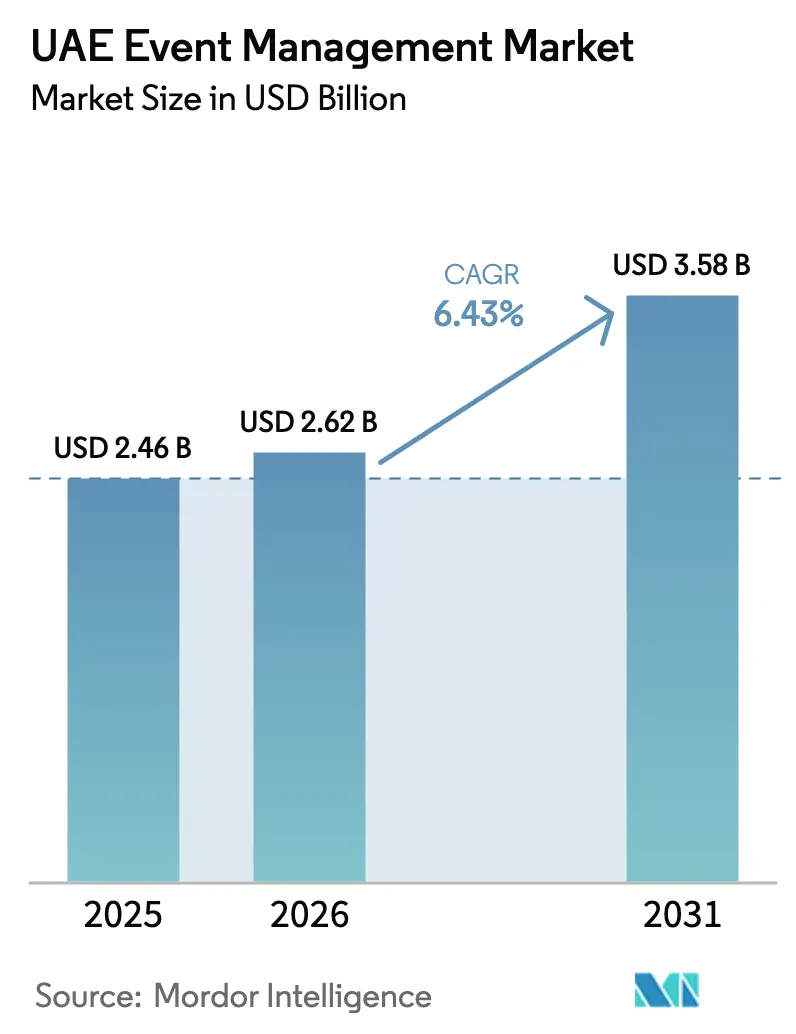
| Base Year Market Size (2025) | USD 2.46 Billion |
| Market Size (2026) | USD 2.62 Billion |
| Market Size (2031) | USD 3.58 Billion |
| Growth Rate (2026 - 2031) | 6.43 % |
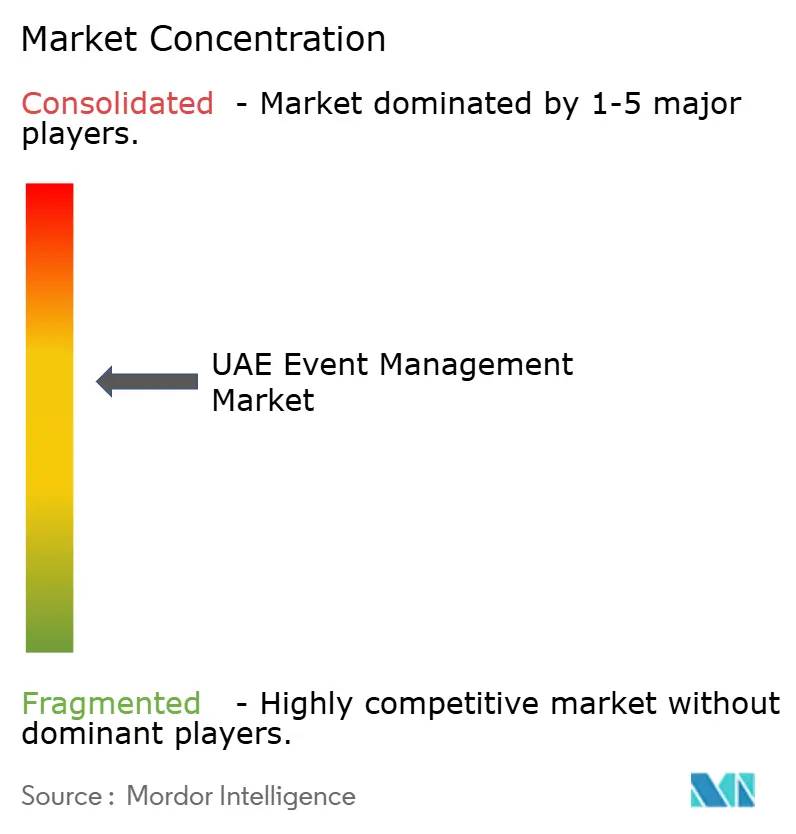
| Market Concentration | Medium |
Major Players *Disclaimer: Major Players sorted in no particular order Image © Mordor Intelligence. Reuse requires attribution under CC BY 4.0. | |
UAE Event Management Market Analysis by Mordor Intelligence
The UAE event management market size in 2026 is estimated at USD 2.62 billion, growing from 2025 value of USD 2.46 billion with 2031 projections showing USD 3.58 billion, growing at 6.43% CAGR over 2026-2031. Growth derives from Dubai’s sustained infrastructure spending, Expo-legacy venue reuse, and nationwide tourism initiatives aimed at lifting travel and meetings demand. Corporate marketers are raising experiential budgets, public entities are deploying events as policy tools, and international leisure arrivals continue to climb—together creating dependable year-round audiences. Venue operators are installing artificial-intelligence building controls, 5G connectivity, and hybrid-event platforms that lower production costs while broadening reach. Consolidation among regional champions and the entry of large global players elevate competitive intensity but also accelerate professionalism and service breadth. Ticketing still anchors revenue, yet sponsorship and premium experiences are scaling quickly as organizers pursue margin resilience in volatile macro conditions.
Key Report Takeaways
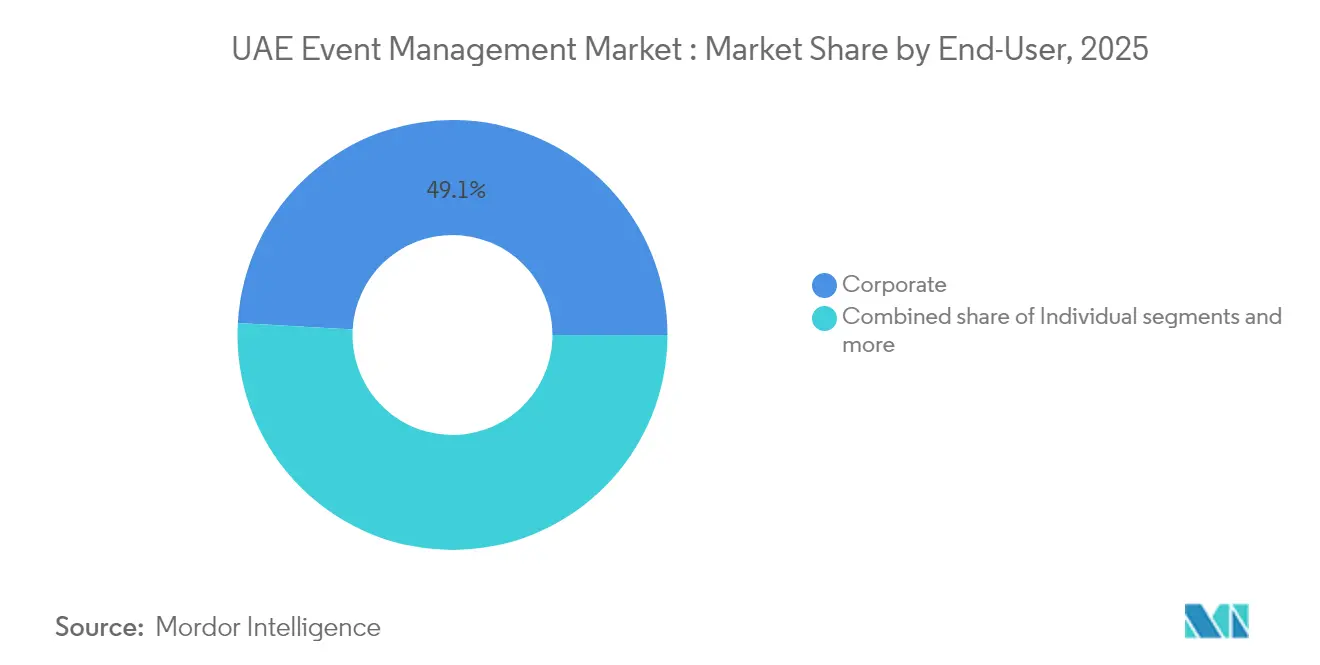
- By end-user, corporate accounted for 49.12% of the UAE event management market share in 2025, while the public segment is projected to grow at the fastest CAGR of 13.18% between 2026 and 2031.
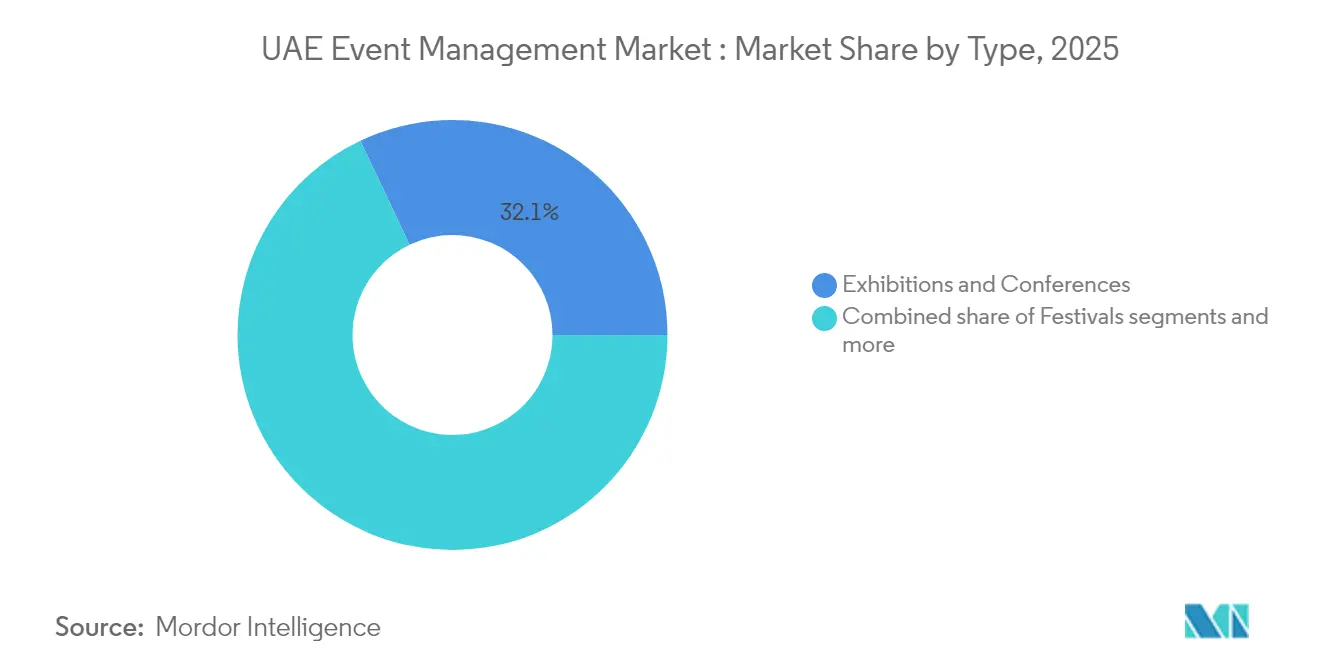
- By type, exhibitions & conferences captured 32.05% of the UAE event management market share in 2025, whereas music concerts are forecast to expand at a CAGR of 16.05% over 2026–2031.
- By revenue source, ticket sales represented 63.14% of the UAE event management market share in 2025, while sponsorships is expected to post a growth rate of 13.79% CAGR from 2026 to 2031.
- By geography, Dubai led with 55.02% of the UAE event management market share in 2025, while Ras Al Khaimah is anticipated to witness the highest growth rate at 14.72% CAGR during 2026–2031.
Note: Market size and forecast figures in this report are generated using Mordor Intelligence’s proprietary estimation framework, updated with the latest available data and insights as of 2026.
UAE Event Management Market Trends and Insights
Drivers Impact Analysis*
| Driver | (~) % Impact on CAGR Forecast | Geographic Relevance | Impact Timeline |
|---|---|---|---|
| Government tourism-led MICE push | +1.8% | UAE-wide, strongest in Dubai and Abu Dhabi | Medium term (2-4 years) |
| Rising corporate marketing budgets | +1.5% | Dubai core, spill-over to Abu Dhabi | Short term (≤ 2 years) |
| Growth in international leisure visitors | +1.2% | Global, early gains in Dubai, Abu Dhabi, Ras Al Khaimah | Medium term (2-4 years) |
| Expo-legacy venue infrastructure | +1.0% | Dubai South, District 2020 focus | Long term (≥ 4 years) |
| Year-round indoor, climate-controlled venues | +0.8% | UAE-wide, particularly northern emirates | Medium term (2-4 years) |
| UAE e-visa automation for event visitors | +0.5% | Global, benefiting all emirates | Short term (≤ 2 years) |
| Source: Mordor Intelligence | |||
Government Tourism-Led MICE Push
Coordinated federal and emirate-level tourism policies are turning opportunistic event hosting into strategic destination marketing. Dubai Business Events secured 437 international bids in 2024, expected to attract more than 210,500 delegates[1]. Abu Dhabi launched Business Events Week to reinforce its MICE credentials. Nationally, the Emirates Tourism Council targets AED 450 billion (USD 122.5 billion) tourism GDP by 2031, up from AED 220 billion (USD 59.8 billion) in 2023. Public-sector capital spending on travel and tourism infrastructure is set to climb 11% annually to USD 20.3 billion by 2027. The multi-entry five-year tourist visa, introduced in 2021, streamlines repeat attendance and longer business itineraries. Collectively, these measures pivot global event traffic away from capacity-constrained or politically uncertain markets.
Rising Corporate Marketing Budgets
Corporate spending on live experiences is accelerating in tandem with economic diversification and the UAE’s hub-and-headquarters appeal. Three-quarters of event professionals intend to increase event counts, citing revenue generation as the chief motive. At Dubai World Trade Centre, healthcare, food, and IT shows produced AED 7.59 billion (USD 2.06 billion) in gross value added and attracted 61% of international visitors in 2024. The Digital Economy Strategy seeks to raise the sector’s GDP share from 9.7% to 19.4% within a decade, pushing demand for tech-centric conferences. High-profile corporate developments, like MGM Resorts’ Dubai projects, illustrate confidence and spur milestone celebrations. Headquarters clusters in DIFC and ADGM generate predictable demand for compliance training and shareholder meetings.
Growth in International Leisure Visitors
Leisure arrivals expand attendee pools and enable cross-selling between tourism and events. Hotels welcomed 28 million guests in 2023, an 11% increase year-on-year. Visitor spending in Dubai exceeded AED 55.5 billion (USD 15.1 billion) locally during 2023, 40% above 2019 levels[2]. DWTC’s delegate mix—32% MENA, 27% Europe, 10% Asia-Pacific—underlines global pull, with Saudi Arabia, India, and China ranking as leading source markets. New hotel pipelines in Fujairah and Sharjah’s USD 6.8 billion Waterfront project extend capacity outside Dubai. The UAE’s geography, within an hour's flight of two-thirds of the world’s population, strengthens its bid for pan-regional events.
Expo-Legacy Venue Infrastructure
Systematic reuse of Expo 2020 assets delivers modular, tech-enabled, and ESG-aligned venues at District 2020. More than 80% of the 4.38 km² site is now repurposed, including the Dubai Exhibition Centre operated by DWTC. Modular pavilions, originally designed by Foster + Partners with legacy in mind, convert efficiently between exposition, office, and conference formats. IoT sensors and AI systems embedded during Expo are harnessed for predictive maintenance and smart-venue analytics. This ready-made ecosystem lowers organizer set-up costs and provides branding associated with a globally recognized event.
Restraints Impact Analysis*
| Restraint | (~) % Impact on CAGR Forecast | Geographic Relevance | Impact Timeline |
|---|---|---|---|
| Seasonality due to extreme summer heat | -0.8% | UAE-wide, most severe in northern emirates | Short term (≤ 2 years) |
| Stringent crowd-control regulations | -0.5% | UAE-wide, stricter enforcement in Dubai and Abu Dhabi | Medium term (2-4 years) |
| Dependence on sponsorship in volatile macro environment | -0.4% | UAE-wide, especially large-scale events | Medium term (2-4 years) |
| Limited mid-tier venue capacity outside Dubai | -0.3% | Northern emirates, spill-over to Abu Dhabi | Long term (≥ 4 years) |
| Source: Mordor Intelligence | |||
Seasonality Due to Extreme Summer Heat
Temperatures surpassing 45 °C from May to September compress outdoor calendars and lift cooling costs for indoor halls. Organizers cluster major shows in the October-April window, causing venue bottlenecks and price premiums that deter smaller budgets. Northern emirates dependent on outdoor adventure or cultural festivals face revenue limitations for seven months annually. ADNEC’s partnership with Siemens on AI energy management illustrates the scale of climate-linked operating expenses. Although expansive indoor facilities mitigate weather constraints, seasonal demand spikes strain staffing and logistics.
Stringent Crowd-Control Regulations
The UAE’s rigorous security framework, led by SIRA, mandates event-specific permits, certified guard rosters, and detailed emergency plans[3]. Two-day processing and fines for non-compliance increase lead times and costs, challenging spontaneous or first-time entrants. International organizers must also navigate emirate-level rules, multiplying administrative complexity. Compliance favors established players possessing in-house safety units and deep local knowledge, reinforcing competitive moats but curbing grassroots or niche concepts.
*Our forecasts treat driver/restraint impacts as directional, not additive. The impact forecasts reflect baseline growth, mix effects, and variable interactions.
Segment Analysis
By End-User: Corporate Dominance Drives Market Leadership
Corporate events generated 49.12% of the UAE event management market size in 2025, benefiting from the clustering of multinational headquarters and consistent need for launches, town-halls, and investor roadshows. Healthcare, F&B, and IT gatherings alone contributed AED 7.59 billion (USD 2.06 billion) in gross value added at DWTC. Individual celebrations add stable baseline demand, with Capital Catering servicing 2,200 weddings and events during 2024. The public segment, while smaller, is accelerating at a 13.18% CAGR as ministries leverage events to advance tourism and SME initiatives. Mega-scale showcases like COP28, which drew about 320,000 visitors, confirm the government's capacity to mobilize worldwide attendance.
Corporate budgets will continue underpinning the UAE event management market through 2031 as the digital economy doubles and the D33 agenda pursues a USD 8.1 trillion GDP target. Simultaneously, public-sector programming scales across all seven emirates, institutionalizing forums that nurture startups and sustainability mandates. This twin-engine dynamic sustains venue utilization, diversifies revenue, and mitigates reliance on any single customer class.

By Type: Exhibitions Lead While Music Concerts Surge
Exhibitions and conferences held a 32.05% share of the UAE event management market size in 2025, cemented by global trade shows such as Big 5 Global, which hosted 81,000 professionals from 166 countries. Sports spectacles like the F1 Etihad Airways Abu Dhabi Grand Prix amplify regional reach through broadcast exposure. Corporate seminars complement the slate, riding on the UAE’s business-friendly stance. Music concerts, though smaller, represent the fastest-growing category with a 16.05% CAGR, propelled by a leisure and entertainment market forecast to hit USD 20 billion by 2027.
Live Nation’s launch of Ticketmaster Middle East illustrates rising promoter confidence. Year-round indoor arenas and 5G-enabled hybrid streaming expand audience reach beyond venue walls, monetizing both in-person and virtual fans. Festivals such as Dubai Jazz Festival leverage streaming, AI-based personalization, and digital music adoption—revenue from which is projected at USD 89 million by 2026, up from USD 62 million in 2022.
By Revenue Sources: Ticket Sales Foundation Supports Sponsorship Growth
Ticket sales captured 63.14% of the UAE event management market size in 2025, underlining consumer willingness to pay for premium experiences; international delegates at DWTC spend AED 9,833 (USD 2676.76) per event versus AED 1,673 (USD 455.4) by locals. Seamless e-ticketing through platforms such as Ticketmaster Middle East reduces fraud and augments data collection. Sponsorship, while accounting for a smaller base, is expanding at 13.79% CAGR, fueled by brands seeking authentic engagement, illustrated by platinum backers of the Sustainable Aviation Futures MENA Congress.
Multiply Group’s acquisition of BackLite Media’s 299 digital screens demonstrates the integration of out-of-home assets with event footprints, enhancing ROI measurement for sponsors. Merchandise, F&B, and VIP packages supplement income, supported by cashless payments and loyalty apps that increase per-capita spend and enable personalized upselling.
Geography Analysis
Dubai retains primacy by combining unparalleled air connectivity, 200,000 m² of exhibit space, and a streamlined licensing regime that hosted 437 international bids in 2024. International delegates’ average AED 9,833 (USD 2676.76) spend underscores high value capture. The forthcoming Dubai Exhibition Centre will inject scalable indoor capacity, forecasting AED 54 billion (USD 14.7 billion) in economic contribution by 2033.
Abu Dhabi’s integrated approach—clean-energy-powered ADNEC Centre and vertical catering integration—advanced its GDP impact to AED 8.5 billion (USD 2.31 billion) in 2024. Events such as IDEX substantiate the defense and aerospace sectors’ reliance on the capital for high-stakes deal-making environments. The Department of Culture and Tourism’s Business Events Week signals continuous investment in knowledge-economy gatherings.
The northern emirates, led by Ras Al Khaimah, leverage lower cost bases and natural landscapes to position themselves as complementary destinations. Sharjah’s AED 6.8 billion (USD 1.8 billion) Waterfront project adds a 1.6 million ft² theme park, extending event capacity while aligning with family tourism. Fujairah’s 2040 Plan injects AED 1.5 billion (USD 0.40 billion) into infrastructure, including 1,500 hotel rooms and expanded airport facilities. Umm Al Quwain’s Downtown UAQ offers a 15 million ft² Trade Centre Free Zone for exhibitions and corporate retreats. These expansions directly mitigate the restraint of limited mid-tier venues and foster a multi-node ecosystem.
Regulatory Landscape
Event delivery in the UAE is shaped by emirate-level licensing and security rules, alongside federal requirements that can affect suppliers and taxation. In Abu Dhabi, event permitting and operating requirements follow the Department of Culture and Tourism (DCT) licensing handbook, with applications routed through the TAMM platform, which influences organizer and venue timelines and documentation needs. In Dubai, Decree No. 25 of 2013 underpins the event eLicensing and eTicketing framework administered through Dubai government channels, reinforcing formal ticketing controls and standardizing approvals for public events.
Operational compliance is tightly linked to safety and crowd management, particularly in Dubai where the Security Industry Regulatory Agency (SIRA) sets requirements for event security permits, guard rosters, and emergency planning, raising the compliance burden for new entrants and short-lead events. On the supply side, the Federal Tax Authority (FTA) maintains a dedicated registration pathway for suppliers providing exhibitions and conferences services, which influences how event contractors structure contracts and invoicing. In May 2026, Dubai introduced temporary exemptions affecting event-related fees (including event permit, postponement, and cancellation fees) as part of a broader relief package, shifting organizer cost structures and making rescheduling more attractive than cancellation.
Value Chain Analysis
The UAE event management value chain typically starts with bid capture and event ownership (corporate clients, public entities, associations, and international exhibition brands), followed by planning and project management by agencies or venue-affiliated operators. Permitting, ticketing, and safety approvals are built into execution early because they are regulated and platform-driven in key emirates, including DCT licensing processes in Abu Dhabi via TAMM and Dubai eLicensing/eTicketing requirements under Dubai’s Decree No. 25 of 2013. Revenue is then split across ticketing, sponsorship, and on-site monetization (F&B, merchandise, and VIP experiences), while digital ticketing platforms and access-control integrations feed attendee data back into sponsor reporting and future bid development.
Downstream delivery is supported by a dense supplier layer, including stand design and build, AV and broadcast production, rigging, logistics, security, and catering. Large venue ecosystems increasingly internalize multiple links in the chain. For example, DXB LIVE (within Dubai World Trade Centre) provides event production services and reported servicing 442 events in 2025, while ADNEC Group operates multiple venues (including ADNEC Centre Abu Dhabi and ADNEC Centre Al Ain) and reported hosting 1,149 events in 2025. This integration improves service consistency and procurement efficiency for large exhibitions and conferences, while smaller organizers rely more on specialist subcontractors that must align with venue technical standards, access rules, and regulated security plans.
Competitive Landscape
The UAE event management industry shows moderate fragmentation, trending toward consolidation. ADNEC Group’s AED 100 million (USD 27.2 million) Royal Catering acquisition secures vertically integrated F&B scale and 2,500 staff. Flash Entertainment’s merger with Abu Dhabi Motorsports Management to form Ethara aggregates 700 events and 16 million attendees across 15 years, strengthening bargaining power with artists and sponsors.
Technology forms the next battleground. ADNEC’s AI energy-management deployment with Siemens reduces operating expenditure while meeting ESG mandates. Du’s Oracle Alloy-based sovereign AI cloud offers low-latency analytics and compliance for hybrid-event platforms. International entrants, notably Live Nation via Ticketmaster Middle East, deepen competition in premium concerts while exporting best-practice ticketing standards.
Opportunities persist for mid-tier venue developers in northern emirates and for specialized service providers—thirty-party streaming, AR wayfinding, or data-driven sponsorship valuation. DXB LIVE doubled revenue by supporting 500 events in 2023, evidence that niche providers can scale rapidly when aligned with venue owners and tech partners. Sustainability certifications, once differentiators, are becoming table stakes as clients embed ESG compliance into RFPs and investors scrutinize carbon footprints.
UAE Event Management Industry Leaders
-
Abu Dhabi National Exhibitions Company (ADNEC)
-
Dubai World Trade Centre (DWTC)
-
DXB LIVE
-
Flash Entertainment
-
MCI Middle East
- *Disclaimer: Major Players sorted in no particular order
Market Opportunities and Future Outlook
Hybrid and data-led delivery remains a clear whitespace, especially for organizers looking to monetize international audiences beyond venue capacity. Venue operators and their event-services arms are formalizing technology roadmaps that support this shift, including ADNEC Group’s March 2026 partnership with Presight to implement AI-powered smart venue management at ADNEC Centre Abu Dhabi and ADNEC Centre Al Ain, alongside ongoing adoption of 5G connectivity and platform-enabled formats across major venues. As events place more emphasis on measurable sponsor outcomes, demand grows for providers that can unify eTicketing, access control, audience segmentation, and real-time content distribution into a single operating layer that fits emirate-specific permitting and security workflows.
A second opportunity area is cost-optimized event production and venue expansion outside core Dubai locations, supported by public and private investment and by policy actions that reduce friction for organizers. In May 2026, Dubai announced a Dh1.5 billion relief package that included temporary exemptions affecting event-related fees and a suspension of hotel and restaurant municipal taxes, improving total trip economics for delegates and exhibitors and broadening the set of commercially viable event formats. Separately, Sharjah’s USD 6.8 billion Waterfront project (announced in December 2024) and Abu Dhabi’s scale signal, including ADNEC Group’s AED 9.2 billion economic contribution in 2025, underline momentum behind multi-node capacity creation across emirates. With UAE Tourism Strategy 2031 anchored around a 40 million annual hotel guest target, the market also supports mid-size multipurpose venues, regional destination management offerings, and specialized suppliers capable of delivering compliant, climate-resilient, indoor-heavy programming during peak demand windows.
Recent Industry Developments
- May 2026: Executed management and custom services for the ninth edition of the International Exhibition for National Security and Resilience ISNR at ADNEC Centre Abu Dhabi, 28,000 square metres. The initiative expands ADNEC's capacity to host large security and resilience focused events, strengthening its venue management footprint and portfolio.
- March 2026: Signed Memorandum of Understanding with Presight to implement AI powered smart venue management within ADNEC Centre Abu Dhabi and ADNEC Centre Al Ain. The collaboration advances AI enabled operations and data driven management for large venues, boosting efficiency and guest experience.
- January 2026: Completed Building Completion Certificate for Phase 1 of the Dubai Exhibition Centre expansion, increasing total exhibition capacity to 140,000 square metres. The expansion broadens capacity for major events, influencing market dynamics and competition among venue operators.
Research Methodology Framework and Report Scope
Market Definition and Coverage
For this report, the UAE event management market is defined as revenues earned by firms that plan, organize, and deliver events for corporate, public, and individual customers across the UAE, including fees linked to production, coordination, and event delivery services.
Scope exclusions: Revenues that sit fully outside event delivery, such as standalone venue rental or travel-only bookings when no event management service is provided, are excluded.
Segmentation Overview
- By End-User
- Corporate
- Individual
- Public
- By Type
- Music Concert
- Festivals
- Sports
- Exhibitions and Conferences
- Corporate Events and Seminars
- Other Types
- By Revenue Sources
- Ticket Sale
- Sponsorship
- Other Revenue Sources
- By Geography
- Dubai
- Abu Dhabi
- Sharjah
- Ras Al Khaimah
- Ajman
- Fujairah
- Umm Al Quwain
Data Sources, Market Sizing, and Validation
Desk Research
Desk research starts with building a fact base on the UAE events environment, then converting it into sizing inputs. Public sources are used to understand demand signals like visitor flows, business activity, and the pipeline of exhibitions and large gatherings, which reduces the risk of sizing from assumptions alone.
We typically refer to non-paywalled sources such as UAE Ministry of Economy and tourism updates, Dubai Department of Economy and Tourism releases, Dubai Statistics Center publications, Federal Competitiveness and Statistics Centre (FCSC) datasets, and Dubai World Trade Centre event calendars and post-event summaries. To ground the model in business conditions across emirates, we also review company filings and investor presentations where available, along with association websites and reputable press coverage. In a few places, paid subscriptions are used for company financials and intelligence, news and financials, and patent databases (to support event technology themes). The source list is not exhaustive because we rely on additional references for cross-checks and clarification when the signals conflict.
Primary Interviews and Surveys
Primary work is used to pressure test the desk-based model, particularly where pricing, service bundling, and client budgeting differ by emirate and event type. We speak with organizers, production partners, venue-side contacts, and buyers from corporate, public, and individual user groups, so assumptions on average event spend, outsourcing share, and the revenue mix can be validated across the UAE.
Distribution of primary research fieldwork respondents
| Company type | Respondent position |
|---|---|
| Top tier: 33% | CXOs: 12% |
| Mid tier: 49% | Functional/Unit leaders: 43% |
| Smaller Players: 18% | Managers: 45% |
Market-Sizing & Forecasting
Sizing is built using a top down approach where demand pools are reconstructed from the cadence of conferences, exhibitions, festivals, sports events, and corporate programs in the UAE, then translated into spend captured by event management services. To keep the output grounded, we corroborate totals with selective bottom-up approximations, such as sampled project values across event types, channel checks on service bundles, and ASP times volume logic where sufficient signals exist.
Key model inputs include the number and scale of scheduled events by emirate, visitor and delegate inflows that drive attendance, corporate marketing and activation intensity, sponsorship participation patterns, and the share of work outsourced to event managers versus done in-house. Pricing is treated carefully because many events are sold as packages, so we normalize revenues into comparable service components before aggregation. For forecasting, scenario analysis is used with a base case reflecting expected tourism and business activity, then a small set of upside and downside adjustments informed by expert views on event pipeline timing, budget sentiment, and venue utilization.
Data Validation & Update Cycle
Model outputs are checked against independent signals, such as major venue activity, publicly announced event pipelines, and implied revenue intensity by event type, then variances are reviewed before sign-off. When an input looks off, for example an unusual jump in ticket-driven revenue share or a sharp shift in average event value, we re-check sources and may re-contact interviewees to confirm what changed and why.
A second analyst review is used to catch unit errors, double counting across revenue streams, and currency or timing mismatches. Reports are refreshed annually, with interim updates when material events occur that could change demand, pricing, or the event calendar. Before delivery, we do a final pass to ensure the latest information is reflected in assumptions and the outputs.
Mordor Intelligence's UAE Event Management Market Size Measured Against Other Published Estimates
Published market sizes for UAE event management can differ a lot, even when they reference the same country and similar event types. The differences typically come from what is counted as event management revenue, the year used as the base, and how ticketing and sponsorship money is attributed.
The benchmark table shows a much lower 2025 value than some wider figures, and in Mordor Intelligence's model the market is counted as organizer-side and event-service revenue tied to delivered events, rather than the full event economy that can bundle venue rental, travel, accommodation, and other adjacent spend. Year selection also matters, since some estimates anchor on a different base year and then apply faster growth assumptions without reconciling them to event calendar capacity, realistic price progression, and the split between corporate, public, and individual end users.
Benchmark comparison
| Source | Market Size | Gaps in Research Methodology |
|---|---|---|
| Mordor Intelligence | USD 2.46 B (2025) | |
| Trade Publisher A | USD 8.50 B (2024) | Uses a broader events-industry lens that can include adjacent spend items and applies a different base year, which inflates totals versus a service-revenue view. |
| Advisory Brief B | USD 14.00 B (2024) | Appears to aggregate multiple revenue pools into one number, and growth assumptions are less tied to event count, venue utilization, and realistic packaging of sponsorship and ticket revenues. |
Overall, the spread is mainly explained by scope width and how revenue is attributed across the event value chain. By keeping inputs tied to observable event activity and validated pricing patterns, we can provide a number that is easier to trace and update when the market shifts.
Key Questions Answered in the Report
What is the current value of the UAE event management market?
The UAE event management market stands at USD 2.62 billion in 2026 and is projected to reach USD 3.58 billion by 2031.
Which event type generates the largest revenue?
Exhibitions and conferences hold the largest revenue share at 32.05% owing to trade-focused shows hosted mainly in Dubai and Abu Dhabi.
Which emirate is growing the fastest for new event venues?
Ras Al Khaimah leads growth with a forecast 14.72% CAGR through 2031 thanks to active infrastructure investment and competitive pricing.
How important are corporate events to overall demand?
Corporate gatherings account for nearly half of all revenue, driven by multinational headquarters and rising marketing budgets.
What role does sponsorship play in event monetization?
Sponsorship is the fastest-growing revenue stream, projected to expand at a 13.79% CAGR as brands seek experiential engagement.
How does Expo 2020 infrastructure influence future events?
District 2020 repurposes more than 80% of Expo assets, providing smart, modular venues that reduce organizer costs and support sustainability goals.