
Truck Trailer Market Size and Share
Market Overview
| Study Period | 2019 - 2031 |
|---|---|
| Market Size (2026) | USD 52.82 Billion |
| Market Size (2031) | USD 71.49 Billion |
| Growth Rate (2026 - 2031) | 6.24 % |
| Fastest Growing Market | Asia-Pacific |
| Largest Market | Asia-Pacific |
| Market Concentration | Medium |
Major Players *Disclaimer: Major Players sorted in no particular order Image © Mordor Intelligence. Reuse requires attribution under CC BY 4.0. | |
Truck Trailer Market Analysis by Mordor Intelligence
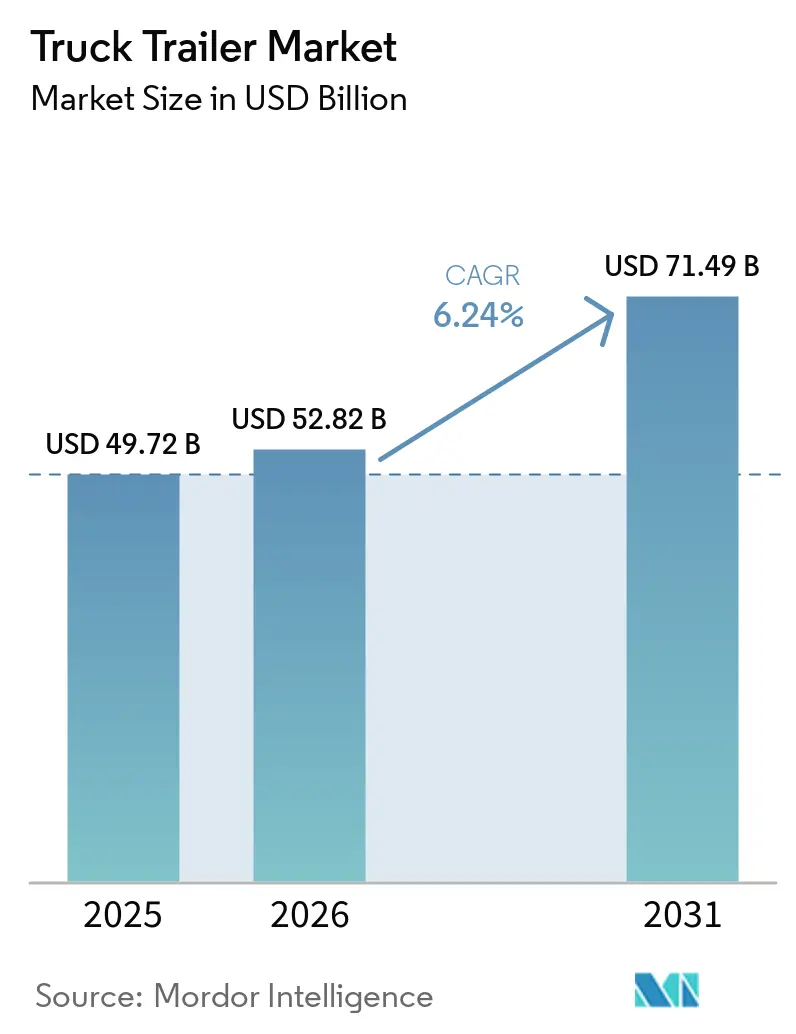
The truck trailer market size was valued at USD 49.72 billion in 2025 and is estimated to reach USD 52.82 billion in 2026, and is projected to reach USD 71.49 billion by 2031, at a CAGR of 6.24% during the forecast period (2026–2031). Growth in e-commerce parcels, infrastructure development, and fleet digitalization is contributing to increased demand while supporting the truck trailer market's stability despite fluctuations in freight activity. Parcel networks are driving demand for high-throughput dry vans, construction projects are increasing the requirement for flatbeds and lowboys, and cold-chain requirements are accelerating the adoption of refrigerated trailers. Furthermore, the adoption of lightweight composites and aluminum alloys is reducing tare weight, thereby maintaining fuel efficiency under stricter axle weight regulations. Additionally, smart telematics are improving asset utilization by integrating trailers with real-time load-matching platforms. Opportunities are emerging in hydrogen-powered refrigeration systems and autonomous-ready chassis, presenting potential for innovators to gain market share as regulatory frameworks and sustainability objectives continue to align.
Key Report Takeaways
- By trailer type, dry vans held 36.17% of the truck trailer market share in 2025, while refrigerated trailers are projected to expand at a 6.55% CAGR through 2031.
- By material, steel accounted for 63.22% of the truck trailer market share in 2025; composites are forecast to post a 6.28% CAGR to 2031.
- By tonnage capacity, the 25–50 ton range captured 41.28% of the truck trailer market share in 2025, whereas the sub-25 ton bracket is poised for a 6.37% CAGR through 2031.
- By length, 28–45 ft units commanded 54.56% of the truck trailer market size in 2025; trailers up to 40 ft are expected to advance at a 6.39% CAGR to 2031.
- By end-use industry, retail and e-commerce represented 34.11% of the truck trailer market size in 2025 and are projected to grow at a 6.31% CAGR through 2031.
- By geography, Asia-Pacific led with 38.74% truck trailer market share in 2025 while expanding at a 6.34% CAGR through 2031.
Note: Market size and forecast figures in this report are generated using Mordor Intelligence’s proprietary estimation framework, updated with the latest available data and insights as of January 2026.
Market Trends and Insights
Drivers Impact Analysis of Truck Trailer Market*
| Driver | (~) % Impact on CAGR Forecast | Geographic Relevance | Impact Timeline |
|---|---|---|---|
| E-Commerce-Driven Parcel Volumes | +1.8% | Global, with concentration in North America and Asia-Pacific | Medium term (2-4 years) |
| Infrastructure and Construction Up-Cycle | +1.2% | Asia-Pacific core, spill-over to the Middle East and Africa | Long term (≥ 4 years) |
| Cold-Chain Network Expansion | +0.9% | Global, early gains in developed markets | Medium term (2-4 years) |
| Fleet Renewal to Lightweight Materials | +0.8% | North America and Europe, expanding to Asia-Pacific | Long term (≥ 4 years) |
| Smart Telematics | +0.6% | North America and Europe core markets | Short term (≤ 2 years) |
| Hydrogen-Powered Refrigeration Adoption | +0.4% | EU and North America pilot markets | Long term (≥ 4 years) |
| Source: Mordor Intelligence | |||
E-Commerce-Driven Parcel Volumes
Parcel networks built for same-day fulfillment rely on dense shuttle loops between micro-fulfillment centers and sorting hubs, increasing dry van turns per day. Amazon’s rollout of branded trailers for Prime fulfillment demonstrates how retailers internalize capacity to safeguard service levels[1]. Standard dock height configurations facilitate efficient cross-docking, while lift gate-equipped vehicles enhance urban delivery density. Furthermore, the increasing focus on packaging right-sizing is driving the demand for trailers equipped with adjustable e-tracks and logistics posts, which are designed to accommodate varying carton heights. The use of real-time location and dwell-time analytics allows fleet managers to optimize trailer movement through regional hubs more effectively, thereby reducing idle time and unlocking previously unused capacity within the system.
Infrastructure and Construction Up-Cycle
New road, rail, and renewable-energy projects in China, India, and Southeast Asia keep flatbed and lowboy assembly lines busy. China’s Belt and Road Initiative channels bulk cement, structural steel, and turbine blades across transcontinental corridors, elevating demand for extendable and multi-axle trailers[2]. India's National Infrastructure Pipeline includes more than 9,000 projects, encouraging local fleets to adopt rigs with capacities ranging from 51 to 100 tons for heavy equipment transportation. Wind farm developments require blade carriers equipped with hydraulic steering systems to effectively navigate rural access roads, while solar farm developers prefer drop-frame flatbeds designed to optimize module stack density. The availability of long-term public-private funding provides original equipment manufacturers (OEMs) with the opportunity to plan and establish localized welding and painting facilities in proximity to major project hubs.
Cold-Chain Network Expansion
Pharmaceutical distributors now embed GDP (Good Distribution Practice) protocols into trailer procurement, requiring temperature mapping and data-logging across every pallet position. Carrier Transicold’s hydrogen cell reefers cut in-route emissions and extend cold-soak endurance, giving fleets both compliance and ESG upside[3]. Grocery retailers are incorporating multi-temperature bulkheads to facilitate the transportation of frozen, chilled, and ambient stock-keeping units (SKUs) in a single delivery to dark store fulfillment nodes. Vaccine corridors established during the pandemic have transitioned into permanent cold-chain lanes, encouraging original equipment manufacturers (OEMs) to invest in insulated panel assembly lines in emerging markets. Furthermore, aggregators of cloud kitchens and meal-kit services are acquiring compact refrigerated trailers that are specifically designed to be compatible with class B tractors, ensuring efficient distribution within urban areas.
Fleet Renewal to Lightweight Materials
Composite sidewalls and aluminum cross-members reduce the weight of a 53 ft dry van by up to 450 kilograms, contributing to measurable fuel savings on North American long-haul routes. Wabash National’s molded structural composite panels provide corrosion resistance, which extends the service life to more than 15 years and reduces the total cost of ownership for fleet operators. In response to carbon-pricing regulations, fleet operators increasingly prioritize payload-per-kilogram metrics, which has led to a shift in demand, with steel-dominant designs becoming more prevalent among price-sensitive buyer segments. The adoption of composite designs is gradually expanding from grocery and parcel carriers to regional less-than-truckload (LTL) fleets as repair networks gain familiarity with composite patch kits. Furthermore, material suppliers are strategically co-locating curing ovens at original equipment manufacturer (OEM) clusters to optimize logistics costs associated with the transportation of bulky molded parts.
Restraints Impact Analysis of Truck Trailer Market*
| Restraint | (~) % Impact on CAGR Forecast | Geographic Relevance | Impact Timeline |
|---|---|---|---|
| Volatile Steel and Aluminium Prices | -0.7% | Global, acute in manufacturing hubs | Short term (≤ 2 years) |
| Axle-Weight Regulatory Limits | -0.5% | North America and EU core markets | Medium term (2-4 years) |
| Shortage of Certified Trailer Mechanics | -0.4% | Global, severe in developed markets | Medium term (2-4 years) |
| Cyber-Security Risks | -0.3% | North America and EU, expanding globally | Short term (≤ 2 years) |
| Source: Mordor Intelligence | |||
Volatile Steel and Aluminum Prices
Benchmark hot-rolled coil prices experienced a fluctuation of 40% in 2024, which significantly impacted OEM gross margins and created challenges in determining the pricing of long-term order books. The introduction of aluminum import tariffs in the United States resulted in an additional cost of USD 250 per ton, thereby reducing the cost difference between aluminum and composite builds. To address these challenges, manufacturers adopted quarterly price-adjustment clauses; however, smaller dealers encountered difficulties in transferring these surcharges to end users. Although hedging contracts provided partial mitigation against price volatility, they required cash collateral, which placed constraints on working capital. Consequently, some fleets deferred their replacement cycles, leading to a temporary reduction in demand until raw material prices achieved greater stability.
Axle-Weight Regulatory Limits
The U.S. Federal Bridge Formula imposes limitations on axle group loads, requiring engineers to distribute weight across additional axles or implement pusher configurations, which increases the overall build costs. In Europe, differences in regulations among member states necessitate that cross-border haulers underload trailers to comply with the strictest limits encountered on specific routes, thereby reducing payload efficiency. The deployment of enforcement cameras equipped with weigh-in-motion sensors has resulted in an increase in fines, prompting fleets to adopt on-board scales to ensure compliance. Efforts to establish harmonized 44-ton gross weight limits across European Union corridors are ongoing; however, achieving a consensus remains challenging. This lack of agreement continues to contribute to significant design and operational complexities for international operators.
*Our forecasts treat driver/restraint impacts as directional, not additive. The impact forecasts reflect baseline growth, mix effects, and variable interactions.
Truck Trailer Market Segment Analysis
By Trailer Type:
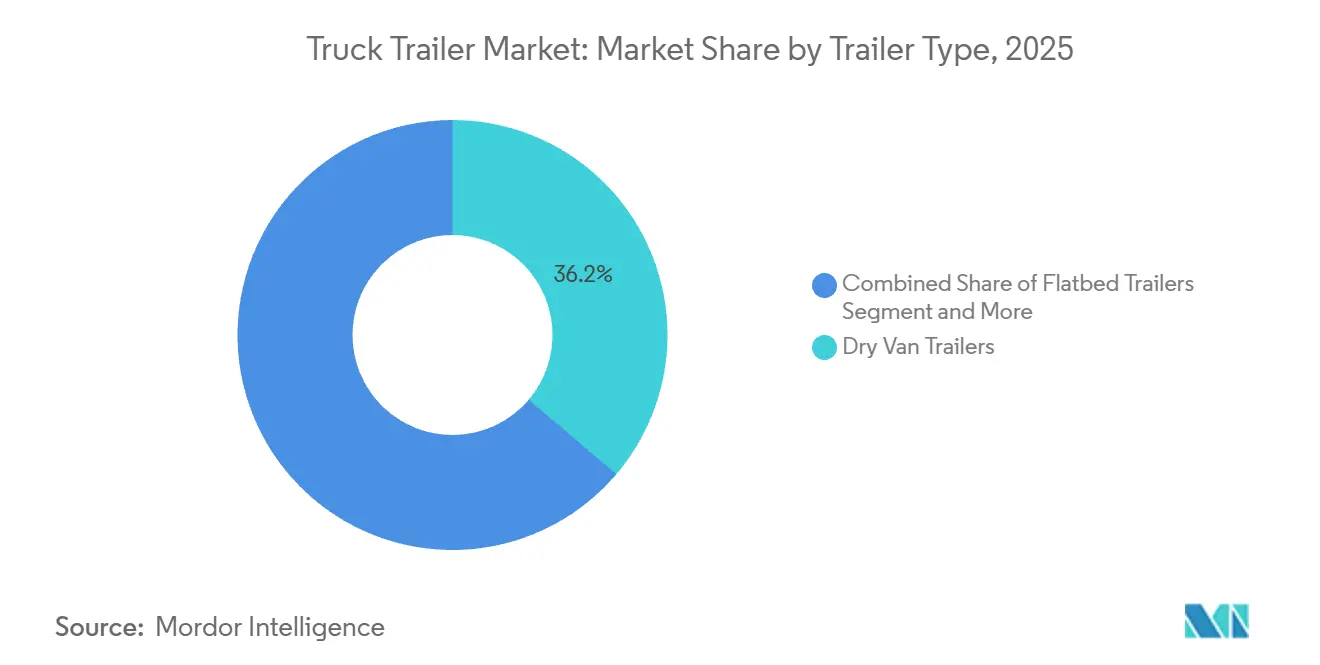
Dry Van Leadership and Reefer MomentumIn 2025, dry vans accounted for 36.17% of the truck trailer market share, emphasizing their suitability for cube-oriented parcels and general merchandise transportation. While refrigerated trailers represent a smaller market segment, they are projected to grow at a CAGR of 6.55% through 2031, driven by increasing demand in fresh grocery and pharmaceutical logistics. Flatbeds play a critical role in transporting construction steel, lumber, and machinery, particularly in scenarios where side or top loading is required. Additionally, lowboys are essential for moving oversized excavators used in infrastructure projects. Tankers remain indispensable for the transportation of hazardous liquids, while extendable blade carriers are gaining importance in supporting wind-energy projects.
E-commerce operators are retrofitting dry vans with captive logistics posts and load bars to enhance parcel cube density. In contrast, cold-chain specialists are investing in multi-zone reefers equipped with hydrogen or electric standby systems to comply with urban emissions regulations. Over the forecast period, the truck trailer market is expected to witness increased adoption of telematics across all trailer types, enabling real-time load monitoring and predictive maintenance scheduling. Original Equipment Manufacturers (OEMs) that offer connectivity features as part of standard warranty packages are likely to secure long-term fleet contracts, further consolidating the fragmented supplier landscape.

By Material:
Steel Sustains Volume, Composites Capture PremiumIn 2025, steel accounted for 63.22% of the truck trailer market share, driven by its cost-effectiveness and established service networks. However, as fleets increasingly prioritize fuel efficiency and corrosion resistance, composite and aluminum variants are anticipated to grow at a 6.28% CAGR, potentially representing one-third of new builds by 2031. Steel's recyclability and upfront cost advantage continue to secure its position in cost-sensitive dry van fleets. Nevertheless, operators of weight-sensitive reefers and tankers are progressively opting for advanced materials with higher capital expenditures, citing reduced operating expenses as a key factor.
Composite sandwich panels, in contrast to traditional steel skins, demonstrate resistance to delamination and maintain insulation R-values for extended periods, thereby reducing energy consumption over their life cycle. Additionally, hybrid designs integrate steel coupler regions with aluminum side rails, achieving a balance between cost and weight. Material suppliers, in collaboration with OEM design studios, are utilizing finite-element modeling to optimize panel lay-ups, ensuring adequate strength margins without unnecessary over-engineering. As sustainability-focused procurement policies become more widespread, life-cycle assessments are expected to influence a greater number of orders toward alternative materials, gradually redistributing the truck trailer market size shares between steel and composites.
By Tonnage Capacity:
Mid-Range Efficiency PrevailsIn 2025, trailers weighing between 25 and 50 tons accounted for 41.28% of the truck trailer market share, highlighting their compliance with regional weight distribution regulations and associated mandates. Trailers under 25 tons are anticipated to grow at a 6.37% CAGR, driven by the increasing adoption of urban consolidation centers that require lighter rigs capable of efficiently navigating narrow streets and curbside docks. At the same time, the 51 to 100 ton and super-heavy segments, which are essential for energy, mining, and construction logistics, are experiencing slower volume growth. This slower growth is attributed to infrastructure megaprojects currently transitioning from planning to execution phases.
As regulators enforce stricter axle-weight compliance, fleets are under pressure to optimize their capacities, thereby avoiding over-specification and inefficiencies associated with empty backhauls. The adoption of lightweight materials is enhancing payload capacities across all weight categories, enabling fleets to offset the additional weight introduced by emissions-control equipment. Over the forecast period, telematics-enabled load monitoring is expected to allow dispatchers to allocate the appropriate tonnage class for each shipment, effectively reducing fuel consumption and non-revenue miles across the broader truck trailer market.
By Length:
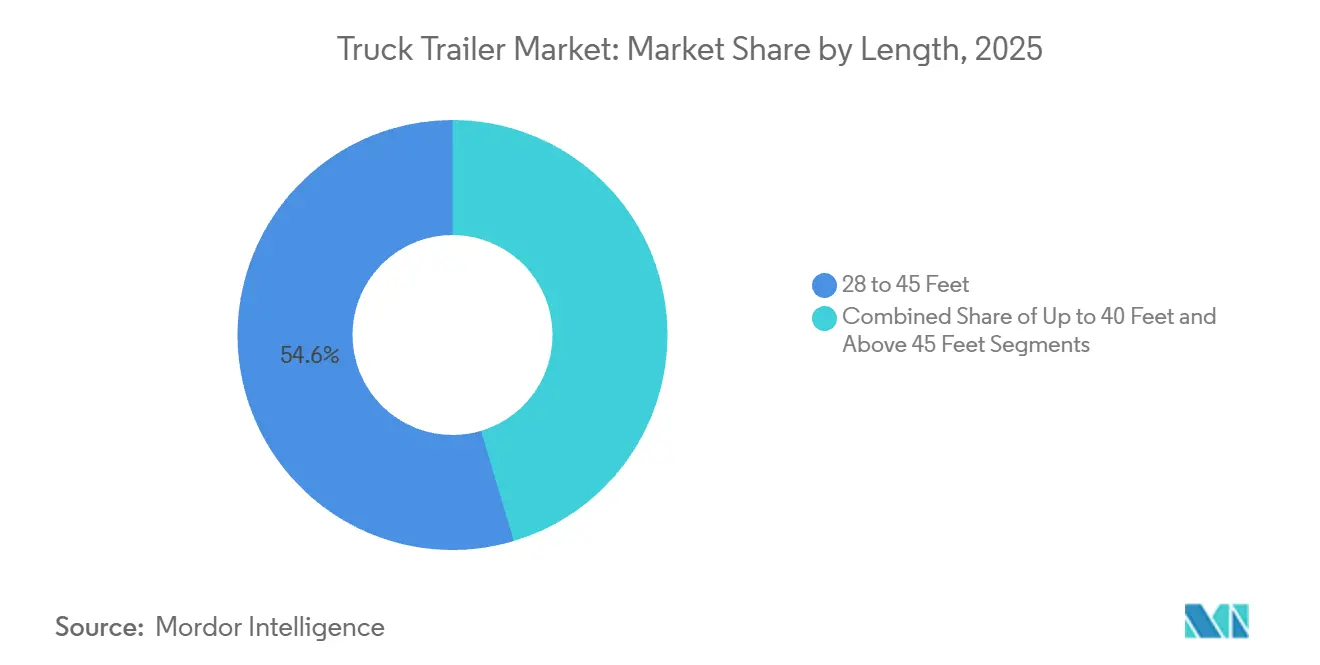
Standard 28 to 45 ft Dominance Meets Compact GrowthIn 2025, truck trailers measuring between 28 to 45 feet accounted for 54.56% of the market share, aligning with dock heights and intermodal rail standards in North America and Europe. However, trailers shorter than 40 feet are projected to register a CAGR of 6.39%, as urban areas implement curb-space fees and right-turn restrictions that create challenges for longer wheelbases. On the other hand, while trailers exceeding 45 feet remain essential for transporting volumetric items such as insulation panels and furniture, they face stringent regulations that limit opportunities for length extensions.
Fleet route modeling increasingly incorporates GIS restrictions, recommending smaller trailers for congested areas during peak times. In response, OEMs are introducing modular chassis that allow for the addition or removal of center bays, enabling fleets to utilize a versatile asset for both urban and regional routes. Over time, growing pressures for standardization around parcel cube dimensions could influence design trends toward a preferred 32-foot length, reshaping the distribution of shares within the truck trailer industry's length categories.
By End-Use Industry:
Retail and E-Commerce Outpace Traditional VerticalsIn 2025, retail and e-commerce accounted for 34.11% of the truck trailer market, driven by increasing omnichannel demand that integrates store-based and direct-to-consumer fulfillment. With the expansion of same-day delivery services beyond tier-1 cities, this segment is anticipated to grow at a 6.31% CAGR. Following closely, food and beverage shippers are supporting the demand for refrigerated trailers, driven by the growing popularity of fresh produce and meal kits. Flatbed trailers are primarily utilized at construction sites, while consignors in the oil, gas, and chemical sectors depend on tankers equipped with advanced multi-compartment safety systems to ensure secure transportation.
Digitalization is transforming all end-use sectors. Retailers are implementing IoT tags to enhance SKU-level visibility, agribusinesses are deploying sensor-equipped grain hoppers to monitor moisture levels during transit, and petrochemical fleets are integrating electronic logging device (ELD) data with environmental, social, and governance (ESG) dashboards. End-users are increasingly demanding predictive uptime guarantees in their procurement requests for proposals (RFPs), encouraging original equipment manufacturers (OEMs) to integrate analytics into their standard specifications. As sustainability audits become more rigorous, customers are placing greater emphasis on evaluating life-cycle emissions. They are increasingly favoring trailer manufacturers that certify the use of low-carbon steel in production or offer hydrogen-ready refrigerated trailer options.
Geography Analysis
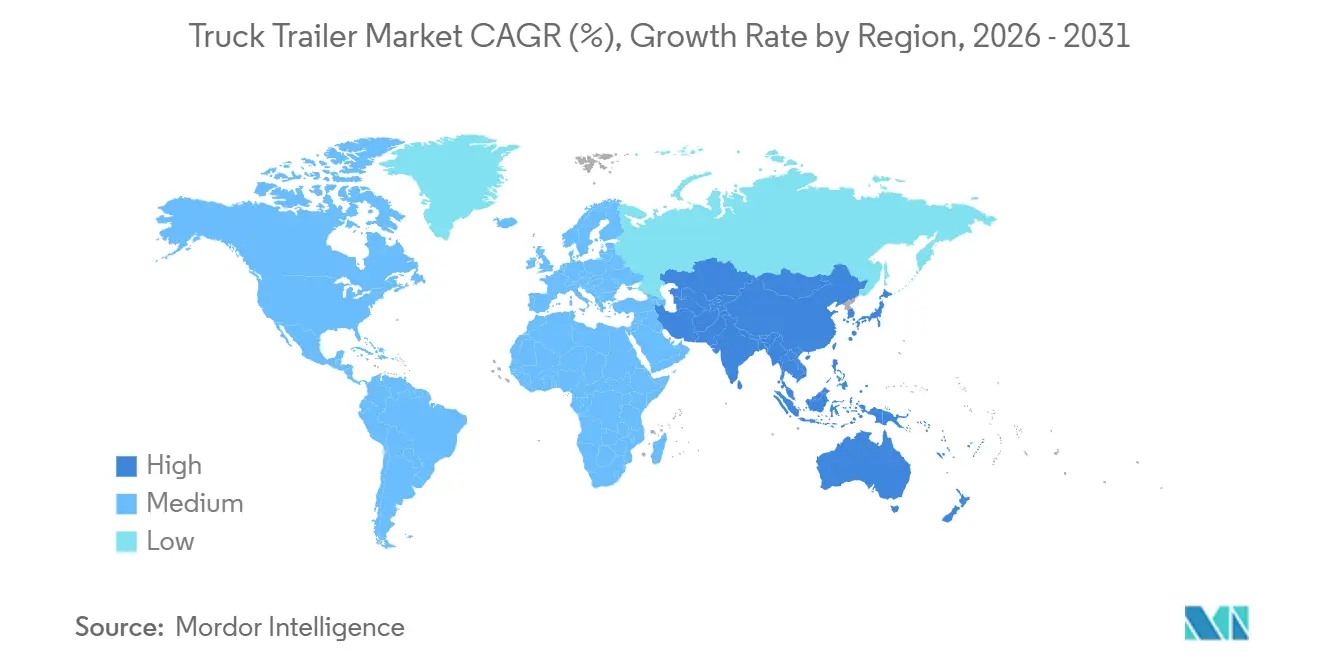
In 2025, Asia-Pacific accounted for a significant 38.74% share of the truck trailer market, supported by China's extensive manufacturing corridor and India's logistics consolidation facilitated by the Goods and Services Tax (GST). With rising e-commerce penetration and steady infrastructure investment, the region is expected to lead with a 6.34% CAGR through 2031. Additionally, government incentives promoting Euro-VI-equivalent emission standards are accelerating fleet replacement cycles, thereby boosting production for regional original equipment manufacturers (OEMs).
North America, which holds the second-largest market volume, continues to drive advancements in telematics adoption and the use of lightweight materials. In the United States, large parcel carriers are increasingly adopting composites, while Canada's resource-dependent economy sustains demand for multi-axle tankers and bulk trailers. The United States-Mexico-Canada Agreement (USMCA) framework facilitates cross-border capacity rebalancing, enabling fleets to reposition assets across regions to manage seasonal freight surges without necessitating new purchases.
Europe is emphasizing sustainability, encouraging OEMs to incorporate recyclable composites and alternative-fuel refrigeration units in alignment with the EU Green Deal. Although axle-weight disparities among member states present challenges for long-haul routes, ongoing efforts to harmonize corridors could enable standardized 44-ton gross limits during the forecast period. Following Brexit, the United Kingdom is restructuring its supply chains by increasing imports of finished trailers and enhancing domestic refurbishment capabilities to extend asset lifespans in response to import tariffs. Meanwhile, emerging assemblers in Eastern Europe are targeting price-sensitive fleets by leveraging lower operating costs, thereby challenging established players in the western regions.
Competitive Landscape
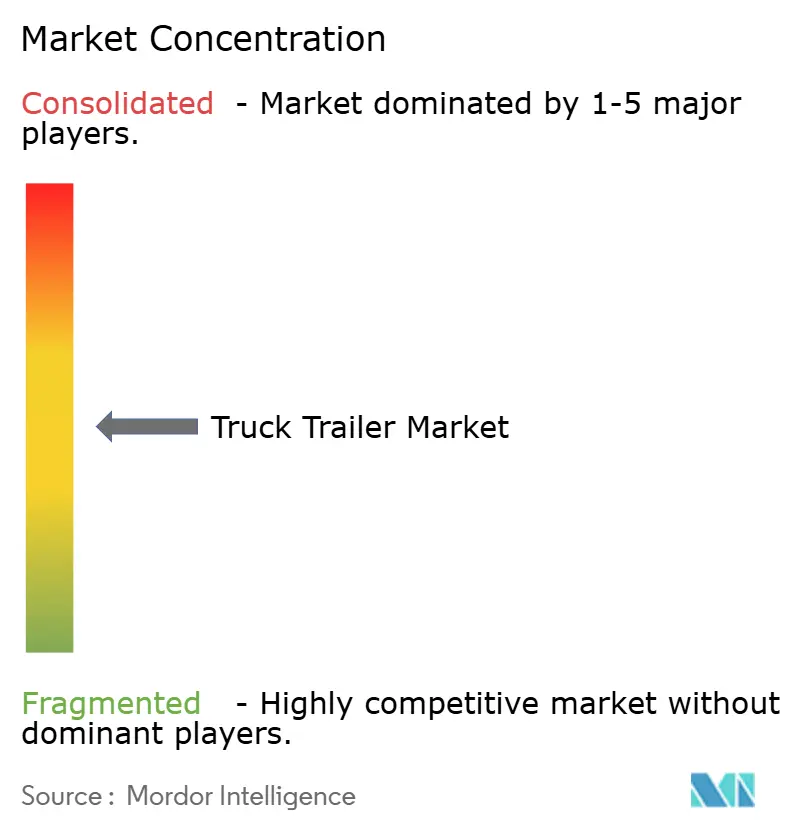
The truck trailer market is moderately fragmented. Regional champions maintain scale advantages but face increasing technology requirements. CIMC, leveraging its China-based manufacturing scale, serves both the Asia-Pacific and export markets. Wabash National differentiates itself through its patented composite body technology, which reduces tare weight and maintenance costs. Schmitz Cargobull has made substantial investments in IoT-enabled digital services, particularly by integrating sensor hardware with predictive maintenance subscriptions. TerraVest's acquisition of EnTrans consolidates specialty tanker and cryogenic trailer capabilities into a unified North American platform.
Strategic partnerships are developing around hydrogen refrigeration initiatives, connecting trailer original equipment manufacturers (OEMs) with fuel-cell integrators and grocery fleets aiming to establish zero-emission cold chains. Private equity firms are actively pursuing roll-up opportunities among regional builders, particularly those that are unlikely to finance their own telematics development strategies. Concurrently, start-ups focusing on autonomous-ready dollies and self-powered chassis are attracting venture capital investments, although regulatory timelines are expected to limit immediate revenue generation. Volatility in steel and aluminum prices benefits vertically integrated producers that hedge their material inputs, while smaller fabricators are increasingly pressured to outsource panel kits and narrow their product offerings.
OEMs that achieve ISO 9001 and Advance Quality Planning certifications establish compliance barriers for new entrants and secure long-term contracts with global parcel networks. The use of digital twins for trailer builds accelerates engineering lead times, enhancing make-to-order production for customized specifications. Over the forecast period, success in the market will depend on combining manufacturing scale with software-driven service packages, increasing revenue per unit and retaining customers through multi-year data subscription agreements.
Truck Trailer Industry Leaders
-
CIMC Vehicles (Group) Co., Ltd.
-
Wabash National Corporation
-
Schmitz Cargobull AG
-
Fahrzeugwerk Bernard Krone GmbH
-
Hyundai Translead
- *Disclaimer: Major Players sorted in no particular order
Truck Trailer Market Companies Covered in this Report
- CIMC Vehicles (Group) Co., Ltd.
- Wabash National Corporation
- Utility Trailer Manufacturing Company
- Great Dane LLC
- Hyundai Translead
- Schmitz Cargobull AG
- Fahrzeugwerk Bernard Krone GmbH
- Kögel Trailer GmbH & Co. KG
- Stoughton Trailers LLC
- Lamberet SAS
- Randon Implementos
- Kässbohrer
- Fontaine Trailer Company
- Vanguard National Trailer Corp.
- Titan Trailers Inc.
- MAC Trailer Enterprises Inc.
- Schwarzmüller Group
- SDC Trailers Ltd.
Recent Industry Developments in Truck Trailer Market
- April 2026: ZF Friedrichshafen is accelerating its push into the trailer segment, targeting OEMs with advanced trailer control and software systems. The move is driven by upcoming regulatory changes requiring smarter and more connected trailer platforms. ZF is actively positioning itself as a technology partner for trailer manufacturers, not just a component supplier.
- March 2026: Rheinmetall has signed a strategic cooperation agreement with Nooteboom Trailers to jointly develop and commercialize military heavy equipment trailers.
- March 2026: Volvo Trucks North America is developing a new truck–trailer connector system with TECTRAN, enabling high-speed wireless data transfer. The solution aims to create a new industry standard for connected trailer operations across North America.
Global Truck Trailer Market Report Scope
The truck trailer market is segmented by trailer type, material, tonnage capacity, length, end-use industry, and geography. By trailer type, the market is segmented into dry van trailers, flatbed trailers, refrigerated (reefer) trailers, lowboy trailers, tankers, and extendable trailers. By material, the market is segmented into steel, aluminum, and composite materials. By tonnage capacity, the market is segmented into below 25 tons, 25 to 50 tons, 51 to 100 tons, and above 100 tons. By length, the market is segmented into up to 40 feet, 28 to 45 feet, and above 45 feet. By end-use industry, the market is segmented into food and beverage, construction, oil and gas, agriculture, retail and e-commerce, chemicals, and others. By geography, the market is segmented into North America, South America, Europe, Asia-Pacific, and the Middle East and Africa. The Market Forecasts are Provided in Terms of Value (USD) and Volume (Units).
Segmentation Overview
| Dry Van Trailers |
| Flatbed Trailers |
| Refrigerated (Reefer) Trailers |
| Lowboy Trailers |
| Tankers |
| Extendable Trailers |
| Steel |
| Aluminum |
| Composite Materials |
| Below 25 Tons |
| 25 to 50 Tons |
| 51 to 100 Tons |
| Above 100 Tons |
| Up to 40 Feet |
| 28 to 45 Feet |
| Above 45 Feet |
| Food and Beverage |
| Construction |
| Oil and Gas |
| Agriculture |
| Retail and E-Commerce |
| Chemicals |
| Others |
| North America | United States |
| Canada | |
| Rest of North America | |
| South America | Brazil |
| Argentina | |
| Rest of South America | |
| Europe | United Kingdom |
| Germany | |
| Spain | |
| Italy | |
| France | |
| Russia | |
| Rest of Europe | |
| Asia-Pacific | India |
| China | |
| Japan | |
| South Korea | |
| Rest of Asia-Pacific | |
| Middle East and Africa | United Arab Emirates |
| Saudi Arabia | |
| Turkey | |
| Egypt | |
| South Africa | |
| Rest of Middle East and Africa |
| By Trailer Type | Dry Van Trailers | |
| Flatbed Trailers | ||
| Refrigerated (Reefer) Trailers | ||
| Lowboy Trailers | ||
| Tankers | ||
| Extendable Trailers | ||
| By Material | Steel | |
| Aluminum | ||
| Composite Materials | ||
| By Tonnage Capacity | Below 25 Tons | |
| 25 to 50 Tons | ||
| 51 to 100 Tons | ||
| Above 100 Tons | ||
| By Length | Up to 40 Feet | |
| 28 to 45 Feet | ||
| Above 45 Feet | ||
| By End-Use Industry | Food and Beverage | |
| Construction | ||
| Oil and Gas | ||
| Agriculture | ||
| Retail and E-Commerce | ||
| Chemicals | ||
| Others | ||
| By Geography | North America | United States |
| Canada | ||
| Rest of North America | ||
| South America | Brazil | |
| Argentina | ||
| Rest of South America | ||
| Europe | United Kingdom | |
| Germany | ||
| Spain | ||
| Italy | ||
| France | ||
| Russia | ||
| Rest of Europe | ||
| Asia-Pacific | India | |
| China | ||
| Japan | ||
| South Korea | ||
| Rest of Asia-Pacific | ||
| Middle East and Africa | United Arab Emirates | |
| Saudi Arabia | ||
| Turkey | ||
| Egypt | ||
| South Africa | ||
| Rest of Middle East and Africa | ||
Key Questions Answered in the Report
What is the forecast value of the truck trailer market by 2031?
The market is expected to reach USD 71.49 billion by 2031.
Which trailer type is growing the fastest?
Refrigerated trailers are projected to grow at a 6.55% CAGR through 2031.
How large is Asia-Pacific’s share today?
Asia-Pacific holds 38.74% of global revenue and is the fastest-growing region.
Why are composites gaining popularity in trailer builds?
Composites reduce tare weight, resist corrosion, and lower fuel consumption, driving a 6.28% CAGR in adoption.
What impact do steel and aluminum prices have on manufacturers?
Price volatility compresses margins, forcing OEMs to adopt hedging and dynamic pricing strategies.
Which technology trend offers new revenue streams for trailer OEMs?
Integrated telematics and predictive maintenance subscriptions boost lifetime revenue per unit and differentiate offerings.