
Modular Trailer Market Size and Share
Market Overview
| Study Period | 2019 - 2031 |
|---|---|
| Market Size (2026) | USD 9.39 Billion |
| Market Size (2031) | USD 12.23 Billion |
| Growth Rate (2026 - 2031) | 5.42 % |
| Fastest Growing Market | Asia Pacific |
| Largest Market | North America |
| Market Concentration | Medium |
Major Players *Disclaimer: Major Players sorted in no particular order Image © Mordor Intelligence. Reuse requires attribution under CC BY 4.0. | |
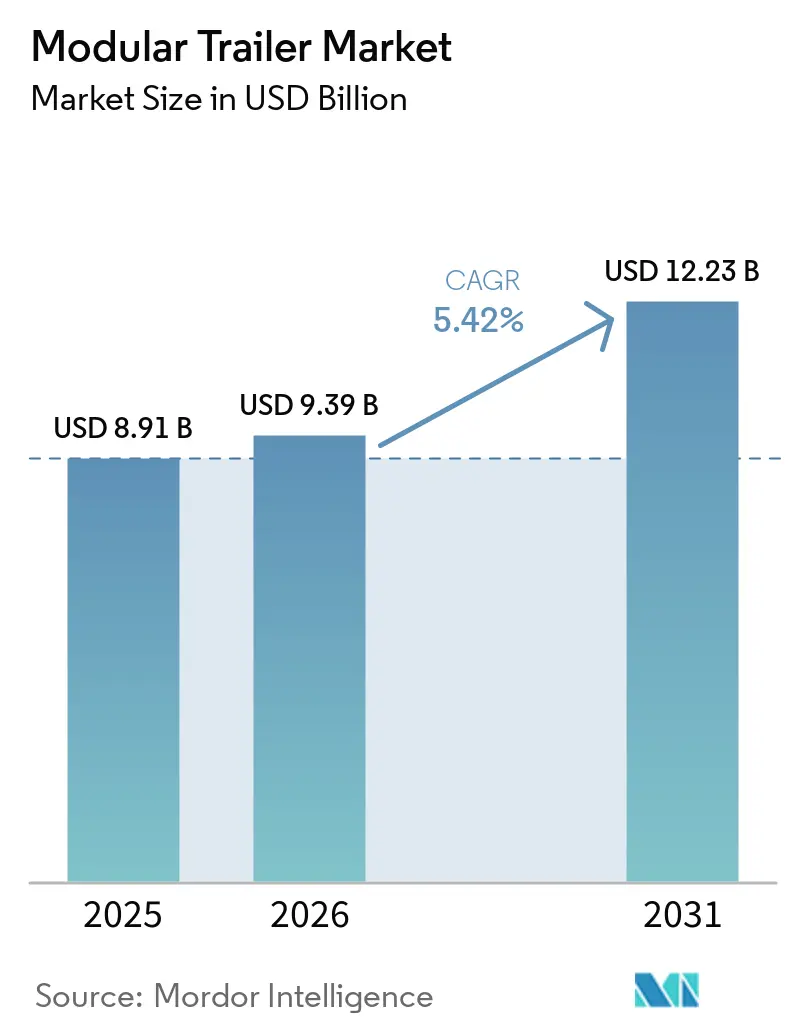
Modular Trailer Market Analysis by Mordor Intelligence
The Modular Trailer Market size is expected to increase from USD 8.91 billion in 2025 to USD 9.39 billion in 2026 and reach USD 12.23 billion by 2031, growing at a CAGR of 5.42% over 2026-2031. Stricter EU CO₂ limits, surging wind-energy logistics, and rapid adoption of innovative telematics collectively underpin this expansion. North America commands the largest modular trailer market share at 32.05%, benefiting from mature heavy-haul corridors, while Asia-Pacific is projected to post the fastest CAGR at 7.80% on the back of a USD 26 trillion infrastructure drive. OEMs are investing in lightweight chassis to meet the mandated 7.5% and 10% CO₂ cuts for drawbar and semi-trailers by 2030. Electrified axle solutions such as ZF’s AxTrax 2 deliver up to 16% fuel savings for diesel tractors and up to 40% when operated in plug-in mode. However, persistent steel-price swings and a deepening shortage of certified heavy-haul drivers are weighing on profit margins and asset utilization.
Key Report Takeaways
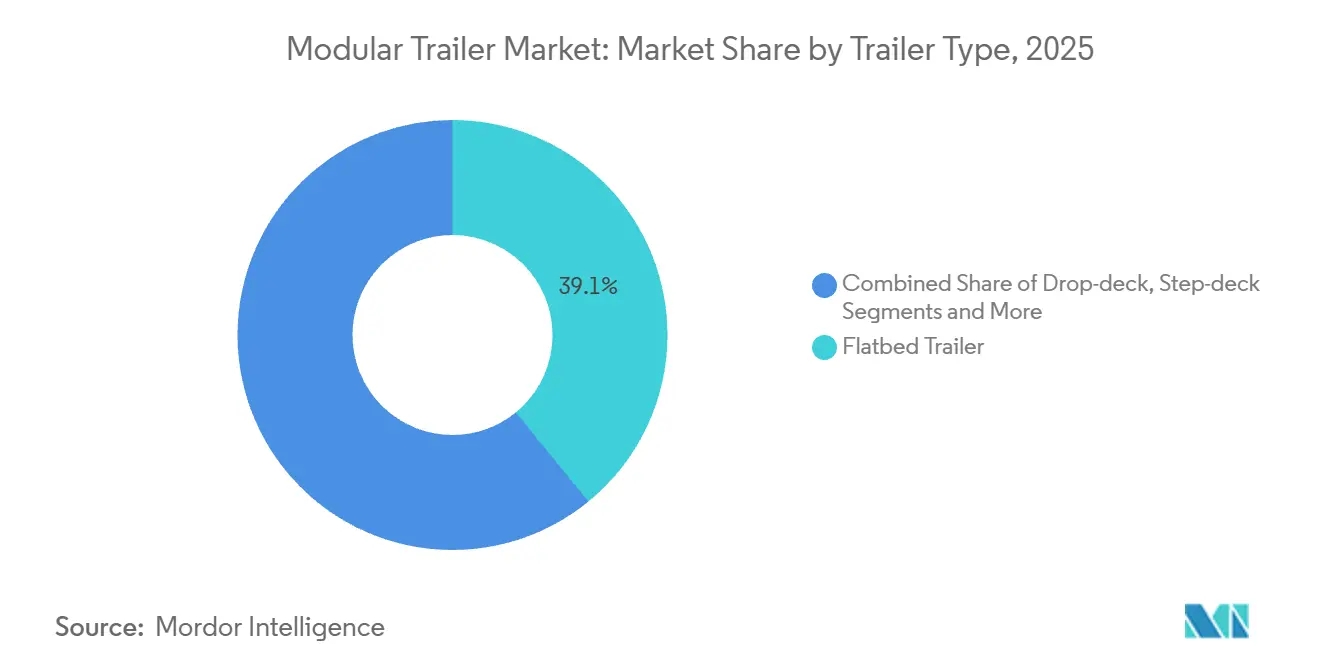
- By trailer type, flatbed units held 39.05% of the modular trailer market share in 2025, whereas low-boy platforms are forecast to advance at an 8.20% CAGR through 2031.
- By axle configuration, tandem systems captured a 46.28% share of the modular trailer market in 2025, while quad- and above assemblies are projected to expand at a 7.55% CAGR through 2031.
- By material, carbon steel dominated, with 70.95% of the modular trailer market share in 2025; aluminum frames are expected to grow at a 6.90% CAGR over the forecast period through 2031.
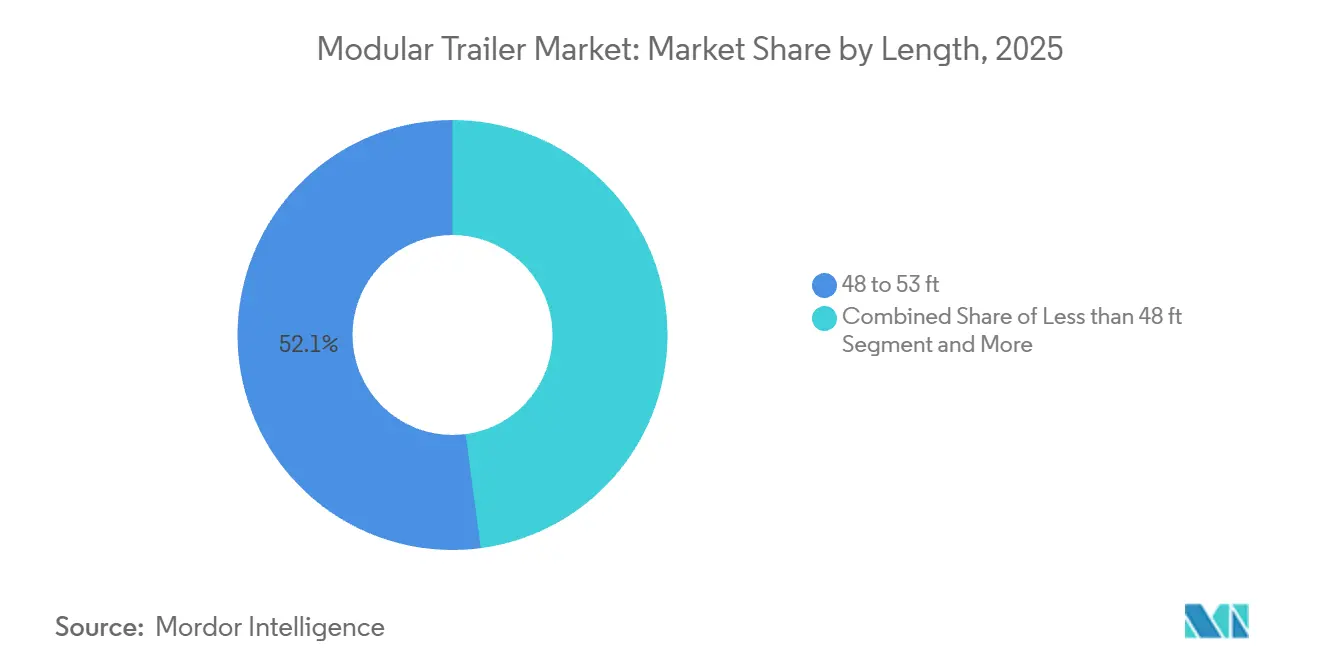
- By length, the 48-53 ft category commanded a 52.10% share of the modular trailer market in 2025, and trailers longer than 60 ft are set to grow at a 9.31% CAGR through 2031.
- By end-user industry, construction and infrastructure led with a 24.12% revenue share in 2025, while wind-energy logistics is projected to grow at an 11.30% CAGR through 2031.
- By geography, North America accounted for 32.05% of the modular trailer market share in 2025, while Asia-Pacific is anticipated to deliver the fastest CAGR of 7.80% over 2026-2031.
Note: Market size and forecast figures in this report are generated using Mordor Intelligence’s proprietary estimation framework, updated with the latest available data and insights as of January 2026.
Market Trends and Insights
Drivers Impact Analysis of Modular Trailer Market*
| Driver | (~) % Impact on CAGR Forecast | Geographic Relevance | Impact Timeline |
|---|---|---|---|
| Wind-Blade Logistics Spurring Extendable Trailers | +1.2% | North America, Europe, Asia-Pacific | Medium term (2-4 years) |
| Southeast Asian Mega-Infrastructure Corridors | +0.9% | Asia-Pacific, spill-over to MEA | Long term (≥ 4 years) |
| Lightweight Aluminium-Steel Hybrid Chassis | +0.8% | Europe, North America, Global | Medium term (2-4 years) |
| EU CO₂ Trailer Rules (EU 2019/1242) | +0.7% | Europe, Global influence | Short term (≤ 2 years) |
| Smart-Sensor Telematics Lowering TCO | +0.6% | North America, Global | Short term (≤ 2 years) |
| Rare-Earth-Free E-Axle Modules | +0.4% | Europe, North America, Global | Long term (≥ 4 years) |
| Source: Mordor Intelligence | |||
Shift to Wind-Blade Logistics Driving Extendable Modular Trailers
As modern wind turbine blades stretch beyond 80 meters and entire assemblies tip the scales at over 700 tons, the demands of transporting these blades are fundamentally reshaping trailer design specifications. Route planning complexity intensifies with each project that requires multiple visual inspections and swept-path analyses to navigate infrastructure constraints, as demonstrated by the Southland Wind Farm in New Zealand and the Golden Plains Wind Farm in Australia [1]. North America installed 8.2 GW of wind capacity in 2025, up 49% year-over-year, with 11 GW expected in 2026 and 48 GW scheduled through 2030, creating a sustained replacement cycle for transport equipment. In response, manufacturers are crafting modular systems that push the boundaries of traditional length limits, all while ensuring structural integrity for the delivery of oversized components. The intricate logistics of wind blade transportation pose challenges for smaller fabricators, leading to a consolidation of market share among specialized heavy-haul providers equipped with engineering expertise.
Growth of South-East Asian Mega-Infrastructure Corridor Projects
Southeast Asia's infrastructure transformation requires over USD 26 trillion in transport investments through 2030, with freight transport demand projected to increase nearly 80% between 2015 and 2030[2]. Connecting Bangkok, Phnom Penh, and Ho Chi Minh City, the Southern Economic Corridor exemplifies the region's evolving economic landscape by facilitating cross-border trade and encouraging private sector investment in logistics infrastructure. Thailand's ambitious Land Bridge project spans approximately 90 kilometers, seamlessly connecting the Andaman Sea at Ranong to the Gulf of Thailand at Chumphon. This extensive corridor boasts dual deep-sea ports, alongside integrated rail and highway infrastructure. With an estimated price tag of around THB 997 billion (equivalent to USD 28–36 billion), the project stands as one of Southeast Asia's most monumental infrastructure undertakings. Additionally, the region's focus on developing special economic zones and implementing simplified customs procedures is further increasing demand for container chassis and intermodal trailer configurations.
OEM Pivot to Lightweight Aluminum-Steel Hybrid Chassis
Manufacturers are increasingly innovating materials as part of their efforts to achieve weight reductions that enhance payload capacity and improve fuel efficiency. For example, high-strength steel has facilitated a 10% reduction in the weight of commercial vehicles and a 30% decrease in the weight of main frame components. Demonstrating the industry's commitment to sustainability and efficiency, Constellium is actively participating in Project M-LightEn. This initiative focuses on developing ultra-lightweight chassis structures, with objectives including a 50% reduction in carbon intensity and a 25% decrease in weight, achieved through the use of 80% recycled aluminum. CarbonTT's CFRP chassis development achieved an 185-kilogram weight reduction and a 36% payload increase for specialized commercial vehicles, addressing urban logistics constraints under 3.5 MT weight limits [3]. Great Dane's carbon-fiber concept trailer demonstrated 4,000-pound weight savings compared to conventional designs, with carbon-fiber costs declining to approximately USD 10 per pound [4].
Tightening EU CO₂ Trailer Compliance Rules (EU 2019/1242)
By 2030, the European Union mandates a 7.5 percent reduction in CO₂ emissions for drawbar trailers and a 10 percent reduction for semi-trailers. Looking further ahead, targets for heavy-duty vehicles aim for a significant 90 percent reduction by 2040. Under the Vehicle Energy Consumption Calculation Tool (VECTO), manufacturers are required to demonstrate compliance through measures such as aerodynamic optimization, weight reduction, and improvements in tire rolling resistance. Non-compliance is associated with substantial financial penalties, amounting to EUR 4,250 per gCO2/tkm in 2025 and increasing to EUR 6,800 by 2030, which places immediate financial pressure on manufacturers. Schmitz Cargobull's S.KOe COOL, a fully electric refrigerated trailer, exemplifies a successful compliance strategy, aligning with the growing demand for zero-emission urban logistics. The regulation's technology-neutral approach provides manufacturers with flexibility in their compliance methods while simultaneously encouraging the integration of zero-emission vehicles. Furthermore, trailers that demonstrate efficiency are eligible for road charging advantages, resulting in reduced operational costs and supporting the market's transition towards compliant designs.
Restraints Impact Analysis of Modular Trailer Market*
| Restraint | (~) % Impact on CAGR Forecast | Geographic Relevance | Impact Timeline |
|---|---|---|---|
| Shortage of Certified Heavy-Haul Drivers | -1.1% | North America, Europe, Global | Medium Term (2–4 Years) |
| Slow Homologation of Autonomous Trailer Control Systems | -1.0% | Europe, North America | Long Term (4+ Years) |
| Volatile Steel Prices | -0.8% | Global, Pronounced in Emerging Markets | Short Term (≤ 2 Years) |
| Port Bottlenecks Delaying Oversized-Cargo Permits | -0.7% | Global Seaports, Especially Asia and EU | Short Term (≤ 2 Years) |
| Source: Mordor Intelligence | |||
Volatile Steel Prices Squeezing Small Regional Fabricators
Small regional fabricators, unlike their larger OEM counterparts, face challenges due to their limited hedging capabilities and reduced negotiating power with steel suppliers. This disparity becomes more significant as tariffs on steel and aluminum imports continue to exert cost pressures. In response, some manufacturers are adopting supplier diversification strategies and reshoring initiatives to address potential supply chain disruptions. Although the delay in tariff implementation until April 2025 provides temporary relief, it perpetuates uncertainty regarding production planning and pricing strategies. With carbon steel accounting for 70.95% of the market, the industry's heightened price sensitivity is evident, particularly for smaller players with fewer material alternatives. To address these challenges, manufacturers are optimizing inventory management processes and establishing strategic supplier partnerships. However, margin compression remains an unavoidable outcome during periods of market volatility.
Shortage of Certified Heavy-Haul Drivers Globally
In the United States, a driver shortage exceeding 80,000 positions persists, with projections indicating it could double by 2030. This increase is primarily driven by factors such as retirement, stress, and fatigue within the profession. Heavy haul operations, which require specialized certifications and expertise in oversized cargo permits, encounter significant challenges in recruiting and retaining drivers. This shortage has a substantial impact on modular trailer utilization rates, as qualified operators command premium wages, reducing fleet deployment flexibility. In response to these challenges, the development of autonomous trailers is progressing rapidly. Companies such as Aurora and Waymo are actively seeking regulatory exemptions to implement modifications to safety equipment. To address workforce constraints while maintaining operational efficiency, innovative business models such as Driver-as-a-Service and Capacity-as-a-Service are emerging as viable solutions.
*Our forecasts treat driver/restraint impacts as directional, not additive. The impact forecasts reflect baseline growth, mix effects, and variable interactions.
Modular Trailer Market Segment Analysis
By Trailer Type:
Flatbed Trailer Dominance Amid Low-Boy AccelerationIn 2025, flatbed trailers accounted for a 39.05% share of the market, highlighting their adaptability in general freight applications and their established integration within supply chains. At the same time, low-boy configurations are experiencing significant growth, with a 8.20% CAGR projected through 2031. This growth is driven by the increasing demand for wind energy logistics and the transportation of heavy machinery, both of which require specialized loading capabilities. Flatbed trailers continue to play a critical role in construction and infrastructure projects, benefiting significantly from the Asia-Pacific's USD 26 trillion infrastructure investment pipeline. Drop-deck and step-deck configurations effectively meet the requirements of height-sensitive cargo while maintaining payload efficiency for transporting industrial equipment.
The demand for container chassis is closely aligned with maritime trade volumes, particularly as freight transport in Southeast Asia is expected to grow by 80% through 2031. Tanker trailers continue to benefit from activity in the oil and gas sector; however, their growth is moderating due to pressures associated with the global energy transition. ZF's TrailTrax electrification system demonstrates its applicability across multiple segments, achieving 16% energy savings in diesel applications and a 40% improvement with plug-in charging. The evolution of this segment reflects a trend toward specialization, with manufacturers increasingly focusing on developing purpose-built solutions rather than adopting generalized approaches.

By Axle Configuration:
Tandem Systems Lead While Quad-Plus AcceleratesIn 2025, tandem axle configurations account for a significant 46.28% market share, ensuring optimal weight distribution and improved maneuverability for standard freight operations across various road conditions. Quad and larger configurations are experiencing a notable 7.55% CAGR, driven by increasing demand for super-heavy cargo transport and the delivery of wind turbine components, both of which require optimal load distribution. Single-axle systems are primarily used for lighter applications and urban deliveries, while tridem configurations effectively address capacity gaps in specialized industrial transport.
The increasing shift toward heavier cargo loads is driving the adoption of advanced axle technologies. In 2024, Schmitz Cargobull achieved the production milestone of its 2,000,000th axle while implementing fully automated manufacturing processes to enhance efficiency. The adoption of electric generator axles is gaining momentum, supported by the growing integration of telematics, which enhances smart-trailer capabilities and predictive maintenance. Regulatory compliance remains a critical factor, with EU CO₂ standards compelling manufacturers to optimize axle configurations by balancing weight distribution with aerodynamic efficiency. Furthermore, multi-axle systems offer modular design flexibility, allowing operators to configure trailers to meet specific cargo requirements and route constraints.
By Material:
Carbon-Steel Dominance Faces Aluminum ChallengeIn 2025, carbon steel holds a significant 70.95% market share, supported by its cost advantages and well-established manufacturing processes. Concurrently, aluminum alternatives are growing at a 6.90% CAGR, driven by the industry's focus on weight reduction to improve fuel efficiency and optimize payload capacity. Hybrid configurations that combine aluminum and steel are increasingly being adopted as they effectively balance weight savings with the structural integrity required for heavy-duty applications. Advancements in high-strength steel technology have resulted in a notable 10% reduction in the weight of commercial vehicles while maintaining stringent durability standards.
Constellium is demonstrating leadership in sustainability by producing ultra-high-strength aluminum using 80% recycled materials, integrating environmental considerations with performance enhancements. Although carbon fiber applications remain limited to niche markets, their potential is evident. For instance, Great Dane's concept trailer has achieved a substantial 4,000-pound weight reduction, supported by declining material costs. Fluctuations in steel prices are creating opportunities to adopt alternative materials; however, manufacturers must carefully evaluate initial costs against long-term lifecycle benefits. Material selection is increasingly influenced by regulatory compliance requirements, with European Union emissions standards encouraging the adoption of weight-reduction strategies across all trailer configurations.
By Length:
Mid-Range Dominance With Extended GrowthIn 2025, trailers measuring 48 to 53 feet account for a significant 52.10% market share, establishing themselves as the industry standard for general freight and intermodal applications while ensuring compatibility with road infrastructure. At the same time, trailers exceeding 60 feet are experiencing the fastest growth, with a projected 9.31% CAGR through 2031. This growth is primarily driven by the transportation of wind energy components and specialized industrial cargo that require maximum-length utilization. Sweden's regulatory approval of vehicle combinations exceeding 25.25 meters, including Nordic combinations of approximately 27 meters, reflects increasing accommodation of longer configurations.
Trailers under 48 feet are utilized for urban deliveries and specialized applications where maneuverability takes precedence over capacity. The 53- to 60-foot segment provides a balance between capacity and regulatory compliance across various jurisdictions. The transportation of modern wind turbine blades, which now exceed 80 meters in length, is driving demand for extendable configurations and requires advanced route planning. The focus on length optimization highlights operational efficiency priorities: longer trailers reduce per-unit transport costs, while shorter configurations enhance accessibility and parking flexibility in urban environments.
By End-User Industry:
Construction Leadership Amid Wind Energy SurgeIn 2025, the construction and infrastructure sectors account for a 24.12% market share, driven by global infrastructure investment initiatives and urbanization trends in developing markets. Wind energy is identified as the fastest-growing segment, with an 11.30% CAGR projected through 2031. This growth reflects the ongoing expansion of renewable energy and the increasing need for specialized transport solutions for turbine components, which frequently exceed conventional size limitations. Oil and gas applications continue to experience stable demand despite challenges posed by the energy transition, while the mining and metals sector benefits from critical mineral extraction initiatives. A notable example includes the U.S. Department of Defense's USD 870 million investment aimed at strengthening domestic supply chains.
In the defense and aerospace sectors, the transportation of military equipment necessitates highly specialized configurations. For instance, Rheinmetall's TGS-Mil Protected demonstrates modular design capabilities that cater to mission-specific requirements. Each end-user segment drives distinct trailer specifications, with wind energy focusing on length requirements and the defense sector emphasizing stringent protection standards. This diversification across industries contributes to market stability, while specialized segments are able to command premium pricing for their engineered solutions.
Geography Analysis
North America Modular Trailer Market
In 2025, North America is projected to hold a 32.05% market share, highlighting the region's well-developed heavy-haul infrastructure and established regulatory frameworks that facilitate the transportation of oversized cargo across state boundaries. The United States is facing a significant challenge: a driver shortage exceeding 80,000, a figure expected to double by 2031. This situation is accelerating the development of autonomous trucking, with adoption rates anticipated to reach 13% by 2035. Freight bottlenecks result in approximately 243 million truck-hours of delays annually, leading to an estimated USD 7.8 billion in costs and spurring efforts to improve infrastructure. Canada benefits from resource extraction activities that require specialized transport solutions, while the expansion of Mexico's manufacturing sector supports the growth in trailer demand.
APAC Modular Trailer Market
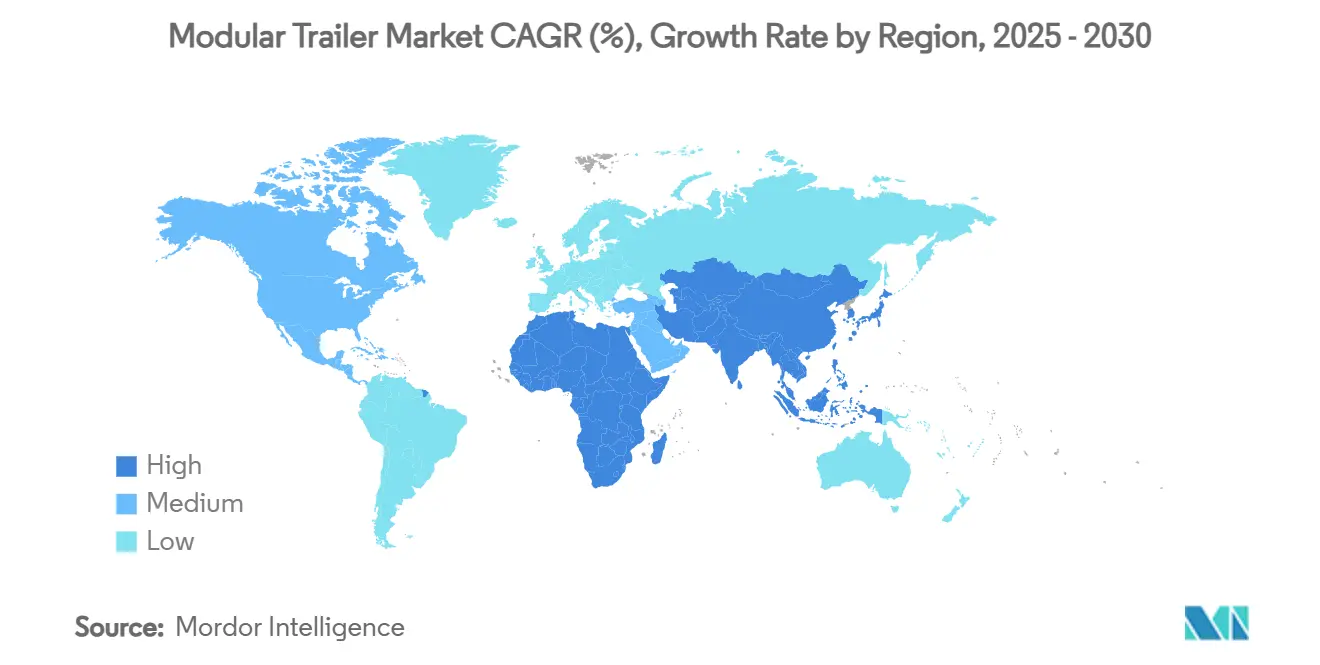
Asia-Pacific is emerging as the fastest-growing region, with a 7.80% CAGR projected through 2031. This growth is driven by Southeast Asia's significant infrastructure development, which requires over USD 26 trillion in transport investments by 2030. Freight transport demand is expected to increase by nearly 80% between 2015 and 2030. Maritime shipping is anticipated to dominate, accounting for 90% of freight tonne-kilometers, thereby creating opportunities for port-to-inland transport. The Southern Economic Corridor, which connects Bangkok, Phnom Penh, and Ho Chi Minh City, is facilitating cross-border trade and the development of logistics infrastructure. China's manufacturing dominance, combined with India's infrastructure development, is driving substantial demand for trailers. Additionally, Indonesia and other ASEAN nations are benefiting from improvements in regional connectivity.
EMEA and South America Modular Trailer Market
Europe maintains a significant market presence while addressing stringent CO₂ compliance requirements. By 2030, regulations mandate a 7.5% reduction in emissions for drawbar trailers and a 10% reduction for semi-trailers. South America and the Middle East-Africa regions exhibit slower growth, constrained by infrastructure gaps and permit bottlenecks, yet niche opportunities are emerging. Brazil's wind-energy pipeline and Mexico's nearshoring-driven construction are the primary drivers in South America.
Geographic Market Expansion Assessment (Raw Score (1–5): 1 = Low, 5 = High. Weighted Score: Raw Score × assigned weight; reflects importance-adjusted impact. Interpretation: Higher Opportunity = more attractive market; higher Risk = greater challenges.) of Modular Trailer Market
| Opportunity | Risk | |||||
|---|---|---|---|---|---|---|
| Regions | Ease of Entry (Raw/Weighted) | Market Size (Raw/Weighted) | Solution Fit (Raw/Weighted) | Competition (Raw/Weighted) | Investment (Raw/Weighted) | Barriers (Raw/Weighted) |
| North America | 3/0.9 | 5/1.5 | 5/1.5 | 5/1.5 | 5/1.5 | 4/1.2 |
| South America | 3/0.9 | 3/0.9 | 3/0.9 | 2/0.6 | 3/0.9 | 3/0.9 |
| Europe | 2/0.6 | 4/1.2 | 4/1.2 | 5/1.5 | 4/1.2 | 5/1.5 |
| Asia-Pacific | 5/1.5 | 5/1.5 | 5/1.5 | 4/1.2 | 4/1.2 | 3/0.9 |
| Middle East and Africa | 3/0.9 | 4/1.2 | 3/0.9 | 3/0.9 | 4/1.2 | 4/1.2 |
| Source: Mordor Intelligence | ||||||
Competitive Landscape
European manufacturers maintain a dominant position in the modular trailer market by capitalizing on technological advancements and large-scale manufacturing capabilities. Schmitz Cargobull, a prominent player in the market, continues to consolidate its position by increasing its European market share, producing approximately 60,000 vehicles annually, and generating EUR 2.4 billion in revenue. Strategic partnerships are playing a pivotal role in reshaping the competitive landscape. For example, Schmitz Cargobull has acquired a 26% stake in Australia's MaxiTRANS, while Faymonville Group is expanding its footprint in North America by developing a facility in Arkansas. Technological advancements, particularly in electrification, are driving differentiation. ZF's TrailTrax system partnerships and Range Energy's eTrailer are notable examples, achieving annual savings of up to USD 20,000 per trailer.
The market is witnessing emerging opportunities in autonomous trailer systems and the integration of smart telematics. This is evident from patent applications for technologies such as bearing condition monitoring and power supply optimization. Regulatory compliance requirements, particularly the EU CO₂ standards, are intensifying competition and creating opportunities for companies that develop aerodynamic and lightweight solutions. Emerging disruptors include defense contractors like Rheinmetall, which partnered with Nooteboom in March 2026 to develop military heavy-equipment transporters with integrated e-axles, potentially pioneering autonomous trailer movement before civilian adoption scales.
The introduction of Trailers-as-a-Service models is transforming traditional ownership structures within the market. Wabash's national network approach exemplifies this shift, focusing on utilization optimization rather than asset sales. This model is creating new competitive dynamics and altering the way companies approach trailer management. White-space opportunities are concentrated in extended-length platforms (more than 60 feet) for wind-energy logistics, where specialized engineering and permit expertise create barriers to entry, and in e-axle integration, where rare-earth-free motors like AEM's HDSRM150 insulate manufacturers from supply-chain volatility.
Modular Trailer Industry Leaders
-
Schmitz Cargobull
-
Goldhofer
-
Faymonville
-
Scheuerle (TII Group)
-
Wabash National Corporation
- *Disclaimer: Major Players sorted in no particular order

Modular Trailer Market Companies Covered in this Report
- Schmitz Cargobull
- Krone
- CIMC Vehicles
- Wielton
- Goldhofer
- Broshuis
- Kässbohrer
- Pacton
- Nooteboom
- Unitrailer
- Fliegl Fahrzeugbau
- Chereau
- Faymonville
- Scheuerle (TII Group)
- Wabash National Corporation
- Great Dane
- Kögel Trailer
- Hyundai Translead
- Tiger Trailers
- Schwarzmüller
Recent Industry Developments in Modular Trailer Market
- April 2026: Fruehauf unveiled new 2026 modular heavy-duty trailers at ScotPlant, including halfpipe and sloper configurations. These new builds are designed for construction and infrastructure logistics applications with higher durability and payload efficiency.
- March 2026: Goldhofer demonstrated its latest heavy-haul modular trailer and SPMT solutions at CONEXPO 2026, reinforcing its leadership in ultra-heavy transport systems.
- January 2025: Schmitz Cargobull announced expansion of its delivery center for refrigerated and box body semi-trailers at Vreden site, creating 750 new parking spaces and reducing CO₂ emissions by approximately 150 tonnes annually.
Global Modular Trailer Market Report Scope
Segmentation Overview
| Flatbed |
| Drop-deck |
| Step-deck |
| Low-boy |
| Tanker |
| Container Chassis |
| Single |
| Tandem |
| Tridem |
| Quad and Above |
| Carbon-steel |
| Aluminium |
| Hybrid Aluminium-Steel |
| Less than 48 ft |
| 48 to 53 ft |
| 53 to 60 ft |
| More than 60 ft |
| Construction and Infrastructure |
| Wind-Energy |
| Oil and Gas |
| Mining and Metals |
| Defense and Aerospace |
| North America | United States |
| Canada | |
| Rest of North America | |
| South America | Brazil |
| Mexico | |
| Rest of South America | |
| Europe | Germany |
| United Kingdom | |
| France | |
| Italy | |
| Spain | |
| Russia | |
| Rest of Europe | |
| Asia-Pacific | China |
| India | |
| Japan | |
| South Korea | |
| Indonesia | |
| Rest of Asia-Pacific | |
| Middle-East and Africa | United Arab Emirates |
| Saudi Arabia | |
| Turkey | |
| Egypt | |
| South Africa | |
| Rest of Middle-East and Africa |
| By Trailer Type | Flatbed | |
| Drop-deck | ||
| Step-deck | ||
| Low-boy | ||
| Tanker | ||
| Container Chassis | ||
| By Axle Configuration | Single | |
| Tandem | ||
| Tridem | ||
| Quad and Above | ||
| By Material | Carbon-steel | |
| Aluminium | ||
| Hybrid Aluminium-Steel | ||
| By Length | Less than 48 ft | |
| 48 to 53 ft | ||
| 53 to 60 ft | ||
| More than 60 ft | ||
| By End-user Industry | Construction and Infrastructure | |
| Wind-Energy | ||
| Oil and Gas | ||
| Mining and Metals | ||
| Defense and Aerospace | ||
| By Geography | North America | United States |
| Canada | ||
| Rest of North America | ||
| South America | Brazil | |
| Mexico | ||
| Rest of South America | ||
| Europe | Germany | |
| United Kingdom | ||
| France | ||
| Italy | ||
| Spain | ||
| Russia | ||
| Rest of Europe | ||
| Asia-Pacific | China | |
| India | ||
| Japan | ||
| South Korea | ||
| Indonesia | ||
| Rest of Asia-Pacific | ||
| Middle-East and Africa | United Arab Emirates | |
| Saudi Arabia | ||
| Turkey | ||
| Egypt | ||
| South Africa | ||
| Rest of Middle-East and Africa | ||
Key Questions Answered in the Report
What is the current size of the modular trailer market?
The modular trailer market size is expected to reach SD 9.39 billion in 2026 and is forecast to reach USD 12.23 billion by 2031.
Which region will grow fastest?
Asia-Pacific is projected to record the highest 7.80% CAGR through 2031 on the back of a USD 26 trillion infrastructure pipeline.
How are EU regulations affecting trailer design?
EU 2019/1242 obliges drawbar and semi-trailers to cut CO₂ by 7.5% and 10% respectively by 2030, spurring wider adoption of lightweight materials and aerodynamic kits.
Which trailer type is expanding most quickly?
Low-boy trailers are advancing at an 8.20% CAGR owing to heightened wind-energy and heavy-equipment transport needs.