
Market Overview
| Study Period | 2019 - 2031 |
|---|---|
| Market Size (2026) | USD 55.38 Billion |
| Market Size (2031) | USD 70.74 Billion |
| Growth Rate (2026 - 2031) | 5.02 % |
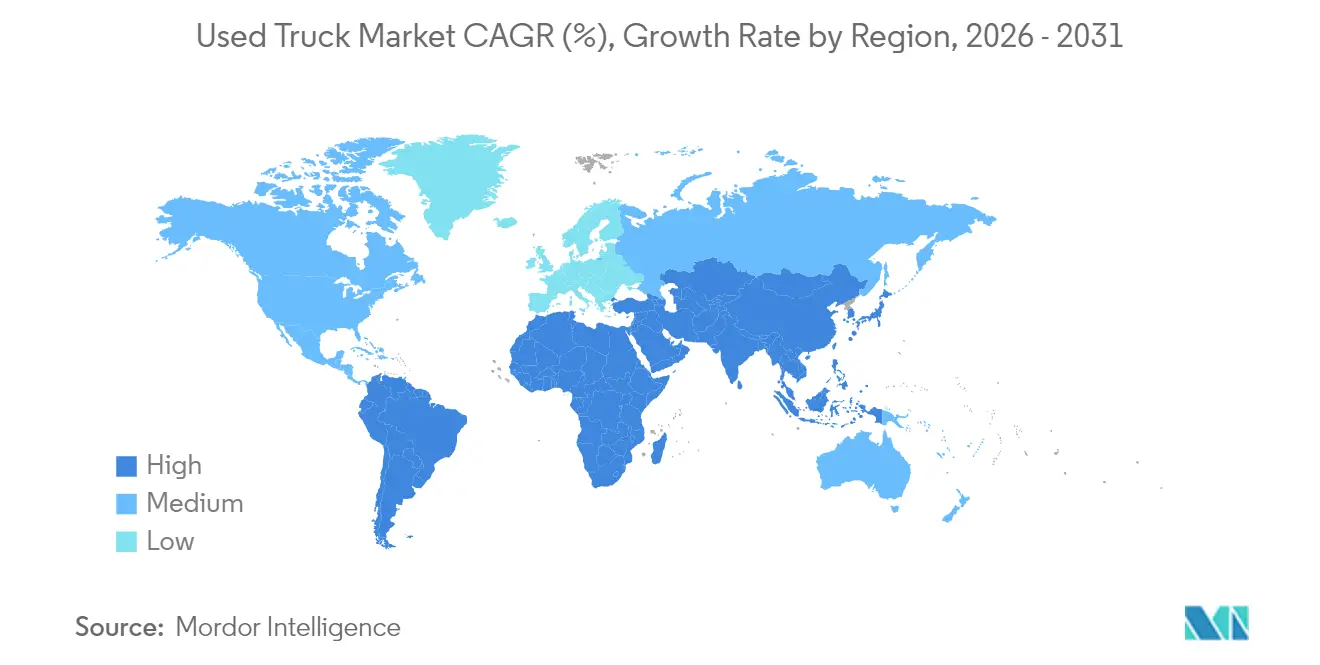
| Fastest Growing Market | Middle East and Africa |
| Largest Market | Asia-Pacific |
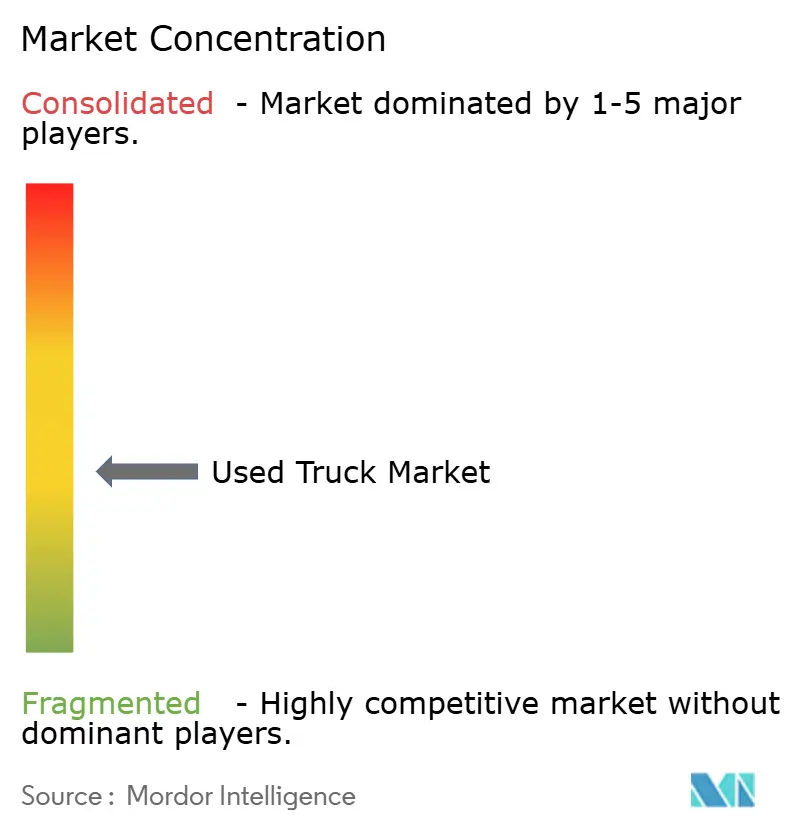
| Market Concentration | Medium |
Major Players *Disclaimer: Major Players sorted in no particular order Image © Mordor Intelligence. Reuse requires attribution under CC BY 4.0. | |
Used Truck Market Analysis by Mordor Intelligence
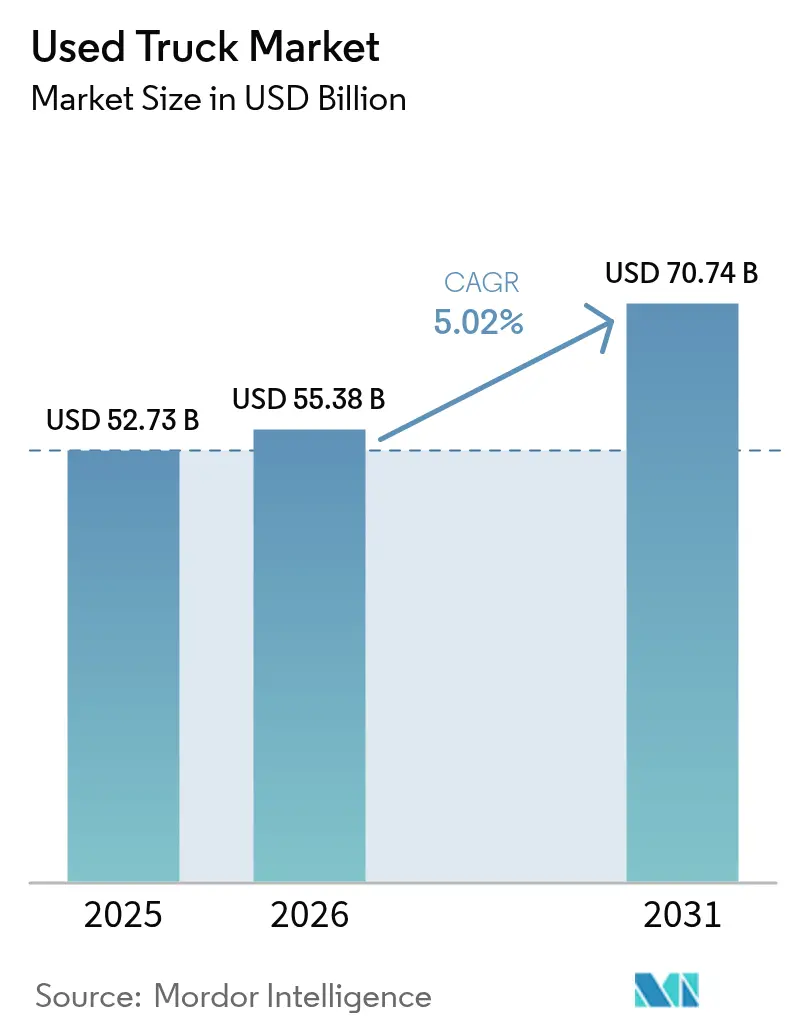
The used truck market size is expected to increase from USD 52.73 billion in 2025 to USD 55.38 billion in 2026 and reach USD 70.74 billion by 2031, growing at a CAGR of 5.02% over 2026-2031. This expansion reflects a structural shift in fleet-ownership economics as carriers weigh up-front capital constraints against tightening emission rules and rising digital-auction penetration. Heavy-duty models still anchor residual values, but last-mile demand is tilting growth toward lighter classes. Digital marketplaces are compressing information gaps, while certified pre-owned programs from leading truck makers are raising trust in the secondary channel. Supply patterns also hinge on regulatory divergence, with European NOx limits discouraging older imports even as scrappage incentives in India remove aged inventory and lift prices for mid-life assets.
Key Report Takeaways
- By vehicle type, heavy-duty trucks led the used truck market with a 43.57% share in 2025, while light trucks are projected to expand at a 7.69% CAGR to 2031.
- By fuel type, diesel held a commanding 93.36% used truck market share in 2025, while the hybrid and battery-electric segment is expected to post a 22.55% CAGR through 2031.
- By age bracket, 4-7-year-old vehicles accounted for 38.39% of the used-trucks market in 2025, whereas trucks up to 3 years old are set to post a 9.23% CAGR through 2031.
- By vehicle class, Class 8 maintained 39.42% of the used truck market share in 2025, whereas Class 4 is set to grow at a 7.18% CAGR between 2026 and 2031.
- By end-use industry, logistics and e-commerce led the used truck market with a 35.27% share in 2025, while construction and infrastructure are projected to register a CAGR of 9.02% through 2031.
- By sales channel, independent dealers captured 53.94% of 2025 revenues, while online peer-to-peer and auction platforms are advancing at a 12.31% CAGR to 2031.
- By geography, Asia-Pacific retains the world’s most extensive regional fleet base, capturing 47.92% market share. In contrast, the Middle East and Africa are expected to lead regional growth, posting a 7.41% CAGR to 2031.
Note: Market size and forecast figures in this report are generated using Mordor Intelligence’s proprietary estimation framework, updated with the latest available data and insights as of 2026.
Market Trends and Insights
Drivers Impact Analysis of Used Truck Market*
| Driver | (~) % Impact on CAGR Forecast | Geographic Relevance | Impact Timeline |
|---|---|---|---|
| Infrastructure-Led Construction Booms | +1.2% | India, ASEAN core (Indonesia, Vietnam, Thailand) | Medium Term (2-4 Years) |
| E-Commerce Last-Mile Expansion | +1.0% | North America, with spillover to urban Latin America | Short Term (≤ 2 Years) |
| OEM Certified Pre-Owned Programs | +0.8% | Europe (Germany, France, UK, Italy, Spain) | Medium Term (2-4 Years) |
| Digital Wholesale Auctions | +0.7% | Middle East, North Africa, with global digital reach | Short Term (≤ 2 Years) |
| Fleet Electrification Targets | +0.6% | China, with secondary effects in Southeast Asia | Medium term (2-4 years) |
| Tax Incentives on Used Commercial Vehicles | +0.4% | Brazil, with potential extension to Argentina and Chile | Short term (≤ 2 years) |
| Source: Mordor Intelligence | |||
Infrastructure-Led Construction Booms in India and ASEAN Stimulating Heavy Used-Truck Turnover
The National Infrastructure Pipeline earmarks more than USD 1.4 trillion to transport and logistics projects, which is raising heavy-duty registrations that later flow into the used truck market[1]. Large projects such as highway corridors and port expansions shorten ownership cycles because contractors prefer asset-light balance sheets once projects end. Resulting mid-life trucks enter secondary channels in good condition, attracting small builders that cannot finance new equipment. India’s 2024 scrappage policy, offering registration-fee waivers for retiring trucks aged over 15 years, removes aged assets and supports unit values in the 4-to-7-year window[2]. Comparable public works agendas in Indonesia and Vietnam have similar knock-on effects, ensuring a stable pipeline of compliant, late-model heavy dumpers and tractors.
E-commerce Last-Mile Expansion in North America Triggering Demand for Used Light-Duty Trucks
Rapid parcel growth led carriers to open micro-hubs that rely on Class 3-5 box trucks for same-day delivery. Compliance deadlines under the U.S. Environmental Protection Agency’s Clean Truck Plan, finalized in 2024, encourage fleets to retire diesel models before 2027 NOx ceilings take hold[3]. Turnover raises the supply of low-mileage units that owner-operators can afford. In parallel, zero-emission pilot zones in several U.S. metros spur early adopters to remarket first-generation electric vans, broadening fuel mix in the secondary channel without sacrificing range for urban drops. Light-truck absorption remains robust because these vehicles require modest capital and deliver quick payback.
OEM Certified Pre-Owned Programs in Europe Enhancing Trust and Residual Values
Truck makers now refurbish returned lease units under standardized checklists and attach multi-year powertrain warranties, strengthening confidence in the Used Truck Market. Buyers gain transparency into mileage, repair history, and telematics data, helping reduce volatility in the total cost of ownership. Demand for certified units rose after the European Commission’s Corporate Sustainability Reporting Directive made Scope 3 disclosures mandatory from 2024. Large shippers thus prefer documented fuel-efficient vehicles over unverified inventory. National development banks in Germany and France extend low-interest lines to small hauliers acquiring Euro VI-E-compliant CPO trucks, reinforcing take-up.
Digital Wholesale Auctions Broadening Buyer Pool, Especially in Middle East
Online bidding removes geographic constraints, enabling Gulf-based firms to source surplus inventory from Europe and North America in real time. Blockchain-backed title tools cut fraud risk and entice banks to underwrite cross-border invoices. The schemes mesh with regional logistics visions that aim to diversify oil economies via freight corridors. Importers value Euro V and Euro VI trucks that comply with local sulfur mandates but still cost less than new purchases, supporting growth in the used truck market. The convenience of door-to-door shipping quotes within auction dashboards further accelerates platform shift.
Restraints Impact Analysis of Used Truck Market*
| Restraint | (~) % Impact on CAGR Forecast | Geographic Relevance | Impact Timeline |
|---|---|---|---|
| Tightening Euro-VII/Phase-3 NOx Rules | -0.5% | European Union, with spillover to UK and Norway | Medium term (2-4 years) |
| Low-Cost New Chinese Trucks | -0.4% | Sub-Saharan Africa, North Africa | Medium term (2-4 years) |
| Limited Financing Options | -0.3% | ASEAN rural markets (Indonesia, Philippines, Vietnam) | Long term (≥ 4 years) |
| Chip Shortages | -0.2% | Global, with pronounced effects in North America and Europe | Short term (≤ 2 years) |
| Source: Mordor Intelligence | |||
Tightening Euro-VII/Phase-3 NOx Rules Discouraging Older Diesel Imports in EU
Starting in 2027, the Euro VII framework will prohibit many pre-Euro VI trucks from accessing low-emission corridors, effectively dampening the demand for older diesel vehicles. In Germany and the UK, municipal clean-air zones are penalizing heavy vehicles that don't meet compliance standards, further dissuading potential buyers. Importers are shifting their focus to Eastern Europe and North Africa for liquidating these vehicles, influencing the used truck market. This shift is narrowing the pool of buyers within the EU and driving up prices for compliant Euro VI vehicles.
Low-Cost New Chinese Trucks Compressing Used Price Premiums in Africa
New heavy-duty models from Chinese OEMs are priced significantly lower, around 30-40% less, than their Western counterparts, which limits the resale value of imported trucks aged 4-7 years. In African cities, the improved availability of spare parts has reduced the maintenance benefits that European brands previously offered, thereby tightening profit margins for traditional exporters. To navigate this shift, traders with adaptable logistics strategies are redirecting inventory to markets like Latin America and Southeast Asia. However, these shifts come with challenges, including increased freight costs and extended delivery times, which constrain the growth potential of the used trucks market in these regions.
*Our forecasts treat driver/restraint impacts as directional, not additive. The impact forecasts reflect baseline growth, mix effects, and variable interactions.
Used Truck Market Segment Analysis
By Vehicle Type:
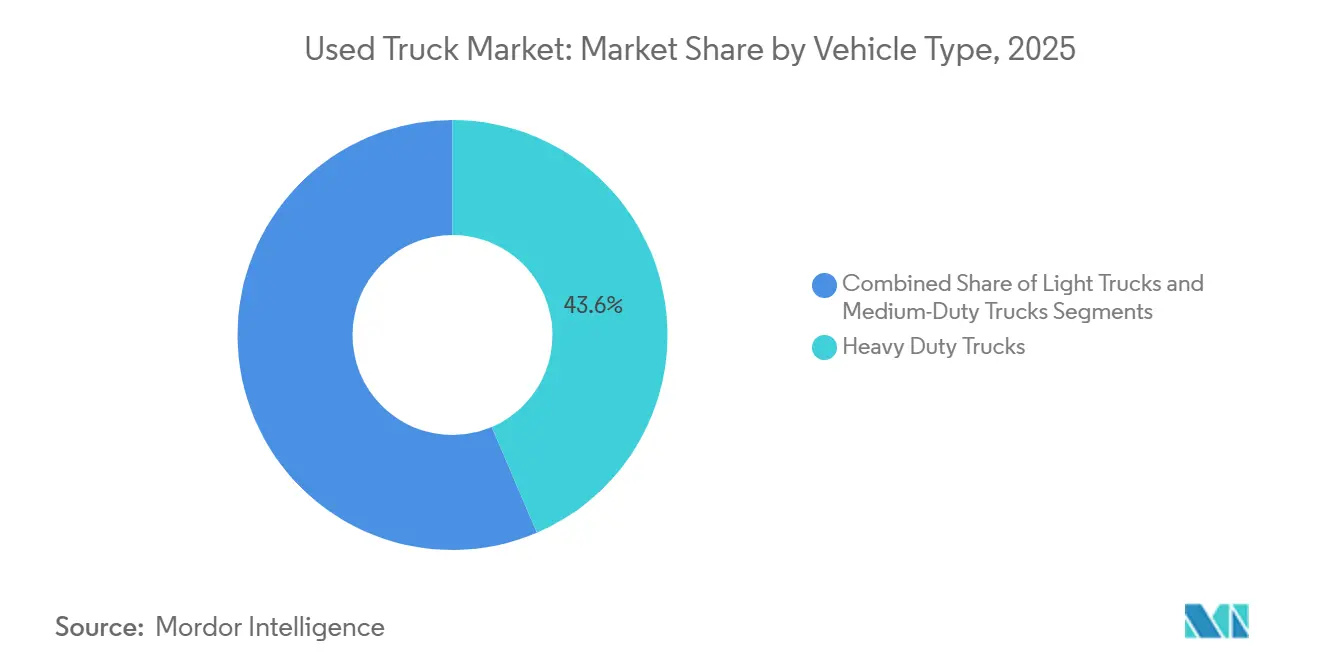
Heavy-Duty Trucks Remain Dominant While Light Trucks AccelerateHeavy-duty trucks captured 43.57% of the used-truck market share in 2025, underscoring their entrenched role in long-haul freight and infrastructure hauling. They remain the preferred choice for fleets that prioritize payload capacity, durability, and an extensive service network. Yet tightening emission rules and shifting delivery patterns are prompting operators to reassess fleet composition, opening space for lighter formats that better suit urban corridors. Manufacturers are responding by broadening certified pre-owned programs that include turnkey maintenance bundles, raising buyer confidence in previously owned heavy rigs. Against this backdrop, residual values for well-maintained heavy-duty units stay resilient even as buyers diversify into smaller classes.
Light trucks in the Class 3–5 band are projected to expand at a 7.69% CAGR through 2031, the fastest pace among all weight classes in the used-truck market. This surge reflects last-mile e-commerce growth, municipal clean-air initiatives, and lower capital hurdles for independent owner-operators. Fleets cycling out of first-generation electric vans are releasing late-model diesel and battery-electric light trucks into secondary channels, offering budget-minded buyers multiple propulsion choices. Urban delivery contracts often specify tight turning radii and low curb weights, making light trucks the logical selection for same-day routes. Digital auction houses expand access to these assets by publishing telematics data and inspection reports, thereby shortening due diligence cycles.

By Fuel Type:
Diesel Dominates but Electrification Momentum BuildsDiesel engines retained 93.36% of the used truck market share in 2025, supported by ubiquitous fueling infrastructure and proven reliability in high-torque duty cycles. Operators value the established parts ecosystem and the predictable maintenance intervals associated with diesel powertrains. Even as zero-emission mandates tighten, many carriers hedge compliance risk by refreshing to newer, cleaner diesel models rather than switching to propulsion entirely. Certified pre-owned channels reinforce this trend by bundling extended engine warranties and advanced telematics for mileage verification. Consequently, diesel continues to anchor price discovery across dealer lots and digital platforms alike.
Hybrid and battery-electric trucks are scaling at a 22.55% CAGR through 2031, the swiftest rate across the fuel type spectrum. Early adopters who trialed first-wave electric rigs now release them into resale pools, creating an emerging inventory stream for smaller fleets eager to test zero-tailpipe technology. Government incentives, such as scrappage credits or clean-transport rebates, further tilt economics in favor of electrified options. Buyers weigh the lower operating costs of electricity against the uncertainty of battery health, making OEM-issued battery-warranty transfers a critical differentiator. Over time, improved charging networks and standardized diagnostics are expected to normalize valuation models for used electric trucks.
By Age Bracket:
4–7 Years Remain the Sweet SpotTrucks aged 4 to 7 years accounted for 38.39% of transactions in 2025, setting the benchmark for liquidity in the used truck market. These assets typically fall just outside factory warranty yet carry complete service histories, allowing buyers to balance price against remaining life. Leasing companies and large corporate fleets often rotate vehicles at this interval to maintain uptime targets, feeding a steady pipeline into independent dealerships. Dealers recondition these units and append limited warranties that mimic new-truck assurances, reinforcing mid-cycle value. For buyers in emerging markets, this bracket offers a combination of modern emissions compliance and manageable acquisition costs.
Units under 3 years old are advancing at a 9.23% CAGR through 2031, the fastest growth inside the age matrix. OEM buy-back schemes accelerate this flow by guaranteeing remarketing outlets and stabilizing residual values. Younger equipment often comes bundled with transferable telematics subscriptions, enabling predictive maintenance that appeals to data-driven fleets. Financial institutions view low-mileage assets as lower-risk collateral, expanding financing availability for small operators. The combination of technology features, remaining warranty coverage, and favorable loan terms supports rapid turnover in this segment.
By Vehicle Class:
Class 8 Leads, Class 4 Moves FastestClass 8 tractors accounted for 39.42% of the used truck market share in 2025, reflecting their indispensability to bulk freight corridors and cross-border commerce. Long-distance hauliers rely on the payload advantages and aerodynamic refinements of these heavy rigs to optimize cost per mile. A robust dealer network keeps downtime to a minimum through readily available parts and trained technicians. Even as lighter classes gain traction in urban delivery, Class 8 units continue to anchor the resale ecosystem for fleet renewal strategies. Their dominance also encourages auction houses to curate specialized lanes for this class, thereby improving price transparency.
Class 4 trucks are forecast to register the quickest uptick at a 7.18% CAGR through 2031. Urban logistics firms favor narrower frames and compliance with evolving low-emission zone regulations. Municipal authorities often grant Class 4 vehicles preferential access and parking permits, reinforcing demand. Refurbishers can upfit these chassis with refrigerated boxes, flatbeds, or utility booms, broadening end-use appeal. Digital marketplaces expedite cross-country sourcing of Class 4 units, matching surplus fleet inventory with emerging last-mile operators.
By End-use Industry:
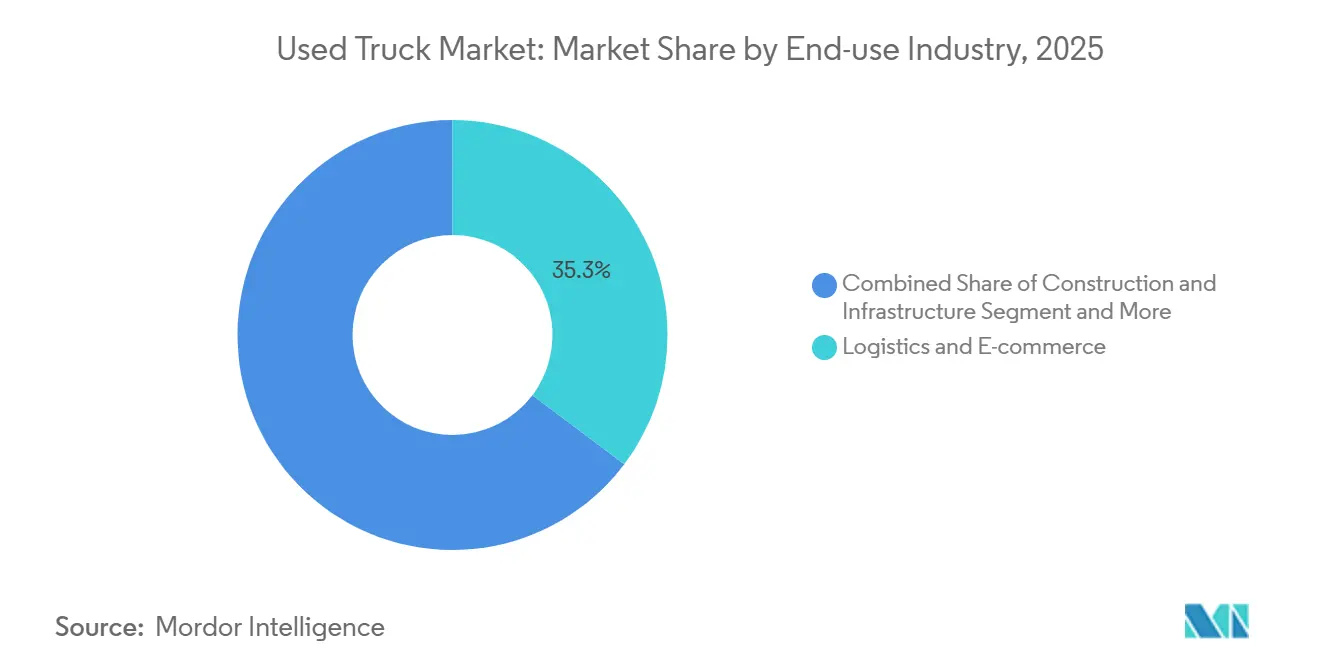
Logistics and E-commerce DominateLogistics and e-commerce delivery captured 35.27% of the used-truck market share in 2025, mirroring continued online retail expansion and consumer expectations for faster fulfillment. Parcel carriers rotate assets frequently to maintain service reliability, enriching the secondary pool with relatively young, well-spec’d trucks. Telematics-enabled route optimization favors vehicles that integrate seamlessly with fleet-management software, a factor now common in used-truck listings. Warehousing networks sited near urban centers amplify short-haul demand that lighter trucks efficiently meet. Consequently, logistic operators remain the primary price-setters across multiple weight classes.
Construction and infrastructure projects are projected to grow at a 9.02% CAGR, the highest among end-use categories. Governments in Asia and Latin America are allocating substantial budgets for roads, ports, and public facilities, prompting contractors to acquire rugged tippers and concrete mixers. These buyers appreciate the cost advantages of reliable mid-life trucks over new units that face immediate depreciation. Seasonal project cycles ensure a recurring flow of equipment back into resale lanes once work concludes, supporting a circular market dynamic. The segment also benefits from favorable lending programs for small subcontractors, keeping demand buoyant through economic cycles.
By Sales Channel:
Independent Dealers Hold Ground, Digital Marketplaces SurgeIndependent dealers controlled 53.94% of the used truck market share in 2025, underscoring their pivotal role in localized asset remarketing. They cultivate community relationships, tailor payment schedules, and often package trade-in deals that resonate with small fleet owners. In-house service bays enable quick turnaround for reconditioning, shortening the time assets sit idle. Face-to-face negotiation remains a cultural norm in many regions, preserving the relevance of brick-and-mortar yards. Dealer consortia are also investing in online storefronts to widen geographic reach without diluting relationship capital.
Online peer-to-peer and auction platforms are set to climb at a 12.31% CAGR, outpacing all other channels. Transparent pricing dashboards and remote inspection tools reduce information asymmetry, drawing in first-time buyers who value convenience. Cross-border logistics integration lets Middle Eastern and African importers source compliant Euro-standard trucks without travel, shrinking procurement cycles. Blockchain-anchored title verification builds lender confidence, unlocking new financing avenues. As platform algorithms refine asset matching, digital channels are expected to capture greater mindshare among tech-savvy operators.
Geography Analysis
APAC Used Truck Market
Asia-Pacific accounted for 47.92% of global volume in 2025, cementing its position as the nucleus of the used truck market. Infrastructure megaprojects in India and Southeast Asia keep heavy-duty units circulating swiftly between primary and secondary owners. China’s electrification trajectory is prompting fleets to sell diesel stock earlier in the lifecycle, enriching export pipelines across the region. Digital auction hubs in Singapore and Bangkok simplify cross-border trade, tightening regional price spreads. Collectively, these factors reinforce Asia-Pacific’s standing as both the largest demand center and an increasingly sophisticated supply hub.
North America Used Truck Market
North America sustains steady activity as e-commerce networks grow denser and carriers pre-empt stricter EPA rules by refreshing assets. The easing of semiconductor bottlenecks improves new-truck availability, but many smaller fleets still gravitate toward used alternatives to conserve capital. State-level incentives for low-emission trucks create a selective appetite for late-model diesel and emerging electric units. Auction facilities across the Midwest and Southeast now livestream events, attracting buyers well beyond local markets. The region’s mature financing infrastructure further lubricates transaction velocity.
MEA Used Truck Market
The Middle East and Africa region is poised for the fastest expansion, with a 7.41% CAGR through 2031. Gulf logistics visions emphasize multimodal freight corridors, driving appetite for heavy tractors that meet Euro V and Euro VI benchmarks. Online auctions connect regional buyers with surplus inventory in Europe and North America, compressing historical supply gaps. In Africa, the influx of competitively priced trucks strengthens trade routes that serve mining and agriculture. These dynamics collectively elevate the region from a peripheral participant to a focal growth frontier.
Regulatory Landscape
Regulation shaping the used truck market is increasingly anchored in emissions compliance and roadworthiness enforcement, which affects which model years can be operated, resold, or exported. In the United States, the Environmental Protection Agency (EPA) finalized Phase 3 greenhouse-gas emissions standards for heavy-duty vehicles in 2024, with phased-in requirements starting in model year 2027 and extending to model year 2032 and later. This timeline pushes fleets to manage replacement timing and the flow of late-model units into the secondary channel.
In Europe, policy direction on circularity and used-vehicle exports is tightening alongside in-use access restrictions tied to emissions classes. The European Union is advancing revisions to End-of-Life Vehicles (ELV) and related type-approval rules that include measures aimed at limiting exports of non-roadworthy used vehicles. The stricter approach raises compliance expectations for exporters and inspection providers and supports price premiums for verified, compliant inventory across cross-border auction lanes.
Value Chain Analysis
The used truck value chain begins with supply creation from fleet rotations (leasing and large shippers), OEM buyback and certified pre-owned pipelines, and trade-ins collected by independent and franchised dealers. It then moves through inspection, reconditioning, pricing, and remarketing via dealer lots and online auction platforms. Digital marketplaces and auction operators increasingly standardize condition reporting and payment processes, while OEM-backed programs add warranty and telematics-based service history to reduce information asymmetry, particularly for 3-to-7-year-old trucks.
Downstream execution is shifting toward logistics-led operations, with transport, title/registration handling, and cross-border shipping playing a larger role in cycle time and realized margins. Technology integrations between auction ecosystems and vehicle logistics providers are speeding up post-sale movement, including Super Dispatch partnering with Copart (July 2025) to enable immediate shipping options after purchase. The consolidation of auto logistics operations under shared platforms (SYCN Auto Logistics, Mercury Auto Transport, and Rite Way Auto Transport Group, August 2025) is also designed to move higher volumes with tighter dispatch and pricing control. Taken together, digital remarketing paired with integrated delivery reduces days-to-sell and expands the buyer radius for assets moving from North America and Europe to the Middle East, Africa, and selected Asia-Pacific corridors.
Competitive Landscape
The competitive environment is moderately concentrated, anchored by five global truck makers that operate certified pre-owned programs spanning inspection, warranty, and telematics. Such programs stabilize residual values and funnel repeat customers back into OEM ecosystems for parts and service. Auction giants add liquidity by offering real-time bidding and secured payment rails, making cross-border purchases routine. Independent dealers maintain relevance through community ties and bespoke financing, countering margin pressure with value-added reconditioning. Telematics vendors further empower buyers by surfacing asset-health data previously limited to primary owners.
Digital disruption continues to redraw boundaries among stakeholders. Auction platforms integrate blockchain-based title verification, lowering fraud risk and drawing institutional capital into floorplan financing. OEMs experiment with subscription-style aftercare on sold units, prolonging customer engagement beyond the point of sale. Dealers respond by forming alliances with fintech start-ups to streamline loan approvals and extend reach into underserved regions. As data transparency rises, price discovery tightens, leaving service quality as a chief differentiator in buyer decision-making.
Sustainability mandates are also shaping strategy. Manufacturers emphasize fuel-efficient powertrains and predictive maintenance packages to align with transport decarbonization targets. Fleets pursuing scope-based emissions reporting increasingly favor certified units whose fuel economy and service records are verifiable. Auction houses collaborate with environmental agencies to tag listings with emission-standard badges, easing compliance checks for buyers. Collectively, these moves underscore how regulatory forces, technology integration, and shifting customer expectations converge to shape competitiveness in the used-truck arena.
Used Truck Industry Leaders
-
Scania AB
-
Daimler AG
-
PACCAR Inc.
-
Navistar International Corporation
-
AB Volvo
- *Disclaimer: Major Players sorted in no particular order
Used Truck Market Companies Covered in this Report
- Daimler AG (SelecTrucks)
- PACCAR Inc.
- Volvo Group
- Scania AB
- MAN Truck and Bus SE
- Navistar International Corp.
- Tata Motors
- Ashok Leyland
- Isuzu Motors
- Hino Motors
- Mitsubishi Fuso Truck and Bus Corp.
- Eicher Motors (VECV)
- Iveco Group N.V.
- Ford Otosan
- Sinotruk (CNHTC)
- FAW Jiefang
- Dongfeng Commercial Vehicles
- UD Trucks
- Penske Used Trucks
- Enterprise Truck Rental
- Ryder Used Vehicle Sales
- AmeriQuest Used Trucks
- Copart Inc.
- Ritchie Bros. Auctioneers
- Mascus
- TruckPlanet (IronPlanet)
- AutoNation USA
- OLX Autos Commercial
Market Opportunities and Future Outlook
Digital inspection-as-a-service and transaction enablement are clear growth areas as cross-border buying expands and regulators raise expectations for roadworthiness and emissions documentation. This shows up in auction activity and price discovery, with ACT Research reporting in 2026 that auction volumes outpaced retail dynamics in the United States, and that pricing firmed as inventory conditions shifted. The results support demand for standardized condition grading, remote inspections, and integrated logistics that reduce buyer risk on long-distance purchases.
Electrified trucks also create a distinct set of needs for remarketing, diagnostics, and warranty coverage. Valuation increasingly depends on battery health, software status, and charging access, not only drivetrain hours and chassis condition. Charging and fleet adoption programs provide real-world anchors for secondary-market infrastructure, including Amazon Relay integrating 75 heavy-duty electric trucks from Einride into its freight network (April 2026), and Australias Clean Energy Finance Corporation committing AUD 22 million to Zenobe to finance 148 Foton T5 battery-electric trucks for Woolworths (July 2026). As these trucks cycle through fleet refresh and redeployment decisions, OEMs, dealers, and platforms that can package battery-state reporting, transferable warranties, and depot-compatible charging pathways have a clearer basis to build trust and liquidity in used electric trucks.
Recent Industry Developments in Used Truck Market
- July 2026: CEFC committed AUD 22 million to Zenobe to finance 148 Foton T5 battery-electric trucks for Woolworths, signaling public-private funding to expand BEV freight capacity in Australasia. The move supports cross-border remarketing of BEV trucks and strengthens fleet electrification workflows across the regional supply chain.
- May 2026: ACT Research reported a shift in the United States Class 8 used market, with same-dealer retail sales down 13% in May while auction sales jumped 79%. The divergence highlights the role of auctions in clearing inventory and accelerating price discovery as buyers and sellers adjust to freight and funding conditions.
- July 2025: Rush Truck Centers partnered with Asset Intelligence Group to provide end-to-end remarketing solutions for financial institutions. The collaboration targets faster dispositions and better recovery values on repossessed or off-lease equipment, strengthening supply pipelines of higher-quality used trucks into dealer and auction channels.
Used Truck Market Report Scope and Research Methodology
Market Definition and Coverage
The used truck market is defined as the value of pre-owned trucks sold through organized and unorganized channels, where the vehicle has had at least one prior owner and is sold for continued commercial use in freight, construction, municipal, or similar operations.
This sizing excludes brand-new truck sales, and it also excludes parts, maintenance, insurance, and financing services that may be bundled around a transaction.
Segments Covered in This Report
- By Vehicle Type
- Light Trucks (Class 3-5)
- Medium-Duty Trucks (Class 6-7)
- Heavy-Duty Trucks (Class 8 and Over 15 t)
- By Fuel Type
- Diesel
- Gasoline
- Natural Gas and LPG
- Hybrid and Battery-Electric
- By Age Bracket
- Up to 3 Years
- 4 to 7 Years
- 8 to 12 Years
- Above 12 Years
- By Vehicle Class
- Class 3
- Class 4
- Class 5
- Class 6
- Class 7
- Class 8
- By End-use Industry
- Construction and Infrastructure
- Logistics and E-commerce Delivery
- Mining and Quarrying
- Agriculture and Forestry
- Municipal and Utilities
- Others
- By Sales Channel
- Independent Dealer
- Franchised Dealer
- OEM-Backed Certified Pre-Owned
- Online Peer-to-Peer and Auction
- By Geography
- North America
- United States
- Canada
- Rest of North America
- South America
- Brazil
- Argentina
- Chile
- Rest of South America
- Europe
- Germany
- United Kingdom
- France
- Italy
- Spain
- Russia
- Rest of Europe
- Asia-Pacific
- China
- India
- Japan
- South Korea
- Rest of Asia-Pacific
- Middle East and Africa
- United Arab Emirates
- Saudi Arabia
- Qatar
- South Africa
- Rest of Middle East and Africa
- North America
Data Sources, Market Sizing, and Validation
Desk Research
Desk work starts with public datasets that describe fleet activity and demand conditions before a used unit changes hands. We typically use national vehicle registration and parc statistics, road freight and logistics indicators, customs trade releases for commercial vehicles, and transport ministry publications that track trucking activity.
To keep assumptions grounded, we also rely on company annual reports, investor presentations, auction and dealer channel disclosures, and reputable press coverage on pricing and inventory swings. When needed, a paid subscription focused on company financials and news is used to cross-check revenue direction. For trade-linked supply signals in key corridors, an import-export shipment-level database is used to sanity check the direction implied by customs data. The sources mentioned are illustrative and not exhaustive, and many other references were consulted for data collection, validation, and clarification.
Primary Interviews and Surveys
Primary inputs are gathered through expert interviews and structured surveys with dealers, fleet operators, logistics buyers, financiers, and service ecosystem participants who see transaction volumes and pricing shifts in real time. We use this step to confirm how resale values move by age and class, understand how channel mix shifts across dealer networks, certified programs, auctions, and online listings, and pressure-test desk assumptions across APAC, EMEA, and the Americas.
Distribution of primary research fieldwork respondents
| Company type | Respondent position | Region |
|---|---|---|
| Top tier: 30% | CXOs: 12% | APAC: 51% |
| Mid tier: 54% | Functional/Unit leaders: 31% | EMEA: 29% |
| Smaller Players: 16% | Managers: 57% | Americas: 20% |
Market-Sizing & Forecasting
Sizing is built using a top-down approach where registration and parc trends are translated into a realistic used-transaction pool, and then converted into value using observed pricing by truck class and age. Totals are corroborated with selective bottom-up approximations, including sampled dealer and auction throughput checks and an ASP multiplied by estimated volumes in a few anchor markets. This helps adjust for over-counting and missing informal activity.
Key inputs used in the model include the in-service truck parc and replacement cycles, average holding periods by fleet type, the share of transactions occurring through organized channels, age brackets that influence resale value, and price movements tied to freight demand and credit availability. For forecasting, scenario analysis is used to reflect different paths for freight activity and interest rates, and the selected case is aligned with what primary respondents expect for inventory normalization and price progression. Where country data is patchy, we use regional proxies and then re-scale to match observable signals such as fleet growth and traded-unit trends.
Data Validation & Update Cycle
Outputs are checked through multiple passes so the final number stays consistent with real market signals. We compare results against independent indicators such as truck parc direction, used-to-new substitution patterns, and visible pricing trends, and we investigate outliers before sign-off.
When a large variance shows up, analysts re-check the underlying assumptions and may re-contact sources to understand whether the change is structural or temporary. Reports are refreshed annually, with interim updates when major events materially shift demand, supply, or pricing, and a final pre-delivery review is completed so clients receive the latest updated view.
Mordor Intelligence's Used Truck Market Size Measured Against Other Published Estimates
Published values for the used truck market can differ widely, even when they are referring to similar years, because the transaction definition, channel coverage, and pricing logic are rarely the same. Differences also come from how quickly assumptions are refreshed during periods when used prices and inventories swing.
The main gap often comes from whether the estimate counts only completed resale transactions versus also adding adjacent value pools such as off-road units, refurbishment services, or financing add-ons. Mordor Intelligence treats the market as the resale value of used truck transactions while keeping non-vehicle items outside the total. Another driver is how average selling prices are progressed by age and class, since mixing heavy-duty and lighter trucks without consistent weighting can lift or depress the headline number.
Benchmark comparison
| Source | Market Size | Gaps in Research Methodology |
|---|---|---|
| Mordor Intelligence | USD 52.73 B (2025) | |
| Global Consultancy A | USD 58.16 B (2025) | Often reflects broader channel capture and may apply higher blended ASP assumptions across light, medium, and heavy duty mixes, which can lift value when heavy-duty pricing is weighted more heavily. |
| Industry Publisher B | USD 53.96 B (2025) | May include adjacent categories such as off-road used trucks and may use a more aggressive growth setup for post-2025 pricing and demand, which shifts the implied baseline and the later-year curve. |
Across the three figures, the spread is mainly explained by scope choices and how pricing is averaged across truck classes and ages, followed by how quickly assumptions are updated when market conditions change. By tying the value to a clear transaction pool and then validating it with channel checks and independent fleet signals, the final estimate stays easier to reproduce and interpret for planning.
Key Questions Answered in the Report
What is the growth outlook for the used truck market through 2031?
It is projected to expand from USD 55.38 billion in 2026 to USD 70.74 billion by 2031, equating to a 5.02% CAGR.
Which vehicle type is expected to grow fastest in the secondary channel?
Light trucks in the Class 3-5 window are set to advance at about 7.69% CAGR on last-mile demand.
How are emissions rules shaping resale values in Europe?
Forthcoming Euro VII NOx limits narrow the buyer pool for older diesels, pushing up prices for Euro VI-compliant units.
Why are digital auctions important for Middle East buyers?
They provide direct access to Euro V and Euro VI inventory from Europe and North America, shortening procurement cycles and enhancing price discovery.
What role do certified pre-owned programs play?
CPO schemes add inspections and warranties, boosting buyer confidence and supporting residual values for 3-to-7-year-old trucks.