
Thailand Cold Chain Logistics Market Size and Share
Market Overview
| Study Period | 2020 - 2031 |
|---|---|
| Forecast Data Period | 2026 - 2031 |
| Base Year Market Size (2025) | USD 2.31 Billion |
| Market Size (2026) | USD 2.4 Billion |
| Market Size (2031) | USD 2.89 Billion |
| Growth Rate (2026 - 2031) | 3.79 % |
| Market Concentration | Low |
Major Players *Disclaimer: Major Players sorted in no particular order Image © Mordor Intelligence. Reuse requires attribution under CC BY 4.0. | |
Thailand Cold Chain Logistics Market Analysis by Mordor Intelligence
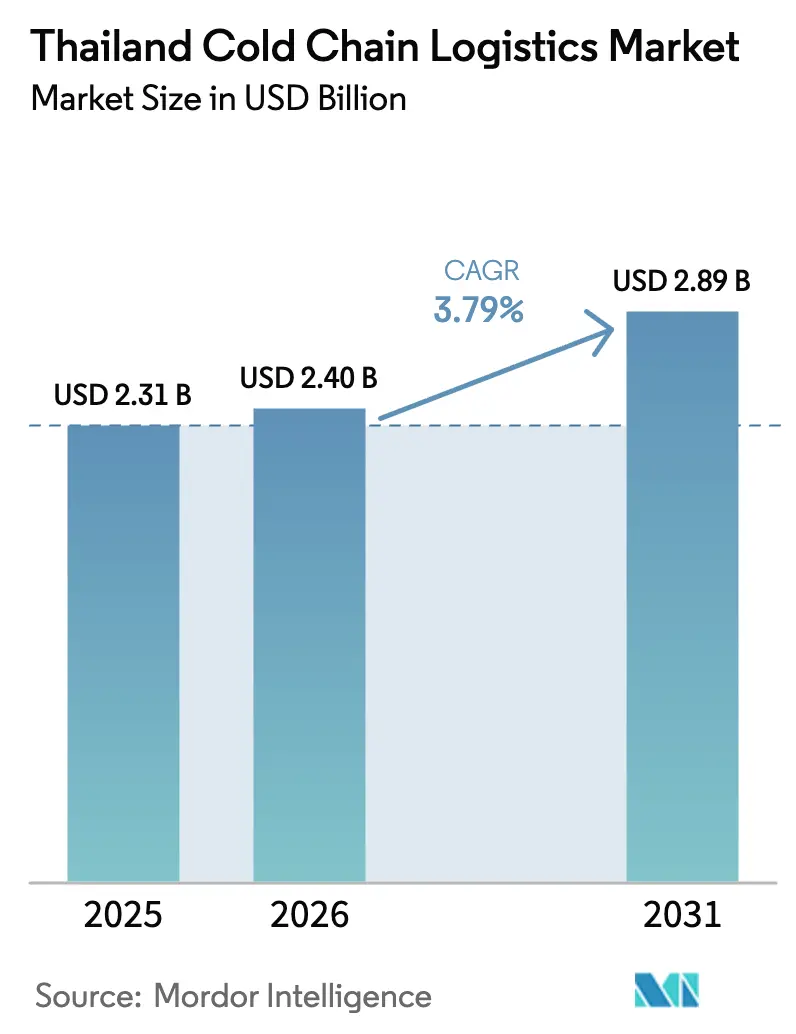
The Thailand Cold Chain Logistics market size is expected to grow from USD 2.31 billion in 2025 to USD 2.4 billion in 2026 and is forecast to reach USD 2.89 billion by 2031 at 3.79% CAGR over 2026-2031.
Consistent government outlays of THB 2.68 trillion (USD 78 billion) for multimodal infrastructure, coupled with the Eastern Economic Corridor’s (EEC) magnet effect on foreign direct investment, keep capital flowing into temperature-controlled storage and transport assets[1]Thailand Government PR Department, “Transport Min Launches 2.68 Trillion Baht Infrastructure Project,” thailand.prd.go.th. Energy-related cost relief, brought about by a scheduled tariff cut from THB 4.15 (USD 0.12) to THB 3.70 (USD 0.1) per unit, promises THB 100 billion (USD 2.9 billion) in annual savings for warehouse operators and retailers, sharpening the near-term competitiveness of the Thailand cold chain logistics market. Strategic automation—exemplified by PepsiCo’s 16,520-pallet automated storage and retrieval system—offsets a chronic labor shortfall while raising throughput accuracy. Intensifying vertical integration among food processors, drug distributors, and 3PLs is spurring consolidation, with the SCG-JWD merger forming a nationwide, multimodal platform able to bundle storage, transport, and value-added services into one offering.
Key Report Takeaways
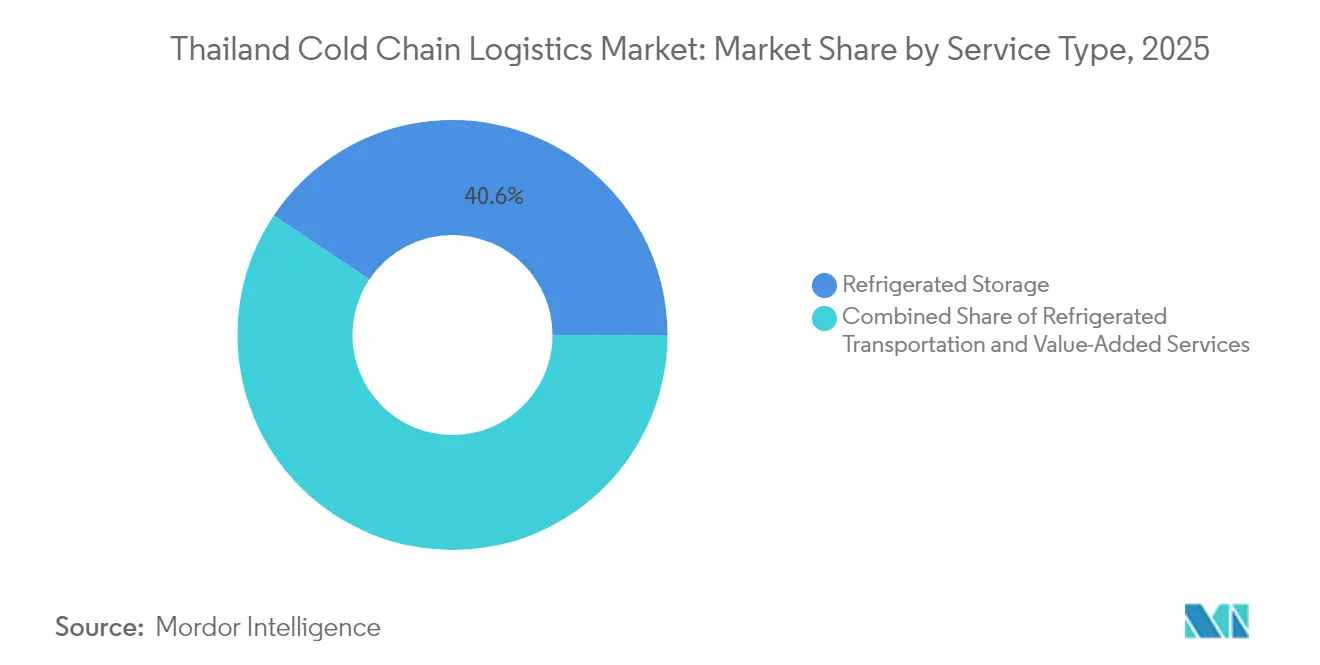
- By service type, Refrigerated Storage led with 40.62% of Thailand cold chain logistics market share in 2025, while Value-Added Services is poised for a 4.63% CAGR through 2031.
- By temperature band, Frozen storage held 52.55% of the Thailand cold chain logistics market size in 2025; Deep-Frozen/Ultra-Low facilities are forecast to expand at a 5.14% CAGR through 2031.
- By application, Meat & Poultry captured 21.74% of Thailand cold chain logistics market share in 2025; Pharmaceuticals & Biologics is projected to post a 5.88% CAGR to 2031.
- By region, the Central corridor commanded 28.72% of the Thailand cold chain logistics market size in 2025, while the Eastern region should realize a 4.18% CAGR on the back of EEC incentives.
Note: Market size and forecast figures in this report are generated using Mordor Intelligence’s proprietary estimation framework, updated with the latest available data and insights as of 2026.
Competitive positioning in Thailand includes both locally based firms and those operating across multiple regions. The market landscape in the global cold chain logistics industry research shows how these players are arranged internationally.
Thailand Cold Chain Logistics Market Trends and Insights
Drivers Impact Analysis*
| Driver | (~) % Impact on CAGR Forecast | Geographic Relevance | Impact Timeline |
|---|---|---|---|
| Boom in online grocery & meal-kit delivery | +0.8% | Central & Eastern | Short term (≤ 2 years) |
| Expansion of vaccine & biologics distribution network | +1.2% | Central hubs nationwide | Medium term (2-4 years) |
| Government EEC infrastructure subsidies | +0.9% | Eastern, spillover Central & Southern | Long term (≥ 4 years) |
| Automation & IoT for real-time temperature visibility | +0.7% | National | Medium term (2-4 years) |
| Rapid-freeze protocols for China fruit import rules | +0.5% | Northern & Central | Short term (≤ 2 years) |
| Net-zero warehousing incentives | +0.4% | Industrial zones nationwide | Long term (≥ 4 years) |
| Source: Mordor Intelligence | |||
Boom in Online Grocery & Meal-Kit Delivery
E-commerce adoption has accelerated the Thailand cold chain logistics market, especially for chilled and frozen grocery orders delivered within metropolitan Bangkok and EEC industrial towns. Reduced electricity charges under the tariff cut create margin headroom for last-mile couriers operating energy-intensive hubs[2]US-ASEAN Business Council, “Thailand's Electricity Price Cut Gains Private Sector Support,” usasean.org. Kerry Express and Betagro now co-brand the “Kerry Cool” network, letting retailers ship poultry, ready-to-eat meals, and desserts in insulated shippers overnight to 77 provinces. A rebound in Chinese tourist arrivals has lifted demand for meal-kit services catering to condo rentals and hotels, widening the addressable base. Ongoing Thai FDA consultations around beverage and ice labeling signal tighter hygiene oversight, which in turn boosts requirements for traceable, temperature-verified supply chains. Operators such as WICE Logistics are investing in cloud-based transport management systems and handheld scanners to deliver item-level visibility from dock to doorstep.
Expansion of Vaccine & Biologics Distribution Network
Thailand’s ambition to become a regional vaccine exporter aligns squarely with the Thailand cold chain logistics market. UPS Healthcare, DHL, and Logisteed have rolled out -20 °C freezers, 2-8 °C coolers, and -80 °C ultra-cold bays that comply with WHO GDP guidelines. The National Vaccine Policy’s 2023–2027 action plan positions domestic makers such as Siam Bioscience and BioNet Asia to scale biologic output, amplifying ultra-low demand in Central-region science parks. Real-time IoT sensors, pioneered locally by DataKind pilot programs, transmit humidity and shock alerts directly to qualified persons in charge, cutting excursion risk for live-virus formulations[3]DataKind, “AI & Data Science for Vaccine Deployment,” datakind.org. DHL Supply Chain has doubled dedicated healthcare pallet spots near Suvarnabhumi Airport, bundling customs brokerage, validated packaging, and final-mile dispatch. Economic modeling shows routine dengue vaccination could curb symptomatic cases by 41%-57%, underscoring the social payoff of resilient sub-zero infrastructure.
Government EEC Infrastructure Subsidies
Long-horizon subsidies and a 17% flat income tax for EEC investors de-risk green-field warehouse construction, making the corridor a beehive for multinational 3PLs. Laem Chabang Port’s Phase 3 upgrade lifts container capacity to 18 million TEUs by 2026, shortening dwell time for reefer boxes destined for China and Japan. Land sales in EEC industrial estates jumped 53% in H1-2024, pushing land prices to THB 6.7 million (USD 196,430) per rai, a signal that operators want proximity to dual-carriage expressways and LNG-ready power grids. Sumisho Global Logistics now positions dedicated reefer trucks in Chonburi to service automotive, dairy, and plasma derivative cargo in one circuit. Smart-port roadmaps mandating shore-power hookups and customs single-window systems trim clearance cycles, giving exporters a cost-per-kilogram edge when routing frozen chicken or durian pulp to North Asia.
Automation & IoT for Real-Time Temperature Visibility
Labor shortages, particularly certified refrigeration mechanics, have sped up capital spending on conveyor robotics, shuttle systems, and predictive maintenance platforms. PepsiCo’s Rojana facility leverages a Dematic AS/RS—Thailand’s tallest at 32 meters—to double throughput per square meter while keeping variance within ±0.5 °C across 16,520 pallets. CP Foods loops edge-AI cameras into hatcheries and grow-out barns, enabling batch-level tracing from farm to distribution dock. AutoStore’s Rayong robot plant will supply cube-storage modules that fit into Thailand's cold chain logistics market depots as small as 500 sqm, opening automation to mid-tier distributors. MOL’s OMEGA 1 Bang Na complex, set for 2027 delivery, stacks ambient and 0 °C rooms in mezzanine tiers to shrink travel distance between pick faces. Predictive analytics tie compressor vibration readings to maintenance support tickets, raising uptime and preserving product quality.
Restraints Impact Analysis*
| Restraint | (~) % Impact on CAGR Forecast | Geographic Relevance | Impact Timeline |
|---|---|---|---|
| High electricity tariffs & fuel surcharges | -0.6% | National | Short term (≤ 2 years) |
| Cold-room equipment breakdown & downtime risk | -0.4% | National | Medium term (2-4 years) |
| Shortage of certified refrigeration technicians | -0.3% | National | Medium term (2-4 years) |
| Costly retrofit to low-GWP refrigerants | -0.2% | National | Long term (≥ 4 years) |
| Source: Mordor Intelligence | |||
High Electricity Tariffs & Fuel Surcharges
Energy still commands as much as 30% of warehouse operating cost despite the tariff cut, and EGAT’s debt overhang may force surcharge reinstatements after 2026. Switching to CO₂ systems cuts kilowatt-hour consumption but entails a USD 0.5 million retrofit for a 10,000-pallet site, a hurdle for SMEs. Betagro sidesteps this by coupling rooftop solar with ice-bank thermal storage to shave peak-hour demand. Haulers face similar fuel surcharges, with biodiesel B20 adoption providing only marginal cost relief.
Cold-Room Equipment Breakdown & Downtime Risk
Compressor failures threaten batch loss worth USD 250,000 per incident for pharmaceutical cargo. A 2024 survey showed 69% of SME warehouses lacked vibration sensors to flag bearing wear, prolonging unplanned outages. Konoike Cool Logistics implements monthly thermographic scans and boroscopic inspections, reducing chiller downtime by 18% year-on-year. Industry training pipelines remain shallow; only 420 technicians nationwide hold Category II ammonia certifications. Predictive maintenance platforms tether IoT probes to cloud algorithms, generating work orders before anomalies escalate—a practice that trimmed inventory holding costs in Northern Thai factories by up to 55% between 2022 and 2024.
*Our forecasts treat driver/restraint impacts as directional, not additive. The impact forecasts reflect baseline growth, mix effects, and variable interactions.
Segment Analysis
By Service Type: Storage Infrastructure Drives Market Foundation
Refrigerated Storage accounted for 40.62% of Thailand's cold chain logistics market share in 2025, underpinning nationwide distribution hubs that feed retail, food-service, and healthcare channels. Warehousing landlords capitalize on land-use incentives near the EEC, where MOL’s OMEGA 1 Bang Na will add multi-temperature bays across 100,000 sqm by 2027. Users demand racking to -25 °C, cross-docks with 12-meter clear heights, and shuttle-based carton retrieval to accelerate SKU churn.
Value-Added Services, although only 9.12% of 2025 revenue, will expand at a 4.63% CAGR through 2031, the fastest within the Thailand cold chain logistics market. Services such as kitting, blast-freezing, labeling for halal certification, and GDP documentation command 20%-plus gross margins, enticing 3PLs to bundle them into existing contracts. Retailers lean on these ancillary streams to localize product assortment without committing capex.



By Temperature Type: Frozen Dominance With Ultra-Low Growth
Frozen storage retained 52.55% of the Thailand cold chain logistics market size in 2025, mirroring robust export orders for chicken, shrimp, and ice cream. Productivity hinges on tunnel freezers able to process three tons per hour and hold set-point within ±1 °C, critical for meeting Japanese import protocols.
Deep-Frozen/Ultra-Low chambers will chart a 5.14% CAGR as vaccine filling and genomic therapy pipelines proliferate. DHL Supply Chain opened -80 °C capacity adjacent to its existing 2-8 °C bays at Bang Na, trimming order-to-ship lead times for monoclonal antibody vials to under four hours. Sustainability mandates push chilled rooms toward natural refrigerants; CO₂ transcritical systems meet Global Warming Potential thresholds while cutting energy use 8% compared with R-404A baselines.

By Application: Pharmaceuticals Lead Growth Transformation
Meat & Poultry maintained 21.74% of Thailand's cold chain logistics market share in 2025, anchored by 2.6% production growth and new bilateral protocols with Saudi Arabia and China. CP Foods’ AI-enabled welfare monitoring automates feed adjustments, raising weight gain while preserving animal health certificates.
Pharmaceuticals & Biologics will clock a 5.88% CAGR, outpacing food segments as new drug approvals and regional distribution mandates require rigid temperature assurance. UPS Healthcare’s Thai network adds Phase-Change Material shippers capable of 120-hour hold time, enabling transport from Suvarnabhumi to Yangon without dry-ice replenishment. The shift brings higher revenue per pallet—often triple that of frozen seafood—supporting margin expansion across the Thailand cold chain logistics market.
Geography Analysis
The Central corridor, anchored by Bangkok, accounted for 28.72% of Thailand's cold chain logistics market share in 2025, benefiting from the density of supermarkets, pharma depots, and quick-service restaurant commissaries. Dematic-enabled automation at PepsiCo’s Ayutthaya site illustrates how firms embed high-bay storage within commuter belts to slash last-mile latency. Tariff relief worth THB 100 billion (USD 2.9 billion) annually further sweetens operating economics for chilled DCs serving Greater Bangkok.
The Eastern region will post a 4.18% CAGR through 2031 as the Thailand cold chain logistics market pivots around the EEC’s THB 1.34 trillion (USD 39 billion) smart-city spend that embeds fiber, LNG pipelines, and dual-gauge rail. Laem Chabang’s Phase 3 berths, with automatic straddle carriers and hydrogen-ready reefer points, underwrite faster gate-turns for containerized fruit and chilled salmon bound for Shanghai.
Mordor Intelligence tracks the cold chain logistics market across other major regions such as Africa and South America, with additional country-level coverage spanning Indonesia, Mexico, Sweden, and Netherlands, each reflecting localized structural drivers, restraints and more.
Regulatory Landscape
Thailand cold chain operators operate under food safety and logistics governance frameworks, with increased focus on traceability and temperature assurance for both food and healthcare shipments. Q Cold Chain certification is used to standardize cold chain practices and reduce post-harvest losses, while WHO GDP-aligned requirements shape handling and documentation in pharmaceuticals and biologics.
Facility development also reflects siting and sustainability constraints, including a prohibition on constructing new cold storage facilities within Bangkok city limits (while allowing expansions of existing sites). As a result, new-build momentum shifts toward surrounding provinces and industrial estates. Alongside this, Thailand’s climate-policy direction supports investments in lower-GWP refrigeration and efficiency upgrades, and the government’s 2025-2026 transport development plan reinforces broader compliance and operating conditions through multimodal connectivity programs that influence where reefer assets and multi-temperature depots are positioned.
Value Chain Analysis
The Thailand cold chain logistics value chain begins with producers and importers of perishables (fresh produce, meat, seafood, dairy, and ready-to-eat foods) and temperature-sensitive healthcare products. These flows then move through pre-cooling, grading, packing, and compliance labeling before feeding into refrigerated storage and transportation networks. Consolidation and vertical integration show up midstream, including the SCG-JWD combination, which created a nationwide, multimodal platform that brings together storage, transportation, and value-added services, while large shippers such as Betagro partner with parcel and express players to extend chilled and frozen reach across all 77 provinces.
Enabling layers include refrigeration equipment and services, packaging suppliers, and monitoring technology that help maintain temperature integrity from origin to last mile. WSCBA helps professionalize operating controls where cold chain breaks often occur, especially around import arrival and cross-docking handoffs. Downstream demand is served through modern trade and food service distribution centers, e-commerce last-mile networks, and healthcare depots around Bangkok and airport-adjacent zones, with emerging aggregation nodes (including logistics centers referenced in Phitsanulok and Khon Kaen) supporting longer-haul flows and multimodal shifts.
Competitive Landscape
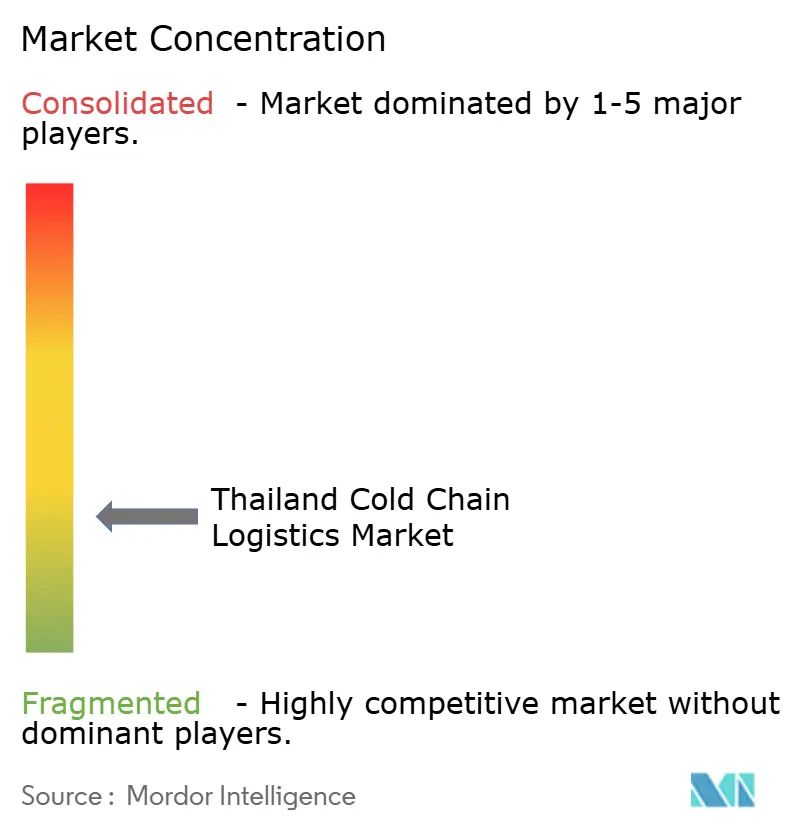
The Thailand cold chain logistics market is moderately fragmented. SCGJWD’s 2024 merger pooled 1.2 million pallet positions and 4,000 vehicles into a platform spanning ambient to -40 °C coverage. Thai Yokorei retains leadership in deep-frozen tuna and poultry exports, but DHL Supply Chain is scaling healthcare racks to erode that dominance in life-science verticals.
Competitive advantage now rests on automation, sustainability, and cross-border reach. AutoStore’s Rayong robot hub ensures Thai 3PLs receive cube-storage modules with 30% shorter lead times than importing from Norway. WICE Logistics layers blockchain timestamps onto transport management feeds, satisfying EU deforestation-free regulation audits for frozen cassava.
Strategic tie-ups are proliferating. Kerry Express secures food-grade volume via Betagro, while Sumisho Global Logistics piggybacks on Sumitomo’s supplier ecosystems for auto parts and frozen noodles. Foreign entrants face licensing checks under the Thai FDA, though investor visas and waived import duties on automation parts lower barriers. Pricing pressure persists from e-commerce platforms building in-house fleets, but higher service expectations favor incumbents with validated processes.
Thailand Cold Chain Logistics Industry Leaders
JWD Group
Thai Yokorei Cold Storage
Linfox Thailand
DHL Supply Chain (Thailand)
Kerry Express
- *Disclaimer: Major Players sorted in no particular order

Market Opportunities and Future Outlook
White space in Thailand’s cold chain logistics market is concentrated around multi-temperature capacity outside Bangkok city limits, alongside improved operating discipline for SMEs. The effort to broaden Q Cold Chain certification to smaller operators supports take-up of standardized SOPs, digital temperature records, and auditable handling processes, which fits the market’s faster-growing value-added services such as labeling, documentation, and controlled kitting for food and healthcare.
Thailand’s 2025-2026 multimodal connectivity program provides a second opportunity area through a funded pipeline. The plan cites 287 combined transport projects, including 64 projects costed at THB 116.96 billion for 2026, supporting reefer corridor development, inland node formation, and tighter links between production provinces and export gateways. Capability upgrading is also active: WSCBA promotes training such as the April 2026 Smart Cold Chain Management for Professionals course, and the Thai Refrigeration Association’s participation in the EU-funded IMPACT-F project launched July 2026 supports a cooling transition roadmap. That roadmap widens scope for natural-refrigerant retrofits, energy optimization, and technician upskilling, which is particularly relevant where current shortages can constrain uptime and compliance performance.
Recent Industry Developments
- June 2026: Linfox Thailand installs an advanced Goods-to-Person automation system at its multi-temperature warehouse at Asia Industrial Estate Suvarnabhumi. The automation enhances throughput and labor efficiency for urban distribution and high-value goods. It signals deeper automation in Thailand’s cold chain and strengthens Linfox’s ability to service high-demand urban markets.
- May 2026: SCGJWD Logistics reports 17.7% YoY revenue growth in its cold chain segment for 1Q26. The growth underscores strong demand in seafood, tuna, and poultry across the cold chain. This strengthens its position in the Thai cold storage landscape and validates market momentum for the segment.
- February 2026: Linfox Thailand commissions a new multi-temperature facility in Bangkok, operational in the last week of February 2026. The expansion grows multi-temperature capacity and creates a regional hub to support broader Southeast Asia cold chain activity.


Research Methodology Framework and Report Scope
Market Definition and Coverage
For this study, the Thailand cold chain logistics market covers paid logistics services that protect product temperature from pickup through storage, handling, and delivery, including chilled and frozen flows within Thailand.
Scope exclusions: The market does not include the value of goods shipped, packaging manufacturing, or in-house cold chain operations that are not monetized as third-party logistics revenue.
Segmentation Overview
- By Service Type
- Refrigerated Storage
- Public Warehousing
- Private Warehousing
- Refrigerated Transportation
- Road
- Rail
- Sea
- Air
- Value-Added Services
- Refrigerated Storage
- By Temperature Type
- Chilled (0–5 °C)
- Frozen (-18–0 °C)
- Ambient
- Deep-Frozen / Ultra-Low (less than-20 °C)
- By Application
- Fruits & Vegetables
- Meat & Poultry
- Fish & Seafood
- Dairy & Frozen Desserts
- Bakery & Confectionery
- Ready-to-Eat Meals
- Pharmaceuticals & Biologics
- Vaccines & Clinical Trial Materials
- Chemicals & Specialty Materials
- Other Perishables
- By Region (Thailand)
- Central
- Eastern
- Northern
- North-Eastern
- Southern
Data Sources, Market Sizing, and Validation
Desk Research
Desk research starts by grounding the model in Thailand logistics and cold storage realities, where capacity, trade flows, and food and pharma handling needs shape service demand. For this, we reviewed public sources such as Thailand Customs trade statistics, Bank of Thailand macro series, and publications from the Ministry of Commerce and Department of Internal Trade.
To translate activity into market value, we also referenced company annual reports and investor decks, association websites, and reputed press coverage on warehouse commissioning and cold-chain expansion. Where it helped validate revenue pools and service mix, paid subscriptions for company financials and intelligence, news and financials, and an import and export shipment-level database were used as support checks. The desk sources listed here are illustrative only, and many other sources were also used for data collection, validation, and clarification.
Primary Interviews and Surveys
Primary work was used to pressure-test desk assumptions on how services are priced and bundled in Thailand, and where utilization is trending across chilled and frozen networks. We spoke with a mix of logistics operators, cold storage managers, and demand-side stakeholders across food, retail, and healthcare supply chains. This helped fill gaps around lane economics, warehouse occupancy patterns, and the intensity of value-added temperature-controlled handling.
Distribution of primary research fieldwork respondents
| Company type | Respondent position |
|---|---|
| Top tier: 33% | CXOs: 12% |
| Mid tier: 52% | Functional/Unit leaders: 32% |
| Smaller Players: 15% | Managers: 56% |
Market-Sizing & Forecasting
Sizing begins with a top-down build that reconstructs the Thailand revenue pool by linking temperature-controlled warehousing and refrigerated transport activity to payable service demand, and then applying realistic service price ranges used in the country. Once the first-cut total is formed, it is corroborated with selective bottom-up approximations, such as rolling up sampled operator revenue disclosures, cross-checking facility capacity additions, and applying ASP-by-service to plausible throughput volumes where data is available.
Key model inputs include cold storage capacity additions and commissioning timelines, warehouse utilization and occupancy direction, the mix of chilled versus frozen requirements by end-use, reefer fleet availability and route intensity, and trade-linked volumes for temperature-sensitive food and healthcare products. Where operators do not publish a clean split between ambient and cold services, gaps are handled by using service-mix ratios from interviews, then validating them against observable expansion patterns and reported logistics revenue bands.
Forecasting is done using scenario analysis supported by a light multivariate regression, where service demand is tied to drivers such as modern retail penetration, processed and frozen food consumption direction, export and import momentum for temperature-sensitive categories, and announced capacity pipelines. Assumptions are reviewed with primary respondents to confirm whether expected rate changes and utilization shifts look realistic for the next few years, and then the forecast is adjusted so it stays consistent with the operational constraints seen in Thailand.
Data Validation & Update Cycle
Validation is done through triangulation across multiple angles, so the final number is not dependent on one data series or one set of interviews. Outputs are checked against independent signals such as capacity pipelines, trade direction, and observable logistics expansion activity, and then variances are investigated before sign-off.
A second analyst review is carried out to spot anomalies in growth rates, implied price levels, and service-mix shares, and follow-up questions are triggered when a datapoint creates a large swing. Reports refresh annually, with interim updates when a material event can change demand or pricing, and a final pre-delivery pass is completed so clients receive the most current view.
Mordor Intelligence's Thailand Cold Chain Logistics Market Size Versus Other Published Estimates
Published market sizes for Thailand cold chain logistics often do not match because each publisher defines included services differently, and they may also use different years, exchange rates, and pricing progressions. The table helps show how these choices can move the total, even when similar demand drivers are discussed.
The table shows the spread is usually explained by whether refrigerated transport and value-added cold handling are counted alongside cold storage. In Mordor Intelligence's model, these value-added fees are included only when they are billed as part of third-party cold logistics services within Thailand.
Benchmark comparison
| Source | Market Size | Gaps in Research Methodology |
|---|---|---|
| Mordor Intelligence | USD 2.31 B (2025) | |
| Trade Journal A | USD 0.75 B (2025) | Uses a cold warehouse revenue proxy and omits refrigerated transport and handling fees, which compresses the payable service pool. |
| Regional Consultancy B | USD 2.85 B (2025) | Expands scope into broader temperature-sensitive supply chain services and applies aggressive rate escalation, which inflates logistics revenue beyond third-party billing. |
Taken together, the comparison points to scope and pricing math as the main drivers of the gap, rather than a disagreement that cold chain demand is rising in Thailand. With inputs tied to measurable activity like capacity additions, utilization direction, and payable service rates, our number is easier to trace and repeat using the same steps next year.


Key Questions Answered in the Report
What is the value of the Thailand cold chain logistics market in 2026?
The Thailand cold chain logistics market size is valued at USD 2.4 billion in 2026.
How fast will the Thailand cold chain logistics market grow through 2031?
It is projected to expand at a 3.79% CAGR, reaching USD 2.89 billion by 2031.
Which service segment is expanding the quickest?
Value-Added Services is the fastest-growing segment, with a forecast 4.63% CAGR through 2031.
Where is the strongest regional growth expected?
The Eastern region should post the highest growth, at a 4.18% CAGR, driven by EEC incentives.
Which application is expected to outperform overall market growth?
Pharmaceuticals & Biologics will advance at a 5.88% CAGR, outpacing food categories.
How are operators mitigating energy-related cost pressures?
They are deploying rooftop solar, CO₂ refrigeration, and predictive maintenance platforms to lower kilowatt consumption and improve uptime.
Page last updated on:




