
Market Overview
| Study Period | 2020 - 2031 |
|---|---|
| Forecast Data Period | 2026 - 2031 |
| Base Year Market Size (2025) | USD 3.87 Billion |
| Market Size (2026) | USD 4.63 Billion |
| Market Size (2031) | USD 11.39 Billion |
| Growth Rate (2026 - 2031) | 19.71 % |
| Market Concentration | Low |
Major Players *Disclaimer: Major Players sorted in no particular order Image © Mordor Intelligence. Reuse requires attribution under CC BY 4.0. | |
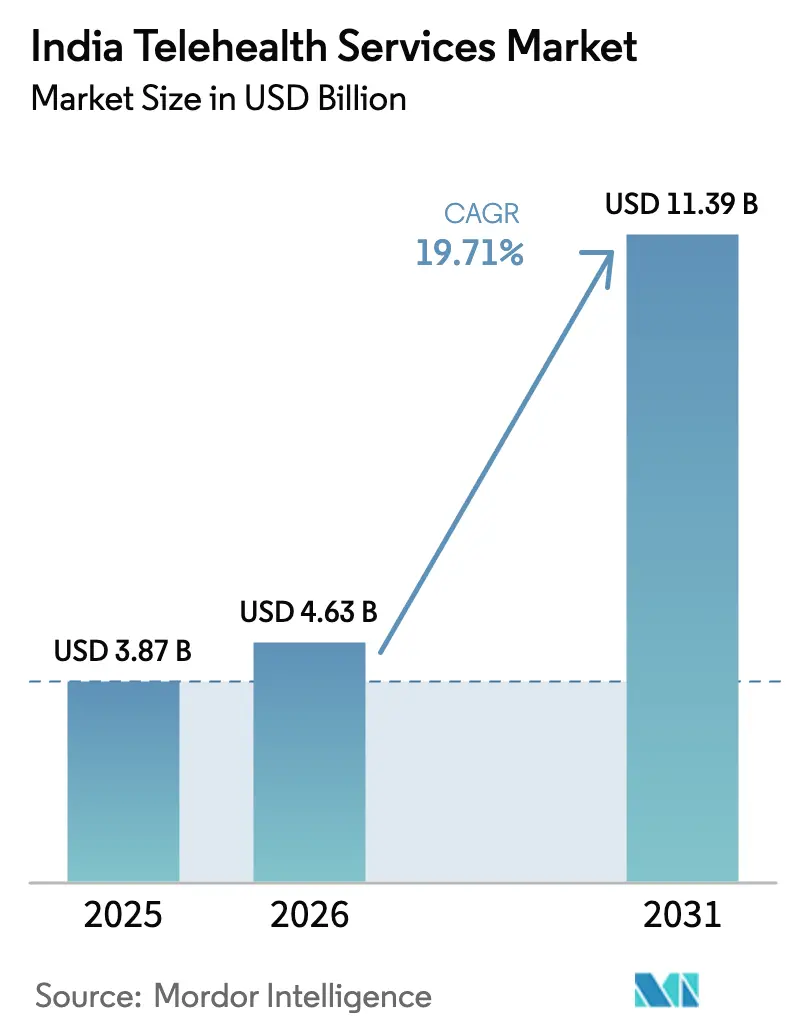
India Telehealth Services Market Analysis by Mordor Intelligence
India telehealth services market size in 2026 is estimated at USD 4.63 billion, growing from 2025 value of USD 3.87 billion with 2031 projections showing USD 11.39 billion, growing at 19.71% CAGR over 2026-2031. A nationwide push toward digital health infrastructure, the permanence of habits formed during the pandemic, and fast-rising broadband coverage are the primary growth engines. Government initiatives such as the Ayushman Bharat Digital Mission (ABDM) have already issued more than 650 million digital health IDs, giving providers an interoperable backbone for e-consultations.[1]Source: Ministry of Health & Family Welfare, “Initiatives & Achievements-2024,” pib.gov.in Private funding momentum—typified by Apollo HealthCo’s INR 2,475 crore capital infusion—signals continued confidence in scaling omnichannel care models. Meanwhile, real-time video platforms dominate patient preference, but asynchronous “store-and-forward” models gain traction as providers adapt to connectivity variations. Rising chronic disease prevalence, greater mental-health awareness, and vernacular AI chatbots round out the demand story, turning telehealth from a convenience into an everyday healthcare utility.
Key Report Takeaways
- By type, services led with 84.68% revenue share of the India telehealth services market in 2025, while Software is forecast to expand at a 20.38% CAGR to 2031.
- By technology, real-time platforms accounted for 58.97% of market revenue in 2025; the store-and-forward segment is growing at 20.12% CAGR through 2031.
- By application, tele-radiology held 30.11% share in 2025, whereas tele-psychiatry is advancing at 21.42% CAGR through 2031.
- By end-user, providers captured 57.54% of revenue in 2025; the patient self-service segment shows the highest projected CAGR at 21.58% to 2031.
- By delivery mode, audio-visual consultations commanded 68.21% of revenue in 2025 and continue to post the fastest CAGR of 21.19%.
Note: Market size and forecast figures in this report are generated using Mordor Intelligence’s proprietary estimation framework, updated with the latest available data and insights as of 2026.
India Telehealth Services Market Trends and Insights
Drivers Impact Analysis*
| Driver | (~) % Impact on CAGR Forecast | Geographic Relevance | Impact Timeline |
|---|---|---|---|
| Smartphone and Broadband Penetration Surge | +3.2% | National, with stronger impact in Tier-2/3 cities | Medium term (2-4 years) |
| Government Telemedicine and ABDM Push | +4.1% | National, with early gains in Karnataka, Tamil Nadu, Maharashtra | Long term (≥ 4 years) |
| Growing Chronic Disease Burden | +2.8% | National, with higher concentration in urban areas | Long term (≥ 4 years) |
| Tier-2/3 Digital-Payment Adoption | +2.3% | Tier-2/3 cities and rural areas | Medium term (2-4 years) |
| Vernacular AI Triage Bots Rollout | +1.9% | Regional focus on Hindi, Tamil, Bengali speaking areas | Short term (≤ 2 years) |
| ONDC Integration for Telehealth | +1.5% | National, with early adoption in metropolitan areas | Medium term (2-4 years) |
| Source: Mordor Intelligence | |||
Government Telemedicine and ABDM Push
The Ayushman Bharat Digital Mission has created an interoperable health-data backbone that links patients, providers, and payers under a single consent-driven architecture. More than 1,000 private firms are now ABDM-certified, letting e-pharmacies and hospitals exchange data through standardized APIs, which boosts network effects for every new participant. eSanjeevani’s 340 million cumulative consultations prove mass acceptance of government-backed teleconsultation pathways. The Digital Personal Data Protection Act 2023 and its forthcoming rules offer legal certainty, yet providers still seek granular guidance around consent flows and breach liabilities.[2]Source: Ministry of Electronics & IT, “Draft Digital Personal Data Protection Rules 2025,” pib.gov.in Expanded telemedicine nodes at 175,338 Ayushman Arogya Mandirs further widen the last-mile footprint. Collectively, these policies cement digital care as a mainstream delivery channel within the India telehealth services market.
Smartphone and Broadband Penetration Surge
Affordable handsets and nationwide 4G/5G rollout lift the technical ceiling on video quality, making real-time diagnostics viable outside metros. Rural residents gain faster access to specialty care because mobile-first workflows bypass the scarcity of brick-and-mortar clinicians. Vernacular interfaces boost usability among non-English speakers, as illustrated by TatvaCare’s 16-language deployment on Microsoft Azure. Seamless UPI payments remove purchasing friction, allowing direct-to-consumer models to flourish. Wearable integrations feed real-time vitals into cloud dashboards, letting physicians intervene earlier and reducing hospital admissions. These technology layers collectively accelerate adoption across the India telehealth services market.
Growing Chronic Disease Burden
NCD prevalence—particularly diabetes and hypertension—requires constant monitoring, something episodic in-person visits cannot provide cost-effectively. Telehealth platforms combine glucometer streams, BP cuffs, and AI analytics to flag anomalies before complications arise, lowering emergency admissions. Predictive algorithms segment high-risk cohorts, steering case managers toward patients who need intervention most urgently. For payers, these capabilities translate into lower claim ratios; for policymakers, they free up tertiary-care capacity for critical cases. The economic burden of NCDs is a strong motivator for continued public-private investment, reinforcing long-term growth in the India telehealth services market.
Vernacular AI Triage Bots Rollout
Advances in large-language models such as L2M3 support symptom triage in Hindi, Tamil, Bengali, and nine other languages, extending digital care to linguistically diverse populations. TinyML inference on low-cost smartphones permits offline symptom assessment, ensuring continuity even when data networks falter. These bots handle first-line queries, freeing clinicians for complex cases and reducing average wait times. Coupled with ABDM-linked e-prescriptions, they can complete end-to-end patient journeys in under 20 minutes. Early pilots show a 25% drop in unnecessary in-person visits, signalling cost and capacity benefits across the India telehealth services market.
Restraints Impact Analysis*
| Restraint | (~) % Impact on CAGR Forecast | Geographic Relevance | Impact Timeline |
|---|---|---|---|
| Data-Privacy and E-Pharmacy Regulation Gaps | -2.1% | National, with higher impact in metropolitan areas | Short term (≤ 2 years) |
| Low Digital Literacy Among Rural Elderly | -1.8% | Rural areas, particularly in Northern and Eastern states | Long term (≥ 4 years) |
| Doctor Attrition Over Payment Delays | -1.4% | National, with higher impact in private telehealth platforms | Medium term (2-4 years) |
| Rising Cyber-Insurance Premiums | -0.9% | National, affecting primarily large healthcare organizations | Short term (≤ 2 years) |
| Source: Mordor Intelligence | |||
Data-Privacy and E-Pharmacy Regulation Gaps
While the Digital Personal Data Protection Act lays a statutory baseline, sector-specific rules remain nascent, creating uncertainty over consent validity in clinical contexts.[3]Source: Government of India, “Digital Personal Data Protection Act 2023,” egazette.gov.in Parallel ambiguity in e-pharmacy licensing enables rogue vendors, eroding consumer trust. Hospitals now allocate up to 10% of IT budgets to cybersecurity, yet attacks persist, with healthcare ranking among India’s top five breached sectors. Absent a unified accreditation standard, smaller tele-pharmacies struggle to meet compliance costs, stalling scale. These gaps collectively shave growth from the otherwise buoyant India telehealth services market.
Low Digital Literacy Among Rural Elderly
Elderly patients in rural belts often lack the skills or confidence to navigate video-based care. Infrastructure deficits—spotty 4G and limited device ownership—compound the challenge. Community health workers serve as digital intermediaries, but scalability remains an issue given workforce shortages. Moreover, post-pandemic fatigue fuels a resurgence of in-person preferences for initial consults, requiring providers to blend physical and virtual pathways. Unless literacy programs accelerate, adoption in high-need cohorts will lag the broader India telehealth services market.
*Our forecasts treat driver/restraint impacts as directional, not additive. The impact forecasts reflect baseline growth, mix effects, and variable interactions.
Segment Analysis
By Type: Software Dominance Drives Integration
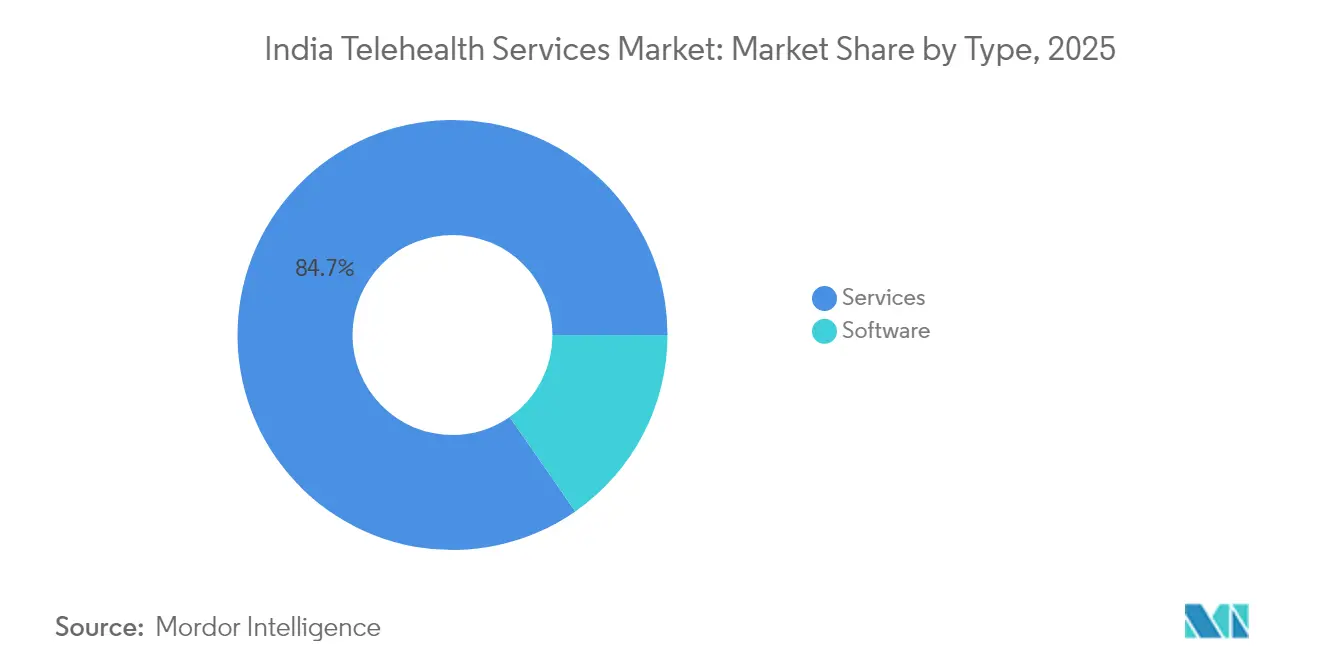
Services represented 84.68% of 2025 revenue, underscoring the platform-centric nature of the India telehealth services market. High-margin subscription models let providers update features in weeks rather than quarters, ensuring alignment with evolving ABDM APIs. Software’s 20.38% CAGR reflects growing demand for various software solutions in telehealth.
The production-linked incentive (PLI) scheme for medical devices boosts domestic manufacturing, reducing import dependence and shortening supply chains. Seamless firmware updates and ISO-13485 compliance give local OEMs export-ready credibility. As devices proliferate, advanced analytics engines synthesize multi-parameter streams, generating outcome-based dashboards for clinicians and empowering patients to self-manage chronic conditions.



By Technology: Real-Time Leads Despite Connectivity Constraints
Real-time platforms held 58.97% of the India telehealth services market share in 2025, reflecting user preference for face-to-face interaction and the clinical necessity of synchronous examination in acute cases. Yet store-and-forward workflows, expanding at 20.12% CAGR, offer bandwidth efficiency and richer documentation, especially for radiology, dermatology, and pathology. Hybrid triage engines recommend the optimal mode via AI scoring that weighs urgency, available bandwidth, and clinician workload.
As 5G densifies urban clusters, latency falls below ophthalmology’s minimum threshold for retinal imaging, enabling near-real-time diagnostics. Conversely, in regions still reliant on 3G, compressed DICOM files sent asynchronously keep specialist feedback cycles under 6 hours. The India telehealth services market size contribution from store-and-forward is projected to climb substantially, cementing asynchronous modalities as a vital complement rather than a competitor to live video.
By Application: Radiology Leadership Faces Psychiatry Surge
Tele-radiology accounted for 30.11% of 2025 revenue due to established PACS integration and round-the-clock reading hubs that serve domestic and overseas health systems. Structured imaging datasets and AI annotation tools improve throughput, letting radiologists clear high-volume backlogs without compromising accuracy. In contrast, tele-psychiatry is scaling at 21.42% CAGR, fueled by destigmatization campaigns and insurance coverage for mental-health video consults. Chat-based cognitive-behavioral therapy bots augment human therapists, achieving 30% reductions in session frequency for mild anxiety cases.
COVID-19’s long tail of psychological distress sustained demand beyond the crisis stage, and 2025 insurance circulars mandating parity for mental-health reimbursements catalyze further uptake. Collectively, the two segments illustrate a shift from diagnostics-heavy to holistic care models within the India telehealth services market.
By End-User: Provider Focus Shifts Toward Patient Empowerment
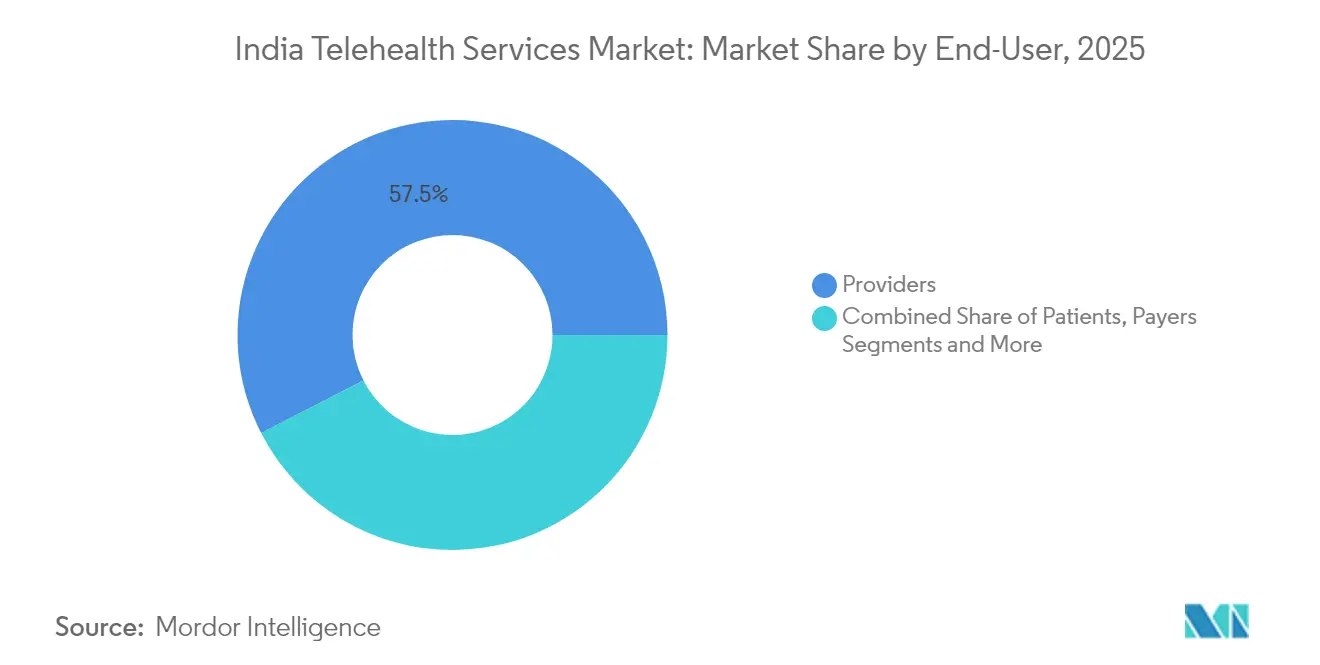
Hospitals and multi-specialty chains captured 57.54% of revenue in 2025 as they embed digital modules into existing EMRs for continuity of care. Yet patient-driven platforms, registering a 21.58% CAGR, highlight the rise of consumer choice and direct-pay consults. Price-transparent apps show specialty rates side-by-side, and near-instant wallet settlements draw clinicians seeking predictable income streams.
Employers bundle telehealth into health-and-wellness perks to control absenteeism and claims. Meanwhile, payers adopt managed-care models where teleconsult touchpoints feed risk-scoring engines, allowing differential premiums. Together, these shifts redistribute negotiating power, making service personalization a key differentiator across the India telehealth service industry.
By Delivery Mode: Audio-Visual Dominance Faces Accessibility Challenges
Audio-visual channels remain the first choice, grabbing 68.21% of 2025 revenue on the back of HD cameras embedded in budget smartphones. Augmented-reality overlays let orthopedists mark joint angles live, improving diagnostic accuracy. Yet audio-only and text-based modes keep rural uptake alive when video bandwidth dips below 512 kbps.
Emerging privacy-preserving codecs allow pixelation of sensitive backgrounds without degrading anatomical clarity, relieving user anxiety over home-environment exposure. The India telehealth services market size for audio-visual delivery is forecast to grow in the coming years, underscoring its central role while highlighting the continued need for fallback channels.
Geography Analysis
Southern India leads with a significant market share in 2025, helped by Karnataka’s early adoption of ABDM APIs and Tamil Nadu’s fiber-to-village program that links 12,525 rural PHCs to district hospitals. Strong IT talent anchors collaborative pilots between health systems and SaaS vendors, producing rapid iteration cycles on vernacular UX. Multiple tertiary hospitals deploy hybrid tele-ICUs, cutting sepsis mortality by 18% within 12 months, further reinforcing regional dominance.
Northern India records the fastest growth, propelled by massive public-sector spending on 5G corridors and a young, mobile-first population. Digital health ID uptake surpasses 60% in tier-2 cities such as Lucknow, signaling readiness for integrated care pathways. Rural literacy programs anchored by ASHA workers reduce onboarding friction for elderly users, yet device affordability remains an obstacle that government loan schemes aim to mitigate.
Western India’s industrial hubs such as Mumbai and Ahmedabad exhibit strong willingness to pay for premium telehealth packages bundled with annual health checks, opening cross-sell opportunities for diagnostics labs. Eastern states lag due to lower per-capita income and infrastructure gaps, but pilot tele-ophthalmology vans using satellite backhaul demonstrate scalable promise. Collectively, regional diversification balances the overall growth trajectory of the India telehealth services market, ensuring nationwide penetration by 2030.
Regulatory Landscape
The Telemedicine Practice Guidelines were issued in 2020 by the Board of Governors, superseding the Medical Council of India, and oversight now sits with the National Medical Commission (NMC). To practice telemedicine legally, medical practitioners must be registered with a State Medical Council and hold a recognized degree. Platform operations are governed by the Information Technology Act, 2000 and related data-privacy provisions.
ABDM provides a national interoperability backbone for health data, and its alignment is increasingly embedded in public-scheme workflows such as AB-PMJAY. The Digital Personal Data Protection Act, 2023 establishes a baseline privacy framework, with implementing rules moving toward operational clarity as adoption expands, including programs like Model Districts and Model Facilities to accelerate on-ground uptake.
Competitive Landscape
India’s telehealth arena remains fragmented, with more than 200 active platforms spanning e-consultation, e-pharmacy, and RPM niches. Apollo HealthCo’s plan to merge with Keimed indicates a vertical-integration play that marries pharmacy distribution with virtual care to lock-in lifetime customer value. Tata Digital’s acquisition of 1mg adds a deep catalog of medicines and diagnostics to its super-app ecosystem, intensifying competition for wallet share.
Niche disruptors build defensible moats through AI IP, such as cloud-based ECG interpretation engines that deliver 95% sensitivity in under 30 seconds. Multilingual UX platforms win rural mindshare, while hospital-backed ventures emphasize clinical governance to attract risk-averse patients. Strategic alliances with non-banking finance companies unlock BNPL payment models for high-ticket procedures like oncology second opinions. A looming theme across the India telehealth services market is the pivot from growth-at-all-costs to profitability, spurred by reports that digital health startups hold a sub-9-month cash runway. Firms that integrate offline touchpoints—labs, clinics, or home-care—into digital journeys are better positioned to achieve margin resilience.
Looking ahead, entry barriers will rise as interoperability compliance, cyber-insurance, and data-localization requirements inflate fixed costs. This environment favors capital-rich incumbents or scale-seeking mergers, pointing toward accelerated consolidation by 2027. Providers who can couple tech prowess with domain depth will likely dominate the India telehealth services market as it matures.
India Telehealth Services Industry Leaders
TeleVital
Apollo TeleHealth Services
Tata 1mg Healthcare Solutions
Practo Technologies
Netmeds Marketplace
- *Disclaimer: Major Players sorted in no particular order


Market Opportunities and Future Outlook
ABDM functions as a core digital health infrastructure layer, connecting patients, providers, and facilities through a consent-driven, interoperable backbone. As of July 2026, more than 100 crore health records are linked to over 90 crore ABHA accounts.
Hybrid care models are expanding, with Tata 1mg and Apollo 24/7 rolling out omnichannel care that blends teleconsultation with pharmacy and diagnostics to improve retention and per-user revenue. Practo operates a dual B2B and B2C model that supports data liquidity across 40,000+ verified doctors. National Health Authority initiatives, including Model Districts and Model Facilities, are accelerating adoption across states and districts, reinforcing the basis for digitally enabled care.
Recent Industry Developments
- June 2026: Online Chikitsa Mitra (Salubrious Technologies) expands to 15 states, delivering 1.5 lakh consultations via 600 e-clinic partners. Expands capacity for remote consultations through a growing network of partners across India. Supports access expansion alongside higher consultation volumes, which can help providers scale toward profitability and consolidation.
- May 2026: Tata 1mg Healthcare Solutions posts EBITDA positivity across core businesses for FY26 and diagnostics crossing Rs 600 crore ARR. The update highlights a profitability trajectory in a crowded telehealth and omnichannel market. It also points to scope for capital reallocation toward store expansion and deeper integration with diagnostics.
- April 2026: Apollo TeleHealth (Apollo Hospitals Group) launches integrated care model in Sri City, Tamil Nadu, including Tele-ER services and 5G enabled ambulance support. The rollout reflects an integrated approach to care delivery at scale. It strengthens rural and semi-urban capabilities within an omnichannel model.


Research Methodology Framework and Report Scope
Market Definition and Coverage
For this methodology, the India telehealth services market covers paid, remote healthcare interactions delivered through digital channels, where a clinical service is provided without an in-person visit, and revenue is counted at the point of service delivery.
Scope exclusions: We exclude general wellness content and fitness-only apps that do not involve a clinical interaction, and we also exclude sales of standalone medical devices unless they are bundled and billed as part of a telehealth service.
Segmentation Overview
- By Type
- Services
- Software
- By Technology
- Store and Forward
- Real-Time
- Others
- By Application
- Tele-Psychiatry
- General Consultations
- Tele-Radiology
- Tele-Pathology
- Tele-Dermatology
- Others
- By End-User
- Providers
- Patients
- Payers
- Others
- By Delivery Mode
- Audio-Visual
- Audio Only
- Text / Written
Data Sources, Market Sizing, and Validation
Desk Research
Desk research helped us set the guardrails for what should be counted and what should not, before building the model. We relied on public health and digital policy references, along with adoption signals, to understand how virtual consultations and remote care programs are being used across India.
Sources included official publications and datasets such as the Ministry of Health and Family Welfare and its Telemedicine Practice Guidelines, National Health Authority updates on digital health programs, TRAI telecom indicators for connectivity, RBI payment and digital transaction statistics, and peer-reviewed articles that track telemedicine adoption and outcomes. We also reviewed hospital and platform disclosures in annual reports, investor presentations, and credible press coverage, then cross-checked company-level context using paid databases for company financials and intelligence and for patent databases. This list is illustrative, and additional public sources were used during data collection, validation, and clarification.
Primary Interviews and Surveys
Primary interviews and surveys were used to pressure-test demand assumptions and pricing logic, where public sources often leave gaps. We spoke with healthcare provider leaders, digital health operations teams, insurers and TPAs, and frontline managers running teleconsultations, remote monitoring, and scheduling workflows, and we compared inputs across metro and non-metro demand patterns.
Responses were used to confirm what gets billed as telehealth services versus what is treated as software or enablement fees, and to validate how utilization, repeat consult rates, and specialty mix are shifting as guidelines and patient comfort mature.
Distribution of primary research fieldwork respondents
| Company type | Respondent position |
|---|---|
| Top tier: 26% | CXOs: 15% |
| Mid tier: 55% | Functional/Unit leaders: 34% |
| Smaller Players: 19% | Managers: 51% |
Market-Sizing & Forecasting
Sizing started with a top-down demand pool build, where telehealth-eligible outpatient interactions and specialist follow-ups were reconstructed using healthcare utilization patterns, then filtered by likely digital adoption and payer willingness. Once the total demand picture was set, we converted it into revenue using India-specific average price points by delivery mode (audio, video, asynchronous), along with expected follow-up rates.
To keep the estimate realistic, we corroborated outputs with selective bottom-up checks such as sampled provider roll-ups, platform revenue disclosures where available, and a simple volume-times-ASP sense-check across major specialties. Key inputs used in the model included smartphone and broadband penetration trends, provider onboarding and availability, consultation completion rates, share of video versus audio, remote monitoring use in chronic care programs, and typical discounting patterns in subscription or package offerings. For forecasting, we used scenario analysis supported by expert consensus on adoption drivers, and the scenarios were tied to regulation clarity, reimbursement momentum, and provider capacity expansion. Where company data was missing, we used conservative proxies from similar care settings, then adjusted them after interview feedback.
Data Validation & Update Cycle
Validation used a step-by-step triangulation process, where model totals were compared with independent signals such as digital payment intensity for healthcare services, reported virtual care volumes from providers, and observed pricing bands from market checks. If a segment moved too quickly versus its drivers, we reopened assumptions and triggered follow-up calls to re-check the specific variable that caused the jump.
Before sign-off, the work is reviewed in multiple analyst passes so logic, math, and scope remain consistent across years, and large variances are explained in plain language. Reports are refreshed annually, with interim updates when material events occur such as guideline changes, reimbursement shifts, or major care delivery expansions. Right before delivery, we complete another review so clients receive the most current view available.
Mordor Intelligence's India Telehealth Services Market Size Compared Against Other Published Estimates
Published market sizes for telehealth in India can look far apart because sources do not always count the same elements, and they often use different base years and pricing ladders. Differences show up quickly when some estimates focus only on teleconsultations, while others mix in remote monitoring, tele-diagnostics, or adjacent software fees.
The main gap comes from whether non-clinical digital health revenue and device-led remote monitoring kits are bundled into the total. Mordor Intelligence counts telehealth only when a clinical service is delivered and billed, and it prices using India-specific delivery mode mixes instead of relying on a single blended ASP.
Benchmark comparison
| Source | Market Size | Gaps in Research Methodology |
|---|---|---|
| Mordor Intelligence | USD 3.87 B (2025) | |
| Advisory Firm A | USD 4.00 B (2024) | Uses a telemedicine definition that leans into broader care models and can pull forward revenue from remote monitoring and specialty telecare that is not always billed as a telehealth service in India. |
| Trade Journal B | USD 5.50 B (2025) | Often reports a single headline forecast without showing the underlying utilization and price build, and may include aggressive adoption and packaged pricing assumptions across providers. |
The table shows that the spread is largely explained by what gets counted as service revenue and how quickly adoption and pricing are assumed to rise. By keeping the revenue link tied to delivered clinical interactions and then checking totals against practical utilization signals, the final number is easier to audit and replicate year to year.


Key Questions Answered in the Report
What is the current size of the India telehealth services market?
The market is valued at USD 4.63 billion in 2026 and is on track to reach USD 11.39 billion by 2031.
How fast is the market growing?
A robust 19.71% CAGR is forecast between 2026 and 2031, powered by government digital-health programs and expanding broadband coverage.
Which region leads telehealth adoption in India?
Southern India commands major share of revenue due to strong digital infrastructure and proactive state policies.
Which telehealth application is expanding the quickest?
Tele-psychiatry is advancing at a 21.42% CAGR due to greater mental-health awareness and insurance reimbursement parity.
What technology model is gaining popularity alongside real-time video?
Store-and-forward workflows are growing at 20.12% CAGR as providers optimize for bandwidth variability while enhancing documentation.
How are regulations shaping market growth?
The Digital Personal Data Protection Act provides a legal framework, but pending e-pharmacy and sector-specific rules must clarify compliance to unlock full potential.
Page last updated on:





