
Technical SEO Services Market Size and Share
Market Overview
| Study Period | 2020 - 2031 |
|---|---|
| Market Size (2026) | USD 16.89 Billion |
| Market Size (2031) | USD 28.37 Billion |
| Growth Rate (2026 - 2031) | 10.93 % |
| Fastest Growing Market | Asia-Pacific |
| Largest Market | North America |
| Market Concentration | Low |
Major Players *Disclaimer: Major Players sorted in no particular order Image © Mordor Intelligence. Reuse requires attribution under CC BY 4.0. | |
Technical SEO Services Market Analysis by Mordor Intelligence
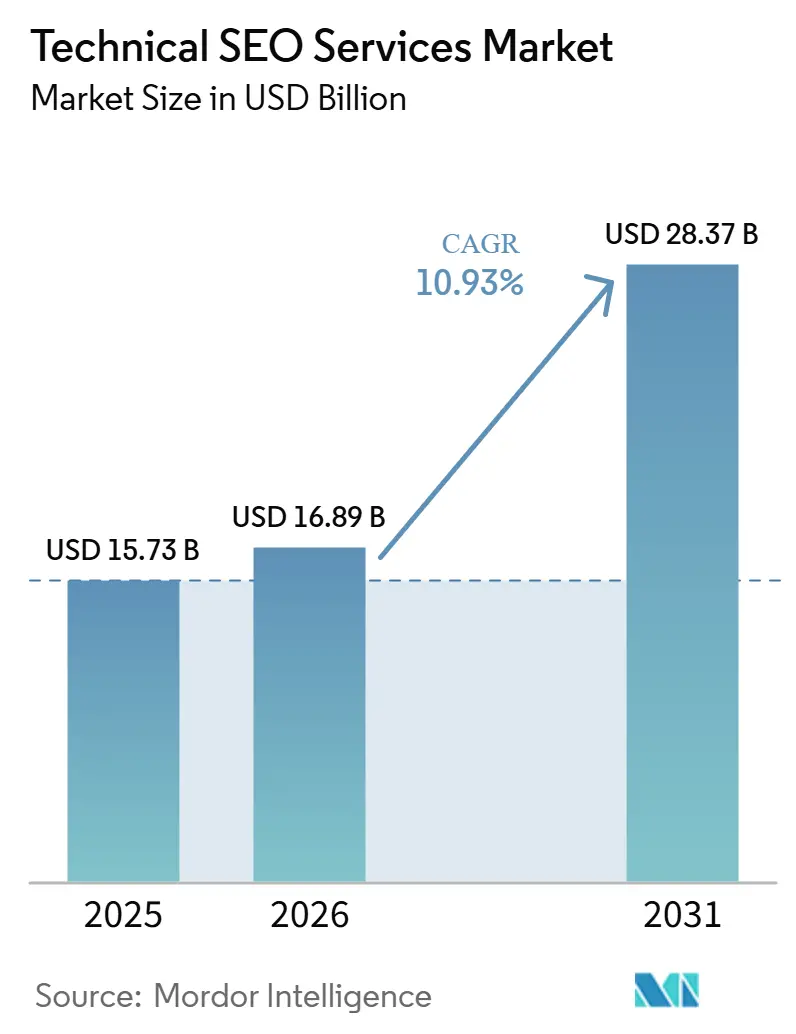
The Technical SEO Services Market size was valued at USD 15.73 billion in 2025 and estimated to grow from USD 16.89 billion in 2026 to reach USD 28.37 billion by 2031, at a CAGR of 10.93% during the forecast period (2026-2031). Search visibility now sits closer to revenue planning than to stand-alone marketing activities, keeping technical SEO spending tied to operating priorities across digital businesses. The growth path also reflects the heavier technical load created by AI-driven search interfaces, larger content estates, and more complex site frameworks. Frequent search updates and the rise of zero-click behavior are pushing companies to monitor crawlability, rendering, and content retrieval more closely, rather than treating SEO as a periodic project. Competition in the Technical SEO Services Market is moving toward platforms and service providers that combine technical audits with AI visibility tracking and support for answer engine optimization. The strongest opportunities remain where large web estates, local discovery, and multi-market digital operations depend on stable indexing, performance, and structured site governance.
Key Report Takeaways
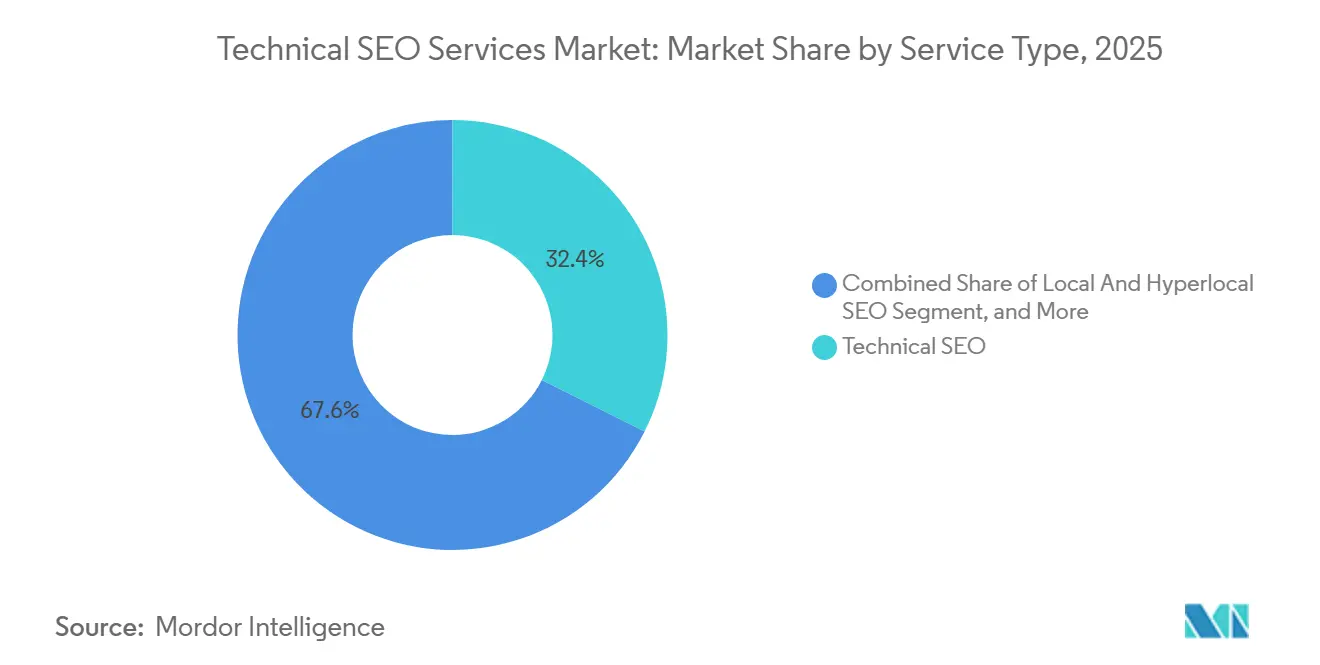
- By service type, Technical SEO led with 32.41% of the Technical SEO Services Market share in 2025, while Local and Hyperlocal SEO are projected to expand at a 14.82% CAGR through 2031.
- By enterprise size, Large Enterprises held 61.24% of the Technical SEO Services Market share in 2025, while Small and Medium Enterprises are projected to record the highest CAGR at 13.69% through 2031.
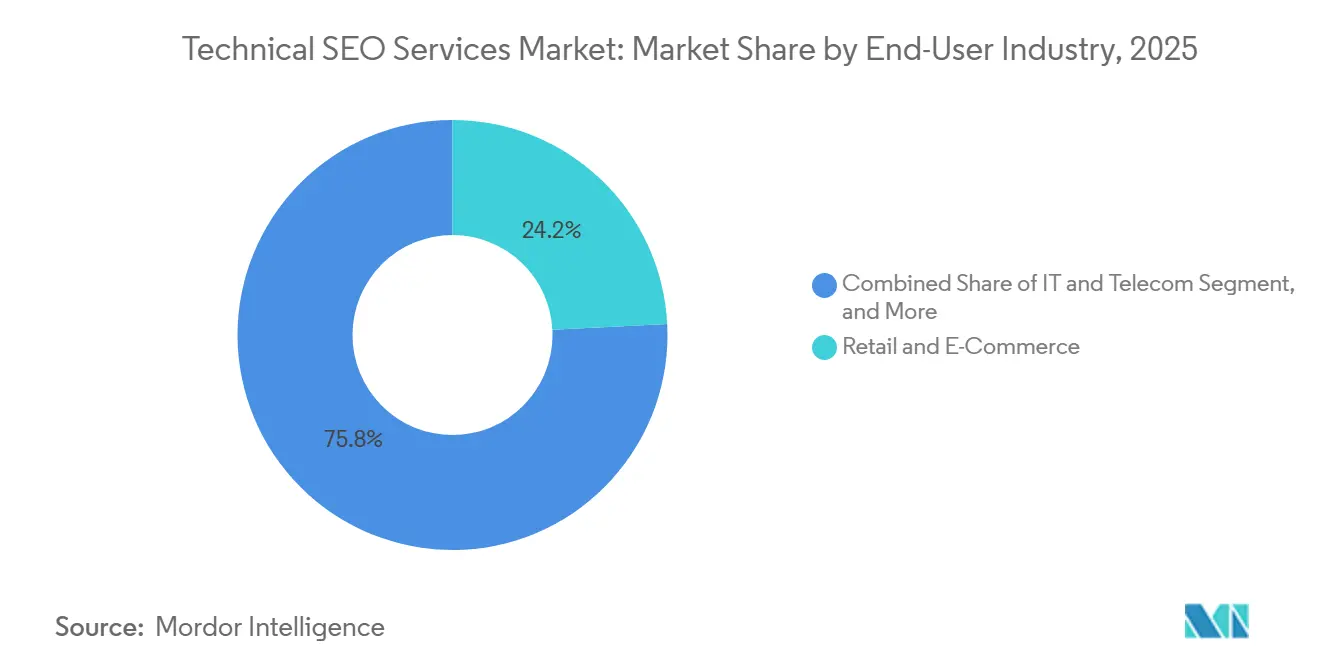
- By end-user industry, Retail and E-Commerce accounted for 24.18% of the Technical SEO Services Market in 2025, while IT and Telecom is projected to grow at a 15.43% CAGR through 2031.
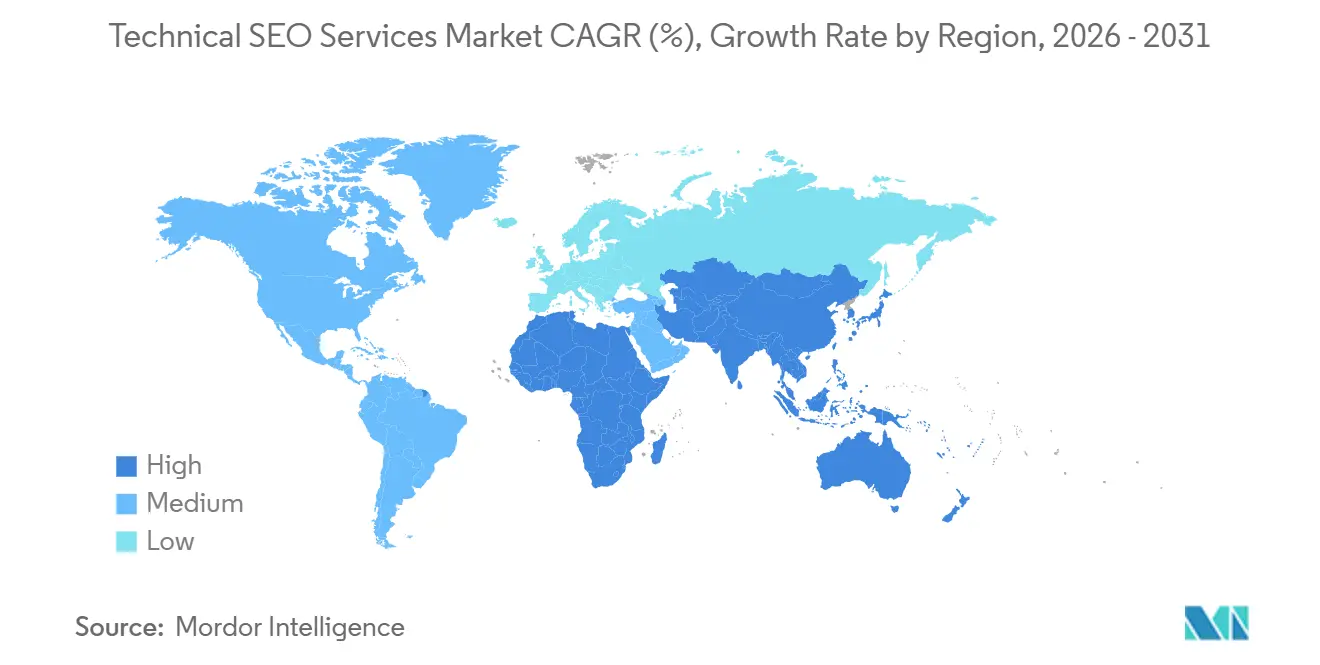
- By geography, North America held 34.62% of the market in 2025, while Asia-Pacific is projected to expand at a 14.27% CAGR through 2031.
Note: Market size and forecast figures in this report are generated using Mordor Intelligence’s proprietary estimation framework, updated with the latest available data and insights as of January 2026.
Market Trends and Insights
Drivers Impact Analysis of Technical SEO Services Market*
| Driver | (~) % Impact on CAGR Forecast | Geographic Relevance | Impact Timeline |
|---|---|---|---|
| Rising Demand for Organic Traffic Efficiency | +2.5% | Global, with highest intensity in North America and Europe | Long term (≥ 4 years) |
| Accelerating Search Algorithm Volatility | +2.0% | Global, acute in North America, Europe, and Asia-Pacific core | Medium term (2-4 years) |
| Rising Enterprise Migration to AI-Assisted SEO Workflows | +1.8% | North America and Europe, with spillover to Asia-Pacific and Middle East and Africa | Medium term (2-4 years) |
| Expanding Need for Technical Site Health at Scale | +1.4% | Global, concentrated among large enterprise and e-commerce segments | Long term (≥ 4 years) |
| Growing Competition in High-Intent Digital Commerce Categories | +1.0% | North America, Europe, Asia-Pacific core | Medium term (2-4 years) |
| Increasing Zero-Click Search Pressure on Brand Visibility | +0.7% | Global, with early gains in North America and Western Europe | Short term (≤ 2 years) |
| Source: Mordor Intelligence | |||
Rising Demand for Organic Traffic Efficiency
Enterprise buyers now view SEO services more through acquisition efficiency and revenue stability than through brand awareness alone. In the Technical SEO Services Market, this change supports steady demand for work that improves crawl access, page performance, structured data, and site clarity across large digital properties. Organic channels remain attractive because technical improvements can support durable traffic quality without the same ongoing media spend required in paid channels. This is pushing buyers away from one-time cleanups and toward recurring retainers that cover monitoring, testing, and remediation. It also favors providers that can explain technical work in commercial terms and tie site health to conversion quality and search resilience.
Accelerating Search Algorithm Volatility
Ranking conditions remained unstable in 2025 as Google rolled out multiple broad core updates, keeping technical preparedness high on the operating agenda for publishers, retailers, and enterprise brands. The Technical SEO Services Market benefits from this pressure because companies now treat search volatility as an ongoing risk rather than as an occasional disruption. Technical weaknesses such as slow rendering, unstable page experience, and weak crawl paths become more costly when ranking systems tighten. Google states that Core Web Vitals remain part of search evaluation, which keeps performance work tied to visibility management.[1] This supports longer service scopes for agencies and platforms that can monitor large site estates and respond quickly when search conditions change.
Rising Enterprise Migration to AI-Assisted SEO Workflows
Enterprise adoption of AI-assisted workflows is changing how Technical SEO Services are delivered and priced. Buyers increasingly expect platforms to identify issues, rank priorities, and support execution within the same working environment. Adobe completed its acquisition of Semrush on April 28, 2026, demonstrating that SEO, GEO, and competitive intelligence had become strategic platform capabilities within broader customer experience stacks. Semrush reported USD 443.6 million in full-year 2025 revenue and USD 471.4 million in annual recurring revenue, which reinforced the scale now attached to enterprise SEO platforms.[2] This shift favors vendors that combine automation with expert oversight instead of offering isolated audits with limited operational follow-through.
Expanding Need for Technical Site Health at Scale
The scope of technical work has widened, and the Technical SEO Services Market is expanding with that broader workload. Large websites now need to manage JavaScript rendering, schema coverage, bot access, duplicate content, redirect discipline, and indexation control at the same time. Google Search Central continues to link site performance and technical readiness to search outcomes, which keeps engineering work closely connected to SEO execution. For large catalogs and fast-changing content estates, even small technical faults can spread across thousands of URLs and weaken retrieval in both classic and AI-led discovery. That gives specialized service providers an advantage when clients need consistent governance across complex site environments.
Restraints Impact Analysis of Technical SEO Services Market*
| Restraint | (~) % Impact on CAGR Forecast | Geographic Relevance | Impact Timeline |
|---|---|---|---|
| Measurement Gaps Between SEO Effort and Revenue Attribution | -1.2% | Global, strongest in North America and Europe where finance scrutiny is high | Medium term (2-4 years) |
| Dependence on Search Engine Policy and Interface Changes | -1.0% | Global | Short term (≤ 2 years) |
| In-House SEO Talent Scarcity for Technical Implementation | -0.7% | North America, Europe, Asia-Pacific core | Long term (≥ 4 years) |
| Rising Client Fatigue from Long SEO Payback Cycles | -0.5% | Global, most pronounced among SMEs in cost-sensitive markets | Medium term (2-4 years) |
| Source: Mordor Intelligence | |||
Measurement Gaps Between SEO Effort and Revenue Attribution
The largest friction point in the Technical SEO Services Market remains the gap between visibility work and revenue reporting. Many organizations still assess channels through short attribution windows, even though SEO often influences discovery much earlier in the buying path. Zero-click behavior exacerbates this problem because users can consume answers within search results without generating a visit or a measurable session. When finance teams cannot see a simple link between technical work and booked revenue, contract reviews and approvals take longer. Demand does not disappear under these conditions, but reporting pressure rises and procurement moves more slowly.[3]
Dependence on Search Engine Policy and Interface Changes
SEO providers still depend on search engines that can change ranking surfaces, answer formats, and user flows without notice. AI Overviews and similar features can redirect attention even when a brand remains visible in conventional results. That raises delivery risk for fixed-fee engagements because the amount of work required to preserve visibility can change before contract terms do. The Technical SEO Services Market, therefore, rewards providers that can adapt across traditional search, answer engines, and AI discovery layers with limited delay. It also leaves smaller agencies more exposed when new search interfaces force retraining, workflow changes, or additional tooling.
*Our forecasts treat driver/restraint impacts as directional, not additive. The impact forecasts reflect baseline growth, mix effects, and variable interactions.
Technical SEO Services Market Segment Analysis
By Service Type:
Technical SEO Leads While Local SEO Gains SpeedTechnical SEO held 32.41% of the Technical SEO Services Market share in 2025, which reflected the heavier engineering load behind modern site management. The category remains central because rendering, site structure, redirects, schema, and page performance now shape whether content can be found and retrieved at scale. On-page and off-page SEO still matter, but both depend on a stable technical foundation when sites run on large templates, dynamic frameworks, or multi-layered navigation. Across the technical SEO services industry, this kept technical work at the center of enterprise scopes as AI search placed more weight on machine-readable content and stable architecture.
Local and Hyperlocal SEO is projected to expand at a 14.82% CAGR through 2031, making it the fastest-growing service category in the Technical SEO Services Market. That rise reflects the commercial value of discovery closer to the point of purchase, where users want immediate and location-specific answers. Rio SEO reported that direction clicks rose 6.4% year over year across more than 239,000 U.S. enterprise locations in 2025, even as broader listing views declined. The service mix is also moving toward bundled offerings that combine technical auditing, listing control, and AI visibility tracking under one operating scope.[4]

By Enterprise Size:
Large Enterprises Hold The Base While SMEs Expand FasterLarge Enterprises accounted for 61.24% of the market in 2025, underscoring how much of the Technical SEO Services Market still comes from complex, high-volume site estates. These buyers manage multiple domains, international pages, internal governance rules, and deeper engineering dependencies, which increase the value of specialist support. That profile supports demand for platforms and service teams that pair crawl analysis with implementation guidance and cross-team reporting. The technical SEO services industry remains most concentrated at this end of the client base because large programs reward integration depth and long contract duration.
Small and Medium Enterprises are projected to expand at a 13.69% CAGR through 2031, which makes them the fastest-growing client group in the Technical SEO Services Market. Cloud-based tools and lower setup costs now let smaller firms outsource technical work without maintaining a full in-house team. This matters most in markets where first-generation digital growth depends more on search visibility than on sustained paid media budgets. Providers that package audits, fixes, and local optimization into simpler monthly plans are therefore widening their reach beyond traditional enterprise accounts.
By End-User Industry:
Retail And E-Commerce Lead While IT And Telecom Advance FastestRetail and E-Commerce accounted for 24.18% of the Technical SEO Services Market in 2025, making it the largest end-user group. Large product catalogs, layered navigation, and duplicate content risks create constant technical maintenance needs in this segment. Google states that Core Web Vitals continue to matter for search evaluation, which keeps speed and page experience tied to discoverability for retail sites. That link matters because weak mobile performance can affect both rankings and conversion quality on commercial pages. Retail programs also face greater pressure from AI-generated answers, underscoring the value of clean schema and stable indexation controls.
IT and Telecom is projected to expand at a 15.43% CAGR through 2031, making it the fastest-growing vertical in the Technical SEO Services Market. This segment produces high volumes of technical content, service comparisons, and structured documentation that fit AI-assisted search behavior. BFSI also sustains demand because regulated content environments increase governance needs around visibility, accuracy, and page-level updates. Healthcare and Life Sciences, Media and Entertainment, Industrial Manufacturing, and Government and Public Administration remain smaller but durable demand pools because each depends on accessible, well-structured digital information.
Geography Analysis
North America and Europe Technical SEO Services Market
North America held 34.62% of the Technical SEO Services Market share in 2025, which made it the largest regional revenue base. The region benefits from dense enterprise demand, mature digital budgets, and a strong platform vendor presence. The United States anchors spending in large, multi-site deployments that require constant monitoring and implementation support. Canada and Mexico also contribute to regional demand through cross-border commerce and multilingual site structures, which increase technical complexity. Europe remained the second-largest region, where consent management, analytics controls, and multilingual content governance shape service requirements.
APAC Technical SEO Services Market
Asia-Pacific is projected to expand at a 14.27% CAGR through 2031, making it the fastest-growing region in the Technical SEO Services Market. India is a major driver because SMEs and startup-led digital businesses rely heavily on organic discovery during scaling. China adds large-volume demand through its wide e-commerce base and rising investment in corporate digital marketing operations. Japan and South Korea contribute through enterprise programs that require precise implementation and stable technical governance. Southeast Asia extends the growth runway as businesses in Indonesia, Vietnam, and Thailand formalize digital acquisition strategies.
MEA and South America Technical SEO Services Market
South America remains smaller, but Brazil is the key growth center in the Technical SEO Services Market as domestic e-commerce and formal digital teams expand. Argentina adds regional capability through agency talent, even though macro conditions remain less stable. The Middle East and Africa also represent a smaller base, with Saudi Arabia and the UAE supporting demand through broad digital investment across public and private sectors. Nigeria and South Africa lead adoption in Africa because mobile-first commerce and export-oriented SMEs keep organic acquisition relevant.
Competitive Landscape
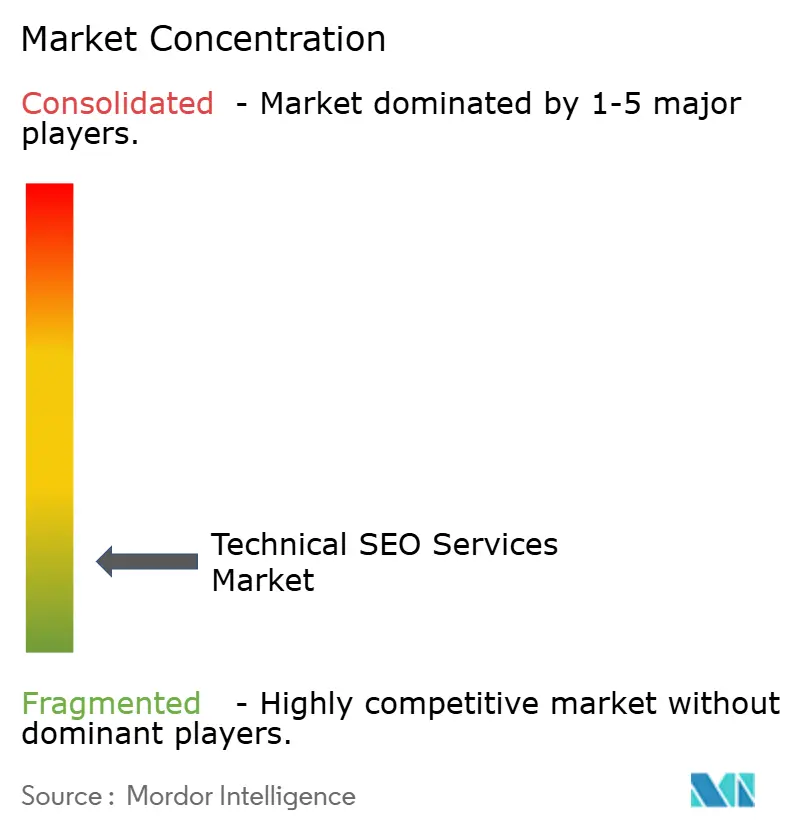
The Technical SEO Services Market is fragmented, with enterprise platforms and specialist agencies competing across overlapping service layers. BrightEdge Technologies, Inc., Conductor, Inc., Botify SAS, SEOClarity, Inc., Lumar Group Ltd., and Semrush Holdings, Inc. compete most directly where technical crawling, AI visibility, and workflow integration matter. Adobe completed its acquisition of Semrush in April 2026, which showed how search intelligence is moving into broader customer experience stacks. The Technical SEO Services Market is also shifting toward unified platforms that track both search rankings and AI citation presence across several discovery environments.
Conductor, Inc. launched the next generation of AI Search Performance in April 2026 and positioned it as a system of record for answer engine optimization. SEOClarity, Inc. launched Clarity ArcAI 3.0 in April 2026 to shift from visibility tracking to guided execution within the same workflow. BrightEdge Technologies, Inc. launched AI Hyper Cube in March 2026 to help brands understand how they appear across AI-driven search environments. These launches show that product strategy now centers on visibility in generative answers, not only on classic rank tracking. Vendors that integrate diagnosis, prioritization, and execution in a single environment are likely to protect pricing better than point-solution providers.
Botify SAS introduced AgenticCatalog in March 2026 to automate AI-optimized product feeds, which extended competition into agent-led commerce workflows. Lumar Group Ltd. launched AI Search Visibility in March 2026 and linked AI brand reporting with technical crawl analysis inside the same platform. Agency players such as Bruce Clay, Inc., Delante sp. z o.o., Ignite Visibility, LLC, and OuterBox, Inc. remain relevant because implementation sequencing, cross-team coordination, and custom remediation still need human oversight. That leaves the Technical SEO Services Market open to both platform consolidation at the top end and specialized service differentiation in the mid-market.
Technical SEO Services Industry Leaders
-
Semrush Holdings, Inc.
-
BrightEdge Technologies, Inc.
-
Conductor, Inc.
-
Ahrefs Pte. Ltd.
-
Moz, Inc.
- *Disclaimer: Major Players sorted in no particular order
Technical SEO Services Market Companies Covered in this Report
- Semrush Holdings, Inc.
- BrightEdge Technologies, Inc.
- Conductor, Inc.
- Botify SAS
- seoClarity, Inc.
- Lumar Group Ltd.
- Ahrefs Pte. Ltd.
- Screaming Frog Ltd.
- Moz, Inc.
- Similarweb Ltd.
- Searchmetrics GmbH
- Market Brew, Inc.
- OnCrawl SAS
- Siteimprove A/S
- DeepCrawl Limited
- Surfer Sp. z o.o.
- Yoast B.V.
- Bruce Clay, Inc.
- Delante sp. z o.o.
- Ignite Visibility, LLC
- OuterBox, Inc.
Recent Industry Developments in Technical SEO Services Market
- June 2026: Sitecore acquired Scrunch, an AI search optimization and agent experience platform, for approximately USD 225 million. The acquisition embeds Scrunch's Agent Experience Platform (AXP) into Sitecore's digital experience platform, enabling enterprise content teams to manage AI brand presence and answer engine optimization within their core CMS workflow, signaling the broader convergence of content management and GEO infrastructure.
- June 2026: Screaming Frog Ltd. released SEO Spider v24.3 (June 29, 2026), continuing its rapid release cadence with bug fixes and interface improvements following the major v24.0 launch in May. The v24.1 release (June 8, 2026) added scheduled crawl enhancements and usage statistics charting improvements.
- May 2026: creaming Frog Ltd. released SEO Spider v24.0 (May 19, 2026), adding an MCP server that enables AI assistants to trigger crawls and export site data via natural language, automatic crawl comparison for scheduled crawls, and uncrawlable link detection that flags non-standard markup patterns.
- April 2026: Adobe completed its USD 1.9 billion all-cash acquisition of Semrush Holdings, Inc. on April 28, 2026. The deal integrates Semrush's SEO, GEO, and competitive intelligence capabilities into Adobe's Customer Experience Orchestration suite, with the combined offering positioned to serve businesses from SMEs to global enterprises across search engine optimization, generative engine optimization, and agentic search optimization. Semrush had reported USD 443.6 million in full-year 2025 revenue and USD 471.4 million in annual recurring revenue.
Global Technical SEO Services Market Report Scope
The technical SEO services market encompasses the professional services provided by agencies, consultants, and specialists to optimize a website's infrastructure, code, and content to improve its visibility, crawlability, and ranking on search engine results pages (SERPs). While the market is fundamentally anchored in core technical optimizations such as site speed enhancement, mobile-friendliness, structured data implementation, crawl error resolution, and indexation management, it also encompasses integrated on-page, off-page, and local/hyperlocal SEO strategies to drive holistic organic growth. These services are utilized by organizations of varying sizes, from large enterprises to small and medium businesses, across diverse sectors including retail, BFSI, healthcare, and IT. The market value represents the revenue generated by service providers for auditing, strategizing, implementing, and continuously managing search engine optimization efforts to ensure long-term digital presence, user acquisition, and competitive advantage.
The Technical SEO Services Market Report is Segmented by Service Type (On-Page SEO, Off-Page SEO, Technical SEO, and Local And Hyperlocal SEO), Enterprise Size (Large Enterprises, and Small And Medium Enterprises), End-User Industry (Retail and E-Commerce, BFSI, Healthcare and Life Sciences, IT and Telecom, Media and Entertainment, Industrial Manufacturing, Government and Public Administration, and Other End-User Industries), and Geography (North America, South America, Europe, Asia-Pacific, and Middle East and Africa). The Market Forecasts are Provided in Terms of Value (USD).
Segmentation Overview
| On-Page SEO |
| Off-Page SEO |
| Technical SEO |
| Local And Hyperlocal SEO |
| Large Enterprises |
| Small And Medium Enterprises |
| Retail and E-Commerce |
| BFSI |
| Healthcare and Life Sciences |
| IT and Telecom |
| Media and Entertainment |
| Industrial Manufacturing |
| Government and Public Administration |
| Other End-User Industries |
| North America | United States | |
| Canada | ||
| Mexico | ||
| South America | Brazil | |
| Argentina | ||
| Rest of South America | ||
| Europe | Germany | |
| United Kingdom | ||
| France | ||
| Italy | ||
| Spain | ||
| Russia | ||
| Rest of Europe | ||
| Asia-Pacific | China | |
| India | ||
| Japan | ||
| South Korea | ||
| Australia | ||
| Rest of Asia-Pacific | ||
| Middle East and Africa | Middle East | Saudi Arabia |
| United Arab Emirates | ||
| Rest of Middle East | ||
| Africa | South Africa | |
| Nigeria | ||
| Rest of Africa | ||
| By Service Type | On-Page SEO | ||
| Off-Page SEO | |||
| Technical SEO | |||
| Local And Hyperlocal SEO | |||
| By Enterprise Size | Large Enterprises | ||
| Small And Medium Enterprises | |||
| By End-User Industry | Retail and E-Commerce | ||
| BFSI | |||
| Healthcare and Life Sciences | |||
| IT and Telecom | |||
| Media and Entertainment | |||
| Industrial Manufacturing | |||
| Government and Public Administration | |||
| Other End-User Industries | |||
| By Geography | North America | United States | |
| Canada | |||
| Mexico | |||
| South America | Brazil | ||
| Argentina | |||
| Rest of South America | |||
| Europe | Germany | ||
| United Kingdom | |||
| France | |||
| Italy | |||
| Spain | |||
| Russia | |||
| Rest of Europe | |||
| Asia-Pacific | China | ||
| India | |||
| Japan | |||
| South Korea | |||
| Australia | |||
| Rest of Asia-Pacific | |||
| Middle East and Africa | Middle East | Saudi Arabia | |
| United Arab Emirates | |||
| Rest of Middle East | |||
| Africa | South Africa | ||
| Nigeria | |||
| Rest of Africa | |||
Key Questions Answered in the Report
What is the current and forecast value of Technical SEO Services?
The Technical SEO Services Market was valued at USD 15.73 billion in 2025, is estimated at USD 16.89 billion in 2026, and is forecast to reach USD 28.37 billion by 2031 at a 10.93% CAGR.
Which service category leads Technical SEO Services today?
Technical SEO led all service types with a 32.41% share in 2025 because large and complex websites need stable rendering, crawl control, and structured site management.
Which client group is expanding fastest in Technical SEO Services?
Small and Medium Enterprises are projected to grow at a 13.69% CAGR through 2031 as lower-cost cloud tools make outsourced technical support easier to adopt.
Why is Local and Hyperlocal SEO gaining traction so quickly?
Local and Hyperlocal SEO is projected to grow at a 14.82% CAGR because businesses want stronger visibility near the point of purchase, and location actions remain commercially important.
Which region offers the strongest growth outlook through 2031?
Asia-Pacific is expected to record the fastest regional growth at a 14.27% CAGR, supported by rising SME digitization and expanding digital acquisition activity across major Asian markets.
How are leading vendors changing their product strategy in this field?
Leading vendors are moving beyond classic rank tracking and adding AI visibility, answer engine optimization, and guided execution features, as seen in launches from Conductor, seoClarity, BrightEdge, Botify, and Lumar.