
Local SEO Software Market Size and Share
Market Overview
| Study Period | 2025 - 2031 |
|---|---|
| Market Size (2026) | USD 10.34 Billion |
| Market Size (2031) | USD 19.36 Billion |
| Growth Rate (2026 - 2031) | 13.37 % |
| Fastest Growing Market | Asia-Pacific |
| Largest Market | North America |
| Market Concentration | Medium |
Major Players *Disclaimer: Major Players sorted in no particular order Image © Mordor Intelligence. Reuse requires attribution under CC BY 4.0. | |
Local SEO Software Market Analysis by Mordor Intelligence
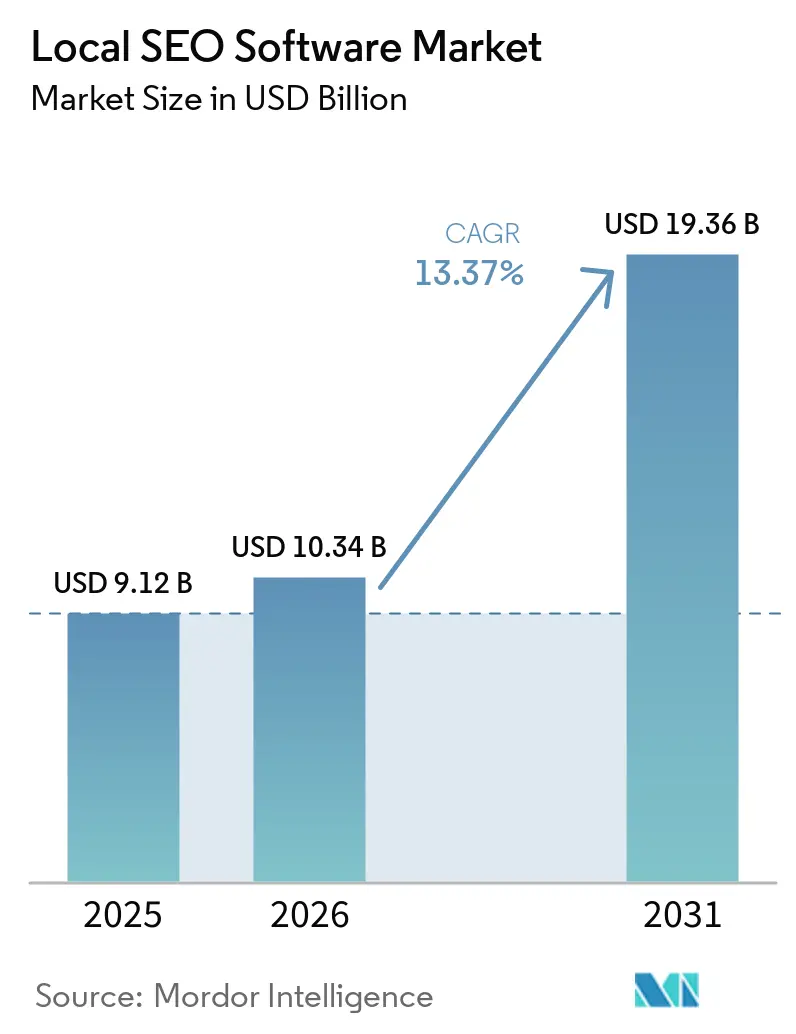
The local SEO software market size is expected to increase from USD 9.12 billion in 2025 to USD 10.34 billion in 2026 and reach USD 19.36 billion by 2031, growing at a CAGR of 13.37% over 2026-2031. The local SEO software market is moving from basic directory correction toward systems that help brands stay visible across search, maps, and AI-generated answers. This shift is changing vendor competition because platform buyers now want entity verification, structured data controls, and AI citation monitoring in the same workflow. Cloud delivery remains central because policy changes from Google Business Profile and publisher networks require fast updates that customers do not want to manage on their own. The local SEO software market also reflects a clear split in demand, with SMEs driving volume and large enterprises driving higher-value deployments built around compliance, auditability, and automation. Competitive activity shows that buyers increasingly favor vendors that can fit into larger marketing and customer experience stacks, which creates room for both consolidation and specialized product development.
Key Report Takeaways
- By deployment model, cloud-based solutions held 67.45% share in 2025, while on-premises solutions are projected to expand at a 13.40% CAGR through 2031.
- By organization size, SMEs held 60.14% of local SEO software market share in 2025, while large enterprises are projected to record the highest CAGR at 14.10% through 2031.
- By functionality, keyword research accounted for 28.34% of the local SEO software market in 2025, while local listings management is projected to expand at a 14.80% CAGR through 2031.
- By end user, local businesses held 56.23% of the local SEO software market in 2025, while marketing agencies are projected to grow at a 14.30% CAGR through 2031.
- By geography, North America accounted for 41.34% of the local SEO software market size in 2025, while Asia-Pacific is projected to expand at a 15.20% CAGR through 2031.
Note: Market size and forecast figures in this report are generated using Mordor Intelligence’s proprietary estimation framework, updated with the latest available data and insights as of January 2026.
Market Trends and Insights
Drivers Impact Analysis of Local SEO Software Market*
| Driver | (~) % Impact on CAGR Forecast | Geographic Relevance | Impact Timeline |
|---|---|---|---|
| Expansion Of Multi-Location And Franchise Programs | +3.2% | Global, concentrated in North America and Europe | Medium term (2-4 years) |
| Rising Dependence On Reviews And Reputation Signals | +2.8% | Global | Short term (≤ 2 years) |
| Migration To Cloud-Based Local Marketing Stacks | +2.4% | Global, led by North America and Asia-Pacific | Medium term (2-4 years) |
| Growth In Mobile, Maps, And Near-Me Search | +2.0% | Asia-Pacific, North America, and Europe | Short term (≤ 2 years) |
| Shift From Citation Cleanup To AI Entity Verification | +1.5% | North America and Europe, with spillover to Asia-Pacific | Medium term (2-4 years) |
| Need For Real-Time Location Data Syndication Across Search, Maps, And AI Endpoints | +1.2% | Global | Long term (≥ 4 years) |
| Source: Mordor Intelligence | |||
Expansion of Multi-Location and Franchise Marketing Programs
Expansion of franchise systems and distributed retail networks continues to support the local SEO software market because each location must win visibility on its own. Central brand spending does not guarantee location-level ranking strength, which pushes operators toward platforms that can manage large networks without adding matching labor. SOCi reported that only 1.2% of business locations are recommended by ChatGPT, compared with 35.9% visibility in Google’s local 3-Pack, which shows how selective AI-era local discovery has become for multi-location brands. The U.S. Chamber of Commerce reported in 2025 that 58% of small businesses were already using generative AI, which shows that organizational readiness for AI-assisted local marketing has moved beyond early adopters.[1] As a result, the local SEO software market is seeing stronger demand for workflow automation, brand controls, and execution models that scale across hundreds or thousands of locations.
Growing Dependence on Online Reviews and Reputation Signals
Review management has become a core part of the local SEO software market because AI systems now read review content for sentiment, service themes, and recency instead of only counting ratings. This changes the value of reputation tools because platforms must now help brands respond at scale and keep messaging consistent across many profiles. Rio SEO stated in 2025 that 75% of consumers read at least 4 reviews before making a purchase decision and 59% expect a business to respond within 24 hours, which raises the pressure on brands with large location footprints. BrightLocal said in April 2026 that consumers were checking an average of 6 review sites before choosing a business, which widened the operational scope beyond Google alone. These changes are pushing the local SEO software market toward solutions that combine monitoring, solicitation, and AI-assisted response management inside the same system.
Migration Toward Cloud-Based Local Marketing Stacks
Migration toward unified cloud platforms remains a major support for the local SEO software market because customers want a single operating layer for listings, reviews, analytics, and AI visibility. Cloud delivery makes it easier to update policy logic when Google Business Profile rules, publisher schemas, or AI endpoint requirements change. Adobe’s completion of the Semrush acquisition in April 2026 showed that local and AI visibility data are becoming part of wider customer experience systems rather than staying in stand-alone tools.[2] Yext’s May 2026 launch of Scout MCP and Scout API also showed that platform buyers want local visibility intelligence delivered through scalable infrastructure that partners can connect directly into their own workflows. This gives the local SEO software market a clear cloud bias because real-time governance, integration, and multi-tenant updates are difficult to match in isolated deployments.
Growth in Mobile, Maps, and Near-Me Search Activity
Mobile and map-based discovery continues to support the local SEO software market because local intent often appears close to the moment of purchase. Businesses need accurate listings, consistent hours, and strong profile content because searchers often make decisions without moving far beyond map results and instant answers. Birdeye said in September 2025 that AI-generated discovery had increased 527% in 2025 versus 2024, which suggests that mobile and AI-driven local discovery are increasingly converging. Google has also framed local mobile search as a high-intent behavior that often leads to store visits and same-day purchases, which keeps location accuracy and map visibility central to digital customer acquisition. This means the local SEO software market benefits not only from search traffic growth, but also from the direct link between visibility, foot traffic, and same-day revenue.
Restraints Impact Analysis of Local SEO Software Market*
| Restraint | (~) % Impact on CAGR Forecast | Geographic Relevance | Impact Timeline |
|---|---|---|---|
| Data Privacy, Consent, And Platform Compliance Burdens | -2.2% | Europe, North America, and Asia-Pacific | Short term (≤ 2 years) |
| Search Algorithm and GBP Policy Volatility | -1.8% | Global | Medium term (2-4 years) |
| Zero-Click AI Answers Compressing Click-Based Attribution | -1.5% | North America and Europe | Long term (≥ 4 years) |
| Distribution Fragmentation Between Direct API And Aggregator Networks | -1.0% | Global | Medium term (2-4 years) |
| Source: Mordor Intelligence | |||
Data Privacy, Consent, and Platform Compliance Burdens
Privacy and consent rules create friction for the local SEO software market because many advanced marketing functions depend on customer data, location signals, and behavioral tracking. Under GDPR, businesses can face fines of up to EUR 20 million, which equals USD 22.6 million using the 2025 yearly average exchange reference cited by the IRS.[3] These requirements raise the cost of feature deployment for vendors and make some customers more cautious about personalization-heavy local marketing programs. The burden rises further when enterprise buyers require ISO 27001 certification, SOC 2 Type II attestation, and formal consent management integration during procurement. For the local SEO software market, this creates a gap between vendors that can absorb governance costs and smaller providers that may struggle to meet enterprise standards.
Search Algorithm And Google Business Profile Policy Volatility
Algorithm and policy volatility restrain the local SEO software market because customers want predictable ranking outcomes while search platforms keep changing the rules. Google released 4 core updates since June 2025, which has made ranking guidance harder to stabilize and harder to tie directly to software actions. Search Engine Land reported that the March 2026 core update brought the highest search volatility seen in the prior 12 months, which reinforced buyer concerns around renewal confidence and attribution clarity. Google Business Profile verification changes have added more onboarding friction for service-area businesses, especially for brands managing large location portfolios. This pressure does not remove demand from the local SEO software market, but it does make providers work harder to prove value when ranking shifts come from external platform changes.
*Our forecasts treat driver/restraint impacts as directional, not additive. The impact forecasts reflect baseline growth, mix effects, and variable interactions.
Local SEO Software Market Segment Analysis
By Deployment Model:
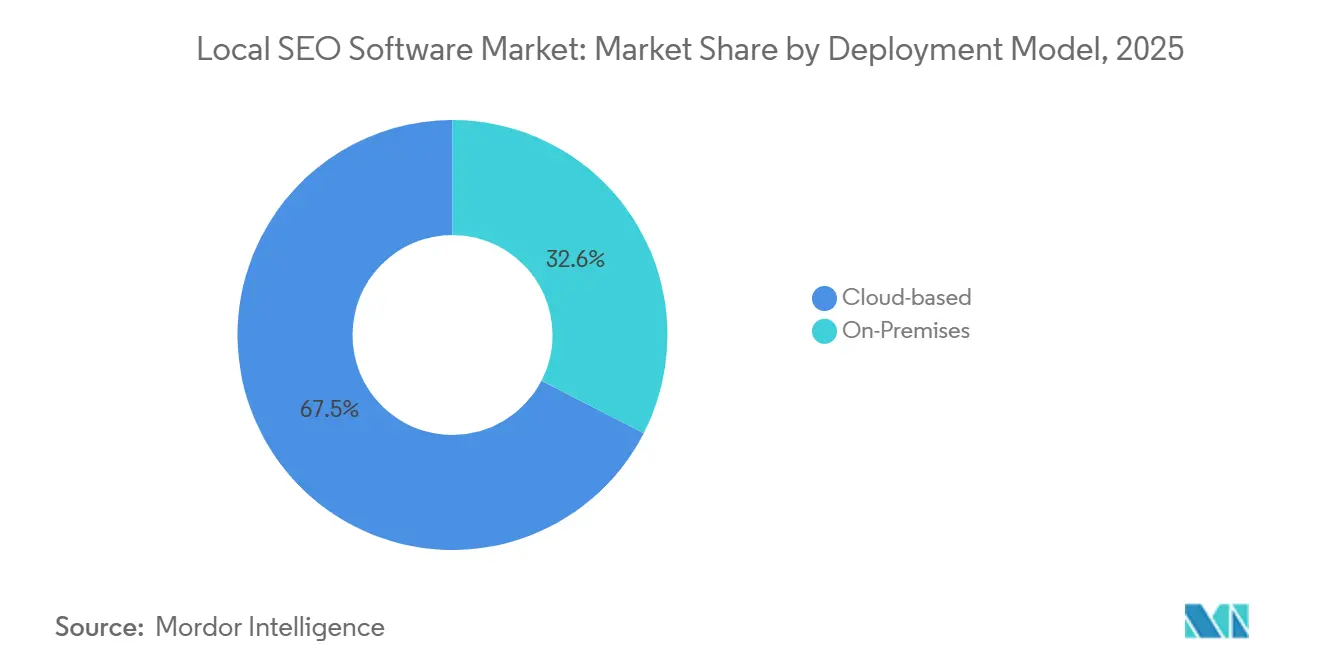
Cloud Platforms Keep the Market Center of GravityCloud-based deployment accounted for 67.45% of the local SEO software market size in 2025, which shows that most buyers preferred infrastructure that can be updated centrally as publisher standards change. This model fits both enterprises and SMEs because it lowers the need for internal maintenance while keeping listings, reviews, and profile controls current. In the local SEO software market, cloud delivery also supports faster response when Google Business Profile policies, publisher schemas, or AI endpoint requirements shift with little notice. That advantage matters because visibility losses can appear quickly when structured data, hours, or profile attributes fall out of sync across platforms.
Cloud vendors also benefit from the ability to push changes across the entire customer base at once, which reduces the version mismatch that can slow reaction time in more static environments. This matters more now because entity trust is shaped by consistency across search engines, maps, directories, and AI-generated local answers. Direct publisher integrations become easier to maintain in the cloud, which helps reduce syndication lag and lowers the risk of NAP inconsistency across the local SEO software industry. On-premises deployments remained the smaller segment, yet they are projected to expand at a 13.40% CAGR through 2031 because large enterprises in regulated sectors still value data residency, internal governance, and hybrid control models.
By Organization Size:
SME Demand Anchors Volume While Enterprise Spending AcceleratesSMEs held 60.14% of local SEO software market share in 2025, reflecting the volume of geographically bounded businesses that depend on local discovery to win customers. Subscription pricing and cloud access have widened availability for tools such as listings management, rank tracking, and review monitoring, which helps smaller firms compete with regional and national brands. In the local SEO software market, SME demand remains broad because location visibility is no longer optional for businesses that rely on walk-in or service-area revenue. Entry-level and tiered plans also make it easier for growing firms to adopt software before scaling into more advanced packages.
Large enterprises are projected to grow at a 14.10% CAGR through 2031, and that growth reflects a different buying logic centered on control, scale, and compliance. Brands with thousands of locations need role-based permissions, audit trails, structured workflows, and automation that can run continuously without matching headcount growth. The local SEO software market is also seeing enterprise demand rise because AI visibility now sits alongside traditional local ranking in the same governance problem. Within the local SEO software industry, point solutions are less suited to this need because large brands increasingly want a single platform that can manage both standard listings work and AI citation oversight. This keeps volume with SMEs, while higher-value platform contracts continue shifting toward enterprise buyers.
By Functionality:
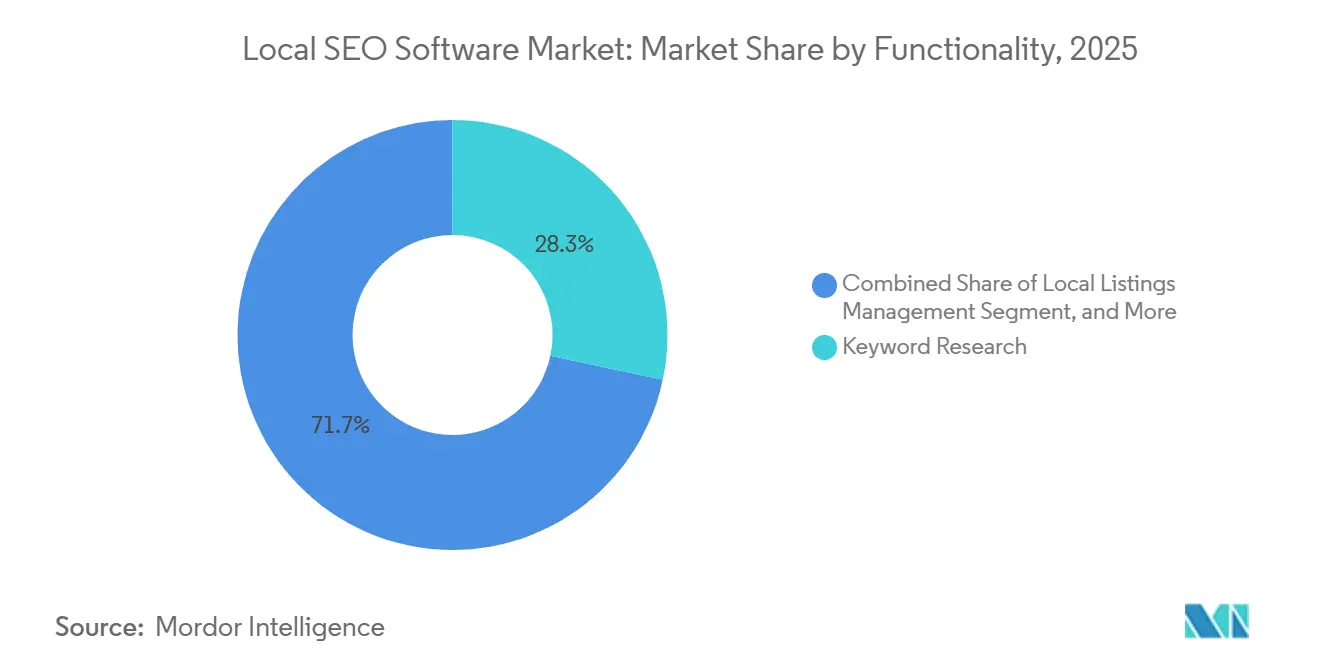
Listings Management Gains Speed As Accuracy Becomes A Visibility GateKeyword research held 28.34% of the local SEO software market in 2025, which kept it in the lead because it remains the starting point for many local search programs. Its broad availability across platform types also helped it retain scale, from specialized local tools to larger visibility suites. Semrush reinforced this direction in October 2025 when it launched Semrush One to combine traditional SEO tracking with AI search performance measurement in one environment. Even so, the center of investment is moving toward data accuracy and distribution because visibility now depends on what platforms can verify across many endpoints.
Local listings management is projected to expand at a 14.80% CAGR through 2031, making it the fastest-growing functionality in the local SEO software market size discussion. That pace reflects how real-time data synchronization has moved from a maintenance task to a direct requirement for AI citation eligibility and map accuracy. Yext’s May 2026 launch of Scout MCP and Scout API showed how vendors are investing in infrastructure that can connect visibility intelligence, competitive signals, and location data at large scale. Reputation management and analytics are also advancing because review text and no-click visibility now influence outcomes that older reporting models did not capture. As a result, the local SEO software market is rewarding platforms that can turn listings management into a live data layer instead of treating it as periodic cleanup work.

By End User:
Local Businesses Lead Adoption While Agencies Expand FasterLocal businesses accounted for 56.23% of the local SEO software market in 2025, which reflects the direct connection between visibility in nearby searches and day-to-day revenue. For this group, software value is usually measured through calls, visits, bookings, and same-day customer action rather than broad brand awareness. The local SEO software market continues to draw strong demand from local businesses because they need practical tools for keeping hours, addresses, reviews, and profile details accurate across many consumer touchpoints. This keeps adoption strong even when budgets are tighter, since local presence errors can immediately affect store visits and conversion.
Marketing agencies are projected to expand at a 14.30% CAGR through 2031, which makes them the fastest-growing end-user group. Their service model is shifting away from narrow rank-tracking work and toward broader local presence management that includes reviews, listings, AI citation checks, and multi-platform reporting. Yext’s 2026 consumer survey also showed that AI has already become a starting point for local business discovery among higher-income households, which gives agencies a stronger reason to broaden client programs beyond Google-only visibility. Agencies are well placed to close the measurement gap because many clients want GEO support but do not have in-house methods for tracking it. This keeps the local SEO software market attractive to agencies that can turn platform complexity into recurring managed service revenue.
Geography Analysis
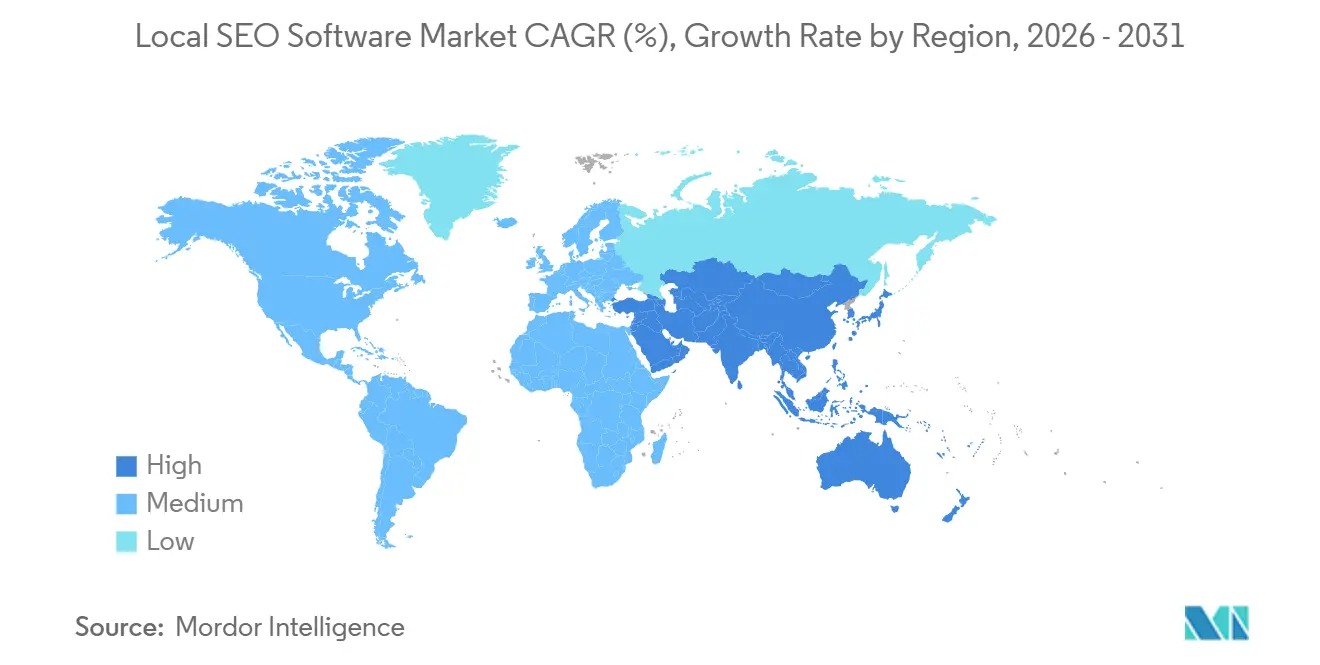
North America Local SEO Software Market
North America held 41.34% of local SEO software market share in 2025, which kept it as the largest regional contributor. The region benefits from a dense base of franchise systems, multi-location brands, and mature digital marketing budgets. The United States remained the core national market because of its large SME base, intense local competition, and early adoption of AI-enabled visibility tools. Yext reported in 2026 that AI has already overtaken Google as the starting point for local business discovery among U.S. households earning over USD 150,000, which shows why enterprise buyers in the region are moving faster on AI citation readiness. Canada added support through agency growth and franchise expansion, while Mexico remained an emerging opportunity tied to mobile internet growth and rising business formalization.
APAC Local SEO Software Market
Asia-Pacific is projected to expand at a 15.20% CAGR through 2031, making it the fastest-growing region in the local SEO software market. Growth is supported by SME digitalization, mobile-first consumer behavior, and a wider need for local discovery tools in fast-growing urban markets. The region also presents a language and localization challenge because platforms must support varied scripts, review ecosystems, and search behavior across national markets. This gives both global providers and regional specialists room to compete on usability, automation, and content adaptation.
EMEA and South America Local SEO Software Market
Europe held a meaningful share of the local SEO software market in 2025, with Germany, the United Kingdom, and France standing out as the strongest markets for enterprise spending. Semrush expanded its AI visibility database to 32 countries in May 2026, including several European markets, which shows the region’s growing strategic weight for platform vendors. South America, led by Brazil and Argentina, is still earlier in adoption but benefits from mobile internet expansion and rising digital commerce activity. The Middle East is seeing stronger demand in Saudi Arabia and the United Arab Emirates, where smart-city programs and high smartphone use are lifting the importance of digital local presence. Africa remains the smallest regional segment, though South Africa, Nigeria, and Kenya continue to offer longer-term potential as mobile access and business formalization improve.
Competitive Landscape
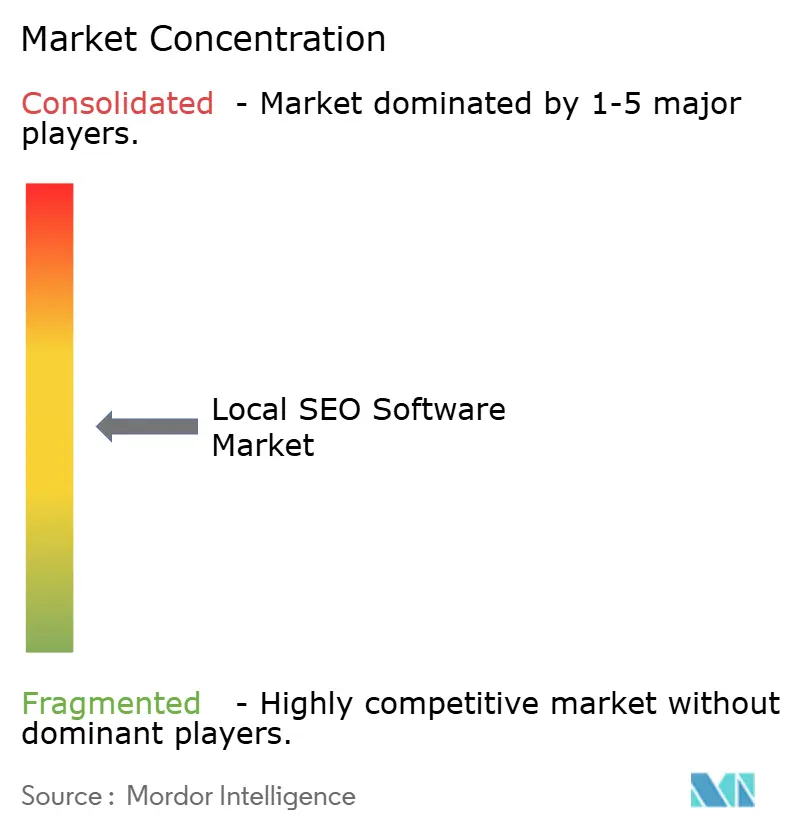
The local SEO software market remains moderately fragmented, with vendors competing on direct publisher connections, AI visibility tools, multi-location workflow design, and the strength of their structured data controls. Yext holds a strong position because it maintains a large direct publisher network and continues to invest in visibility intelligence that can be extended through partner integrations. Semrush gained a wider platform context after Adobe completed its USD 1.9 billion acquisition in April 2026, which tied search and AI discoverability intelligence more closely to broader customer experience software. BrightLocal, Birdeye, and SOCi continue to compete by focusing on local visibility workflows, agency usability, reputation management, and multi-location brand needs. The local SEO software market is therefore not dominated by one platform type, and buyers still choose across enterprise suites, specialist providers, and increasingly AI-focused entrants.
A clear strategic pattern in the local SEO software market is platform consolidation through acquisition and ecosystem embedding. Adobe’s takeover of Semrush and Alchemer’s acquisition of Chatmeter both show that local visibility data are being pulled into broader experience, feedback, and marketing systems. Birdeye’s launch of Search AI in September 2025 showed another path, where vendors use product expansion to address AI-generated discovery directly instead of relying on traditional listings value alone. Yext followed a similar logic by opening Scout infrastructure to partners, which strengthened its role as a data layer rather than only a front-end application.
The local SEO software market also shows growing separation between vendors built for very large location networks and those serving SMEs or agencies with lighter needs. SOCi and Birdeye have leaned into distributed brand workflows, while BrightLocal and similar tools remain attractive for agencies and smaller businesses that value ease of use and lower entry cost. Another competitive gap sits in regulated sectors such as healthcare, legal services, and financial services, where data governance needs can shape platform choice as much as ranking functionality. The market still leaves room for specialist entrants, especially in AI citation tracking and entity verification, but defensibility is increasingly tied to infrastructure depth, integration breadth, and the ability to support multi-surface visibility measurement.
Local SEO Software Industry Leaders
-
Yext, Inc.
-
Semrush Holdings, Inc.
-
BrightLocal Ltd
-
Reputation.com, Inc.
-
Whitespark Inc.
- *Disclaimer: Major Players sorted in no particular order
Local SEO Software Market Companies Covered in this Report
- Yext, Inc.
- Semrush Holdings, Inc.
- BrightLocal Ltd
- Reputation.com, Inc.
- Whitespark Inc.
- Birdeye Inc.
- SOCi, Inc.
- uberall GmbH
- Moz, Inc.
- Chatmeter, Inc.
- Advice Interactive Group LLC
- Vendasta Technologies Limited
- Thryv, Inc.
- Milestone Inc.
- DAC Group Holdings Limited
- SE Ranking
- Synup
- Rio SEO
- LocaliQ
- LocalClarity
Recent Industry Developments in Local SEO Software Market
- May 2026: Yext, Inc. launched Scout MCP and Scout API on May 18, 2026, opening its visibility and competitive intelligence infrastructure to global partners. Scout analyzes 10 billion signals monthly across 4 AI models for over 12 million business locations, surfacing 150 visibility metrics across 20 competitors per scan. The launch positions Yext as the data layer for agentic marketing programs as AI commoditizes local content generation and publishing.
- May 2026: Semrush, now an Adobe company, expanded its AI visibility prompt database to 32 countries on May 14, 2026, adding 17 new regional markets and growing the total database to 261 million prompts globally, including 126 million US prompts and 58.4 million ChatGPT prompts. The expansion extends enterprise-grade AI search intelligence to previously unmeasured markets across South America, Europe, and the Middle East.
- April 2026: Adobe completed its acquisition of Semrush Holdings, Inc. on April 28, 2026 for USD 1.9 billion, combining Semrush's discoverability intelligence with Adobe's Customer Experience Enterprise platform. Adobe cited a 269% year-over-year increase in AI traffic to US retail sites as evidence of the strategic urgency, with the integration connecting Semrush's SEO and GEO capabilities directly to Adobe Experience Manager, Adobe LLM Optimizer, and Adobe Brand Concierge.
- April 2026: BrightLocal launched AI Insights on April 8, 2026, a feature built on 16 years of proprietary local search data that analyzes rankings, GBP reviews, citations, and content to produce prioritized remediation recommendations. The feature addresses a documented consumer behavior shift, consumers now consult an average of 6 review sites before selecting a business, significantly broadening the multi-platform management surface for local businesses and agencies alike.
Global Local SEO Software Market Report Scope
The Local SEO Software Market refers to the industry segment focused on tools and platforms that help businesses optimize their online presence for geographically targeted searches, enabling them to attract and engage nearby customers more effectively. This market includes solutions for managing local business listings, monitoring online reviews, tracking keyword rankings, analyzing competitor performance, and enhancing visibility across search engines and map services.
The Local SEO Software Market Report is Segmented by Deployment Model (Cloud-Based and On-Premises), Organization Size (Small and Medium-Sized Enterprises and Large Enterprises), Functionality (Keyword Research, Local Listings Management, Reputation Management, and Analytics and Reporting), End User (Local Businesses, Marketing Agencies, and SEO Professionals and Consultants), and Geography (North America, South America, Europe, Asia-Pacific, Middle East, Africa). The Market Forecasts are Provided in Terms of Value (USD).
Segmentation Overview
| Cloud-Based |
| On-Premises |
| Small and Medium-Sized Enterprises |
| Large Enterprises |
| Keyword Research |
| Local Listings Management |
| Reputation Management |
| Analytics and Reporting |
| Local Businesses |
| Marketing Agencies |
| SEO Professionals and Consultants |
| North America | United States |
| Canada | |
| Mexico | |
| South America | Brazil |
| Argentina | |
| Rest of South America | |
| Europe | Germany |
| United Kingdom | |
| France | |
| Italy | |
| Spain | |
| Rest of Europe | |
| Asia-Pacific | China |
| Japan | |
| India | |
| South Korea | |
| Rest of Asia-Pacific | |
| Middle East | Saudi Arabia |
| United Arab Emirates | |
| Turkey | |
| Rest of Middle East | |
| Africa | South Africa |
| Nigeria | |
| Kenya | |
| Rest of Africa |
| By Deployment Model | Cloud-Based | |
| On-Premises | ||
| By Organization Size | Small and Medium-Sized Enterprises | |
| Large Enterprises | ||
| By Functionality | Keyword Research | |
| Local Listings Management | ||
| Reputation Management | ||
| Analytics and Reporting | ||
| By End User | Local Businesses | |
| Marketing Agencies | ||
| SEO Professionals and Consultants | ||
| By Geography | North America | United States |
| Canada | ||
| Mexico | ||
| South America | Brazil | |
| Argentina | ||
| Rest of South America | ||
| Europe | Germany | |
| United Kingdom | ||
| France | ||
| Italy | ||
| Spain | ||
| Rest of Europe | ||
| Asia-Pacific | China | |
| Japan | ||
| India | ||
| South Korea | ||
| Rest of Asia-Pacific | ||
| Middle East | Saudi Arabia | |
| United Arab Emirates | ||
| Turkey | ||
| Rest of Middle East | ||
| Africa | South Africa | |
| Nigeria | ||
| Kenya | ||
| Rest of Africa | ||
Key Questions Answered in the Report
What is the current and forecast value of local SEO software demand?
The local SEO software market was valued at USD 9.12 billion in 2025, reached USD 10.34 billion in 2026, and is forecast to reach USD 19.36 billion by 2031 at a 13.37% CAGR.
Which deployment model leads software adoption for local search visibility?
Cloud-based deployment led with 67.45% share in 2025 because buyers prefer scalable systems that update quickly as publisher rules and AI endpoint needs change.
Why are agencies growing faster in this space than some other end users?
Marketing agencies are projected to expand at a 14.30% CAGR through 2031 because clients increasingly want bundled support across listings, reviews, AI citation audits, and GEO measurement.
Which functionality is growing the fastest for local presence platforms?
Local listings management is projected to grow at a 14.80% CAGR through 2031 as real-time data synchronization becomes essential for search, maps, and AI-generated answers.
Which region offers the strongest growth opportunity through 2031?
Asia-Pacific is the fastest-growing region with a 15.20% CAGR, supported by SME digitalization, mobile-first search behavior, and rising use of AI-driven discovery tools.
What are the main risks vendors and buyers need to watch?
The main pressures are privacy compliance costs, search and Google Business Profile policy volatility, zero-click AI answers, and fragmentation between direct API and aggregator distribution models.