
Global Tacrolimus Market Size and Share
Market Overview
| Study Period | 2020 - 2031 |
|---|---|
| Forecast Data Period | 2026 - 2031 |
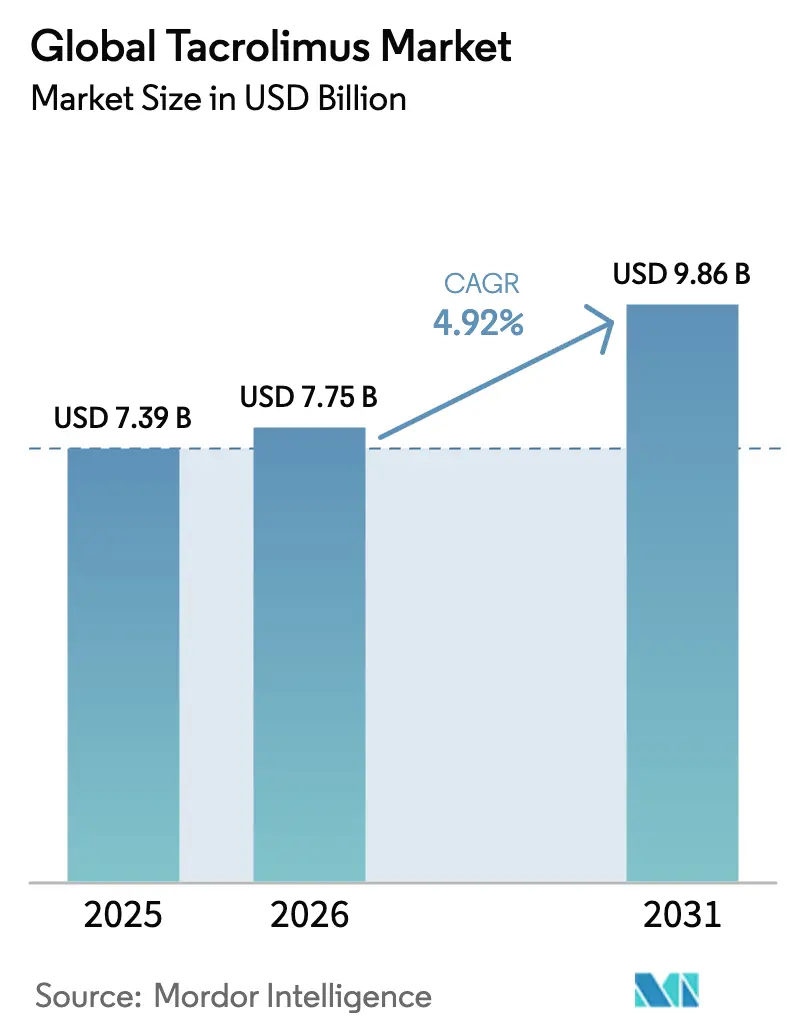
| Market Size (2026) | USD 7.75 Billion |
| Market Size (2031) | USD 9.86 Billion |
| Growth Rate (2026 - 2031) | 4.92 % |
| Fastest Growing Market | Asia-Pacific |
| Largest Market | North America |
Major Players *Disclaimer: Major Players sorted in no particular order Image © Mordor Intelligence. Reuse requires attribution under CC BY 4.0. | |
Global Tacrolimus Market Analysis by Mordor Intelligence
The tacrolimus market size was valued at USD 7.39 billion in 2025 and estimated to grow from USD 7.75 billion in 2026 to reach USD 9.86 billion by 2031, at a CAGR of 4.92% during the forecast period (2026-2031). The tacrolimus market is propelled by wider acceptance of once-daily extended-release products, growing transplant procedure volumes, and rising prescriptions for steroid-refractory autoimmune diseases. Generic penetration is accelerating after Prograf’s exclusivity loss, yet innovators sustain a premium through complex delivery platforms and robust pharmacovigilance programs. Therapeutic-drug-monitoring (TDM) technology adoption improves dose optimization and long-term adherence, mitigating toxicity risks that once limited uptake. Supply-chain security has become a strategic priority as manufacturers diversify Streptomyces fermentation sources to cope with demand spikes in Asia-Pacific.
Key Report Takeaways
- By formulation, extended-release products held 28.56% of tacrolimus market share in 2025 while intravenous preparations are forecast to expand at a 8.79% CAGR through 2031.
- By application, organ transplantation captured 38.41% of the tacrolimus market size in 2025; autoimmune diseases are projected to record a 9.91% CAGR to 2031.
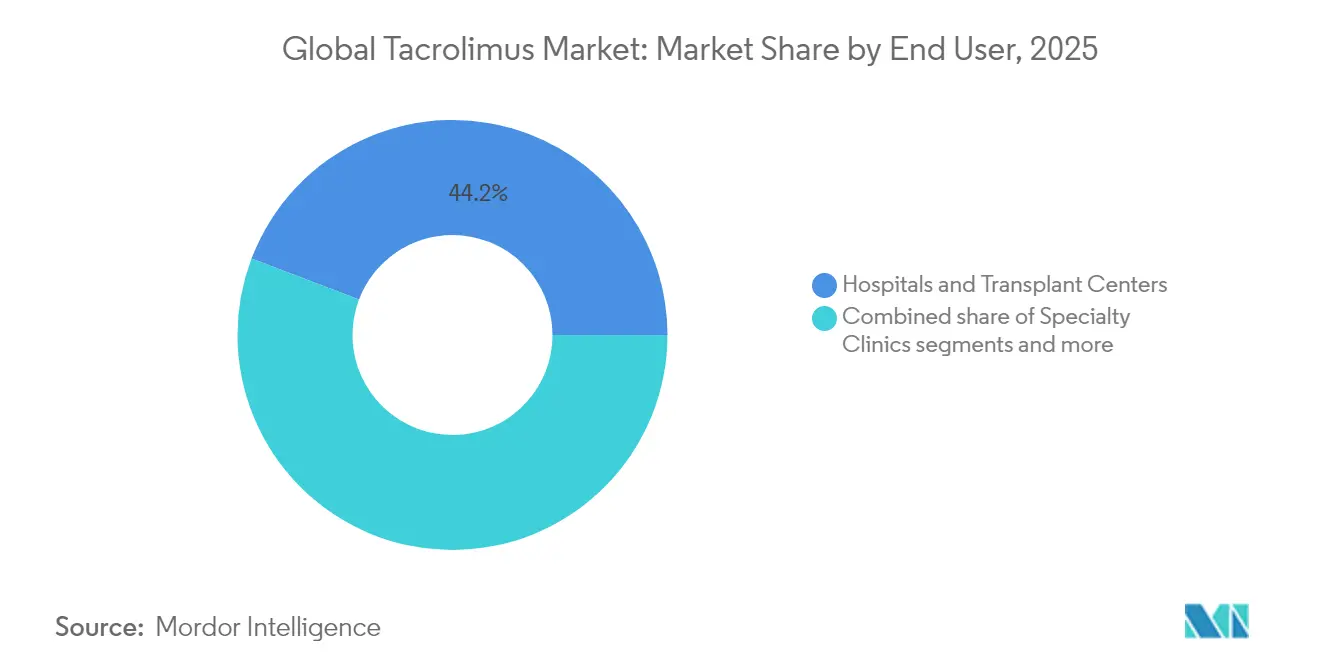
- By end-user, hospitals and transplant centers accounted for 44.22% of tacrolimus market share in 2025, whereas specialty clinics are expected to grow at a 10.48% CAGR until 2031.
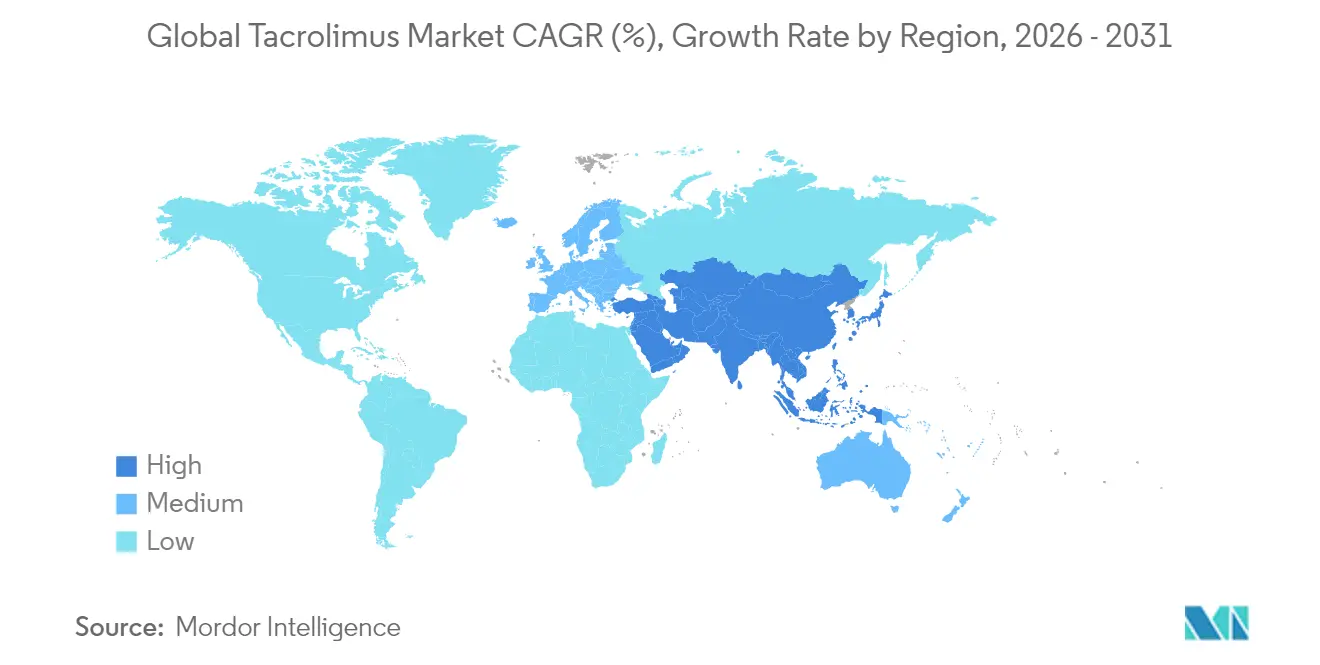
- By geography, North America led with 39.74% revenue share in 2025, and Asia-Pacific is advancing at a 9.21% CAGR through 2031.
Note: Market size and forecast figures in this report are generated using Mordor Intelligence’s proprietary estimation framework, updated with the latest available data and insights as of 2026.
Market Trends and Insights
Drivers Impact Analysis of Global Tacrolimus Market*
| Driver | (~) % Impact on CAGR Forecast | Geographic Relevance | Impact Timeline |
|---|---|---|---|
| Surging post-transplant survival rates boosting long-term immunosuppressant use | +1.2% | Global, with highest impact in North America & Europe | Long term (≥ 4 years) |
| Shift from cyclosporine to tacrolimus in solid-organ transplants | +0.8% | Global, accelerated adoption in Asia-Pacific | Medium term (2-4 years) |
| Regulatory approvals for extended-release formulations | +0.7% | North America & Europe, expanding to Asia-Pacific | Short term (≤ 2 years) |
| Rising autoimmune disease burden in Asia-Pacific & Europe | +0.6% | Asia-Pacific core, spill-over to Europe | Medium term (2-4 years) |
| Innovative drug-delivery platforms (nano-eye-drops, biodegradable implants) | +0.4% | North America & Europe, early adoption markets | Long term (≥ 4 years) |
| Precision-dosing software integrated into therapeutic drug-monitoring (TDM) systems | +0.3% | Global, with faster adoption in developed markets | Medium term (2-4 years) |
| Source: Mordor Intelligence | |||
Surging Post-Transplant Survival Rates Boost Long-Term Drug Use
Ten-year kidney graft survival now exceeds 85%, giving patients much longer exposure to maintenance immunosuppression. Higher survival translates into 40–60% more lifetime tacrolimus doses per recipient, enlarging recurring revenue streams for both innovators and generics. Clinicians increasingly choose once-daily extended-release variants, which improve adherence by simplifying complex pill schedules. Parallel growth in digital TDM platforms allows remote dose adjustment and reduces hospitalization linked to toxicity. Together, these shifts secure durable volume gains for tacrolimus through at least the next decade.
Therapeutic Migration from Cyclosporine to Tacrolimus
Large meta-analyses confirm lower acute rejection, reduced nephrotoxicity, and fewer cardiovascular events when tacrolimus replaces cyclosporine. In response, global transplant guidelines have revised first-line protocols, and more than 80% of liver-graft centers now open with tacrolimus. Rapid generic entry in Asia-Pacific removes historical cost barriers, enabling lower-income health systems to modernize regimens quickly. Hospitals also report shorter post-operative stays because tacrolimus minimizes early complications, freeing scarce ICU beds. These clinical and economic advantages sustain the formulation’s steady capture of cyclosporine share.
Rapid Regulatory Acceptance of Extended-Release Variants
Envarsus XR and similar products demonstrate smoother pharmacokinetic profiles that cut peak-trough swings linked to rejection crises. Regulators in the United States and Europe now grant priority reviews, citing clear adherence benefits and lower monitoring intensity. Patent protection until 2035 shields these variants from immediate price competition, preserving a premium of 20–30% over twice-daily capsules. Health-technology assessments in Canada and Germany show net budget savings from avoided hospital readmissions despite higher acquisition costs. Consequently, extended-release uptake is accelerating in both mature and emerging markets.
Escalating Autoimmune Disease Prevalence
Incidence of lupus nephritis, rheumatoid arthritis, and ulcerative colitis is climbing fastest in Asia-Pacific and Eastern Europe. Tacrolimus now features in multiple regional guidelines as a steroid-sparing option when standard therapy fails. Chinese health-economic models report superior quality-adjusted life-years versus cyclophosphamide, bolstering national reimbursement decisions. Pharmaceutical companies are funding large real-world registries to document long-term safety outside transplant populations. This emerging evidence base is forecast to lift autoimmune demand by double digits through 2030.
Restraints Impact Analysis of Global Tacrolimus Market*
| Restraint | (~) % Impact on CAGR Forecast | Geographic Relevance | Impact Timeline |
|---|---|---|---|
| Narrow therapeutic index necessitating costly TDM | -0.9% | Global, particularly impactful in cost-sensitive markets | Long term (≥ 4 years) |
| Patent-protected LP-10/veloxis ER forms delaying price erosion | -0.5% | North America & Europe primarily | Medium term (2-4 years) |
| High nephro- & neuro-toxicity profile versus next-gen agents | -0.7% | Global, with higher impact in developed markets | Medium term (2-4 years) |
| Supply-chain vulnerability due to single-strain fermentation inputs | -0.3% | Global, with acute impact in Asia-Pacific manufacturing hubs | Short term (≤ 2 years) |
| Source: Mordor Intelligence | |||
TDM Cost Burden
Tacrolimus requires a narrow therapeutic‐index check, and monthly assays cost USD 100–200 per test, straining payer budgets in price-sensitive systems. These cumulative expenses can surpass drug acquisition costs within five years for many transplant patients. Rural hospitals across Latin America and Africa often lack calibrated chromatography platforms, forcing patients to travel long distances for blood draws. Dried-blood-spot kits reduce logistics hurdles but still rely on centralized laboratories, offering only partial relief. Until affordable point-of-care analyzers scale globally, high monitoring charges will continue to curb tacrolimus adoption in developing regions.
Extended-Release Patent Moats Slow Price Erosion
Veloxis safeguards its LP-10 once-daily coating technology with patents that run to 2035, creating a durable exclusivity window. Manufacturing requires multilayer spray deposition and real-time dissolution analytics, capabilities that most generic plants do not possess. These technical hurdles keep rivals at bay and sustain a 25% price premium over immediate-release generics. Payers in North America and Europe accept the higher list price because improved adherence lowers costly rejection-related readmissions. Consequently, extended-release pricing remains sticky, muting overall market price compression even as commodity capsules face aggressive discounting
*Our forecasts treat driver/restraint impacts as directional, not additive. The impact forecasts reflect baseline growth, mix effects, and variable interactions.
Global Tacrolimus Market Segment Analysis
By Formulation:
Extended-Release Commands Premium PricingExtended-release variants held 28.56% of tacrolimus market share in 2025 and generated USD 2.11 billion of tacrolimus market size that year. Superior pharmacokinetics flatten peak-to-trough swings, lowering rejection episodes and supporting once-daily adherence. Intravenous preparations, though smaller in value, are advancing at a 8.79% CAGR on wider adoption for peri-operative induction in kidney and liver grafts. Immediate-release oral generics defend volume in maintenance therapy but feel price pressure as payers bundle purchasing contracts.
Manufacturers are investing in nanocapsule suspensions, transdermal patches, and biodegradable ocular implants that promise week-long or month-long release. Coating lines capable of real-time dissolution analytics allow innovators to lock in quality differentiation and deter rapid generic replication. Pilots with 3-D-printed mini-tablets show accurate micro-dosing for paediatric use, an area still underserved by current capsule strengths. Regulatory agencies have signalled willingness to use adaptive review pathways for such technologies, provided plasma-level variability remains within established bioequivalence limits. These innovations collectively raise the technical bar for market entry while enlarging the future addressable base of complex-need patients.




By Application:
Autoimmune Uptake Reconfigures Demand MixOrgan transplantation contributed 38.41% of tacrolimus market size in 2025, anchored by kidney and liver grafts that dominate global transplant volumes. Autoimmune diseases, however, are forecast to post the quickest expansion at a 9.91% CAGR as clinical evidence validates tacrolimus in lupus nephritis, rheumatoid arthritis, and steroid-refractory ulcerative colitis. Dermatological uses such as atopic dermatitis sustain a niche through topical ointments, though growth trails systemic indications. Heart and lung transplantation remain steady but constrained by donor scarcity.
Guideline changes in Taiwan, China, and parts of Europe now list tacrolimus ahead of cyclophosphamide for second-line lupus nephritis, driving formulary wins and regional reimbursement decisions. Pooled real-world data suggest a 25% drop in hospital readmissions for autoimmune flares when tacrolimus is added to steroid-sparing regimens. Ongoing trials are testing micro-dosed tacrolimus in chronic graft-versus-host disease, an application that could create a fresh orphan-drug sub-segment. Health-technology-assessment bodies are beginning to factor lifetime productivity gains for young autoimmune sufferers, a shift that favours broader coverage. These dynamics collectively pivot overall growth momentum away from transplant-centric demand toward chronic immune-modulation markets.
By End-User:
Specialty Clinics Accelerate DecentralisationHospitals and transplant centres captured 44.22% of tacrolimus market share in 2025, reflecting their role in acute post-operative care and early-phase TDM. Specialty clinics, however, are on track for a 10.48% CAGR as payers push follow-up care into lower-cost outpatient settings. Dermatology offices maintain durable demand for topical tacrolimus, while ambulatory-surgery centres gain relevance for same-day graft biopsies and immediate re-dosing protocols. Telepharmacy platforms enable rural clinicians to consult tertiary-centre pharmacologists for dose titration decisions.
Portable immunoassay kits and Bluetooth-enabled pill bottles let clinicians monitor trough levels and adherence without repeated hospital visits. Value-based-care contracts in the United States now reimburse speciality clinics for outcome metrics such as graft-survival days rather than visit counts, incentivising proactive dose management. In Europe, bundled-payment pilots across Spain and Germany include tacrolimus dispensing inside capitated transplant packages, formalising the hand-off from university hospitals to community nephrology centres. Large pharmacy-benefit managers are aligning with integrated specialty clinics to negotiate volume-based discounts on once-daily capsules. Together, these shifts firmly anchor long-term demand in outpatient channels and redistribute negotiating power across the supply chain.
Geography Analysis
North America Tacrolimus Market
North America accounted for 39.74% of tacrolimus market size in 2025. Established transplant infrastructure, comprehensive insurance coverage, and strict bioequivalence standards favor suppliers with strong quality systems. The FDA’s February 2025 downgrade of Accord’s generic from AB to BX underscored the reputational stakes tied to manufacturing rigor.
APAC Tacrolimus Market
Asia-Pacific is the fastest-growing region at 9.21% CAGR. China’s NMPA shortened review cycles for complex generics, enabling Biocon’s January 2025 approval of three strengths in one filing. Japan emphasizes local production and post-marketing surveillance, supporting domestic suppliers, whereas India leverages cost-efficient fermenters to feed global demand.
EMEA and South America Tacrolimus Market
Europe grows steadily under universal healthcare and harmonized EMA pathways. Germany, the United Kingdom, and France dominate volumes, while Eastern European markets expand as transplant programs mature. South America and Middle East & Africa progress more slowly because reimbursement gaps and limited donor networks constrain procedure counts, yet Brazil’s public-private partnerships hint at faster adoption ahead.

Regulatory Landscape
Tacrolimus is regulated as a narrow-therapeutic-index immunosuppressant across major markets, with labeling and pharmacovigilance focused on careful physician supervision to reduce the risk of graft rejection or serious adverse reactions from under- or over-exposure during product or formulation switching. In the United States, FDA labeling and therapeutic-equivalence controls remain a key market gate, reinforced by FDA actions such as the February 2025 therapeutic-equivalence rating change for an Accord generic (AB to BX), which elevated scrutiny on manufacturing and bioequivalence performance.
Regulatory requirements are also being influenced by trade and guidance updates. In April 2026, the White House issued a Section 232 proclamation on imports of patented pharmaceuticals and related ingredients, introducing a tiered duty framework effective from July 31, 2026. Generic pharmaceuticals and their associated ingredients are excluded, limiting direct tariff exposure for much of the tacrolimus generic supply chain. In May 2026, FDA issued revised draft product-specific guidance for generic tacrolimus to support product development while maintaining bioequivalence expectations for this sensitive drug class.
Value Chain Analysis
The tacrolimus value chain begins with high-potency API production, relying on microbial fermentation using Streptomyces tsukubaensis, then moving to complex extraction, purification, and impurity-profile controls to meet USP/EP/BP specifications. Upstream constraints center on strain productivity and process controls, which push API producers toward strain engineering and fermentation optimization to manage low natural yields and late-stage product inhibition. These technical hurdles increase qualification lead times and raise the strategic value of Drug Master File quality and audit readiness.
Midstream and downstream steps include finished-dose manufacturing across immediate-release oral products, once-daily extended-release variants, topical formulations, and hospital-use injectables, followed by regulated distribution through wholesalers, hospital pharmacies, and specialty channels tied to therapeutic drug monitoring (TDM). Because FDA boxed warnings state that tacrolimus products are not therapeutically interchangeable without supervision, procurement and dispensing practices prioritize continuity of specific formulations and strengths, making pharmacy-level stocking reliability a practical bottleneck even when overall supply is available. Supplier documentation and market-access readiness across multiple jurisdictions are increasingly differentiators, illustrated by April 2026 KDMF approval for Fishfa Biogenics tacrolimus API in South Korea, which supports cross-border sourcing options for finished-dose manufacturers.
Competitive Landscape
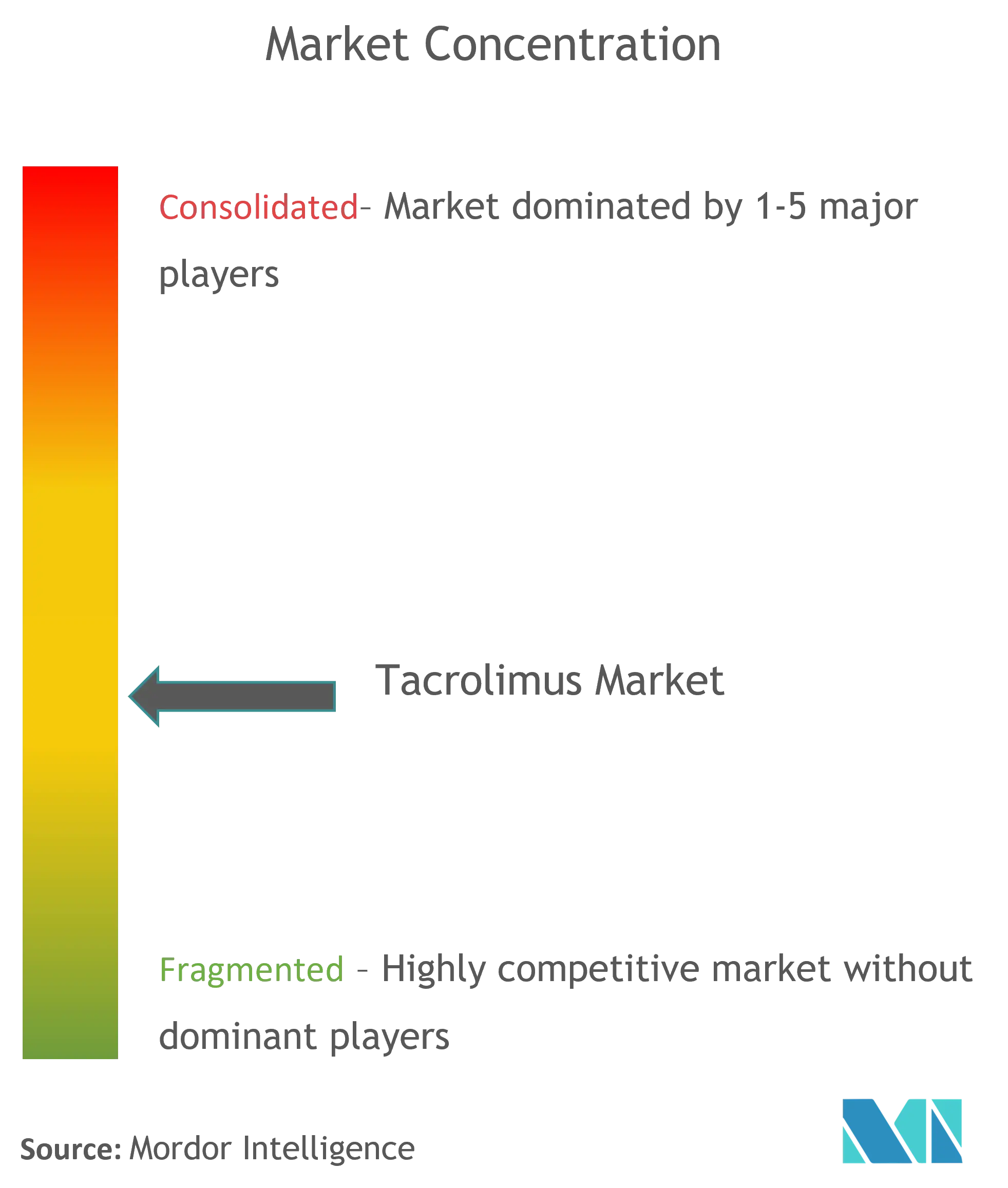
The tacrolimus market remains moderately consolidated. Astellas maintains leadership with Prograf, yet generic makers from India and the EU capture share through aggressive pricing.
Veloxis sustains a patent fence around Envarsus XR, enabling premium pricing and shielding against commoditization. Indian firms such as Dr. Reddy’s and Sun Pharmaceutical fortify positions by dual-sourcing fermentation inputs and securing FDA and EMA certifications.
Strategic focus is shifting toward service differentiation: partnerships with AI-based dosing platforms and integrated TDM services enhance value propositions. Manufacturers that diversify Streptomyces strains or co-locate production across continents mitigate supply risk and gain favor with risk-averse hospital buyers.
Global Tacrolimus Industry Leaders
Pfizer Inc.
Astellas Pharma Inc.
Lupin Pharmaceuticals Inc.
Glenmark Pharmaceuticals Inc.
Biocon Ltd.
- *Disclaimer: Major Players sorted in no particular order
Global Tacrolimus Market Companies Covered in this Report
- Astellas Pharma
- Novartis
- Dr. Reddy’s Laboratories Ltd.
- Sun Pharmaceuticals Industries
- Lupin
- Cipla
- Biocon
- Teva Pharmaceutical Industries
- Sandoz Group AG
- Viatris
- Accord Healthcare Ltd.
- Aurobindo Pharma Ltd.
- Glenmark Pharmaceuticals
- Zydus Lifesciences Ltd.
- Strides Pharma Science Ltd.
- Apotex
- Amneal Pharmaceuticals
- Panacea Biotec Ltd.
- Asahi Kasei

Market Opportunities and Future Outlook
Precision dosing and monitoring services are a clear whitespace area for tacrolimus, given its narrow therapeutic index and the need for close clinical oversight during switching and titration. In February 2026, Thermo Fisher Scientific launched the TacroType pharmacogenetic test to provide CYP3A5 genotype information for personalized tacrolimus dosing, reinforcing an opportunity for manufacturers, labs, and specialty clinics to bundle drug supply with TDM, pharmacogenetics, and dose-optimization workflows that reduce variability and support broader outpatient management.
Non-oral and differentiated delivery platforms also create commercialization headroom beyond commodity immediate-release capsules, particularly where adherence, local tolerability, or organ-specific targeting is prioritized. Novaliq initiated the Phase II EYETAC trial in January 2026 for NOV05, a water-free tacrolimus ophthalmic solution after FDA IND clearance. TFF Pharmaceuticals communicated FDA feedback in June 2024 supporting the development pathway for its tacrolimus inhalation powder program in lung transplant rejection prevention. On the supply side, large-scale capacity programs that strengthen drug-substance availability and reduce single-region dependence are strategically relevant for a fermentation-based API. Celltrion highlighted this direction with a March 2026 plan to invest KRW 1.23 trillion in new drug-substance plants in Songdo, aligning with broader industry moves toward more resilient, scalable manufacturing footprints.
Recent Industry Developments in Global Tacrolimus Market
- May 2026: FDA published revised draft product-specific guidance for generic tacrolimus to support development programs while maintaining bioequivalence expectations for a narrow-therapeutic-index immunosuppressant. The update increases the importance of robust analytical, formulation, and manufacturing controls for ANDA sponsors and can affect the pace and quality of generic submissions.
- December 2025: Nexus Pharmaceuticals launched Tacrolimus Injection, USP 5 mg/mL in a single-dose vial format in the United States. This adds another hospital-use presentation that can support peri-operative and acute-care protocols where intravenous dosing is needed, increasing competitive intensity in injectable tacrolimus.
- April 2024: Biocon received SAHPRA approval in South Africa for tacrolimus capsules (0.5 mg, 1 mg, and 5 mg strengths). The approval expands access to multiple strengths in an important emerging market and supports regional diversification for suppliers with established quality and regulatory dossiers.


Global Tacrolimus Market Report Scope and Research Methodology
Market Definition and Coverage
For this report, the tacrolimus market covers revenues generated from tacrolimus based therapies across major formulations used in transplant immunosuppression and selected non-transplant uses, captured at the manufacturer level in USD across key geographies.
Scope exclusions: We exclude combination regimens as separate drug classes, procedure costs, diagnostics and therapeutic drug monitoring services, and non-tacrolimus immunosuppressants.
Segments Covered in This Report
- By Formulation (Value)
- Extended Release
- Topical Ointment
- Intravenous
- Oral
- Others
- By Application (Value)
- Organ Transplant
- Kidney Transplant
- Liver Transplant
- Heart Transplant
- Lung Transplant
- Autoimmune Diseases
- Rheumatoid Arthritis
- Lupus Nephritis
- Ulcerative Colitis
- Psoriasis
- Dermatological Conditions
- Atopic Dermatitis
- Dry Eye Disease
- Organ Transplant
- By End-user (Value)
- Hospitals & Transplant Centers
- Specialty Clinics
- Dermatology Clinics
- Ambulatory Surgery Centers
- By Geography (Value)
- North America
- United States
- Canada
- Mexico
- Europe
- Germany
- United Kingdom
- France
- Italy
- Spain
- Rest of Europe
- Asia-Pacific
- China
- India
- Japan
- South Korea
- Australia
- Rest of Asia-Pacific
- South America
- Brazil
- Argentina
- Rest of South America
- Middle East and Africa
- GCC
- South Africa
- Rest of Middle East and Africa
- North America
Data Sources, Market Sizing, and Validation
Desk Research
Desk research was used to set the market frame and anchor the demand pool to clinical activity patterns we can observe. We reviewed public health statistics on transplant volumes and waitlist trends from sources such as the Organ Procurement and Transplantation Network and WHO, then used drug utilization guidance and safety updates from sources such as the FDA and EMA to understand where tacrolimus is typically used and how use is changing.
To cross-check supply-side signals, we also reviewed public company filings (annual reports and investor decks), used peer-reviewed clinical literature on dosing and persistence, and considered reputable press releases on approvals and shortages. In addition, we used paid database subscriptions for company financials and news screening, and a patent database to track formulation innovation and expected generic timing. These sources are illustrative, and many other public and paid references were also used for data collection, validation, and clarification.
Primary Interviews and Surveys
Primary work focused on validating the split between transplant and non-transplant demand, and sense-checking how average selling prices move across major formulations and regions. We spoke with manufacturers, distributors, transplant pharmacists, dermatology prescribers, and procurement and reimbursement stakeholders, so gaps from desk research (for example, channel mix and switching patterns) could be closed and assumptions could be pressure-tested across APAC, EMEA, and the Americas.
Distribution of primary research fieldwork respondents
| Company type | Respondent position | Region |
|---|---|---|
| Top tier: 32% | CXOs: 18% | APAC: 40% |
| Mid tier: 48% | Functional/Unit leaders: 25% | EMEA: 33% |
| Smaller Players: 20% | Managers: 57% | Americas: 27% |
Market-Sizing & Forecasting
Sizing was built using a top-down demand reconstruction tied to clinical activity and treatment intensity. Transplant procedure volumes and post-transplant maintenance patterns were converted into tacrolimus consumption, and then translated into value using formulation-level pricing. The totals were corroborated with selective bottom-up approximations, such as sampled supplier revenue roll-ups, channel checks on hospital and specialty distribution, and volume times ASP checks for key countries to adjust any over-statements.
The model inputs that mattered most included solid organ transplant volumes, average duration of therapy and adherence in maintenance, the shift toward once-daily extended-release products, the mix of branded versus generic prescriptions, and regional reimbursement and tender behavior that affects realized prices. For the non-transplant portion, we used dermatologist and autoimmune prescribing rates, strength and pack-size mixes, and seasonality in flare-driven demand as practical indicators.
For forecasting, we ran scenario analysis supported by trend smoothing on the historical series so the model could separate steady transplant growth from pricing resets after new generic entries or policy changes. Where bottom-up signals were incomplete for smaller countries, we proxied from comparable markets based on transplant activity and access levels, then re-validated the implied per-patient spending with interview feedback.
Data Validation & Update Cycle
Validation was handled through multiple checks to keep the final number tied to observable market signals. We compared outputs against independent indicators such as transplant volumes, public safety label changes, and generic approval timing, then re-ran sensitivity tests on the inputs that typically drive most variance, including persistence and realized pricing.
Before sign-off, anomalies were reviewed by another analyst, and the key assumptions were revisited with selected respondents when results looked out of range for a country or formulation. The report is refreshed annually, and interim updates are done when material events occur (for example, major approvals, supply disruptions, or policy shifts). Right before delivery, we complete a fresh review pass so clients receive the most current view available.
Mordor Intelligence's Tacrolimus Market Estimate Compared With Other Published Estimates
Published market numbers for tacrolimus can differ substantially because the underlying counting rules are not always the same, even when the topic label matches. Differences usually come from what is included as tacrolimus revenue, how generics are priced over time, and whether the estimate is refreshed after major approvals or reimbursement shifts.
Some external estimates appear to bundle the wider immunosuppressant therapy basket, or they extend value to adjacent services such as monitoring and hospital protocols. In contrast, Mordor Intelligence counts only tacrolimus drug revenues by formulation and use case, and it builds pricing from realized selling prices after typical channel and tender effects rather than list prices.
Benchmark comparison
| Source | Market Size | Gaps in Research Methodology |
|---|---|---|
| Mordor Intelligence | USD 7.75 B (2026) | |
| Trade Journal A | USD 2.80 B (2025) | Often tracks brand and generic drug sales more narrowly, and can undercount hospital procurement and extended-release formats when ex-manufacturer value is not reconstructed across regions. |
| Industry Research Desk B | USD 7.30 B (2025) | Uses a broader reporting lens with faster growth assumptions and less transparent ASP progression, and currency timing and refresh cadence can differ when inputs are not rechecked after new generic waves. |
Taken together, the spread mostly comes from what gets counted as market value and how pricing is converted from observed channels into a single USD total. Our approach keeps the estimate traceable to transplant volumes, persistence, and formulation mix, and it can be repeated with the same steps when assumptions need to be updated.


Key Questions Answered in the Report
What is the 2026 value of the tacrolimus market?
The tacrolimus market size is USD 7.75 billion in 2026.
How fast will tacrolimus sales grow through 2031?
Revenue is forecast to rise at a 4.92% CAGR, reaching USD 9.86 billion by 2031.
Which region leads global tacrolimus demand?
North America holds the largest share at 39.74% of 2025 revenue.
Which formulation segment is expanding quickest?
Intravenous preparations are advancing at a 8.79% CAGR thanks to wider acute-care adoption.
Why are extended-release products priced at a premium?
Patent protection until 2035 and complex manufacturing maintain limited competition and higher prices.
What is the main growth driver outside transplantation?
Rising autoimmune disease prevalence is propelling tacrolimus uptake in lupus nephritis and rheumatoid arthritis therapies.
Page last updated on:


 Your data is secure and never sold or shared.


