
Semaglutide Market Size and Share
Market Overview
| Study Period | 2020 - 2031 |
|---|---|
| Market Size (2026) | USD 31.97 Billion |
| Market Size (2031) | USD 58.72 Billion |
| Growth Rate (2026 - 2031) | 12.93 % |
| Fastest Growing Market | Asia Pacific |
| Largest Market | North America |
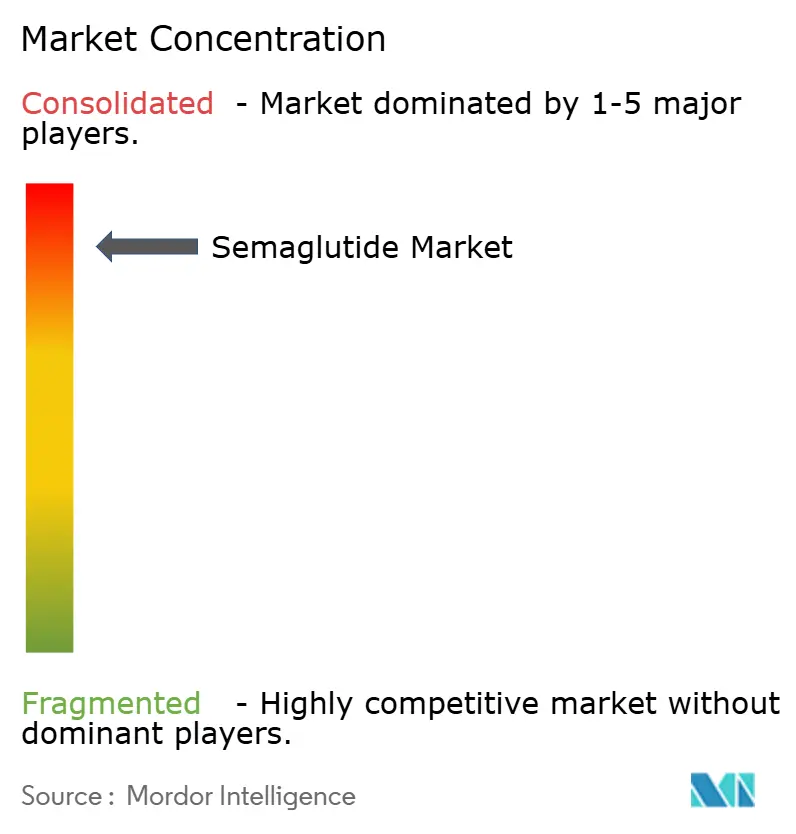
| Market Concentration | High |
Major Players *Disclaimer: Major Players sorted in no particular order Image © Mordor Intelligence. Reuse requires attribution under CC BY 4.0. | |
Semaglutide Market Analysis by Mordor Intelligence
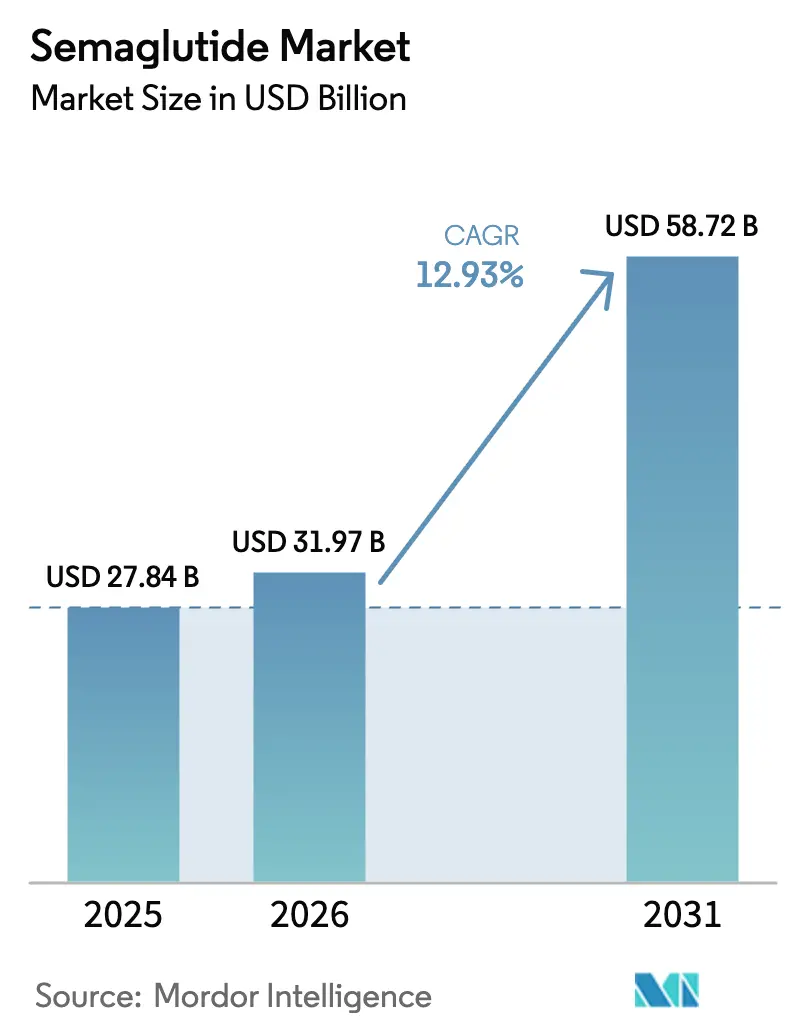
The Semaglutide Market size was valued at USD 27.84 billion in 2025 and is estimated to grow from USD 31.97 billion in 2026 to reach USD 58.72 billion by 2031, at a CAGR of 12.93% during the forecast period (2026-2031).
This growth reflects a strategic shift from single-disease glucose control to integrated cardiometabolic management, anchored by broader payer coverage for cardiovascular risk reduction, employer-sponsored weight management programs, and real-world adherence data that favor once-weekly dosing. North America remains the revenue anchor, yet accelerated approvals in Europe and Asia-Pacific are widening geographic demand. Clinician adoption is rising as cardiology and endocrinology societies embed GLP-1 receptor agonists into secondary-prevention algorithms, while contract manufacturers race to alleviate pen-fill bottlenecks. Competitive intensity is intensifying as Eli Lilly’s tirzepatide prompts Novo Nordisk to expand its oral formulations and dose strengths, thereby heightening the focus on manufacturing scale, supply security, and patient-centric delivery formats.
Key Report Takeaways
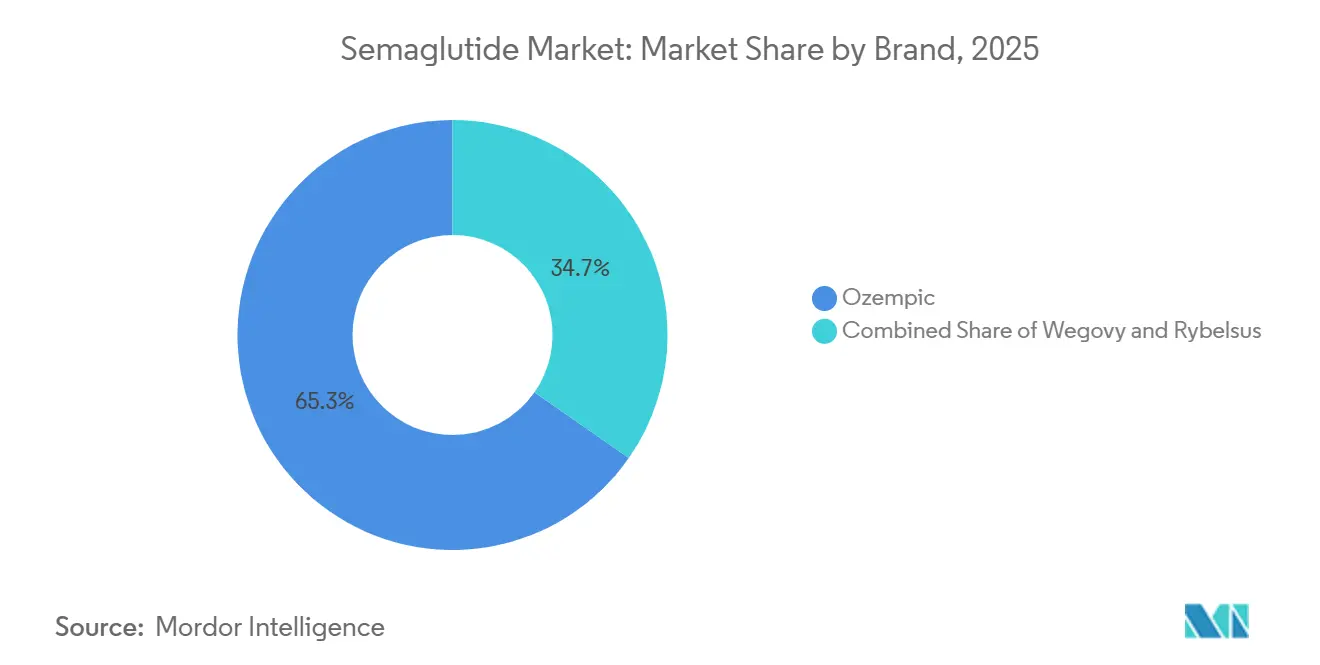
- By brand, the Ozempic segment led with a 65.31% share of the semaglutide market in 2025; Wegovy is forecast to expand at a 15.13% CAGR through 2031.
- By formulation, the injectable segment led with a 59.73% share of the semaglutide market in 2025; oral is forecast to expand at a 16.87% CAGR through 2031.
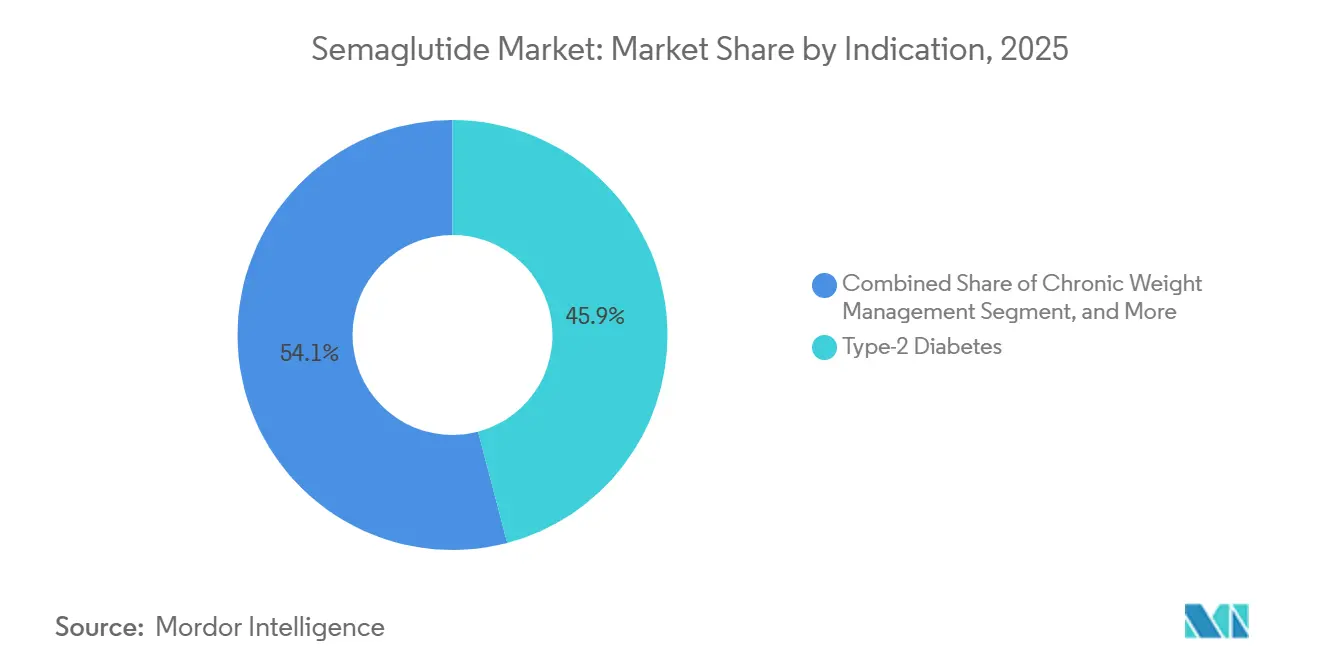
- By indication, type 2 diabetes accounted for 45.88% of the semaglutide market size in 2025, while cardiovascular risk reduction is projected to advance at a 13.23% CAGR through 2031.
- By distribution channel, hospital pharmacies accounted for 65.36% of 2025 revenue; online pharmacies are projected to record the highest CAGR of 14.35% from 2026 to 2031.
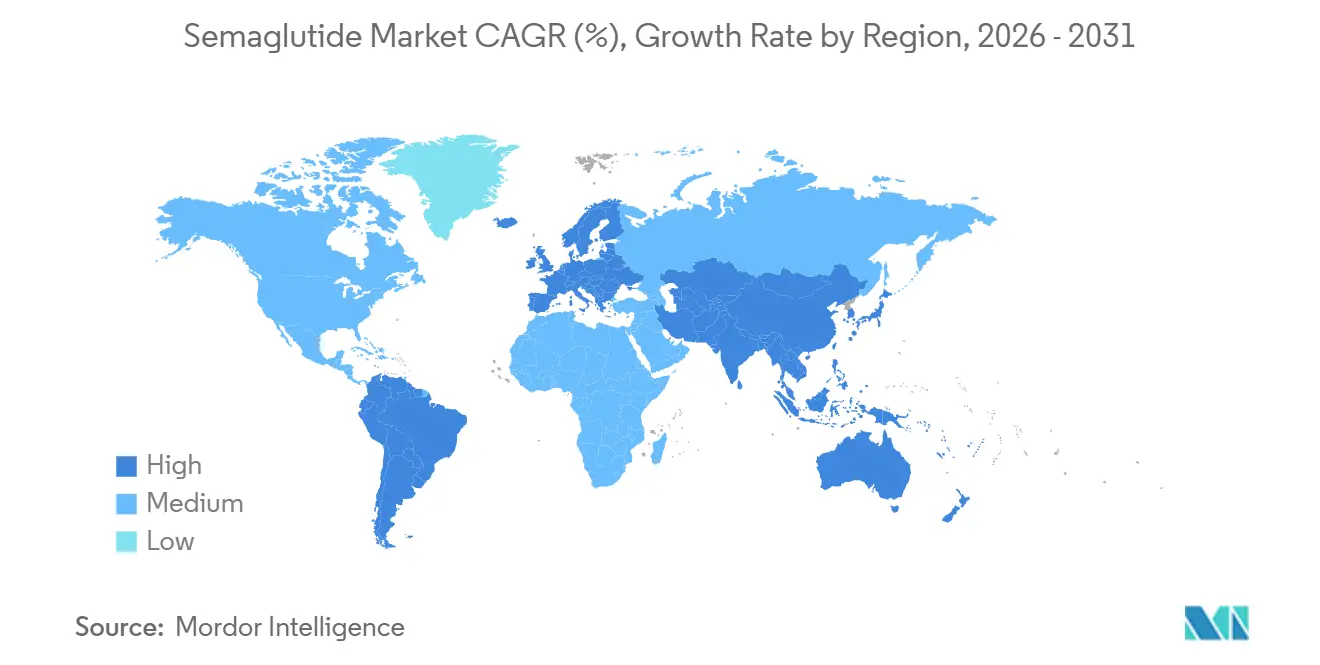
- By geography, North America accounted for 46.38% of the 2025 revenue, while the Asia-Pacific region is the fastest-growing, with a 17.12% CAGR from 2026 to 2031.
Note: Market size and forecast figures in this report are generated using Mordor Intelligence’s proprietary estimation framework, updated with the latest available data and insights as of January 2026.
Market Trends and Insights
Drivers Impact Analysis of Semaglutide Market*
| Driver | (~) % Impact on CAGR Forecast | Geographic Relevance | Impact Timeline |
|---|---|---|---|
| Rising prevalence of obesity & type-2 diabetes | +2.8% | Global, highest in North America, Middle East, Pacific Islands | Long term (≥ 4 years) |
| Superior weight-loss efficacy versus other GLP-1 RAs | +2.1% | North America and Europe | Medium term (2–4 years) |
| Expanded regulatory approvals for CVD risk reduction | +3.2% | North America and Europe, spillover to Asia-Pacific | Medium term (2–4 years) |
| Growing adoption of self-injectable pens & oral tablets | +1.5% | Global, faster uptake in high-income markets | Short term (≤ 2 years) |
| Employer-sponsored obesity-management programs | +1.9% | North America, select European markets | Short term (≤ 2 years) |
| API supply-chain localization incentives in Asia | +1.4% | China, India, South Korea | Long term (≥ 4 years) |
| Source: Mordor Intelligence | |||
Rising Prevalence of Obesity & Type-2 Diabetes
Global obesity surpassed 1 billion adults in 2024, while 537 million people lived with diabetes, creating fundamental demand for therapies that address both conditions.[1]International Diabetes Federation, “IDF Diabetes Atlas 10th Edition,” diabetesatlas.org Middle Eastern ministries included GLP-1 agonists on essential medicines lists in 2025, signaling a policy-level acceleration of demand. Asia-Pacific health agencies report earlier onset of diabetes, with China noting that 35% of new diagnoses now occur in adults under 45 years. Working-age populations favor once-weekly injections over daily pills, reinforcing uptake. The interplay between rising disease burden and patient convenience is thus central to the expansion of the semaglutide market.
Superior Weight-Loss Efficacy Versus Other GLP-1 RAs
Wegovy achieved a 15.8% mean weight loss in the STEP 1 trial, whereas tirzepatide posted a 22.5% mean weight loss, prompting U.S. payers to tier formularies by patient profile. European cost-effectiveness bodies updated modeling frameworks in 2025 to credit cardiovascular benefit, tilting decisions toward semaglutide for secondary prevention.[2]National Institute for Health and Care Excellence, “Semaglutide for Managing Overweight and Obesity,” nice.org.uk Novo Nordisk is currently testing 25 mg and 50 mg oral doses to close the efficacy gap without injections, with Phase III readouts expected in late 2026.
Expanded Regulatory Approvals for CVD Risk Reduction
The FDA cleared Wegovy’s cardiovascular label in March 2024, following the publication of the SELECT trial results, which showed a 20% relative risk reduction in major adverse cardiovascular events.[3]Food and Drug Administration, “FDA Approves First Treatment to Reduce Risk of Serious Heart Problems,” fda.gov The EMA followed in June 2024, Canada in September 2024, and South Korea in December 2025, creating synchronized access in high-income markets. Japan’s priority review is slated to conclude by mid-2026, extending the semaglutide market into national insurance coverage.
Growing Adoption of Self-Injectable Pens & Oral Tablets
Pre-filled FlexTouch pens achieve 12-month adherence rates of above 70%, compared to 50–60% for daily oral medications. Oral semaglutide holds an 8% prescription share yet covers needle-averse cohorts. Surveys show that 42% of patients would switch to oral therapy if its efficacy matched that of injectables, underscoring the need for trials of higher-dose tablets.
Restraints Impact Analysis of Semaglutide Market*
| Restraint | (~) % Impact on CAGR Forecast | Geographic Relevance | Impact Timeline |
|---|---|---|---|
| High therapy cost & limited reimbursement | –1.8% | Middle-income markets, pressure also in high-income formularies | Medium term (2–4 years) |
| Supply shortages of pen-fill & cartridge capacity | –1.2% | North America and Europe | Short term (≤ 2 years) |
| GI side effects driving real-world discontinuations | –0.9% | Global, higher where dietitian support is sparse | Short term (≤ 2 years) |
| Regulatory scrutiny of off-label cosmetic use | –0.6% | North America and Europe | Short term (≤ 2 years) |
| Source: Mordor Intelligence | |||
High Therapy Cost & Limited Reimbursement
Semaglutide ranked among the costliest chronic therapies in obesity care, at USD 1,300 per month in 2025. Brazil, Mexico, South Africa, and Turkey declined reimbursement, citing budget-impact models showing 5-8% of drug spending would shift to a single product. Even in high-income markets, prior-authorization delays average six weeks, which can dampen initiation. Tiered pricing and patient-assistance programs have yet to impact uptake in price-sensitive geographies significantly.
Supply Shortages of Pen-Fill & Cartridge Capacity
Novo Nordisk flagged pen-fill lines as the bottleneck in 2024, despite a USD 2 billion capacity expansion; validation of aseptic filling lines extends 18–24 months. Spot shortages fostered gray-market imports, prompting FDA import alerts in 2025. Supply normalization is expected by late 2026 as new lines and vertically integrated assets come online.
*Our forecasts treat driver/restraint impacts as directional, not additive. The impact forecasts reflect baseline growth, mix effects, and variable interactions.
Semaglutide Market Segment Analysis
By Brand:
Ozempic’s Diabetes Franchise Anchors Revenue While Wegovy Captures Obesity GrowthOzempic held a 65.31% brand share in 2025, underpinned by its 2017 launch and subsequent inclusion in cardiometabolic guidelines following the SUSTAIN-6 study, which showed a 26% reduction in cardiovascular events. Wegovy is advancing at a 15.13% CAGR through 2031 as expanded labels unlock broader payer coverage. The semaglutide market size for cardiovascular risk reduction is therefore scaling rapidly, enabling Novo Nordisk to segment indications and optimize lifecycle revenue. Rybelsus, the oral variant, serves injection-averse patients and is positioned to gain share pending higher-dose approvals.
Competitive pressure from tirzepatide is prompting Novo Nordisk to accelerate oral dose escalation and explore combination regimens with amylin analogs. Brand-level negotiations vary by budget silo, with Ozempic reimbursed under diabetes spend and Wegovy under obesity or preventive care, granting the innovator flexibility to shift promotional focus. This multi-brand strategy stabilizes revenue even as individual formularies shift volume between indications.



By Formulation:
Injectable Pens Dominate While Oral Tablets Target Injection-Averse CohortsInjectable pens accounted for 59.73% of 2025 revenue and are forecast to grow at a 16.87% CAGR, as once-weekly dosing sustains 72% 12-month adherence. Oral tablets currently hold the balance; they exploit SNAC technology protected by patents through 2032, temporarily insulating against generic erosion. If ongoing Phase III trials validate the 25 mg and 50 mg doses, the oral segment’s semaglutide market share is likely to increase, particularly in primary care channels.
Manufacturing economics differ: oral bioavailability below 1% drives up API usage and cost, whereas injectables concentrate demand on pen-fill capacity. Innovation across delivery devices, including auto-injectors with integrated sharps disposal, is expected to sustain injectable preference despite gains in oral administration. The semaglutide industry is therefore investing on both fronts to meet heterogeneous patient preferences.
By Indication:
Cardiovascular Risk Reduction Emerges as Fastest-Growing SegmentType 2 diabetes retained a 45.88% revenue share in 2025; however, cardiovascular risk reduction is expanding at a 13.23% CAGR, the fastest among all indications. The incorporation of GLP-1 therapy into cardiology guidelines encourages the initiation of GLP-1 therapy in secondary prevention regimens, thereby boosting the semaglutide market. Chronic weight management remains sizable, supported by employer programs and increasing social acceptance that obesity is a chronic disease requiring pharmacotherapy.
“Other” investigational uses, such as non-alcoholic steatohepatitis, offer pipeline upside but currently contribute marginal revenue. Payers are tightening prior-authorization criteria to curb off-label prescribing, helping preserve budget predictability. Over the forecast period, cardiovascular indications are expected to significantly expand the semaglutide market size by capturing high-risk patients with elevated baseline costs.
By Distribution Channel:
Hospital Pharmacies Retain Majority Share as Online Platforms ScaleHospital pharmacies dispensed 65.36% of 2025 volumes due to initiation during inpatient cardiometabolic events. Retail chains handle routine refills but face prior-authorization hurdles that extend dispensing timelines. Online pharmacies are advancing at a 14.35% CAGR, driven by telehealth integration, discreet home delivery, and bundled coaching programs. New FDA guidance now requires synchronous video consultation before prescribing, raising compliance costs yet not halting digital uptake.
For manufacturers, online channels present higher gross-to-net spreads due to direct contracting, creating incremental margin opportunity. The semaglutide industry is thus partnering with telehealth platforms to secure future share and patient engagement data.
Geography Analysis
North America Semaglutide Market
North America generated 46.38% of global revenue in 2025, driven by extensive employer coverage and the inclusion of Medicare Part D for diabetes, as well as the growth of cardiovascular indications. U.S. adult obesity prevalence reached 41.9% in 2024, sustaining high demand. Canada added the cardiovascular label in 2024, and provincial formularies followed by mid-2025, expanding patient eligibility. Mexico remains largely private pay due to limited public reimbursement, moderating uptake.
Europe Semaglutide Market
Europe exhibits broad albeit patchy reimbursement. Germany’s IQWiG recognized considerable additional benefit for cardiovascular prevention in 2025, enabling premium pricing. The UK’s NICE recommended semaglutide for adults with established CVD and BMI ≥ 27 kg/m² in March 2025, opening NHS access to more than 1 million patients. France and Italy await real-world evidence before finalizing budgets, while Spain completed formulary inclusion in late 2025. Aging demographics and high cardiovascular burden underpin continued growth.
APAC Semaglutide Market
The Asia-Pacific region posts the strongest growth at a 17.12% CAGR. China approved the obesity indication in late 2024 and targets essential-medicine reimbursement in 2026, amplified by domestic API production scaling. Japan’s anticipated mid-2026 cardiovascular approval will unlock national insurance coverage, while South Korea’s December 2025 label extension makes it the regional trailblazer. India’s market is currently cash-based, yet biosimilar initiatives by Dr. Reddy’s and Gland Pharma aim to widen affordability post-2031 patent expiries. Australia reimburses Wegovy under the Pharmaceutical Benefits Scheme but enforces strict prior-authorization criteria.
MEA and South America Semaglutide Market
The Middle East & Africa and South America together hold smaller shares but exhibit double-digit growth. Gulf Cooperation Council states added semaglutide to formularies in 2024-2025, although high list prices restrict access to insured populations. Brazil rejected public reimbursement in 2024, yet private demand persists in major urban centers. Over time, the expansion of middle classes and evolving reimbursement policies are expected to unlock incremental volume.

Regulatory Landscape
Semaglutide market access has expanded through indication and formulation decisions led by major regulators, with cardiovascular risk reduction and obesity use cases driving label breadth. After the FDA cleared Wegovy for cardiovascular risk reduction in March 2024 and the EMA followed in June 2024, Europe added another inflection point in 2026 when the EMA CHMP recommended marketing authorisation for an oral Wegovy (multiple strengths including 25 mg) in May 2026, followed by European Commission marketing authorisation in July 2026 for weight management.
In parallel, regulators have tightened oversight of non-authorized supply routes as shortages eased. The FDA announced in February 2026 that it intended to take action against GLP-1 APIs used in non-FDA-approved compounded products, and the agency ended shortage-linked enforcement discretion for compounded semaglutide injections in May 2025. These steps reinforce a shift toward authorized brands and compliant manufacturing and distribution, while country-by-country HTA and formulary decisions continue to determine real-world utilization and channel mix.
Value Chain Analysis
The semaglutide value chain remains highly integrated around peptide API production, sterile fill-finish and device assembly for injectable pens, and tableting capacity for oral formulations, followed by cold-chain logistics (for injectables), wholesaler distribution, and dispensing through hospital, retail, and online pharmacy channels. Persistent pen-fill and cartridge constraints, highlighted by Novo Nordisk as a bottleneck since 2024, have elevated the role of specialized fill-finish, device component suppliers, and contract manufacturers such as Bachem, PolyPeptide Group, and WuXi AppTec in expanding peptide throughput and reducing single-site risk.
Manufacturing scale-up is a defining competitive lever, with Novo Nordisk using a combination of internal expansions and external assets to increase resilience across geographies. The company reported capital expenditure of DKK 60.1 billion in 2025 and guided to around DKK 55 billion in 2026, while adding fill-finish capacity through the Catalent acquisition with capacity additions starting from 2026. Parallel site investments and projects across Denmark (Kalundborg), the United States (Clayton, North Carolina), and other locations, plus new oral-focused capacity initiatives such as the Athlone, Ireland upgrades, align the supply chain to both injectable demand and higher-dose oral development needs.
Competitive Landscape
Novo Nordisk maintains its leading position through Ozempic, Wegovy, and Rybelsus; however, Eli Lilly’s tirzepatide products are shifting the semaglutide market toward a duopoly. Both firms are investing billions in manufacturing capacity; Novo Nordisk’s USD 11 billion purchase of Catalent facilities in 2024 signals vertical integration aimed at securing pen-fill output. Contract manufacturers such as Bachem, PolyPeptide Group, and WuXi AppTec are scaling peptide output, fragmenting supply lines, and introducing more geographic resilience.
Emergent players include Hybio and Zhejiang Jiuzhou in China and SG Biopharm in South Korea, each leveraging localization incentives to sign offtake contracts with Western brand owners. Indian companies, including Dr. Reddy’s, Sun Pharma, Gland Pharma, and Torrent, are developing biosimilar pipelines timed to coincide with post-2031 patent cliffs. Regulatory uncertainty persists, as the FDA has yet to finalize its guidance on GLP-1 biosimilars, creating a timing risk for follow-on entrants. Innovation opportunities span oral bioavailability enhancers, ultra-long-acting injectables that may halve injection frequency, and fixed-dose combinations pairing semaglutide with SGLT-2 inhibitors or amylin analogs.
Semaglutide Industry Leaders
Novo Nordisk A/S
- *Disclaimer: Major Players sorted in no particular order
Semaglutide Market Companies Covered in this Report
- Novo Nordisk

Market Opportunities and Future Outlook
Oral weight-management access in regulated markets is opening a new whitespace segment within semaglutide, especially for injection-averse patients and primary-care-led obesity pathways. A concrete 2026 catalyst is the European Commission marketing authorisation in July 2026 for Wegovy pill for weight management, following a positive CHMP opinion in May 2026, which broadens the addressable patient pool beyond injectable-only preferences and creates new levers for payers and providers to structure adherence programs.
Manufacturing and delivery-format upgrades also create near-term commercial headroom by easing supply constraints and extending lifecycle positioning. Novo Nordisk announced a more than EUR 400 million expansion at its Athlone, Ireland facility in March 2026 to support oral GLP-1 production (with completion targeted over 2027-2028), and it communicated plans tied to EU rollout timing for new formats such as the Wegovy 7.2 mg single-dose pen (Q3 2026). As regulators clamp down on non-authorized compounded GLP-1 products and shortage-driven exceptions unwind, branded supply reliability, authorized distribution partnerships (including digital pharmacy pathways that meet new prescribing rules), and differentiated dose and format options become primary routes to capture incremental demand within existing obesity, diabetes, and cardiovascular risk reduction care pathways.
Recent Industry Developments in Semaglutide Market
- July 2026: European Commission marketing authorisation for Wegovy pill (oral semaglutide 25 mg) for weight management and single-dose pen for higher-dose injections. The approval expands access to oral GLP-1 and broadens the patient pool for Novo Nordisk in a key regulatory market.
- March 2026: FDA approves Wegovy R-HD injection (semaglutide 7.2 mg) for weight management. The approval confirms a high-dose option in the United States and increases dosing flexibility for patients and clinicians.
- March 2026: Announces more than 400 million euro expansion in its Athlone, Ireland manufacturing facility for oral GLP-1 manufacturing. The expansion increases manufacturing capacity and strengthens supply resilience for the oral GLP-1 portfolio.


Semaglutide Market Report Scope and Research Methodology
Market Definition and Coverage
This market covers revenue generated from semaglutide medicines sold for approved patient use across key indications, tracked as sales value across major geographies and channels.
Scope exclusions: We exclude upstream R&D spending, clinical trial budgets, and non-commercial compassionate use supply from the market value.
Segments Covered in This Report
- By Brand
- Wegovy
- Ozempic
- Rybelsus
- By Formulation
- Injectable
- Oral
- By Indication
- Type-2 Diabetes
- Chronic Weight Management
- Cardiovascular Risk Reduction
- Others
- By Distribution Channel
- Hospital Pharmacies
- Retail Pharmacies
- Online Pharmacies
- By Geography
- North America
- United States
- Canada
- Mexico
- Europe
- Germany
- United Kingdom
- France
- Italy
- Spain
- Rest of Europe
- Asia-Pacific
- China
- Japan
- India
- Australia
- South Korea
- Rest of Asia-Pacific
- Middle East & Africa
- GCC
- South Africa
- Rest of Middle East & Africa
- South America
- Brazil
- Argentina
- Rest of South America
- North America
Data Sources, Market Sizing, and Validation
Desk Research
Desk research was used to set the basic structure of demand and supply for semaglutide, and then to pin down country level context such as diagnosis pools and treatment patterns. We relied on public sources such as WHO and OECD health statistics, the CDC and other national public health agencies, and medicine regulator websites such as FDA and EMA for label changes and safety communications.
To connect demand to realistic volumes and pricing, we also reviewed sources such as national reimbursement and HTA publications, peer reviewed clinical and outcomes literature, and trade and customs statistics where relevant for API and finished dose movement. On top of this, we used company filings, investor presentations, and trusted press coverage for reported sales and capacity commentary, and we referenced paid subscriptions that help with company financials, patent lookups, and shipment level import export screening. The sources listed above are illustrative and not exhaustive, since many other public documents and data series were also used for cross checks and clarification.
Primary Interviews and Surveys
Primary work focused on validating how semaglutide demand is actually converted into treated patients and paid prescriptions across regions, and then checking the main pricing and access assumptions. We spoke with a mix of manufacturers and distributors, prescribers, pharmacists, and payor side experts, which helped us confirm channel splits, shortages and backorder patterns, and the pace of adoption across diabetes and obesity use cases.
Distribution of primary research fieldwork respondents
| Company type | Respondent position | Region |
|---|---|---|
| Top tier: 26% | CXOs: 14% | APAC: 40% |
| Mid tier: 55% | Functional/Unit leaders: 28% | EMEA: 33% |
| Smaller Players: 19% | Managers: 58% | Americas: 27% |
Market-Sizing & Forecasting
Sizing starts from a top-down build where the treated patient pool is reconstructed using diabetes and obesity prevalence, diagnosis rates, therapy eligibility, and the share that reaches GLP-1 treatment in each geography. That demand pool is then converted into value using typical dosing cadence, persistence, and an average net price progression by channel, followed by adjustments for supply constraints that can cap shipments in a given year.
To keep the totals grounded, we corroborate the output with selective bottom-up checks, such as sampling reported product sales, cross checking distributor movements, and stress testing volume by dose form where the mix is changing. Inputs that most often move the model include new indication approvals, formulary coverage changes, manufacturing expansion timing, reported backorders, and inflation driven price updates, which are then filtered through local currency conversion assumptions.
For the forecast, scenario analysis is used so the base case reflects the most likely path for capacity relief and access expansion, while alternative cases bracket slower reimbursement or faster uptake. When country data is thin, gaps are handled through proxying from similar markets using insured population mix, prescriber density, and historical GLP-1 uptake patterns, and then these proxies are validated again in expert follow ups.
Data Validation & Update Cycle
Validation is done through triangulation across multiple signals so the modeled value lines up with what is feasible in the real market. Outputs are checked against independent indicators like reported sales disclosures, public supply shortage notices, and shifts in prescribing guidance, and then any outliers are reviewed and corrected before sign off.
A second analyst review is performed to confirm that inputs, conversions, and currency handling are consistent across countries and years. The report is refreshed annually, and interim updates are triggered when material events occur such as a major label expansion, a sustained shortage, or a notable reimbursement change. Right before delivery, we run a fresh update pass so clients receive the latest adjusted view.
Mordor Intelligence's Semaglutide Market Size Compared With Other Published Estimates
Published numbers for semaglutide can be far apart because the counted revenue base is not always the same, and the timing of updates also varies. Differences show up quickly when some studies treat list price as revenue, when others assume shortages are fully resolved, or when the same therapy is grouped with nearby molecules.
The spread is mainly driven by whether obesity and diabetes demand are both counted in full, how net price and rebates are handled by channel, and whether the forecast start year uses observed shipment limits or an idealized supply curve. When a like for like scope is applied (commercial sales only, current labels, and capacity checked against public shortage signals), the resulting market size aligns better with what can be repeatedly traced, which is the approach applied here by Mordor Intelligence.
Benchmark comparison
| Source | Market Size | Gaps in Research Methodology |
|---|---|---|
| Mordor Intelligence | USD 27.84 B (2025) | |
| Press Release Publisher A | USD 27.79 B (2025) | Uses a different forecast window through 2033 and can apply a smoother capacity ramp, which may not fully reflect year to year supply constraints and channel level net pricing changes. |
| Trade Media Publisher B | USD 15.19 B (2024) | Combines semaglutide with liraglutide, so the total is shaped by an added molecule scope and a different base year, which makes direct comparison to semaglutide only estimates less clean. |
Across the three references, the main lesson is that even small scope choices like molecule inclusion, base year selection, and net price treatment can shift the final value by a lot. By tying demand to treated cohorts and then validating the implied volumes against real world supply and access signals, the final number stays easier to re-check and update as market conditions change.


Key Questions Answered in the Report
What is the projected size of the semaglutide market by 2031?
The semaglutide market size is projected to reach USD 58.72 billion by 2031, reflecting a 12.93% CAGR from 2026.
Which indication is growing fastest for semaglutide products?
Cardiovascular risk reduction drives growth at a 13.23% CAGR as payers recognize its role in secondary prevention.
Why are injectable formulations still dominant despite oral options?
Once-weekly injectable pens deliver higher adherence and steady pharmacokinetics, sustaining 59.73% revenue share in 2025.
What regions present the highest growth potential?
The Asia-Pacific region shows the fastest trajectory, with a 17.12% CAGR, driven by regulatory acceleration and local API production.
How are employers influencing demand in the United States?
Employer-sponsored plans covered weight-management drugs for 44% of insured lives by mid-2025, expanding access and volume.
Page last updated on:


 Your data is secure and never sold or shared.


