
Market Overview
| Study Period | 2021 - 2031 |
|---|---|
| Forecast Data Period | 2026 - 2031 |
| Base Year Market Size (2025) | USD 420.11 Million |
| Market Size (2026) | USD 440.36 Million |
| Market Size (2031) | USD 557.09 Million |
| Growth Rate (2026 - 2031) | 4.82 % |
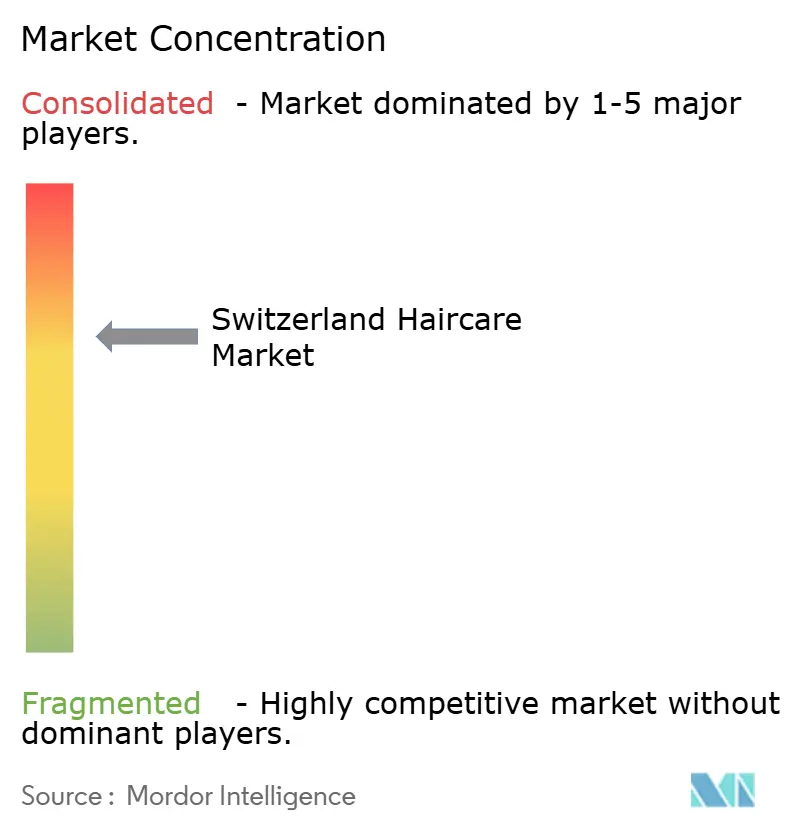
| Market Concentration | Medium |
Major Players *Disclaimer: Major Players sorted in no particular order Image © Mordor Intelligence. Reuse requires attribution under CC BY 4.0. | |
Switzerland Haircare Market Analysis by Mordor Intelligence
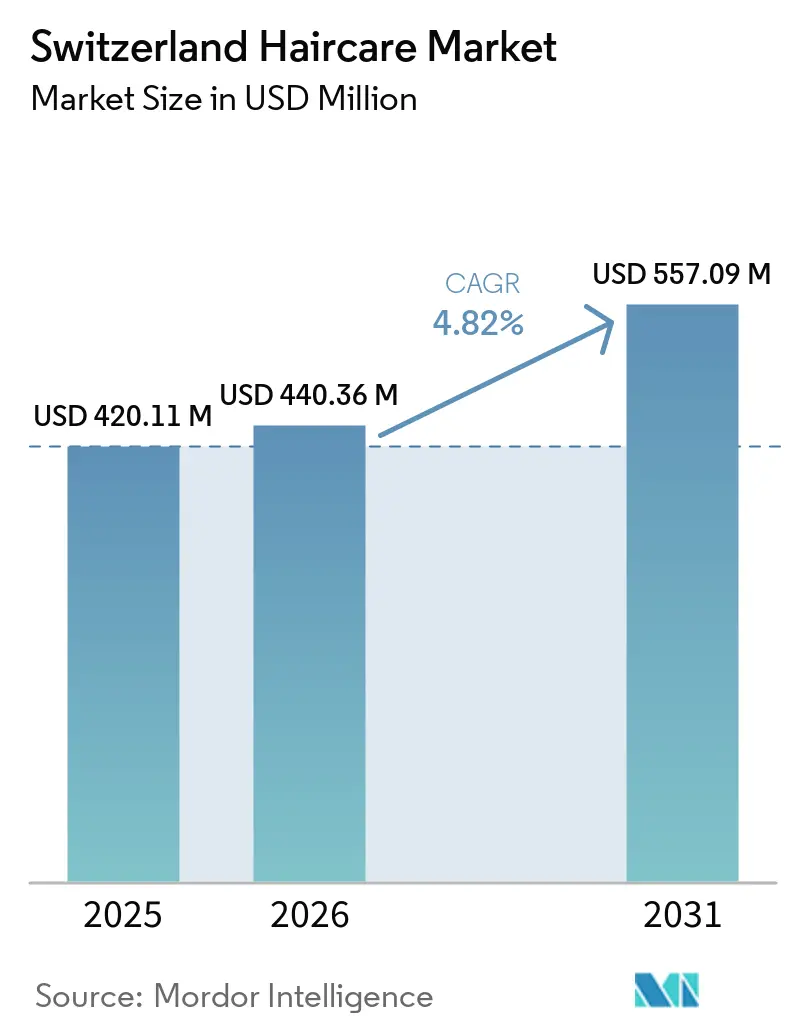
The Swiss Hair Care Market size was valued at USD 420.11 million in 2025 and estimated to grow from USD 440.36 million in 2026 to reach USD 557.09 million by 2031, at a CAGR of 4.82% during the forecast period (2026-2031). The market expansion is attributed to heightened consumer consciousness regarding hair health, increased demand for premium and customized products, and a substantial shift toward natural and organic formulations. Switzerland's concentrated urban demographic, characterized by substantial purchasing power, generates significant demand for specialized hair care products and professional salon services. The proliferation of e-commerce platforms has enhanced product accessibility and distribution efficiency, resulting in accelerated growth in online sales. Market dynamics are further influenced by sustainability initiatives and technological advancements, encompassing AI-driven personalization solutions and environmentally conscious packaging innovations. These factors, together with Switzerland's robust economic framework, indicate sustained market development in the coming years.
Key Report Takeaways
- By product type, shampoo led with 43.02% of the Swiss hair care market share in 2025, whereas hair styling products are advancing at a 5.1% CAGR through 2031.
- By category, mass products accounted for 69.55% of the Swiss hair care market share in 2025, while premium products are forecast to climb at a 6.18% CAGR to 2031.
- By ingredient type, conventional formulations captured 75.72% of the Swiss hair care market size in 2025, yet natural and organic alternatives are poised to expand at a 6.44% CAGR between 2026 and 2031.
- By distribution channel, supermarkets and hypermarkets contributed 43.86% to the Swiss hair care market size in 2025, but online retail stores are projected to post the fastest 7.21% CAGR over the same horizon.
Note: Market size and forecast figures in this report are generated using Mordor Intelligence’s proprietary estimation framework, updated with the latest available data and insights as of 2026.
Switzerland Haircare Market Trends and Insights
Drivers Impact Analysis*
| Driver | (~) % Impact on CAGR Forecast | Geographic Relevance | Impact Timeline |
|---|---|---|---|
| Growing demand for personalized hair care solutions | +0.8% | National, with early gains in Zurich, Geneva, Basel | Medium term (2-4 years) |
| Sustainable packaging appeals to eco-conscious consumers | +0.6% | National, stronger in German-speaking regions | Long term (≥ 4 years) |
| Ageing population driving demand for anti-hair-loss and colour maintenance | +0.9% | National, concentrated in urban cantons | Long term (≥ 4 years) |
| Increasing popularity of scalp health and holistic hair care | +0.7% | National, with premium positioning in affluent areas | Medium term (2-4 years) |
| Influence of social media and beauty influencers | +0.6% | National, youth-concentrated in urban centers | Short term (≤ 2 years) |
| Innovative ingredients and formulations | +0.7% | National, with Research and Development concentration in the Basel region | Medium term (2-4 years) |
| Source: Mordor Intelligence | |||
Growing Demand for Personalized Hair Care Solutions
The Swiss Hair Care Market is experiencing increased demand for personalized hair care solutions, driven by evolving consumer preferences and economic factors. Consumers actively seek customized formulations that effectively address specific concerns, including dryness, hair loss, scalp sensitivity, and color preservation. These targeted solutions strongly align with Swiss consumers' established focus on product efficacy and quality. According to the World Population Review, Switzerland's sophisticated high-income consumer base significantly supports the growth of premium hair care products. With an average household net-adjusted disposable income per capita of USD 47,124 in 2023, Swiss consumers demonstrate substantial purchasing power to invest in specialized hair care solutions rather than standard mass-produced products [1]. This robust economic strength, combined with the deeply rooted Swiss emphasis on quality and precision, continues to drive substantial growth in the market for personalized hair care products.
Sustainable Packaging Appeals to Eco-Conscious Consumers
Environmental packaging serves as a primary growth catalyst in the Swiss Hair Care Market, as consumers demonstrate an increasing preference for environmentally responsible products. Swiss consumers exhibit a strong inclination toward hair care brands that implement recyclable, biodegradable, or reusable packaging materials. Environmental consciousness and plastic waste concerns significantly influence consumer purchasing patterns, necessitating companies to implement sustainable packaging solutions. Industry participants are advancing their environmental initiatives through packaging innovations. For instance, in April 2024, Wella Company implemented its Welloxon Perfect professional color product, incorporating multi-layer molding technology that facilitates the substitution of up to 70% virgin plastic with post-consumer recycled materials. These advancements correspond to consumer requirements while establishing enhanced sustainability standards in the market.
Ageing Population Driving Demand for Anti-Hair-Loss and Colour Maintenance
The demographic composition in Switzerland demonstrates a significant correlation between the aging population and increased demand for specialized hair care products, particularly anti-hair-loss and color maintenance solutions. The substantial increase in the older adult demographic has generated heightened requirements for addressing hair thinning, loss prevention, and color preservation. This demographic segment requires comprehensive hair care solutions that effectively minimize hair loss, enhance structural integrity, and maintain color retention, thereby addressing both physiological and psychological requirements. According to the Federal Statistical Office of Switzerland, in 2024, there were 37.4 persons aged 65 or older for every 100 economically active persons aged 20 to 64. [2]. This demographic distribution indicates substantial market opportunities for hair care products specifically formulated for mature consumers. The expansion of the elderly population segment continues to generate consistent demand for specialized formulations addressing aging hair and scalp conditions, with particular emphasis on color retention and hair fortification solutions.
Increasing Popularity of Scalp Health and Holistic Hair Care
The hair care market is driven by the growing focus on scalp health and comprehensive hair care solutions. Consumers recognize that scalp health directly influences hair quality, increasing the demand for products that address scalp cleansing, nourishment, and balance. This approach extends beyond aesthetic improvements to target fundamental scalp conditions, including dryness, irritation, dandruff, and sensitivity. The market growth is supported by new formulations incorporating natural and therapeutic ingredients for scalp care. Product categories such as exfoliating scrubs, serums, oils, and masks designed for scalp improvement and hair growth have gained consumer interest. Technological developments in personalized hair care and diagnostic tools enable consumers to identify and address specific scalp issues. Environmental factors, stress, and frequent use of chemical or heat treatments have increased scalp sensitivity concerns, emphasizing the importance of targeted scalp care products.
Restraints Impact Analysis*
| Restraint | (~) % Impact on CAGR Forecast | Geographic Relevance | Impact Timeline |
|---|---|---|---|
| Presence of counterfeit hair care products affects market revenues | -0.4% | National, with higher impact in border regions | Short term (≤ 2 years) |
| Stringent safety and regulatory compliance | -0.5% | National, affecting all market participants | Long term (≥ 4 years) |
| Health concerns over chemical ingredients | -0.4% | National, stronger in urban educated segments | Medium term (2-4 years) |
| Intense competition between local and international brands | -0.3% | National, concentrated in retail channels | Short term (≤ 2 years) |
| Source: Mordor Intelligence | |||
Presence of Counterfeit Hair Care Products Affects Market Revenues
The proliferation of counterfeit hair care products presents a substantial impediment to the Swiss Hair Care Market, resulting in diminished market revenues. These unauthorized products, typically sold at lower prices without meeting quality and safety standards, damage consumer trust and market competition. The presence of fake products results in revenue losses for legitimate manufacturers and retailers while damaging brand reputation and consumer confidence. Additionally, counterfeit hair care products may contain harmful ingredients that pose health risks, increasing consumer skepticism toward hair care purchases. The rise of e-commerce platforms has made it more challenging to detect and control counterfeit product distribution. These factors collectively impede market expansion by diminishing sales volumes and compromising initiatives to maintain product quality standards and consumer protection within the Swiss hair care market.
Stringent Safety and Regulatory Compliance
Strict safety and regulatory compliance requirements constrain the Hair Care Market. The industry must adhere to comprehensive regulations, including the revised Swiss Chemicals Ordinance and the upcoming Packaging Ordinance. These regulations establish specific standards for product formulation, ingredient safety, packaging, labeling, and environmental impact. While these measures protect consumers and promote sustainability, they increase product development costs and complicate market entry processes. New and smaller companies face significant challenges in meeting compliance requirements, which involve extensive documentation, testing, and certification. The regulatory requirements can delay product launches, reduce innovation capabilities, and increase operational costs, affecting profit margins. Companies also face risks such as fines, product recalls, and reputation damage for non-compliance. These regulatory demands create market entry barriers and favor established companies with existing compliance systems, limiting growth opportunities for new brands in the Swiss hair care market.
*Our forecasts treat driver/restraint impacts as directional, not additive. The impact forecasts reflect baseline growth, mix effects, and variable interactions.
Segment Analysis
By Product Type: Shampoo Dominance Faces Styling Innovation
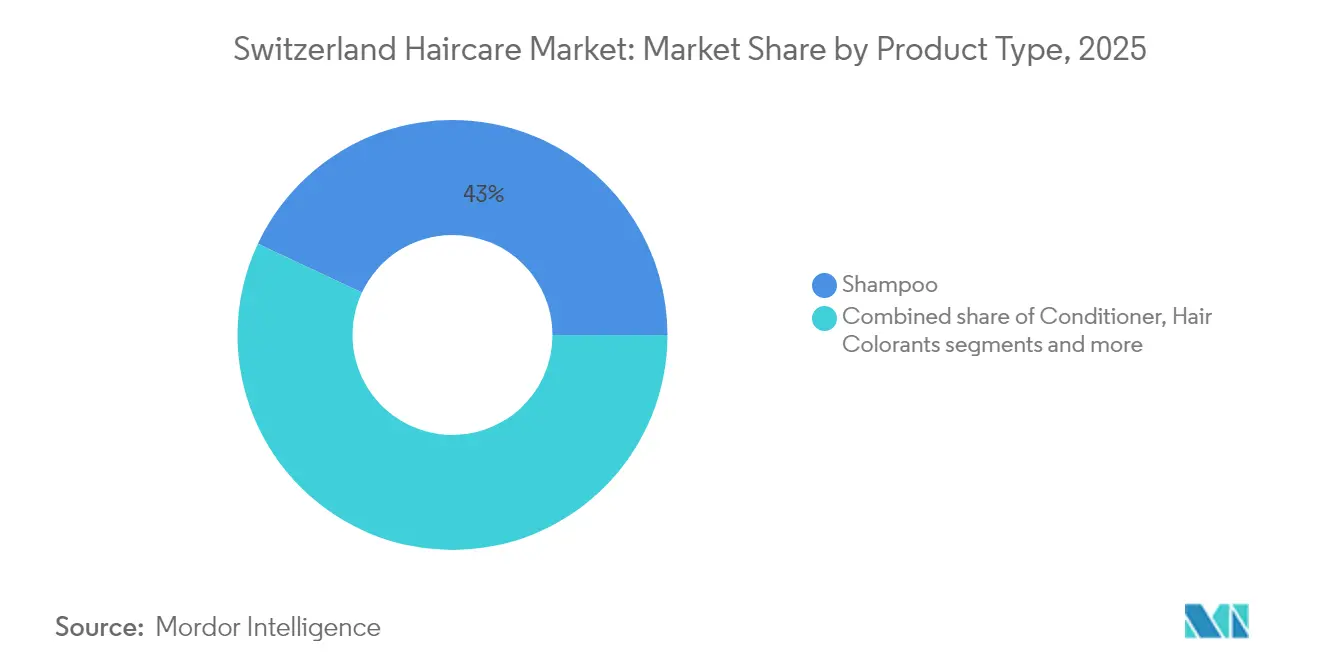
In 2025, shampoo held the largest share in the Swiss Hair Care Market at 43.02%. This significant share reflects shampoo's essential role in daily hair care routines, primarily for cleansing hair and removing dirt, excess oils, and impurities. The segment's strength stems from ongoing formulation improvements that enhance hair health through the inclusion of vitamins, botanical extracts, and oils for hair growth and scalp health. The availability of diverse variants for different hair types and concerns, including herbal and organic options, maintains consistent consumer demand. The widespread daily use of shampoos across consumer segments reinforces its market position.
Hair Styling Products in the Swiss Hair Care Market are expected to grow at a CAGR of 5.1% through 2031. This growth stems from consumers' increasing focus on hair aesthetics and personal grooming. The market expansion is supported by demand for products offering long-lasting hold, heat protection, and nourishing benefits. Social media, fashion trends, and celebrity influences drive increased product adoption. The segment's growth is further supported by its diverse product range, including gels, sprays, mousses, and serums for various hair types and styling requirements. This growth trajectory indicates a market shift from basic hair care towards styling and personalization.

By Category: Premium Acceleration Amid Mass Market Stability
Mass Products dominated the Switzerland Hair Care Market in 2025 with a market share of 69.55%, meeting the everyday hair care needs of a large consumer base. This dominance stems from their affordability and widespread availability, making these products accessible to consumers across diverse demographics. Mass products are readily available in mainstream retail channels, facilitating convenient purchases and strengthening their market presence. The functional and reliable nature of mass products appeals to price-sensitive consumers who prioritize value for money. Regular innovation within the mass segment, including improvements in formulations that address common hair concerns like dandruff, dryness, and hair fall, helps maintain consumer loyalty while attracting new buyers. Marketing strategies emphasizing everyday practicality and established brand reputations contribute to the strong position of mass products in the Swiss hair care market.
Premium Products in the Switzerland Hair Care Market are projected to grow at a compound annual growth rate (CAGR) of 6.18% through 2031. This growth reflects consumer preferences for high-quality, specialized hair care solutions that offer benefits beyond basic cleansing and conditioning. The increasing demand is driven by greater awareness of advanced formulations with natural, organic, and scientifically backed ingredients that promote hair health and address specific concerns such as damage repair, anti-aging, and scalp care. Consumer interest in personalized beauty routines and premium self-care experiences supports market expansion for these upscale products. The premium segment benefits from innovations in sustainable and eco-friendly packaging that appeal to environmentally conscious consumers.
By Ingredient Type: Natural Surge Challenges Conventional Dominance
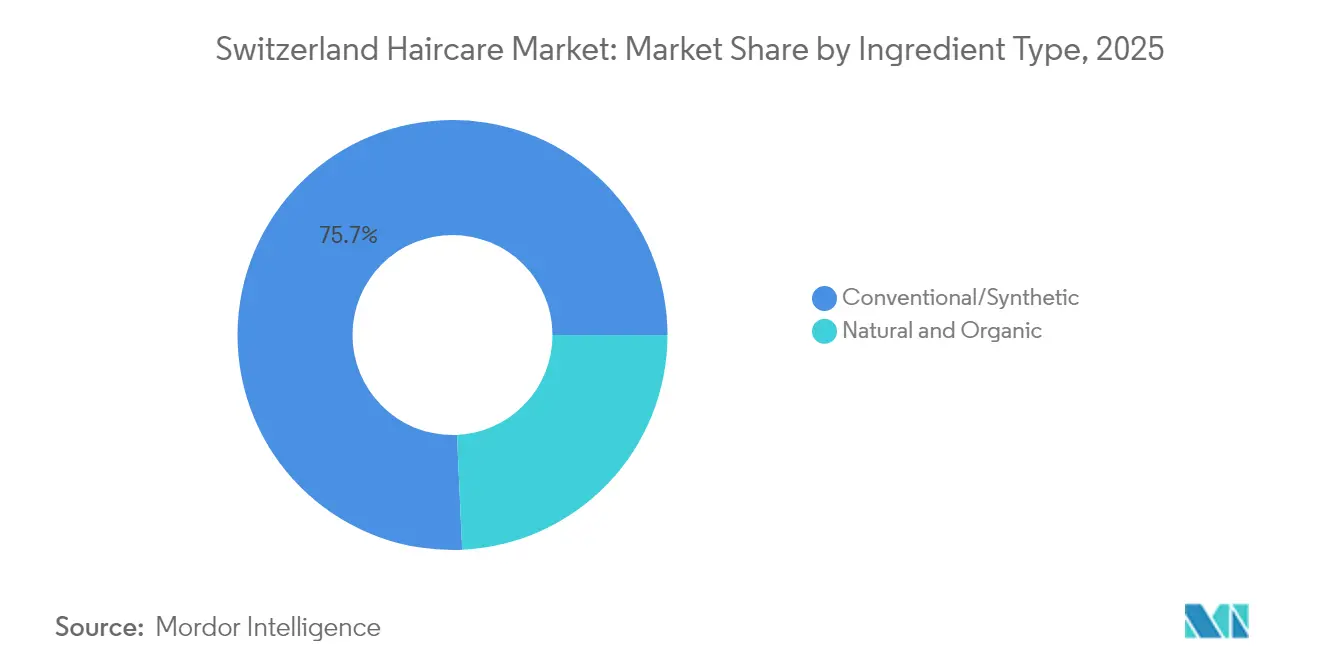
In 2025, conventional and synthetic ingredients held a dominant market share of 75.72% within the Market. These ingredients remain prevalent due to their consistent performance and efficacy in hair care products. Conventional and synthetic formulations provide targeted solutions for hair concerns such as dandruff control, hair strengthening, and scalp health, attracting consumers who prioritize proven results at competitive prices. Their widespread use across hair care product categories stems from their versatility and effectiveness. The established manufacturing infrastructure and regulatory compliance of synthetic ingredients further reinforce their market position. Consequently, conventional and synthetic-based products maintain their substantial market presence by offering reliability, affordability, and functionality that address consumer needs.
Natural and organic formulations in the Hair Care Market are growing at a CAGR of 6.44% through 2031, indicating increased consumer preference for clean and environmentally conscious hair care options. This growth stems from heightened awareness of natural ingredient benefits, including reduced chemical exposure, improved scalp health, and sustainable sourcing practices. The trend aligns with Swiss consumers' increasing focus on wellness and environmental responsibility. According to the International Federation of Organic Agriculture Movements (IFOAM), Switzerland recorded one of the highest organic product retail sales shares among European countries in 2023, with organic products accounting for 11.6% of total retail sales . This significant organic market presence demonstrates Swiss consumers' established preference for natural products, directly contributing to the growth of natural and organic hair care formulations.
By Distribution Channel: Digital Acceleration Transforms Traditional Retail
In 2025, supermarkets and hypermarkets held a dominant market share of 43.86% in hair care product distribution. These large-scale retail outlets offer consumers extensive reach and convenience through their one-stop shopping experience for household and personal care items. Their market leadership stems from competitive pricing strategies and regular promotional activities that appeal to price-sensitive consumers. These stores stock a comprehensive range of mass-market and premium hair care brands, addressing diverse consumer needs. Their widespread presence in urban and suburban locations ensures accessibility and consistent customer traffic, maintaining steady sales volumes.
Online retail stores in the Switzerland hair care market are experiencing growth at a CAGR of 7.21% through 2031, indicating a fundamental shift in consumer purchasing patterns. The Federal Statistical Office of Switzerland reports that in 2023, 82% of individuals aged 25 to 34 made online purchases, while 45% of those aged 65 to 74 engaged in e-commerce activities. This growth is driven by the convenience, extensive product selection, and competitive pricing of online platforms. The increasing digital literacy and mobile internet adoption across age groups continue to strengthen the online retail channel for hair care products.
Geography Analysis
Switzerland's hair care market benefits from concentrated population growth in urban cantons surrounding Zurich and Geneva. Demographic projections indicate growth in other urban centers like Lucerne, contributing to a rising consumer base with higher purchasing power and evolving lifestyle preferences. These urban cantons function as centers for mass and premium hair care consumption due to increased awareness of grooming and beauty trends. The high population density in these areas supports a robust market for hair care products.
The regional concentration supports growth in salon density and professional hair care services, particularly in urban corridors connecting major cities. The high number of salons and beauty service providers creates opportunities for specialized treatments and premium product categories through direct consumer interaction and professional recommendations. The expansion of professional channels increases demand for advanced formulations and premium brands, developing a strong value-added segment alongside mass-market sales.
Border cantons face specific competitive challenges due to cross-border shopping, with over half of residents shopping abroad more frequently than the national average. This creates pricing pressure and revenue loss for domestic hair care retailers. In response, the Swiss government implemented a policy in 2025 that reduced the tax-free limit on cross-border purchases. This measure aims to minimize domestic sales loss to foreign markets. The policy change is expected to improve hair care sales within border regions by encouraging local shopping, strengthening domestic market stability, and improving competitive conditions for Swiss retailers in these cantons.
Regulatory Landscape
Hair care products in Switzerland are regulated as cosmetics under the Foodstuffs Act (LMG; SR 817.0) and the EDI Ordinance on Cosmetic Products (VKos; SR 817.023.31). Oversight sits with the Federal Food Safety and Veterinary Office (BLV), while cantonal authorities carry out enforcement. Switzerland largely aligns substance restrictions with the EU Cosmetics Regulation (EC) No 1223/2009, but keeps Swiss-specific requirements and exceptions for certain regulated substances. Product labeling must be provided in at least one official language (German, French, or Italian), with INCI ingredient listing.
The compliance model is built around self-monitoring (Selbstkontrolle), so legal responsibility for conformity sits primarily with the manufacturer or importer, rather than through a mandatory pre-market approval process. Companies must maintain a Product Information File (PIF) with a safety report signed by a qualified professional, and manufacturing must follow hygiene and quality requirements corresponding to ISO 22716 (GMP), even where formal certification is not mandatory. For many EU-compliant products, the Cassis de Dijon principle can reduce technical barriers to entry, but brands still need to manage Swiss-specific safety exceptions and prepare local documentation for inspections and market surveillance.
Competitive Landscape
The Swiss hair Care Market shows moderate concentration, with international companies like Beiersdorf AG, The Procter & Gamble Company, Henkel AG & Co. KGaA, Wella Company, and L'Oreal S.A. maintaining dominant positions through established distribution partnerships. These multinational corporations utilize extensive networks to maintain market leadership. Meanwhile, domestic companies focus on Swiss-made products and specialized formulations to capture premium market segments. The market structure balances global brand presence with local players who appeal to quality-focused consumers.
Technology adoption has emerged as a significant competitive differentiator in the market. Major hair care brands implement augmented reality (AR) and virtual reality (VR) technologies for product trials, allowing consumers to test products digitally before purchasing. AI-powered personalization enables brands to provide customized hair care recommendations based on individual consumer needs. These technological integrations improve customer engagement and retention, offering companies strategic advantages in market share growth.
The Swiss Chemicals Ordinance significantly influences competitive dynamics in the hair care market. Established companies with robust regulatory compliance systems are better positioned to meet strict requirements. The regulations require extensive documentation, safety protocols, and sustainability standards, creating substantial barriers for new market entrants who lack the necessary expertise and operational capabilities. These regulatory requirements favor established firms, strengthening their market positions while limiting opportunities for smaller or new companies entering the market.
Switzerland Haircare Industry Leaders
-
Beiersdorf AG
-
The Procter & Gamble Company
-
Henkel AG & Co. KGaA
-
Wella Company
-
L'Oreal S.A.
- *Disclaimer: Major Players sorted in no particular order
Market Opportunities and Future Outlook
Premiumization and targeted treatment routines represent a practical opportunity area in Switzerland, aligned with demand for efficacy across scalp-health, damage-repair, and anti-hair-loss or colour-maintenance use cases. This is supported by in-country signals already visible in the category, including the Federal Statistical Office metric of 37.4 persons aged 65 or older per 100 economically active persons aged 20 to 64 in 2024, and e-commerce participation across age groups (82% of 25-34 year-olds and 45% of 65-74 year-olds purchasing online in 2023). Together, these factors help brands scale specialist assortments beyond what shelf space can support.
Natural and organic product development and sustainable packaging also create space for portfolio refinement, supported by Switzerland's high organic retail penetration (organic products at 11.6% of total retail sales in 2023 per IFOAM) and ongoing packaging redesign activity in the category, including Wella Company's April 2024 move to reduce virgin plastic in professional color packaging. On the innovation side, technology-led differentiation is becoming more tangible through advances in encapsulation and active delivery systems, highlighted by Givaudan's June 2026 equity investment and its strategic collaboration with Microcaps AG to strengthen encapsulation capabilities. This direction can support longer-lasting sensorial performance and more sustained functional benefit delivery in haircare and hair styling formats. Brands that execute compliance locally (PIF discipline, official-language labeling, and Swiss-specific substance restrictions) while using digital diagnostics and professional channels for regimen-building have room to expand premium and treatment-led portfolios in Switzerland.
Recent Industry Developments
- July 2026: Henkel AG & Co. KGaA announced completion of its acquisition of the premium haircare brand Olaplex following regulatory approvals. The deal expands Henkels access to prestige hair repair positioning and can increase competitive intensity in professional and premium retail haircare segments relevant to Switzerland.
- April 2026: Henkel AG & Co. KGaA completed the acquisition of Not Your Mothers, adding a hair care and styling brand to its Consumer Brands portfolio. The move strengthens Henkels reach in styling-led routines and supports broader portfolio coverage across mass to premium price tiers that can be leveraged through Swiss retail and online channels.
- April 2024: Wella Company implemented multi-layer molding technology for its Welloxon Perfect professional color product packaging, enabling replacement of up to 70% virgin plastic with post-consumer recycled materials. This packaging shift reinforces sustainability-linked differentiation in salon and professional color ecosystems, aligning with Swiss consumer preferences for environmentally responsible formats.
Research Methodology Framework and Report Scope
Market Definition and Coverage
For this methodology, the Switzerland hair care market is defined as the value of hair-focused consumer and professional products sold within Switzerland across common retail and salon channels, covering everyday cleansing, conditioning, styling, and treatment needs.
Scope exclusions: We exclude hair tools and appliances (such as dryers and straighteners) and standalone salon service revenue where no packaged hair care product sale is involved.
Segmentation Overview
- By Product Type
- Shampoo
- Conditioner
- Hair Colorants
- Hair Styling Products
- Other Product Types
- By Category
- Premium Products
- Mass Products
- By Ingredient Type
- Natural and Organic
- Conventional/Synthetic
- By Distribution Channel
- Supermarkets/Hypermarkets
- Health and Beauty Stores
- Online Retail Stores
- Other Distribution Channels
Data Sources, Market Sizing, and Validation
Desk Research
Desk work started with mapping the Switzerland beauty and personal care context, then narrowing it to hair care formats and routes to market. We relied on public sources such as the Swiss Federal Statistical Office for household spending indicators, the Swiss Federal Customs Administration trade statistics for relevant hair preparations, and the Swiss Federal Institute of Intellectual Property and global patent repositories to track innovation direction.
To keep assumptions realistic, we also reviewed sources such as the European Commission and OECD consumer and price indicators, association websites and retailer disclosures on channel development, and company filings and investor presentations that clarify category focus and pricing moves. Where helpful, paid database subscriptions were used only for company financials and news screening, and for cross-checking import and export shipment patterns at a high level. The desk sources listed here are illustrative, since many other public references were used for data collection, validation, and clarifying open questions.
Primary Interviews and Surveys
Interviews and surveys with Swiss hair care manufacturers, importers, distributors, salon suppliers, retailers, and channel managers clarify product pricing, online and offline sales movement, salon product demand, category gaps, and the timing of premium and natural product adoption within Switzerland. Analysts use this input to adjust secondary data and test the final market model.
Distribution of primary research fieldwork respondents
| Company type | Respondent position |
|---|---|
| Top tier: 28% | CXOs: 15% |
| Mid tier: 47% | Functional/Unit leaders: 30% |
| Smaller Players: 25% | Managers: 55% |
Market-Sizing & Forecasting
Sizing was built using a top-down approach where Switzerland consumption and trade signals, channel development, and price movement are used to reconstruct the annual value pool for hair care products, then split across the major product formats. Once that first view was formed, selective bottom-up approximations were used to validate totals, such as sampled price checks by format across key channels and a light roll-up of reported category exposure from supplier and distributor discussions.
Key inputs that shaped the model included premium versus mass mix shifts, the share of sales moving to e-commerce, promotion intensity and average selling price progression, product-format rotation between shampoo, conditioner, styling, and colorants, and the role of pharmacy and salon channels for treatments. Forecasts were run using scenario analysis supported by short-run trend smoothing, then adjusted using what interviewees expected for pricing, channel share, and innovation cycles. Where a direct datapoint was missing, we filled gaps with conservative ranges and then trimmed them through repeated channel checks so the final totals stayed within realistic spend and pricing bounds.
Data Validation & Update Cycle
Outputs were validated through multiple checks, where model totals were compared against independent signals such as category trade direction, consumer spending movement, and channel growth narratives gathered in interviews. When an outlier showed up, it was investigated at the assumption level, and the relevant primary contacts were re-engaged if the variance could not be explained with public data.
Before sign-off, the work went through a step-by-step internal review so that inputs, calculations, and year-to-year changes were consistent and traceable. Reports are refreshed annually, and interim updates are made when material events occur, such as major price shocks, regulatory changes affecting cross-border shopping behavior, or notable channel disruptions. Right before delivery, a final pass is completed so clients receive the most current view available at that time.
Mordor Intelligence's Switzerland Hair Care Market Size Compared With Other Published Estimates
Published market sizes for Switzerland hair care do not always match, even when the topic sounds the same, because the counted products, valuation basis, and base year can shift from one source to another. Differences also come from how quickly prices are assumed to move, and whether channel changes like e-commerce growth are applied evenly across all formats.
The main gap comes from whether "other" hair care items are counted broadly, where Mordor Intelligence treats the scope as hair care formats like shampoo, conditioner, styling products, colorants, and related items, but keeps tools and pure salon service revenue outside the value pool. Timing matters too, since some sources anchor on 2024 retail selling price with taxes, while others use 2025 as the base year and then apply a different inflation and premiumization path, which can push values up or down.
Benchmark comparison
| Source | Market Size | Gaps in Research Methodology |
|---|---|---|
| Mordor Intelligence | USD 420.11 M (2025) | |
| Industry Publisher A | USD 381.90 M (2024) | Uses 2024 retail selling price and explicitly includes taxes, and it groups "others" to include items like perms, relaxers, and hair loss treatments, which can shift comparability versus a 2025-based value pool. |
| Global Research House B | USD 427.76 M (2025) | States tax-inclusive valuation and applies a longer 2026-2035 forecast arc, which can imply a different price escalation and channel mix assumption set than a shorter-cycle forecast anchored to near-term Swiss retail and salon channel checks. |
Seen together, the spread is mostly explained by base-year timing and what gets bundled into "other" hair care, followed by differences in price and channel assumptions. By keeping the inputs tied to observable channel shares, format-level pricing, and clear inclusion rules, the estimate stays easier to reproduce and simpler to reconcile with real-world purchase behavior.
Key Questions Answered in the Report
How large is the Switzerland hair care market in 2026?
It is valued at USD 440.36 million, with growth projected to a USD 557.09 million ceiling by 2031.
Which product leads category sales?
Shampoo accounts for 43.02% of 2025 value, maintaining category primacy.
What is the fastest-growing segment by ingredient?
Natural and organic formulations are expanding at a 6.44% CAGR through 2031.
Which sales channel is growing the quickest?
Online retail stores are projected to post a 7.21% CAGR, outpacing all physical channels.