
Market Overview
| Study Period | 2020 - 2031 |
|---|---|
| Forecast Data Period | 2026 - 2031 |
| Base Year Market Size (2025) | USD 3.61 Billion |
| Market Size (2026) | USD 3.73 Billion |
| Market Size (2031) | USD 4.42 Billion |
| Growth Rate (2026 - 2031) | 3.45 % |
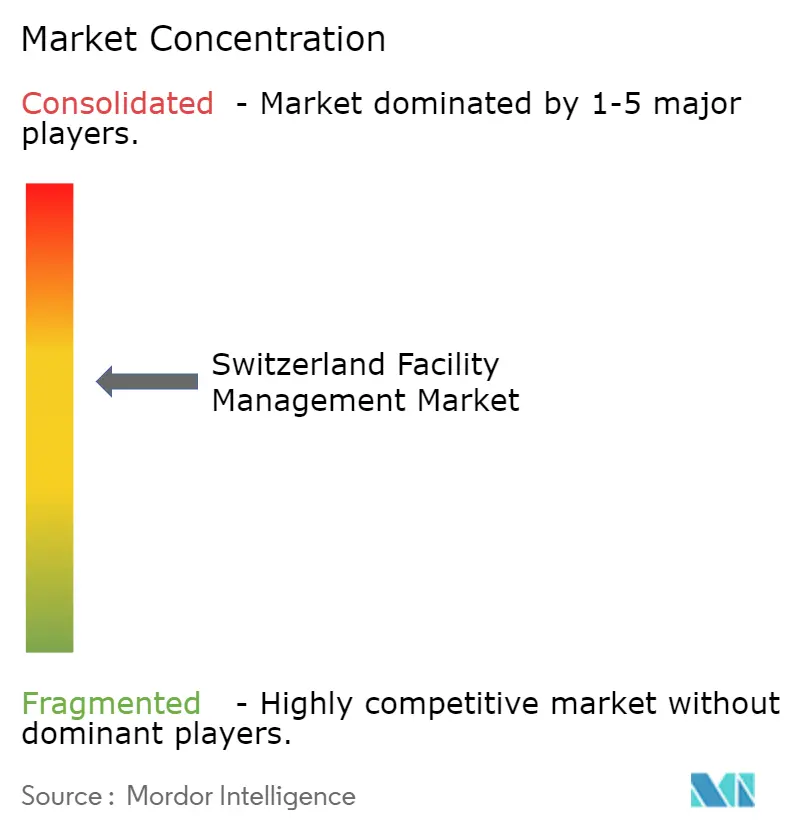
| Market Concentration | Medium |
Major Players *Disclaimer: Major Players sorted in no particular order Image © Mordor Intelligence. Reuse requires attribution under CC BY 4.0. | |
Switzerland Facility Management Market Analysis by Mordor Intelligence
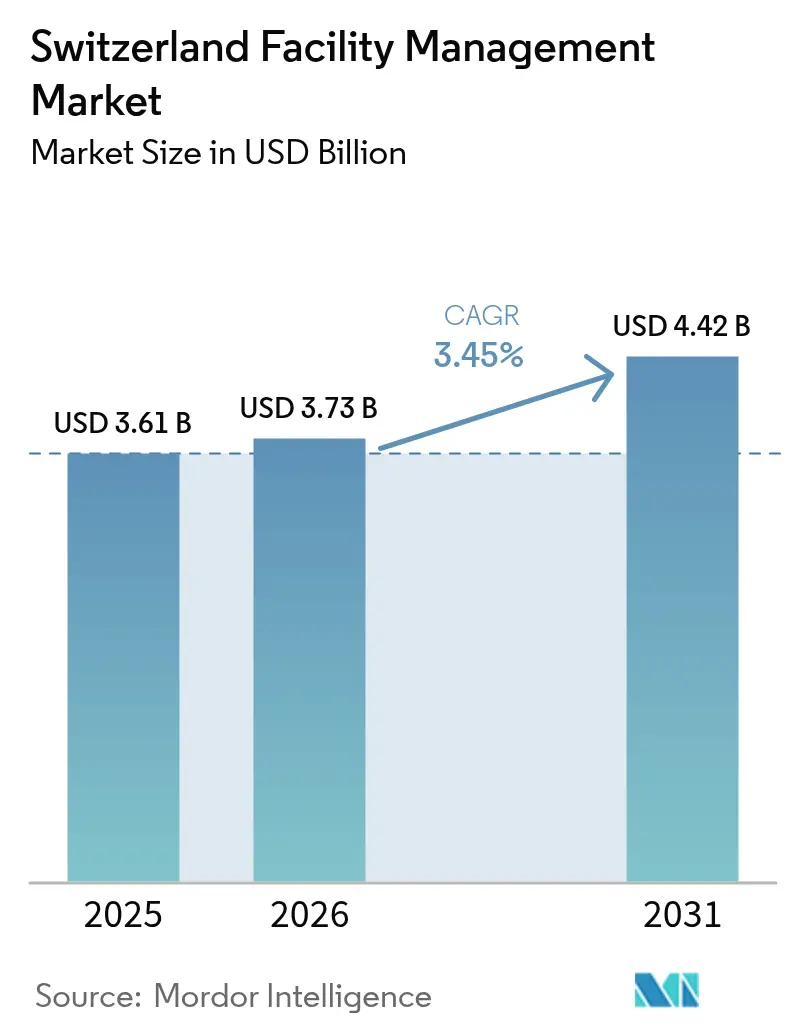
The Switzerland facility management market size is expected to grow from USD 3.61 billion in 2025 to USD 3.73 billion in 2026 and is forecast to reach USD 4.42 billion by 2031 at 3.45% CAGR over 2026-2031. Steady GDP expansion, structural labour scarcity, rising automation and stringent ESG mandates are combining to create a resilient facility management market that rewards providers able to blend technical depth with data-driven service models. Hard Services currently dominate revenue because sophisticated building systems demand specialised maintenance, yet Soft Services are expanding faster as hybrid work elevates occupant-experience priorities. Outsourcing remains the preferred operating model; the 66.21% outsourced share in 2024 underlines how clients seek flexibility, scale and regulatory know-how that are hard to replicate in-house. Consolidation among international and domestic leaders is accelerating as the capital required for IoT roll-outs, predictive algorithms and ESG reporting outpaces the capacity of smaller regional firms. Against this backdrop the facility management market is steadily transitioning from labour-intensive contracts toward outcome-based agreements where energy, carbon and space-efficiency targets drive premium pricing.
Key Report Takeaways
- By service type, Hard Services led with 60.10% revenue share in 2025, whereas Soft Services are projected to advance at a 3.88% CAGR through 2031.
- By offering, the outsourced model held 65.70% of the facility management market share in 2025 and is tracking a 3.62% CAGR to 2031.
- By end-user industry, Commercial facilities commanded 40.05% of the facility management market size in 2025 while Institutional & Public Infrastructure is forecast to expand fastest at 3.66% CAGR through 2031.
Note: Market size and forecast figures in this report are generated using Mordor Intelligence’s proprietary estimation framework, updated with the latest available data and insights as of 2026.
Switzerland Facility Management Market Trends and Insights
Drivers Impact Analysis*
| Driver | (~) % Impact on CAGR Forecast | Geographic Relevance | Impact Timeline |
|---|---|---|---|
| Hybrid Work Reshaping Space Utilization | +0.8% | National; Zurich, Geneva, Basel | Short term (≤ 2 years) |
| Value-Added Services Driving Margins | +0.6% | National; commercial hubs | Medium term (2-4 years) |
| Talent Shortage Driving Automation | +0.9% | National; acute in healthcare & IT | Long term (≥ 4 years) |
| Smart City Integration | +0.5% | Zurich, Geneva, Basel metros | Medium term (2-4 years) |
| ESG Regulations Accelerating Green Facilities | +0.7% | National; stricter in urban cantons | Long term (≥ 4 years) |
| Government Grants for Smart Building Retrofits | +0.4% | National; public infrastructure | Medium term (2-4 years) |
| Source: Mordor Intelligence | |||
Hybrid Work Reshaping Space Utilization
Swiss occupiers are embedding three-day office schedules, with 64% planning workforce growth but only 16% expecting to lease more space, signalling a decisive pivot toward desk-sharing and space-on-demand strategies[1]JLL Research, “Decoding the Return-to-Office Puzzle in Switzerland,” JLL, jll.com. Flex-office supply in Zurich rose from 19 to 50 locations between 2019 and 2024, swelling usable space from 28,000 m² to 75,000 m² and underscoring the appetite for agile footprints[2]JLL Research, “Flex Offices in Switzerland – Here to Stay?,” JLL, jll.com. Only 27% of firms now envisage one-desk-per-employee layouts, down sharply from two-thirds in 2019, which pushes facility managers to master dynamic occupancy analytics. As collaborative zones eclipse conventional cubicles, demand intensifies for building-management platforms that automatically tune lighting, HVAC and air-quality to real-time head-counts. Clients value in-person collaboration over simple cost relief, so providers must deliver high-comfort shared environments rather than pure densification plays.
Value-Added Services Driving Margins
Mature Swiss occupiers increasingly benchmark service providers on employee wellness, hospitality and workplace-experience metrics, lifting demand for bundled concierge, food and smart-cleaning offerings that carry richer margins than standard maintenance. In premium commercial hubs, corporates contract for biophilic design upgrades and sensor-based indoor-air optimisation to support talent attraction. Facility managers able to integrate catering, security and reception under integrated FM contracts are winning longer tenures and performance-linked fee escalators. The trend mirrors the premium employers place on health, safety and ESG transparency, creating upsell pathways into consulting on carbon accounting, WELL certification and waste-segregation protocols. As a result, pure-play technical providers are broadening portfolios or partnering with hospitality specialists to defend share.
Talent Shortage Driving Automation
Switzerland’s unemployment rate fell to 2% in late 2024 while vacancies surpassed 120,000, signalling structural labour scarcity that is acute in facilities and healthcare services. By 2040 the economy could face a manpower gap of 430,000, prompting FM firms to mechanise repetitive tasks and adopt AI-backed scheduling that lifts worker productivity. Automation potential varies: agricultural and forestry FM tasks carry a 76% likelihood whereas health-sector routines sit below 20%, guiding selective robotics deployment. Schindler Switzerland’s “Liftcamps,” which retrain career-changers as elevator technicians, illustrate creative responses to talent scarcity. With labour costs already averaging CHF 63.62 per hour, providers see automation not as workforce replacement but as augmentation that keeps margins viable.[3]Federal Statistical Office, “Labour Costs,” bfs.admin.ch
ESG Regulations Accelerating Green Facilities
The Climate and Innovation Act obliges Switzerland to reach net-zero by 2050, unlocking a USD 20 billion retrofit market for energy-efficiency services. Mandatory TCFD reporting from January 2024 compels firms to publish granular climate-risk data, so FM partners are now core to measurement and disclosure workflows. Buildings account for 45% of national energy use and one-third of emissions; IoT-enabled heating optimisation already trims 10-20% of carbon in more than 700 Swiss buildings, with plans for 25,000 additional sensors[4]Swisscom Corporate News, “Cutting Costs and Carbon Emissions for Buildings Using Artificial Intelligence,” swisscom.ch. Green-compliant assets attract rental premiums; 85% of investors report higher valuations for ESG-aligned facilities, intensifying demand for providers who can verify performance. FM companies with carbon-analytics platforms thus convert regulation into competitive advantage.
Restraints Impact Analysis*
| Restraint | (~) % Impact on CAGR Forecast | Geographic Relevance | Impact Timeline |
|---|---|---|---|
| High Operating Costs: Premium Market Pressures | -0.5% | National; Zurich & Geneva | Short term (≤ 2 years) |
| Fragmented Market Structure: Integration Challenges | -0.3% | National; rural cantons | Medium term (2-4 years) |
| Stringent Compliance and Certification Costs | -0.4% | National; urban areas | Long term (≥ 4 years) |
| Limited Flexibility in Long-term Real Estate Contracts | -0.2% | National; commercial sector | Medium term (2-4 years) |
| Source: Mordor Intelligence | |||
High Operating Costs: Premium Market Pressures
At CHF 63.62 per hour, Swiss labour is among the world’s priciest, squeezing FM margins and disadvantaging small local firms unable to scale[5]Federal Statistical Office, “Labour Costs,” bfs.admin.ch. A policy-rate cut to 0.25% in March 2025 stimulates real-estate demand but forces FM suppliers to recalibrate services as occupancy swings more rapidly. New lease rents rose 1.8% in Q1 2025 against a 1.08% vacancy low, driving more frequent contract renegotiations and pass-through clauses. Simultaneously, ESG reporting adds monitoring and certification costs that erode small-provider profitability. The cumulative burden propels consolidation as scale economies in technology and procurement become decisive.
Fragmented Market Structure: Integration Challenges
Switzerland’s 26 cantons enforce distinct real-estate and labour rules, obliging FM vendors to customise processes and digital tools for each jurisdiction[6]Switzerland Global Enterprise, “Cantonal Business Development,” s-ge.com. Language segmentation across German, French and Italian regions elevates training spend and undermines standardised delivery. Healthcare FM illustrates the difficulty: cantonal hospital systems stipulate divergent hygiene and data-protection standards that impede nationwide roll-outs. Divergent BMS protocols also limit IoT-sensor interoperability, complicating predictive-maintenance deployments. As a result, national efficiency programs progress slowly, and smaller cantonal players struggle to integrate into wider digital ecosystems.
*Our forecasts treat driver/restraint impacts as directional, not additive. The impact forecasts reflect baseline growth, mix effects, and variable interactions.
Segment Analysis
By Service Type: Hard Services Remain Dominant Amid Infrastructure Sophistication
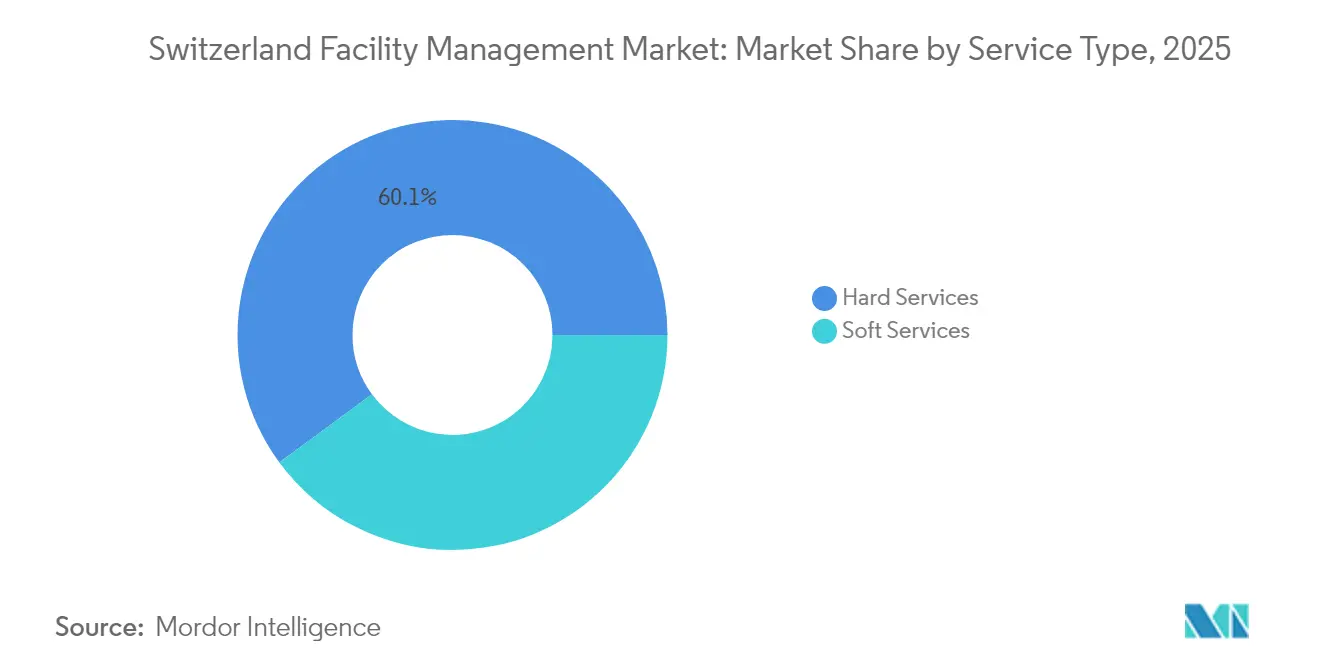
Hard Services accounted for 60.10% revenue in 2025, highlighting the critical role of technical maintenance in a country where building systems are highly automated and heavily regulated. The segment benefits from mandatory periodic inspections of fire safety, elevators and HVAC that secure recurrent revenue, while Switzerland’s alpine climate drives demand for high-spec heating and ventilation solutions. Asset-management subservices are scaling rapidly as IoT deployment accelerates; Siemens alone installed more than 7,000 sensors across Kantonsspital Baden, an illustration of sensor density now expected in critical facilities. Predictive maintenance platforms improve uptime and compliance, allowing FM providers to tie fees to KPI outcomes. Despite dominance, Hard Services growth trails Soft Services because many technical tasks are maturing toward price competition.
Soft Services are forecast to grow at a 3.88% CAGR to 2031, reflecting heightened emphasis on employee experience in hybrid workplaces. Cleaning protocols evolved during the pandemic into sensor-triggered, needs-based regimes that optimise labour and hygiene simultaneously. Catering and vending services integrate nutritional analytics and cashless payments, elevating perceived value. Security has shifted to cloud-enabled access control and video analytics, embedding FM into corporate risk management. As a result, Soft-Service contracts increasingly bundle hospitality and wellbeing solutions that command premium rates. Providers that combine data-driven space services with traditional soft capabilities are poised to outpace purely technical competitors.



By Offering Type: Outsourcing Builds Scale As Complexity Rises
The outsourced model represented 65.70% of total spend in 2025 and is set to compound at 3.62% annually to 2031, underscoring client preference for specialised expertise amid tightening labour supply. Integrated FM offerings bundle hard and soft tasks under unified KPIs, simplifying vendor oversight for multinationals and public entities. Outsourcers leverage scale to attract scarce technicians, invest in AI-based maintenance and absorb compliance risk. The facility management market size attached to integrated contracts is expanding fastest, particularly in healthcare where hospital EBITDA pressure demands holistic optimisation. Bundled FM also suits mid-market clients needing a single point of accountability yet unwilling to relinquish strategic control of core assets.
In-house management retained 34.30% share in 2025 but faces strain. Corporates must fund technology upgrades, maintain talent pipelines and reconcile ESG reporting in addition to core business priorities. Nonetheless, in-house teams persist in defence, energy and high-tech manufacturing where security or process integration outweigh outsourcing efficiencies. Some firms operate hybrid models, outsourcing technical tasks while keeping strategic space planning internal. Over the forecast, continued skills shortages and IoT capex will tip incremental volumes toward specialised providers.
By End-user Industry: Commercial Leads but Institutional Pipelines Surge
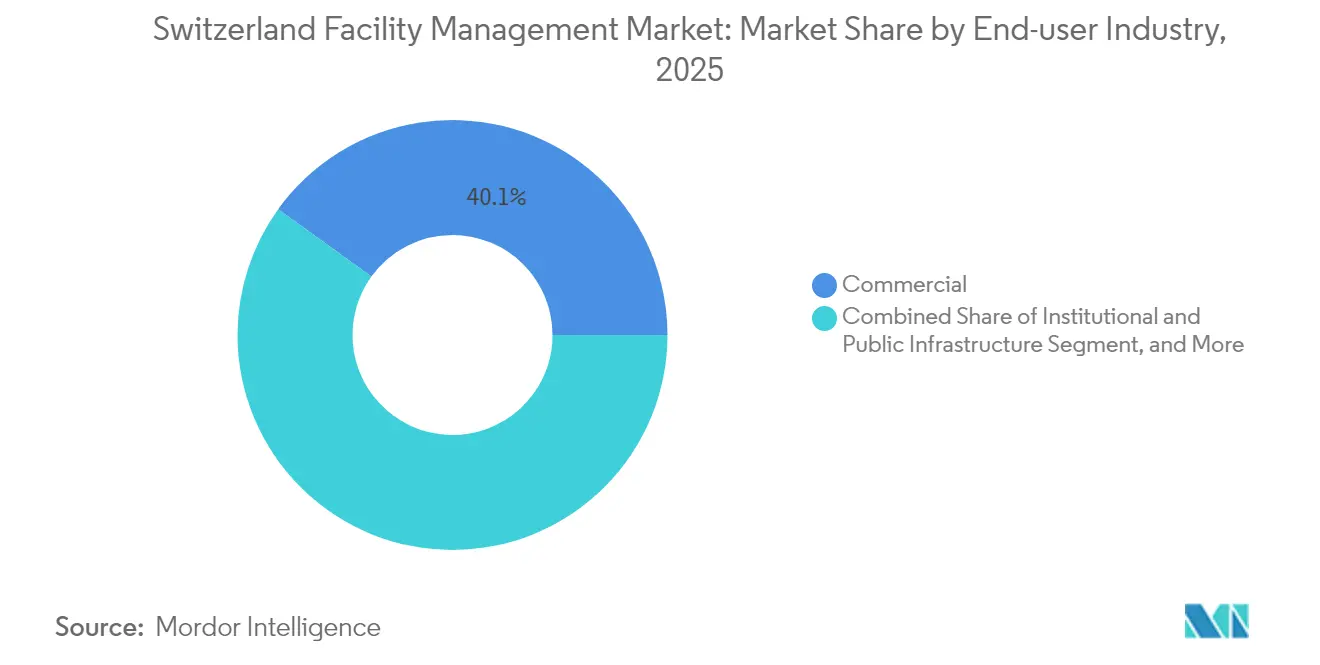
Commercial real estate-including banking offices, data centres and retail-held 40.05% of 2025 revenue. Financial-services anchors in Zurich and Geneva demand 24/7 uptime, cyber-secure BMS and WELL-certified workplaces. Data-centre FM requires advanced cooling optimisation; technology and hyperscale clients drove a 16% jump in CBRE’s Swiss FM revenue for Q1 2025. However hybrid work dampens net office take-up, compelling FM firms to pivot toward experience-centric amenities rather than pure space growth.
Institutional and Public Infrastructure is the fastest-growing vertical, projected at a 3.66% CAGR through 2031. Smart city grants, hospital modernisation and decarbonisation mandates create long contract visibility. Zurich earmarks CHF 1.25 million annually for smart-city trials, channelling work to FM specialists versed in IoT and open-data integration. Hospitals seek FM partners to lift EBITDA margins from the current 2.7% to sustainable levels by automating logistics and energy use. Transport and e-mobility networks likewise need high-availability maintenance that blends civil, electrical and digital skills, further enlarging outsourced pipelines.
Geography Analysis
Switzerland’s facility management demand is concentrated in metropolitan cantons where dense corporate footprints, advanced infrastructure and progressive regulation coalesce. Zurich leads spending owing to its role as a financial nucleus and first-mover on smart-city initiatives that aim to accommodate 25% population growth by 2030 through data-driven urban services. Premium landlords require continuous uptime, LEED & WELL certifications and high-spec security, sustaining price premiums for integrated FM contracts. Geneva follows, shaped by UN agencies, NGOs and multinational commodity firms whose stringent security and protocol standards raise service complexity. The city’s fully electric TOSA bus system pushes demand for specialists who can integrate vehicle-charging, depot maintenance and energy-management solutions.
Basel’s life-science cluster creates niche FM needs around cleanrooms, hazardous-waste handling and GMP compliance, generating steady high-margin opportunities. Eastern Switzerland (St. Gallen, Appenzell) shows rising adoption of outsourced FM as mid-sized manufacturing plants modernise to meet carbon targets. The Espace Mittelland, anchored by Bern, delivers reliable public-sector demand but lower margin potential because tender rules favour price-competitive bids. Ticino’s bilingual context calls for suppliers fluent in Italian legal and cultural frameworks, erecting soft barriers to entry for international players. Rural cantons remain fragmented; limited economies of scale deter large FM entrants, yet pilot smart-village schemes in Dietikon and Wädenswil signal long-term growth as IoT hardware becomes cheaper. Collectively these regional nuances necessitate flexible operating models that balance national standards with local compliance and language adaptation.
Regulatory Landscape
Switzerland facility management operates under a decentralized compliance environment in which cantons hold primary responsibility for building-energy measures, while federal rules set the framework for federal assets and national climate targets. The Climate and Innovation Act anchors the net-zero by 2050 pathway, and mandatory TCFD-aligned climate reporting from January 2024 increases the demand for auditable energy, emissions, and risk data that FM providers increasingly operationalize through monitoring and reporting workflows.
Technical delivery is also shaped by Swiss and European standards that influence how buildings are planned, handed over, and operated for lifecycle performance. SIA standards (including FM-aware planning guidance) and process models such as ProLeMo (supported by IFMA Switzerland and CRB) help structure service specifications and performance measurement, which is especially relevant in public-sector tenders where traceable processes and documentation are required.
Value Chain Analysis
The Swiss facility management value chain starts upstream with asset owners (commercial landlords, corporates, and public entities) and advisory roles (architects, engineers, and specialist planners), then moves through procurement and contract structuring into single, bundled, or integrated FM delivery. Hard services execution depends on OEM and specialist supply for elevators, HVAC/MEP, fire systems, and building automation, while soft services rely on labor-intensive subcontracting networks. Both are increasingly coordinated through CAFM and BMS layers to standardize SLAs, compliance records, and work-order flows across multi-site portfolios.
Digital and sustainability requirements are pulling technology firms and proptech start-ups deeper into the chain, alongside established integrators such as SPIE Switzerland and Equans Switzerland that can combine technical FM with energy and digitalization capabilities. Performance-based models are emerging as providers deploy smart hardware and analytics (occupancy, indoor air quality, and energy monitoring) and recover investment through measured savings, reinforcing the role of data platforms and IoT connectivity from mobilization through continuous operations.
Competitive Landscape
The Switzerland facility management market is moderately fragmented but trending toward consolidation as capital-intensive digitalisation raises entry thresholds. ISS’s acquisition of gammaRenax in May 2024 brought 1,800 staff and 1,600 sites under its umbrella, strengthening its national footprint and proprietary FM Academy talent funnel. CBRE deepened global reach by purchasing Industrious, creating a Building Operations & Experience segment with USD 20 billion revenue that can cross-sell flexible workspace and integrated FM to Swiss multinationals. Siemens, Bouygues-Equans and SPIE focus on technical niches, leveraging engineering heritage to win high-spec hospital, energy and data-centre projects; Siemens’ 7,000-sensor hospital deployment epitomises technology-led differentiation.
Regional champions such as Wincasa and Dussmann protect share through local market intimacy and language agility. Wincasa’s new Target Operating Model establishes 26 walk-in centres, signaling a human-centric strategy to counter purely digital entrants. Dussmann recorded EUR 3 billion sales in 2023 and is rolling out a “Road to 2030” plan that emphasises bundled services and energy performance contracting. Meanwhile Equans Switzerland emerged from Bouygues E&S’ merger with Engie’s service arm, adding scale across building-life-cycle offerings from design to maintenance. Technology pure-plays delivering AI-driven energy analytics increasingly challenge incumbents on single-solution bids, nudging traditional players to invest or partner.
Strategic moves centre on IoT roll-outs, sustainability consulting and outcome-based pricing that ties revenue to energy-savings or uptime guarantees. Providers also expand academies and apprenticeship schemes to mitigate labour scarcity. As the top five players’ combined revenue roughly equals 45% of national spend, the market still offers room for niche specialists yet shows clear drift toward a more consolidated structure.
Switzerland Facility Management Industry Leaders
Honegger AG
Swiss FM AG
Livit FM Services Ltd.
PHM Group
SPIE Switzerland
- *Disclaimer: Major Players sorted in no particular order

Market Opportunities and Future Outlook
Energy and carbon compliance creates space for providers that can package retrofit execution with measurement, verification, and reporting. Mandatory TCFD reporting from January 2024 and the net-zero by 2050 pathway push building owners toward continuous performance tracking, and Swisscom has framed AI-enabled heating optimization as a practical lever, citing 10-20% carbon reduction outcomes across more than 700 Swiss buildings and a plan to extend sensor deployments materially beyond current coverage.
Digital integrated FM adoption also still has room for scaled rollouts, especially in portfolios that require standardized data for asset, space, and ESG reporting. In 2025, the ZHAW Smart Building Management Index placed smart-building-management maturity at 51/100, and only about 35% of Swiss buildings used smart management solutions, pointing to an installed base where FM firms can combine CAFM, BMS integration, and predictive maintenance into outcome-based contracts. The outsourcing-heavy delivery model (65.70% share in 2025) further supports opportunities for large providers and specialist partners to industrialize these deployments across cantons and languages.
Recent Industry Developments
- March 2026: Livit announced a new project-management mandate for the FIDELIO new-build development in St. Gallen, covering 207 residential units plus commercial space, with marketing scheduled for autumn 2026. The mandate expands the upstream role of FM-linked property managers into development-stage coordination, supporting smoother handover into operations and longer-duration lifecycle revenues.
- January 2026: Geneva Airport expanded collaboration with Honegger AG under a digitized mandate covering cleaning and maintenance across more than 60 buildings, incorporating Planon CAFM software and robotics. The scope highlights how large, complex infrastructure clients are bundling services with digital execution tools to improve transparency, quality control, and scalable compliance management.
- May 2024: ISS completed the acquisition of gammaRenax, bringing around 1,800 staff and 1,600 customer sites into its Swiss platform. The deal increased national delivery scale and strengthens the case for consolidation as providers invest in technology, training capacity, and multi-canton service coverage.


Research Methodology Framework and Report Scope
Market Definition and Coverage
For this report, the Switzerland facility management market is defined as the value of services used to operate, maintain, and support buildings and built assets so they stay safe, compliant, and usable for occupants across the country.
Scope exclusions: We exclude purely one-off construction activity and standalone real-estate transactions that do not relate to ongoing facility operations or maintenance services.
Segmentation Overview
- By Service Type
- Hard Services
- Asset Management
- MEP and HVAC Services
- Fire Systems and Safety
- Other Hard FM Services
- Soft Services
- Office Support and Security
- Cleaning Services
- Catering Services
- Other Soft FM Services
- Hard Services
- By Offering Type
- In-house
- Outsourced
- Single FM
- Bundled FM
- Integrated FM
- By End-user Industry
- Commercial (IT and Telecom, Retail and Warehouses, etc.)
- Hospitality (Hotels, Eateries, Large-scale Restaurants)
- Institutional and Public Infrastructure (Govt, Education, Transportation)
- Healthcare (Public and Private Facilities)
- Industrial and Process (Manufacturing, Energy, Mining)
- Other End-user Industries (Multi-housing, Entertainment, Sports and Leisure)
Data Sources, Market Sizing, and Validation
Desk Research
Desk work started with mapping Switzerland demand for facilities that need ongoing services, and then aligning that map with the most consistent public data series available. We referenced sources such as the Swiss Federal Statistical Office for building stock and activity indicators, SECO labor and productivity datasets, and Swiss Federal Customs Administration trade statistics for selected equipment and material flows that can affect hard-services work.
To keep inputs grounded, we also used association and standards bodies (such as ISSA for cleaning benchmarks and ISO guidance on FM definitions), along with company annual reports, public tender portals, and trusted business press for contract announcements and pricing signals. In parallel, we used paid databases only for company financials and news screening, plus patent databases to identify building-operations trends that can shift service intensity. The desk sources listed above are illustrative only, and we checked many other public references to collect, validate, and clarify data points.
Primary Interviews and Surveys
Fieldwork covers Switzerland-based facility service executives, FM and maintenance leaders, property or operations managers, and procurement specialists. Their responses help estimate outsourced share, contract pricing, labor costs, service mix, and renewal timing. They also help test secondary indicators and resolve gaps between published turnover data and provider-level assumptions. Unusual responses are rechecked before the assumptions are accepted.
Distribution of primary research fieldwork respondents
| Company type | Respondent position |
|---|---|
| Top tier: 29% | CXOs: 18% |
| Mid tier: 49% | Functional/Unit leaders: 31% |
| Smaller Players: 22% | Managers: 51% |
Market-Sizing & Forecasting
Market sizing was built using a top-down approach where building stock and usage proxies are translated into an addressable service pool, and then filtered by typical outsourcing rates and service intensity in Switzerland. We modeled demand using cross-checkable inputs such as commercial and institutional floor area trends, outsourcing penetration by end-user, average contract tenures, service frequency differences between hard and soft services, and wage and energy cost movements that influence FM pricing.
After the first cut, totals were corroborated using selective bottom-up checks, including sampled price-per-square-meter ranges by facility type, provider revenue sanity checks from public financial disclosures, and channel checks on the bundled versus integrated contract mix. Where bottom-up visibility is limited (for smaller private providers and in-house spend), we expanded using ratio-based adjustments tied to employment and building-use indicators, then validated those expansions with interview feedback. Forecasts were developed using scenario analysis with a light regression overlay, so the model responds to macro drivers (employment, office utilization, public infrastructure activity) without overfitting short-term noise.
Data Validation & Update Cycle
Validation is done in several steps so outliers get caught early and assumptions stay explainable. Our team compares model outputs against independent signals, including public employment trends linked to services, tender activity direction, and observable pricing movements in labor-heavy soft services, then reviews large variances at segment and total levels.
If a key input moves outside the expected range, analysts re-check the desk sources and re-contact experts to confirm whether a structural change is occurring or whether it is a one-time event. Before sign-off, the model is reviewed by another analyst for logic, arithmetic, and consistency across historical and forecast years. Reports are refreshed annually, with interim updates when material events affect costs, outsourcing behavior, or major contract volumes, and a final pre-delivery check is performed so clients receive the latest view.
Mordor Intelligence's Switzerland Facility Management Market Estimate Compared With Other Published Estimates
Published numbers for Switzerland facility management do not always match because they often bundle different service baskets, count different buyer groups, and use different timing for currency and inflation adjustments. Even when the topic name looks the same, the underlying inclusions can shift the result by a meaningful amount.
Some external estimates widen scope by folding in adjacent property services and workplace programs, which can inflate the total when cross-border contracts and pass-through costs are also treated as market value. In Mordor Intelligence, only facility management services tied to operating and maintaining built environments in Switzerland are counted, and one-off construction activity and pure real-estate transactions are kept out so pricing and volume drivers remain traceable.
Benchmark comparison
| Source | Market Size | Gaps in Research Methodology |
|---|---|---|
| Mordor Intelligence | USD 3.61 B (2025) | |
| Industry Association A | USD 4.10 B (2025) | Uses a broader services bucket that can mix FM with wider property services and workplace offerings, and it may treat pass-through items as value, which lifts the topline versus a pure FM scope. |
| Global Consultancy B | USD 3.20 B (2025) | Applies conservative outsourcing penetration and tighter service intensity assumptions for hard services, and it can undercount smaller outsourced providers and in-house spend when relying mainly on sampled contracts. |
The spread across the three figures is mainly explained by what gets included as FM value and how outsourcing and pricing are handled in the base year. By keeping the demand pool tied to Switzerland building-use indicators and cross-checking it with realistic contract and pricing ranges from fieldwork, we reach a market value that can be repeated and defended with clear steps.


Key Questions Answered in the Report
What is the current size of the Switzerland facility management market?
The facility management market size is USD 3.73 billion in 2026 and is projected to reach USD 4.42 billion by 2031.
Which facility management service type generates the highest revenue?
Hard Services dominate with 60.10% of 2025 revenue, driven by technical-infrastructure complexity.
Why is outsourcing growing faster than in-house facility management?
Acute labour shortages, escalating compliance costs and the need for IoT investment are pushing organisations toward specialised outsourced providers that deliver integrated solutions at scale.
Which end-user segment is expanding most rapidly?
Institutional and Public Infrastructure is forecast to grow at 3.66% CAGR through 2031, propelled by smart-city programs and healthcare modernisation.
How are ESG regulations affecting Swiss facility management providers?
Net-zero mandates and mandatory climate-risk disclosure boost demand for energy-efficiency retrofits and data-driven monitoring, favouring providers with advanced sustainability expertise.
What technological trends are redefining Swiss facility management contracts?
IoT sensors, predictive maintenance algorithms and outcome-based agreements that guarantee energy or carbon performance are transforming service delivery and pricing models.
Page last updated on:


 Your data is secure and never sold or shared.


