
Market Overview
| Study Period | 2019 - 2031 |
|---|---|
| Forecast Data Period | 2026 - 2031 |
| Base Year Market Size (2025) | USD 24.86 Billion |
| Market Size (2026) | USD 27.97 Billion |
| Market Size (2031) | USD 50.42 Billion |
| Growth Rate (2026 - 2031) | 12.51 % |
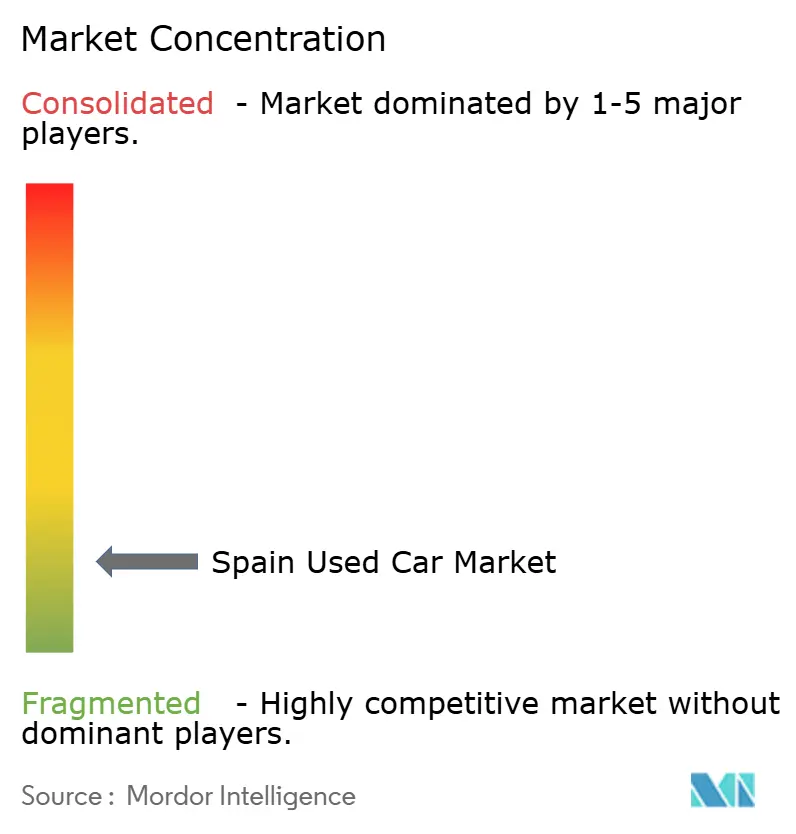
| Market Concentration | Low |
Major Players *Disclaimer: Major Players sorted in no particular order Image © Mordor Intelligence. Reuse requires attribution under CC BY 4.0. | |
Spain Used Car Market Analysis by Mordor Intelligence
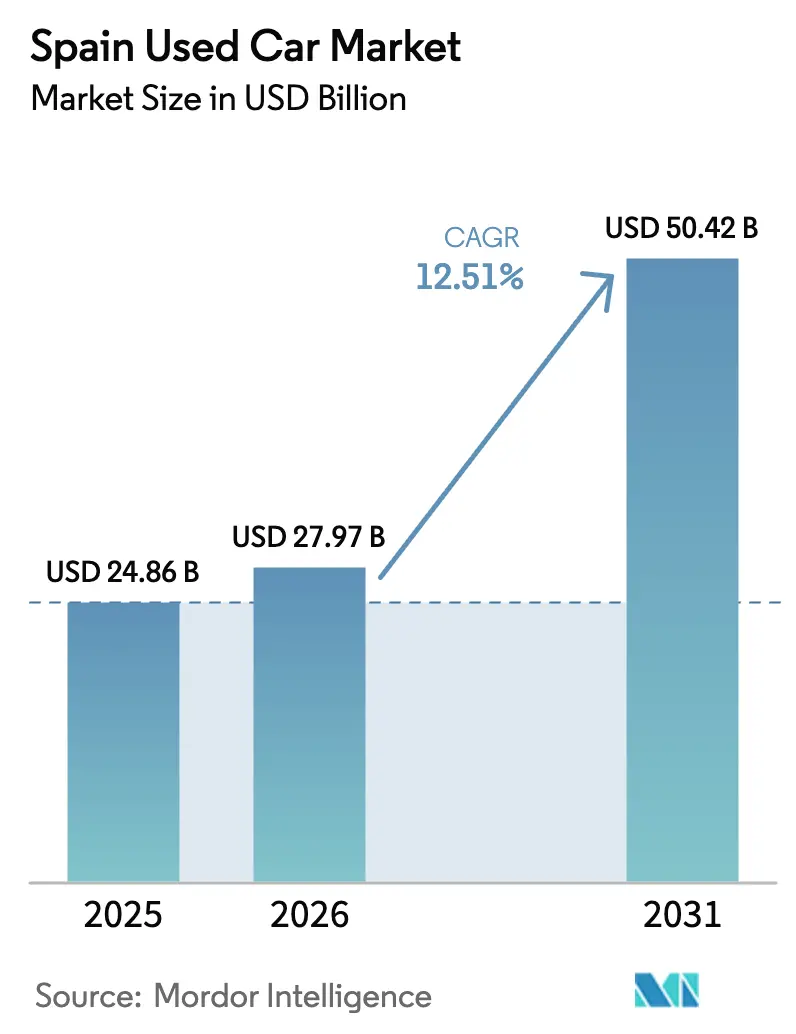
The Spain Used Car Market size was valued at USD 24.86 billion in 2025 and is estimated to grow from USD 27.97 billion in 2026 to reach USD 50.42 billion by 2031, at a CAGR of 12.51% during the forecast period (2026-2031), as tightening Euro 7 rules and macroeconomic caution channel buyers toward affordable second-hand mobility.[1]Directorate-General for Mobility and Transport, “Euro 7 Vehicle Emissions Proposal,” European Commission, ec.europa.eu Demand is reinforced by a national fleet whose average age exceeds 14 years, a factor that broadens the stock of trade-ins, compresses depreciation in older diesel inventory, and raises the appeal of younger, electrified models. Digital platforms that promise 2-hour home delivery and transparent vehicle-history reports are reshaping dealer economics, allowing organized players to erode the price advantage long held by unorganized lots. Regionally, Andalusia anchors sales through volume, whereas Madrid leverages higher disposable income and strong corporate fleet turnover to produce the fastest regional growth. Inventory pipelines benefit from leasing and rental operators cycling out 0-2 year-old vehicles, altering residual-value curves, and encouraging OEMs to expand certified pre-owned programs.
Key Report Takeaways
- By vehicle body style, SUVs and MPVs led with a 46.03% revenue share in 2025 and are expected to advance at a 13.45% CAGR through 2031.
- By vendor type, the unorganized segment held 66.13% of the Spanish used-car market share in 2025, while organized platforms recorded the highest projected CAGR at 14.65% through 2031.
- By booking type, offline transactions accounted for 75.25% of the Spanish used-car market in 2025; however, online bookings are expected to expand at a 15.46% CAGR through 2031.
- By fuel type, diesel accounted for 48.33% of the Spanish used-car market in 2025, and electric vehicles are projected to post the fastest growth, with a 16.21% CAGR through 2031.
- By vehicle age, the 3-5-year bracket commanded a 39.12% share of the Spanish used-car market in 2025, while units aged 0-2 years are expected to advance at a 15.08% CAGR through 2031.
- By price band, units below USD 10,000 accounted for 49.24% of sales in 2025, while the USD 15,000-25,000 range is growing at a 13.78% CAGR.
- By customer type, individual buyers represented 86.11% of the volume in 2025, while corporate or fleet buyers are expected to log the highest 15.71% CAGR through 2031.
- By Spanish Region, Andalusia captured a 37.44% share in 2025, whereas the Community of Madrid is set to expand at a 13.05% CAGR through 2031.
Note: Market size and forecast figures in this report are generated using Mordor Intelligence’s proprietary estimation framework, updated with the latest available data and insights as of January 2026.
Spain Used Car Market Trends and Insights
Drivers Impact Analysis*
| Driver | (~) % Impact on CAGR Forecast | Geographic Relevance | Impact Timeline |
|---|---|---|---|
| Off-Lease Fleet Adds Younger Inventory | +2.5% | National, early concentration in Madrid, Catalonia | Medium term (2-4 years) |
| EU Rules Boost Older Car Trade | +2.3% | National, with concentration in Andalusia, Catalonia, and Madrid | Medium term (2-4 years) |
| Digital Platforms and Home Delivery | +2.1% | National, early adoption in Madrid, Barcelona, Valencia | Medium term (2-4 years) |
| Uncertainty Drives Value-Focused Buyers | +1.8% | National, most visible in Andalusia and the Valencian Community | Short term (≤ 2 years) |
| OEM CPO Programs Expanding | +1.6% | National, led by Madrid, Barcelona, and Seville | Long term (≥ 4 years) |
| Vehicle History Reports Availability | +1.4% | National, supported by DGT and ITV systems | Short term (≤ 2 years) |
| Source: Mordor Intelligence | |||
Growing Supply of Off-Lease and Rental Fleet Vehicles Adds Younger Inventory
In Spain's used-car market, an unprecedented influx of near-new stock is being injected as leasing fleets, now exceeding significant volumes, return vehicles after approximately 2 years. Arval’s MotorTrade platform, a key player, annually pushes a substantial number of units and has shown remarkable growth in its Re-lease proposition, which recontracts late-model cars. Meanwhile, rental companies are disposing of cars within a shorter time frame, driving growth in the younger vehicle segment. This influx of younger vehicles not only elevates average quality and reduces reconditioning times but also bolsters the rise of certified pre-owned programs, which come bundled with warranties and roadside assistance.
EU Emissions Rules Enlarging Pool of Trade-Ins for Older ICE Vehicles
Euro 7 standards, scheduled to take effect from 2025, raise the cost of ownership for aging diesel and petrol cars, encouraging owners to dispose of non-compliant units before urban low-emission zones tighten enforcement. Spain’s fleet age of 14.2 years is driving a surge of diesel trade-ins that are now facing rapid price compression, particularly in the 6-8-year bracket[2]“Vehicle Fleet 2025,” Spanish Directorate General of Traffic, dgt.es . In a bid to hasten fleet renewal, Royal Decree Law 4/2024 offers accelerated depreciation for low-emission vehicles. This incentive is pushing fleet operators to refresh their assets at a quicker pace. Certain regions are experiencing the largest influx of older internal combustion engine (ICE) vehicles. This trend is altering the dealer landscape, as organized vendors pivot to focus on younger inventory for better margins. The uptick in supply is making consumers more price-sensitive, a trend that favors larger marketplaces adept at algorithmic pricing.
End-to-End Digital Retail Platforms With Home Delivery
Shoppers can now complete paperwork, make payments, and schedule deliveries online via platforms such as Clicars, AutoScout24, Wallapop Motors, and Coches.net. This innovation has significantly reduced the time required for the search-to-purchase process. The growing popularity of virtual storefronts highlights a sustained shift in consumer behavior. Data from GANVAM reveals that a considerable portion of buyers begin their journey online, with many completing it digitally—a trend that continues to grow steadily. Early adoption is more prevalent in urban areas such as Madrid, Barcelona, and Valencia, where smartphone use is widespread. However, rural areas show slower adoption, indicating potential for hybrid click-and-collect models. To address the lack of physical test drives, platforms now offer inspection reports and return policies, which help boost conversion rates among cautious buyers.
Economic Uncertainty Heightens Value-Conscious Consumer Behavior
In 2024, GDP growth slowed, as rising mortgage rates reduced disposable incomes and pushed households toward the second-hand market. The preference for used cars reflects a broader focus on affordability, as families prioritize financial flexibility over purchasing new vehicles. High unemployment levels and limited asset bases further constrain budgets, driving demand for more economical car options. In regions with lower economic performance, such as Andalusia and the Valencian Community, buyers are particularly sensitive to financing conditions. This has led organized vendors to strengthen partnerships with banks, offering more accessible loan terms. These dynamics support faster sales turnover at reduced profit margins, benefiting platforms that excel in scaling digital underwriting.
Restraints Impact Analysis*
| Restraint | (~) % Impact on CAGR Forecast | Geographic Relevance | Impact Timeline |
|---|---|---|---|
| Depreciation Risk for ICE | -1.9% | National, most acute in low-emission zones of Madrid, Barcelona, Valencia | Medium term (2-4 years) |
| Sparse Public Charging Limits | -1.5% | National, particularly outside major metros | Long term (≥ 4 years) |
| Chip-Shortage Easing Price Gap | -1.2% | National, affecting all price bands | Short term (≤ 2 years) |
| VAT and Registration Taxes | -0.8% | National, friction highest on Andalusia-to-Madrid corridor | Medium term (2-4 years) |
| Source: Mordor Intelligence | |||
Rapid Depreciation Risk for ICE Assets Amid Electrification
Transactions continue to be led by diesel units, yet these units are witnessing sharper price drops, coinciding with a significant decline in new diesel registrations. Current data indicates that young BEVs are sitting on the market for extended periods, pointing to an oversupply and potential risks to their residual value. In contrast, petrol and hybrid units are spending less time on the market. Dealers, particularly those with substantial diesel inventories, are feeling the pinch. They're slashing margins to offload stock, especially for older cars nearing their annual ITV inspections. With low-emission zone restrictions tightening in Madrid and Barcelona, the stakes are raised, steering buyers more towards hybrid options.
Sparse Public Charging Limits Residuals on Used EVs
By mid-2024, public charging point installations had fallen significantly short of the target, with fast chargers exceeding 22 kW making up only a small proportion of the total. Due to range anxiety, buyers are less inclined to pay for used Battery Electric Vehicles (BEVs), resulting in a decline in their average asking price[3]“Average Used Car Price by Region July 2025,” Ganvam, ganvam.es. In rural areas, where many households lack private parking, the pure-EV market remains inaccessible, sustaining demand for hybrids. As a result, the growth forecast for electric units faces challenges until infrastructure density improves.
*Our forecasts treat driver/restraint impacts as directional, not additive. The impact forecasts reflect baseline growth, mix effects, and variable interactions.
Segment Analysis
By Vehicle Body Style: SUVs Capture Versatility Demand
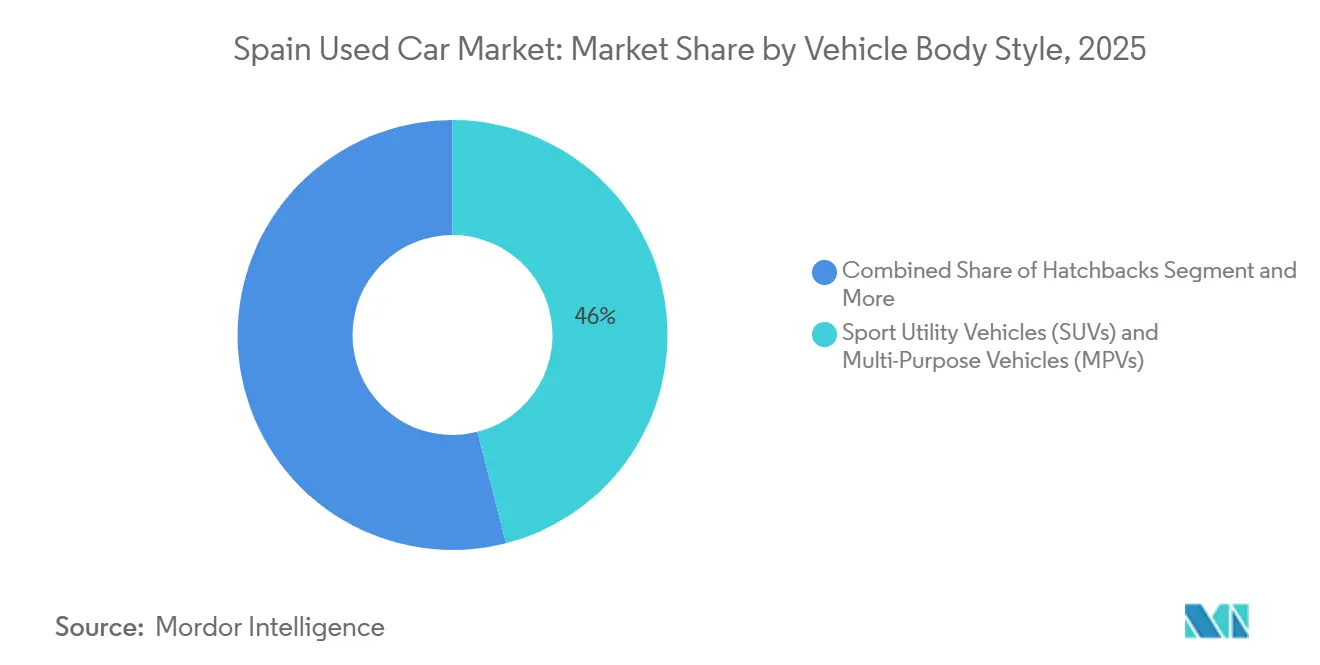
Sport Utility Vehicles (SUVs) and Multi-Purpose Vehicles (MPVs) accounted for 46.03% of sales in 2025 and are growing at a 13.45% CAGR, outpacing hatchbacks and sedans as families seek higher seating positions and flexible cargo space. Fleet disposals supply late-model hybrids such as the Tucson and Sportage, bolstering fuel-efficient choices. The Spanish used-car market for SUVs is projected to expand further as OEMs focus new-car launches on crossover designs, ensuring a robust secondary pipeline. Hatchbacks remain popular in urban areas where parking density favors compact dimensions, yet their share declines in absolute terms.
Demand drivers include tax incentives for low-emission SUVs, improved mild-hybrid efficiency, and stronger residuals linked to consumer preference stability. As public charging improves, electrified SUVs will likely displace older diesel MPVs, raising average transaction values. The Spanish used-car market share for SUVs is therefore poised to expand by the decade’s end if current flow dynamics persist.



By Vendor Type: Organized Platforms Scale Trust
Unorganized dealers controlled 66.13% of transactions in 2025, yet organized channels are compounding at 14.65% annually by 2031. Margin compression to 3-5% is offset by financing commissions and high sales velocity. Platforms integrate miDGT reports, blockchain verification, and 14-day returns to differentiate on transparency. The Spanish used car market size attributable to organized vendors is set to expand by 2031 as rural penetration improves.
Unorganized outlets retain strength in rural areas where personal relationships and flexible cash terms persist. However, as smartphone adoption saturates and bank partnerships extend credit scoring deeper into the population, digital marketplaces gain further leverage. Their ability to guarantee vehicle quality and deliver cars nationwide within hours reshapes buyer expectations, raising switching costs back to traditional lots.
By Booking Type: Digital Channels Compress Cycles
Online bookings will grow at a 15.46% CAGR as younger buyers prioritize convenience. Virtual 360-degree tours, single-click financing approval, and two-hour delivery reduce buying friction by a step change. Offline channels remain dominant with a 75.25% share in 2025, especially among older consumers who value tactile inspection. Dealers address that gap by offering hybrid models that enable online reservations and in-person pickup within 72 hours.
Growth headwinds include cybersecurity concerns and limited broadband in sparsely populated provinces, but as 5G coverage widens, these barriers recede. The shift to online is also expanding the Spanish used-car industry’s data pool, enhancing pricing algorithms that keep listed prices close to market-clearing levels, thereby accelerating stock turnover.
By Fuel Type: Electrification Tentatively Advances
Diesel retained 48.33% of 2025 transactions, but rising low-emission zones and a significant slide in new diesel registrations curbed future share. Battery-electric cars show the fastest 16.21% CAGR, yet sparse charging limits absolute penetration. Hybrids bridge the gap, enjoying strong loyalty among SUV buyers seeking lower running costs without range anxiety. Petrol remains stable due to widespread refueling access and attractive entry prices.
Used BEV pricing deflates as technology improves, trimming the Spain used-car market's premium once attached to electrification. Until charging density reaches critical thresholds, hybrids are likely to capture most incremental share. LPG and CNG stay niche because infrastructure and OEM support lag.
By Vehicle Age: Younger Inventory Gains
Cars aged 3-5 years held 39.12% of volume in 2025, but 0-2 year units grow at 15.08% CAGR on the back of leasing and rental disposals. Buyers appreciate warranty cover, low mileage, and improved emissions compliance. Corporate fleets favor near-new cars to manage downtime, amplifying demand. Vehicles 6-8 years old lose share as ITV testing frequency rises and depreciation accelerates, particularly for diesel.
Cars older than 8 years persist in budget-sensitive provinces, yet tightening scrappage programs will gradually remove the most aged units. The quality uplift lets organized dealers expand CPO lines and capture value beyond simple margin on metal, such as subscription and re-lease offerings.
By Price Band: Mid-Market Expands
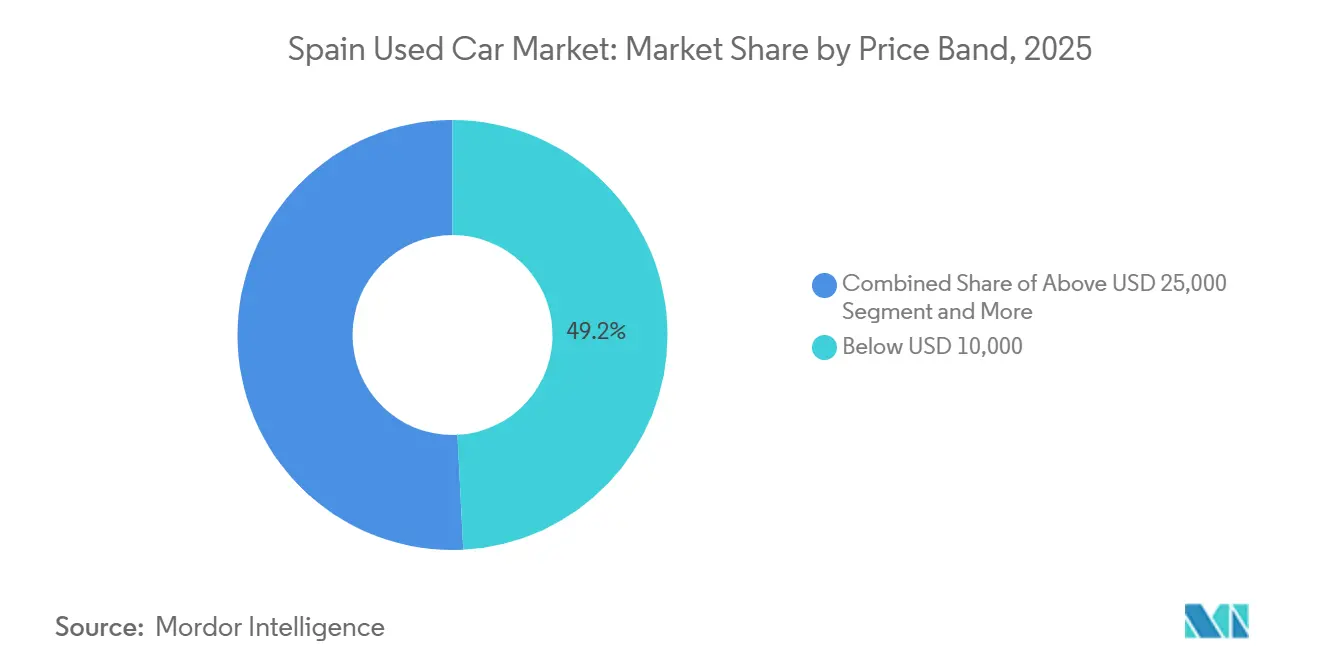
Sub-USD 10,000 cars still command 49.24% share in 2025 but will slowly cede ground to the USD 15,000-25,000 bracket, growing at 13.78% CAGR. Mid-market growth aligns with buyers trading up to younger hybrids that lower lifetime running costs. The Spanish used car market size for mid-priced cars benefits from bank financing, pushing loan affordability wider. Above-USD 25,000 units edge up via luxury SUVs that retain residual value, especially in Madrid, Catalonia, and the Basque Country.
Inflationary pressures and older-fleet scrappage gradually lift baseline pricing, compressing the lowest tier’s share. Platforms respond by extending longer loan tenures and offering warranty add-ons to justify higher ticket sizes.
By Customer Type: Corporate Fleets Accelerate
Individual shoppers accounted for 86.11% of 2025 volume, while corporate buyers grew at a 15.71% CAGR, driven by leasing penetration surpassing a notable share of new registrations. Fleet managers favor younger cars for lower downtime and predictable total cost, feeding a secondary pipeline every 24-30 months. Arval data show a substantial share of fleets already employing used cars alongside planning adoption within three years, implying a sizeable uptick in B2B demand.
The trend accelerates residual-value stability in the 0-3 year cohort and prompts organized vendors to stand up dedicated fleet channels offering maintenance packages and bulk discounts. Individual demand remains resilient for affordable models, but the corporate shift tightens the supply of the youngest stock, underpinning price floors in that bracket.
Geography Analysis
Andalusia accounted for 37.44% of transactions in 2025, due to its 8.6 million inhabitants and lower average ticket prices that favor budget-conscious households. A dense network of unorganized dealers in Seville, Málaga, and Granada supplies older diesel inventory attractive to buyers prioritizing low upfront cost. Madrid captured a smaller base yet posted a 13.05% CAGR, propelled by GDP per capita above the national mean, dynamic corporate fleet turnover, and rapid uptake of digital marketplaces that furnish home delivery across the metro.
Catalonia, anchored by Barcelona, edges up on the back of electrification demand and tech-savvy consumers comfortable with full online purchase flows. The Valencian Community records balanced growth, reflecting a mix of affordability and rising organized penetration. In contrast, the Rest of Spain sees share erosion as younger adults migrate to urban hubs and aged stock exits the fleet under scrappage schemes.
In the Basque Country, average prices are among the highest, while Madrid is close behind. Andalusia lags, influenced by a vehicle mix leaning towards older diesels. Charging infrastructure is predominantly found in Madrid and Catalonia, leading to quicker adoption of Battery Electric Vehicles (BEVs) than in rural areas. As low-emission zones expand and logistics networks streamline delivery times, the historical drawback of cross-regional purchases diminishes, signaling an ongoing geographic shift.
Regulatory Landscape
Spain’s used-car transactions and fleet renewal are increasingly shaped by EU emissions tightening and national mobility policy. The Sustainable Mobility Law (Law 9/2025), in force since December 5, 2025, sets out obligations and planning around the mobility transition and fleet management. It also influences the mix of trade-ins entering the second-hand channel.
Taxation and end-of-life rules feed through to pricing and supply. The Direccion General de Tributos has reiterated the use of official market values for taxation of used vehicle imports under IEDMT, backed by annually updated valuation tables, including those approved via Orden HAC/1501/2025 and subsequent guidance such as binding rulings issued in November 2025 and February 2026. On the circular-economy side, Real Decreto 265/2021 on end-of-life vehicles raises operational requirements for Centros Autorizados de Tratamiento (CATs), with component recovery targets increasing to 15% of vehicle weight for reused parts from January 1, 2026. This can expand the formal supply of reusable components for reconditioning and repairs.
Value Chain Analysis
Spain’s used-car value chain runs from upstream vehicle supply into refurbishment and retail, and then into aftersales and end-of-life processing. Trade-ins from private owners provide a baseline input, while the growing flow of off-lease and rental vehicles supports 0-2 year and 3-5 year inventory. Organized retailers and OEM networks can remarket this stock quickly through certified and digitally enabled channels.
Intermediaries and enablers include dealer and distribution bodies (GANVAM), manufacturers (ANFAC), parts and workshop ecosystems (SERNAUTO and ANCERA), and dismantlers and recyclers (AEDRA) supporting end-of-life and parts reuse. Organized retailers increasingly internalize inspection, refurbishment, warranty, financing, and logistics to deliver end-to-end journeys. OcasionPlus, for instance, operates a broad national network and emphasizes standardized multi-point inspections alongside trial or return-style policies, while digital platforms rely on vehicle-history and inspection information linked to DGT and ITV systems to reduce buyer risk and improve conversion.
Competitive Landscape
Spain’s used-car arena remains fragmented, yet algorithm-driven platforms such as AUTO1, BCA, and Coches.net aggressively consolidate share by pairing low margins with high stock velocity. Their scale allows 2-hour delivery, 14-day returns, and high financing approval rates, building competitive barriers hard to replicate in single-lot operations. Hybrid models merging peer-to-peer listings with professional inventories, typified by Wallapop Motors and AutoScout24, attract substantial traffic and deepen data insights.
Disruptive finance plays include Arval Re-lease, which grew significantly year over year by offering second-hand leasing that expands access for cash-strapped buyers. Tech providers like carVertical improve transparency through blockchain histories, enabling smaller dealers to compete on trust.
Competition intensifies as organized share approaches a notable share by the decade’s close. Unorganized dealers may consolidate into franchise networks or pivot to niche offerings such as older diesel vans for rural use. Data analytics, omnichannel logistics, and captive financing will differentiate winners, while regulatory harmonization could further unlock cross-regional inventory flows, magnifying scale benefits.
Spain Used Car Industry Leaders
OcasionPlus
Clicars Spain SL
BCA Group
YAMOVIL SA
AUTO1.com GmbH
- *Disclaimer: Major Players sorted in no particular order

Market Opportunities and Future Outlook
Fleet renewal and compliance-driven replacement create room for younger, lower-emission used inventory and for the services that come with it. Law 9/2025 (Sustainable Mobility Law) places formal emphasis on mobility transition and fleet management from December 2025, supporting programs designed to move older vehicles out of circulation and to accelerate turnover into newer used hybrids and EVs. This aligns with a national fleet already averaging an older profile, broadening the pool of trade-ins while sharpening demand for compliant urban-use vehicles.
Circular-economy requirements also point to opportunity in refurbishment and parts reuse. From January 1, 2026, CATs face a 15% reused-component recovery requirement by weight under Real Decreto 265/2021, which increases incentives for more structured harvesting and commercialization of reusable parts. That, in turn, strengthens the economics for professional reconditioning among organized sellers and workshop networks (including ANCERA-linked channels) and can reduce repair lead times for older vehicles, where sub-USD 10,000 units remain a large share of transactions. Industry coordination, including ANFAC activity around connected and autonomous mobility events scheduled for late 2026 in Madrid, supports investment and partnerships focused on data, diagnostics, and digital retail workflows that carry into used-vehicle remarketing.
Recent Industry Developments
- June 2026: Ancove reports that used passenger car sales in Spain increased by 6.3% in June 2026 compared with June 2025. The uptick points to stronger consumption of second-hand mobility and ongoing fleet renewal dynamics. This market momentum could support dealer activity and financing throughput in the near term.
- June 2026: Clicars (Aramis Group and Stellantis partnership) reports a 49% reduction in losses during its 2025 fiscal year and expects a return to profitability in fiscal year 2026. The improvement in unit economics may shift competitive dynamics and pricing power as players with stronger margins gain share. The partnership also suggests consolidation pressure as profitability improves.
- June 2026: Ancove reports that used passenger car sales in Spain rose 6.3% in June 2026 versus the same month in the prior year. The acceleration reflects stronger demand for affordable mobility and supports renewed dealer capacity utilization. It reinforces the case for ongoing emphasis on second-hand platforms and financing options.


Research Methodology Framework and Report Scope
Market Definition and Coverage
For this study, the market refers to the transaction value of used passenger vehicles sold in Spain through both organized and unorganized channels, counted at the transaction level in current USD terms.
Scope exclusions: the sizing does not include brand-new vehicle sales, most aftermarket services (repairs, parts, insurance), and value from financing that is outside the vehicle transaction price.
Segmentation Overview
- By Vehicle Body Style
- Hatchbacks
- Sedans
- Sport Utility Vehicles (SUVs) and Multi-Purpose Vehicles (MPVs)
- By Vendor Type
- Organized
- Unorganized
- By Booking Type
- Online
- Offline
- By Fuel Type
- Petrol
- Diesel
- Electric
- Hybrid
- Others
- By Vehicle Age
- 0-2 Years
- 3-5 Years
- 6-8 Years
- Above 8 Years
- By Price Band
- Below USD 10,000
- USD 10,000-15,000
- USD 15,000-25,000
- Above USD 25,000
- By Customer Type
- Individual
- Corporate/Fleet
- By Spanish Region
- Andalusia
- Catalonia
- Community of Madrid
- Valencian Community
- Rest of Spain
Data Sources, Market Sizing, and Validation
Desk Research
Desk research starts by mapping demand and supply conditions for used vehicles in Spain, then identifying which series can be measured consistently year to year. Public data points help keep the model anchored, especially on unit transfers, fleet size, vehicle age mix, and fuel mix.
We typically use sources such as Spain vehicle registration and transfer statistics published by the relevant transport authority, national traffic and road-safety statistics, and official macro indicators from the national statistics office and central bank. We also review European-level datasets to cross-check fleet and emissions trends, and we use customs and trade releases where cross-border used vehicle flows are relevant. To fill data gaps and confirm directional trends, we review company annual reports, investor presentations, reputable automotive press coverage, and a paid subscription for company financials plus shipment-level trade checks. This list is not exhaustive, and we also consulted additional sources to collect inputs, validate assumptions, and clarify open questions.
Primary Interviews and Surveys
Primary work focuses on validating the market structure, not just the headline value. We speak with dealer groups, independent resellers, online-focused retailers, remarketing intermediaries, and related service providers across Spain. Interviews and short surveys are also used to sense-check pricing movement, stock availability by age band, and the share of transactions by each channel.
When desk sources show a mismatch, we re-check assumptions with market participants and then revise the model inputs so they reflect what is happening in the channel mix and transaction patterns on the ground.
Distribution of primary research fieldwork respondents
| Company type | Respondent position |
|---|---|
| Top tier: 39% | CXOs: 12% |
| Mid tier: 41% | Functional/Unit leaders: 29% |
| Smaller Players: 20% | Managers: 59% |
Market-Sizing & Forecasting
The core sizing uses a top-down and bottom-up mix. The total market is reconstructed from Spain used-vehicle transfer volumes, split by major channel and typical transaction value ranges, and then converted into annual market value. To keep the results realistic, we corroborate with selective bottom-up checks, including dealer throughput samples, observed listing-to-sale conversion ranges, and ASP time-per-unit approximations for key age brackets.
In this market, a few inputs drive the outcome most. We track annual used-car transfers, the used-to-new sales ratio, the fleet age distribution, fuel type shifts (diesel, gasoline, hybrids, and EVs), and average ticket size movements affected by inflation and supply tightness. Where a series is missing for a specific sub-split, we handle it through proxy indicators, such as using fleet and registration changes to infer likely shifts in the age mix, then re-test the logic with interview feedback.
For forecasting, we apply scenario analysis around unit growth and pricing, since macro conditions, new-car supply normalization, and policy signals can shift consumer behavior relatively quickly. The final forecast path is kept consistent with the validated assumptions on transfers and pricing, and then reviewed for reasonableness against broader mobility and vehicle ownership signals.
Data Validation & Update Cycle
Validation is performed in stages so a weak input does not pull the full output off track. Analysts compare the modeled market value against independent signals such as used transfer counts, new registrations, and macro affordability measures, and they investigate any sharp variances before signing off the number. If a spread is driven mainly by one assumption, for example an abrupt ASP jump, it is re-checked through follow-up calls and updated desk sources.
Reports are refreshed annually. Interim updates are triggered when material events occur, including major tax changes, sharp shifts in new-car supply, or unusual swings in transfer volumes. Before delivery, an analyst completes a fresh pass so clients get the latest updated view rather than relying on an older snapshot.
Mordor Intelligence's Spain Used Car Market Size Compared With Other Published Estimates
Different published values for Spain used cars can diverge significantly because the counting unit is not always the same, and the scope is not always restricted to used passenger vehicle transaction value. Some estimates are built mainly from consumer survey intent, while others start from unit transfers but apply broad average pricing assumptions that may not match the vehicle age mix that actually sells.
Key gap drivers in this market usually include whether light commercial vehicles are included, whether cross-border inflows are treated as incremental demand or as part of the supply mix, and how pricing is handled when older vehicles dominate volumes. Timing is another frequent factor, since currency conversion points and how often inputs are refreshed can change the current-year value even when unit volumes are similar.
Benchmark comparison
| Source | Market Size | Gaps in Research Methodology |
|---|---|---|
| Mordor Intelligence | USD 24.86 B (2025) | |
| Industry Association A | USD 22.10 B (2024) | Often reported using calendar-year transfer counts with a broader average price assumption, which can understate value when the share of newer used cars rises or when dealer channel pricing differs from peer-to-peer deals. |
| Regional Consultancy B | USD 29.40 B (2025) | Some models fold in used vans and transaction-linked financing or service add-ons, and they may also uplift ASP using advertised listing prices rather than realized sale prices. |
The spread across the table is mostly explained by what gets counted and how pricing is translated from units into value. When the model is anchored to transfer volumes, checked against channel mix, and kept focused on used passenger vehicle transaction value, the estimate remains repeatable year to year, which is the approach applied by Mordor Intelligence.


Key Questions Answered in the Report
How large is the Spain used car market today?
The Spain used car market size reached USD 27.97 billion in 2026
Which body style sells the most in Spain?
SUVs and MPVs lead, accounting for 46.03% of 2025 sales and growing faster than any other format.
Are online platforms overtaking traditional dealerships?
Online bookings held 24.75% of 2025 volume and are expanding at a 15.46% CAGR, yet offline channels remain dominant for now.
What fuel type is growing quickest in Spain’s second-hand market?
Electric vehicles post the fastest 16.21% CAGR through 2031, although hybrids currently capture broader demand due to charging limitations.
Why is Madrid the fastest-growing regional market?
Higher incomes, dense corporate fleets, and early adoption of digital purchasing push Madrid to a 13.05% CAGR through 2031.
Page last updated on:





