
Middle East And Africa Plant-based Meat And Dairy Products Market Size and Share
Market Overview
| Study Period | 2021 - 2031 |
|---|---|
| Forecast Data Period | 2026 - 2031 |
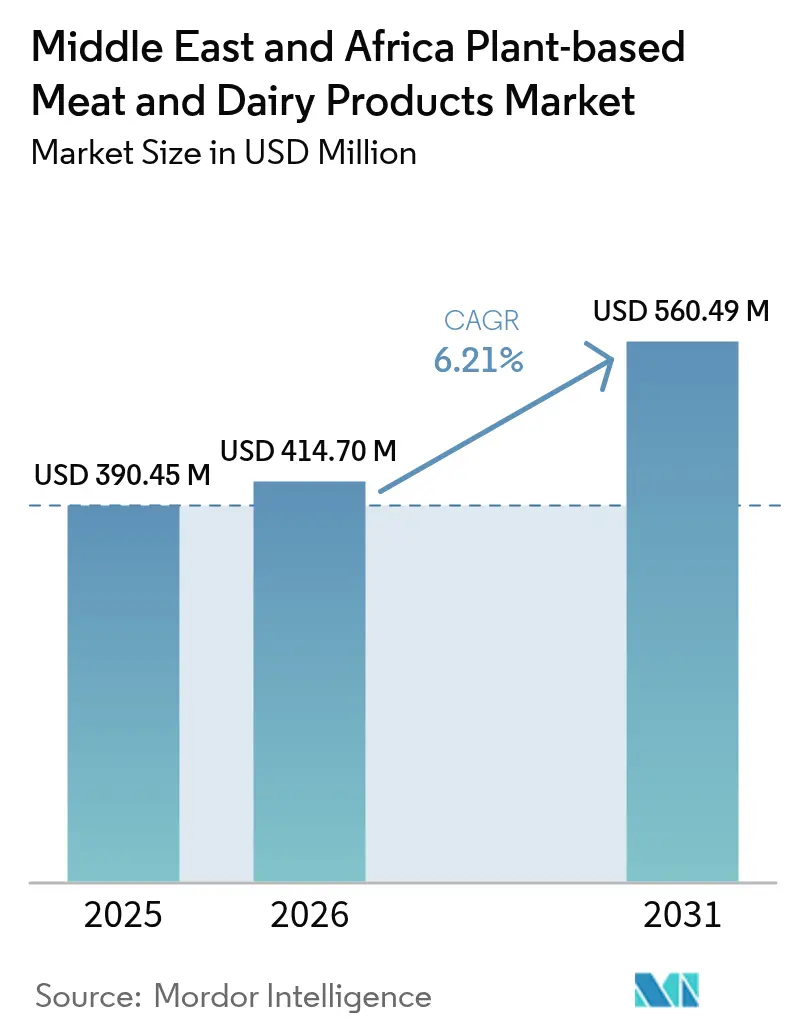
| Base Year Market Size (2025) | USD 390.45 Million |
| Market Size (2026) | USD 414.7 Million |
| Market Size (2031) | USD 560.49 Million |
| Growth Rate (2026 - 2031) | 6.21 % |
| Market Concentration | Medium |
Major Players *Disclaimer: Major Players sorted in no particular order Image © Mordor Intelligence. Reuse requires attribution under CC BY 4.0. | |
Middle East And Africa Plant-based Meat And Dairy Products Market Analysis by Mordor Intelligence
The Middle East and Africa plant-based meat and dairy products market size in 2026 is estimated at USD 414.7 million, growing from 2025 value of USD 390.45 million with 2031 projections showing USD 560.49 million, growing at 6.21% CAGR over 2026-2031. Current growth is propelled by sovereign food-security programs that treat alternative proteins as strategic infrastructure, not niche trends. Government-backed initiatives such as the UAE’s Future Food Foundry are channeling capital into precision fermentation, while Saudi regulators have fast-tracked approvals for microbial proteins. Consumer behavior is evolving in parallel: health-driven shoppers, expanding flexitarian segments, and rising lactose intolerance rates are steering demand toward fortified dairy alternatives. Meanwhile, supply-chain pressures linked to grain imports and shipping costs are nudging producers toward vertical integration and local crop substitution, reshaping sourcing and pricing dynamics within the Middle East and Africa plant-based meat and dairy products market.
Key Report Takeaways
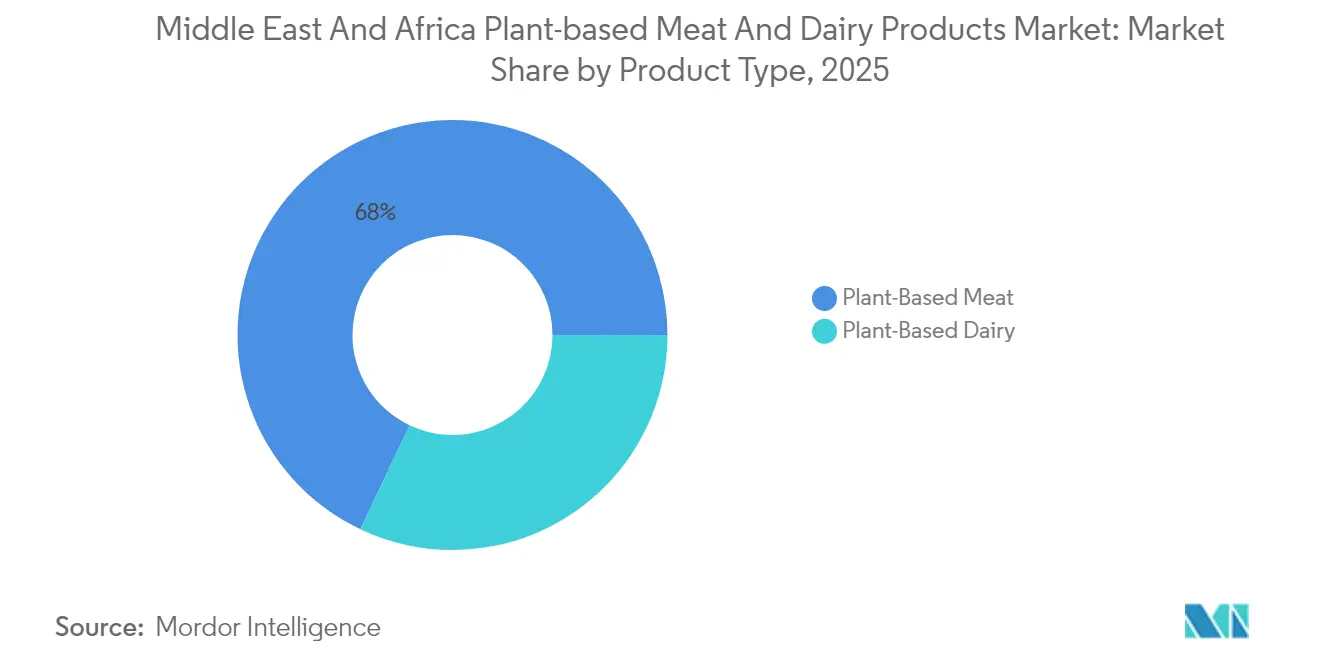
- By product type, plant-based meat led with 67.95% revenue share in 2025; plant-based dairy is forecast to expand at a 7.21% CAGR through 2031.
- By protein source, soy commanded 41.86% of the Middle East and Africa plant-based meat and dairy products market share in 2025, while pea protein is set to grow at 7.55% CAGR to 2031.
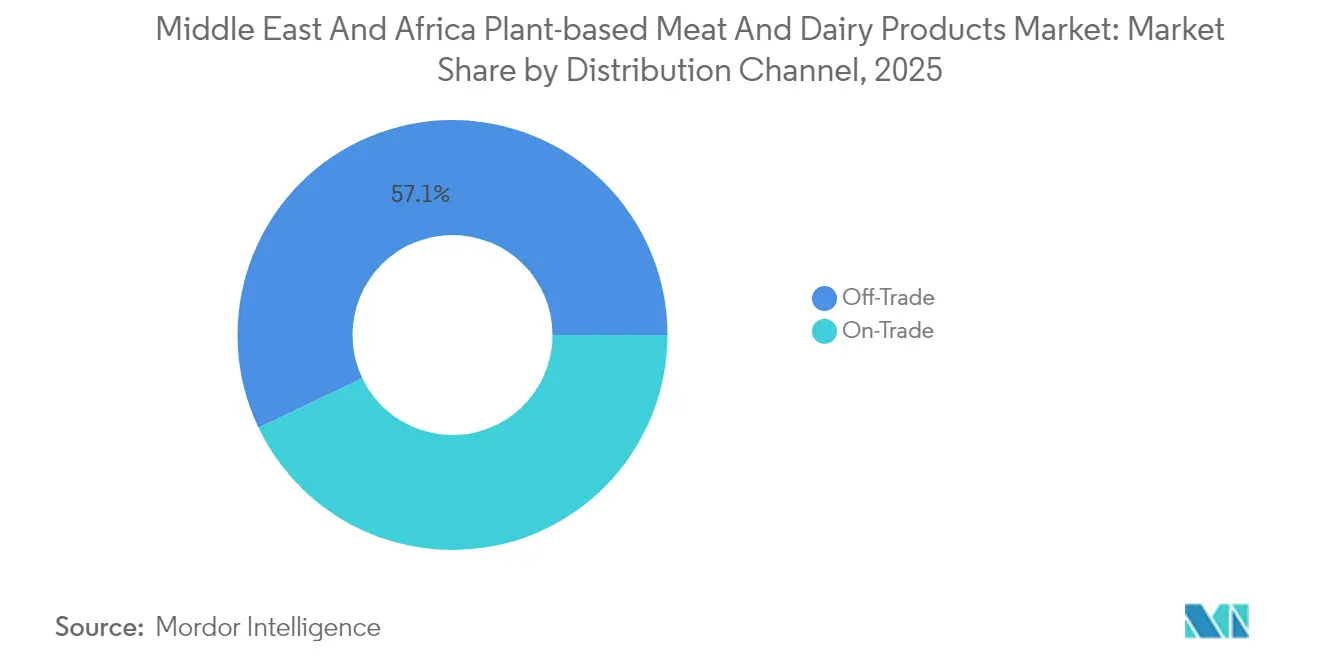
- By distribution channel, off-trade formats held 57.10% share of the Middle East and Africa plant-based meat and dairy products market size in 2025; on-trade channels record the fastest trajectory at 6.88% CAGR to 2031.
- By geography, South Africa captured 29.75% of regional sales in 2025; Saudi Arabia shows the highest growth outlook at 7.34% CAGR through 2031.
Note: Market size and forecast figures in this report are generated using Mordor Intelligence’s proprietary estimation framework, updated with the latest available data and insights as of 2026.
Market Trends and Insights
Drivers Impact Analysis of Middle East And Africa Plant-based Meat And Dairy Products Market*
| Driver | (~) % Impact on CAGR Forecast | Geographic Relevance | Impact Timeline |
|---|---|---|---|
| Growing consumer awareness about health benefits of plant-based diets | +1.2% | Regional, with stronger penetration in United Arab Emirates, South Africa | Medium term (2-4 years) |
| Rising prevalence of lactose intolerance and dairy allergies in the region | +0.8% | Middle East core markets, spillover to North Africa | Long term (≥ 4 years) |
| Expansion of vegan and flexitarian populations in urban areas | +1.0% | Urban centers in United Arab Emirates, Saudi Arabia, South Africa | Medium term (2-4 years) |
| Government initiatives and favorable regulations promoting sustainable and alternative protein sources | +1.5% | United Arab Emirates, Saudi Arabia, South Africa with regulatory leadership | Short term (≤ 2 years) |
| Growing investments by major companies in product innovation and portfolio expansion | +1.3% | Regional hubs in United Arab Emirates, Saudi Arabia, expanding to Egypt, Morocco | Medium term (2-4 years) |
| Rising demand for ethical and animal welfare-friendly food products | +0.7% | Urban markets across the Region, concentrated in higher-income segments | Long term (≥ 4 years) |
| Source: Mordor Intelligence | |||
Growing consumer awareness about health benefits of plant-based diets
Growing consumer awareness about the health benefits of plant-based diets is a key driver of the Middle East and Africa (MEA) plant-based meat and dairy products market. This trend is further reinforced by the rising prevalence of lifestyle diseases such as diabetes in the region, which is creating a strong demand for healthier dietary alternatives. According to the International Diabetes Federation, in 2024, around 85 million adults aged 20 to 79 in the Middle East and North Africa (MENA) region were diagnosed with diabetes, representing one of the highest regional diabetes burdens globally [1]. The increasing incidence of diabetes and related health concerns is encouraging consumers to adopt plant-based meat and dairy options, which are perceived to be lower in cholesterol, saturated fats, and better suited for managing such chronic conditions. Consequently, this health-driven dietary shift, combined with rising disposable incomes and urbanization, is propelling the growth of the MEA plant-based meat and dairy market significantly.
Rising prevalence of lactose intolerance and dairy allergies in the region
In North Africa, about 70% of adults are genetically predisposed to lactose intolerance. This widespread condition not only highlights a significant market for dairy alternatives but also underscores their medical necessity. Healthcare providers in the region are increasingly reporting a rise in diagnoses related to dairy-induced digestive issues, such as bloating, diarrhea, and abdominal pain. This trend is especially pronounced in urban areas, where there's been a surge in processed dairy consumption due to changing dietary habits and increased availability of packaged foods [2]. Such physiological needs foster a consistent demand for dairy alternatives, one that's notably less influenced by price fluctuations than mere preference. Furthermore, the medical validation of plant-based dairy substitutes positions them as viable solutions for individuals with lactose intolerance. This validation opens opportunities for endorsements from the healthcare system and considerations for insurance coverage, both of which could significantly hasten their acceptance and integration into mainstream markets.
Expansion of vegan and flexitarian populations in urban areas
Urban demographic shifts are creating concentrated demand clusters, facilitating efficient distribution and marketing strategies for plant-based products. In Dubai, where expatriates make up over 85% of the population, the presence of diverse dietary preferences is driving the normalization of plant-based consumption patterns [3]. This trend is further supported by the growing awareness of health, environmental sustainability, and ethical considerations associated with plant-based diets. Major cities like Johannesburg, Cairo, and Riyadh are experiencing a notable rise in flexitarian adoption, primarily fueled by younger demographics who are increasingly prioritizing dietary flexibility and exploring alternatives to traditional protein sources. These younger consumers are also influenced by global trends and social media, which promote plant-based lifestyles as modern and progressive. This urban concentration provides companies with an opportunity to penetrate the market effectively through targeted retail partnerships and foodservice integration, enabling them to establish a strong foothold.
Government initiatives and favorable regulations promoting sustainable and alternative protein sources
Government initiatives and favorable regulations are significantly promoting sustainable and alternative protein sources in the Middle East and Africa (MEA), driving growth in the plant-based meat and dairy products market. Recognizing the pressing challenges of climate change, food security, and resource scarcity, governments in the region are increasingly adopting policies that support innovation and investment in alternative proteins such as plant-based, cultivated meat, and protein from microbial fermentation. For example, Saudi Arabia is advancing projects to produce protein using cutting-edge biotechnology and local resources to reduce environmental stress and boost food self-sufficiency. Regulatory frameworks are being developed to ensure the safety and market access of novel protein products, while public investment and partnerships are encouraged to foster research and commercialization. These initiatives not only aim to provide sustainable protein options but also create economic opportunities and align with global climate goals, thus accelerating the adoption of alternative proteins across MEA markets.
Restraints Impact Analysis of Middle East And Africa Plant-based Meat And Dairy Products Market*
| Restraint | (~) % Impact on CAGR Forecast | Geographic Relevance | Impact Timeline |
|---|---|---|---|
| High price premium of plant-based meat and dairy compared to conventional products | -1.8% | Regional impact with strongest effect in price-sensitive markets like Egypt, Morocco | Short term (≤ 2 years) |
| Supply chain complexities and sourcing of raw plant-based ingredients | -1.2% | Import-dependent markets including United Arab Emirates, Saudi Arabia, with spillover effects | Medium term (2-4 years) |
| Limited awareness and acceptance of plant-based products among certain population segments | -0.9% | Rural and traditional communities across the region | Long term (≥ 4 years) |
| Cultural and religious dietary preferences influencing consumer choices | -0.6% | Conservative communities with traditional dietary practices | Long term (≥ 4 years) |
| Source: Mordor Intelligence | |||
High price premium of plant-based meat and dairy compared to conventional products
The high price premium of plant-based meat and dairy products compared to conventional animal-based products acts as a significant restraint for the Middle East and Africa (MEA) plant-based meat and dairy market. Despite growing consumer interest driven by health and environmental concerns, the relatively higher production costs associated with plant-based alternatives—stemming from expensive raw materials, advanced processing technologies, and supply chain complexities—result in higher retail prices. This price differential limits accessibility, especially in price-sensitive segments and developing countries within the region, where conventional meat and dairy remain more affordable. While premium pricing appeals to affluent and urban consumers, broader market penetration requires strategies to reduce costs through innovation, economies of scale, and localized production to make plant-based options more competitively priced. The challenge of balancing cost and consumer demand is critical for sustained growth and mainstream adoption in the MEA market.
Supply chain complexities and sourcing of raw plant-based ingredients
The Middle East and Africa plant-based meat and dairy products market faces notable supply chain complexities and challenges in sourcing raw plant-based ingredients, which act as a significant market restraint. The region relies heavily on imports for key raw materials and finished plant-based products, predominantly from countries like India, the United Kingdom, United States, and various European nations, leading to vulnerability in supply continuity and higher costs. Limited local production infrastructure and underdeveloped supply chains impede the scalability and affordability of plant-based alternatives. Additionally, logistical hurdles such as transportation, storage, and distribution inefficiencies exacerbate these supply challenges, especially in countries with less advanced food supply systems. These factors collectively restrict market growth by impacting product availability and causing price premiums, which can deter wider consumer adoption. Addressing supply chain resilience and boosting local ingredient sourcing is essential to overcome these bottlenecks and enable sustainable expansion of the plant-based market in MEA.
*Our forecasts treat driver/restraint impacts as directional, not additive. The impact forecasts reflect baseline growth, mix effects, and variable interactions.
Middle East And Africa Plant-based Meat And Dairy Products Market Segment Analysis
By Product Type:
Meat Alternatives Drive Market LeadershipThe plant-based meat segment holds the largest market share in the Middle East and Africa plant-based meat and dairy products market, commanding approximately 67.95% of the market in 2025. This dominant position is driven by strategic positioning of plant-based meat products as direct substitutes for conventional protein sources rather than niche or specialty items. Consumers in the region are increasingly adopting flexitarian and meat-reducing diets, which has led to widespread availability of plant-based meat products like burger patties, sausages, and meatballs in mainstream retail outlets. The success of the segment is reinforced by continuous product innovation aimed at replicating the taste, texture, and nutritional benefits of traditional meat. Key markets such as the UAE and South Africa are particularly instrumental in driving demand, fueled by rising health awareness and environmental concerns. Retailers and manufacturers in these countries have expanded their plant-based meat portfolios to cater to diverse consumer preferences and dietary requirements.
In contrast, the plant-based dairy segment is the fastest-growing segment within the Middle East and Africa market, projected to grow at a CAGR of 7.21% through 2031. This strong growth trajectory is driven primarily by increasing consumer demand for functional plant-based dairy applications, especially in coffee culture and dessert preparations, which have gained substantial popularity in urban centers. The rise in lactose intolerance cases and a growing interest in vegan and vegetarian lifestyles are key factors propelling this segment. Manufacturers are responding with innovative products derived from various plant sources like soy, almond, and coconut, including vegan cheeses and plant-based milks. These products have started to penetrate mainstream retail channels more deeply, becoming a staple in cafes and dessert shops across metropolitan areas. Enhanced product development efforts focusing on taste, nutritional value, and texture continue to strengthen the appeal of plant-based dairy alternatives, making this segment a significant growth driver in the overall market.

By Protein Source:
Soy Dominance Faces Diversification PressureSoy protein holds the largest market share of 41.86% in the Middle East and Africa plant-based meat and dairy products market in 2025. This dominance is underpinned by its well-established supply chains and proven functionality across a variety of product applications. Soy protein is widely recognized for its complete amino acid profile and versatility, making it a preferred ingredient in meat alternatives, dairy substitutes, and nutritional supplements. The extensive adoption of soy protein is supported by robust production infrastructure and consumer awareness about its health benefits. It is extensively used in both conventional and organic forms, facilitating its integration into multiple food products including beverages, bakery items, and processed foods. Moreover, soy protein benefits from economies of scale and competitive pricing, further solidifying its market leadership in the region.
Conversely, pea protein represents the fastest-growing segment in the market, with a compelling CAGR of 7.55% projected through 2031, signaling a trend towards diversification in plant-based protein sources. Pea protein's growth is driven by rising consumer concerns over soy's potential hormonal impacts and genetic modification issues, encouraging a shift to allergen-friendly and non-GMO alternatives. It offers exceptional adaptability to local cultivation conditions, which benefits supply chains and sustainability considerations, especially in varying Middle Eastern and African climates. The increasing preference for clean-label products and plant-based protein options free from common allergens is fueling demand. Innovations in pea protein processing and formulation are expanding its use across meat analogs, dairy-free products, and nutritional supplements. This trend highlights a strategic market shift toward inclusivity and health-conscious consumption patterns, broadening the plant-based protein landscape in the Middle East and Africa.
By Distribution Channel:
Retail Infrastructure Shapes Market AccessIn the Middle East and Africa plant-based meat and dairy products market, off-trade channels hold the largest market share at 57.10% in 2025. This reflects the critical importance of retail infrastructure, such as supermarkets, hypermarkets, and convenience stores, in driving consumer trial and repeat purchase behavior. These channels provide consumers with wide product variety, competitive pricing, and convenient access, which promotes greater adoption of plant-based alternatives. Retailers are increasingly dedicating shelf space to plant-based products and utilizing strategic product placements and promotions to enhance visibility. The established retail network ensures a one-stop shopping experience for consumers looking to incorporate plant-based options into their diets. This extensive reach and accessibility have established off-trade channels as the primary driver of market penetration in the region.
On the other hand, on-trade channels, which include restaurants, cafes, and foodservice outlets, are the fastest-growing segment within this market, showing a CAGR of 6.88% through 2031. This growth indicates an increasing integration of plant-based products into foodservice menus to meet the rising demand for diverse dietary options. The acceleration is driven by consumer interest in healthier, environmentally friendly, and allergen-conscious food choices available outside the home. Foodservice establishments are expanding their plant-based offerings, reflecting evolving consumer preferences and dietary requirements. This trend not only increases market consumption but also raises consumer awareness and acceptance through experiential tasting and meal occasions. As plant-based foods become more normalized in dining out scenarios, on-trade channels are expected to play an increasingly important role in market growth and diversification.
Geography Analysis
South Africa Plant-based Meat and Dairy Products Market
The Middle East and Africa Plant-based Meat and Dairy Products Market showcases significant geographical dynamics, with South Africa leading regional development in 2025 by capturing a 29.75% market share. The country leverages its robust food processing infrastructure and supportive regulatory frameworks to drive product innovation and facilitate market entry. Notably, South Africa's investments in precision fermentation, highlighted by the launch of its first public funding initiative in 2024, position it as a technological hub for alternative protein development. Urban centers such as Johannesburg and Cape Town exhibit consumer acceptance rates that surpass regional averages, fueled by health-conscious and diverse dietary preferences among affluent populations.
Saudi Arabia Plant-based Meat and Dairy Products Market
Saudi Arabia is emerging as the fastest-growing geography in the region, with a projected CAGR of 7.34% through 2031. This growth is underpinned by government initiatives that prioritize alternative proteins as strategic assets for food security. The kingdom's Vision 2030 sustainability goals provide strong policy support for plant-based alternatives, while the Saudi Food and Drug Authority's (SFDA) streamlined regulatory approvals for microbial proteins facilitate smoother market entry. These efforts reflect Saudi Arabia's commitment to fostering a sustainable and secure food ecosystem, driving the adoption of plant-based products across the country.
United Arab Emirates and Wider MEA Plant-based Meat and Dairy Products Market
The UAE serves as a critical innovation and distribution hub within the region, driven by Dubai's diverse expatriate population, which generates demand for international plant-based brands and products. Government-backed initiatives such as the Future Food Foundry and Food Tech Valley highlight the UAE's dedication to advancing alternative protein development. Premium retail chains like Spinneys provide international brands with market access, while the integration of plant-based offerings in hotels and restaurants enhances consumer exposure. Meanwhile, emerging markets such as Egypt, Morocco, Nigeria, and Turkey exhibit substantial growth potential. However, challenges such as infrastructure limitations and price sensitivity necessitate the adoption of localized strategies and tailored product formulations to overcome barriers and unlock market opportunities.
Regulatory Landscape
Regulation across the Middle East and Africa for plant-based meat and dairy is tightening around labeling, food-safety registration, and novel-food assessments, with enforcement largely handled at the national level. In South Africa, the Department of Agriculture, Land Reform and Rural Development (DALRRD) issued Government Gazette Notice R. 6436 (July 2025), setting stricter labeling expectations for meat alternatives, including a minimum protein threshold and limits on animal-specific terminology. This is pushing manufacturers to revise claims, front-of-pack descriptors, and in some cases formulations.
In the Gulf, approval pathways are increasingly formalized for novel proteins and fermentation-derived ingredients. Saudi Arabia’s Saudi Food and Drug Authority (SFDA) requires pre-registration and a technical dossier for products classified as novel foods, including composition, process, and safety evidence, alongside compliance with the Kingdom’s Food Law requirements for registered and Sharia-compliant food handling. In the UAE, the Abu Dhabi Agriculture and Food Safety Authority (ADAFSA) announced (November 2025) work on a regulatory framework to accelerate approvals for cultivated meat and precision fermentation-derived foods, aiming to align registration and permitting steps for innovators and importers.
Value Chain Analysis
The MEA plant-based meat and dairy value chain runs from imported and local crop inputs (soy, pea, wheat, almond, and other plant sources) through ingredient processing into isolates and functional systems, manufacturing (extrusion for meat analogs and beverage processing for dairy alternatives), and distribution via off-trade retail and on-trade foodservice. Import dependence for key ingredients and finished products remains a defining feature, but recent activity points to more local manufacturing and technology licensing to lower landed costs and improve supply continuity, particularly in the UAE and Saudi Arabia.
Upstream and midstream capability is also being strengthened through partnerships that bring processing and packaging technology closer to demand centers. In the UAE, Al Ain Farms Group signed a joint development agreement with FoodIQ (June 2025) to implement industrial-scale Multi-Layer Cooker technology for local plant-based milk, cheese, and smoothie production, while NÜITREE partnered with SIG Group (October 2025) at Dubai Investment City to integrate an aseptic filling line for plant-based beverages. For next-generation inputs, Liberation Labs and the NEOM Investment Fund agreed to a feasibility study (April 2025) for a precision fermentation facility in Saudi Arabia, showing how sovereign food-security platforms are being used to build local production capacity for both retail and foodservice.
Competitive Landscape
The competitive landscape of the Middle East and Africa Plant-based Meat and Dairy Products Market reflects moderate fragmentation, with a concentration score of 4. This indicates a balanced environment where both multinational corporations and regional specialists can establish competitive positions. Global players such as Danone, Nestlé, and Oatly are leveraging their international brand recognition, extensive supply chain networks, and expertise to penetrate premium market segments. These companies are focusing on catering to the growing demand for high-quality plant-based alternatives, which aligns with the increasing consumer preference for sustainable and health-conscious products. On the other hand, regional companies like SADAFCO and Almarai are utilizing their well-established distribution networks and strong consumer trust to expand into the plant-based category.
Competitive strategies in the market are evolving significantly, moving beyond traditional product development to emphasize vertical integration and supply chain control. Companies are increasingly recognizing the importance of cost competitiveness and supply security in maintaining their market positions. Vertical integration allows firms to streamline operations, reduce costs, and ensure a steady supply of raw materials, which is critical in a market where input costs and supply chain disruptions can significantly impact profitability. Additionally, supply chain control is becoming a focal point as companies aim to mitigate risks associated with import dependencies and currency fluctuations. This strategic shift highlights the growing need for operational efficiency and resilience in the face of global economic uncertainties.
Investment patterns in the Middle East and Africa Plant-based Meat and Dairy Products Market further underscore the emphasis on local manufacturing capabilities. Companies are increasingly establishing regional production facilities to reduce reliance on imports and minimize exposure to currency risks. These facilities not only help in lowering production costs but also enable companies to respond more swiftly to local market demands. By investing in local infrastructure, firms can enhance their supply chain efficiency and strengthen their presence in the region. This approach also aligns with the broader trend of promoting sustainability and reducing the carbon footprint associated with long-distance transportation. As the market continues to grow, these strategic investments are expected to play a pivotal role in shaping the competitive dynamics of the region.
Middle East And Africa Plant-based Meat And Dairy Products Industry Leaders
-
Blue Diamond Growers
-
Beyond Meat Inc.
-
Al Islami Foods
-
Saudi Dairy & Food Stuff Co.
-
Danone S.A.
- *Disclaimer: Major Players sorted in no particular order

Middle East And Africa Plant-based Meat And Dairy Products Market Companies Covered in this Report
- Danone S.A.
- Beyond Meat Inc.
- Upfield Holdings B.V.
- Saudi Dairy & Food Stuff Co.
- Al Islami Foods
- Blue Diamond Growers
- Superbom Alimentos
- Koita FZE
- The Meatless Farm Co.
- Al Islami Foods
- V Bites Foods Limited
- Almarai Company
- Oatly Group AB
- Nestlé S.A.
- Impossible Foods Inc.
- Al Rawabi Dairy Co LLC
- Al Ain Farms
- Sunbulah Group
- Vgarden
- TiNDLE Foods
Market Opportunities and Future Outlook
Opportunities in MEA are focused on reducing cost and lead times by localizing manufacturing, aligning products with national food-security programs, and moving beyond imported, premium-positioned SKUs into mainstream formats that fit local consumption occasions. The UAE is building an approvals-and-capacity model around Abu Dhabi’s effort to develop a unified novel-food regulatory framework involving ADAFSA, the Quality and Conformity Council (QCC), and the Abu Dhabi Investment Office (ADIO), with an announced goal of shortening approval timelines by six to nine months through a single contact point covering registration, Halal certification, and production or import permits.
Another opportunity is expanding ingredient and processing capacity that can support both plant-based dairy and meat applications at scale. ADIO-backed partnerships with The EVERY Company and Vivici for an industrial-scale protein fermentation facility in Abu Dhabi, and Change Foods’ agreement with KEZAD Group to establish a precision fermentation facility (targeting 1.2 million litre capacity by 2027), point to where additional B2B supply, co-manufacturing, and localized formulation development can plug into the market. On the conventional plant-based side, investments in regional manufacturing technology, including Al Ain Farms Group’s work with FoodIQ and NÜITREE’s SIG-enabled beverage line in Dubai Investment City, support whitespace in barista-style milks, yogurts, and functional dairy alternatives that address lactose intolerance-driven demand, while also widening distribution through both retail and out-of-home channels.
Recent Industry Developments in Middle East And Africa Plant-based Meat And Dairy Products Market
- April 2026: Saudi Dairy & Food Stuff Co. (SADAFCO) highlighted continued channel expansion through e-commerce and out-of-home foodservice in its reported quarterly update. This reinforces the role of digitally enabled retail and institutional consumption in scaling plant-based dairy availability beyond premium grocery footprints.
- November 2025: Abu Dhabi regulators ADAFSA announced work on a regulatory framework to accelerate approvals for cultivated meat and precision fermentation-derived foods, aligning registration and permitting steps under a clearer pathway for innovators and importers. The move follows ongoing alignment with the Abu Dhabi food safety ecosystem and supports faster market access for novel protein products.
- December 2024: Almarai announced a USD 4.8 billion investment program in domestic dairy production facilities across Saudi Arabia, with stated plans to integrate plant-based alternatives into existing manufacturing infrastructure. This linked large-scale processing and distribution capabilities with alternative dairy ambitions, supporting local production pathways and faster commercialization once portfolios are finalized.
Middle East And Africa Plant-based Meat And Dairy Products Market Report Scope and Research Methodology
Market Definition and Coverage
For this study, the market counts sales value generated from plant-based products positioned as substitutes for conventional meat and dairy, across the Middle East and Africa, and sold through retail and foodservice routes.
Scope exclusions: This sizing excludes animal-derived meat and dairy, and it also excludes non-substitute ingredients that are not sold as plant-based meat or plant-based dairy end products.
Segments Covered in This Report
- By Product Type
- Plant-Based Meat
- Burger Patties
- Sausages
- Strips and Nuggets
- Meatballs
- Minced Meat
- Other Plant-based Meats
- Plant-Based Dairy
- Milk
- Yogurt
- Butter and Cheese
- Creamers
- Other Plant-based Dairy
- Plant-Based Meat
- By Protein Source
- Soy
- Pea
- Wheat
- Almond
- Others
- By Distribution Channel
- On-Trade
- Off-Trade
- Supermarkets/Hypermarkets
- Convenience Stores
- Specialty Health Stores
- Online Retailers
- Other Distribution Channel
- By Geography
- South Africa
- Saudi Arabia
- United Arab Emirates
- Nigeria
- Egypt
- Morocco
- Turkey
- Rest of Middle East and Africa
Data Sources, Market Sizing, and Validation
Desk Research
Desk research started with building the demand and supply context for plant-based foods in the Middle East and Africa, so our assumptions on volumes and pricing were anchored to realistic retail and foodservice conditions. We referenced public sources such as FAOSTAT for food supply indicators, UN Comtrade for trade flows of relevant food preparations and inputs, and national statistics portals and customs releases across the region where category data is available.
We also used datasets and publications from bodies such as the World Bank for macro and currency indicators, and USDA FAS reports for country notes on food demand and import reliance, which helps when local production data is thin. To ground the model in what is actually being sold, we reviewed company filings, investor presentations, press releases, and trusted retail and trade press coverage for product launches and channel expansion. Paid subscriptions were used selectively for company financials and for patent lookups to clarify innovation and manufacturing direction, although the core market math is not dependent on any single paid source. These desk research sources are illustrative, and many other public documents and data series were used for cross-checks and clarification.
Primary Interviews and Surveys
Primary interviews and surveys were used to pressure-test what desk research could not confirm cleanly, mainly around average selling price movement, channel mix (on-trade versus off-trade), and how fast plant-based dairy is expanding versus plant-based meat in key MEA countries. We spoke with a mix of manufacturers, ingredient and co-manufacturing contacts, distributors, and retail-facing category participants. Then we validated assumptions across the major MEA sub-regions so outlier country dynamics did not skew the regional total.
Distribution of primary research fieldwork respondents
| Company type | Respondent position |
|---|---|
| Top tier: 29% | CXOs: 15% |
| Mid tier: 49% | Functional/Unit leaders: 37% |
| Smaller Players: 22% | Managers: 48% |
Market-Sizing & Forecasting
The sizing starts from a top-down build where country-level food category demand is reconstructed using a practical demand pool, and then rolled up to a Middle East and Africa total after applying plant-based penetration and channel splits. What made the model workable was keeping the logic tied to observable levers, including the pace of new listings in modern retail, foodservice menu adoption, the price premium or discount versus conventional meat and dairy, and the share of soy, pea, wheat, almond, and other sources used in commercial products.
Once the total was formed, we corroborated it with selective bottom-up approximations, such as sampled brand and private-label pricing checks, distributor feedback on turnover, and simple volume times ASP calculations for high-visibility categories like plant-based burgers and plant-based milk. Where a country had limited visible data, gaps were handled using proxy indicators from similar markets in the region, followed by adjustments after interview feedback so the final number stayed realistic.
For forecasting, we used scenario analysis supported by variable-level expectations collected in interviews, and then we linked the scenarios to measurable drivers such as household purchasing power, urban retail expansion, import reliance, and expected normalization in pricing as local production scales.
Data Validation & Update Cycle
Model outputs are checked against independent signals, including trade direction, category-level retail activity, and whether implied per-capita consumption stays within believable bounds for each country. When unusual jumps appear, the assumptions behind channel mix, penetration, and pricing are reopened, and follow-up calls are triggered with the most relevant participants before the estimate is signed off.
Each report is refreshed annually, and interim updates are made when material events occur, such as policy changes, major capacity additions, or a sharp currency move in a key market. Before delivery, we complete a fresh review pass so the latest public information is reflected in the final market size and forecast.
Mordor Intelligence's Middle East and Africa Plant Based Meat and Dairy Products Market Sizing Compared With Other Published Estimates
Published estimates for MEA plant-based meat and dairy can land far apart because different studies mix product boundaries, use different exchange-rate timing, and rely on different pricing approaches when products are still premium-priced. Some publishers also report broader alternative protein baskets, which can make the number look larger even when the consumer end-market remains the same.
In practice, the biggest gaps usually come from how on-trade sales are treated, whether plant-based ingredients are counted as finished products, and how quickly average selling prices are assumed to soften as more local supply comes in. By refreshing currency conversion timing, rechecking ASP points in modern retail, and rerunning variance checks against trade and category signals, Mordor Intelligence keeps the total closer to what is being purchased in MEA rather than what is theoretically addressable.
Benchmark comparison
| Source | Market Size | Gaps in Research Methodology |
|---|---|---|
| Mordor Intelligence | USD 390.45 M (2025) | |
| Regional Consultancy A | USD 300.00 M (2024) | Uses a Middle East-only lens with an earlier base year, and it appears to rely on limited channel coverage where foodservice and several African markets are not fully captured. |
| Industry Publisher B | USD 1.11 B (2025) | Looks closer to a broader plant-based meat scope with aggressive growth assumptions, and it likely includes adjacent categories that are not strict meat and dairy substitutes, which inflates the addressable value. |
The spread across sources is mainly explained by geography coverage, what is counted as a finished substitute product, and how pricing and currency timing are handled. Our approach keeps the steps easy to follow, with assumptions that can be traced back to channel reality and checked again as the market matures.
Key Questions Answered in the Report
What is the current value of the Middle East and Africa plant-based meat and dairy products market?
The market stands at USD 414.7 million in 2026.
How fast is the category expected to grow?
It is projected to expand at a 6.21% CAGR to reach USD 560.49 million by 2031.
Which country holds the largest regional share?
South Africa leads with 29.75% of 2025 sales.
Which product segment is growing fastest?
Plant-based dairy shows the highest CAGR at 7.21%.
What role do government initiatives play?
Policies in the UAE and Saudi Arabia fast-track regulatory approvals and fund precision-fermentation facilities, accelerating innovation and local production.