
Market Overview
| Study Period | 2020 - 2031 |
|---|---|
| Forecast Data Period | 2026 - 2031 |
| Base Year Market Size (2025) | USD 1.24 Billion |
| Market Size (2026) | USD 1.31 Billion |
| Market Size (2031) | USD 1.73 Billion |
| Growth Rate (2026 - 2031) | 5.67 % |
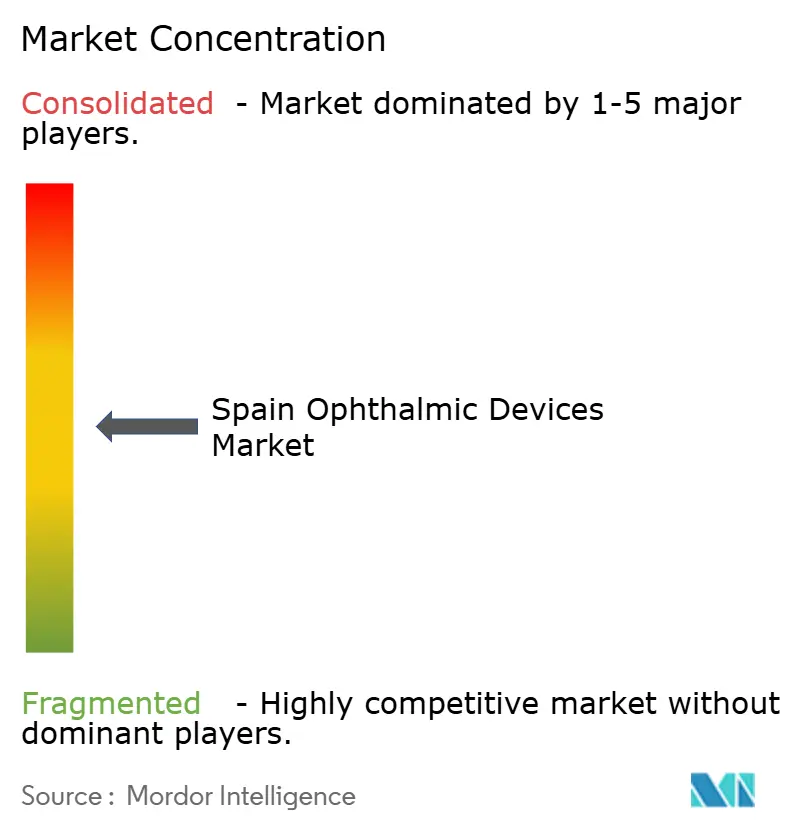
| Market Concentration | Medium |
Major Players *Disclaimer: Major Players sorted in no particular order Image © Mordor Intelligence. Reuse requires attribution under CC BY 4.0. | |
Spain Ophthalmic Devices Market Analysis by Mordor Intelligence
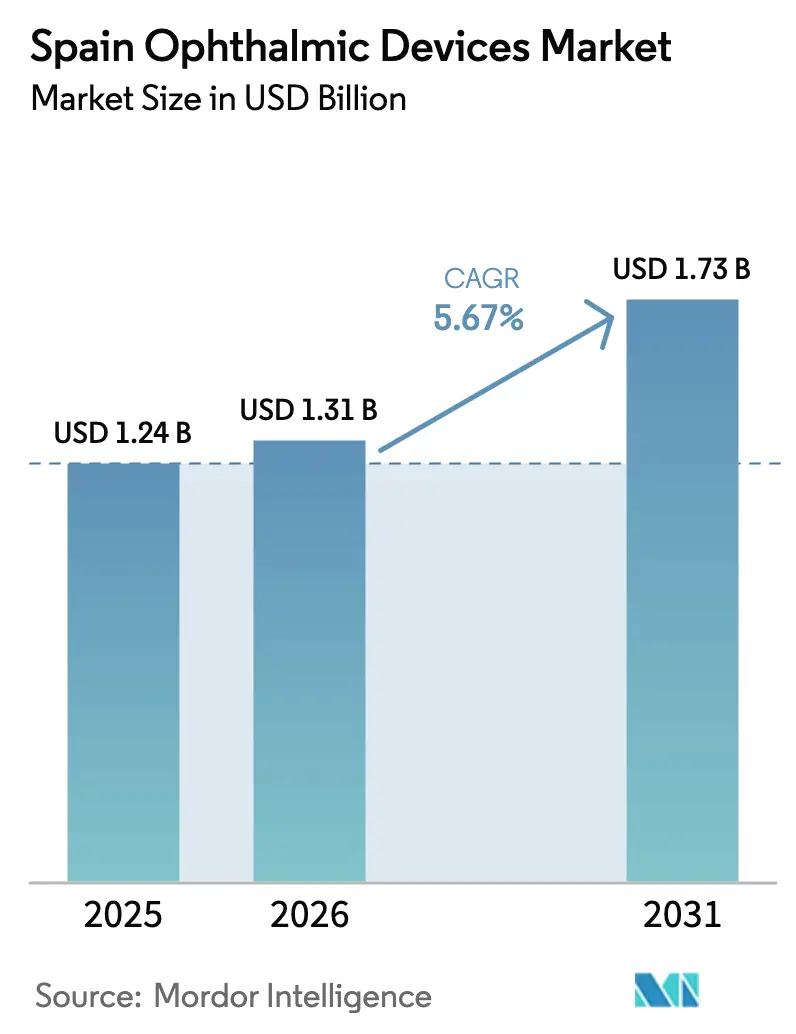
The Spain Ophthalmic Devices Market size is projected to expand from USD 1.24 billion in 2025 and USD 1.31 billion in 2026 to USD 1.73 billion by 2031, registering a CAGR of 5.67% between 2026 to 2031.
Spain’s rapid demographic shift toward an older population is expanding demand for cataract, glaucoma, and age-related macular degeneration care. Public-sector stimulus under the Recovery, Transformation and Resilience Plan is shortening replacement cycles for surgical microscopes, optical coherence tomography (OCT) scanners, and phacoemulsification consoles. Artificial intelligence in fundus cameras and OCT systems is easing physician workload and accelerating diabetic-retinopathy screening, while inbound medical tourism sustains premium refractive demand along the Mediterranean coast. At the same time, hospital sustainability targets are nudging buyers toward bio-based single-use instruments, adding a green dimension to procurement criteria.
Key Report Takeaways
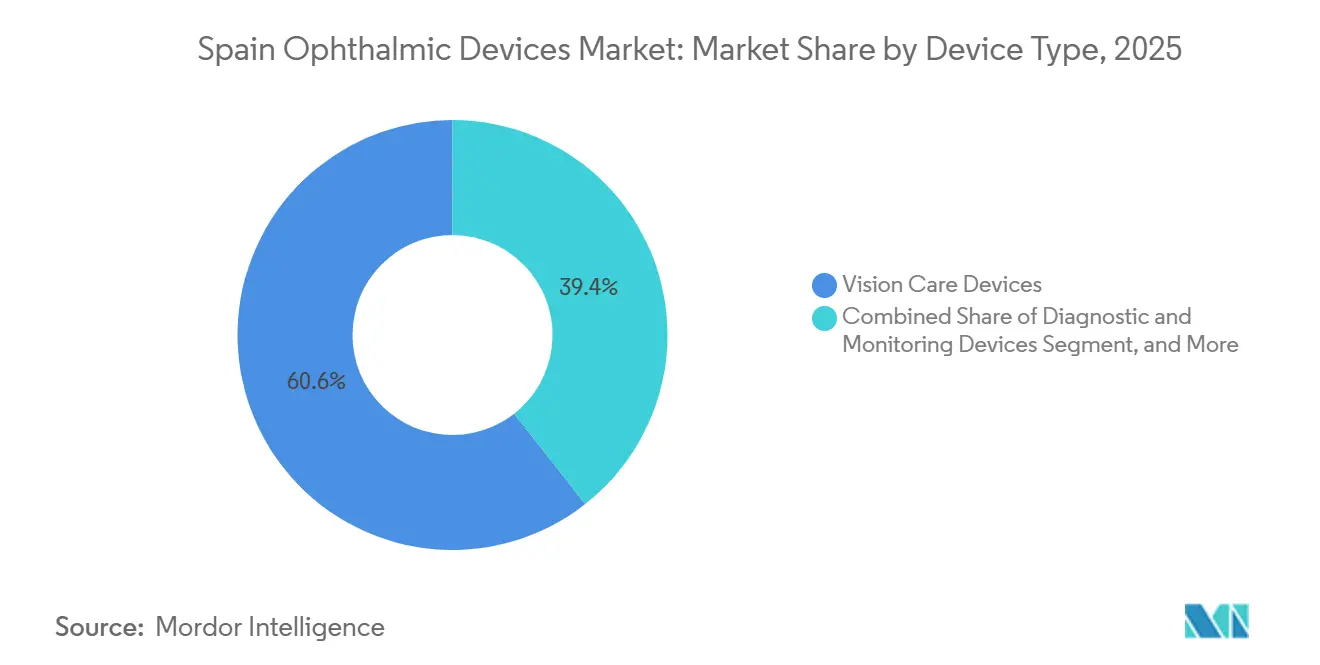
- By device type, vision-care products led the Spain ophthalmic devices market with 60.59% market share in 2025, whereas diagnostic and monitoring devices are forecast to log a 7.64% CAGR through 2031.
- By disease indication, cataract accounted for 37.66% of the Spain ophthalmic devices market in 2025, while diabetic retinopathy devices are expected to expand at a 6.98% CAGR between 2026 and 2031.
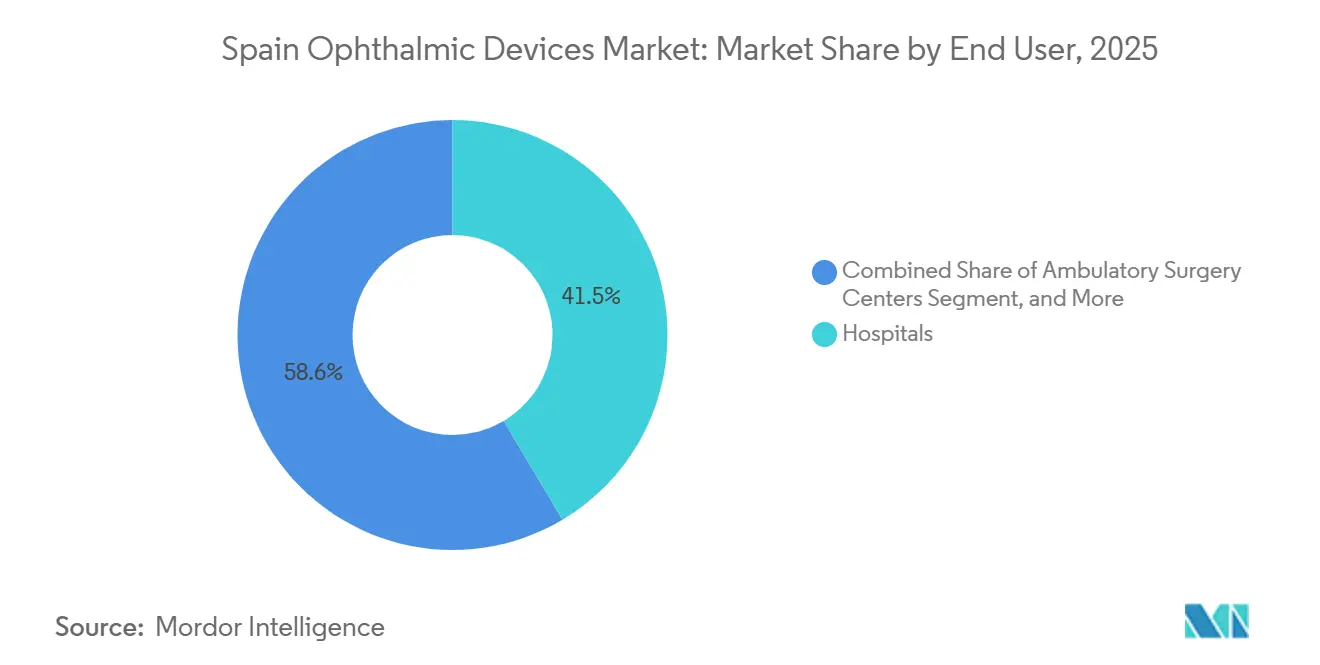
- By end user, hospitals accounted for 41.45% of the Spain ophthalmic devices market in 2025; ambulatory surgery centers are projected to post a 9.41% CAGR through 2031.
Note: Market size and forecast figures in this report are generated using Mordor Intelligence’s proprietary estimation framework, updated with the latest available data and insights as of January 2026.
Spain Ophthalmic Devices Market Trends and Insights
Drivers Impact Analysis*
| Driver | (~) % Impact on CAGR Forecast | Geographic Relevance | Impact Timeline |
|---|---|---|---|
| Rapidly ageing population driving cataract, AMD and glaucoma procedures | +1.2% | Galicia, Castilla y León, Asturias | Long term (≥ 4 years) |
| AI-enabled OCT and fundus imaging adoption across hospitals | +0.8% | Catalonia, Madrid, Navarre | Medium term (2-4 years) |
| Government recovery-plan funding for ophthalmic equipment | +1.0% | Nationwide underserved areas | Short term (≤ 2 years) |
| Expansion of private ophthalmology chains | +0.9% | Madrid, Barcelona, Valencia | Medium term (2-4 years) |
| Inbound medical tourism for refractive and cataract surgery | +0.5% | Costa del Sol, Balearic Islands | Medium term (2-4 years) |
| Hospital sustainability targets favoring bio-based instruments | +0.3% | Catalonia, Basque Country | Long term (≥ 4 years) |
| Source: Mordor Intelligence | |||
Rapidly Ageing Population Driving Cataract, AMD & Glaucoma Procedures
Life expectancy reached 83.2 years in 2024, and the share of citizens aged 65 or above rose to 20.4% in 2025, trends projected to accelerate through 2050.[1] Cataract prevalence now exceeds 60% among Spaniards older than 70, generating roughly 450,000 surgeries each year. Regions with the oldest populations are refreshing their phaco systems and premium intraocular-lens inventories to meet demand. Universal insurance coverage stabilizes procedure volumes, yet rural dispersion steers interest to portable OCT scanners and smartphone fundus cameras for primary-care triage.
AI-Enabled OCT & Fundus Imaging Adoption Across Spanish Hospitals
Navarre’s NaIA-RD platform screened 78,000 diabetic patients in 2024 with 94% sensitivity, and Catalonia’s MIRA network processed more than 100,000 images in the same year.[2] These pilots relieve specialist bottlenecks, important because Spain has one ophthalmologist for every 4,200 residents. Vendors now embed AI into device firmware; Heidelberg Engineering’s SPECTRALIS update trims image-interpretation time to two minutes. Regulatory backing is solid, with 12 CE marks for ophthalmic AI software granted in 2024.
Government Recovery-Plan Funding for Ophthalmic Equipment
Component 18 of the national plan earmarked EUR 1.2 billion (USD 1.3 billion) for the installation of 750 high-tech devices by December 2025. Extremadura and Castilla-La Mancha allocated more than EUR 40 million to OCT and femtosecond platforms. Replacement cycles are shrinking; the average age of phaco consoles fell from 9.2 years in 2023 to 7.4 years in 2025.
Expansion of Private Ophthalmology Chains Boosting Device Procurement
Clínica Baviera operates 83 clinics and spent EUR 12 million in 2024 to deploy 15 new femtosecond lasers. Miranza, now part of Veonet, posts annual revenue of EUR 83 million and standardizes its equipment fleet to secure volume rebates. Waiting times in public hospitals average 112 days for cataract surgery, compared with 18 days in private clinics, accelerating patient migration and device uptake.
Restraints Impact Analysis*
| Restraint | (~) % Impact on CAGR Forecast | Geographic Relevance | Impact Timeline |
|---|---|---|---|
| High capital cost and restricted reimbursement for premium devices | −0.7% | Budget-constrained regions | Short term (≤ 2 years) |
| Stringent EU MDR and AEMPS approval timelines | −0.5% | Nationwide | Medium term (2-4 years) |
| Shortage of skilled ophthalmic technicians | −0.4% | Rural provinces | Medium term (2-4 years) |
| Budget disparities between autonomous communities | −0.6% | Low-income regions | Long term (≥ 4 years) |
| Source: Mordor Intelligence | |||
High Capital Cost & Restricted Reimbursement for Premium Devices
Femtosecond lasers cost between EUR 400,000 and EUR 600,000, yet public reimbursement per cataract case is EUR 1,850, unchanged since 2019. Private insurers cover upgrades only in high-tier plans, limiting access to 18% of privately insured citizens. Hospitals, therefore, favor durable, high-throughput systems over premium platforms, bifurcating the Spanish ophthalmic devices market into cost-focused public tenders and technology-driven private clinics.
Stringent EU MDR / AEMPS Approval Timelines
EU MDR extended regulatory clearance from 6 to 18 months, cutting Spain’s ophthalmic submissions by 28% in 2024. Fourteen niche suppliers exited Europe amid compliance costs, leading to short-term shortages of pediatric lenses and toric implants.[3] Hospitals now face nine-to-twelve-month lead times for newly certified devices.
*Our forecasts treat driver/restraint impacts as directional, not additive. The impact forecasts reflect baseline growth, mix effects, and variable interactions.
Segment Analysis
By Device Type: Vision Care Dominates, Diagnostics Accelerate
Vision Care Devices held 60.59% of Spain ophthalmic devices market share in 2025, anchored by 1,200 optical stores run by EssilorLuxottica’s GrandVision and Multiópticas, while CooperVision lenses secured about 28% of contact-lens revenue. Diagnostic & Monitoring Devices will post a 7.64% CAGR to 2031, the fastest among categories, because hospitals invest in swept-source OCT and AI-ready fundus cameras. OCT scanners alone account for 37% of diagnostic revenue, and Carl Zeiss Meditec and Heidelberg Engineering units are present in roughly 65% of public hospitals.
Spain ophthalmic devices market size for surgical platforms is rising as femtosecond lasers replace manual capsulotomy, and micro-invasive glaucoma implants see wider pairing with cataract procedures. Vitreoretinal tools are shifting to 27-gauge instrumentation for faster recovery, and robotic prototypes are slated for commercial launch after 2026.

By Disease Indication: Cataract Leads, Diabetic Retinopathy Surges
Cataract captured 37.66% of 2025 revenue. More than 1.2 million Spaniards qualify clinically for surgery, but capacity limits keep annual volumes at 450,000. Spain's ophthalmic devices market for diabetic retinopathy is expanding at a 6.98% CAGR, driven by 14.8% of adults living with diabetes and AI screening that detects the disease earlier.
MIGS implants allow pressure control in outpatient settings, raising demand for single-use stents. Anti-VEGF regimens dominate AMD management, creating recurring sales for injection kits and imaging follow-up.
By End-User: Hospitals Anchor, ASCs Gain Momentum
Hospitals retained 41.45% of end-user spending in 2025, performing 70% of cataract and 85% of vitreoretinal work under centralized purchasing that bundles service and consumables. Spain's ophthalmic devices market, driven by ambulatory surgery centers, is expected to grow 9.41% per year through 2031, as they cut cataract costs to EUR 1,200 per case and secure licenses in 9 months.
Specialty clinics such as Clínica Baviera and Miranza operate high-utilization theaters and digital booking systems. Optical retailers expand in-store triage, pushing handheld autorefractors and tonometers into primary-care workflows.
Geography Analysis
Madrid, Catalonia, and Andalucía account for 45% of the national population and have dense hospital networks. Madrid alone houses 28% of femtosecond lasers and 35% of swept-source OCT units, underscoring the capital region's purchasing power. Catalonia leads tele-retina adoption with 47 portable fundus cameras and 68% screening coverage among its diabetic community.
Andalucía wrestles with 16.2% adult diabetes prevalence and lower health outlays, resulting in 138-day cataract wait times despite EUR 1.8 billion in EU cohesion funding for 85 new OCT scanners and 12 femtosecond systems. Smaller regions such as Navarre and País Vasco punch above their weight; Navarre achieved 94% AI screening sensitivity, and País Vasco has the highest per-capita surgical device density.
Regulatory Landscape
Ophthalmic devices commercialized in Spain fall under the EU Medical Device Regulation (MDR) 2017/745 and Spain's national framework under Royal Decree 192/2023, with the Spanish Agency of Medicines and Medical Devices (AEMPS) acting as the national competent authority. Manufacturers and other economic operators must align technical documentation, vigilance (including serious-incident reporting), and post-market surveillance requirements with MDR while also meeting Spain-specific national notification and commercialization steps managed via AEMPS. A key compliance inflection point occurred on May 28, 2026, when the first four EUDAMED modules became mandatory at EU level for manufacturers, importers, and authorized representatives, increasing the importance of EU-wide operator and device registrations alongside Spain's national processes. For non-EU supply into Spain, economic operators also face operational requirements such as an AEMPS operating license for importing, customs health checks through the pharmaceutical inspectorate using the SIFAEX system, and applicable medical equipment tariff treatment that commonly falls in the low single digits (often cited around 3% to 5%) for non-EU products.
Competitive Landscape
The top five suppliers held a significant share of the Spain ophthalmic devices market through direct sales and exclusive distributors. Alcon dominates cataract platforms with Centurion and PanOptix, while Carl Zeiss Meditec owns two-thirds of the installed OCT base. EssilorLuxottica controls retail channels after adding 900 Spanish stores via GrandVision, enabling lens-to-consumer vertical integration.
White-space pockets in Castilla-La Mancha, Extremadura, and Murcia tempt challengers that bundle installation, training, and per-procedure pricing to overcome fiscal constraints. STAAR Surgical’s EVO+ lens captured 18% of refractive-lens exchange in 2024, and Ziemer sells a femtosecond laser priced 25% below incumbents, appealing to cost-sensitive clinics.
Technology differentiation is decisive. Topcon’s Harmony platform integrates an AI layer segmentation that cuts review time by 75%, and Alcon filed 14 Spanish patents in 2024 for fluidics, IOL materials, and visualization algorithms. Smaller firms focus on niche tools to avoid premium-portfolio head-to-heads.
Spain Ophthalmic Devices Industry Leaders
-
Alcon Inc.
-
Carl Zeiss Meditec AG
-
Essilor International SA
-
Johnson & Johnson Vision Care
-
Bausch + Lomb Corp.
- *Disclaimer: Major Players sorted in no particular order
Market Opportunities and Future Outlook
Digitization and compliance tooling are creating near-term whitespace for suppliers and service partners that can simplify MDR-era commercialization and lifecycle management for hospitals and private chains. In June 2026, AEMPS launched RECOPS, an IT application used for mandatory registration of medical devices (excluding custom-made devices) and IVDs, reinforcing the shift toward structured, traceable product registration workflows in Spain. This supports opportunities for manufacturers and distributors that pair ophthalmic device supply with stronger regulatory operations (UDI, registration, vigilance readiness) and for hospital groups that standardize fleets (OCT, fundus cameras, surgical platforms) to streamline maintenance, training, and software updates. Procurement and local capability-building are also visible opportunity areas because Spain's purchasing is decentralized across 17 autonomous communities, pushing vendors to adapt to regional tendering and service expectations rather than relying on a single national route-to-market. Sector-level initiatives highlighted by Fenin in 2026, including calls for value-based purchasing and contract indexation, underscore demand for outcome-linked proposals in cataract and diabetic-retinopathy pathways where AI-enabled screening platforms are already in use (for example, Navarre's NaIA-RD and Catalonia's MIRA network). Fenin also described a broad base of more than 1,000 companies across manufacturing, distribution, and importing, reinforcing the addressable partner ecosystem for Spain-focused installation, training, and after-sales networks that can shorten adoption cycles in hospitals and fast-growing ambulatory settings.
Recent Industry Developments
- April 2026: Alcon introduced the Clareon TruPlus intraocular lens line at ASCRS 2026, extending its IOL portfolio messaging around improved depth of focus through the Opti-Balance design. This strengthens competitive intensity in premium cataract offerings and supports upsell strategies in Spanish private clinics where patients pay for upgrades beyond standard reimbursement.
- June 2026: AEMPS launched RECOPS, an IT platform for mandatory registration of medical devices and IVDs, reinforcing traceability and lifecycle management across Spanish hospitals and distributors. The platform links device registration to vigilance reporting and post-market surveillance workflows, shaping how ophthalmic devices are sourced and serviced.
- September 2025: Fenin outlined value-based purchasing and contract indexation initiatives for ophthalmic devices across Spain, underscoring demand for outcome-linked procurement in cataract and diabetic-retinopathy pathways. The program signals broader validation of clinical outcomes in hospital procurement decisions.
Research Methodology Framework and Report Scope
Market Definition and Coverage
For this report, the Spain ophthalmic devices market is defined as revenues generated from devices used to diagnose, monitor, correct, or treat eye conditions within Spain, across public and private care settings.
Scope exclusions: We exclude veterinary ophthalmic equipment and over-the-counter cosmetic products that are not used for clinical eye health outcomes.
Segmentation Overview
- By Device Type
- Diagnostic & Monitoring Devices
- OCT Scanners
- Fundus & Retinal Cameras
- Corneal Topography Systems
- Ultrasound Imaging Systems
- Other Diagnostic & Monitoring Devices
- Surgical Devices
- Cataract Surgical Devices
- Vitreoretinal Surgical Devices
- Glaucoma Surgical Devices
- Other Surgical Devices
- Vision Care Devices
- Spectacles Frames & Lenses
- Contact Lenses
- Diagnostic & Monitoring Devices
- By Disease Indication
- Cataract
- Glaucoma
- Diabetic Retinopathy
- Other Disease Indications
- By End-user
- Hospitals
- Specialty Ophthalmic Clinics
- Ambulatory Surgery Centers (ASCs)
- Other End-users
Data Sources, Market Sizing, and Validation
Desk Research
Initial desk research was used to build the demand and supply context in Spain, before any figures were finalized. We relied on public healthcare and population signals, such as national health statistics, OECD health data, and Eurostat demographic series, which help explain procedure volumes and patient pool growth.
For device-specific grounding, we also reviewed sources such as Spain-focused procurement and reimbursement notes published by public bodies, customs and trade statistics where relevant, and peer-reviewed ophthalmology journals that report utilization trends for diagnostics and cataract or refractive procedures. Company annual reports, investor presentations, and reputable press releases were used to cross-check product mix shifts and pricing direction, while a paid subscription database for company financials and another for patents were used selectively to validate revenue exposure and innovation intensity. The desk sources named here are illustrative rather than exhaustive, and many other references were screened to collect data, validate assumptions, and clarify open questions.
Primary Interviews and Surveys
Primary work focused on validating how ophthalmic device demand is actually formed in Spain, and then confirming what gets purchased through hospitals, specialty clinics, and optical and distributor channels. We spoke with a mix of manufacturers, distributors, service providers, clinicians, and procurement-focused contacts to test assumptions around procedure throughput, replacement cycles, and realistic price ranges.
Since Spain is part of a broader EU supply chain, we also checked inputs with regional experts who track imports, tender behavior, and equipment upgrade cycles. This helped close gaps that desk research alone could not cover.
Distribution of primary research fieldwork respondents
| Company type | Respondent position |
|---|---|
| Top tier: 30% | CXOs: 17% |
| Mid tier: 53% | Functional/Unit leaders: 33% |
| Smaller Players: 17% | Managers: 50% |
Market-Sizing & Forecasting
Market sizing was anchored using a top-down and bottom-up structure, where Spain's diagnosed and treated eye-care demand pool is first reconstructed from demographics and care utilization, and then translated into device demand through procedure intensity and installed base needs. Those totals were then corroborated with selective bottom-up checks, such as sampled average selling prices times estimated unit volumes for key device groups, followed by distributor channel checks to keep the outcomes realistic.
Key inputs used in the model include cataract and refractive procedure activity, ophthalmic imaging and diagnostics utilization, installed base replacement cycles for equipment, tender timing in public facilities, and price progression for higher value devices (for example, imaging systems and surgical platforms). Where bottom-up signals were missing for smaller channels, gaps were handled using conservative penetration assumptions that were re-tested in interviews and adjusted only when multiple respondents aligned.
For forecasting, scenario analysis was used so growth could be flexed based on procedure growth, budget release timing, and upgrade cycles, and then smoothed through year-to-year adoption patterns that field experts considered reasonable. We kept the forecasting steps simple enough to be repeated with refreshed inputs each year, without needing hard-to-get transactional datasets.
Data Validation & Update Cycle
Validation was done through repeated cross-checks across independent signals, so no single dataset could drive the final number by itself. We compared the model outputs with procedure trends, installed base logic, and pricing direction, and then re-checked any sharp jumps that did not align with known procurement or replacement behavior.
Before sign-off, the work goes through multi-step analyst review, and follow-up calls are triggered when assumptions move beyond an agreed range or when new public updates change key inputs. Reports are refreshed annually, with interim updates when material events occur, such as major reimbursement changes or procurement shifts. Right before delivery, a final pass is completed so clients receive the most current view available.
Mordor Intelligence's Spain Ophthalmic Devices Market Size Versus Other Published Estimates
It is normal to see different market values published for Spain ophthalmic devices, even when the topic name looks the same. The gaps usually come from what is counted as a device market versus a broader vision-care basket, what year is treated as the base, and how pricing and procedure growth are carried forward.
By tracking procedure-linked demand signals and installed-base replacement cycles, Mordor Intelligence keeps the value focused on clinical diagnostic and surgical equipment plus vision-care devices, and excludes non-device vision-care items like spectacles and cosmetic products that can push totals upward.
Benchmark comparison
| Source | Market Size | Gaps in Research Methodology |
|---|---|---|
| Mordor Intelligence | USD 1.24 B (2025) | |
| Industry Publisher A | USD 1.31 B (2025) | Uses a wider ophthalmology and vision-care scope that can include items like spectacles and soft contact lenses, which increases the addressable revenue pool beyond clinical devices. |
| Specialty Research B | USD 0.05 B (2024) | Tracks only a narrow slice of the category, focused on ophthalmic handheld surgical instruments, so the value is not comparable to a full ophthalmic devices market total. |
The benchmark spread is mainly explained by scope boundaries rather than arithmetic differences. When the same device-only definition is held steady and checked against procedure activity, replacement cycles, and realistic pricing, the total stays traceable to clear inputs and can be repeated with the same steps as new data comes in.
Key Questions Answered in the Report
How big is the Spain ophthalmic devices market in 2026?
The Spain ophthalmic devices market size is valued at USD 1.31 billion in 2026.
What is the projected CAGR for Spanish ophthalmic devices through 2031?
Revenue is forecast to rise at a 5.76% CAGR between 2026 and 2031.
Which device category is expanding fastest in Spain?
Diagnostic & Monitoring Devices are expected to grow at a 7.64% CAGR through 2031.
Why are ambulatory surgery centers gaining share?
They deliver cataract and refractive procedures at lower cost and faster scheduling, driving a 9.41% CAGR for ASC equipment demand.
Which regions lead in premium device adoption?
Madrid and Catalonia host the highest densities of femtosecond lasers and swept-source OCT systems.